

The Great Battle, the Birth of a Powerful Nation
 |
Description
Book Introduction
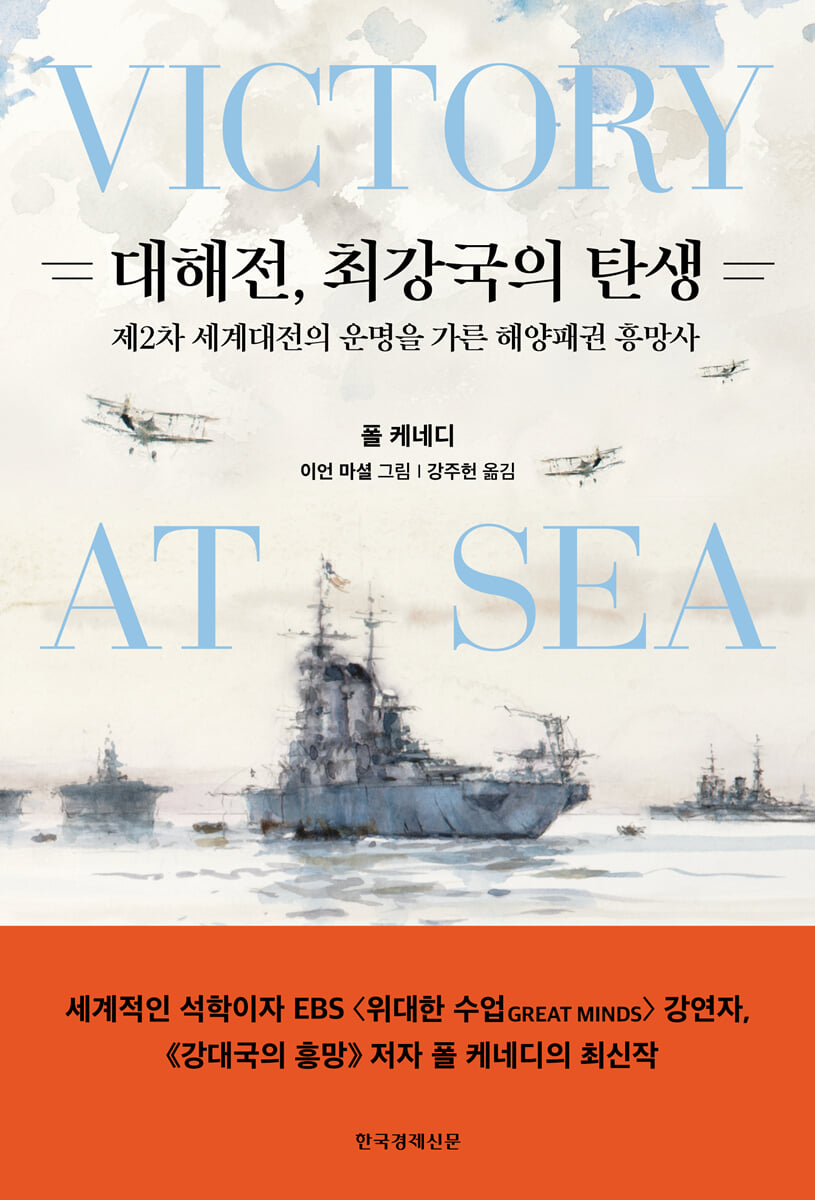
A World War II version of "The Rise and Fall of the Great Powers": A World History of the Rise and Fall of Maritime Hegemony “When you win at sea, you win everything!” A world-renowned scholar and lecturer on EBS's "Great Minds" program, The latest work by Paul Kennedy, author of "The Rise and Fall of the Great Powers" Paul Kennedy, a world-renowned historian and author of the internationally best-selling book "The Rise and Fall of the Great Powers," winner of the Wolfson Medal, often called the Nobel Prize of history, returns with a story about the history of maritime warfare, a time when victory at sea determined everything. The story of the rise and fall of great powers during World War II unfolds in a captivating way, told through the beautiful watercolors of Ian Marshall, a leading American marine artist. This book is a vivid and powerful account of how the Great Battle of the Pacific influenced the outcome of World War II, how World War II influenced naval power, and how the resulting shift in the global landscape of hegemony. It is also another monumental work by Paul Kennedy, a remarkably extensive and in-depth analysis of how the United States was able to emerge as a world power with immense economic and military power while reshaping the world's maritime order after the war. |
- You can preview some of the book's contents.
Preview
index
introduction
Types of warships
Part 1: Darkening Dark Clouds
Chapter 1 Prologue - Naval Power and Its History
Chapter 2 Warships and Naval Forces before 1939
Chapter 3 Geography, Economics, and Geopolitics
Part 2: The Great War, 1939–1942
Chapter 4: Early Naval Battles - September 1939 to July 1940
Chapter 5: The Seas of Europe in War - July 1940 to December 1941
Chapter 6: The War Expands to All Seas - 1942
The year that the third division was decided, 1943
Chapter 7: The Allies Take Control of the Seas - 1943
Chapter 8: The Changing World Power Map - 1943–1944
Part 4: The Great War, 1944–1945
Chapter 9: Allied Naval Victory - 1944
Chapter 10: Allied Victory at Sea - 1945
Part 5: Aftereffects and Reflection
Chapter 11: Naval Powers in World War II - Summary
Chapter 12: Epilogue - A Brief History
Appendix - 1943: The Turning Point of the War _ From Three Criteria
Acknowledgements
Translator's Note
main
List of Ian Marshall's paintings
Types of warships
Part 1: Darkening Dark Clouds
Chapter 1 Prologue - Naval Power and Its History
Chapter 2 Warships and Naval Forces before 1939
Chapter 3 Geography, Economics, and Geopolitics
Part 2: The Great War, 1939–1942
Chapter 4: Early Naval Battles - September 1939 to July 1940
Chapter 5: The Seas of Europe in War - July 1940 to December 1941
Chapter 6: The War Expands to All Seas - 1942
The year that the third division was decided, 1943
Chapter 7: The Allies Take Control of the Seas - 1943
Chapter 8: The Changing World Power Map - 1943–1944
Part 4: The Great War, 1944–1945
Chapter 9: Allied Naval Victory - 1944
Chapter 10: Allied Victory at Sea - 1945
Part 5: Aftereffects and Reflection
Chapter 11: Naval Powers in World War II - Summary
Chapter 12: Epilogue - A Brief History
Appendix - 1943: The Turning Point of the War _ From Three Criteria
Acknowledgements
Translator's Note
main
List of Ian Marshall's paintings
Detailed image
Into the book
This book also analyzes causality from various angles, showing how Allied strategists, scientists, and engineers overcame tactical and operational obstacles to victory on sea, air, and land by developing new weapons and methods of warfare.
We also focused on the pivotal year of 1943, which determined the outcome of the war.
It deals with the great sea battles that took place between 1939 and 1945, but also places emphasis on the question of 'how'.
How could the Allied navies and air forces, after 1943, have been supplied in such large quantities with long-range patrol aircraft like the "Liberator," escort carriers and landing craft, fleet carriers and their carrier-based aircraft, and self-homing torpedoes? The answer, once again, lies in the sudden growth of American industrial productivity and scientific and technological prowess in the midst of the war.
By the end of 1943, the weakness of the Royal Navy and the US Navy was a thing of the past.
Since late 1943, the question has not been whether to win, but when—that is, “When will victory at sea be achieved?”
--- p.15~16, from the “Preface”
It is clear that the Naval Department of the 1930s did not read Karl Marx.
But some officials would have known Marx's famous saying: "Man makes history, but history does not always follow the path he wants it to take."
The sentence continues by saying that “regardless of the number and power of their ships and destroyers, the six major naval powers mentioned above are only making history in an environment they did not create, that is, a situation given and inherited from the past.”
In other words, the Navy, being merely a military organization, had to operate within inherited constraints that could not be turned to its own advantage.
Among the “existing situations,” geographical and economic factors had the greatest influence.
Naval power was ultimately about material.
--- p.117, from “Chapter 3: Geography, Economy, and Geopolitics”
Overall, the 18 months between the surrender of France in June 1940 and the attack on Pearl Harbor in December 1941 were arguably the most volatile in the history of the great powers.
The Anglo-French camp that had been opposing Germany changed to the German-Italian camp opposing Britain after nine months, and France was eliminated from the game.
A year later, after Operation Barbarossa was launched, the war turned into a war between the Berlin-Rome Axis and the London-Moscow Allied Powers.
Five months later, Japan challenged the United States and Britain militarily, and Hitler declared war on the United States.
The result was a war between three fascist states, to borrow Churchill's phrase, the "grand alliance" of Great Britain, the Soviet Union, and the United States.
After that, there was no significant change until late 1943, when Italy withdrew from the war.
If Japan's military actions in China were included in the war zone, 80 percent of the world would be involved in the war.
--- p.310, from “Chapter 5_The Seas of Europe Embroiled in War”
A massive B-29 bomber took off, roared north for six hours, and dropped a single bomb that destroyed the entire city.
When the news reached him, Robert Oppenheimer, who had overseen the atomic bomb development project, recalled an ancient Hindu scripture and muttered, “I have become death…the destroyer of worlds.”
The old, war-torn but easily understood world order, one in which cruisers and battleships held a prominent position, now seemed to have changed.
A sad fate now awaited the old battle cruiser Renown.
In May 1945, Renown was ordered decommissioned by the Navy, and shortly thereafter the auxiliary gun turrets were removed.
The Renown was ordered to move north to the Clyde Dockyard, where it had been launched exactly 40 years earlier.
It waited there for a long time in a partially dismantled state, finally being completely dismantled in the summer of 1948.
Many other old warships were also decommissioned around that time, but their departure received little attention.
'Sictransit gloria (So the glory passed)'.
We also focused on the pivotal year of 1943, which determined the outcome of the war.
It deals with the great sea battles that took place between 1939 and 1945, but also places emphasis on the question of 'how'.
How could the Allied navies and air forces, after 1943, have been supplied in such large quantities with long-range patrol aircraft like the "Liberator," escort carriers and landing craft, fleet carriers and their carrier-based aircraft, and self-homing torpedoes? The answer, once again, lies in the sudden growth of American industrial productivity and scientific and technological prowess in the midst of the war.
By the end of 1943, the weakness of the Royal Navy and the US Navy was a thing of the past.
Since late 1943, the question has not been whether to win, but when—that is, “When will victory at sea be achieved?”
--- p.15~16, from the “Preface”
It is clear that the Naval Department of the 1930s did not read Karl Marx.
But some officials would have known Marx's famous saying: "Man makes history, but history does not always follow the path he wants it to take."
The sentence continues by saying that “regardless of the number and power of their ships and destroyers, the six major naval powers mentioned above are only making history in an environment they did not create, that is, a situation given and inherited from the past.”
In other words, the Navy, being merely a military organization, had to operate within inherited constraints that could not be turned to its own advantage.
Among the “existing situations,” geographical and economic factors had the greatest influence.
Naval power was ultimately about material.
--- p.117, from “Chapter 3: Geography, Economy, and Geopolitics”
Overall, the 18 months between the surrender of France in June 1940 and the attack on Pearl Harbor in December 1941 were arguably the most volatile in the history of the great powers.
The Anglo-French camp that had been opposing Germany changed to the German-Italian camp opposing Britain after nine months, and France was eliminated from the game.
A year later, after Operation Barbarossa was launched, the war turned into a war between the Berlin-Rome Axis and the London-Moscow Allied Powers.
Five months later, Japan challenged the United States and Britain militarily, and Hitler declared war on the United States.
The result was a war between three fascist states, to borrow Churchill's phrase, the "grand alliance" of Great Britain, the Soviet Union, and the United States.
After that, there was no significant change until late 1943, when Italy withdrew from the war.
If Japan's military actions in China were included in the war zone, 80 percent of the world would be involved in the war.
--- p.310, from “Chapter 5_The Seas of Europe Embroiled in War”
A massive B-29 bomber took off, roared north for six hours, and dropped a single bomb that destroyed the entire city.
When the news reached him, Robert Oppenheimer, who had overseen the atomic bomb development project, recalled an ancient Hindu scripture and muttered, “I have become death…the destroyer of worlds.”
The old, war-torn but easily understood world order, one in which cruisers and battleships held a prominent position, now seemed to have changed.
A sad fate now awaited the old battle cruiser Renown.
In May 1945, Renown was ordered decommissioned by the Navy, and shortly thereafter the auxiliary gun turrets were removed.
The Renown was ordered to move north to the Clyde Dockyard, where it had been launched exactly 40 years earlier.
It waited there for a long time in a partially dismantled state, finally being completely dismantled in the summer of 1948.
Many other old warships were also decommissioned around that time, but their departure received little attention.
'Sictransit gloria (So the glory passed)'.
--- p.618~619, from “Chapter 11_Naval Powers in World War II”
Publisher's Review
“It proves that Paul Kennedy is the best in this field.” - [New York Times]
“Paul Kennedy is a remarkable scholar who writes stories, not papers.” - [Washington Post]
“A deeply immersive, authoritative vision of history.” - [The Wall Street Journal]
“A vivid account, fitting praise, and clear analysis.” - [Financial Times]
“The illustrations alone are enough to spark interest.” - [The Sunday Times]
The epic maritime battle of World War II in one volume
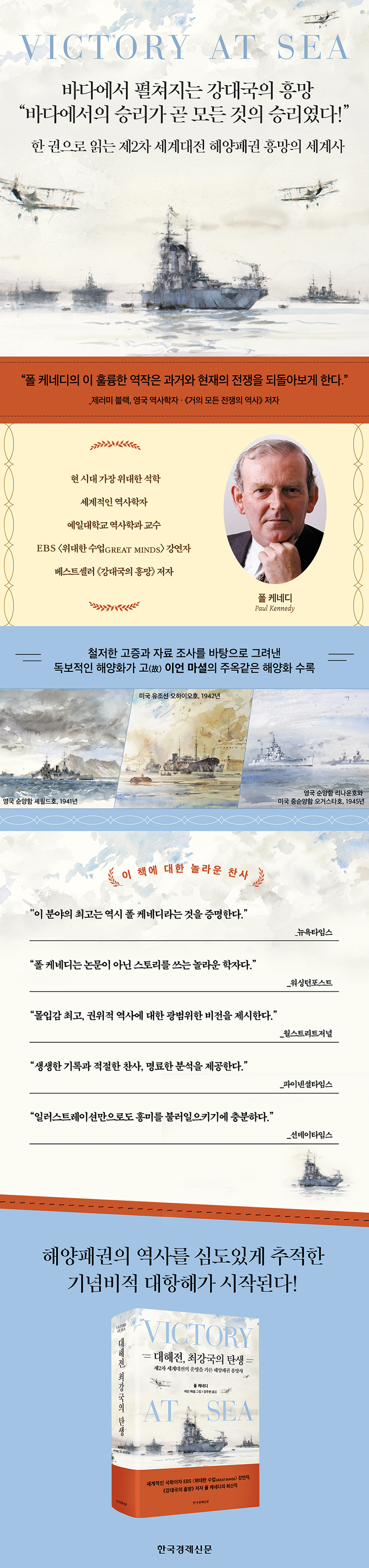
A masterpiece containing 53 illustrations by Ian Marshall, a leading American marine artist.
Paul Kennedy, who has taught history at Yale University for over 40 years and is considered the greatest historian of our time, has published a brilliant and engaging book, The Rise and Fall of Maritime Hegemony, written by mobilizing all his talents.
This book is a history of World War II at sea, tracing how the six major naval powers maneuvered for victory and how the balance shifted during World War II from 1939 to 1945, and detailing battles, military operations, transport convoys, and amphibious operations at sea.
It is also noteworthy that the book includes 53 beautiful illustrations by Ian Marshall, a leading American marine artist who vividly depicts actual warships and scenes of maritime warfare based on thorough research.
Before 1939, the six major countries with significant naval powers were Britain, the United States, France (Allied), Japan, Italy, and Germany (Axis).
The British Navy was the world's strongest, but only slightly ahead of the American Navy, and the three navies of Japan, Italy, and Germany were preparing for future challenges that would change the status quo of the seas.
The European war that broke out in September 1939 was a limited war because the British and French navies overwhelmed the German navy.
The balance of naval power shifted after Hitler conquered all of northwestern Europe, but the Royal Navy struggled to hold off a joint Italian and German attack at sea.
A further dramatic shift in the balance of naval power occurred when Japan attacked American and British bases in the Pacific, sparking a truly global war.
For more than two years since then, the struggle for control of the seas has been fiercely fought on land and in the air, in the world's major oceans and seas.
1942 was the 'most combat-heavy year' in naval history, but despite the victory in the Mediterranean, the naval situation was by no means favorable for the Allies.
Change was needed for the Allies to win, and it wasn't until 1943 that things really started to change.
And finally, the winner was decided.
The reorganization of the new world order that began after the maritime war
A monumental voyage that deeply traces the history of maritime hegemony.
Summarizing World War II historically is not easy, but the key factors that ultimately secured the Allied victory can be summarized simply.
The Allies were able to crush Italy, Germany, and Japan thanks to the endless flow of soldiers and supplies across the two oceans by the United States and Great Britain.
This was possible because of two factors: naval power and a productivity revolution.
The US military continued to advance without slowing down at all.
1943 was not only marked by fierce fighting along convoys of transport ships, amphibious landings in the Mediterranean and Pacific, and the sinking of German cruisers off the coast of Norway.
It was the year in which America's productive power, which had previously existed only in a latent form, was finally 'concretely realized' in all theaters of war.
The following year, supplies flooded the front, contributing to victories at Leyte Gulf and Normandy.
Behind the production of military equipment was stronger financial support and tax increases than ever before.
The Allied naval supremacy was assured thanks to the booming American economy, which dwarfed all its competitors.
In this way, this book uncovers the stages by which naval victory led to Allied victory, and traces the causal relationships between those stages, thereby uncovering aspects of the war we were unaware of.
The author meticulously explains the reasons for naval supremacy and victory in war, citing not only the naval's military operations but also trade, diplomacy, financial policies, and innovative science and technology.
Ultimately, after victory at sea in 1945 was confirmed, the United States was the clear victor of World War II, and this marked the beginning of a new world order.
In this way, the author points out that the strategic landscape of the naval powers active on the world stage between 1936 and 1946 completely changed from the following four perspectives.
First, the multinational balance that had been maintained with the demise of the navies of Italy, Germany, Japan, and France disappeared, and second, the era of warships (surface vessels) equipped with cannons ended.
Third, the advent of the atomic bomb called into question the effectiveness and role of traditional military power, and fourth, a new international order was created in which the United States dominated the world's oceans with its strong economic and military power.
A chronicle of the rise and fall of a great power unfolding at sea.
The Conditions of True Victory Revisited with a New Perspective
Paul Kennedy, while adopting a chronological structure, strives to excel at reflecting multiple perspectives, moving beyond simply listing and explaining historical facts.
First, in Chapter 1, before getting into the main topic, we will look at the overall flow of world affairs at the time.
Chapter 2 opens the door to the overall story by unraveling the story of warships and navies before 1939, while Chapter 3 deals with two important factors in naval power: geographical conditions and economic power.
Chapters 4-6 cover the full-scale naval battles leading up to the turning point in 1939-1942.
This part corresponds to the most important 'history of events'.
Chapters 7 and 8 then delve into the dramatic naval battles of 1943, which determined victory and defeat, and provide in-depth analysis. Chapters 9 and 10 then delve into the final naval battles that took place between 1944 and 1945, and provide a detailed analysis of how Anglo-American naval power transformed.
Finally, Chapter 11 concludes with a final assessment of the decisive impact the Great Battle had on the development of world history.
We usually think that history is driven by large nations and large organizations.
It is also believed that historical structures are formed through careful planning by the subjects.
But if we look closely at key moments in history, we see that they are complex networks of relationships between various actors, large and small, and that they were never determined by design, but by small shocks and variables that formed by chance or over time.
In that sense, the task of tracing the interesting chain of causality, intertwined with chance and choice, between the beginning and the end of the war cannot but be very meaningful.
We still live in an age of war.
The world is still in the midst of a war for hegemony that has not yet ended and will continue in the future.
Therefore, it is important to examine how war has shaped and changed our history, and how great powers have risen and fallen, through a history of maritime warfare written by a world-renowned scholar with a burning interest and passion for research, gathering vast amounts of data.
I have no doubt that this book will not only provide a profound and accurate understanding of the past, but will also serve as a cornerstone for predicting the future.
“Paul Kennedy is a remarkable scholar who writes stories, not papers.” - [Washington Post]
“A deeply immersive, authoritative vision of history.” - [The Wall Street Journal]
“A vivid account, fitting praise, and clear analysis.” - [Financial Times]
“The illustrations alone are enough to spark interest.” - [The Sunday Times]
The epic maritime battle of World War II in one volume
A masterpiece containing 53 illustrations by Ian Marshall, a leading American marine artist.
Paul Kennedy, who has taught history at Yale University for over 40 years and is considered the greatest historian of our time, has published a brilliant and engaging book, The Rise and Fall of Maritime Hegemony, written by mobilizing all his talents.
This book is a history of World War II at sea, tracing how the six major naval powers maneuvered for victory and how the balance shifted during World War II from 1939 to 1945, and detailing battles, military operations, transport convoys, and amphibious operations at sea.
It is also noteworthy that the book includes 53 beautiful illustrations by Ian Marshall, a leading American marine artist who vividly depicts actual warships and scenes of maritime warfare based on thorough research.
Before 1939, the six major countries with significant naval powers were Britain, the United States, France (Allied), Japan, Italy, and Germany (Axis).
The British Navy was the world's strongest, but only slightly ahead of the American Navy, and the three navies of Japan, Italy, and Germany were preparing for future challenges that would change the status quo of the seas.
The European war that broke out in September 1939 was a limited war because the British and French navies overwhelmed the German navy.
The balance of naval power shifted after Hitler conquered all of northwestern Europe, but the Royal Navy struggled to hold off a joint Italian and German attack at sea.
A further dramatic shift in the balance of naval power occurred when Japan attacked American and British bases in the Pacific, sparking a truly global war.
For more than two years since then, the struggle for control of the seas has been fiercely fought on land and in the air, in the world's major oceans and seas.
1942 was the 'most combat-heavy year' in naval history, but despite the victory in the Mediterranean, the naval situation was by no means favorable for the Allies.
Change was needed for the Allies to win, and it wasn't until 1943 that things really started to change.
And finally, the winner was decided.
The reorganization of the new world order that began after the maritime war
A monumental voyage that deeply traces the history of maritime hegemony.
Summarizing World War II historically is not easy, but the key factors that ultimately secured the Allied victory can be summarized simply.
The Allies were able to crush Italy, Germany, and Japan thanks to the endless flow of soldiers and supplies across the two oceans by the United States and Great Britain.
This was possible because of two factors: naval power and a productivity revolution.
The US military continued to advance without slowing down at all.
1943 was not only marked by fierce fighting along convoys of transport ships, amphibious landings in the Mediterranean and Pacific, and the sinking of German cruisers off the coast of Norway.
It was the year in which America's productive power, which had previously existed only in a latent form, was finally 'concretely realized' in all theaters of war.
The following year, supplies flooded the front, contributing to victories at Leyte Gulf and Normandy.
Behind the production of military equipment was stronger financial support and tax increases than ever before.
The Allied naval supremacy was assured thanks to the booming American economy, which dwarfed all its competitors.
In this way, this book uncovers the stages by which naval victory led to Allied victory, and traces the causal relationships between those stages, thereby uncovering aspects of the war we were unaware of.
The author meticulously explains the reasons for naval supremacy and victory in war, citing not only the naval's military operations but also trade, diplomacy, financial policies, and innovative science and technology.
Ultimately, after victory at sea in 1945 was confirmed, the United States was the clear victor of World War II, and this marked the beginning of a new world order.
In this way, the author points out that the strategic landscape of the naval powers active on the world stage between 1936 and 1946 completely changed from the following four perspectives.
First, the multinational balance that had been maintained with the demise of the navies of Italy, Germany, Japan, and France disappeared, and second, the era of warships (surface vessels) equipped with cannons ended.
Third, the advent of the atomic bomb called into question the effectiveness and role of traditional military power, and fourth, a new international order was created in which the United States dominated the world's oceans with its strong economic and military power.
A chronicle of the rise and fall of a great power unfolding at sea.
The Conditions of True Victory Revisited with a New Perspective
Paul Kennedy, while adopting a chronological structure, strives to excel at reflecting multiple perspectives, moving beyond simply listing and explaining historical facts.
First, in Chapter 1, before getting into the main topic, we will look at the overall flow of world affairs at the time.
Chapter 2 opens the door to the overall story by unraveling the story of warships and navies before 1939, while Chapter 3 deals with two important factors in naval power: geographical conditions and economic power.
Chapters 4-6 cover the full-scale naval battles leading up to the turning point in 1939-1942.
This part corresponds to the most important 'history of events'.
Chapters 7 and 8 then delve into the dramatic naval battles of 1943, which determined victory and defeat, and provide in-depth analysis. Chapters 9 and 10 then delve into the final naval battles that took place between 1944 and 1945, and provide a detailed analysis of how Anglo-American naval power transformed.
Finally, Chapter 11 concludes with a final assessment of the decisive impact the Great Battle had on the development of world history.
We usually think that history is driven by large nations and large organizations.
It is also believed that historical structures are formed through careful planning by the subjects.
But if we look closely at key moments in history, we see that they are complex networks of relationships between various actors, large and small, and that they were never determined by design, but by small shocks and variables that formed by chance or over time.
In that sense, the task of tracing the interesting chain of causality, intertwined with chance and choice, between the beginning and the end of the war cannot but be very meaningful.
We still live in an age of war.
The world is still in the midst of a war for hegemony that has not yet ended and will continue in the future.
Therefore, it is important to examine how war has shaped and changed our history, and how great powers have risen and fallen, through a history of maritime warfare written by a world-renowned scholar with a burning interest and passion for research, gathering vast amounts of data.
I have no doubt that this book will not only provide a profound and accurate understanding of the past, but will also serve as a cornerstone for predicting the future.
GOODS SPECIFICS
- Date of issue: October 30, 2023
- Format: Hardcover book binding method guide
- Page count, weight, size: 740 pages | 1,380g | 150*225*47mm
- ISBN13: 9788947549226
- ISBN10: 8947549223
You may also like
카테고리
korean


korean

![GQ KOREA Mark (Monthly): December [2025]](http://librairie.coreenne.fr/cdn/shop/files/8ef265dbbfbf186523ed75ba7319009d.jpg?v=1765340328&width=3840)


