

Polymath
 |
Description
Book Introduction
Polymath, a convergence talent ahead of its time
A chronicle of geniuses who rewrote history at the forefront of knowledge across fields.
Polymaths are people who have outstanding talents and have interests, knowledge, and expertise in various fields.
It does not simply mean genius, but rather refers to a person who has demonstrated a spirit of inquiry and has been active across seemingly unrelated fields.
Leonardo da Vinci and Comenius of the Renaissance, Leibniz of the 17th century, and Oliver Sacks and Susan Sontag of our time were well-known intellectuals and convergents who, rather than being experts in just one field, demonstrated their talents in various fields without defining their own limitations and changed the times.
Polymaths are often described as people who know 'everything' rather than people who are well-versed in a specific field of knowledge.
History has not always been kind to those with encyclopedic curiosity.
Despite his talent and many accomplishments in various fields, he is often remembered for only one or two accomplishments.
The numerous achievements of polymaths introduced in this book are not only success stories.
There was a price to pay for being knowledgeable.
In the Greco-Roman era, polymaths like Pythagoras were denounced as charlatans, and many polymaths were attacked as frauds, eccentrics, or superficial in their knowledge.
A chronicle of geniuses who rewrote history at the forefront of knowledge across fields.
Polymaths are people who have outstanding talents and have interests, knowledge, and expertise in various fields.
It does not simply mean genius, but rather refers to a person who has demonstrated a spirit of inquiry and has been active across seemingly unrelated fields.
Leonardo da Vinci and Comenius of the Renaissance, Leibniz of the 17th century, and Oliver Sacks and Susan Sontag of our time were well-known intellectuals and convergents who, rather than being experts in just one field, demonstrated their talents in various fields without defining their own limitations and changed the times.
Polymaths are often described as people who know 'everything' rather than people who are well-versed in a specific field of knowledge.
History has not always been kind to those with encyclopedic curiosity.
Despite his talent and many accomplishments in various fields, he is often remembered for only one or two accomplishments.
The numerous achievements of polymaths introduced in this book are not only success stories.
There was a price to pay for being knowledgeable.
In the Greco-Roman era, polymaths like Pythagoras were denounced as charlatans, and many polymaths were attacked as frauds, eccentrics, or superficial in their knowledge.
- You can preview some of the book's contents.
Preview
index
Introduction: What is a Polymath?
Chapter 1: Polymaths of Ancient East and West
Chapter 2: The Age of the Renaissance (1400s–1600s)
Chapter 3: The Age of the "Edgy Monsters" (1600s-1700s)
Chapter 4: The Age of Intellectuals (1700s–1850s)
Chapter 5: The Age of Specialization (1850s–2000s)
Chapter 6: Are Polymaths Special People?
Chapter 7: How were polymaths raised?
Chapter 8: The Era of Cross-Sectoral Knowledge Convergence
Outgoing post
Appendix: 500 Polymaths of the West
Americas
Search
Further Reading
Chapter 1: Polymaths of Ancient East and West
Chapter 2: The Age of the Renaissance (1400s–1600s)
Chapter 3: The Age of the "Edgy Monsters" (1600s-1700s)
Chapter 4: The Age of Intellectuals (1700s–1850s)
Chapter 5: The Age of Specialization (1850s–2000s)
Chapter 6: Are Polymaths Special People?
Chapter 7: How were polymaths raised?
Chapter 8: The Era of Cross-Sectoral Knowledge Convergence
Outgoing post
Appendix: 500 Polymaths of the West
Americas
Search
Further Reading
Detailed image
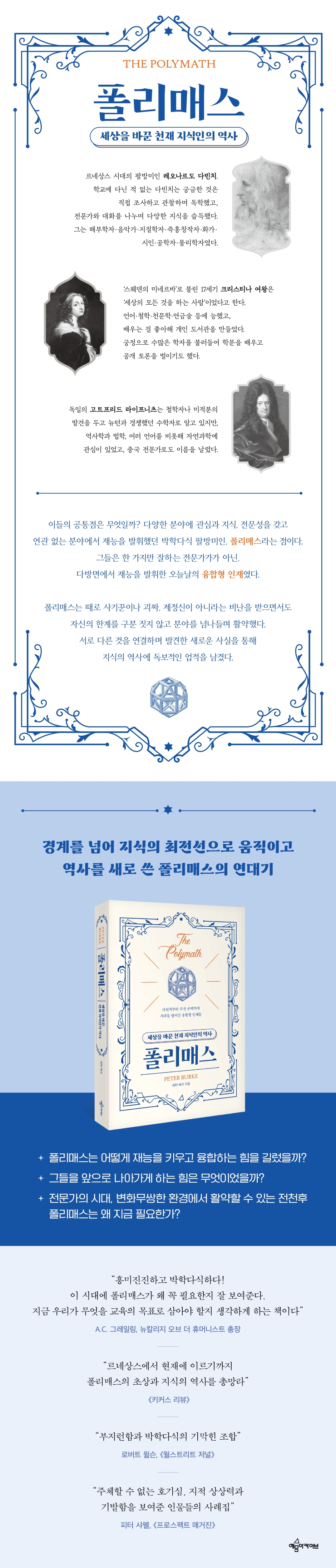
Into the book
Before the disciplines were specialized or during the Middle Ages, when only a few disciplines existed, there would have been no need for concepts such as polymath.
In those days, a broad curiosity was not only common but even considered a cardinal virtue.
The practice of writing books on various topics was the same.
Before the Renaissance, there was not much to know beyond the obvious, so at least the basic knowledge could be acquired completely with considerable effort.
Yet, in ancient Western societies, including Greece and Rome, ancient China, the Islamic world, and the Western Middle Ages, many were revered for their extraordinary breadth of knowledge.
However, some have been criticized for having shallow knowledge.
--- p.35
During the Renaissance, the ideal human being was considered to be a versatile person, or 'uomo universale'.
Vittorino da Feltre, a renowned teacher in 15th-century Italy, often praised the comprehensive learning that the Greeks called "encyclopaedia," and said that to be a complete person who could benefit one's fellows, one must be able to discuss natural philosophy, ethics, astronomy, geometry, chemistry, arithmetic, and surveying.
His ideal was to have knowledge of many different disciplines.
Also, the narrator of Matteo Palmieri's "Vita Civica" from Florence asks how one can learn much and become well-versed in great art.
The famous figure who is known as the embodiment of the omnipotent is Faust.
This hero, who appears in the German original Faust published in 1587, has an insatiable thirst for knowledge.
--- p.61
Leonardo da Vinci is famous as a representative figure of the Renaissance, but he is not a typical Renaissance man.
He was not a humanist, and unlike the technicians mentioned above, he had not even received a humanities education.
Da Vinci never attended school and could barely read Latin even in his later years.
As da Vinci described himself in his notebooks as "an unlearned man," he was largely self-taught in most fields and prided himself on the fact that he gained knowledge from experience rather than from written sources.
…Da Vinci seems to have acquired more diverse knowledge by conversing with experts.
Above all, da Vinci acquired knowledge through direct investigation and observation.
He studied anatomy and practiced dissection because he wanted to more accurately represent humans and horses, but he also continued his research out of curiosity.
Anatomy is known as the field in which he made his most important discoveries.
--- p.77~79
What made the 17th century a golden age for polymaths? While the answer to such a grand question inevitably relies on speculation, a few points are worth considering.
Some argue that the achievements discussed above are the result of social and cultural changes, rather than the miraculous birth of giants or monsters.
First, in 17th-century Europe, the tradition of being wary of curiosity persisted, and as the division of intellectual labor created and persisted as a negative atmosphere toward versatility, people enjoyed more freedom.
Secondly, the discovery of the New World through exploration and the increased contact with Asians and Africans through trade, missionary work, and conquest strongly stimulated European curiosity.
This fact is evidenced by the 'Room of Curiosities', which displays exotic objects.
Some Europeans became familiar with new plants, animals, and peoples, as well as their languages and customs.
--- p.125~126
A third crisis, closely related to the topic of polymaths, is the increase in available knowledge.
This was beneficial to the group, but it created anxiety for individuals because there was so much to know.
The invention of printing (the European method of movable type printing) in the mid-15th century led to a proliferation of books, initially relatively slowly but later exponentially.
Recent estimates suggest that about 345,000 copies were printed in the early 17th century.
More and more people are starting to express their dissatisfaction with this knowledge explosion.
Complaints about having too many books grew, and readers' metaphorical expressions about being swept away by a flood of books or feeling lost in a forest of books piled up.
… To relieve this overload, scholars began to focus on systematizing knowledge, writing down necessary or likely-to-be-needed information on notes and attaching them to books or putting them in separate boxes.
The explosion of books wasn't the only reason scholars felt they had too much to know.
As we saw earlier, the discovery of the New World also stimulated research because of the new knowledge it brought.
--- p.130
No matter what anyone says, the representative polymath of the 19th century and a monster with a wealth of knowledge on a par with Leibniz was his younger brother, Alexander Humboldt.
People of that time were well aware of his extensive knowledge.
Harvard University President John Kirkland described him as a man "well-versed in all subjects."
In a speech commemorating the centennial of Alexander Humboldt's birth, the poet and philosopher Ralph Waldo Emerson said that Humboldt, like Aristotle, Julius Caesar, and "the good Crichton," was a "jack of all trades," one of those wondrous figures who appear from time to time to show the possibilities of the human mind and the extent and range of human power.
…Alexander Humboldt feared falling into what he called the “encyclopedist’s superficial knowledge,” but he proved firsthand that a person with broad and deep knowledge can make original and important contributions to a wide range of disciplines.
He goes beyond being called 'the last man who knew everything' to being called 'the last polymath'.
--- p.174
It would be a mistake to view all the achievements of polymaths as solely the results of thoroughly Apollonian people who prioritize reason and moderation, working hard and not playing.
Their achievements also had a Dionysian aspect, as they pursued instinct and passion, finding joy in gaining knowledge and solving problems.
The historian Carlo Ginzburg, who boasted an unusually wide range of interests, once likened the pleasure of learning about a new subject to the joy of skiing on fresh snow.
Among the polymaths, there were some who enjoyed wordplay: philosopher Jacques Derrida created the word "différance" by combining the meanings of "difference" and "postponement," Slavoj Zizek published a book of jokes, and sociologist Gilberto Freire shocked readers by including a Portuguese pun about civilization and syphilis in his book.
Claude Shannon is called a playful inventor.
One of the devices he created was a juggling machine.
In those days, a broad curiosity was not only common but even considered a cardinal virtue.
The practice of writing books on various topics was the same.
Before the Renaissance, there was not much to know beyond the obvious, so at least the basic knowledge could be acquired completely with considerable effort.
Yet, in ancient Western societies, including Greece and Rome, ancient China, the Islamic world, and the Western Middle Ages, many were revered for their extraordinary breadth of knowledge.
However, some have been criticized for having shallow knowledge.
--- p.35
During the Renaissance, the ideal human being was considered to be a versatile person, or 'uomo universale'.
Vittorino da Feltre, a renowned teacher in 15th-century Italy, often praised the comprehensive learning that the Greeks called "encyclopaedia," and said that to be a complete person who could benefit one's fellows, one must be able to discuss natural philosophy, ethics, astronomy, geometry, chemistry, arithmetic, and surveying.
His ideal was to have knowledge of many different disciplines.
Also, the narrator of Matteo Palmieri's "Vita Civica" from Florence asks how one can learn much and become well-versed in great art.
The famous figure who is known as the embodiment of the omnipotent is Faust.
This hero, who appears in the German original Faust published in 1587, has an insatiable thirst for knowledge.
--- p.61
Leonardo da Vinci is famous as a representative figure of the Renaissance, but he is not a typical Renaissance man.
He was not a humanist, and unlike the technicians mentioned above, he had not even received a humanities education.
Da Vinci never attended school and could barely read Latin even in his later years.
As da Vinci described himself in his notebooks as "an unlearned man," he was largely self-taught in most fields and prided himself on the fact that he gained knowledge from experience rather than from written sources.
…Da Vinci seems to have acquired more diverse knowledge by conversing with experts.
Above all, da Vinci acquired knowledge through direct investigation and observation.
He studied anatomy and practiced dissection because he wanted to more accurately represent humans and horses, but he also continued his research out of curiosity.
Anatomy is known as the field in which he made his most important discoveries.
--- p.77~79
What made the 17th century a golden age for polymaths? While the answer to such a grand question inevitably relies on speculation, a few points are worth considering.
Some argue that the achievements discussed above are the result of social and cultural changes, rather than the miraculous birth of giants or monsters.
First, in 17th-century Europe, the tradition of being wary of curiosity persisted, and as the division of intellectual labor created and persisted as a negative atmosphere toward versatility, people enjoyed more freedom.
Secondly, the discovery of the New World through exploration and the increased contact with Asians and Africans through trade, missionary work, and conquest strongly stimulated European curiosity.
This fact is evidenced by the 'Room of Curiosities', which displays exotic objects.
Some Europeans became familiar with new plants, animals, and peoples, as well as their languages and customs.
--- p.125~126
A third crisis, closely related to the topic of polymaths, is the increase in available knowledge.
This was beneficial to the group, but it created anxiety for individuals because there was so much to know.
The invention of printing (the European method of movable type printing) in the mid-15th century led to a proliferation of books, initially relatively slowly but later exponentially.
Recent estimates suggest that about 345,000 copies were printed in the early 17th century.
More and more people are starting to express their dissatisfaction with this knowledge explosion.
Complaints about having too many books grew, and readers' metaphorical expressions about being swept away by a flood of books or feeling lost in a forest of books piled up.
… To relieve this overload, scholars began to focus on systematizing knowledge, writing down necessary or likely-to-be-needed information on notes and attaching them to books or putting them in separate boxes.
The explosion of books wasn't the only reason scholars felt they had too much to know.
As we saw earlier, the discovery of the New World also stimulated research because of the new knowledge it brought.
--- p.130
No matter what anyone says, the representative polymath of the 19th century and a monster with a wealth of knowledge on a par with Leibniz was his younger brother, Alexander Humboldt.
People of that time were well aware of his extensive knowledge.
Harvard University President John Kirkland described him as a man "well-versed in all subjects."
In a speech commemorating the centennial of Alexander Humboldt's birth, the poet and philosopher Ralph Waldo Emerson said that Humboldt, like Aristotle, Julius Caesar, and "the good Crichton," was a "jack of all trades," one of those wondrous figures who appear from time to time to show the possibilities of the human mind and the extent and range of human power.
…Alexander Humboldt feared falling into what he called the “encyclopedist’s superficial knowledge,” but he proved firsthand that a person with broad and deep knowledge can make original and important contributions to a wide range of disciplines.
He goes beyond being called 'the last man who knew everything' to being called 'the last polymath'.
--- p.174
It would be a mistake to view all the achievements of polymaths as solely the results of thoroughly Apollonian people who prioritize reason and moderation, working hard and not playing.
Their achievements also had a Dionysian aspect, as they pursued instinct and passion, finding joy in gaining knowledge and solving problems.
The historian Carlo Ginzburg, who boasted an unusually wide range of interests, once likened the pleasure of learning about a new subject to the joy of skiing on fresh snow.
Among the polymaths, there were some who enjoyed wordplay: philosopher Jacques Derrida created the word "différance" by combining the meanings of "difference" and "postponement," Slavoj Zizek published a book of jokes, and sociologist Gilberto Freire shocked readers by including a Portuguese pun about civilization and syphilis in his book.
Claude Shannon is called a playful inventor.
One of the devices he created was a juggling machine.
--- p.279~280
Publisher's Review
From Leonardo da Vinci to Leibniz, Humboldt, George Eliot, Oliver Sacks, and Susan Sontag
A History of 500 Polymaths: Multi-Talented Intellectuals Who Changed the World
All knowledge in the world has its own history.
Ancient hunter-gatherers needed a wide range of knowledge to survive, and any group, whether farmers, artisans, midwives, merchants, musicians, or soccer players, needed to possess superior knowledge in their field.
The term 'polymath', which was once reserved for those who studied academics, is now widely used to refer to people who have achieved great things in various fields, from athletes to politicians.
Polymaths, multifaceted individuals with interests and talents in many fields, have made unique contributions to the advancement of knowledge by connecting disparate fields and discovering things that specialists in specific fields have not seen.
In this book, the author, a cultural historian, traces the history of knowledge by following the footsteps of 500 Western polymaths who were ahead of their time from the Renaissance to the present.
By focusing on how the explosive growth of knowledge that coincided with the invention of printing, the discovery of the New World, and the Scientific Revolution had a synergistic effect on the polymaths of the time, it offers a broad insight into why polymaths, who have the ability to create something new by connecting seemingly disparate fields and the capacity to operate across fields, are so necessary in this rapidly changing era.
This book follows an intellectual journey, drawing on rich case studies of leading polymath figures.
We categorize polymaths by how they studied knowledge, and examine the wide range of achievements they achieved, along with the driving force that propelled them forward.
Looking at the accomplishments of polymaths as individuals, one might think that they would have achieved everything effortlessly, accumulated success easily, and lived surrounded by praise and applause, but in reality, the other side of the story was somewhat shabby.
Many polymaths worked silently and alone amidst the ignorance and discord of the world.
The famous story of the childhood of the mathematician Pascal, who rediscovered geometry without the help of books or teachers, created the myth of the polymath as a 'lonely genius who learned all his knowledge by himself'.
Leonardo da Vinci, the loneliest polymath of all, was also a famous court musician in Milan when he was young.
A Glance at the History of Knowledge and the Chronology of Western Polymaths
In the Age of Experts, Why Are All-Round Polymaths Needed Now?
Polymaths were not only active in the modern West.
The author focuses on the post-medieval era, when the ideal human was considered an "omnipotent being" who knew "everything," including polymaths from the East and the West, including China and Islam, from ancient Greece to the late Middle Ages, and the multi-talented scholars, engineers, and artists of the Renaissance, especially Leonardo da Vinci, who is called the epitome of polymath.
We look back on the 'age of the learned monsters' through the eyes of seven polymaths who were active during the golden age of polymaths in the 17th century and dreamed of academic ideals.
Despite the limitations of being unable to receive higher education during this period, there were also female polymaths who continued their research in their own ways.
Polymaths demonstrate through their lives what great achievements can be achieved when knowledge, diligence, and a pure curiosity that must be satisfied.
The half-life of knowledge is getting shorter, and in a world where we can't learn everything at once and where solutions to each problem must vary, knowledge will continue to become more detailed and specialized, branching out into new branches.
The main concern of this book is how polymaths can survive in these changing times.
The author says:
“In an era where knowledge labor is divided like today, generalists are more necessary.
As Leibniz declared, what we need is an 'omnipotent being'.
One person who can connect everything can do the work of ten or more.
“In this age of high specialization, we need such people more than ever.”
A History of 500 Polymaths: Multi-Talented Intellectuals Who Changed the World
All knowledge in the world has its own history.
Ancient hunter-gatherers needed a wide range of knowledge to survive, and any group, whether farmers, artisans, midwives, merchants, musicians, or soccer players, needed to possess superior knowledge in their field.
The term 'polymath', which was once reserved for those who studied academics, is now widely used to refer to people who have achieved great things in various fields, from athletes to politicians.
Polymaths, multifaceted individuals with interests and talents in many fields, have made unique contributions to the advancement of knowledge by connecting disparate fields and discovering things that specialists in specific fields have not seen.
In this book, the author, a cultural historian, traces the history of knowledge by following the footsteps of 500 Western polymaths who were ahead of their time from the Renaissance to the present.
By focusing on how the explosive growth of knowledge that coincided with the invention of printing, the discovery of the New World, and the Scientific Revolution had a synergistic effect on the polymaths of the time, it offers a broad insight into why polymaths, who have the ability to create something new by connecting seemingly disparate fields and the capacity to operate across fields, are so necessary in this rapidly changing era.
This book follows an intellectual journey, drawing on rich case studies of leading polymath figures.
We categorize polymaths by how they studied knowledge, and examine the wide range of achievements they achieved, along with the driving force that propelled them forward.
Looking at the accomplishments of polymaths as individuals, one might think that they would have achieved everything effortlessly, accumulated success easily, and lived surrounded by praise and applause, but in reality, the other side of the story was somewhat shabby.
Many polymaths worked silently and alone amidst the ignorance and discord of the world.
The famous story of the childhood of the mathematician Pascal, who rediscovered geometry without the help of books or teachers, created the myth of the polymath as a 'lonely genius who learned all his knowledge by himself'.
Leonardo da Vinci, the loneliest polymath of all, was also a famous court musician in Milan when he was young.
A Glance at the History of Knowledge and the Chronology of Western Polymaths
In the Age of Experts, Why Are All-Round Polymaths Needed Now?
Polymaths were not only active in the modern West.
The author focuses on the post-medieval era, when the ideal human was considered an "omnipotent being" who knew "everything," including polymaths from the East and the West, including China and Islam, from ancient Greece to the late Middle Ages, and the multi-talented scholars, engineers, and artists of the Renaissance, especially Leonardo da Vinci, who is called the epitome of polymath.
We look back on the 'age of the learned monsters' through the eyes of seven polymaths who were active during the golden age of polymaths in the 17th century and dreamed of academic ideals.
Despite the limitations of being unable to receive higher education during this period, there were also female polymaths who continued their research in their own ways.
Polymaths demonstrate through their lives what great achievements can be achieved when knowledge, diligence, and a pure curiosity that must be satisfied.
The half-life of knowledge is getting shorter, and in a world where we can't learn everything at once and where solutions to each problem must vary, knowledge will continue to become more detailed and specialized, branching out into new branches.
The main concern of this book is how polymaths can survive in these changing times.
The author says:
“In an era where knowledge labor is divided like today, generalists are more necessary.
As Leibniz declared, what we need is an 'omnipotent being'.
One person who can connect everything can do the work of ten or more.
“In this age of high specialization, we need such people more than ever.”
GOODS SPECIFICS
- Date of issue: October 10, 2023
- Page count, weight, size: 448 pages | 600g | 150*210*23mm
- ISBN13: 9791163862239
- ISBN10: 1163862231
You may also like
카테고리
korean


korean

![GQ KOREA Mark (Monthly): December [2025]](http://librairie.coreenne.fr/cdn/shop/files/8ef265dbbfbf186523ed75ba7319009d.jpg?v=1765340328&width=3840)


