

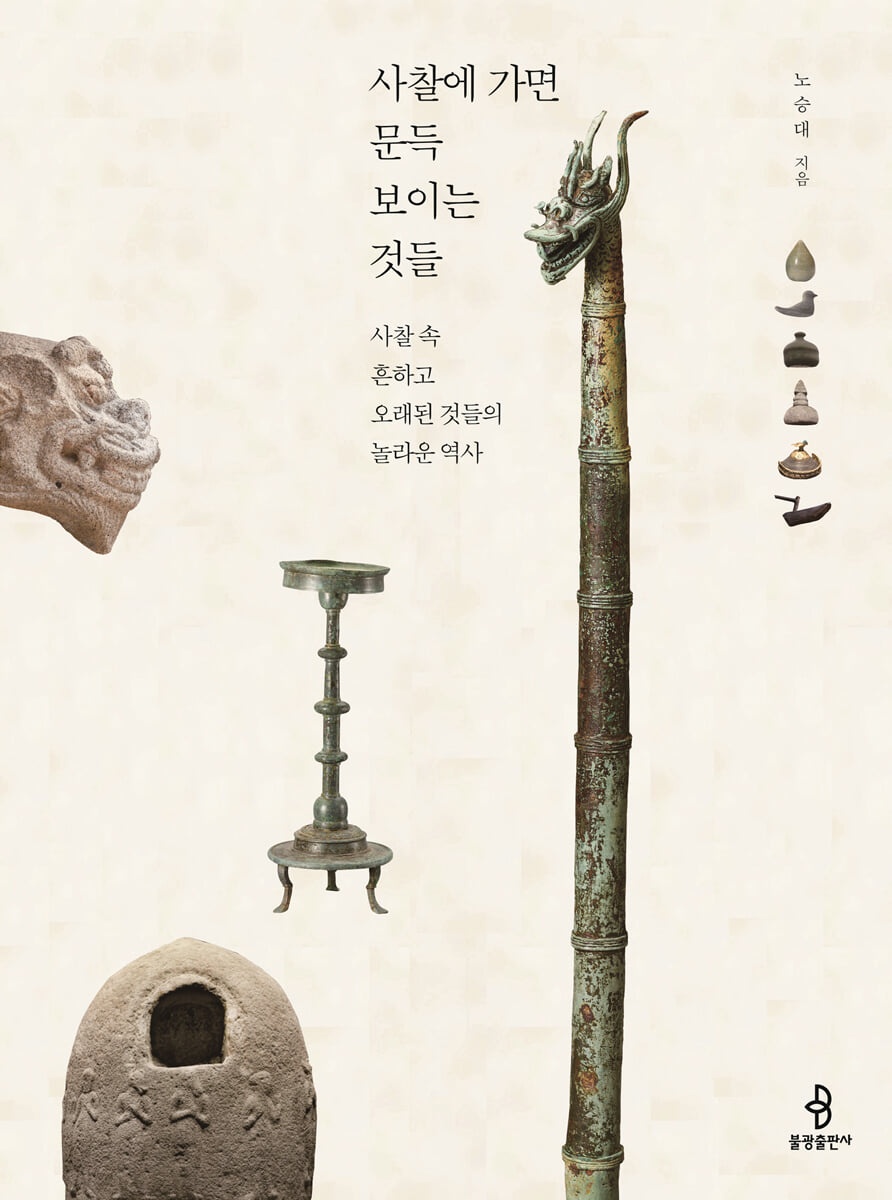
Things you suddenly see when you go to a temple
 |
Description
Book Introduction
The final round of the treasure hunt hidden in every corner of the temple!
Amazing history engraved in common and old things in temples!
Some people call the temples located throughout the country 'museums in the forest.'
This may be because there are Buddhist statues, paintings, and halls that have been preserved in their place for a long time and have been recognized for their historical value.
But are those the only treasures in the temple?
The author says that things we 'usually' pass by in temples we 'suddenly' visit, such as stone pillars in the temple yard whose purpose we don't know, duck sculptures on the roof that seem to be simple decorations, tables placed in front of Buddhist statues, and even stairs and stone walls that assist in the daily life of temple residents, are treasures of our history.
The reason is not simply because it is 'old'.
Surprisingly, each of these is engraved with a grand historical context, symbolic meaning, and the wisdom and wishes of our ancestors.
The author, who has been introducing another side of temples by highlighting the mysterious and surprising beings that have been hiding in temples and their history and culture, continues the 'final round' of the search for hidden treasures in temples, following his previous works, 'Goblins and Samshin Halmi Live in Temples' and 'Hidden Supporting Characters in Temples'.
In this two-part book, the author explores the temple's stone structures, carved into rock faces and carved from rock, as well as the fun and unexpected treasures found within the temple grounds.
Thus, in Part 1, we will cover treasures that can be found in any temple and thus may not have been of much interest: rock-carved Buddhas, stone pagodas, stone lanterns, and stupas, as well as stone pillars and stone lanterns whose uses are not well known.
The next two parts cover the stories of seemingly ordinary or trivial things, such as the sumidan and table, stairs and stone walls, the Haewooso, the temple's toilet, the white-stone peak and celadon tiles on the roof of the main building, jars hidden under the eaves, and the ducks sitting on the ridge.
This is the record of a true traveler who has spent over 40 years reading about our history and the culture of our ancestors, not from a desk, but on the road! Through this book's vivid accounts, readers will confirm that nothing within temples exists in vain.
Amazing history engraved in common and old things in temples!
Some people call the temples located throughout the country 'museums in the forest.'
This may be because there are Buddhist statues, paintings, and halls that have been preserved in their place for a long time and have been recognized for their historical value.
But are those the only treasures in the temple?
The author says that things we 'usually' pass by in temples we 'suddenly' visit, such as stone pillars in the temple yard whose purpose we don't know, duck sculptures on the roof that seem to be simple decorations, tables placed in front of Buddhist statues, and even stairs and stone walls that assist in the daily life of temple residents, are treasures of our history.
The reason is not simply because it is 'old'.
Surprisingly, each of these is engraved with a grand historical context, symbolic meaning, and the wisdom and wishes of our ancestors.
The author, who has been introducing another side of temples by highlighting the mysterious and surprising beings that have been hiding in temples and their history and culture, continues the 'final round' of the search for hidden treasures in temples, following his previous works, 'Goblins and Samshin Halmi Live in Temples' and 'Hidden Supporting Characters in Temples'.
In this two-part book, the author explores the temple's stone structures, carved into rock faces and carved from rock, as well as the fun and unexpected treasures found within the temple grounds.
Thus, in Part 1, we will cover treasures that can be found in any temple and thus may not have been of much interest: rock-carved Buddhas, stone pagodas, stone lanterns, and stupas, as well as stone pillars and stone lanterns whose uses are not well known.
The next two parts cover the stories of seemingly ordinary or trivial things, such as the sumidan and table, stairs and stone walls, the Haewooso, the temple's toilet, the white-stone peak and celadon tiles on the roof of the main building, jars hidden under the eaves, and the ducks sitting on the ridge.
This is the record of a true traveler who has spent over 40 years reading about our history and the culture of our ancestors, not from a desk, but on the road! Through this book's vivid accounts, readers will confirm that nothing within temples exists in vain.
- You can preview some of the book's contents.
Preview
index
Ⅰ Dreaming of a Land of Stone
Rock-carved Buddha
stone pagoda
stone lantern
pagoda
Chairman Roh
Dangganjiju
Ⅱ Everything has a history
Sumidan and table
Stairs and stone walls
Haewooso
Things you suddenly see when you go to a temple
Temple signboard
lotus ovary fragment
log stairs
Baek Ja-yeon's salary
Celadon roof tiles and blue roof tiles
Stupa
No expectations
Stop the fire
Rock-carved Buddha
stone pagoda
stone lantern
pagoda
Chairman Roh
Dangganjiju
Ⅱ Everything has a history
Sumidan and table
Stairs and stone walls
Haewooso
Things you suddenly see when you go to a temple
Temple signboard
lotus ovary fragment
log stairs
Baek Ja-yeon's salary
Celadon roof tiles and blue roof tiles
Stupa
No expectations
Stop the fire
Detailed image

Into the book
When visiting rock-carved Buddhas scattered across the country, you will often find them carved on rock altars that were used as traditional prayer sites before Buddhism.
There are springs and valleys nearby, and the atmosphere itself is often unusual.
Ultimately, it means that a Buddhist rock-carved Buddha appeared in a place that had been used as a traditional Korean shrine for a long time, and a hermitage was built, transforming it into a Buddhist temple.
In places like this where there are rock-carved Buddhas, we must also consider the history before Buddhism.
--- p.25
The mountain god of Seondosan, the western mountain among the five mountains of the capital of Seorabeol, is ‘Seondo Seongmo (仙桃聖母)’.
There is a legend that Seondo Seongmo was a daughter of the Chinese imperial family who came to Haedong and enshrined herself as the mountain god of this mountain, and that the son she gave birth to was Park Hyeokgeose, the founder of Silla.
After Buddhism was recognized during the reign of King Beopheung, the story of Seondo Seongmo became associated with Buddhism.
Seondo Seongmo also liked Buddhism and donated 10 geun of gold to the Buddhist service of Bhikshuni Jihye of Anheungsa Temple, requesting that she serve the gods of the five great mountains as well as the Buddha. This shows that the traditional beliefs of the people were able to coexist with Buddhist beliefs without conflict.
These contents are recorded in the ‘Seondo Seongmo Suhee Bulsa’ section of Samguk Yusa.
--- p.52
The Changdong-ri rock-carved Buddha in Chungju is best viewed from a boat floating on the river, so it is believed to have been created for the safety of boat users.
This was because there were many rapids from Chungju to Yeoju, making the sea route dangerous.
Rafts are available for use in summer when the river water level rises, but caution must always be taken in shallow rapids that have become clogged with gravel and sediment.
--- p.68
As the Japanese colonial period began in 1910 due to the Gyeongsul Treaty, Japanese Buddhism began to infiltrate Korea, and Japanese Buddhism gradually took hold.
The traditional practice of creating rock-carved Buddha statues, which had barely continued until the end of the Joseon Dynasty, has decreased significantly, but rock-carved Buddha statues influenced by Japanese Buddhism are now appearing.
Such relics remain in Yudal Mountain, Mokpo.
--- p.83~84
Long ago, during the era of non-statuary Buddhas, it was thought that the precious Buddha could not be made into any form, so people carved Buddha's footprints, the Bodhi tree where he achieved enlightenment, lotus flowers, and the Dharma wheel to use as symbols of Buddha.
Among them, the most important religious object was the Buddhist pagoda that housed the Buddha's relics.
--- p.93~94
Baekje possessed world-class pagoda-building technology at the time.
Thus, Baekje's craftsmen were dispatched or invited to other countries to build pagodas.
When Silla built the nine-story wooden pagoda of Hwangryongsa Temple in the 14th year of Queen Seondeok's reign (645), the person in charge of the technology was Baekje's craftsman Abiji.
The five-story pagoda of Shitennoji Temple in Osaka, Japan was completed in 593 by three Baekje craftsmen.
Although it was destroyed by US bombing during the Pacific War, it was built 50 years earlier than the Hwangryongsa Nine-Story Wooden Pagoda.
The five-story wooden pagoda of Horyuji Temple in Kyoto, built a little later in 607, is also a building influenced by Baekje, and excavation results have revealed that it was a Baekje-style temple like the Buyeo Gunsuri temple site.
--- p.95
The Baekje people carved stones to make pagodas in the shape of wooden pagodas.
Since the basic model was a wooden pagoda, its appearance was reproduced in stone.
This stone pagoda is the Iksan Mireuksa Temple Site Stone Pagoda (National Treasure).
If you take apart this stone pagoda, which was built in the 40th year of King Mu of Baekje (639), you can see that it has wooden building styles throughout.
--- p.97
Around the base of the three-story stone pagoda at Bulguksa Temple, eight round stones carved with lotus flowers were placed and connected with stones to indicate the sections of the pagoda.
This is called the 'Eight-Dimensional Diamond Seat', and there are various interpretations, such as the seat where the eight bodhisattvas sit or the seat of the Eight Guardian Deities.
However, since the original name of this tower is 'Shakyamuni Buddha's Preaching Tower', it is also seen as a place where Buddhas and Bodhisattvas gathered from all directions to sit when Shakyamuni Buddha gave a sermon.
In other words, it is a pagoda that makes one imagine a scene of a Buddhist ceremony led by Shakyamuni Buddha.
--- p.110
In the Mahaparinirvana Sutra, there is also a saying, "While living beings lose wisdom due to the darkness of their delusions, the Buddha uses expedient means to light the lamp of wisdom, thereby leading all living beings to nirvana."
Eventually, the lantern came to symbolize the light of the world for the salvation of all living beings and the never-ending light of wisdom, so attempts were made to make it a permanent facility, and in Korea, the 'stone lantern' appeared.
--- p.160
After the introduction of Buddhism, the long tradition of worshipping light became more significant as it was combined with the offering of lamps to Buddhist temples.
As time passed, stone lanterns were eventually created as a symbol of keeping a lamp lit all the time, rather than just temporarily.
The author believes that this is because it allows for the symbolism of the Dharma Lamp of Truth that illuminates the entire world by practicing the wisdom and teachings of the Buddha, the meaning of always offering a lamp before the Buddha, and even the traditional belief in worshipping light.
--- p.163~164
There are several relics that I carefully examined while visiting Sutasa Temple, one of which is the stone pillar in front of Daejeokgwangjeon Hall.
When looking at the main hall from the front, what was the purpose of the stone pillar standing alone on the right side of the central staircase without a railing?
--- p.254
If you look at the stone lantern and lantern stand in front of Daejeokgwangjeon Hall of Haeinsa Temple, you can read about the history of temple lighting that has been flickering for over 100 years.
So, I feel grateful that Haeinsa Temple has preserved such traces without erasing them.
--- p.271
Even in this way, there is a long period of change and historical process in just one Sumidan.
The current Sumidan was born over a period of over 1,000 years.
The table that was simply placed in front of the Buddha in the temple changed into a screen-shaped table, and then developed into a two- and three-tiered Sumidan that also houses the Buddha.
During that process, I thought that the table placed in front of the remaining large pedestal of the Daeungjeon Hall of Sudeoksa Temple, along with the remaining large pedestal, are cultural assets that we should treasure and protect.
--- p.341
The beauty of our country, which is half natural and half artificial, has been evident since the Three Kingdoms period, and the place that symbolically shows it is the Great Stone Altar of Bulguksa Temple.
This is designated as a national treasure under the name of ‘Gyeongju Bulguksa Temple Furniture-style Stone Wall.’
--- p.347
The part where the natural stone and the artificial long stone meet is the highlight.
This is because the lower part of the long stone was naturally cut and placed on top of the jagged part of the natural stone so that the teeth fit together.
This is a method of using a granite method to place horizontal stones on top of a natural stone wall, by cutting the lower part of the stones to match the curves of the natural stones.
This construction method is a representative construction method of Goguryeo, and appears frequently in Silla architecture after the unification of the Three Kingdoms.
--- p.347
The creativity and sense of humor of the monk who created this ritual stand out.
As you enter the temple, a nameplate is engraved on the stone used as the left pillar.
There is no complicated content.
It is a square frame with only one Chinese character, ‘佛’, engraved on it.
Doesn't that mean that the owner of the temple is Buddha?
Anyone who sees the name engraved on it, as if it were a signboard for a brothel, cannot help but smile faintly.
There are springs and valleys nearby, and the atmosphere itself is often unusual.
Ultimately, it means that a Buddhist rock-carved Buddha appeared in a place that had been used as a traditional Korean shrine for a long time, and a hermitage was built, transforming it into a Buddhist temple.
In places like this where there are rock-carved Buddhas, we must also consider the history before Buddhism.
--- p.25
The mountain god of Seondosan, the western mountain among the five mountains of the capital of Seorabeol, is ‘Seondo Seongmo (仙桃聖母)’.
There is a legend that Seondo Seongmo was a daughter of the Chinese imperial family who came to Haedong and enshrined herself as the mountain god of this mountain, and that the son she gave birth to was Park Hyeokgeose, the founder of Silla.
After Buddhism was recognized during the reign of King Beopheung, the story of Seondo Seongmo became associated with Buddhism.
Seondo Seongmo also liked Buddhism and donated 10 geun of gold to the Buddhist service of Bhikshuni Jihye of Anheungsa Temple, requesting that she serve the gods of the five great mountains as well as the Buddha. This shows that the traditional beliefs of the people were able to coexist with Buddhist beliefs without conflict.
These contents are recorded in the ‘Seondo Seongmo Suhee Bulsa’ section of Samguk Yusa.
--- p.52
The Changdong-ri rock-carved Buddha in Chungju is best viewed from a boat floating on the river, so it is believed to have been created for the safety of boat users.
This was because there were many rapids from Chungju to Yeoju, making the sea route dangerous.
Rafts are available for use in summer when the river water level rises, but caution must always be taken in shallow rapids that have become clogged with gravel and sediment.
--- p.68
As the Japanese colonial period began in 1910 due to the Gyeongsul Treaty, Japanese Buddhism began to infiltrate Korea, and Japanese Buddhism gradually took hold.
The traditional practice of creating rock-carved Buddha statues, which had barely continued until the end of the Joseon Dynasty, has decreased significantly, but rock-carved Buddha statues influenced by Japanese Buddhism are now appearing.
Such relics remain in Yudal Mountain, Mokpo.
--- p.83~84
Long ago, during the era of non-statuary Buddhas, it was thought that the precious Buddha could not be made into any form, so people carved Buddha's footprints, the Bodhi tree where he achieved enlightenment, lotus flowers, and the Dharma wheel to use as symbols of Buddha.
Among them, the most important religious object was the Buddhist pagoda that housed the Buddha's relics.
--- p.93~94
Baekje possessed world-class pagoda-building technology at the time.
Thus, Baekje's craftsmen were dispatched or invited to other countries to build pagodas.
When Silla built the nine-story wooden pagoda of Hwangryongsa Temple in the 14th year of Queen Seondeok's reign (645), the person in charge of the technology was Baekje's craftsman Abiji.
The five-story pagoda of Shitennoji Temple in Osaka, Japan was completed in 593 by three Baekje craftsmen.
Although it was destroyed by US bombing during the Pacific War, it was built 50 years earlier than the Hwangryongsa Nine-Story Wooden Pagoda.
The five-story wooden pagoda of Horyuji Temple in Kyoto, built a little later in 607, is also a building influenced by Baekje, and excavation results have revealed that it was a Baekje-style temple like the Buyeo Gunsuri temple site.
--- p.95
The Baekje people carved stones to make pagodas in the shape of wooden pagodas.
Since the basic model was a wooden pagoda, its appearance was reproduced in stone.
This stone pagoda is the Iksan Mireuksa Temple Site Stone Pagoda (National Treasure).
If you take apart this stone pagoda, which was built in the 40th year of King Mu of Baekje (639), you can see that it has wooden building styles throughout.
--- p.97
Around the base of the three-story stone pagoda at Bulguksa Temple, eight round stones carved with lotus flowers were placed and connected with stones to indicate the sections of the pagoda.
This is called the 'Eight-Dimensional Diamond Seat', and there are various interpretations, such as the seat where the eight bodhisattvas sit or the seat of the Eight Guardian Deities.
However, since the original name of this tower is 'Shakyamuni Buddha's Preaching Tower', it is also seen as a place where Buddhas and Bodhisattvas gathered from all directions to sit when Shakyamuni Buddha gave a sermon.
In other words, it is a pagoda that makes one imagine a scene of a Buddhist ceremony led by Shakyamuni Buddha.
--- p.110
In the Mahaparinirvana Sutra, there is also a saying, "While living beings lose wisdom due to the darkness of their delusions, the Buddha uses expedient means to light the lamp of wisdom, thereby leading all living beings to nirvana."
Eventually, the lantern came to symbolize the light of the world for the salvation of all living beings and the never-ending light of wisdom, so attempts were made to make it a permanent facility, and in Korea, the 'stone lantern' appeared.
--- p.160
After the introduction of Buddhism, the long tradition of worshipping light became more significant as it was combined with the offering of lamps to Buddhist temples.
As time passed, stone lanterns were eventually created as a symbol of keeping a lamp lit all the time, rather than just temporarily.
The author believes that this is because it allows for the symbolism of the Dharma Lamp of Truth that illuminates the entire world by practicing the wisdom and teachings of the Buddha, the meaning of always offering a lamp before the Buddha, and even the traditional belief in worshipping light.
--- p.163~164
There are several relics that I carefully examined while visiting Sutasa Temple, one of which is the stone pillar in front of Daejeokgwangjeon Hall.
When looking at the main hall from the front, what was the purpose of the stone pillar standing alone on the right side of the central staircase without a railing?
--- p.254
If you look at the stone lantern and lantern stand in front of Daejeokgwangjeon Hall of Haeinsa Temple, you can read about the history of temple lighting that has been flickering for over 100 years.
So, I feel grateful that Haeinsa Temple has preserved such traces without erasing them.
--- p.271
Even in this way, there is a long period of change and historical process in just one Sumidan.
The current Sumidan was born over a period of over 1,000 years.
The table that was simply placed in front of the Buddha in the temple changed into a screen-shaped table, and then developed into a two- and three-tiered Sumidan that also houses the Buddha.
During that process, I thought that the table placed in front of the remaining large pedestal of the Daeungjeon Hall of Sudeoksa Temple, along with the remaining large pedestal, are cultural assets that we should treasure and protect.
--- p.341
The beauty of our country, which is half natural and half artificial, has been evident since the Three Kingdoms period, and the place that symbolically shows it is the Great Stone Altar of Bulguksa Temple.
This is designated as a national treasure under the name of ‘Gyeongju Bulguksa Temple Furniture-style Stone Wall.’
--- p.347
The part where the natural stone and the artificial long stone meet is the highlight.
This is because the lower part of the long stone was naturally cut and placed on top of the jagged part of the natural stone so that the teeth fit together.
This is a method of using a granite method to place horizontal stones on top of a natural stone wall, by cutting the lower part of the stones to match the curves of the natural stones.
This construction method is a representative construction method of Goguryeo, and appears frequently in Silla architecture after the unification of the Three Kingdoms.
--- p.347
The creativity and sense of humor of the monk who created this ritual stand out.
As you enter the temple, a nameplate is engraved on the stone used as the left pillar.
There is no complicated content.
It is a square frame with only one Chinese character, ‘佛’, engraved on it.
Doesn't that mean that the owner of the temple is Buddha?
Anyone who sees the name engraved on it, as if it were a signboard for a brothel, cannot help but smile faintly.
--- p.391
Publisher's Review
Things I 'usually' pass by at a temple I 'suddenly' visit
The history, culture, and wishes of the ancient people contained in those common and old things!
The more you know, the more you see hidden treasures in every corner of the temple.
That last round!
Some people call the temples located throughout the country 'museums in the forest.'
This may be because there are Buddhist statues, paintings, and halls that have been preserved in their place for a long time and have been recognized for their historical value.
But the temple's treasures are not limited to that.
The author says that the stone pillars in the temple courtyard, whose purpose is not easily known, the duck sculptures on the roof that appear to be simple decorations, the table placed in front of the Buddha statue, and even the stairs and stone walls leading up to the main hall are all treasures of our history with deep stories.
The author, a veteran historical and cultural explorer, has introduced the "golden supporting actors" on the stage of temples through two books (『Goblins and Samshin Halmi Live in Temples』 and 『Hidden Supporting Actors in Temples』), namely, animals such as rabbits, crabs, and turtles that stay in temples, as well as mystical beings such as immortals, Samshin Halmi, the Four Heavenly Kings, and the Ten Kings.
The subjects that the author deals with in this book are familiar things that can be found in any temple, and old temple buildings that are small or insignificant and thus difficult to notice.
Things that are usually overlooked at temples that you visit by chance.
What kind of story is hidden in it?
Nothing in the temple is just there.
This book is divided into two parts.
Part 1 is about the stone structures of temples carved on rock faces and created by cutting rocks.
Starting with the rock-carved Buddha, also known as the Buddha on the Road, we will cover things that can be easily seen at temples such as pagodas, stone lanterns, and stupas, as well as stone pillars and stone lanterns, the reasons for which were not well known.
Part 2 is about unexpected treasures that seem trivial but are fun to discover.
The main characters include the table placed in front of the Buddha statue in the main hall, the stairs leading up to the main hall, the stone retaining wall, the temple restroom, the duck sculpture on the roof of the main building, and the jar placed under the eaves.
In some ways, they may seem so obvious that we don't pay attention to them, or they may be thought of as simple decorations or household items in temples or everyday spaces, but nothing can just exist.
The author generously shares the stories he has gathered through his studies and field trips, telling us about the history engraved in each and every one of them.
In particular, in explaining its origins, how it came to be established on our land, and the symbolic meaning contained within it, it covers a wide range of religion, history, old literature and records, tales, and myths.
Furthermore, by introducing examples of existing relics through approximately 300 photographic images, it allows readers to experience a vivid field trip experience through the pages, rather than a text-based temple culture guide.
The final round of the temple treasure hunt
The stories in this book may also provide answers to questions that arise while visiting temples or Buddhist sites.
For example, why are there so many rock-carved Buddhas in Korea compared to China or Japan? The author suggests that this point holds clues to the fusion of Korean traditional beliefs and Buddhism.
In fact, many of the actual rock-carved Buddhas were created in places that were used as places of prayer by our ancestors before the introduction of Buddhism.
A representative example is Namsan in Gyeongju.
The statement in the first chapter on the ‘Rock-carved Buddha’ that “where there is a rock-carved Buddha, we must also consider the history before Buddhism” is in this context.
The historical scope contained in these seemingly common and trivial things is deeper and greater than we might think.
The 'history' of the twenty things covered in this book mostly dates back to before Buddhism was introduced to our land, and spatially, it extends beyond our land to as far away as Japan and as far away as India.
Meanwhile, the story of 'the seemingly trivial things of the temple', told over two parts at the end of the book, is enjoyable, like listening to an old story.
For example, those who have toured Gongju Gapsa Temple may have discovered a duck sculpture on the ridge of Bojanggak Pavilion.
A duck sculpture out of the blue in this sacred space, and it's adorable too.
The story is that one of the things that most temples, which are mostly wooden buildings, must be most wary of is 'fire', and in order to avoid fire, the temple placed symbols of 'water' throughout the temple.
The duck carving on the ridge of the Gapsa Temple's Bojanggak Pavilion is in the same vein.
What's interesting is that the same symbol has a different meaning in each temple, so it's literally a 'treasure hunt' as it's hidden throughout the temples in various forms other than just ducks.
Through the twenty common and ancient objects the author included in this book, we can delve into our history and secret symbolic meanings, as well as the wisdom and aspirations of our ancestors.
The surprising history of common and ancient objects in temples
- The joy of discovery
So how did the author discover these treasures? Perhaps it's because, over the past 40 years, he's lived a life of passion and interest in our history and culture. He's a true explorer, having spent far more time on the road than at a desk.
'Interest', it brings unexpected joy on a journey of exploration that adds pleasure to a busy daily life.
You don't need to have any professional knowledge.
The joy of discovering a 'treasure' that has endured for a long time in a temple, the site of our history, is great for everyone.
This book, written with love and devotion about temple treasures discovered unexpectedly and temples where evidence of their history is gathered, will leave you deeply moved by the temple culture that is approaching you the more you learn about it.
Why not join the author on his final field trip this fall?
The history, culture, and wishes of the ancient people contained in those common and old things!
The more you know, the more you see hidden treasures in every corner of the temple.
That last round!
Some people call the temples located throughout the country 'museums in the forest.'
This may be because there are Buddhist statues, paintings, and halls that have been preserved in their place for a long time and have been recognized for their historical value.
But the temple's treasures are not limited to that.
The author says that the stone pillars in the temple courtyard, whose purpose is not easily known, the duck sculptures on the roof that appear to be simple decorations, the table placed in front of the Buddha statue, and even the stairs and stone walls leading up to the main hall are all treasures of our history with deep stories.
The author, a veteran historical and cultural explorer, has introduced the "golden supporting actors" on the stage of temples through two books (『Goblins and Samshin Halmi Live in Temples』 and 『Hidden Supporting Actors in Temples』), namely, animals such as rabbits, crabs, and turtles that stay in temples, as well as mystical beings such as immortals, Samshin Halmi, the Four Heavenly Kings, and the Ten Kings.
The subjects that the author deals with in this book are familiar things that can be found in any temple, and old temple buildings that are small or insignificant and thus difficult to notice.
Things that are usually overlooked at temples that you visit by chance.
What kind of story is hidden in it?
Nothing in the temple is just there.
This book is divided into two parts.
Part 1 is about the stone structures of temples carved on rock faces and created by cutting rocks.
Starting with the rock-carved Buddha, also known as the Buddha on the Road, we will cover things that can be easily seen at temples such as pagodas, stone lanterns, and stupas, as well as stone pillars and stone lanterns, the reasons for which were not well known.
Part 2 is about unexpected treasures that seem trivial but are fun to discover.
The main characters include the table placed in front of the Buddha statue in the main hall, the stairs leading up to the main hall, the stone retaining wall, the temple restroom, the duck sculpture on the roof of the main building, and the jar placed under the eaves.
In some ways, they may seem so obvious that we don't pay attention to them, or they may be thought of as simple decorations or household items in temples or everyday spaces, but nothing can just exist.
The author generously shares the stories he has gathered through his studies and field trips, telling us about the history engraved in each and every one of them.
In particular, in explaining its origins, how it came to be established on our land, and the symbolic meaning contained within it, it covers a wide range of religion, history, old literature and records, tales, and myths.
Furthermore, by introducing examples of existing relics through approximately 300 photographic images, it allows readers to experience a vivid field trip experience through the pages, rather than a text-based temple culture guide.
The final round of the temple treasure hunt
The stories in this book may also provide answers to questions that arise while visiting temples or Buddhist sites.
For example, why are there so many rock-carved Buddhas in Korea compared to China or Japan? The author suggests that this point holds clues to the fusion of Korean traditional beliefs and Buddhism.
In fact, many of the actual rock-carved Buddhas were created in places that were used as places of prayer by our ancestors before the introduction of Buddhism.
A representative example is Namsan in Gyeongju.
The statement in the first chapter on the ‘Rock-carved Buddha’ that “where there is a rock-carved Buddha, we must also consider the history before Buddhism” is in this context.
The historical scope contained in these seemingly common and trivial things is deeper and greater than we might think.
The 'history' of the twenty things covered in this book mostly dates back to before Buddhism was introduced to our land, and spatially, it extends beyond our land to as far away as Japan and as far away as India.
Meanwhile, the story of 'the seemingly trivial things of the temple', told over two parts at the end of the book, is enjoyable, like listening to an old story.
For example, those who have toured Gongju Gapsa Temple may have discovered a duck sculpture on the ridge of Bojanggak Pavilion.
A duck sculpture out of the blue in this sacred space, and it's adorable too.
The story is that one of the things that most temples, which are mostly wooden buildings, must be most wary of is 'fire', and in order to avoid fire, the temple placed symbols of 'water' throughout the temple.
The duck carving on the ridge of the Gapsa Temple's Bojanggak Pavilion is in the same vein.
What's interesting is that the same symbol has a different meaning in each temple, so it's literally a 'treasure hunt' as it's hidden throughout the temples in various forms other than just ducks.
Through the twenty common and ancient objects the author included in this book, we can delve into our history and secret symbolic meanings, as well as the wisdom and aspirations of our ancestors.
The surprising history of common and ancient objects in temples
- The joy of discovery
So how did the author discover these treasures? Perhaps it's because, over the past 40 years, he's lived a life of passion and interest in our history and culture. He's a true explorer, having spent far more time on the road than at a desk.
'Interest', it brings unexpected joy on a journey of exploration that adds pleasure to a busy daily life.
You don't need to have any professional knowledge.
The joy of discovering a 'treasure' that has endured for a long time in a temple, the site of our history, is great for everyone.
This book, written with love and devotion about temple treasures discovered unexpectedly and temples where evidence of their history is gathered, will leave you deeply moved by the temple culture that is approaching you the more you learn about it.
Why not join the author on his final field trip this fall?
GOODS SPECIFICS
- Date of issue: October 6, 2023
- Page count, weight, size: 432 pages | 942g | 170*230*22mm
- ISBN13: 9791192997926
- ISBN10: 1192997921
You may also like
카테고리
korean


korean

![GQ KOREA Mark (Monthly): December [2025]](http://librairie.coreenne.fr/cdn/shop/files/8ef265dbbfbf186523ed75ba7319009d.jpg?v=1765340328&width=3840)


