

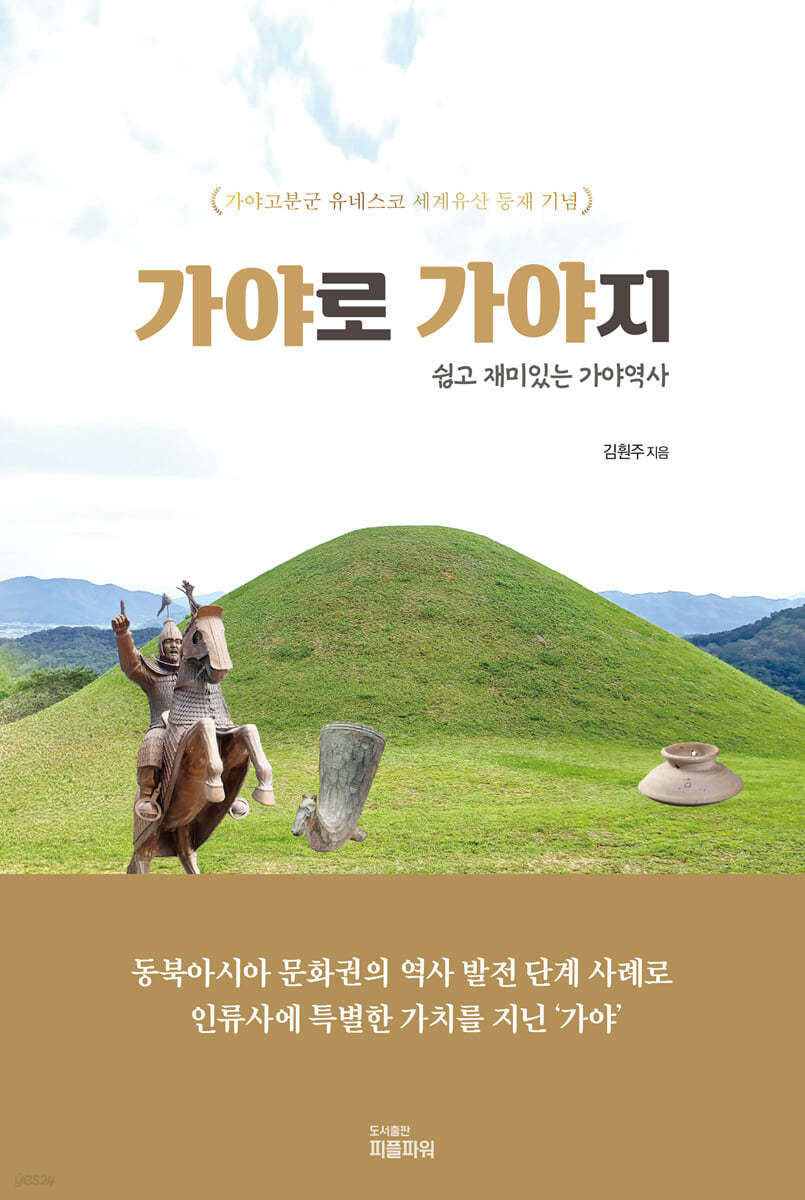
I have to go to Gaya
 |
Description
Book Introduction
Organized in easy-to-understand, popular language
The first complete Gaya history book
The Gaya Tombs were designated as a UNESCO World Heritage Site in September 2023.
During the evaluation process, it received favorable reviews, stating that it “exhibits well the unique autonomous and horizontal system of ‘Gaya’ while coexisting with neighboring countries, and is important evidence of the diversity of ancient East Asian civilizations,” thus achieving the long-awaited fruition.
It is also interesting to learn about Gaya's history through books.
But if you visit the site and use your imagination, the story of Gaya will come to life much more realistically.
It has been designed to be helpful as a guide when visiting a site.
We also included a simple wish that it would help promote Gaya and raise pride in its history.
The first complete Gaya history book
The Gaya Tombs were designated as a UNESCO World Heritage Site in September 2023.
During the evaluation process, it received favorable reviews, stating that it “exhibits well the unique autonomous and horizontal system of ‘Gaya’ while coexisting with neighboring countries, and is important evidence of the diversity of ancient East Asian civilizations,” thus achieving the long-awaited fruition.
It is also interesting to learn about Gaya's history through books.
But if you visit the site and use your imagination, the story of Gaya will come to life much more realistically.
It has been designed to be helpful as a guide when visiting a site.
We also included a simple wish that it would help promote Gaya and raise pride in its history.
- You can preview some of the book's contents.
Preview
index
preface
Part 1: What kind of country was Gaya?
Skim
Gaya is a rich man
There was a separate representative name
Where does Gaya's activities extend?
When did Gaya begin?
History of Gaya (Biography)
The Birth of the Iron Kingdom of Gaya
What was Gaya's currency?
The secret to the popularity of Gaya iron materials is
What is the meaning of the confrontation between Kim Su-ro and Seok Tal-hae?
A flower path that cannot be walked forever
A land of iron, rich in agricultural and marine products
Gaya, a relay base between China and Japan
Fall of Lelang and Daifang Commanderies to Goguryeo
Crisis becomes opportunity, opportunity becomes crisis
Garak Kingdom falls
History of Gaya (later)
The newly emerging Gaya
How did Daegaya replace Garak Kingdom?
Where were miniature farm tools used?
The rise and fall of Daegaya
How did the envoy of King Karawang Haji get to China?
Aragaya, always number two, was strong.
Hold an Arago Party meeting
The End of Gaya
Curious story
Why are the Gaya records so poor?
Where is the reward for the eight countries?
Why did the Eight Kingdoms of Bosang start a war?
A story told by the past to the present, Sunjang
There was a formula for burial
The extraordinary scale of Daegaya's burial
The beginning and the end of the burial
Which country had the strongest military force?
The introduction of horses to Japan and Daegaya
Is that a truck? An armored vehicle?
And give me some goldware too
Part 2: In Search of the Gaya Tombs
Gimhae-si, Gyeongsangnam-do
Daeseong-dong Ancient Tombs, as sacred as Gujibong
Make a tomb on top of a tomb
The mound has disappeared and only traces remain.
Dolmen, a Bronze Age tomb
The only Gaya-specialized National Gimhae Museum in the country
Bonghwang-dong ruins containing a garbage dump
The royal site that is paired with the Daeseong-dong Ancient Tombs
Yangdong-ri, on par with Daeseong-dong
Gimhae, a center of international exchange, is rich in ports.
Gaya roads were stronger than Joseon roads
Gujibong Peak, the most sacred peak in Garak Kingdom
What did the original appearance of King Suro's tomb and Queen Heo's tomb look like?
Why are the graves of a married couple separated?
Goryeong-gun, Gyeongsangbuk-do
Mountain fortresses, royal palaces, and ancient tombs
The height remains the same, but the diameter becomes smaller.
From shared to exclusive
From Silla to Baekje and back to Silla
First down, then up
What kind of food is there in the grave?
Tomb No. 73, the first royal tomb
Tomb No. 75, the first large stone tomb
The largest and most prominent Tomb No. 5
Tomb No. 30, famous for its unique burial ritual
Two couples side by side in tombs 32-35
Tomb No. 44, which has the largest number of burials
What is the reason for the empty coffin?
Is Tomb No. 45 the queen of Tomb No. 44?
Evidence of Buddhism's acceptance: the Goari Mural Tomb
The last royal tomb, Goa 2-ri Tomb
The founding myth contained in a drop of Daegaya soil
Renewing the founding myth to suit the new hierarchy
Namwon-si, Jeollabuk-do
Yugok-ri and Durak-ri tumuli
The first Gaya-style national historic site in the Jeolla region
Chinese bronze mirror and Baekje gilt-bronze shoes
There are also many other Gaya cultural relics
The reason for the active exchange was the abundant production of iron.
Tomb No. 36, full of twists and turns
Wolsan-ri Tombs, where Gaya in the Jeolla region was first confirmed
Chinese products unearthed intact
The first Daegaya-style tomb on the Unbong Plateau
Changed and unchanged forms
Jangsu County, Jeollabuk-do
The only Gaya power west of Baekdudaegan
The horse of Dongchon-ri Tomb Cluster
Tongs, hammers, and anvils from the Gaya tombs in Janggye Basin
More iron smelting sites than Unbong Plateau
The final destination of the beacon fire is Janggye Basin
How much autonomy does Gaya have in eastern Jeollabuk-do?
Hapcheon-gun, Gyeongsangnam-do
Immigrants become the masters of the Okjeon Tombs
What is the reason for the Silla and Baekje styles?
A field of beads scattered across the earth
The small but colorful Hapcheon Museum
A great place to live, Seongsan Toseong
The Jeonggyeonmoju enshrined in the National Temple of Haeinsa Temple
Did Prince Wolgwang walk around Wolgwangsa Temple?
The intertwined fates of three people: the Silla loyal subject Jukjukbi
Haman-gun, Gyeongsangnam-do
Excellent location selection, Malisan Ancient Tombs
An orderly grave is one that has been planned.
The Hidden Secret of the Giant Mound
Nammun outer tomb complex integrated with Malisan
It's obvious that it's Ara Gaya, Haman Museum
Ara Gaya's royal castle, Gayari ruins
Dangsan Relics, a large ancient building site
Is Seongsan Mountain Fortress from Gaya or Silla?
Changnyeong-gun, Gyeongsangnam-do
The Gyodong and Songhyeon-dong tumuli clusters, where two or three groups coexisted
The characteristic of having many features
While maintaining close ties with Silla, it also maintained its independence.
Another story of the Gyesong Tombs
The largest tomb in Gaya is here
The reincarnation of Song Hyeon-i, a girl who died innocent, at Changnyeong Museum
Changnyeong Dolmen, the Dawn of Gaya
Goseong-gun, Gyeongsangnam-do
A super-large tumulus complex in Songhak-dong?
Japan's misunderstandings revealed
Relics from various lineages pour out at once
Naesan-ri Tombs, the protagonists of maritime trade
Traces of the Sen Gaya People, Goseong Museum
Dongoe-dong shell mound and Solseom ruins
Manrimsan earthen fortress protecting the Songhak-dong Ancient Tombs
Other important relics
The Changwon Daho-ri Ancient Tombs, where lacquerware has been confirmed
Evidence of a literal life
Log cabins that remained intact even after 2000 years
How did you survive? Changwon Seongsan Shell Mound
The Jinju Okbong and Sujeongbong Tombs, destroyed by the Japanese
Why is Baekje here? Uiryeong Jungdong-ri Tombs
Gaya on the outside, Silla on the inside: Yangsan Bukjeong-ri Tombs
Why are you out there? Sancheong Jeon Guhyeong Royal Tomb
Sancheong Saengcho Tomb Cluster along the Namgang River
Unpyeong-ri Tombs that shattered the Imna-Japan theory
I also have to go to the west of the Seomjin River
Gaya Bokcheon-dong Ancient Tombs east of the Nakdong River
The Gaya Seongsan-dong Ancient Tombs of Samguk Yusa
The secret to maintaining power even under Silla rule
Gaya Relics Museum and Exhibition Hall
Part 1: What kind of country was Gaya?
Skim
Gaya is a rich man
There was a separate representative name
Where does Gaya's activities extend?
When did Gaya begin?
History of Gaya (Biography)
The Birth of the Iron Kingdom of Gaya
What was Gaya's currency?
The secret to the popularity of Gaya iron materials is
What is the meaning of the confrontation between Kim Su-ro and Seok Tal-hae?
A flower path that cannot be walked forever
A land of iron, rich in agricultural and marine products
Gaya, a relay base between China and Japan
Fall of Lelang and Daifang Commanderies to Goguryeo
Crisis becomes opportunity, opportunity becomes crisis
Garak Kingdom falls
History of Gaya (later)
The newly emerging Gaya
How did Daegaya replace Garak Kingdom?
Where were miniature farm tools used?
The rise and fall of Daegaya
How did the envoy of King Karawang Haji get to China?
Aragaya, always number two, was strong.
Hold an Arago Party meeting
The End of Gaya
Curious story
Why are the Gaya records so poor?
Where is the reward for the eight countries?
Why did the Eight Kingdoms of Bosang start a war?
A story told by the past to the present, Sunjang
There was a formula for burial
The extraordinary scale of Daegaya's burial
The beginning and the end of the burial
Which country had the strongest military force?
The introduction of horses to Japan and Daegaya
Is that a truck? An armored vehicle?
And give me some goldware too
Part 2: In Search of the Gaya Tombs
Gimhae-si, Gyeongsangnam-do
Daeseong-dong Ancient Tombs, as sacred as Gujibong
Make a tomb on top of a tomb
The mound has disappeared and only traces remain.
Dolmen, a Bronze Age tomb
The only Gaya-specialized National Gimhae Museum in the country
Bonghwang-dong ruins containing a garbage dump
The royal site that is paired with the Daeseong-dong Ancient Tombs
Yangdong-ri, on par with Daeseong-dong
Gimhae, a center of international exchange, is rich in ports.
Gaya roads were stronger than Joseon roads
Gujibong Peak, the most sacred peak in Garak Kingdom
What did the original appearance of King Suro's tomb and Queen Heo's tomb look like?
Why are the graves of a married couple separated?
Goryeong-gun, Gyeongsangbuk-do
Mountain fortresses, royal palaces, and ancient tombs
The height remains the same, but the diameter becomes smaller.
From shared to exclusive
From Silla to Baekje and back to Silla
First down, then up
What kind of food is there in the grave?
Tomb No. 73, the first royal tomb
Tomb No. 75, the first large stone tomb
The largest and most prominent Tomb No. 5
Tomb No. 30, famous for its unique burial ritual
Two couples side by side in tombs 32-35
Tomb No. 44, which has the largest number of burials
What is the reason for the empty coffin?
Is Tomb No. 45 the queen of Tomb No. 44?
Evidence of Buddhism's acceptance: the Goari Mural Tomb
The last royal tomb, Goa 2-ri Tomb
The founding myth contained in a drop of Daegaya soil
Renewing the founding myth to suit the new hierarchy
Namwon-si, Jeollabuk-do
Yugok-ri and Durak-ri tumuli
The first Gaya-style national historic site in the Jeolla region
Chinese bronze mirror and Baekje gilt-bronze shoes
There are also many other Gaya cultural relics
The reason for the active exchange was the abundant production of iron.
Tomb No. 36, full of twists and turns
Wolsan-ri Tombs, where Gaya in the Jeolla region was first confirmed
Chinese products unearthed intact
The first Daegaya-style tomb on the Unbong Plateau
Changed and unchanged forms
Jangsu County, Jeollabuk-do
The only Gaya power west of Baekdudaegan
The horse of Dongchon-ri Tomb Cluster
Tongs, hammers, and anvils from the Gaya tombs in Janggye Basin
More iron smelting sites than Unbong Plateau
The final destination of the beacon fire is Janggye Basin
How much autonomy does Gaya have in eastern Jeollabuk-do?
Hapcheon-gun, Gyeongsangnam-do
Immigrants become the masters of the Okjeon Tombs
What is the reason for the Silla and Baekje styles?
A field of beads scattered across the earth
The small but colorful Hapcheon Museum
A great place to live, Seongsan Toseong
The Jeonggyeonmoju enshrined in the National Temple of Haeinsa Temple
Did Prince Wolgwang walk around Wolgwangsa Temple?
The intertwined fates of three people: the Silla loyal subject Jukjukbi
Haman-gun, Gyeongsangnam-do
Excellent location selection, Malisan Ancient Tombs
An orderly grave is one that has been planned.
The Hidden Secret of the Giant Mound
Nammun outer tomb complex integrated with Malisan
It's obvious that it's Ara Gaya, Haman Museum
Ara Gaya's royal castle, Gayari ruins
Dangsan Relics, a large ancient building site
Is Seongsan Mountain Fortress from Gaya or Silla?
Changnyeong-gun, Gyeongsangnam-do
The Gyodong and Songhyeon-dong tumuli clusters, where two or three groups coexisted
The characteristic of having many features
While maintaining close ties with Silla, it also maintained its independence.
Another story of the Gyesong Tombs
The largest tomb in Gaya is here
The reincarnation of Song Hyeon-i, a girl who died innocent, at Changnyeong Museum
Changnyeong Dolmen, the Dawn of Gaya
Goseong-gun, Gyeongsangnam-do
A super-large tumulus complex in Songhak-dong?
Japan's misunderstandings revealed
Relics from various lineages pour out at once
Naesan-ri Tombs, the protagonists of maritime trade
Traces of the Sen Gaya People, Goseong Museum
Dongoe-dong shell mound and Solseom ruins
Manrimsan earthen fortress protecting the Songhak-dong Ancient Tombs
Other important relics
The Changwon Daho-ri Ancient Tombs, where lacquerware has been confirmed
Evidence of a literal life
Log cabins that remained intact even after 2000 years
How did you survive? Changwon Seongsan Shell Mound
The Jinju Okbong and Sujeongbong Tombs, destroyed by the Japanese
Why is Baekje here? Uiryeong Jungdong-ri Tombs
Gaya on the outside, Silla on the inside: Yangsan Bukjeong-ri Tombs
Why are you out there? Sancheong Jeon Guhyeong Royal Tomb
Sancheong Saengcho Tomb Cluster along the Namgang River
Unpyeong-ri Tombs that shattered the Imna-Japan theory
I also have to go to the west of the Seomjin River
Gaya Bokcheon-dong Ancient Tombs east of the Nakdong River
The Gaya Seongsan-dong Ancient Tombs of Samguk Yusa
The secret to maintaining power even under Silla rule
Gaya Relics Museum and Exhibition Hall
Into the book
The decline of Garak Kingdom in Gimhae, Gyeongnam can also be seen through the Daeseong-dong Ancient Tombs.
When we think of Gaya tombs, we think of tall and large burial mounds.
The raised mounds appeared in the early 5th century, and although they were initially not very large, from around the mid-5th century onwards, extremely large mounds with a base diameter of over 40 m began to appear.
However, this type of burial mound is not visible in the Daeseong-dong Ancient Tombs of Gimhae Garak Kingdom, which was the most advanced.
It is a cemetery that was built in the early 6th century, but it is just a low hill.
Because of this, people who visit this place sometimes wonder where the tomb is.
The reason is simple.
This is because the highest ruling class of Garak Kingdom at that time no longer had the capacity to build such a large and tall tomb.
This means that the wounds inflicted by the Goguryeo army's invasion in the past were that great and deep.
In the plain tombs of the Daeseong-dong Ancient Tombs, people today get a glimpse of the fleeting glory they once enjoyed.
--- p.38
One thing worth noting is the burial mound.
It refers to the custom of burying the living together during a funeral.
It can also be found in China and Japan, and on the Korean Peninsula, it has been confirmed in Gaya and Silla.
There are records of Buyeo burying people alive, but no actual cases have been confirmed. In Silla, there are records of burying five men and five women alive when the king died, and actual cases of burying people alive have been confirmed.
On the other hand, Gaya has the most cases confirmed through excavation, although there are no records of burials.
--- p.61
The artifacts excavated from the Daeseong-dong Ancient Tombs are diverse, including not only locally produced items but also those of Japanese, Northern, and Chinese origin.
This clearly demonstrates the active international exchange that took place through sea routes.
The various artifacts found in these tombs are of great help in understanding the flow of history.
Until the 3rd century, most agricultural and fishing tools were imported and the quantity was not large, but in the late 4th century, most were manufactured domestically and the quantity increased.
As maritime trade became difficult due to the disappearance of Nakrang and Daebang and international political instability, attention was turned to agriculture and fishing.
You can also see changes in the weapons, armor, helmets, and horse gear that have been unearthed.
Previously, the products were mainly imported from China and the Nakrang region, but as weapons, armor, helmets, and horse gear made locally in Gimhae took their place, the quantity also increased.
The fact that many pieces of iron combat equipment made with their own capabilities have been unearthed indicates that Garak was also a powerful nation militarily.
--- p.88~89
Tomb No. 73 of the Jisan-dong Ancient Tombs in Goryeong, Gyeongbuk Province, is a large tomb measuring 22 to 23 meters in diameter, located at the end of a ridge that flows south from the main mountain's main function line at the earliest point in the 5th century.
While large tombs from a similar period had their main space inside the tomb constructed entirely of stone, Tomb No. 73 is unique in that it is the only one to have used wood.
There are many large wooden Gaya tombs in the Daeseong-dong Ancient Tombs of Gaya, Gimhae.
The difference is that the mound in Daeseong-dong is low, while the mound in Jisan-dong No. 73 is high.
This is the successor to Daeseong-dong Tomb No. 1, which can be said to be the last tomb during the golden age of Gimhae Garak Kingdom.
This means that the tradition of the Daeseong-dong Ancient Tombs was inherited from Daegaya.
At the same time, it has the status of being the first tomb to announce the prosperity of Daegaya and the beginning of the Jisan-dong Tomb Cluster.
--- p.114
The most representative Gaya relics in Jeolla-do are the Yugok-ri and Durak-ri tumuli in Namwon, Jeollabuk-do.
There are two names for the neighborhood, but they are right next to each other.
It stretches along the ridge between two peaks, spanning Yugok-ri, Inwol-myeon in the east and Durak-ri, Ayang-myeon in the west.
So far, about 40 have been identified, but many more lie hidden in the grass, awaiting excavation.
The central period is from the mid-5th century to the early 6th century, and in terms of the Daegaya region, it is a group of high-level tombs comparable to the Okjeon Tomb Group of Daraguk in Hapcheon.
There are 14 large tombs with a diameter of over 20m, thirteen of which are under 30m, and one that is over 30m is located on a high ridge.
The rest are all under 20m, and some are small, with a diameter of around 8m.
However, when this site was designated as a Jeollabuk-do monument in 1973, most people guessed that it was of Baekje or Mahan origin.
However, in 1989, it was discovered to be of the Daegaya lineage through excavation, and later, during the process of promoting the registration of the Gaya Tombs as a UNESCO World Heritage Site, it was designated as a national historic site.
It's 2018.
It was the moment when the first national historic site was created in the Gaya ruins of the Jeolla region.
--- p.136~138
The Daegaya lineage tombs were confirmed not only on the Unbong Plateau in Namwon, Jeollabuk-do, but also on the Jinan Plateau in Jangsu County.
The number of medium-sized tombs of the Gaya lineage confirmed in the Dongchon-ri Tomb Cluster exceeds 240.
This is more than the 180 confirmed in Namwon.
In terms of time, it corresponds to the late 4th century to the mid-6th century.
What's interesting is that the Jinan Plateau is located west of the Baekdudaegan Mountain Range.
Namwon's Unbong Plateau is located to the east of Baekdudaegan, even though it is also in Jeollabuk-do.
Looking at Gyeongsang Province, where there were several Gaya states including Daegaya, it can be said that this was the only region where Gaya forces migrated and advanced beyond the Baekdudaegan Mountains.
Perhaps for this reason, the Gaya tombs in this region are distinct from those on the Unbong Plateau in Namwon.
Although some of the excavated artifacts have distinct Daegaya colors or were manufactured locally, the presence of Baekje pottery is unique.
On the other hand, not many relics from other Gaya groups were found, which means that there was little or no exchange or negotiation with them.
--- p.152
The Okjeon Ancient Tombs in Hapcheon, Gyeongnam Province, are a burial site built around the ruling class that ruled Daraguk, and the royal tombs were built in the early 5th century to early 6th century.
The first tombs date back much earlier, around the 1st century BC.
The scale and artifacts were insignificant.
The first tombs showing the formation of power and the differentiation of classes appear in the late 4th century.
Even then, it was not clearly distinguishable, and it was a tomb that was slightly superior within the same group.
By the early 5th century, tombs that were clearly distinct from those of the previous period began to appear.
The internal structure and scale of the tomb, as well as the content of the relics, are clearly different from before.
Horse-riding artifacts and splendid ornaments, including practical and decorative horse gear, gilt-bronze crafts such as gilt-bronze hats and gold earrings, begin to be unearthed.
These relics were not seen in earlier periods.
It was completely different in character from the civilization of those who lived in that area until the 4th century.
It was in the early 5th century, right after King Gwanggaeto of Goguryeo attacked Garak Kingdom.
At that time, the southern part of the Korean Peninsula had to go through extreme political changes.
Meanwhile, immigrants who had lived in other regions came here and established Daraguk.
--- p.163
The Gayari ruins in Haman, Gyeongnam are the site where the royal palace of Ara Gaya was discovered.
The remains of what is believed to be the royal palace of Ara Gaya, which had only been passed down through writing or word of mouth, have appeared on top of a low mountain, surrounded by an earthen wall.
The earthen wall of the Gayari site in Haman remains almost completely intact, unlike the earthen wall of the Bonghwang-dong site in Gimhae or the Seongsan earthen wall of the Okjeon Tombs in Hapcheon.
It is said to be 8.5 meters high at its highest and 20 to 40 meters wide, making it unparalleled in comparison to other Gaya regions from the same period.
The bottom is covered with bedrock, and traces of holes where wooden pillars were driven in were found here and there.
These are the remains of a row of log fences, a watchtower that looked out into the distance, or a tall building with a high deck.
--- p.188~189
The Gyodong and Songhyeon-dong ancient tomb clusters in Changnyeong, Gyeongsangnam-do, were intensively built from the mid-5th century, just before the golden age of Bihwa Gaya, to the 7th century, after its fall.
Over the past 200 years, over 1,000 tombs, ranging from very large to medium-sized, were built.
If there were 1,000 mounds over 200 years, that would mean 5 mounds were built each year. Considering the technological capabilities of the time, isn't that an enormous number?
The Gyo-dong and Song-hyeon-dong tumuli groups are divided into four groups: Gyo-dong 1 and 2 groups and Song-hyeon-dong 3 and 4 groups.
Gyo-dong is adjacent to the 1st and 2nd districts, but Song-hyeon-dong is separated from the 3rd and 4th districts.
The first to be built was Gyodong 2-gun in the mid-to-late 5th century, while Gyodong 1-gun and Songhyeon-dong 3-4-gun were built simultaneously from the early 6th century.
It shows the possibility that two or three groups with similar powers coexisted and coexisted in Gyo-dong and Song-hyeon-dong, a characteristic not seen in other Gaya tomb groups.
However, it is no different in that the center is centered around a large royal tomb.
Next, large and medium-sized tombs surround the royal tomb like satellites, and several small and medium-sized tombs are built around them.
--- p.196~198
Many people considered the Gaya power in Goseong, Gyeongnam to be Sogaya (small Gaya) as opposed to Daegaya (big Gaya).
The name Sogaya might be thought to have a vague meaning, such as narrow land or weak power.
But it doesn't matter at all.
Goseong was a powerful nation that grew based on maritime trade.
The main item of trade was iron.
In the past, people wrote place names in Chinese characters, sometimes bringing in meanings and sometimes bringing in sounds.
If the meaning of 'small' was taken from So (小) Gaya, it would be an image of lowering oneself to be called Little Gaya, and if the sound of So = cow was taken, it would become Gaya of cow, revealing the fundamental nature of the country.
So which one is closer to the truth?
When we think of Gaya tombs, we think of tall and large burial mounds.
The raised mounds appeared in the early 5th century, and although they were initially not very large, from around the mid-5th century onwards, extremely large mounds with a base diameter of over 40 m began to appear.
However, this type of burial mound is not visible in the Daeseong-dong Ancient Tombs of Gimhae Garak Kingdom, which was the most advanced.
It is a cemetery that was built in the early 6th century, but it is just a low hill.
Because of this, people who visit this place sometimes wonder where the tomb is.
The reason is simple.
This is because the highest ruling class of Garak Kingdom at that time no longer had the capacity to build such a large and tall tomb.
This means that the wounds inflicted by the Goguryeo army's invasion in the past were that great and deep.
In the plain tombs of the Daeseong-dong Ancient Tombs, people today get a glimpse of the fleeting glory they once enjoyed.
--- p.38
One thing worth noting is the burial mound.
It refers to the custom of burying the living together during a funeral.
It can also be found in China and Japan, and on the Korean Peninsula, it has been confirmed in Gaya and Silla.
There are records of Buyeo burying people alive, but no actual cases have been confirmed. In Silla, there are records of burying five men and five women alive when the king died, and actual cases of burying people alive have been confirmed.
On the other hand, Gaya has the most cases confirmed through excavation, although there are no records of burials.
--- p.61
The artifacts excavated from the Daeseong-dong Ancient Tombs are diverse, including not only locally produced items but also those of Japanese, Northern, and Chinese origin.
This clearly demonstrates the active international exchange that took place through sea routes.
The various artifacts found in these tombs are of great help in understanding the flow of history.
Until the 3rd century, most agricultural and fishing tools were imported and the quantity was not large, but in the late 4th century, most were manufactured domestically and the quantity increased.
As maritime trade became difficult due to the disappearance of Nakrang and Daebang and international political instability, attention was turned to agriculture and fishing.
You can also see changes in the weapons, armor, helmets, and horse gear that have been unearthed.
Previously, the products were mainly imported from China and the Nakrang region, but as weapons, armor, helmets, and horse gear made locally in Gimhae took their place, the quantity also increased.
The fact that many pieces of iron combat equipment made with their own capabilities have been unearthed indicates that Garak was also a powerful nation militarily.
--- p.88~89
Tomb No. 73 of the Jisan-dong Ancient Tombs in Goryeong, Gyeongbuk Province, is a large tomb measuring 22 to 23 meters in diameter, located at the end of a ridge that flows south from the main mountain's main function line at the earliest point in the 5th century.
While large tombs from a similar period had their main space inside the tomb constructed entirely of stone, Tomb No. 73 is unique in that it is the only one to have used wood.
There are many large wooden Gaya tombs in the Daeseong-dong Ancient Tombs of Gaya, Gimhae.
The difference is that the mound in Daeseong-dong is low, while the mound in Jisan-dong No. 73 is high.
This is the successor to Daeseong-dong Tomb No. 1, which can be said to be the last tomb during the golden age of Gimhae Garak Kingdom.
This means that the tradition of the Daeseong-dong Ancient Tombs was inherited from Daegaya.
At the same time, it has the status of being the first tomb to announce the prosperity of Daegaya and the beginning of the Jisan-dong Tomb Cluster.
--- p.114
The most representative Gaya relics in Jeolla-do are the Yugok-ri and Durak-ri tumuli in Namwon, Jeollabuk-do.
There are two names for the neighborhood, but they are right next to each other.
It stretches along the ridge between two peaks, spanning Yugok-ri, Inwol-myeon in the east and Durak-ri, Ayang-myeon in the west.
So far, about 40 have been identified, but many more lie hidden in the grass, awaiting excavation.
The central period is from the mid-5th century to the early 6th century, and in terms of the Daegaya region, it is a group of high-level tombs comparable to the Okjeon Tomb Group of Daraguk in Hapcheon.
There are 14 large tombs with a diameter of over 20m, thirteen of which are under 30m, and one that is over 30m is located on a high ridge.
The rest are all under 20m, and some are small, with a diameter of around 8m.
However, when this site was designated as a Jeollabuk-do monument in 1973, most people guessed that it was of Baekje or Mahan origin.
However, in 1989, it was discovered to be of the Daegaya lineage through excavation, and later, during the process of promoting the registration of the Gaya Tombs as a UNESCO World Heritage Site, it was designated as a national historic site.
It's 2018.
It was the moment when the first national historic site was created in the Gaya ruins of the Jeolla region.
--- p.136~138
The Daegaya lineage tombs were confirmed not only on the Unbong Plateau in Namwon, Jeollabuk-do, but also on the Jinan Plateau in Jangsu County.
The number of medium-sized tombs of the Gaya lineage confirmed in the Dongchon-ri Tomb Cluster exceeds 240.
This is more than the 180 confirmed in Namwon.
In terms of time, it corresponds to the late 4th century to the mid-6th century.
What's interesting is that the Jinan Plateau is located west of the Baekdudaegan Mountain Range.
Namwon's Unbong Plateau is located to the east of Baekdudaegan, even though it is also in Jeollabuk-do.
Looking at Gyeongsang Province, where there were several Gaya states including Daegaya, it can be said that this was the only region where Gaya forces migrated and advanced beyond the Baekdudaegan Mountains.
Perhaps for this reason, the Gaya tombs in this region are distinct from those on the Unbong Plateau in Namwon.
Although some of the excavated artifacts have distinct Daegaya colors or were manufactured locally, the presence of Baekje pottery is unique.
On the other hand, not many relics from other Gaya groups were found, which means that there was little or no exchange or negotiation with them.
--- p.152
The Okjeon Ancient Tombs in Hapcheon, Gyeongnam Province, are a burial site built around the ruling class that ruled Daraguk, and the royal tombs were built in the early 5th century to early 6th century.
The first tombs date back much earlier, around the 1st century BC.
The scale and artifacts were insignificant.
The first tombs showing the formation of power and the differentiation of classes appear in the late 4th century.
Even then, it was not clearly distinguishable, and it was a tomb that was slightly superior within the same group.
By the early 5th century, tombs that were clearly distinct from those of the previous period began to appear.
The internal structure and scale of the tomb, as well as the content of the relics, are clearly different from before.
Horse-riding artifacts and splendid ornaments, including practical and decorative horse gear, gilt-bronze crafts such as gilt-bronze hats and gold earrings, begin to be unearthed.
These relics were not seen in earlier periods.
It was completely different in character from the civilization of those who lived in that area until the 4th century.
It was in the early 5th century, right after King Gwanggaeto of Goguryeo attacked Garak Kingdom.
At that time, the southern part of the Korean Peninsula had to go through extreme political changes.
Meanwhile, immigrants who had lived in other regions came here and established Daraguk.
--- p.163
The Gayari ruins in Haman, Gyeongnam are the site where the royal palace of Ara Gaya was discovered.
The remains of what is believed to be the royal palace of Ara Gaya, which had only been passed down through writing or word of mouth, have appeared on top of a low mountain, surrounded by an earthen wall.
The earthen wall of the Gayari site in Haman remains almost completely intact, unlike the earthen wall of the Bonghwang-dong site in Gimhae or the Seongsan earthen wall of the Okjeon Tombs in Hapcheon.
It is said to be 8.5 meters high at its highest and 20 to 40 meters wide, making it unparalleled in comparison to other Gaya regions from the same period.
The bottom is covered with bedrock, and traces of holes where wooden pillars were driven in were found here and there.
These are the remains of a row of log fences, a watchtower that looked out into the distance, or a tall building with a high deck.
--- p.188~189
The Gyodong and Songhyeon-dong ancient tomb clusters in Changnyeong, Gyeongsangnam-do, were intensively built from the mid-5th century, just before the golden age of Bihwa Gaya, to the 7th century, after its fall.
Over the past 200 years, over 1,000 tombs, ranging from very large to medium-sized, were built.
If there were 1,000 mounds over 200 years, that would mean 5 mounds were built each year. Considering the technological capabilities of the time, isn't that an enormous number?
The Gyo-dong and Song-hyeon-dong tumuli groups are divided into four groups: Gyo-dong 1 and 2 groups and Song-hyeon-dong 3 and 4 groups.
Gyo-dong is adjacent to the 1st and 2nd districts, but Song-hyeon-dong is separated from the 3rd and 4th districts.
The first to be built was Gyodong 2-gun in the mid-to-late 5th century, while Gyodong 1-gun and Songhyeon-dong 3-4-gun were built simultaneously from the early 6th century.
It shows the possibility that two or three groups with similar powers coexisted and coexisted in Gyo-dong and Song-hyeon-dong, a characteristic not seen in other Gaya tomb groups.
However, it is no different in that the center is centered around a large royal tomb.
Next, large and medium-sized tombs surround the royal tomb like satellites, and several small and medium-sized tombs are built around them.
--- p.196~198
Many people considered the Gaya power in Goseong, Gyeongnam to be Sogaya (small Gaya) as opposed to Daegaya (big Gaya).
The name Sogaya might be thought to have a vague meaning, such as narrow land or weak power.
But it doesn't matter at all.
Goseong was a powerful nation that grew based on maritime trade.
The main item of trade was iron.
In the past, people wrote place names in Chinese characters, sometimes bringing in meanings and sometimes bringing in sounds.
If the meaning of 'small' was taken from So (小) Gaya, it would be an image of lowering oneself to be called Little Gaya, and if the sound of So = cow was taken, it would become Gaya of cow, revealing the fundamental nature of the country.
So which one is closer to the truth?
--- p.215
Publisher's Review
Commemorating the registration of the Gaya Tombs as a UNESCO World Heritage Site
The Gaya Tombs are evidence of the Gaya civilization that maintained a unique political system called the Gaya Federation while cooperating with the surrounding centralized ancient states.
The registration of the Gaya Tombs as a UNESCO World Heritage Site is evidence of the existence of the Gaya civilization and a heritage site that shows the stages in which various countries in the Northeast Asian cultural sphere developed into ancient states.
As the truth has been revealed through recent active excavations, the perception of Gaya has improved significantly compared to before.
However, there is still a limitation that it remains at a fragmentary level.
To address these issues, I felt the need for a comprehensive introductory book that would provide a clear overview of Gaya's 600-year history.
I thought it would be more helpful if you could go one step further and provide specific details about various facts.
There are many interesting stories, such as the background that allowed for the construction of large and tall mounds in each region, the appearance of the main characters who ruled and commanded the community, and the relationship and exchanges they had with various countries.
Above all, I tried to write it in a way that was easy for the public to understand.
I wanted to break away from the Gaya history that was difficult to read unless you were an expert or a scholar.
Of course, there are clear shortcomings.
Because I worked with a sense of duty 6 and curiosity 4 as a history enthusiast, not an expert.
On the other hand, I think there are also advantages to being able to approach Gaya more comfortably.
The Gaya Tombs are evidence of the Gaya civilization that maintained a unique political system called the Gaya Federation while cooperating with the surrounding centralized ancient states.
The registration of the Gaya Tombs as a UNESCO World Heritage Site is evidence of the existence of the Gaya civilization and a heritage site that shows the stages in which various countries in the Northeast Asian cultural sphere developed into ancient states.
As the truth has been revealed through recent active excavations, the perception of Gaya has improved significantly compared to before.
However, there is still a limitation that it remains at a fragmentary level.
To address these issues, I felt the need for a comprehensive introductory book that would provide a clear overview of Gaya's 600-year history.
I thought it would be more helpful if you could go one step further and provide specific details about various facts.
There are many interesting stories, such as the background that allowed for the construction of large and tall mounds in each region, the appearance of the main characters who ruled and commanded the community, and the relationship and exchanges they had with various countries.
Above all, I tried to write it in a way that was easy for the public to understand.
I wanted to break away from the Gaya history that was difficult to read unless you were an expert or a scholar.
Of course, there are clear shortcomings.
Because I worked with a sense of duty 6 and curiosity 4 as a history enthusiast, not an expert.
On the other hand, I think there are also advantages to being able to approach Gaya more comfortably.
GOODS SPECIFICS
- Date of issue: September 25, 2023
- Format: Paperback book binding method guide
- Page count, weight, size: 248 pages | 152*225*20mm
- ISBN13: 9791186351604
- ISBN10: 1186351608
You may also like
카테고리
korean


korean

![GQ KOREA Mark (Monthly): December [2025]](http://librairie.coreenne.fr/cdn/shop/files/8ef265dbbfbf186523ed75ba7319009d.jpg?v=1765340328&width=3840)


