

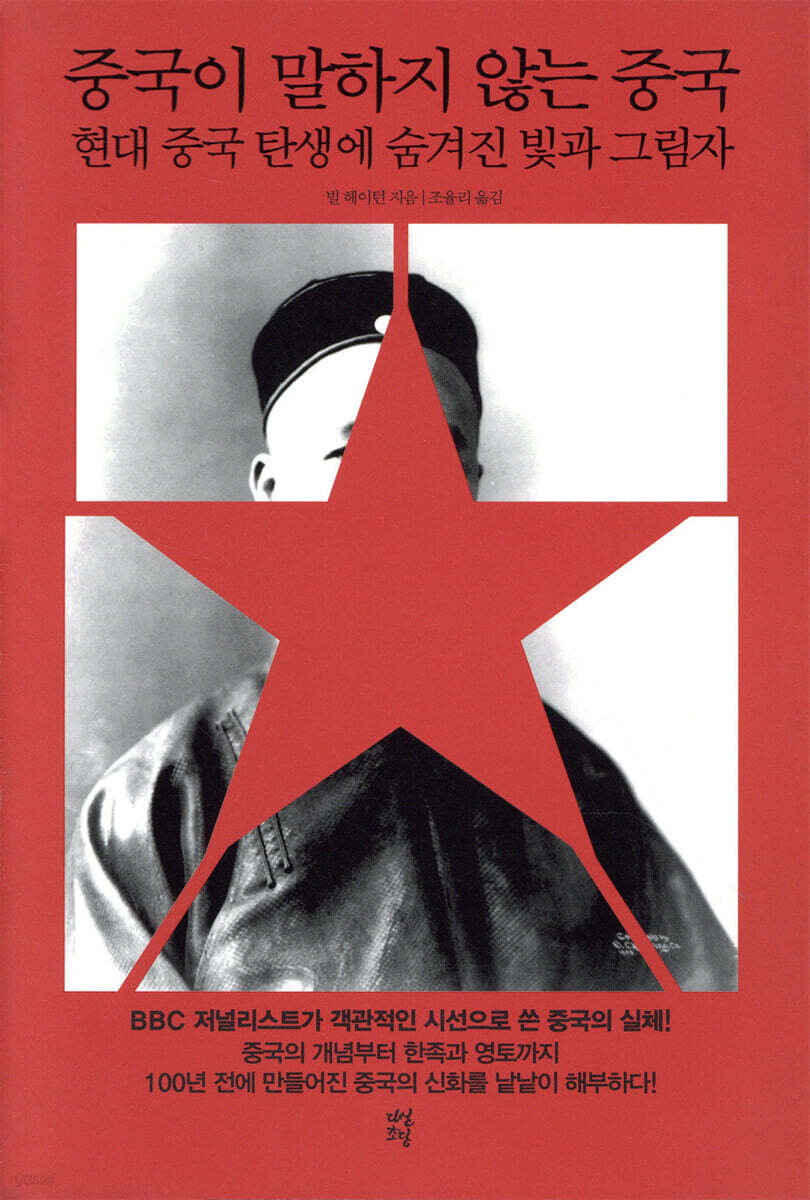
The China that China Doesn't Talk About
 |
Description
Book Introduction
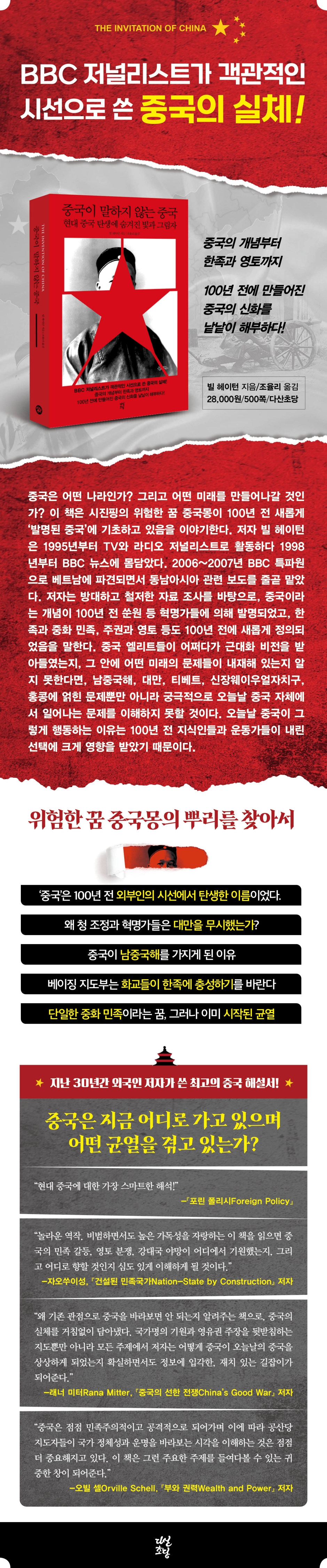
“The reality of China, written objectively by a BBC journalist!”
From the concept of China to the Han people and territory
A detailed dissection of a Chinese myth created 100 years ago!
Dangerous Dream: In Search of the Roots of the Chinese Dream
What kind of country is China? And what kind of future will it create? This book argues that Xi Jinping's dangerous dream, the Chinese Dream, is based on a "China" that was newly invented 100 years ago.
Author Bill Hayton has been a TV and radio journalist since 1995 and has been with BBC News since 1998.
From 2006 to 2007, he was dispatched to Vietnam as a BBC correspondent, where he was responsible for reporting on Southeast Asia.
Based on extensive and thorough research, the author argues that the concept of China was invented 100 years ago by revolutionaries such as Sun Yat-sen, and that the Han Chinese, the Chinese nation, sovereignty, and territory were also redefined 100 years ago.
This Chinese nationalism is now transforming into chauvinism and hegemonism.
The book begins with the concept of "China" and examines how the Chinese elite came to adopt unfamiliar ideas.
It shows how Chinese intellectuals borrowed key concepts from abroad and adapted them to create the myth of a nation and people with a 5,000-year history.
Unless we understand how China's elites came to embrace this vision of modernization and what future problems it entails, we will fail to understand the problems entangled in the South China Sea, Taiwan, Tibet, Xinjiang Uyghur Autonomous Region, and Hong Kong, as well as ultimately the problems facing China itself today.
The reason China acts the way it does today is because it was influenced by choices made by intellectuals and activists a century ago.
From the concept of China to the Han people and territory
A detailed dissection of a Chinese myth created 100 years ago!
Dangerous Dream: In Search of the Roots of the Chinese Dream
What kind of country is China? And what kind of future will it create? This book argues that Xi Jinping's dangerous dream, the Chinese Dream, is based on a "China" that was newly invented 100 years ago.
Author Bill Hayton has been a TV and radio journalist since 1995 and has been with BBC News since 1998.
From 2006 to 2007, he was dispatched to Vietnam as a BBC correspondent, where he was responsible for reporting on Southeast Asia.
Based on extensive and thorough research, the author argues that the concept of China was invented 100 years ago by revolutionaries such as Sun Yat-sen, and that the Han Chinese, the Chinese nation, sovereignty, and territory were also redefined 100 years ago.
This Chinese nationalism is now transforming into chauvinism and hegemonism.
The book begins with the concept of "China" and examines how the Chinese elite came to adopt unfamiliar ideas.
It shows how Chinese intellectuals borrowed key concepts from abroad and adapted them to create the myth of a nation and people with a 5,000-year history.
Unless we understand how China's elites came to embrace this vision of modernization and what future problems it entails, we will fail to understand the problems entangled in the South China Sea, Taiwan, Tibet, Xinjiang Uyghur Autonomous Region, and Hong Kong, as well as ultimately the problems facing China itself today.
The reason China acts the way it does today is because it was influenced by choices made by intellectuals and activists a century ago.
- You can preview some of the book's contents.
Preview
index
Acknowledgements
introduction
Chapter 1: A Name Born from the Perspective of Outsiders, China
Chapter 2: How was Chinese sovereignty invented?
Chapter 3: The Myth of the Descendants of Emperor Xianyuan, the Han Chinese
Chapter 4: Cutting and Pasting History to Create New History
Chapter 5: The Dream of a Unified Chinese Nation and Its Cracks
Chapter 6: One Language for Nationalists
Chapter 7: Why Did the Qing Court and Revolutionaries Ignore Taiwan?
Chapter 8: Why China Owns the South China Sea
Conclusion - The Chinese Dream
Characters
Americas
Recommended literature
introduction
Chapter 1: A Name Born from the Perspective of Outsiders, China
Chapter 2: How was Chinese sovereignty invented?
Chapter 3: The Myth of the Descendants of Emperor Xianyuan, the Han Chinese
Chapter 4: Cutting and Pasting History to Create New History
Chapter 5: The Dream of a Unified Chinese Nation and Its Cracks
Chapter 6: One Language for Nationalists
Chapter 7: Why Did the Qing Court and Revolutionaries Ignore Taiwan?
Chapter 8: Why China Owns the South China Sea
Conclusion - The Chinese Dream
Characters
Americas
Recommended literature
Detailed image
Into the book
Although this book deals with 'Chinese inventions,' it does not aim to criticize China specifically.
All modern nations have gone through a process of 'invention', selecting, remembering, and forgetting aspects of the past in order to present a seemingly consistent and unified vision of the future.
I am writing this in the UK, where the Brexit issue is raging.
Every day we see politicians and commentators selectively remembering or forgetting aspects of Britain's relationship with continental Europe or the island of Ireland, or aspects of the union between England and Scotland, in order to establish a 'legitimate' basis for their political system.
As suppressed issues surrounding sovereignty, identity, and integration erupt, they become a new source of emotion and conflict.
Thousands of kilometers away, Hong Kong is engulfed in flames, and at least a million ethnic Turkic Hui people are imprisoned in "re-education camps."
The context and outcome are very different, but the causes are similar.
This is because there is a contradiction between sovereignty, identity, and integration created by the nation-state.
---From "Preface, pp. 14-15"
But Xi Jinping's perspective on China, projected onto these events, is a political fabrication.
In this chapter, I will show that the way we view China is largely based on European images of China, rather than on ideas of Chinese origin.
As the name suggests, the 'Silk Road' originally originated in Europe and brings imaginary order to a very complex and chaotic history.
In short, the very name 'China' was adopted by Westerners and returned to East Asia, where it was given a new meaning.
Over the centuries, Europeans gleaned information from the writings of explorers and missionaries who sent it back home, creating a vision of the place they called "China."
Subsequent writers and Orientalists expanded this vision.
In the minds of Europeans, 'China' was established as an ancient and independent nation occupying a certain part of the East Asian continent, a nation that had existed continuously since the past.
In fact, at that time, the country called ‘China’ did not exist.
From 1644 to 1912, 'China' was effectively a colony of an empire in Inner Asia, the Qing Dynasty.
The Qing was a multi-ethnic dynasty, and 'mainland China'—the 15 provinces of the defeated Ming Dynasty—was merely one part of the Qing.
The Ming Dynasty, which preceded the Qing Dynasty, lasted for about 300 years, but it did not use the name China.
Before the Ming Dynasty, this territory was part of the great Mongol empire that stretched to the Mediterranean Sea.
East Asia was only a part of the territory of the great Mongol Empire.
---From "Chapter 1: A Name Born from the Perspective of an Outsider, China, pp. 25-26"
Van Braam took the opportunity to plan his own mission.
He knew that 1795 was the 60th anniversary of the Qianlong Emperor's ascension to the throne.
Using his connections in Guangzhou, Ban Braam was invited to the ceremony.
So one winter day, they set off on a 2,000-kilometer journey with their delegation, carriage, and palanquin.
It took a whopping 47 days to arrive in Beijing.
Ban Braam arrived in time for the Lunar New Year (Chinese Lunar New Year - translator's note).
Unlike in England, the gifts were not properly wrapped, and, in Van Braam's words, "nothing was holy." But, unlike in England, the Emperor was prepared to show as much courtesy as he wanted.
In fact, they went one step further.
It is an international fraud.
This anecdote has been examined by historian Richard Smith, who describes how Van Braam showed the Qianlong Emperor a letter from the Dutch king that was incredibly flattering.
'(We foreigners) have changed under the influence of Chinese civilization.' The text reads smoothly.
'Throughout history, there has never been a monarch with such a noble reputation as the Qianlong Emperor, O noble Emperor.' In response, the Qianlong Emperor said, 'I hope to strengthen the bonds of loyalty and sincerity, and to preserve the soundness of the kingdom.
He sent a gift with the message, 'Your Majesty, you will have my eternal respect.'
The only problem with this diplomatic exchange was that the Dutch king did not actually exist.
In 1795, the Netherlands was a republic.
But Ban Braam felt that modern systems of government would not impress the king.
So the Qing Dynasty invented a monarch who could pay the tribute they wanted.
---From “Chapter 2: How Was China’s Sovereignty Invented?”, pp. 79-80
Another major historical myth created by Liang Qichao to support his claims about the power of fairy tales has survived to this day.
In order to show that Han Chinese culture would be dominant in the future, the Manchus were dealt with in advance by saying, 'They have been completely assimilated into China.'
This expression is clearly incorrect, given that the areas in the city where Manchus and Han Chinese lived were still divided into areas where Han Chinese lived.
The ban on intermarriage between Manchus and Han Chinese was not lifted until 1902, and the two peoples largely lived separately.
Nevertheless, Liang Qichao persisted in political expediency.
He also projected his argument further back in time to argue that not only the Manchus (1644–1912) but also the peoples who had previously invaded China—the Tuoba clans (386–535), the Khitan (907–1125), and the Jurchen Jin Dynasty (1115–1234)—had converted to a superior culture.
But the Mongols (1279–1368) failed to change.
Ironically, Liang Qichao's list makes it clear that from 386 AD until mid-1903, when Liang's text was published, more than half of mainland China was ruled by northern 'barbarians'.
During this period, China was effectively a colony within an empire, ruled by non-Han Chinese.
However, Liang Qichao's nationalistic interpretation of the longue durée (a concept first used by the French historian Fernand Braudel, a perspective that extends history beyond human memory or archaeological records to include the realm before that - translator's note) actually meant reverse colonization.
All foreign rulers were intimidated by the superior Han culture and became part of the Chinese nation.
The essence of China has survived unchanged for thousands of years.
---From "Chapter 4: Cutting and Pasting History to Create New History, pp. 204-205"
As orthodox communist ideology retreated after the Tiananmen Square massacre, the word "nation" began to appear frequently in Communist Party manifestos alongside the more traditional term "people."
If 'people' refers only to socialists, then 'nation', according to the Communist Party's definition, can include people of all class backgrounds.
Since President Xi Jinping came to power in late 2012, the Communist Party has consistently emphasized ethnic unity.
The more the People's Republic of China imposes its own historical perspective, the less space there is for alternative historical perspectives.
One result is that life becomes more difficult for minorities and all types of people who oppose the system.
They are seen as a threat to the narrative and an obstacle to modernization, and are treated accordingly.
What should we call this new political ideology—one centered around a single, "core" leader, one that insists on national identity, one that tolerates no differences, one governed by political parties rather than laws, one that employs corporatist economic policies, and one based on ethnic chauvinism—all underpinned by mass state surveillance? The Chinese Communist Party has long talked about building "socialism with Chinese characteristics."
Xi Jinping now appears more interested in building “national socialism with Chinese characteristics.”
All modern nations have gone through a process of 'invention', selecting, remembering, and forgetting aspects of the past in order to present a seemingly consistent and unified vision of the future.
I am writing this in the UK, where the Brexit issue is raging.
Every day we see politicians and commentators selectively remembering or forgetting aspects of Britain's relationship with continental Europe or the island of Ireland, or aspects of the union between England and Scotland, in order to establish a 'legitimate' basis for their political system.
As suppressed issues surrounding sovereignty, identity, and integration erupt, they become a new source of emotion and conflict.
Thousands of kilometers away, Hong Kong is engulfed in flames, and at least a million ethnic Turkic Hui people are imprisoned in "re-education camps."
The context and outcome are very different, but the causes are similar.
This is because there is a contradiction between sovereignty, identity, and integration created by the nation-state.
---From "Preface, pp. 14-15"
But Xi Jinping's perspective on China, projected onto these events, is a political fabrication.
In this chapter, I will show that the way we view China is largely based on European images of China, rather than on ideas of Chinese origin.
As the name suggests, the 'Silk Road' originally originated in Europe and brings imaginary order to a very complex and chaotic history.
In short, the very name 'China' was adopted by Westerners and returned to East Asia, where it was given a new meaning.
Over the centuries, Europeans gleaned information from the writings of explorers and missionaries who sent it back home, creating a vision of the place they called "China."
Subsequent writers and Orientalists expanded this vision.
In the minds of Europeans, 'China' was established as an ancient and independent nation occupying a certain part of the East Asian continent, a nation that had existed continuously since the past.
In fact, at that time, the country called ‘China’ did not exist.
From 1644 to 1912, 'China' was effectively a colony of an empire in Inner Asia, the Qing Dynasty.
The Qing was a multi-ethnic dynasty, and 'mainland China'—the 15 provinces of the defeated Ming Dynasty—was merely one part of the Qing.
The Ming Dynasty, which preceded the Qing Dynasty, lasted for about 300 years, but it did not use the name China.
Before the Ming Dynasty, this territory was part of the great Mongol empire that stretched to the Mediterranean Sea.
East Asia was only a part of the territory of the great Mongol Empire.
---From "Chapter 1: A Name Born from the Perspective of an Outsider, China, pp. 25-26"
Van Braam took the opportunity to plan his own mission.
He knew that 1795 was the 60th anniversary of the Qianlong Emperor's ascension to the throne.
Using his connections in Guangzhou, Ban Braam was invited to the ceremony.
So one winter day, they set off on a 2,000-kilometer journey with their delegation, carriage, and palanquin.
It took a whopping 47 days to arrive in Beijing.
Ban Braam arrived in time for the Lunar New Year (Chinese Lunar New Year - translator's note).
Unlike in England, the gifts were not properly wrapped, and, in Van Braam's words, "nothing was holy." But, unlike in England, the Emperor was prepared to show as much courtesy as he wanted.
In fact, they went one step further.
It is an international fraud.
This anecdote has been examined by historian Richard Smith, who describes how Van Braam showed the Qianlong Emperor a letter from the Dutch king that was incredibly flattering.
'(We foreigners) have changed under the influence of Chinese civilization.' The text reads smoothly.
'Throughout history, there has never been a monarch with such a noble reputation as the Qianlong Emperor, O noble Emperor.' In response, the Qianlong Emperor said, 'I hope to strengthen the bonds of loyalty and sincerity, and to preserve the soundness of the kingdom.
He sent a gift with the message, 'Your Majesty, you will have my eternal respect.'
The only problem with this diplomatic exchange was that the Dutch king did not actually exist.
In 1795, the Netherlands was a republic.
But Ban Braam felt that modern systems of government would not impress the king.
So the Qing Dynasty invented a monarch who could pay the tribute they wanted.
---From “Chapter 2: How Was China’s Sovereignty Invented?”, pp. 79-80
Another major historical myth created by Liang Qichao to support his claims about the power of fairy tales has survived to this day.
In order to show that Han Chinese culture would be dominant in the future, the Manchus were dealt with in advance by saying, 'They have been completely assimilated into China.'
This expression is clearly incorrect, given that the areas in the city where Manchus and Han Chinese lived were still divided into areas where Han Chinese lived.
The ban on intermarriage between Manchus and Han Chinese was not lifted until 1902, and the two peoples largely lived separately.
Nevertheless, Liang Qichao persisted in political expediency.
He also projected his argument further back in time to argue that not only the Manchus (1644–1912) but also the peoples who had previously invaded China—the Tuoba clans (386–535), the Khitan (907–1125), and the Jurchen Jin Dynasty (1115–1234)—had converted to a superior culture.
But the Mongols (1279–1368) failed to change.
Ironically, Liang Qichao's list makes it clear that from 386 AD until mid-1903, when Liang's text was published, more than half of mainland China was ruled by northern 'barbarians'.
During this period, China was effectively a colony within an empire, ruled by non-Han Chinese.
However, Liang Qichao's nationalistic interpretation of the longue durée (a concept first used by the French historian Fernand Braudel, a perspective that extends history beyond human memory or archaeological records to include the realm before that - translator's note) actually meant reverse colonization.
All foreign rulers were intimidated by the superior Han culture and became part of the Chinese nation.
The essence of China has survived unchanged for thousands of years.
---From "Chapter 4: Cutting and Pasting History to Create New History, pp. 204-205"
As orthodox communist ideology retreated after the Tiananmen Square massacre, the word "nation" began to appear frequently in Communist Party manifestos alongside the more traditional term "people."
If 'people' refers only to socialists, then 'nation', according to the Communist Party's definition, can include people of all class backgrounds.
Since President Xi Jinping came to power in late 2012, the Communist Party has consistently emphasized ethnic unity.
The more the People's Republic of China imposes its own historical perspective, the less space there is for alternative historical perspectives.
One result is that life becomes more difficult for minorities and all types of people who oppose the system.
They are seen as a threat to the narrative and an obstacle to modernization, and are treated accordingly.
What should we call this new political ideology—one centered around a single, "core" leader, one that insists on national identity, one that tolerates no differences, one governed by political parties rather than laws, one that employs corporatist economic policies, and one based on ethnic chauvinism—all underpinned by mass state surveillance? The Chinese Communist Party has long talked about building "socialism with Chinese characteristics."
Xi Jinping now appears more interested in building “national socialism with Chinese characteristics.”
---From "Conclusion - The Chinese Dream, p. 427"
Publisher's Review
A historic, yet invented name: China
The expression China has a long history.
It is said that it was engraved on the ‘oracle bone script’ discovered in Henan Province in modern times.
Its origins date back to the Shang Dynasty (c. 1600 BC - c. 1000 BC).
Centuries later, during the period known as the Eastern Zhou Dynasty—about 2,500 years ago (770–221 BC)—China referred to the feudal states established in the central plains of the Yellow River basin, west and south of Beijing.
Those countries were collectively called the 'central country', namely China.
The fact that the name China was used so long ago and that China is still called that today has given nationalist historians a basis for claiming that China was a continuous nation that existed across 5,000 years.
But a careful examination of the evidence reveals otherwise.
Peter Boll, a professor of Chinese at Harvard University, argues that the term has been used intermittently for 3,000 years, and that the consistent principle is that it was not intended to refer to a specific country, but to distinguish cultural differences between people inside and outside China—that is, between the internal people and the barbarians called Yi Di.
China did not intend to use this term as the name of its country, but rather to assert its legitimacy through this term.
Some writers have translated it as 'Middle kingdom', but it is more appropriate to translate it as 'Central state' or 'Center-of-the-world'.
Because it explains the political hierarchy between the 'us' inside and the 'them' outside.
A hundred years ago, reformers and revolutionaries such as Huang Junxian, Liang Qichao, Zhang Binglin, Sun Yat-sen, and Liu Shifei were pondering a new name befitting their new country.
Representative candidates included China, Zhonghua, Huaxia, Daxia, and Zhexia, among which the terms China and Zhonghua were chosen.
Thus, the name China was not used continuously for 5,000 years, but was used intermittently since ancient times and was invented by Chinese reformers and revolutionaries 100 years ago.
Beijing's leadership wants loyalty to the Han Chinese
The concept of Han Chinese was also invented 100 years ago.
Zhang Binglin can be cited as a representative thinker of Han Chinese thought.
Zhang Binglin had an ideological dilemma.
The Qing government and reformers shared the "Confucian" position that political legitimacy came from an enlightened culture.
And even barbarians could become Chinese if they accepted enlightened culture.
In short, the Manchus can become Chinese just as much as the Han Chinese.
But since we concluded that the Manchus were the problem, we needed to argue against culturalism.
Zhang Binglin found in the Spring and Autumn Annals, a historical commentary compiled in the 4th century BC, that kinship ties were more important than culture.
The 'barbarians' could not have as much loyalty as the Han Chinese because they were not of the same 'type' of human beings.
Like most successful new political ideas, Zhang Binglin's ethnic nationalism borrowed from existing ideas—the myth of Emperor Xianyuan, the importance of bloodlines, and antipathy toward the Qing government—and combined them to create a new ideology.
After the Qing government failed to resist the Western powers during the Boxer Rebellion in 1900, Zhang Binglin's ideas gained immense popularity within a few years.
Han Chinese thought became the revolutionaries' most powerful weapon.
The Han Chinese was a concept that linked literate officials and blind peasants.
It was not enough to be a civilized Chinese or a member of the 'yellow race'.
Change could only come about in the Han people, the descendants of Emperor Heonwon.
Beginning in 1900, as a result of Zhang Binglin's innovations, the Chinese diaspora began to refer to themselves differently.
Descendants of Chinese who settled overseas before 1910 call themselves "Chinese" today.
In contrast, people living in the People's Republic of China or Taiwan are more likely to call themselves 'Korean'.
The Communist Party's United Front Department clearly wants to change this.
In many Chinese communities, the promotion of the Emperor's Hyeonwon ancestral rites is a clear example of a political strategy aimed at changing identities and loyalties.
The Beijing leadership wants overseas Chinese to see themselves as descendants of Emperor Xianyuan and to be loyal to the lineage that is embodied in the People's Republic of China today.
China's ambivalent attitude toward Taiwanese territory
China is not the only country concerned about its borders.
But what is striking is that anxiety about the border has reached the level of national neurosis.
The message from the national leadership reminds the Chinese people that the only way to be patriotic is to pursue with all their might the "return" of Taiwan to mainland control, to assert that China is the rightful owner of all rocks and reefs in the South China Sea, to demand that Japan hand over the Diaoyu Islands and their attached/Senkaku Islands, and to make aggressive territorial claims in the Himalayas.
But the story of why certain territories should be 'rightfully' included in Chinese territory and why others should not is not simple to explain.
During the 20th century, some areas, such as Outer Mongolia, that had been considered a "natural" part of the country were let go, while others, particularly the territory of Taiwan, were reclaimed as Chinese territory.
The treaty signed by Li Hongzhang in the Japanese port of Shimonoseki on April 17, 1895, agreed to cede Taiwan and the Pescadores in the surrounding waters "to Japan in perpetuity, with full sovereignty."
Just over a month later, the acting governor of Taiwan, a group of mainlanders, officials, and merchants refused to submit to Japanese rule and declared independence under the name of the "Republic of Taiwan."
However, during the long struggle for independence, the Qing government refused to support the former subjects of the provinces that had once belonged to it.
In fact, in May 1895, the court issued an edict explicitly prohibiting material support to the rebellious republic.
Surprisingly, the revolutionary movement also seemed to have viewed Taiwan's fate with similar composure.
Sun Yat-sen and his comrades did not demand that Taiwan be brought back under Qing control.
Despite growing resentment against Japanese rule, Sun Yat-sen is known to have never once engaged in resistance.
Sun Yat-sen considered Japanese-ruled Taiwan more important as a base for overthrowing the Qing Dynasty than as a territory that could be incorporated into a future Republic of China.
Likewise, the territory of China is different now than it was 100 years ago.
The ongoing conflicts surrounding China's territories, including Tibet, Taiwan, and the South China Sea, were also pains conceived a century ago when modern China was born.
The myth of China already cracked
In the early 20th century, urban Chinese residents grappled with what it meant to be "Chinese."
The country had never been called by that name (China) before, and it was unclear who was included in that definition.
But the imperialist powers of Europe and Japan gave them the answer.
By encroaching on territory that nationalist supporters claim as their rightful homeland.
To be truly Chinese, to belong to the nation, meant to be outraged by the seizure of territory and to regard it as an attack on the dignity of all members of the group.
So how should the world respond to these historical myths? While they should be taken seriously as a driving force behind China's actions, they should not be accepted as a narrative of historical fact.
It is even less a guide to proper social order or local relations.
This has already been accepted by too many people.
Too many commentators happily trumpet the notions of "5,000 years of superior civilization" or "Han unity" without even understanding where these concepts come from.
As a result, it gave Chinese nationalism a free pass.
A nation that believes it has a superior civilization, evolved separately from the rest of humanity, and holds a special position above the imperial order will be seen as a threat not only to its neighbors but to the entire world.
What does Xi Jinping's "Chinese Dream" imply for the world? It feels like a dream from the 1930s.
It's a prescription that evokes nostalgia for a past that almost destroyed the world.
The Chinese Dream was founded on a view of the past that was formed a century ago under very special circumstances, and was influenced by European concepts that have largely disappeared from Europe today.
Xi Jinping's China is not a happy country.
It is a place that is dogmatic, oppressive, insecure, lacking in confidence, and fearful that its unity will crumble at any moment. Mythology may bring China together for a while, but the rift within the Chinese nation has existed from the beginning.
The expression China has a long history.
It is said that it was engraved on the ‘oracle bone script’ discovered in Henan Province in modern times.
Its origins date back to the Shang Dynasty (c. 1600 BC - c. 1000 BC).
Centuries later, during the period known as the Eastern Zhou Dynasty—about 2,500 years ago (770–221 BC)—China referred to the feudal states established in the central plains of the Yellow River basin, west and south of Beijing.
Those countries were collectively called the 'central country', namely China.
The fact that the name China was used so long ago and that China is still called that today has given nationalist historians a basis for claiming that China was a continuous nation that existed across 5,000 years.
But a careful examination of the evidence reveals otherwise.
Peter Boll, a professor of Chinese at Harvard University, argues that the term has been used intermittently for 3,000 years, and that the consistent principle is that it was not intended to refer to a specific country, but to distinguish cultural differences between people inside and outside China—that is, between the internal people and the barbarians called Yi Di.
China did not intend to use this term as the name of its country, but rather to assert its legitimacy through this term.
Some writers have translated it as 'Middle kingdom', but it is more appropriate to translate it as 'Central state' or 'Center-of-the-world'.
Because it explains the political hierarchy between the 'us' inside and the 'them' outside.
A hundred years ago, reformers and revolutionaries such as Huang Junxian, Liang Qichao, Zhang Binglin, Sun Yat-sen, and Liu Shifei were pondering a new name befitting their new country.
Representative candidates included China, Zhonghua, Huaxia, Daxia, and Zhexia, among which the terms China and Zhonghua were chosen.
Thus, the name China was not used continuously for 5,000 years, but was used intermittently since ancient times and was invented by Chinese reformers and revolutionaries 100 years ago.
Beijing's leadership wants loyalty to the Han Chinese
The concept of Han Chinese was also invented 100 years ago.
Zhang Binglin can be cited as a representative thinker of Han Chinese thought.
Zhang Binglin had an ideological dilemma.
The Qing government and reformers shared the "Confucian" position that political legitimacy came from an enlightened culture.
And even barbarians could become Chinese if they accepted enlightened culture.
In short, the Manchus can become Chinese just as much as the Han Chinese.
But since we concluded that the Manchus were the problem, we needed to argue against culturalism.
Zhang Binglin found in the Spring and Autumn Annals, a historical commentary compiled in the 4th century BC, that kinship ties were more important than culture.
The 'barbarians' could not have as much loyalty as the Han Chinese because they were not of the same 'type' of human beings.
Like most successful new political ideas, Zhang Binglin's ethnic nationalism borrowed from existing ideas—the myth of Emperor Xianyuan, the importance of bloodlines, and antipathy toward the Qing government—and combined them to create a new ideology.
After the Qing government failed to resist the Western powers during the Boxer Rebellion in 1900, Zhang Binglin's ideas gained immense popularity within a few years.
Han Chinese thought became the revolutionaries' most powerful weapon.
The Han Chinese was a concept that linked literate officials and blind peasants.
It was not enough to be a civilized Chinese or a member of the 'yellow race'.
Change could only come about in the Han people, the descendants of Emperor Heonwon.
Beginning in 1900, as a result of Zhang Binglin's innovations, the Chinese diaspora began to refer to themselves differently.
Descendants of Chinese who settled overseas before 1910 call themselves "Chinese" today.
In contrast, people living in the People's Republic of China or Taiwan are more likely to call themselves 'Korean'.
The Communist Party's United Front Department clearly wants to change this.
In many Chinese communities, the promotion of the Emperor's Hyeonwon ancestral rites is a clear example of a political strategy aimed at changing identities and loyalties.
The Beijing leadership wants overseas Chinese to see themselves as descendants of Emperor Xianyuan and to be loyal to the lineage that is embodied in the People's Republic of China today.
China's ambivalent attitude toward Taiwanese territory
China is not the only country concerned about its borders.
But what is striking is that anxiety about the border has reached the level of national neurosis.
The message from the national leadership reminds the Chinese people that the only way to be patriotic is to pursue with all their might the "return" of Taiwan to mainland control, to assert that China is the rightful owner of all rocks and reefs in the South China Sea, to demand that Japan hand over the Diaoyu Islands and their attached/Senkaku Islands, and to make aggressive territorial claims in the Himalayas.
But the story of why certain territories should be 'rightfully' included in Chinese territory and why others should not is not simple to explain.
During the 20th century, some areas, such as Outer Mongolia, that had been considered a "natural" part of the country were let go, while others, particularly the territory of Taiwan, were reclaimed as Chinese territory.
The treaty signed by Li Hongzhang in the Japanese port of Shimonoseki on April 17, 1895, agreed to cede Taiwan and the Pescadores in the surrounding waters "to Japan in perpetuity, with full sovereignty."
Just over a month later, the acting governor of Taiwan, a group of mainlanders, officials, and merchants refused to submit to Japanese rule and declared independence under the name of the "Republic of Taiwan."
However, during the long struggle for independence, the Qing government refused to support the former subjects of the provinces that had once belonged to it.
In fact, in May 1895, the court issued an edict explicitly prohibiting material support to the rebellious republic.
Surprisingly, the revolutionary movement also seemed to have viewed Taiwan's fate with similar composure.
Sun Yat-sen and his comrades did not demand that Taiwan be brought back under Qing control.
Despite growing resentment against Japanese rule, Sun Yat-sen is known to have never once engaged in resistance.
Sun Yat-sen considered Japanese-ruled Taiwan more important as a base for overthrowing the Qing Dynasty than as a territory that could be incorporated into a future Republic of China.
Likewise, the territory of China is different now than it was 100 years ago.
The ongoing conflicts surrounding China's territories, including Tibet, Taiwan, and the South China Sea, were also pains conceived a century ago when modern China was born.
The myth of China already cracked
In the early 20th century, urban Chinese residents grappled with what it meant to be "Chinese."
The country had never been called by that name (China) before, and it was unclear who was included in that definition.
But the imperialist powers of Europe and Japan gave them the answer.
By encroaching on territory that nationalist supporters claim as their rightful homeland.
To be truly Chinese, to belong to the nation, meant to be outraged by the seizure of territory and to regard it as an attack on the dignity of all members of the group.
So how should the world respond to these historical myths? While they should be taken seriously as a driving force behind China's actions, they should not be accepted as a narrative of historical fact.
It is even less a guide to proper social order or local relations.
This has already been accepted by too many people.
Too many commentators happily trumpet the notions of "5,000 years of superior civilization" or "Han unity" without even understanding where these concepts come from.
As a result, it gave Chinese nationalism a free pass.
A nation that believes it has a superior civilization, evolved separately from the rest of humanity, and holds a special position above the imperial order will be seen as a threat not only to its neighbors but to the entire world.
What does Xi Jinping's "Chinese Dream" imply for the world? It feels like a dream from the 1930s.
It's a prescription that evokes nostalgia for a past that almost destroyed the world.
The Chinese Dream was founded on a view of the past that was formed a century ago under very special circumstances, and was influenced by European concepts that have largely disappeared from Europe today.
Xi Jinping's China is not a happy country.
It is a place that is dogmatic, oppressive, insecure, lacking in confidence, and fearful that its unity will crumble at any moment. Mythology may bring China together for a while, but the rift within the Chinese nation has existed from the beginning.
GOODS SPECIFICS
- Date of issue: September 4, 2023
- Page count, weight, size: 500 pages | 864g | 153*215*28mm
- ISBN13: 9791130645544
- ISBN10: 1130645541
You may also like
카테고리
korean


korean

![GQ KOREA Mark (Monthly): December [2025]](http://librairie.coreenne.fr/cdn/shop/files/8ef265dbbfbf186523ed75ba7319009d.jpg?v=1765340328&width=3840)


