

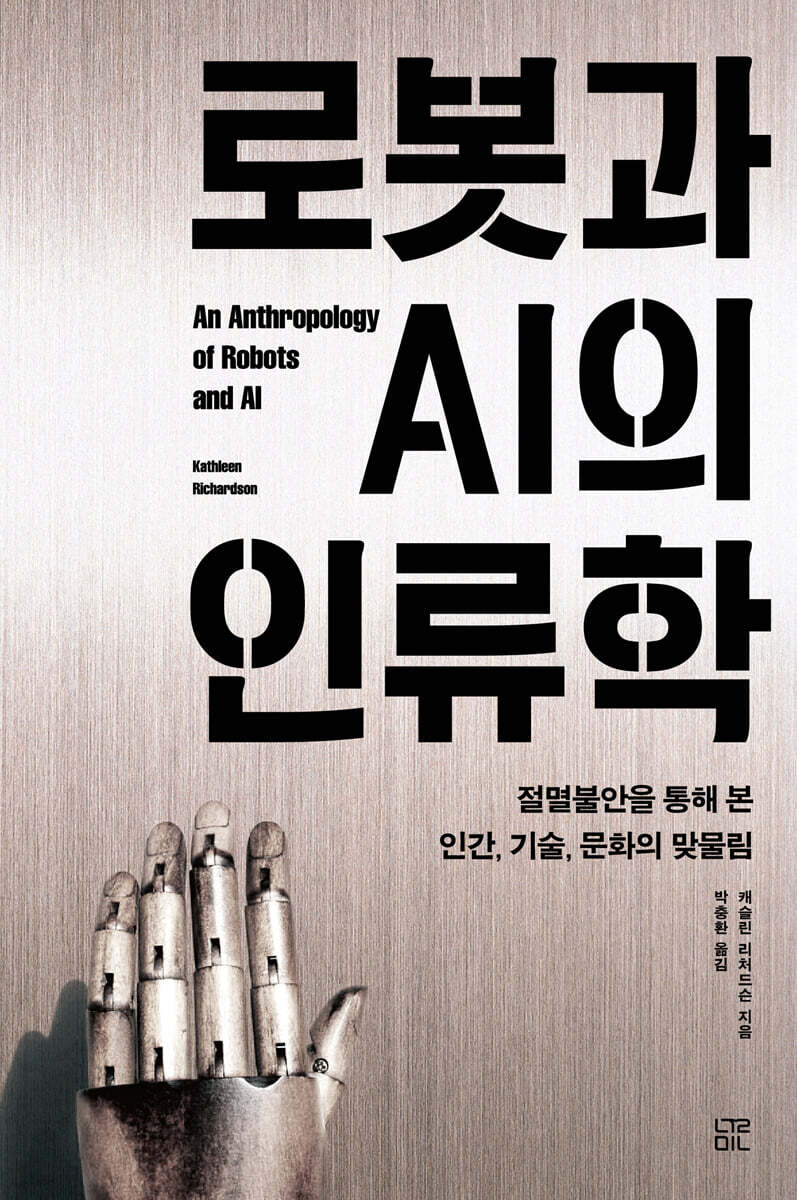
The Anthropology of Robots and AI
 |
Description
Book Introduction
Robots, AI, and humans,
A book that asks fundamental and essential questions about human culture and society!
The hidden, true story of robots and roboticists, created through a firsthand investigation of MIT's robotics lab!
To understand robots and AI, first look into where they come from.
An Anthropology of Robots and AI is a book written by Kathleen Richardson, a scientific anthropologist, based on field research conducted in the MIT Robotics Laboratory over several years starting in May 2003.
The author is currently a professor of culture and ethics in robotics and AI in the Department of Computer and Information Science at DeMontfort University in the UK.
The author continues to research and interpret/reinterpret robots and AI in social, cultural, philosophical, and literary contexts, while also participating in anti-sex robot movements and digital/art convergence projects, and is actively engaged in bringing the negative impact of new technologies on human relationships into the public sphere.
While other books on robots and AI focus on their practicality—that is, their economic feasibility and utility—this book focuses first on the transfer of practicality, namely, on the people who experiment with and build robots and AI.
Moreover, we go into the MIT robotics lab and convey their vivid images.
The author has taken a close look at the very place where robots and AI are born.
It is greatly distinguished in that it more deeply resolves the misunderstandings(?) and curiosities surrounding them.
Through anthropological fieldwork there, the author studies how local roboticists project their social, cultural, or anti-social and counter-cultural ideas into their robot experiments and productions.
It also vividly portrays who the robotics researchers at MIT's robotics lab are, and asks what robots truly mean to them.
That is, it discusses the people who create robots, and how their stories and narratives are projected onto the machines they create.
And we observe how robot fiction is projected into the robot-making process in the MIT laboratory and then fed back into robot fiction.
This ultimately returns us from the question “What is a robot?” to the question “What is a human?”
A book that asks fundamental and essential questions about human culture and society!
The hidden, true story of robots and roboticists, created through a firsthand investigation of MIT's robotics lab!
To understand robots and AI, first look into where they come from.
An Anthropology of Robots and AI is a book written by Kathleen Richardson, a scientific anthropologist, based on field research conducted in the MIT Robotics Laboratory over several years starting in May 2003.
The author is currently a professor of culture and ethics in robotics and AI in the Department of Computer and Information Science at DeMontfort University in the UK.
The author continues to research and interpret/reinterpret robots and AI in social, cultural, philosophical, and literary contexts, while also participating in anti-sex robot movements and digital/art convergence projects, and is actively engaged in bringing the negative impact of new technologies on human relationships into the public sphere.
While other books on robots and AI focus on their practicality—that is, their economic feasibility and utility—this book focuses first on the transfer of practicality, namely, on the people who experiment with and build robots and AI.
Moreover, we go into the MIT robotics lab and convey their vivid images.
The author has taken a close look at the very place where robots and AI are born.
It is greatly distinguished in that it more deeply resolves the misunderstandings(?) and curiosities surrounding them.
Through anthropological fieldwork there, the author studies how local roboticists project their social, cultural, or anti-social and counter-cultural ideas into their robot experiments and productions.
It also vividly portrays who the robotics researchers at MIT's robotics lab are, and asks what robots truly mean to them.
That is, it discusses the people who create robots, and how their stories and narratives are projected onto the machines they create.
And we observe how robot fiction is projected into the robot-making process in the MIT laboratory and then fed back into robot fiction.
This ultimately returns us from the question “What is a robot?” to the question “What is a human?”
- You can preview some of the book's contents.
Preview
index
Acknowledgments·7
Preface: Extinction Anxiety and Machines·11
Humanity, Beware of Your End · 16 | Anxiety about Extinction: Reducing to Nothing · 20
Everything is Connected · 26 | Mechanical Sociality · 34 | Attaching Humans to Machines · 41
Chapter 1: Revolutionary Robots·61
The Birth of Robots · 64 | Robots Become Machines · 68
Separate and/or homologous relationships·77|Production lines·86
Chapter 2: From Body-Mind Dualism·93
Militarism, Turing, and Thinking Machines · 97 | Body and Machine · 107
Behavioral Robotics · 112 | Others: Animals and Machines · 116
Chapter 3: Social Robots·137
Robot Childhood · 142 | Human Bonds · 150 | Social Robots · 154 | Humanization of the Nonhuman · 165
Chapter 4: Gender of the Freak · 175
Nerds Inside and Outside MIT · 178 | Extreme System Builders · 184
Gender and Nerds · 193 | MIT: Another World · 198
Chapter 5: Separated Robots·207
The Self in the Machine · 210 | Partialized Bodies: The Defective Hand · 220
Partialized Bodies: Memory and Emotion of Deficiency · 225 | Disabling the Body · 231 | Dissociated Sociality · 236
Chapter 6: Fantasy and Robots·249
Robot Fantasy · 255 | Uncanny · 262 | Robot Design: Triumph Over Death · 267
Primus in the Real World · 275 | The Theater of the Laboratory and the People Playing Robots · 281
Conclusion: Loving a Robot with Attachment Wounds · 289
Translator's Note·298
Search·304
Preface: Extinction Anxiety and Machines·11
Humanity, Beware of Your End · 16 | Anxiety about Extinction: Reducing to Nothing · 20
Everything is Connected · 26 | Mechanical Sociality · 34 | Attaching Humans to Machines · 41
Chapter 1: Revolutionary Robots·61
The Birth of Robots · 64 | Robots Become Machines · 68
Separate and/or homologous relationships·77|Production lines·86
Chapter 2: From Body-Mind Dualism·93
Militarism, Turing, and Thinking Machines · 97 | Body and Machine · 107
Behavioral Robotics · 112 | Others: Animals and Machines · 116
Chapter 3: Social Robots·137
Robot Childhood · 142 | Human Bonds · 150 | Social Robots · 154 | Humanization of the Nonhuman · 165
Chapter 4: Gender of the Freak · 175
Nerds Inside and Outside MIT · 178 | Extreme System Builders · 184
Gender and Nerds · 193 | MIT: Another World · 198
Chapter 5: Separated Robots·207
The Self in the Machine · 210 | Partialized Bodies: The Defective Hand · 220
Partialized Bodies: Memory and Emotion of Deficiency · 225 | Disabling the Body · 231 | Dissociated Sociality · 236
Chapter 6: Fantasy and Robots·249
Robot Fantasy · 255 | Uncanny · 262 | Robot Design: Triumph Over Death · 267
Primus in the Real World · 275 | The Theater of the Laboratory and the People Playing Robots · 281
Conclusion: Loving a Robot with Attachment Wounds · 289
Translator's Note·298
Search·304
Detailed image

Into the book
When we look at robots, past or present, the age-old theme of destruction constantly returns.
--- p.13
The first robot was created in the 1920s by Czech playwright Karel Čapek in a play called R.
UR: Appeared in Rossum' Universal Robots.
This play is very unique.
This is where the term 'robot' was first used and the cultural representation of robots also first took place.
『R.
UR』 is the first modern play to express the end of humanity through a narrative structure of complete extinction of humanity (Reilly 2011).
--- p.15
At least in American culture, MIT scientists symbolize the impersonal rationality and masculine authority of science and technology.
--- p.17
When building models of robotic humans, theory and practice intertwine in unique and unpredictable ways.
The roboticists in these labs constantly consulted robotic fiction as they built their robots, and the robots repeatedly encountered real-world constraints—the physical, social, and cultural environments that acted as containers for the robots.
The real and the fictional interacted with each other in unusual ways.
--- p.19
Is the fear of machines truly a consequence of "asymmetrical humanism," as Latour argues? Here, I argue that the fear of robots and machines is, rather, a consequence of symmetrical anti-humanism.
Symmetrical antihumanism establishes humans and non-humans as equal beings and does not attribute to humans any characteristics that distinguish them from other agents.
--- p.22
When MIT creates social robots, they are imagined as children.
Adults were encouraged to relate to robotic machines in the role of parents or guardians.
To facilitate these interactive exchanges, robots are specifically designed to be non-threatening or even cute.
--- p.37
Just as autism refers to difficulties with social interaction, it is perhaps not surprising that MIT roboticists have begun to imagine robotic machines as a kind of autistic personality, an entity that lacks the ability to read and respond appropriately to social cues (Scasselate 2001).
We see that the analogy between disabled people and machines is recurring in one aspect of robotics.
--- p.44-45
Robots are a product of modernity, created to help us reflect on what it means to be human.
--- p.63
Animals were the exemplars of inferior otherness, and humans (specifically those who draw inspiration from culture) were 'superior' to animals because of their language, consciousness, agency, culture, and art (Malik 2000 Krantzt 2002).
Activists like philosopher Peter Singer, who argued that animals deserve the same kind of respect and status as humans, now want to make the same point about robots (Lin, Abney and Bekey 2011).
--- p.118
From an anthropological perspective, viewing the lifeworld of animals from a human perspective can confuse or overlook the meanings specific to these different beings (de Waal 1996).
Then, nonhumans are reduced to mere containers for normative categories such as race, sex, gender, and class.
--- p.167
AI robotics and computer scientists emphasize the similarities between humans and machines, viewing humans as merely very complex machines.
In other words, humans are not fundamentally different from machines, but are merely complex machines.
This paradoxical way of thinking has another aspect: the idea that men, being antisocial, are closer to the state of machines, while women, being social, are the furthest from the mechanical.
--- p.178
In American culture, the cultural stereotype of the nerd is a complex one, intertwined with power, prestige, vision of genius, and business acumen.
Bill Gates, Steve Jobs, and Mark Zuckerberg are all symbols of this 'Nerd World Order'.
--- p.182
Some scholars, such as Baron-Cohen (1995, 2003b), argue that antisociality is actually beneficial to science and technology because it makes for better scientists and engineers.
--- p.186
“Everything is mechanical.
Humans are made up of biomolecules that interact according to the laws of physics and chemistry.
We like to think we are in control, but we are not.
“Whether human or humanoid, made of flesh and blood or metal, we are all fundamentally nothing more than social machines.”
--- p.200
What I wanted to argue was the interconnectedness between robots and roboticists.
When designing robots, roboticists tend to default to either their own egos or to diseases and disabilities.
In this sense, robots are intricately intertwined psychologically and physically with their creators.
--- p.243
Freud (2003) describes the uncanny in various ways.
It is an “uncomfortable state” (p.
152), “Whether something is alive or dead” (p.
147) A state of difficulty in judgment, when an object is “too similar to a living thing” (p.
147) The resulting confusion, “intellectual uncertainty” (p.
146), which causes “an inner urge to repeat” (p.
145), and “the double” (p.
141) is the result.
--- p.262
In this book, I have attempted to show that extinction serves as a significant backdrop to the formation of contemporary robotics and anthropological theorizing about humans and non-humans.
So what exactly is being annihilated in this process? It's nothing less than the social.
--- p.291
Today, machines work harder to make humans feel connected to each other.
But for humanity to embrace robotic machines, society must become more mechanized.
In other words, humanity must become less complex, more scripted, more stereotyped, and less autonomous to suit the needs of the machines.
--- p.13
The first robot was created in the 1920s by Czech playwright Karel Čapek in a play called R.
UR: Appeared in Rossum' Universal Robots.
This play is very unique.
This is where the term 'robot' was first used and the cultural representation of robots also first took place.
『R.
UR』 is the first modern play to express the end of humanity through a narrative structure of complete extinction of humanity (Reilly 2011).
--- p.15
At least in American culture, MIT scientists symbolize the impersonal rationality and masculine authority of science and technology.
--- p.17
When building models of robotic humans, theory and practice intertwine in unique and unpredictable ways.
The roboticists in these labs constantly consulted robotic fiction as they built their robots, and the robots repeatedly encountered real-world constraints—the physical, social, and cultural environments that acted as containers for the robots.
The real and the fictional interacted with each other in unusual ways.
--- p.19
Is the fear of machines truly a consequence of "asymmetrical humanism," as Latour argues? Here, I argue that the fear of robots and machines is, rather, a consequence of symmetrical anti-humanism.
Symmetrical antihumanism establishes humans and non-humans as equal beings and does not attribute to humans any characteristics that distinguish them from other agents.
--- p.22
When MIT creates social robots, they are imagined as children.
Adults were encouraged to relate to robotic machines in the role of parents or guardians.
To facilitate these interactive exchanges, robots are specifically designed to be non-threatening or even cute.
--- p.37
Just as autism refers to difficulties with social interaction, it is perhaps not surprising that MIT roboticists have begun to imagine robotic machines as a kind of autistic personality, an entity that lacks the ability to read and respond appropriately to social cues (Scasselate 2001).
We see that the analogy between disabled people and machines is recurring in one aspect of robotics.
--- p.44-45
Robots are a product of modernity, created to help us reflect on what it means to be human.
--- p.63
Animals were the exemplars of inferior otherness, and humans (specifically those who draw inspiration from culture) were 'superior' to animals because of their language, consciousness, agency, culture, and art (Malik 2000 Krantzt 2002).
Activists like philosopher Peter Singer, who argued that animals deserve the same kind of respect and status as humans, now want to make the same point about robots (Lin, Abney and Bekey 2011).
--- p.118
From an anthropological perspective, viewing the lifeworld of animals from a human perspective can confuse or overlook the meanings specific to these different beings (de Waal 1996).
Then, nonhumans are reduced to mere containers for normative categories such as race, sex, gender, and class.
--- p.167
AI robotics and computer scientists emphasize the similarities between humans and machines, viewing humans as merely very complex machines.
In other words, humans are not fundamentally different from machines, but are merely complex machines.
This paradoxical way of thinking has another aspect: the idea that men, being antisocial, are closer to the state of machines, while women, being social, are the furthest from the mechanical.
--- p.178
In American culture, the cultural stereotype of the nerd is a complex one, intertwined with power, prestige, vision of genius, and business acumen.
Bill Gates, Steve Jobs, and Mark Zuckerberg are all symbols of this 'Nerd World Order'.
--- p.182
Some scholars, such as Baron-Cohen (1995, 2003b), argue that antisociality is actually beneficial to science and technology because it makes for better scientists and engineers.
--- p.186
“Everything is mechanical.
Humans are made up of biomolecules that interact according to the laws of physics and chemistry.
We like to think we are in control, but we are not.
“Whether human or humanoid, made of flesh and blood or metal, we are all fundamentally nothing more than social machines.”
--- p.200
What I wanted to argue was the interconnectedness between robots and roboticists.
When designing robots, roboticists tend to default to either their own egos or to diseases and disabilities.
In this sense, robots are intricately intertwined psychologically and physically with their creators.
--- p.243
Freud (2003) describes the uncanny in various ways.
It is an “uncomfortable state” (p.
152), “Whether something is alive or dead” (p.
147) A state of difficulty in judgment, when an object is “too similar to a living thing” (p.
147) The resulting confusion, “intellectual uncertainty” (p.
146), which causes “an inner urge to repeat” (p.
145), and “the double” (p.
141) is the result.
--- p.262
In this book, I have attempted to show that extinction serves as a significant backdrop to the formation of contemporary robotics and anthropological theorizing about humans and non-humans.
So what exactly is being annihilated in this process? It's nothing less than the social.
--- p.291
Today, machines work harder to make humans feel connected to each other.
But for humanity to embrace robotic machines, society must become more mechanized.
In other words, humanity must become less complex, more scripted, more stereotyped, and less autonomous to suit the needs of the machines.
--- p.294
Publisher's Review
Who are they at MIT's Robotics Lab?
Stereotypes of scientists in science and engineering labs, particularly those who are referred to as “nerds” or “geeks,” are complex.
The first thing that comes to mind is a young man who lacks social skills, is unsanitary and dirty, has no sense of humor, and only cares about his own interests and major.
MIT even runs a “Charm School” for these people (see page 180).
On the other hand, entrepreneurs like Bill Gates, Steve Jobs, Mark Zuckerberg, and Elon Musk are portrayed as a combination of power, prestige, brilliant ideas, and keen business sense.
On the other hand, as Baron Cohen and Helmreich argue, even those with hyperintelligence are sometimes seen as having autism spectrum disorder (especially Asperger's syndrome) or social difficulties, and as people who enjoy staying in their own world.
In particular, Baron-Cohen goes so far as to argue that “antisociality is actually beneficial to science and technology because it creates better scientists and engineers” (see p. 168).
However, the author does not agree with this stereotype.
Observing female researchers immersed in their research in the lab, she argues that nerds may be the result of involuntary, severe social isolation, that university labs may be an escape from high school bullying, and that they are created because of the bizarre social image of electrical engineering and computer science.
In any case, it is certain that these stereotypes have a great influence on robotics.
Robots between mind and body, artificial intelligence and machines, and humans and non-humans
What interests the author is the relationship between robots and roboticists.
The author finds several interesting points in that relationship.
When designing robots, roboticists tend to default to either their own egos or to diseases and disabilities.
Robots are intricately intertwined with their creators, both psychologically and physically.
Robotics project their own unique suffering onto the machines they build, while introducing general models of disability, difference, and pain.
If this leads to the creation of machines as complex as humans, there is a great paradox: on the one hand, humans and machines are no different in mind or body, meaning that humans are nothing more than machines, and on the other hand, if machines complement human disabilities and deficiencies, this ultimately contributes to the perfection of humans.
The author draws attention to the dichotomous thinking of masculine and feminine among robotics and AI scholars.
Robots and AI systems have two orientations: cold, calculating, logical AI that exhibits “pure” cognitive reasoning abilities, and emotional, rational robots that desire relationships and love perfection.
We are faced with questions like: Is the human body a machine? How does AI, as a cool-headed rational being, work on humans?
This classification, reminiscent of the Cartesian dichotomy of mind and body, harbors the notion that humans are not fundamentally different from machines, but merely vastly more complex. Furthermore, this line of thinking implicitly assumes that men, being antisocial, are closer to machines, while women, being social, are farther from them.
The authors also point out that robots are being reimagined by researchers as children, companions, friends, and various types of special companions.
That is, by making machines genderless, classless, and raceless, we remove threatening elements, and we design machines that mimic and resemble the relationship between caregivers and children.
The author asks, “Could robots become our lovers, children, therapists, and friends?” and asks whether it is possible for machines to become plausible alternatives to others.
Robots and AI: How We Stopped Worrying and Loved Robots
“When we look at robots, past or present, the age-old theme of destruction constantly returns” (p. 13).
What humanity discovered after the emergence of the modern era was the emergence of a mass of workers who were impersonal and collective, existing only as labor force.
It is like saying that whether a human is made of flesh and blood or a humanoid made of electricity and metal, it is essentially indistinguishable, and whether human or machine, they are basically nothing more than social machines.
It is no coincidence that Karel Capek's work 『RUR』, which first introduced the word "robot" to the world, appeared at this time.
Capek's portrayal of robots as destructive cultural entities stemmed from a profound insight into humanity and modern industrial society.
Robots were a product of modernity, created to help us reflect on what it means to be human.
As the author says, machines still work harder and more positively to make humans feel connected to each other.
But what happens as society becomes increasingly mechanized? The author shares an anecdote from an MIT laboratory.
When a robot makes a mistake or has trouble operating, a roboticist steps in and takes action to resolve the issue.
At first glance, it appears as if humans are helping child-like robots as caregivers, but it is read as a symbol of how humans live, or will live, in harmony with machines.
As humans adapt to the needs of machines, we live less complex and more scripted routines, become more stereotyped, and become less spontaneous (see p. 249).
In doing so, humanity is annihilated through the extinction of the social.
This book explores the complex and interwoven philosophical and anthropological world of person and thing, human and machine, mind and body, human and non-human, fact and fiction, public and private space, theory and practice.
This book poses fundamental and essential questions about robots, AI, and humans, as well as about human culture and society, providing an opportunity to reflect on the modern society in which we live.
Stereotypes of scientists in science and engineering labs, particularly those who are referred to as “nerds” or “geeks,” are complex.
The first thing that comes to mind is a young man who lacks social skills, is unsanitary and dirty, has no sense of humor, and only cares about his own interests and major.
MIT even runs a “Charm School” for these people (see page 180).
On the other hand, entrepreneurs like Bill Gates, Steve Jobs, Mark Zuckerberg, and Elon Musk are portrayed as a combination of power, prestige, brilliant ideas, and keen business sense.
On the other hand, as Baron Cohen and Helmreich argue, even those with hyperintelligence are sometimes seen as having autism spectrum disorder (especially Asperger's syndrome) or social difficulties, and as people who enjoy staying in their own world.
In particular, Baron-Cohen goes so far as to argue that “antisociality is actually beneficial to science and technology because it creates better scientists and engineers” (see p. 168).
However, the author does not agree with this stereotype.
Observing female researchers immersed in their research in the lab, she argues that nerds may be the result of involuntary, severe social isolation, that university labs may be an escape from high school bullying, and that they are created because of the bizarre social image of electrical engineering and computer science.
In any case, it is certain that these stereotypes have a great influence on robotics.
Robots between mind and body, artificial intelligence and machines, and humans and non-humans
What interests the author is the relationship between robots and roboticists.
The author finds several interesting points in that relationship.
When designing robots, roboticists tend to default to either their own egos or to diseases and disabilities.
Robots are intricately intertwined with their creators, both psychologically and physically.
Robotics project their own unique suffering onto the machines they build, while introducing general models of disability, difference, and pain.
If this leads to the creation of machines as complex as humans, there is a great paradox: on the one hand, humans and machines are no different in mind or body, meaning that humans are nothing more than machines, and on the other hand, if machines complement human disabilities and deficiencies, this ultimately contributes to the perfection of humans.
The author draws attention to the dichotomous thinking of masculine and feminine among robotics and AI scholars.
Robots and AI systems have two orientations: cold, calculating, logical AI that exhibits “pure” cognitive reasoning abilities, and emotional, rational robots that desire relationships and love perfection.
We are faced with questions like: Is the human body a machine? How does AI, as a cool-headed rational being, work on humans?
This classification, reminiscent of the Cartesian dichotomy of mind and body, harbors the notion that humans are not fundamentally different from machines, but merely vastly more complex. Furthermore, this line of thinking implicitly assumes that men, being antisocial, are closer to machines, while women, being social, are farther from them.
The authors also point out that robots are being reimagined by researchers as children, companions, friends, and various types of special companions.
That is, by making machines genderless, classless, and raceless, we remove threatening elements, and we design machines that mimic and resemble the relationship between caregivers and children.
The author asks, “Could robots become our lovers, children, therapists, and friends?” and asks whether it is possible for machines to become plausible alternatives to others.
Robots and AI: How We Stopped Worrying and Loved Robots
“When we look at robots, past or present, the age-old theme of destruction constantly returns” (p. 13).
What humanity discovered after the emergence of the modern era was the emergence of a mass of workers who were impersonal and collective, existing only as labor force.
It is like saying that whether a human is made of flesh and blood or a humanoid made of electricity and metal, it is essentially indistinguishable, and whether human or machine, they are basically nothing more than social machines.
It is no coincidence that Karel Capek's work 『RUR』, which first introduced the word "robot" to the world, appeared at this time.
Capek's portrayal of robots as destructive cultural entities stemmed from a profound insight into humanity and modern industrial society.
Robots were a product of modernity, created to help us reflect on what it means to be human.
As the author says, machines still work harder and more positively to make humans feel connected to each other.
But what happens as society becomes increasingly mechanized? The author shares an anecdote from an MIT laboratory.
When a robot makes a mistake or has trouble operating, a roboticist steps in and takes action to resolve the issue.
At first glance, it appears as if humans are helping child-like robots as caregivers, but it is read as a symbol of how humans live, or will live, in harmony with machines.
As humans adapt to the needs of machines, we live less complex and more scripted routines, become more stereotyped, and become less spontaneous (see p. 249).
In doing so, humanity is annihilated through the extinction of the social.
This book explores the complex and interwoven philosophical and anthropological world of person and thing, human and machine, mind and body, human and non-human, fact and fiction, public and private space, theory and practice.
This book poses fundamental and essential questions about robots, AI, and humans, as well as about human culture and society, providing an opportunity to reflect on the modern society in which we live.
GOODS SPECIFICS
- Date of issue: August 18, 2023
- Page count, weight, size: 314 pages | 402g | 140*210*15mm
- ISBN13: 9791187750680
- ISBN10: 1187750689
You may also like
카테고리
korean


korean

![ELLE 엘르 스페셜 에디션 A형 : 12월 [2025]](http://librairie.coreenne.fr/cdn/shop/files/b8e27a3de6c9538896439686c6b0e8fb.jpg?v=1766436872&width=3840)


