

Fall of Berlin 1945
 |
Description
Book Introduction
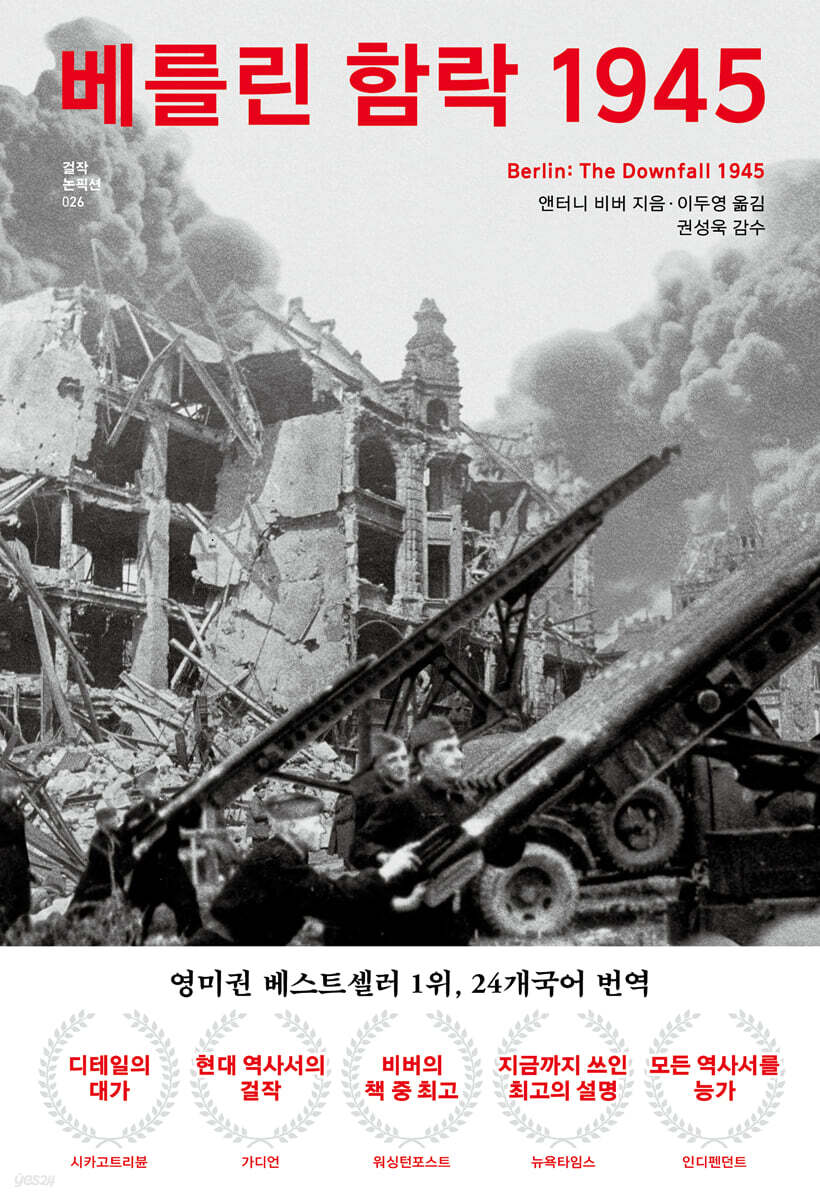
The Battle of Berlin, which lasted two weeks from April 16 to May 2, 1945
Reconstructing the experiences of millions of people based on archive materials, diaries, and memoirs.
An incredible story of pride, foolishness, revenge, perseverance, self-sacrifice, and survival.
In January 1945, the Red Army finally reached the borders of the Third Reich and had much to take revenge on.
Unable to forget the brutality of the German army and the SS, they went into a frenzy, crushing the ranks of refugees with tanks, committing mass rape, looting, and unimaginable destruction, causing enormous damage.
Hundreds of thousands of women and children froze to death or were massacred, two million women were raped, and more than seven million civilians fled west to escape the wrath of the Red Army.
It was the most horrific apocalypse of fire and sword in history.
Antony Beevor reconstructs the experiences of millions caught up in the nightmare of the final collapse of the Third Reich.
The Fall of Berlin is a horrific story of arrogance, foolishness, fanaticism, revenge, and barbarism, but it is also a story of incredible perseverance, self-sacrifice, and survival against all odds.
Reconstructing the experiences of millions of people based on archive materials, diaries, and memoirs.
An incredible story of pride, foolishness, revenge, perseverance, self-sacrifice, and survival.
In January 1945, the Red Army finally reached the borders of the Third Reich and had much to take revenge on.
Unable to forget the brutality of the German army and the SS, they went into a frenzy, crushing the ranks of refugees with tanks, committing mass rape, looting, and unimaginable destruction, causing enormous damage.
Hundreds of thousands of women and children froze to death or were massacred, two million women were raped, and more than seven million civilians fled west to escape the wrath of the Red Army.
It was the most horrific apocalypse of fire and sword in history.
Antony Beevor reconstructs the experiences of millions caught up in the nightmare of the final collapse of the Third Reich.
The Fall of Berlin is a horrific story of arrogance, foolishness, fanaticism, revenge, and barbarism, but it is also a story of incredible perseverance, self-sacrifice, and survival against all odds.
- You can preview some of the book's contents.
Preview
index
preface
introduction
1.
Berlin welcomes the new year
2.
The 'House of Cards' on the Wisła River
3.
Fire, Sword, and Noble Fury
4.
Winter Offensive
5.
The assault on the Oder River
6.
East and West
7.
rear sweep
8.
Pomerania and the Oder River Bridgehead
9.
Target Berlin
10.
favorite ministers and staff
11.
Preparing for the final blow
12.
Waiting for the onslaught
13.
American troops on the Elbe River
14.
eve of battle
15.
Zhukov of Lightbein Spuer
16.
Jello and Spreegang
17.
The President's last birthday
18.
The Escape of the Golden Pheasants
19.
bombarded city
20.
vain hope
21.
street fighting
22.
Battle in the Forest
23.
Betrayal of will
24.
Dawn of the President
25.
The Chancellery and the Reichstag
26.
End of the Battle
27.
Losers are miserable!
28.
Man on a White Horse
introduction
1.
Berlin welcomes the new year
2.
The 'House of Cards' on the Wisła River
3.
Fire, Sword, and Noble Fury
4.
Winter Offensive
5.
The assault on the Oder River
6.
East and West
7.
rear sweep
8.
Pomerania and the Oder River Bridgehead
9.
Target Berlin
10.
favorite ministers and staff
11.
Preparing for the final blow
12.
Waiting for the onslaught
13.
American troops on the Elbe River
14.
eve of battle
15.
Zhukov of Lightbein Spuer
16.
Jello and Spreegang
17.
The President's last birthday
18.
The Escape of the Golden Pheasants
19.
bombarded city
20.
vain hope
21.
street fighting
22.
Battle in the Forest
23.
Betrayal of will
24.
Dawn of the President
25.
The Chancellery and the Reichstag
26.
End of the Battle
27.
Losers are miserable!
28.
Man on a White Horse
Into the book
Hitler learned nothing and forgot nothing.
--- p.55
The scale of the human tragedy that unfolded at the end of the war is inconceivable to those who did not experience it firsthand, especially those who grew up in a disarmed society after the Cold War.
But this fateful moment that befell millions of people still has much to teach us.
One important lesson is that we must be wary of any generalizations about individual behavior.
Extreme suffering, even depravity, can bring out the best as well as the worst of human nature.
Human behavior is evidence of the unpredictability of life and death.
Many Soviet soldiers, especially those on the front lines, often treated German civilians very kindly, unlike their comrades who followed them.
In a cruel and terrifying world where humanity has been destroyed by ideology, a few unexpected acts of kindness and sacrifice shed light on a story that would otherwise be unbearable.
--- p.56
Berliners now exchanged self-deprecating, spooky jokes.
A popular joke during that morbid season was, “Let’s be realistic.
“Bring me the coffin!”
--- p.60
The Red Army had improved in many areas, including heavy weaponry, planning expertise, camouflage, and operational control, and often caught the Germans off guard, but some weaknesses still remained.
The worst of these was the laxity of discipline to the point of disorder.
It was a surprising sight for a totalitarian army.
A severe conflict among young officers was also a cause of the problem.
--- p.76~77
The vast majority of Red Army soldiers, nearly illiterate, were sexually ignorant and completely misinformed about women.
Soviet attempts to suppress the sexuality of its people produced what one Russian writer described as a kind of “barracks eroticism” far more primitive and violent than “the most filthy foreign pornography.”
And all this combined with the dehumanizing influence of modern propaganda and the instinctive drive of men to fear and suffer on the battlefield.
--- p.102
Bormann, the National Socialist Reichstag member whose Gauleiter leaders had prevented the evacuation of women and children until it was too late, made no mention in his diary of those fleeing in terror from the eastern regions.
Their incompetence in dealing with the refugee crisis was appalling, but in the case of the Nazi hierarchy, the line between irresponsibility and inhumanity is often difficult to distinguish.
--- p.159~160
American policymakers did not want to provoke Stalin in any way.
U.S. Ambassador to London John G.
When discussing the occupied territories at the European Advisory Council, Winant refused even to raise the question of a land route to Berlin for fear of damaging relations with the Soviets.
The policy of appeasing Stalin came from high levels and was widely accepted.
Robert Murphy, Eisenhower's political adviser, was told by Roosevelt, "The most important thing is to get the Russians to trust us."
(…) Roosevelt's argument was part of what Robert Murphy has acknowledged as "an all-too-pervasive American theory" that personal friendships could determine national policy.
America's desire to please Stalin obscured the question of how much to trust him.
--- p.171
While Eisenhower underestimated Berlin's importance, Churchill underestimated Stalin's determination to secure the city at any cost and his genuine moral outrage at any attempt by the West to seize the Red Army's spoils from under his nose.
--- p.249~250
“It seemed like sexual fever had taken hold of everyone.
Everywhere, even on the dentist's chair, I witnessed bodies engaged in lustful embraces.
Women abandoned all modesty and bared their private parts without hesitation.” SS officers, who hunted down deserters in basements and streets and hanged them, also lured hungry and impressionable young women to the Führer's residence with promises of parties, endless food, and champagne.
It was a picture of the end of totalitarian corruption.
An existentialist play prepared for hell was presented in the concrete submarine, the underworld of the Chancellery.
--- p.524
The soldiers of the 12th Army were very confused.
They were proud of their rescue mission, trembled at the Red Army, and resented the Americans for not advancing further.
He also hated the Nazi regime for betraying its own people.
All of this seemed to encapsulate the thoughts they had on their refugee journey to Tangermünde.
--- p.55
The scale of the human tragedy that unfolded at the end of the war is inconceivable to those who did not experience it firsthand, especially those who grew up in a disarmed society after the Cold War.
But this fateful moment that befell millions of people still has much to teach us.
One important lesson is that we must be wary of any generalizations about individual behavior.
Extreme suffering, even depravity, can bring out the best as well as the worst of human nature.
Human behavior is evidence of the unpredictability of life and death.
Many Soviet soldiers, especially those on the front lines, often treated German civilians very kindly, unlike their comrades who followed them.
In a cruel and terrifying world where humanity has been destroyed by ideology, a few unexpected acts of kindness and sacrifice shed light on a story that would otherwise be unbearable.
--- p.56
Berliners now exchanged self-deprecating, spooky jokes.
A popular joke during that morbid season was, “Let’s be realistic.
“Bring me the coffin!”
--- p.60
The Red Army had improved in many areas, including heavy weaponry, planning expertise, camouflage, and operational control, and often caught the Germans off guard, but some weaknesses still remained.
The worst of these was the laxity of discipline to the point of disorder.
It was a surprising sight for a totalitarian army.
A severe conflict among young officers was also a cause of the problem.
--- p.76~77
The vast majority of Red Army soldiers, nearly illiterate, were sexually ignorant and completely misinformed about women.
Soviet attempts to suppress the sexuality of its people produced what one Russian writer described as a kind of “barracks eroticism” far more primitive and violent than “the most filthy foreign pornography.”
And all this combined with the dehumanizing influence of modern propaganda and the instinctive drive of men to fear and suffer on the battlefield.
--- p.102
Bormann, the National Socialist Reichstag member whose Gauleiter leaders had prevented the evacuation of women and children until it was too late, made no mention in his diary of those fleeing in terror from the eastern regions.
Their incompetence in dealing with the refugee crisis was appalling, but in the case of the Nazi hierarchy, the line between irresponsibility and inhumanity is often difficult to distinguish.
--- p.159~160
American policymakers did not want to provoke Stalin in any way.
U.S. Ambassador to London John G.
When discussing the occupied territories at the European Advisory Council, Winant refused even to raise the question of a land route to Berlin for fear of damaging relations with the Soviets.
The policy of appeasing Stalin came from high levels and was widely accepted.
Robert Murphy, Eisenhower's political adviser, was told by Roosevelt, "The most important thing is to get the Russians to trust us."
(…) Roosevelt's argument was part of what Robert Murphy has acknowledged as "an all-too-pervasive American theory" that personal friendships could determine national policy.
America's desire to please Stalin obscured the question of how much to trust him.
--- p.171
While Eisenhower underestimated Berlin's importance, Churchill underestimated Stalin's determination to secure the city at any cost and his genuine moral outrage at any attempt by the West to seize the Red Army's spoils from under his nose.
--- p.249~250
“It seemed like sexual fever had taken hold of everyone.
Everywhere, even on the dentist's chair, I witnessed bodies engaged in lustful embraces.
Women abandoned all modesty and bared their private parts without hesitation.” SS officers, who hunted down deserters in basements and streets and hanged them, also lured hungry and impressionable young women to the Führer's residence with promises of parties, endless food, and champagne.
It was a picture of the end of totalitarian corruption.
An existentialist play prepared for hell was presented in the concrete submarine, the underworld of the Chancellery.
--- p.524
The soldiers of the 12th Army were very confused.
They were proud of their rescue mission, trembled at the Red Army, and resented the Americans for not advancing further.
He also hated the Nazi regime for betraying its own people.
All of this seemed to encapsulate the thoughts they had on their refugee journey to Tangermünde.
--- p.597
Publisher's Review
Unparalleled access to data and compelling narratives
The Fall of Berlin 1945 has been praised as “a masterpiece of nonfiction” and “the best of Beaver’s books” for the author’s diligence, faithful footnotes, style and narrative skills, and meticulous approach to the facts.
The author, a former army officer turned historian, explains complex military movements and the reasoning of the commanders who orchestrated them with remarkable clarity.
Hitler's reckless gamble to split the Western Allies with a massive counteroffensive in the Ardennes in December 1944 had failed, and with the Red Army poised to launch a new offensive in the east, Germany's fate was all but sealed.
So, this book begins its exciting story from Christmas 1944.
And by eavesdropping on and narrating the main characters' conversations during the Soviet and major Allied forces' advance on Berlin from January to May 1945, the author makes the reader into an eavesdropper on Hitler and Stalin's monologues.
Beaver's unparalleled access to Russian, German, and Swedish archives, combined with extensive research in British and American sources, has yielded a significant body of new material for this book.
Some of them are bizarre: for example, the author describes how Hitler's jawbone and skull were divided between the spy agency SMERSH and the Soviet secret police, the NKVD, and eventually ended up in Soviet archives.
It also reveals that Hitler's remains, buried beneath a Soviet parade ground in Magdeburg until 1970, were finally exhumed in the middle of the night and his remains were dumped in the city's sewers.
The author's ability to gather evidence is supported by the documents, diaries, interviews, and books used in this book.
While focusing his narrative on the Soviet advance from the east, Beaver moves effortlessly between the Allied forces in the west and the Nazis, presenting the details of the war and its implications with dazzling insight.
For example, sentences like “Studebaker trucks and Dodge trucks, Chevrolet open-tops with mortars in the backseat covered with tarpaulins, tractors pulling heavy howitzers, and a second group behind them on horse-drawn carts” display excellent descriptive power.
The 1945 advance on Berlin was the largest battle in history, with 2.5 million Soviet troops attacking 1 million German soldiers, so a summary sentence is inevitable.
However, the author's unique strength lies in the narrative that reveals judgment through short sentences, such as, "Göring's vanity was as ridiculed as his irresponsibility," and "His sparkling eyes and the fur trimmings on his specially designed uniform reminded him of a 'cheerful market lady.'"
The End of the Millennium Empire, the Last Battle of Berlin
Hitler's invasion of Russia in 1941 brought horrific devastation to civilians and prisoners of war.
In February 1943, a Soviet officer taunted German prisoners of war in the ruins of Stalingrad, saying:
“Berlin will soon become like that!” And a few years later, Berlin paid precisely that price.
The Germans, who knew what had been done to Russian civilians and prisoners of war in 1941, could not shake off their anxiety as the Red Army approached Berlin.
In January 1945, the Soviet Army massed over 4 million troops along the Vistula River for its final offensive against Nazi Germany.
At least 8.5 million people living in East Prussia tried to flee the impending Soviet offensive.
Some hid in the forests, others fled west in the hope of reaching Allied lines before falling into Russian hands, but the majority failed to escape.
In the port city of Königsberg, for example, many people were killed by machine guns, while others were run over by Soviet tanks.
At sea, a Russian submarine torpedoed the passenger ship Wilhelm Gustloff, killing 5,300 of the 6,600 civilian passengers.
In April, the Red Army set up camp on the Oder River, 65 kilometers from Berlin, ready to attack the Third Reich.
First of all, three men, Zhukov, Rokossovsky, and Koneprov, served as commanders.
However, Stalin later excluded Rokossovsky, the commander-in-chief of the 1st Belorussian Front, and ultimately handed over supreme command to Zhukov.
Soon after, the 2.5 million Soviet troops faced the 1 million-man Army Group Vistula, led by Heinrich Himmler.
Himmler was a hero of defense.
On April 16, some 20,000 Russian artillery and rocket launchers unleashed an unprecedented barrage on the outnumbered enemy.
The Soviet Union had two goals.
To capture Berlin by April 22nd (Lenin's birthday) and to surround the city to prevent American and British forces from reaching Berlin.
However, Himmler moved his troops to the second line of defense and stopped the attacking forces.
The Russians faced a much more difficult task than anticipated, and it took until April 25 to encircle Berlin.
(There were more than 3 million civilians inside the barbed wire fence.
Despite the grim news coming from East Prussia from January onwards, neither Goebbels nor any other Nazi official attempted to evacuate the starving civilians.
Stalin cleverly manipulated his commanders to deploy massive forces for a final assault on Berlin.
This attack, which involved 2.5 million troops, 7,500 aircraft, 6,250 tanks, and 41,600 artillery pieces, was so devastating that thunder rumbled and paintings fell from the Berlin Wall.
The Germans counterattacked with panzerfausts, but they were woefully inadequate compared to the offensive of the air force and mechanized units.
Hitler's empire collapsed as the Russian army descended on the capital, pushing back even the most determined defenders - boys, foreign fascists, and the elderly.
As Goering, Himmler, and others pushed ahead with negotiations, potential conflicts surfaced.
German boys who were too young to fight but tall enough to look good had to endure the deadly accusation of being “SS men.”
As the front line became further shortened, the defense of Berlin fell to foreign SS volunteers from France, Latvia, and the Scandinavian countries who had volunteered to fight against Bolshevism.
2 million women have been raped
One of the first places the Soviet army liberated when it entered Germany was Auschwitz and the nearby prisoner-of-war camps.
It was no wonder that a British prisoner of war cried out:
“Oh my God! Whatever Russia does to this country, I will definitely forgive it.
Absolutely anything.” Retaliation was inevitable because of the atrocities committed by the Germans in the Soviet Union earlier, but in the last months of the war, Russian revenge against the German people was so widespread and its fury so terrible.
The author provides a near-accurate account of the victims of war rape and details the horrors they inflicted.
In other words, the real victims of the Reich in 1945 were the German people, especially women.
The Red Army, drunk and driven by revenge, committed gang rape.
The rapes, which began in East Prussia in January 1945, culminated in the two-week Battle of Berlin, and continued like an epidemic even after hostilities ended.
“The Red Army soldiers were not interested in ‘individual affairs’ with German women,” wrote the playwright Zakhar Agranenko, who served as an officer in the Naval Corps in East Prussia, in his diary.
“Nine, ten, twelve soldiers at a time would gang rape the women.” The soldiers used the expression “eating” the German women and said that the German women were “so arrogant” that they had to “climb” on top of them.
Other soldiers complained that German women looked like “dray horses.”
Moreover, 'liberated' forced labor women from Germany, Poland, Russia and Ukraine, aged from 14 to 80, were also subjected to sexual violence in turns by Red Army soldiers.
Jewish survivors of the Nazis made it known that they were victims of the Nazi regime, but once alcohol took hold, the nationality of the prey became irrelevant.
Beaver emphasizes that “the widespread rape of women forcibly taken from the Soviet Union completely undermines any attempt to justify the Red Army’s actions in the Soviet Union on the grounds of revenge for German atrocities.”
Beaver analyzes that the Red Army's rapes showed four stages.
The first step was the brutal rape of nurses, young girls, pregnant women, and mothers who had just given birth, all in a vengeful mood in January and February.
This pattern changed to be less brutal in the second stage.
While serving on the front lines, soldiers mainly satisfied their sexual desires as a form of relaxation, and did not commit unnecessary violence unless women resisted.
But soon the definition of rape became blurred.
Faced with starvation, women offered themselves to soldiers in exchange for necessities and food, without the use of guns or physical violence.
This was the third stage of rape.
The fourth stage was a curious form of cohabitation in which many Soviet officers settled with German "occupation wives" who replaced their Soviet "athlete wives."
Many Red Army officers who had been living with German mistresses chose to desert when the time came to return to their homeland.
Red Army officers had no intention of stopping it. The NKVD rifle regiments did not punish soldiers who committed rape.
Punishment was only carried out when the victims contracted a sexually transmitted disease.
These victims usually had contracted a sexually transmitted disease from their previous rapist.
The Stalinists did not stop rape, euphemistically calling it an “immoral incident.”
During the fighting, 130,000 women were raped, and 10 percent of them committed suicide.
Beaver has established, through clear scholarship, that at least two million women were raped in Germany during the war in 1945, many of them gang rapes.
One woman was raped “by 23 soldiers in quick succession.”
All this, which one writer has described as 'barracks eroticism', combined the dehumanizing influence of modern propaganda with the instinctive drive of men to fear and suffer on the battlefield.
Stories like this make readers pessimistic about human nature.
Beaver argues that Stalin transformed the Soviet Union into a repressed society, and that this was the repressed tsunami that overwhelmed East Germany in 1945.
Given the research Beaver has compiled from numerous foreign archives, he cannot help but be recognized as a moralist, regardless of his intentions.
***
So, was Russia truly the victor? Soviet casualties in the Berlin Operation amounted to 78,291 killed and 274,184 wounded.
Even Russian historians acknowledge that the needless loss of life was partly due to the race to reach Berlin before the Western Allies and partly to the fact that so many troops were committed to the attack on Berlin that they ended up firing at each other.
Moreover, the Russian soldiers who lost their limbs were called 'samovars' and were ostracized, arrested and exiled by their own government.
More than 1.5 million former Soviet prisoners of war were sent to concentration camps or labor battalions.
The 'Black Book' on the Holocaust of Soviet Jews was banned by the authorities due to its communist 'denialism'.
Soviet commander Zhukov's close associates were arrested and tortured in an attempt to expose a non-existent anti-Stalinist conspiracy, and Zhukov himself was exiled for the next 20 years.
The Fall of Berlin 1945 has been praised as “a masterpiece of nonfiction” and “the best of Beaver’s books” for the author’s diligence, faithful footnotes, style and narrative skills, and meticulous approach to the facts.
The author, a former army officer turned historian, explains complex military movements and the reasoning of the commanders who orchestrated them with remarkable clarity.
Hitler's reckless gamble to split the Western Allies with a massive counteroffensive in the Ardennes in December 1944 had failed, and with the Red Army poised to launch a new offensive in the east, Germany's fate was all but sealed.
So, this book begins its exciting story from Christmas 1944.
And by eavesdropping on and narrating the main characters' conversations during the Soviet and major Allied forces' advance on Berlin from January to May 1945, the author makes the reader into an eavesdropper on Hitler and Stalin's monologues.
Beaver's unparalleled access to Russian, German, and Swedish archives, combined with extensive research in British and American sources, has yielded a significant body of new material for this book.
Some of them are bizarre: for example, the author describes how Hitler's jawbone and skull were divided between the spy agency SMERSH and the Soviet secret police, the NKVD, and eventually ended up in Soviet archives.
It also reveals that Hitler's remains, buried beneath a Soviet parade ground in Magdeburg until 1970, were finally exhumed in the middle of the night and his remains were dumped in the city's sewers.
The author's ability to gather evidence is supported by the documents, diaries, interviews, and books used in this book.
While focusing his narrative on the Soviet advance from the east, Beaver moves effortlessly between the Allied forces in the west and the Nazis, presenting the details of the war and its implications with dazzling insight.
For example, sentences like “Studebaker trucks and Dodge trucks, Chevrolet open-tops with mortars in the backseat covered with tarpaulins, tractors pulling heavy howitzers, and a second group behind them on horse-drawn carts” display excellent descriptive power.
The 1945 advance on Berlin was the largest battle in history, with 2.5 million Soviet troops attacking 1 million German soldiers, so a summary sentence is inevitable.
However, the author's unique strength lies in the narrative that reveals judgment through short sentences, such as, "Göring's vanity was as ridiculed as his irresponsibility," and "His sparkling eyes and the fur trimmings on his specially designed uniform reminded him of a 'cheerful market lady.'"
The End of the Millennium Empire, the Last Battle of Berlin
Hitler's invasion of Russia in 1941 brought horrific devastation to civilians and prisoners of war.
In February 1943, a Soviet officer taunted German prisoners of war in the ruins of Stalingrad, saying:
“Berlin will soon become like that!” And a few years later, Berlin paid precisely that price.
The Germans, who knew what had been done to Russian civilians and prisoners of war in 1941, could not shake off their anxiety as the Red Army approached Berlin.
In January 1945, the Soviet Army massed over 4 million troops along the Vistula River for its final offensive against Nazi Germany.
At least 8.5 million people living in East Prussia tried to flee the impending Soviet offensive.
Some hid in the forests, others fled west in the hope of reaching Allied lines before falling into Russian hands, but the majority failed to escape.
In the port city of Königsberg, for example, many people were killed by machine guns, while others were run over by Soviet tanks.
At sea, a Russian submarine torpedoed the passenger ship Wilhelm Gustloff, killing 5,300 of the 6,600 civilian passengers.
In April, the Red Army set up camp on the Oder River, 65 kilometers from Berlin, ready to attack the Third Reich.
First of all, three men, Zhukov, Rokossovsky, and Koneprov, served as commanders.
However, Stalin later excluded Rokossovsky, the commander-in-chief of the 1st Belorussian Front, and ultimately handed over supreme command to Zhukov.
Soon after, the 2.5 million Soviet troops faced the 1 million-man Army Group Vistula, led by Heinrich Himmler.
Himmler was a hero of defense.
On April 16, some 20,000 Russian artillery and rocket launchers unleashed an unprecedented barrage on the outnumbered enemy.
The Soviet Union had two goals.
To capture Berlin by April 22nd (Lenin's birthday) and to surround the city to prevent American and British forces from reaching Berlin.
However, Himmler moved his troops to the second line of defense and stopped the attacking forces.
The Russians faced a much more difficult task than anticipated, and it took until April 25 to encircle Berlin.
(There were more than 3 million civilians inside the barbed wire fence.
Despite the grim news coming from East Prussia from January onwards, neither Goebbels nor any other Nazi official attempted to evacuate the starving civilians.
Stalin cleverly manipulated his commanders to deploy massive forces for a final assault on Berlin.
This attack, which involved 2.5 million troops, 7,500 aircraft, 6,250 tanks, and 41,600 artillery pieces, was so devastating that thunder rumbled and paintings fell from the Berlin Wall.
The Germans counterattacked with panzerfausts, but they were woefully inadequate compared to the offensive of the air force and mechanized units.
Hitler's empire collapsed as the Russian army descended on the capital, pushing back even the most determined defenders - boys, foreign fascists, and the elderly.
As Goering, Himmler, and others pushed ahead with negotiations, potential conflicts surfaced.
German boys who were too young to fight but tall enough to look good had to endure the deadly accusation of being “SS men.”
As the front line became further shortened, the defense of Berlin fell to foreign SS volunteers from France, Latvia, and the Scandinavian countries who had volunteered to fight against Bolshevism.
2 million women have been raped
One of the first places the Soviet army liberated when it entered Germany was Auschwitz and the nearby prisoner-of-war camps.
It was no wonder that a British prisoner of war cried out:
“Oh my God! Whatever Russia does to this country, I will definitely forgive it.
Absolutely anything.” Retaliation was inevitable because of the atrocities committed by the Germans in the Soviet Union earlier, but in the last months of the war, Russian revenge against the German people was so widespread and its fury so terrible.
The author provides a near-accurate account of the victims of war rape and details the horrors they inflicted.
In other words, the real victims of the Reich in 1945 were the German people, especially women.
The Red Army, drunk and driven by revenge, committed gang rape.
The rapes, which began in East Prussia in January 1945, culminated in the two-week Battle of Berlin, and continued like an epidemic even after hostilities ended.
“The Red Army soldiers were not interested in ‘individual affairs’ with German women,” wrote the playwright Zakhar Agranenko, who served as an officer in the Naval Corps in East Prussia, in his diary.
“Nine, ten, twelve soldiers at a time would gang rape the women.” The soldiers used the expression “eating” the German women and said that the German women were “so arrogant” that they had to “climb” on top of them.
Other soldiers complained that German women looked like “dray horses.”
Moreover, 'liberated' forced labor women from Germany, Poland, Russia and Ukraine, aged from 14 to 80, were also subjected to sexual violence in turns by Red Army soldiers.
Jewish survivors of the Nazis made it known that they were victims of the Nazi regime, but once alcohol took hold, the nationality of the prey became irrelevant.
Beaver emphasizes that “the widespread rape of women forcibly taken from the Soviet Union completely undermines any attempt to justify the Red Army’s actions in the Soviet Union on the grounds of revenge for German atrocities.”
Beaver analyzes that the Red Army's rapes showed four stages.
The first step was the brutal rape of nurses, young girls, pregnant women, and mothers who had just given birth, all in a vengeful mood in January and February.
This pattern changed to be less brutal in the second stage.
While serving on the front lines, soldiers mainly satisfied their sexual desires as a form of relaxation, and did not commit unnecessary violence unless women resisted.
But soon the definition of rape became blurred.
Faced with starvation, women offered themselves to soldiers in exchange for necessities and food, without the use of guns or physical violence.
This was the third stage of rape.
The fourth stage was a curious form of cohabitation in which many Soviet officers settled with German "occupation wives" who replaced their Soviet "athlete wives."
Many Red Army officers who had been living with German mistresses chose to desert when the time came to return to their homeland.
Red Army officers had no intention of stopping it. The NKVD rifle regiments did not punish soldiers who committed rape.
Punishment was only carried out when the victims contracted a sexually transmitted disease.
These victims usually had contracted a sexually transmitted disease from their previous rapist.
The Stalinists did not stop rape, euphemistically calling it an “immoral incident.”
During the fighting, 130,000 women were raped, and 10 percent of them committed suicide.
Beaver has established, through clear scholarship, that at least two million women were raped in Germany during the war in 1945, many of them gang rapes.
One woman was raped “by 23 soldiers in quick succession.”
All this, which one writer has described as 'barracks eroticism', combined the dehumanizing influence of modern propaganda with the instinctive drive of men to fear and suffer on the battlefield.
Stories like this make readers pessimistic about human nature.
Beaver argues that Stalin transformed the Soviet Union into a repressed society, and that this was the repressed tsunami that overwhelmed East Germany in 1945.
Given the research Beaver has compiled from numerous foreign archives, he cannot help but be recognized as a moralist, regardless of his intentions.
***
So, was Russia truly the victor? Soviet casualties in the Berlin Operation amounted to 78,291 killed and 274,184 wounded.
Even Russian historians acknowledge that the needless loss of life was partly due to the race to reach Berlin before the Western Allies and partly to the fact that so many troops were committed to the attack on Berlin that they ended up firing at each other.
Moreover, the Russian soldiers who lost their limbs were called 'samovars' and were ostracized, arrested and exiled by their own government.
More than 1.5 million former Soviet prisoners of war were sent to concentration camps or labor battalions.
The 'Black Book' on the Holocaust of Soviet Jews was banned by the authorities due to its communist 'denialism'.
Soviet commander Zhukov's close associates were arrested and tortured in an attempt to expose a non-existent anti-Stalinist conspiracy, and Zhukov himself was exiled for the next 20 years.
GOODS SPECIFICS
- Date of issue: August 25, 2023
- Format: Hardcover book binding method guide
- Page count, weight, size: 712 pages | 982g | 140*205*38mm
- ISBN13: 9791169091343
- ISBN10: 1169091342
You may also like
카테고리
korean


korean

![GQ KOREA Mark (Monthly): December [2025]](http://librairie.coreenne.fr/cdn/shop/files/8ef265dbbfbf186523ed75ba7319009d.jpg?v=1765340328&width=3840)


