

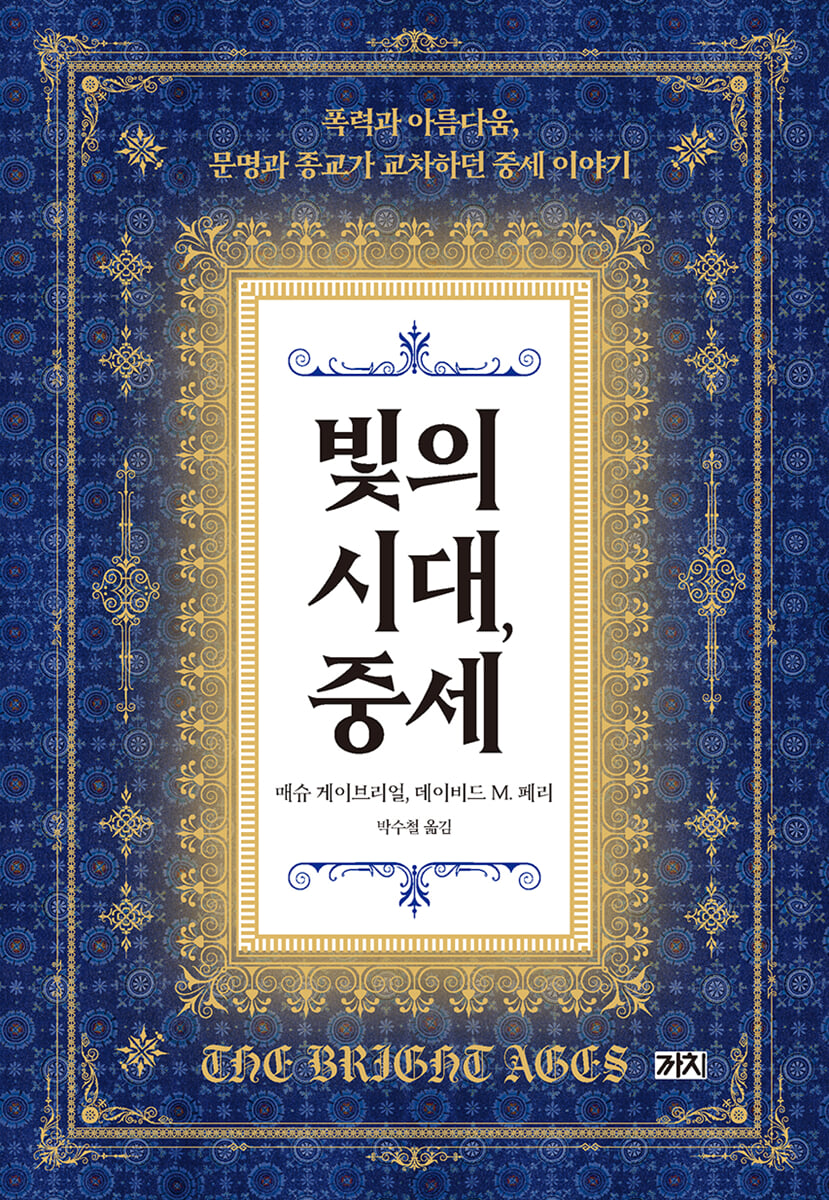
Age of Light, Middle Ages
 |
Description
Book Introduction
Forget the Dark Ages, the Middle Ages, those were truly the Age of Light.
Not the 1,000 years of medieval history of darkness, ignorance, and blind faith.
To the Middle Ages, the age of light when light, reason, and humanity were at work.
* Highly recommended by Joo Kyung-chul (Professor of Western History, Seoul National University) and Peter Frankopan (author of "Silk Road World History") *
* Overwhelming praise from Publisher's Weekly, Kirkus Reviews, Booklist, and others *
This book boldly challenges long-held prejudices and assumptions about the Middle Ages, including the Dark Ages and the Middle Ages! This book rediscovers the colorful light of the Middle Ages through a new historical perspective. It synthesizes the latest discussions on the 1,000 years of the Middle Ages, offering a fresh perspective on the period.
The authors, scholars of medieval translation, cover a vast area that extends beyond the European continent to Africa and Asia, comprehensively and comprehensively portraying a period that has been too easily overlooked, allowing readers to encounter the true face of the Middle Ages and inviting readers into the Age of Light, the Middle Ages.
Rather than focusing on a specific event, such as the migration of the Germanic tribes or the fall of Rome, the book begins with the beautiful mosaics that adorn the ceiling of the Basilica of San Vitale in Ravenna.
And it ends with the appearance of the great poet Dante, who, about 1,000 years later, was inspired by the light reflected from the stars carved on that very ceiling and created a masterpiece for mankind.
Unlike many books dealing with the Middle Ages, this bright, sacred, and serene space is seen as a new starting point and ending point for the Middle Ages.
Through a wealth of historical material, the authors uncover a fluid world from the darkness, where people and ideas moved actively and diverse cultures coexisted.
This book, which captures both the beauty and tragedy of the Middle Ages, as colorful as the stained glass windows of cathedrals, will serve as a valuable guide for readers seeking to understand the Middle Ages.
Not the 1,000 years of medieval history of darkness, ignorance, and blind faith.
To the Middle Ages, the age of light when light, reason, and humanity were at work.
* Highly recommended by Joo Kyung-chul (Professor of Western History, Seoul National University) and Peter Frankopan (author of "Silk Road World History") *
* Overwhelming praise from Publisher's Weekly, Kirkus Reviews, Booklist, and others *
This book boldly challenges long-held prejudices and assumptions about the Middle Ages, including the Dark Ages and the Middle Ages! This book rediscovers the colorful light of the Middle Ages through a new historical perspective. It synthesizes the latest discussions on the 1,000 years of the Middle Ages, offering a fresh perspective on the period.
The authors, scholars of medieval translation, cover a vast area that extends beyond the European continent to Africa and Asia, comprehensively and comprehensively portraying a period that has been too easily overlooked, allowing readers to encounter the true face of the Middle Ages and inviting readers into the Age of Light, the Middle Ages.
Rather than focusing on a specific event, such as the migration of the Germanic tribes or the fall of Rome, the book begins with the beautiful mosaics that adorn the ceiling of the Basilica of San Vitale in Ravenna.
And it ends with the appearance of the great poet Dante, who, about 1,000 years later, was inspired by the light reflected from the stars carved on that very ceiling and created a masterpiece for mankind.
Unlike many books dealing with the Middle Ages, this bright, sacred, and serene space is seen as a new starting point and ending point for the Middle Ages.
Through a wealth of historical material, the authors uncover a fluid world from the darkness, where people and ideas moved actively and diverse cultures coexisted.
This book, which captures both the beauty and tragedy of the Middle Ages, as colorful as the stained glass windows of cathedrals, will serve as a valuable guide for readers seeking to understand the Middle Ages.
- You can preview some of the book's contents.
Preview
index
Preface | The Age of Light
1 Stars twinkling in the Adriatic Sea
2 Shining Tile Pieces of New Rome
3 Dawn in Jerusalem
4 The Golden Hen and the Walls of Rome
5 Sunlight in the northern fields
6 Towering Ivory
7 Burning Ship on the Volga River
8 France's Golden Girls
9 The sparkling jewels of the holy Jerusalem
Sun-drenched towers in the city of 10 religions
11 The holy light reflected in the Nile River
A bright white doe with twelve horns
13 Burning Cities
14 The smell of stained glass and burning books
15 The sparkling snow of the eastern steppe
16 Silent Candles and Falling Stars
17 Stars on the octagonal dome
Conclusion | Dark Ages
Acknowledgements
More to read
Biographical Index
1 Stars twinkling in the Adriatic Sea
2 Shining Tile Pieces of New Rome
3 Dawn in Jerusalem
4 The Golden Hen and the Walls of Rome
5 Sunlight in the northern fields
6 Towering Ivory
7 Burning Ship on the Volga River
8 France's Golden Girls
9 The sparkling jewels of the holy Jerusalem
Sun-drenched towers in the city of 10 religions
11 The holy light reflected in the Nile River
A bright white doe with twelve horns
13 Burning Cities
14 The smell of stained glass and burning books
15 The sparkling snow of the eastern steppe
16 Silent Candles and Falling Stars
17 Stars on the octagonal dome
Conclusion | Dark Ages
Acknowledgements
More to read
Biographical Index
Detailed image

Publisher's Review
The merciless violence against other religions, blind faith, the plague of the Black Death…
The “Middle Ages,” obscured by dark shadows and only vaguely understood
Today, the word “medieval” is often used to describe negative modern phenomena such as violence, ignorance, and blind faith.
When people want to criticize religious extremists' acts of terrorism or the nation's bungled response to a global pandemic, they often call it "medieval."
The word “medieval” is used with a contemptuous connotation to refer to things that humanity has already surpassed and overcome in the past.
But was the Middle Ages really just a dark period, a time when the beauty of antiquity had faded and the light of modernity had yet to arrive? Was it truly a barbaric era, as portrayed in movies, games, and dramas that purport to portray medieval settings as "authentic"? Did medieval people truly blindly follow faith over reason?
This book shatters the centuries-old myth that the Middle Ages were the Dark Ages.
It rediscovers the complexity and humanity of the Middle Ages, which have long been dismissed as an age of violence and blind faith, and boldly reconstructs the Middle Ages, revealing both the beauty and tragedy of that long period.
Sunlight filtering through stained glass, the fire burning forbidden books, the gold of sacred relics…
Rediscovering the light of the Middle Ages in the darkness
This book travels across Europe, the Mediterranean, Asia, and Africa, shedding new light on medieval figures and famous events.
It examines the fall of Rome (and its legacy), Charlemagne, the Vikings, the Crusades, and the Black Death with fresh eyes, as well as the multi-religious coexistence of the Iberian Peninsula, the rise of the Byzantine Empire, and the genius and power of the nun Hildegard and the queens and queens.
Authors studying medievalism meticulously restore the complexity and beauty of the Middle Ages, which have been understood only in a uniform way.
Like all humans, medieval people loved, yearned, hated, and even made friends.
Rather than blindly enforcing a single belief, he coexisted with other beliefs around him and seriously contemplated the meaning of the world and human existence.
He spoke several languages simultaneously and even ventured out to distant worlds.
When we actively seek out the unique lights created by medieval people rather than focusing on the darkness of the Middle Ages, the past takes on new life.
Furthermore, it raises the question of how we, living in the modern era, should view and interpret the Middle Ages, and further, the past.
Crossing social, religious and geographical boundaries
Discover the true face of the Middle Ages, a time when diverse civilization flourished.
Let's go to the Basilica of San Vitale, built in Ravenna, Italy in the 5th century.
Empress Galla Placidia, who is believed to have built this cathedral, was Germanic, Roman, Spanish, Byzantine, and Christian.
Chapter 1 examines her turbulent life and questions whether Rome can truly be said to be “ruined.”
Chapter 2 moves to Constantinople, the new capital of the 6th century, and explores the background of Procopius's work, which records the story of Justinian I and Theodora.
Then, in Chapter 3, the time and place are moved to 7th century Jerusalem, showing the society where Islam and Christianity coexisted and intertwined.
Chapter 4 examines the relationship and actions of Pope Gregory I and Queen Theodelinda, as well as the various forms of Christianity that emerged from ancient times due to differences in opinion regarding the nature of Jesus.
Gregory I also sent missionaries far away to convert the people of Britain.
Chapter 5 interprets the island of Britannia in the early Middle Ages as a place of convergence, and tells the fascinating story of the Ruthwell Cross in Scotland.
Chapter 6 features an elephant named, surprisingly, “Abul-Abbas.”
This elephant, which set out from the Congo, arrived in Germany in 802.
Focusing on the important historical material 『Chronicles of the Frankish Kings』, we examine the social conditions of the Carolingian dynasty, especially 『Textbook』, written by a noblewoman for her beloved son.
Soon the age of the Vikings arrives.
Chapter 7 offers a new interpretation of how European society and culture changed with the arrival of the Vikings.
We also reexamine myths and prejudices about Vikings.
Meanwhile, Chapter 8 examines in detail the influence that the stories of 11th-century Christian saints had (and intended to have) on medieval society.
Chapter 9 deals with the story of the Crusades, a key event in the Middle Ages.
We examine how medieval people interpreted and accepted the important word “revelation,” and explain the philosophy of Augustine of Hippo, a figure who had a profound influence on this.
However, the Middle Ages was not a time when a single religion dominated the world.
Chapter 10 examines the Iberian Peninsula, where Muslims, Christians, and Jews coexisted, and discusses the meaning of convivencia (coexistence) and reconquista (reconquest).
Chapter 11 examines the writings of Maimonides, a Jewish and Islamic thinker, and explains how their ideas intertwined, clashed, and interacted.
Chapter 12 examines the records of Marie de France (and Eleanor), a noblewoman active at court in the late 12th century, and Hildegard of Bingen, a nun who maintained close ties to the powerful figures of her time, offering a glimpse into the previously unknown voices of medieval women.
Chapter 13 examines how Pope Innocent III and the Lateran Council interpreted the ongoing Crusades and the world in which Christians were killing Christians.
Chapter 14 begins with the burning of the Talmud in 13th-century Paris, where it was considered dangerous and heretical.
By examining the history of important buildings such as the Abbey of Saint-Denis under the leadership of Abbot Suger, Notre-Dame de Paris, and the Sainte-Chapelle under Louis IX, we will examine the real reasons why the Talmud had to be burned.
Chapter 15 closely traces the encounters and exchanges between the Mongol Empire in East Asia and Europe.
Chapter 16 deals with the horrific event of the 14th century, the Black Death, and explains its short-term and long-term impact on religion, politics, society, and culture.
In the final chapter, Chapter 17, we return to Ravenna, where Dante arrived after being exiled from Florence, to describe the guilds, a unique community in the Middle Ages.
Dante wrote the Divine Comedy in the very city that appeared in Chapter 1.
A quintessential medieval epic, it is filled with hope for a better world.
Thus, the 1,000-year-long Middle Ages were not stagnant for even a moment.
Medieval people were constantly connected to one another, easily crossing social, economic, religious, and geographical boundaries, and along with people, goods, ideas, and various cultures spread.
The authors of this book rediscover the people and stories that have been marginalized from white, male, Eurocentric historical narratives by changing our perspective on the Middle Ages.
This book, which reinterprets the Middle Ages not as a dark age but as a pivotal place and time in human history, captures both the beauty and tragedy of the Middle Ages.
Perhaps that is the true face of the Middle Ages.
The “Middle Ages,” obscured by dark shadows and only vaguely understood
Today, the word “medieval” is often used to describe negative modern phenomena such as violence, ignorance, and blind faith.
When people want to criticize religious extremists' acts of terrorism or the nation's bungled response to a global pandemic, they often call it "medieval."
The word “medieval” is used with a contemptuous connotation to refer to things that humanity has already surpassed and overcome in the past.
But was the Middle Ages really just a dark period, a time when the beauty of antiquity had faded and the light of modernity had yet to arrive? Was it truly a barbaric era, as portrayed in movies, games, and dramas that purport to portray medieval settings as "authentic"? Did medieval people truly blindly follow faith over reason?
This book shatters the centuries-old myth that the Middle Ages were the Dark Ages.
It rediscovers the complexity and humanity of the Middle Ages, which have long been dismissed as an age of violence and blind faith, and boldly reconstructs the Middle Ages, revealing both the beauty and tragedy of that long period.
Sunlight filtering through stained glass, the fire burning forbidden books, the gold of sacred relics…
Rediscovering the light of the Middle Ages in the darkness
This book travels across Europe, the Mediterranean, Asia, and Africa, shedding new light on medieval figures and famous events.
It examines the fall of Rome (and its legacy), Charlemagne, the Vikings, the Crusades, and the Black Death with fresh eyes, as well as the multi-religious coexistence of the Iberian Peninsula, the rise of the Byzantine Empire, and the genius and power of the nun Hildegard and the queens and queens.
Authors studying medievalism meticulously restore the complexity and beauty of the Middle Ages, which have been understood only in a uniform way.
Like all humans, medieval people loved, yearned, hated, and even made friends.
Rather than blindly enforcing a single belief, he coexisted with other beliefs around him and seriously contemplated the meaning of the world and human existence.
He spoke several languages simultaneously and even ventured out to distant worlds.
When we actively seek out the unique lights created by medieval people rather than focusing on the darkness of the Middle Ages, the past takes on new life.
Furthermore, it raises the question of how we, living in the modern era, should view and interpret the Middle Ages, and further, the past.
Crossing social, religious and geographical boundaries
Discover the true face of the Middle Ages, a time when diverse civilization flourished.
Let's go to the Basilica of San Vitale, built in Ravenna, Italy in the 5th century.
Empress Galla Placidia, who is believed to have built this cathedral, was Germanic, Roman, Spanish, Byzantine, and Christian.
Chapter 1 examines her turbulent life and questions whether Rome can truly be said to be “ruined.”
Chapter 2 moves to Constantinople, the new capital of the 6th century, and explores the background of Procopius's work, which records the story of Justinian I and Theodora.
Then, in Chapter 3, the time and place are moved to 7th century Jerusalem, showing the society where Islam and Christianity coexisted and intertwined.
Chapter 4 examines the relationship and actions of Pope Gregory I and Queen Theodelinda, as well as the various forms of Christianity that emerged from ancient times due to differences in opinion regarding the nature of Jesus.
Gregory I also sent missionaries far away to convert the people of Britain.
Chapter 5 interprets the island of Britannia in the early Middle Ages as a place of convergence, and tells the fascinating story of the Ruthwell Cross in Scotland.
Chapter 6 features an elephant named, surprisingly, “Abul-Abbas.”
This elephant, which set out from the Congo, arrived in Germany in 802.
Focusing on the important historical material 『Chronicles of the Frankish Kings』, we examine the social conditions of the Carolingian dynasty, especially 『Textbook』, written by a noblewoman for her beloved son.
Soon the age of the Vikings arrives.
Chapter 7 offers a new interpretation of how European society and culture changed with the arrival of the Vikings.
We also reexamine myths and prejudices about Vikings.
Meanwhile, Chapter 8 examines in detail the influence that the stories of 11th-century Christian saints had (and intended to have) on medieval society.
Chapter 9 deals with the story of the Crusades, a key event in the Middle Ages.
We examine how medieval people interpreted and accepted the important word “revelation,” and explain the philosophy of Augustine of Hippo, a figure who had a profound influence on this.
However, the Middle Ages was not a time when a single religion dominated the world.
Chapter 10 examines the Iberian Peninsula, where Muslims, Christians, and Jews coexisted, and discusses the meaning of convivencia (coexistence) and reconquista (reconquest).
Chapter 11 examines the writings of Maimonides, a Jewish and Islamic thinker, and explains how their ideas intertwined, clashed, and interacted.
Chapter 12 examines the records of Marie de France (and Eleanor), a noblewoman active at court in the late 12th century, and Hildegard of Bingen, a nun who maintained close ties to the powerful figures of her time, offering a glimpse into the previously unknown voices of medieval women.
Chapter 13 examines how Pope Innocent III and the Lateran Council interpreted the ongoing Crusades and the world in which Christians were killing Christians.
Chapter 14 begins with the burning of the Talmud in 13th-century Paris, where it was considered dangerous and heretical.
By examining the history of important buildings such as the Abbey of Saint-Denis under the leadership of Abbot Suger, Notre-Dame de Paris, and the Sainte-Chapelle under Louis IX, we will examine the real reasons why the Talmud had to be burned.
Chapter 15 closely traces the encounters and exchanges between the Mongol Empire in East Asia and Europe.
Chapter 16 deals with the horrific event of the 14th century, the Black Death, and explains its short-term and long-term impact on religion, politics, society, and culture.
In the final chapter, Chapter 17, we return to Ravenna, where Dante arrived after being exiled from Florence, to describe the guilds, a unique community in the Middle Ages.
Dante wrote the Divine Comedy in the very city that appeared in Chapter 1.
A quintessential medieval epic, it is filled with hope for a better world.
Thus, the 1,000-year-long Middle Ages were not stagnant for even a moment.
Medieval people were constantly connected to one another, easily crossing social, economic, religious, and geographical boundaries, and along with people, goods, ideas, and various cultures spread.
The authors of this book rediscover the people and stories that have been marginalized from white, male, Eurocentric historical narratives by changing our perspective on the Middle Ages.
This book, which reinterprets the Middle Ages not as a dark age but as a pivotal place and time in human history, captures both the beauty and tragedy of the Middle Ages.
Perhaps that is the true face of the Middle Ages.
GOODS SPECIFICS
- Date of issue: July 20, 2023
- Page count, weight, size: 380 pages | 538g | 145*210*24mm
- ISBN13: 9788972918028
- ISBN10: 8972918024
You may also like
카테고리
korean


korean

![GQ KOREA Mark (Monthly): December [2025]](http://librairie.coreenne.fr/cdn/shop/files/8ef265dbbfbf186523ed75ba7319009d.jpg?v=1765340328&width=3840)


