

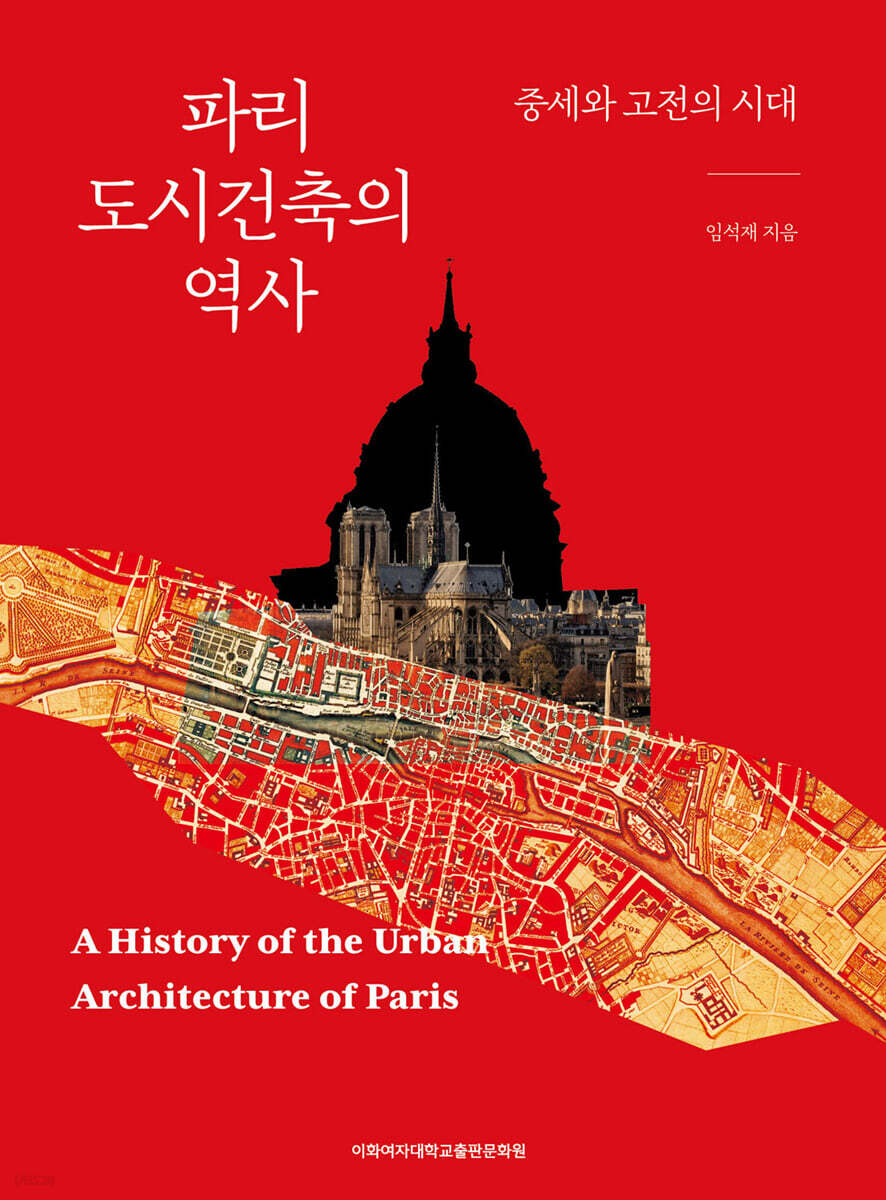
History of Parisian urban architecture
 |
Description
Book Introduction
From 52 BC to 1715 AD,
Discover Paris, the city of European classic masterpieces, through its classical golden age urban architecture.
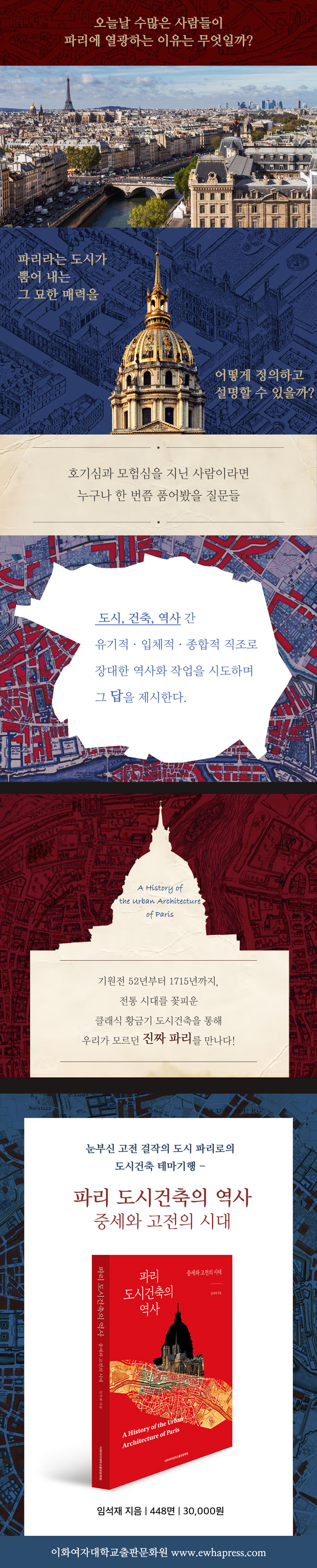
Why do so many people today rave about Paris? How can we define and explain the mysterious allure that the city exudes? This book is the definitive history of Parisian urban architecture, answering these questions—questions that have undoubtedly puzzled anyone with a sense of curiosity and adventure—through the lens of urban studies, architecture, and history.
Paris, which began as a Roman province around the 1st century BC, has developed and laid the foundations of an independent nation over the past 1,700 years, going through the Middle Ages and the Classical period. It can be said to be the capital of France and, by extension, of Europe.
This book examines the urban architecture of the "classical golden age" that flourished in Paris's traditional era, spanning several regions within the broader framework of the era, and examines the histories of the interesting and secret spaces reflected in it.
Based on the city's birth and growth, the urban structure formed in the process, and representative buildings of each era, we explore the history of change and development through numerous dynasties and kings from the founding of the city by Caesar (52 BC) to Louis XIV (1715), and find the meaning of the times.
The unique feature of this book, which consists of 26 chapters in 4 parts, is that it does not explore the three topics of Paris (urban studies), urban architecture (architecture), and history (historiography) separately, but rather organically and three-dimensionally synthesizes them, like weaving warp and weft.
Part 1, "What Kind of City is Paris?" begins with a general introduction to the city of Paris, and examines the cultural and historical significance of Paris, the reasons why Paris is loved, the unique characteristics and strengths of Paris, and the urban structure of modern Paris.
Then, the full-fledged history begins with Part 2, ‘Rome and the Early Christian Era,’ and continues through Part 3, ‘The Middle Ages,’ and Part 4, ‘The Early Modern Era.’
Part 2, which covers the birth of Paris, examines the history of urban architecture from its founding in the Roman era to the Merovingian era, when Paris converted to Christianity.
And in Part 3, which corresponds to the formative period of Paris, we look at the medieval period spanning three dynasties: the Carolingian dynasty, the Capetian dynasty, and the first half of the Bourbon dynasty. In Part 4, which corresponds to the growth period, we look at the urban architecture of Paris in the early modern period, consisting of the 16th-century Renaissance and the 17th-century Baroque.
In particular, the latter part of the book deals in detail with the history of major buildings that can be considered classical masterpieces, such as Notre Dame Cathedral, the Palais de la Cité, the Sainte-Chapelle, the Louvre, the Tuileries Palace, the Luxembourg Palace, the Palais Royal, the Val de Grasse, and Les Invalides.
As a representative building of Paris, Notre Dame Cathedral exudes a strong impression from its exterior. It is the first Gothic building to feature flying buttresses, and it vividly demonstrates the advancement of structural technology of the time, such as realizing the spirit of scholastic theology through the use of stained glass.
However, it is also a place with the dishonor of being a place where religious and superstitious beliefs were rampant, as it condoned and encouraged the formation of a red-light district around the cathedral.
By presenting the little-known origins, changes and developments, and later stories of each of Paris' representative buildings from its traditional era from various architectural and historical perspectives, we can examine the true face of the city of Paris.
This book is the result of a truly grand historical project, examining the history of Paris from its birth to its formation and growth, and introducing the circumstances and urban architecture of each era in detail through 26 chapters and 128 subtopics.
Through the rich and colorful historical material presented in this book, readers will enjoy an exciting time travel to the classical golden age of Paris, the "city of European classical masterpieces."
Discover Paris, the city of European classic masterpieces, through its classical golden age urban architecture.
Why do so many people today rave about Paris? How can we define and explain the mysterious allure that the city exudes? This book is the definitive history of Parisian urban architecture, answering these questions—questions that have undoubtedly puzzled anyone with a sense of curiosity and adventure—through the lens of urban studies, architecture, and history.
Paris, which began as a Roman province around the 1st century BC, has developed and laid the foundations of an independent nation over the past 1,700 years, going through the Middle Ages and the Classical period. It can be said to be the capital of France and, by extension, of Europe.
This book examines the urban architecture of the "classical golden age" that flourished in Paris's traditional era, spanning several regions within the broader framework of the era, and examines the histories of the interesting and secret spaces reflected in it.
Based on the city's birth and growth, the urban structure formed in the process, and representative buildings of each era, we explore the history of change and development through numerous dynasties and kings from the founding of the city by Caesar (52 BC) to Louis XIV (1715), and find the meaning of the times.
The unique feature of this book, which consists of 26 chapters in 4 parts, is that it does not explore the three topics of Paris (urban studies), urban architecture (architecture), and history (historiography) separately, but rather organically and three-dimensionally synthesizes them, like weaving warp and weft.
Part 1, "What Kind of City is Paris?" begins with a general introduction to the city of Paris, and examines the cultural and historical significance of Paris, the reasons why Paris is loved, the unique characteristics and strengths of Paris, and the urban structure of modern Paris.
Then, the full-fledged history begins with Part 2, ‘Rome and the Early Christian Era,’ and continues through Part 3, ‘The Middle Ages,’ and Part 4, ‘The Early Modern Era.’
Part 2, which covers the birth of Paris, examines the history of urban architecture from its founding in the Roman era to the Merovingian era, when Paris converted to Christianity.
And in Part 3, which corresponds to the formative period of Paris, we look at the medieval period spanning three dynasties: the Carolingian dynasty, the Capetian dynasty, and the first half of the Bourbon dynasty. In Part 4, which corresponds to the growth period, we look at the urban architecture of Paris in the early modern period, consisting of the 16th-century Renaissance and the 17th-century Baroque.
In particular, the latter part of the book deals in detail with the history of major buildings that can be considered classical masterpieces, such as Notre Dame Cathedral, the Palais de la Cité, the Sainte-Chapelle, the Louvre, the Tuileries Palace, the Luxembourg Palace, the Palais Royal, the Val de Grasse, and Les Invalides.
As a representative building of Paris, Notre Dame Cathedral exudes a strong impression from its exterior. It is the first Gothic building to feature flying buttresses, and it vividly demonstrates the advancement of structural technology of the time, such as realizing the spirit of scholastic theology through the use of stained glass.
However, it is also a place with the dishonor of being a place where religious and superstitious beliefs were rampant, as it condoned and encouraged the formation of a red-light district around the cathedral.
By presenting the little-known origins, changes and developments, and later stories of each of Paris' representative buildings from its traditional era from various architectural and historical perspectives, we can examine the true face of the city of Paris.
This book is the result of a truly grand historical project, examining the history of Paris from its birth to its formation and growth, and introducing the circumstances and urban architecture of each era in detail through 26 chapters and 128 subtopics.
Through the rich and colorful historical material presented in this book, readers will enjoy an exciting time travel to the classical golden age of Paris, the "city of European classical masterpieces."
- You can preview some of the book's contents.
Preview
index
prolog
Part 1.
What kind of city is Paris?
Chapter 1.
France's Cultural Power and the Characteristics of Parisian Urban Architecture: A Harmony of Hybridity and Formalization
France's Four Cultural Forces 1: Hybrid Culture
France's Four Cultural Forces 2: Openness, Synthesis, and Historicity
Six Urban Architectural Characteristics of Paris 1: Classicism + Social Formalization = Classical Formalization
Six Urban Architectural Characteristics of Paris 2: Structural Rationalism + Medieval Spirit = Medieval Rationalism
Six Urban Architectural Characteristics of Paris 3: The Commercialization of High Art
Chapter 2.
Ten Reasons to Say "Paris, Paris": From Urban Architecture to the Natural Environment
City-building capabilities: The only city that can rival Rome
National Art's Capabilities: A Treasure Trove of Historical Sites and the Blessing of the Seine
Chapter 3.
Paris's Urban Structure: Arrondissements and Concentric Circles
The Seine, the Faubourg, and the Arrondissements: The Geographical and Administrative Structure of Paris
Three Concentric Circles and the Citadel: Paris's Urban Structure as Seen Through Urban Engineering
Chapter 4.
20 Arrondissements: Three-layered concentric circles and dynamic expansion
1st concentric circle 1: 1st and 2nd spheres of the right bank
1st concentric circle 2: 3rd and 4th spheres of the right bank
1st concentric circle 3: 5th and 6th spheres of the left eye
2nd concentric circle 1: 7 balls
2nd concentric circle 2: 8-11 holes
3rd concentric circle 1: 12 balls
3rd concentric circle 2: 13-20 balls
Part 2.
Roman and Early Christian Era (51 BC–751 AD)
Chapter 5.
Roman era (51 BC–476 AD): Caesar and the Lutetia Parisiorum
Lutetia: a fortified market city founded by the Celtic Gauls
A Roman city complex: Lutetia Parisiorum, founded by Caesar
Paris, the city of boulevards: a network of crisscrossing boulevards and radial roads
Late Roman Period: Germanic Invasion and the Construction of the Cité Walls
Modern Parisians' Views of Roman Roots: Both Negative and Positive
Chapter 6.
Early Christian era (250–751): The activities of Sainte-Geneviève and Saint-Germain-des-Prés
The Problem of Defining the Early Christian Era in Paris
Saint-Denis and Saint-Martin: Converting Paris to a Christian City
Sainte-Geneviève: patron saint of Paris and its first spiritual leader
The Frankish Kingdom, Clovis I, and the Merovingian Dynasty: A Political History of Paris in the Early Christian Era
The Urban Architecture of Paris During the Merovingian Dynasty: Laying the Foundations of a Christian City
Saint-Germain-des-Prés: Shin Yu's transfer and relief efforts for the poor
Part 3.
Middle Ages (751–1514)
Chapter 7.
The Definition of the 'Middle Ages' and the Carolingian Dynasty (751–987): Paris, the Capital of the West Frankish Kingdom
The Periodization of the Middle Ages: A Treasure Trove of Rich Historical Discussion
Four criteria for categorizing medieval Paris: ecclesiastical history, political history, urban history, and architectural history
Carolingian Dynasty 1: The Establishment of French National Identity
Carolingian Dynasty 2: Viking Invasion
Chapter 8.
The Capetian Dynasty (987–1328): The golden age of medieval Paris
The Capetian Dynasty: The First True French Kingdom
11th-Century Paris's Stability: Laying the Foundation for a Trade Hub
The Golden Age of 12th-Century Paris: The Development of the East Bank and the Beginning of Great Christian and Non-Christian Architecture
The Paris of Philip II: The Beginning of its 13th-Century Golden Age
The Paris of Louis IX I: The Piety of the Holy King and the Highlight of the French Middle Ages
Louis IX's Paris 2: The 13th-Century Heyday and Christian Architecture
Louis IX's Paris 3: Surpassing Byzantium and the Holy Roman Empire
The Settlement of Paris: Peace and Prosperity in the 12th and 13th Centuries and the Identity of the Prince of Paris
Chapter 9.
The Middle Ages of the Valois Dynasty (1328–1515): Paris Overcoming Hardship and Rebounding
The Valois Dynasty: The Foundation for a Unified State Laid in a Time of Troubles
14th-15th Century Parisian Architecture: Securing Historicity Centered on Churches
The urban landscape of Paris during the Hundred Years' War (1337–1453): Steady development
The urban situation in Paris in the late 15th century: Emerging from war and preparing for the Renaissance
Chapter 10.
The Status of Medieval Paris: The Rise of Europe's Capital
Paris, the medieval city-state: From the center of Northern Europe to the capital of Europe
Two Backgrounds for Integration: Geographic Advantage and Historical and Political Assets
Achievements of Medieval Paris: Creating an Open Metropolis Civilization
Chapter 11.
Medieval Parisian Architecture: The Diverse Buildings Arranged in Four Districts
An Architectural Overview of Medieval Paris: A Comprehensive Capital of a Estates State
Paris, the City of Monasteries: Leading the Expansion of Paris by Renovating the Faubourg
The University of Paris: A cradle of intellectuals who led the medieval Renaissance and scholastic theology.
The four districts of medieval Paris: Ile de la Cité, Left Bank, Right Bank, and Faubourg
Medieval Paris in Pictures: The Problems of Overcrowding and Unsanitary
Chapter 12.
Notre Dame Cathedral 1: A Medieval Record of Glory and Shame
Witnesses of French History: Generating Rich Cultural Discussions
Phase 1 of the building's architectural history: the first flying buttresses in Gothic architecture
The Second Stage of the Building's Architectural History: Realizing Scholastic Theology with Stained Glass
The Medieval Ideal City that Embodies Paradise: Place du Parvis Notre-Dame
An Inescapable Dark History 1: Sexual Depravity in a Red-light District
The Inescapable Dark History 2: The Inquisition and the Myth of Healing
Rabelais's Gargantua and Pantagruel: The Duality of Notre Dame Criticized by Humanists
Chapter 13.
Notre Dame Cathedral 2: Witnesses to French History Since the Middle Ages
The 16th Century and Notre Dame's 'Historical Constancy': A Place for Royal Events and Civic Festivals
The Wars of Religion (1562–1598): The scene of the attempted murder of Coligny
During the Wars of Religion: Where Henry IV celebrated Mass and ended the Wars of Religion
17th century, Louis XIV era: The Fronde and Bernini's visit
Absolute Monarchy ~ 19th Century: A History of Decline, Destruction, and Restoration
Chapter 14.
The Palais de la Cité: A Compendium of French Political History
Cité Palace Overview: The royal palace complex, the cornerstone of Cité Island.
The Palais de la Cité in the Middle Ages: From the Conciergerie to the Paris Parlement
After the Palace: Paris's High Court, the Revolutionary Tribunal, and the Supreme Court
Chapter 15.
Sainte-Chapelle: Stained Glass, Scholastic Theology, Gallicism
A product of Louis IX's piety: a royal chapel that also housed the relics
Three complex functions: a sacristy, a royal chapel, and a university church.
Light and Stained Glass: Heaven Dramatized by the Ascension
Comparison with Notre Dame Cathedral: A Companion That Held Medieval Golden Age Together
The Golden Age of Scholastic Theology and Gallicism: A Representation of the 13th Century
Chapter 16.
Christian architecture in medieval Paris: patron saints, public functions, parish churches, and external saints
Eight Second Churches: A Treasury of Detailed Subjects Enriching the History of Medieval Paris
Saint-Germain-des-Prés and Saint-Gervais: the patron saint's church
Saint-Jacques and Saint-Eustache: The Church as a Public Function
Saint-Étienne-du-Mont and Saint-Germain-aux-Serrois: parish churches attached to the main complex
Saint-Séverin and Saint-Mary: The Church of the Saints Who Came from Outside
Part 4.
Early modern period (1515–1750)
Chapter 17.
Renaissance Paris (1515–1610): An overview of the urban landscape in 16th-century Paris.
The Beginning of the Paris Renaissance: 1515, Between the First Italian War and the Reformation
16th-Century French Renaissance: A Great Century Led by Many Kings
Urban Changes in Paris: Royal Settlement and Population Growth
Chapter 18.
Renaissance Paris: François I–Henry IV
François I: His Achievements in the Interior and His Urban Development Projects in Paris
Francis I II: Repairs to the Louvre Palace, construction of the Paris City Hall, and the mixed style of Saint-Eustache
Henry II, Charles IX, and Henry III: Catherine de Medici and the Construction of the Royal Palace
Rotisman Development Project: Paris's First Real Estate Investment Project
Henri IV 1: Public development, panoramic views, and cityscapes
Henry IV II: The first comprehensive completion of modern urbanization
Chapter 19.
Baroque Paris: An Overview of Urban Architecture and the Reign of Louis XIII (1610–1643)
Overview of Paris in the Baroque (1610-1715): Magnificent and Fantastic
Overview of Baroque Parisian Architecture: The Creation of Grand Manor and National Style
Louis XIII's real estate development projects: Île Saint-Louis, the Luxembourg Palace area, and the Cardinal's Palace area
Louis XIII's Architectural Projects: Initiating and Developing the Baroque
The Expansion of Parisian Urban Architecture: Individual Buildings and Citadels Expand Together
Chapter 20.
Baroque Paris: Louis XIV (1643–1715)
Louis XIV and the Presence of Paris: The Glory of Absolute Monarchy and the Capital of Europe
Paris Urban Development 1: Wall Expansion and Right Bank Development
Paris Urban Development 2: Building Tree-Planted Boulevards
Individual Building 1: 'Non-Christian vs.
Christian architecture is actively underway
Individual Building 2: Louis XIV's Obsession with the Arc de Triomphe
The Rise of the 'Court': Building a Parisian 'Street Culture' Tradition
Chapter 21.
The Louvre (1190–1678): From a castle-like palace to the Old Louvre
Four Royal Palaces of Early Modern Paris: Still in the Heart of Parisians
The Medieval Louvre: From its beginnings as a fortress-like royal palace to defend England
Old Louvre Phase 1: The Lescot Wing and the Beginning of the French National Style
Old Louvre Phase 2, Part 1: The Grand Design Overview
Old Louvre Phase 2 2: The section built during the reign of Henri IV, part of the 'Grand Design'
Old Louvre Phase 3: Construction of Louis XIII and the Clock House
Old Louvre Phase 4: Completion of Louis XIV and the Cour Carré
Dong-ik-rang: Bernini's Visit to Paris and the Awakening of the French National Style
Chapter 22.
The Tuileries Palace: A tragic palace beset by numerous misfortunes
Tuileries Palace Overview: Catherine de Medici's Royal Palace
Catherine's basic concept: connecting the Louvre Palace with a corridor overlooking the Seine.
Henry III and Henry IV: Completion of the first phase of the eye clinic at Bulan
Louis XIV and the Final Completion: Refining the Main Palace to Embody the Grandeur of a Royal Palace
Chapter 23.
The Luxembourg Palace and the Palais Royal: Secondary Royal Palaces on the Left and Right Banks
Architectural History of the Luxembourg Palace: Marie de Medici's Royal Palace
The Luxembourg Palace after Marie: Royal Palace - National Prison - Senate Building
The Architectural Significance of the Luxembourg Palace: An Intermediate Stage on the Path to a National Style
The Architectural History of the Palais Royal: From the Cardinal's Palace to the Ministry of Culture
The Architectural Aesthetics of the Palais Royal: Leading the Hotel's Symmetrical Composition
Chapter 24.
Louis XIII and the Baroque Church: The Clash of 'Italianism' and 'Frenchism'
Early modern cultural facilities and Baroque church architecture
Five Baroque Churches: Creating a National Style Under Gallicism
De Brosse's Saint-Gervais: Presenting 'Italianism' and 'Frenchism' Together
Lemercier's street facade of the Sorbonne: a model of Italianism
The Church of the Visitation of the Virgin Mary at Mansart: A Model of Frenchism
Chapter 25.
Parish Church of the Abbey of Val d'Grâce: The Consolidation of Italianism
Abbey of Val d'Grâce: Royal Abbey of Anne of Austro-Hungarian
Parish Church 1: Original plan by the first architect, Mansart
Louis XIV: Reduced the size of the monastery and expanded the parish church into a Latin cross and completed it.
Parish Church 2: A Masterpiece of Italianism, Compiling Italian Precedents
Chapter 26.
Louis XIV and the Invalides Hospital des Veterans: A National Form Perfected by Patriotism
Les Invalides: The Ultimate Perfection of the French National Style
Invalides Complex 1: Veterans Hospital
Invalides Complex 2: Extensions to the Church of Saint-Louis and the Church of Invalides
Completion of the National Style through the Church 1: Grandeur, Majesty, and Dignity of the Façade
The Completion of the State Form through the Church 2: Grand Manners Emphasized in Three Directions
Veterans Hospital Section: Patriotism as the Social Foundation of the National Style
Epilogue
List of plates
References
Search
Part 1.
What kind of city is Paris?
Chapter 1.
France's Cultural Power and the Characteristics of Parisian Urban Architecture: A Harmony of Hybridity and Formalization
France's Four Cultural Forces 1: Hybrid Culture
France's Four Cultural Forces 2: Openness, Synthesis, and Historicity
Six Urban Architectural Characteristics of Paris 1: Classicism + Social Formalization = Classical Formalization
Six Urban Architectural Characteristics of Paris 2: Structural Rationalism + Medieval Spirit = Medieval Rationalism
Six Urban Architectural Characteristics of Paris 3: The Commercialization of High Art
Chapter 2.
Ten Reasons to Say "Paris, Paris": From Urban Architecture to the Natural Environment
City-building capabilities: The only city that can rival Rome
National Art's Capabilities: A Treasure Trove of Historical Sites and the Blessing of the Seine
Chapter 3.
Paris's Urban Structure: Arrondissements and Concentric Circles
The Seine, the Faubourg, and the Arrondissements: The Geographical and Administrative Structure of Paris
Three Concentric Circles and the Citadel: Paris's Urban Structure as Seen Through Urban Engineering
Chapter 4.
20 Arrondissements: Three-layered concentric circles and dynamic expansion
1st concentric circle 1: 1st and 2nd spheres of the right bank
1st concentric circle 2: 3rd and 4th spheres of the right bank
1st concentric circle 3: 5th and 6th spheres of the left eye
2nd concentric circle 1: 7 balls
2nd concentric circle 2: 8-11 holes
3rd concentric circle 1: 12 balls
3rd concentric circle 2: 13-20 balls
Part 2.
Roman and Early Christian Era (51 BC–751 AD)
Chapter 5.
Roman era (51 BC–476 AD): Caesar and the Lutetia Parisiorum
Lutetia: a fortified market city founded by the Celtic Gauls
A Roman city complex: Lutetia Parisiorum, founded by Caesar
Paris, the city of boulevards: a network of crisscrossing boulevards and radial roads
Late Roman Period: Germanic Invasion and the Construction of the Cité Walls
Modern Parisians' Views of Roman Roots: Both Negative and Positive
Chapter 6.
Early Christian era (250–751): The activities of Sainte-Geneviève and Saint-Germain-des-Prés
The Problem of Defining the Early Christian Era in Paris
Saint-Denis and Saint-Martin: Converting Paris to a Christian City
Sainte-Geneviève: patron saint of Paris and its first spiritual leader
The Frankish Kingdom, Clovis I, and the Merovingian Dynasty: A Political History of Paris in the Early Christian Era
The Urban Architecture of Paris During the Merovingian Dynasty: Laying the Foundations of a Christian City
Saint-Germain-des-Prés: Shin Yu's transfer and relief efforts for the poor
Part 3.
Middle Ages (751–1514)
Chapter 7.
The Definition of the 'Middle Ages' and the Carolingian Dynasty (751–987): Paris, the Capital of the West Frankish Kingdom
The Periodization of the Middle Ages: A Treasure Trove of Rich Historical Discussion
Four criteria for categorizing medieval Paris: ecclesiastical history, political history, urban history, and architectural history
Carolingian Dynasty 1: The Establishment of French National Identity
Carolingian Dynasty 2: Viking Invasion
Chapter 8.
The Capetian Dynasty (987–1328): The golden age of medieval Paris
The Capetian Dynasty: The First True French Kingdom
11th-Century Paris's Stability: Laying the Foundation for a Trade Hub
The Golden Age of 12th-Century Paris: The Development of the East Bank and the Beginning of Great Christian and Non-Christian Architecture
The Paris of Philip II: The Beginning of its 13th-Century Golden Age
The Paris of Louis IX I: The Piety of the Holy King and the Highlight of the French Middle Ages
Louis IX's Paris 2: The 13th-Century Heyday and Christian Architecture
Louis IX's Paris 3: Surpassing Byzantium and the Holy Roman Empire
The Settlement of Paris: Peace and Prosperity in the 12th and 13th Centuries and the Identity of the Prince of Paris
Chapter 9.
The Middle Ages of the Valois Dynasty (1328–1515): Paris Overcoming Hardship and Rebounding
The Valois Dynasty: The Foundation for a Unified State Laid in a Time of Troubles
14th-15th Century Parisian Architecture: Securing Historicity Centered on Churches
The urban landscape of Paris during the Hundred Years' War (1337–1453): Steady development
The urban situation in Paris in the late 15th century: Emerging from war and preparing for the Renaissance
Chapter 10.
The Status of Medieval Paris: The Rise of Europe's Capital
Paris, the medieval city-state: From the center of Northern Europe to the capital of Europe
Two Backgrounds for Integration: Geographic Advantage and Historical and Political Assets
Achievements of Medieval Paris: Creating an Open Metropolis Civilization
Chapter 11.
Medieval Parisian Architecture: The Diverse Buildings Arranged in Four Districts
An Architectural Overview of Medieval Paris: A Comprehensive Capital of a Estates State
Paris, the City of Monasteries: Leading the Expansion of Paris by Renovating the Faubourg
The University of Paris: A cradle of intellectuals who led the medieval Renaissance and scholastic theology.
The four districts of medieval Paris: Ile de la Cité, Left Bank, Right Bank, and Faubourg
Medieval Paris in Pictures: The Problems of Overcrowding and Unsanitary
Chapter 12.
Notre Dame Cathedral 1: A Medieval Record of Glory and Shame
Witnesses of French History: Generating Rich Cultural Discussions
Phase 1 of the building's architectural history: the first flying buttresses in Gothic architecture
The Second Stage of the Building's Architectural History: Realizing Scholastic Theology with Stained Glass
The Medieval Ideal City that Embodies Paradise: Place du Parvis Notre-Dame
An Inescapable Dark History 1: Sexual Depravity in a Red-light District
The Inescapable Dark History 2: The Inquisition and the Myth of Healing
Rabelais's Gargantua and Pantagruel: The Duality of Notre Dame Criticized by Humanists
Chapter 13.
Notre Dame Cathedral 2: Witnesses to French History Since the Middle Ages
The 16th Century and Notre Dame's 'Historical Constancy': A Place for Royal Events and Civic Festivals
The Wars of Religion (1562–1598): The scene of the attempted murder of Coligny
During the Wars of Religion: Where Henry IV celebrated Mass and ended the Wars of Religion
17th century, Louis XIV era: The Fronde and Bernini's visit
Absolute Monarchy ~ 19th Century: A History of Decline, Destruction, and Restoration
Chapter 14.
The Palais de la Cité: A Compendium of French Political History
Cité Palace Overview: The royal palace complex, the cornerstone of Cité Island.
The Palais de la Cité in the Middle Ages: From the Conciergerie to the Paris Parlement
After the Palace: Paris's High Court, the Revolutionary Tribunal, and the Supreme Court
Chapter 15.
Sainte-Chapelle: Stained Glass, Scholastic Theology, Gallicism
A product of Louis IX's piety: a royal chapel that also housed the relics
Three complex functions: a sacristy, a royal chapel, and a university church.
Light and Stained Glass: Heaven Dramatized by the Ascension
Comparison with Notre Dame Cathedral: A Companion That Held Medieval Golden Age Together
The Golden Age of Scholastic Theology and Gallicism: A Representation of the 13th Century
Chapter 16.
Christian architecture in medieval Paris: patron saints, public functions, parish churches, and external saints
Eight Second Churches: A Treasury of Detailed Subjects Enriching the History of Medieval Paris
Saint-Germain-des-Prés and Saint-Gervais: the patron saint's church
Saint-Jacques and Saint-Eustache: The Church as a Public Function
Saint-Étienne-du-Mont and Saint-Germain-aux-Serrois: parish churches attached to the main complex
Saint-Séverin and Saint-Mary: The Church of the Saints Who Came from Outside
Part 4.
Early modern period (1515–1750)
Chapter 17.
Renaissance Paris (1515–1610): An overview of the urban landscape in 16th-century Paris.
The Beginning of the Paris Renaissance: 1515, Between the First Italian War and the Reformation
16th-Century French Renaissance: A Great Century Led by Many Kings
Urban Changes in Paris: Royal Settlement and Population Growth
Chapter 18.
Renaissance Paris: François I–Henry IV
François I: His Achievements in the Interior and His Urban Development Projects in Paris
Francis I II: Repairs to the Louvre Palace, construction of the Paris City Hall, and the mixed style of Saint-Eustache
Henry II, Charles IX, and Henry III: Catherine de Medici and the Construction of the Royal Palace
Rotisman Development Project: Paris's First Real Estate Investment Project
Henri IV 1: Public development, panoramic views, and cityscapes
Henry IV II: The first comprehensive completion of modern urbanization
Chapter 19.
Baroque Paris: An Overview of Urban Architecture and the Reign of Louis XIII (1610–1643)
Overview of Paris in the Baroque (1610-1715): Magnificent and Fantastic
Overview of Baroque Parisian Architecture: The Creation of Grand Manor and National Style
Louis XIII's real estate development projects: Île Saint-Louis, the Luxembourg Palace area, and the Cardinal's Palace area
Louis XIII's Architectural Projects: Initiating and Developing the Baroque
The Expansion of Parisian Urban Architecture: Individual Buildings and Citadels Expand Together
Chapter 20.
Baroque Paris: Louis XIV (1643–1715)
Louis XIV and the Presence of Paris: The Glory of Absolute Monarchy and the Capital of Europe
Paris Urban Development 1: Wall Expansion and Right Bank Development
Paris Urban Development 2: Building Tree-Planted Boulevards
Individual Building 1: 'Non-Christian vs.
Christian architecture is actively underway
Individual Building 2: Louis XIV's Obsession with the Arc de Triomphe
The Rise of the 'Court': Building a Parisian 'Street Culture' Tradition
Chapter 21.
The Louvre (1190–1678): From a castle-like palace to the Old Louvre
Four Royal Palaces of Early Modern Paris: Still in the Heart of Parisians
The Medieval Louvre: From its beginnings as a fortress-like royal palace to defend England
Old Louvre Phase 1: The Lescot Wing and the Beginning of the French National Style
Old Louvre Phase 2, Part 1: The Grand Design Overview
Old Louvre Phase 2 2: The section built during the reign of Henri IV, part of the 'Grand Design'
Old Louvre Phase 3: Construction of Louis XIII and the Clock House
Old Louvre Phase 4: Completion of Louis XIV and the Cour Carré
Dong-ik-rang: Bernini's Visit to Paris and the Awakening of the French National Style
Chapter 22.
The Tuileries Palace: A tragic palace beset by numerous misfortunes
Tuileries Palace Overview: Catherine de Medici's Royal Palace
Catherine's basic concept: connecting the Louvre Palace with a corridor overlooking the Seine.
Henry III and Henry IV: Completion of the first phase of the eye clinic at Bulan
Louis XIV and the Final Completion: Refining the Main Palace to Embody the Grandeur of a Royal Palace
Chapter 23.
The Luxembourg Palace and the Palais Royal: Secondary Royal Palaces on the Left and Right Banks
Architectural History of the Luxembourg Palace: Marie de Medici's Royal Palace
The Luxembourg Palace after Marie: Royal Palace - National Prison - Senate Building
The Architectural Significance of the Luxembourg Palace: An Intermediate Stage on the Path to a National Style
The Architectural History of the Palais Royal: From the Cardinal's Palace to the Ministry of Culture
The Architectural Aesthetics of the Palais Royal: Leading the Hotel's Symmetrical Composition
Chapter 24.
Louis XIII and the Baroque Church: The Clash of 'Italianism' and 'Frenchism'
Early modern cultural facilities and Baroque church architecture
Five Baroque Churches: Creating a National Style Under Gallicism
De Brosse's Saint-Gervais: Presenting 'Italianism' and 'Frenchism' Together
Lemercier's street facade of the Sorbonne: a model of Italianism
The Church of the Visitation of the Virgin Mary at Mansart: A Model of Frenchism
Chapter 25.
Parish Church of the Abbey of Val d'Grâce: The Consolidation of Italianism
Abbey of Val d'Grâce: Royal Abbey of Anne of Austro-Hungarian
Parish Church 1: Original plan by the first architect, Mansart
Louis XIV: Reduced the size of the monastery and expanded the parish church into a Latin cross and completed it.
Parish Church 2: A Masterpiece of Italianism, Compiling Italian Precedents
Chapter 26.
Louis XIV and the Invalides Hospital des Veterans: A National Form Perfected by Patriotism
Les Invalides: The Ultimate Perfection of the French National Style
Invalides Complex 1: Veterans Hospital
Invalides Complex 2: Extensions to the Church of Saint-Louis and the Church of Invalides
Completion of the National Style through the Church 1: Grandeur, Majesty, and Dignity of the Façade
The Completion of the State Form through the Church 2: Grand Manners Emphasized in Three Directions
Veterans Hospital Section: Patriotism as the Social Foundation of the National Style
Epilogue
List of plates
References
Search
Detailed image
Into the book
In Europe, there has been a tradition since the Middle Ages of celebrating civic festivals or city festivals together with Christian holidays, and the Fool's Day was one of them.
Held between Christmas and Epiphany, it was a boisterous festival that often went beyond enthusiasm and into frenzy as the suppressed desire to play erupted in the excitement of the end of the year.
So, they were given the words 'fools' and 'crazy people'.
The riots took place throughout Paris, with the Place de la Notre Dame being the most important and central location.
Major festivals, including the Basilica of the Assumption, are accompanied by processions, and Notre Dame was both the starting point and the end point of these processions.
In this respect, the medieval city festivals were more than just mere entertainment events; they were also a place for the various civic organizations of Paris to come together and unite.
Notre Dame Square was a space where such harmony and integration took place.
--- p.201
In the 14th century, the early years of the Valois dynasty, the country was plagued by crises both large and small, such as the Hundred Years' War, the Jacquerie's Revolt, and the Marcel's Revolt.
The one who solely faced this crisis was King Jang II (reigned 1350-1364), when rebels invaded the Cité Palace and murdered a high-ranking official.
Charles V (reigned 1364–1380), who witnessed this at a young age, hated such memories and left the Palais de la Cité in 1364, the year of his accession to the throne, to make the Louvre his new home.
As a result, only the functions of the court, banquets, and assemblies remained in the city palace, and in the process of strengthening the judicial function, the prison area was also expanded.
(…) During the Ancien Régime period before the French Revolution, the Palais de la Cité became the headquarters of the French judiciary and a symbolic place to check the absolute monarchy.
--- p.220~221
Usually, the pinnacle of stained glass is considered to be Notre Dame Cathedral in Chartres, located in the Île-de-France region near Paris, but in terms of daring, dynamism, and artistry, Sainte-Chapelle is by far the best.
When you first step in, the only thing that comes out is an exclamation of 'Ah!' No other words are needed.
Among the countless classical masterpieces that adorn European architecture, few evoke such awe-inspiring reactions.
(…) (The windows of the Sainte-Chapelle) go beyond appearing wider than they actually are and have an extreme, dramatic, and exaggerated quality.
Medieval Europeans living in a Christian civilization would have been able to immediately and experientially understand what this vertical polarization symbolized.
It is to head towards heaven or to worship heaven.
Moreover, stained glass faithfully fulfills the role of a 'picture Bible', an important religious role of medieval cathedrals, in that it depicts biblical content.
Held between Christmas and Epiphany, it was a boisterous festival that often went beyond enthusiasm and into frenzy as the suppressed desire to play erupted in the excitement of the end of the year.
So, they were given the words 'fools' and 'crazy people'.
The riots took place throughout Paris, with the Place de la Notre Dame being the most important and central location.
Major festivals, including the Basilica of the Assumption, are accompanied by processions, and Notre Dame was both the starting point and the end point of these processions.
In this respect, the medieval city festivals were more than just mere entertainment events; they were also a place for the various civic organizations of Paris to come together and unite.
Notre Dame Square was a space where such harmony and integration took place.
--- p.201
In the 14th century, the early years of the Valois dynasty, the country was plagued by crises both large and small, such as the Hundred Years' War, the Jacquerie's Revolt, and the Marcel's Revolt.
The one who solely faced this crisis was King Jang II (reigned 1350-1364), when rebels invaded the Cité Palace and murdered a high-ranking official.
Charles V (reigned 1364–1380), who witnessed this at a young age, hated such memories and left the Palais de la Cité in 1364, the year of his accession to the throne, to make the Louvre his new home.
As a result, only the functions of the court, banquets, and assemblies remained in the city palace, and in the process of strengthening the judicial function, the prison area was also expanded.
(…) During the Ancien Régime period before the French Revolution, the Palais de la Cité became the headquarters of the French judiciary and a symbolic place to check the absolute monarchy.
--- p.220~221
Usually, the pinnacle of stained glass is considered to be Notre Dame Cathedral in Chartres, located in the Île-de-France region near Paris, but in terms of daring, dynamism, and artistry, Sainte-Chapelle is by far the best.
When you first step in, the only thing that comes out is an exclamation of 'Ah!' No other words are needed.
Among the countless classical masterpieces that adorn European architecture, few evoke such awe-inspiring reactions.
(…) (The windows of the Sainte-Chapelle) go beyond appearing wider than they actually are and have an extreme, dramatic, and exaggerated quality.
Medieval Europeans living in a Christian civilization would have been able to immediately and experientially understand what this vertical polarization symbolized.
It is to head towards heaven or to worship heaven.
Moreover, stained glass faithfully fulfills the role of a 'picture Bible', an important religious role of medieval cathedrals, in that it depicts biblical content.
--- p.229~231
GOODS SPECIFICS
- Date of issue: July 5, 2023
- Page count, weight, size: 448 pages | 170*230*22mm
- ISBN13: 9791158904876
- ISBN10: 1158904878
You may also like
카테고리
korean


korean

![GQ KOREA Mark (Monthly): December [2025]](http://librairie.coreenne.fr/cdn/shop/files/8ef265dbbfbf186523ed75ba7319009d.jpg?v=1765340328&width=3840)


