

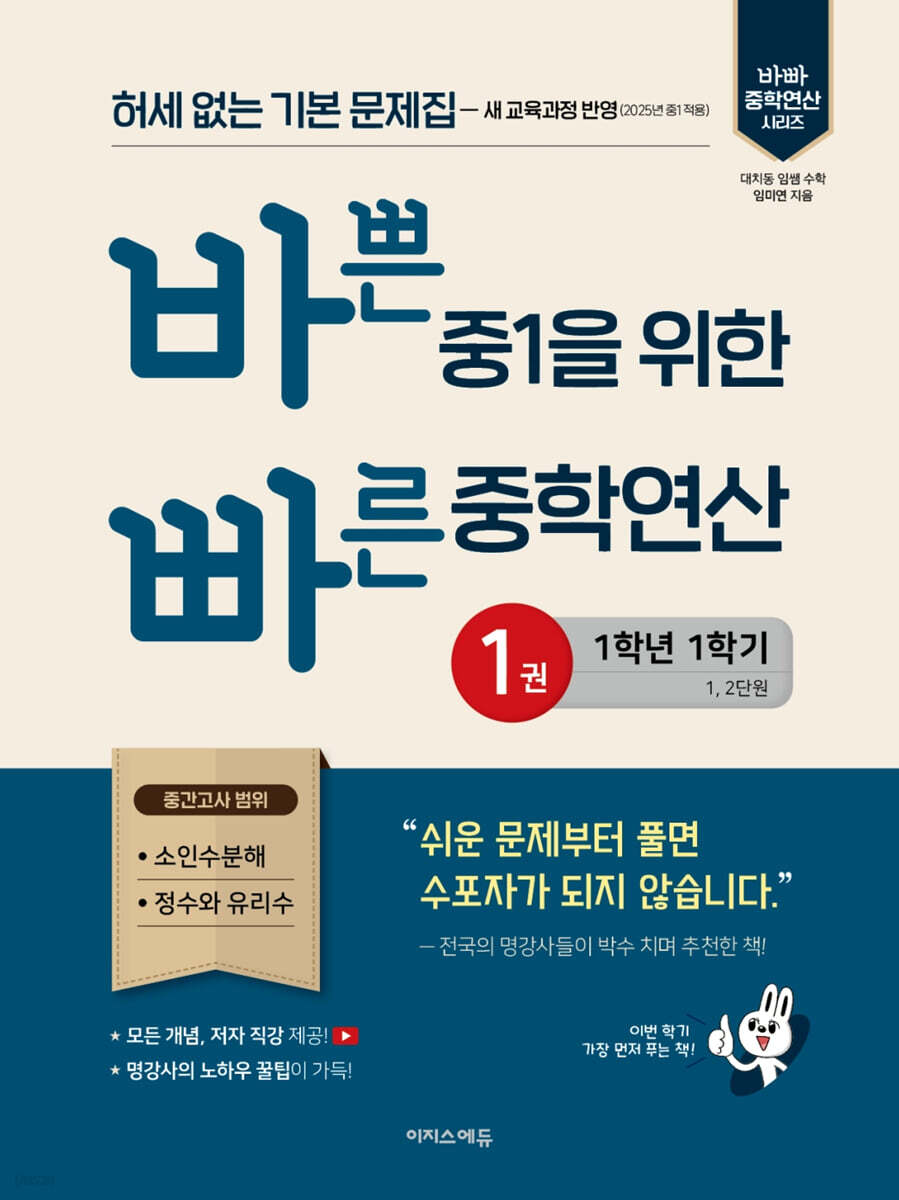
Quick Middle School Calculation for Busy Middle School Students, Volume 1 (2026 Edition)
 |
Description
Book Introduction
“If you start with easy problems, you won’t fail.” Basic, No-Pretend Workbook - "Busy Middle School Math" 2022 Revised Curriculum Edition Released! The perfect age for self-study: first year middle school! "Quick Middle School Math for Busy First Years" (hereafter "Busy First Years Math"), a middle school math textbook designed for independent study, has been updated to reflect the 2022 revised curriculum. 'Busy Middle School 1st Grade Math' is divided into two volumes for the first semester and contains the largest number of problems by type. Volume 1 of 'Busy Middle School 1st Grade Math' covers the midterm exam for the first semester of the first year, and is a training book that progresses from basic problems in a small step manner, so you can understand the concepts on your own while solving them. The first math book for first-year middle school students should be easy enough for them to solve on their own. The explanation of 'Busy Middle School 1st Grade Math' is easy. It's as if the teacher is speaking right in front of the students, so they can solve problems without getting frustrated. This book's 'Busy Tips' also contains the know-how of the author, a renowned lecturer in Daechi-dong. Additionally, 'Author Direct Concept Lecture Videos' are provided for every step of this book, allowing you to hear explanations of concepts directly. Therefore, even if you solve it alone, you can build a solid foundation. Additionally, through the 'Oops! Mistake' corner, we have compiled the points of mistakes that 70% of middle school students frequently make. Lastly, the 'Easy Test Questions' corner includes basic questions that are sure to appear on the exam and 'hit rates', so if you solve only this book in the first semester of the first year of middle school, you will be prepared for the school exam. |
- You can preview some of the book's contents.
Preview
index
First yard.
Factorization 01 Prime and composite numbers
02 Meaning and expression of exponentiation
03 Factorization
04 Creating square numbers
05 Finding the divisors and number of divisors using prime factorization
Second yard.
Greatest common divisor and least common multiple
06 Finding the Greatest Common Divisor Using the Reverse Division Method
07 Finding the greatest common divisor using prime factorization
08 Finding the Least Common Multiple Using the Reverse Division Method
09 Finding the least common multiple using prime factorization
10 Applications of the Greatest Common Divisor and the Least Common Multiple
Third yard.
Integers and rational numbers
11 integers
12 rational numbers
13 Absolute value
14 The relationship between absolute values and distance
15. The relationship between numbers
16 A number between two rational numbers
Fourth yard.
Calculation of integers and rational numbers
17 Addition of integers
18 Addition of rational numbers
19 Subtraction of integers
20 Subtraction of rational numbers
21 Mixed calculations of addition and subtraction
22 Addition and subtraction of numbers without signs or parentheses
23 Applications of addition and subtraction
24 multiplication
Calculating powers of 25
26 Division
27 Mixed calculations of addition, subtraction, multiplication, and division - calculations without parentheses, calculations with parentheses
28 Mixed calculations of addition, subtraction, multiplication, and division - calculations with exponents, parentheses, curly brackets, and square brackets
Factorization 01 Prime and composite numbers
02 Meaning and expression of exponentiation
03 Factorization
04 Creating square numbers
05 Finding the divisors and number of divisors using prime factorization
Second yard.
Greatest common divisor and least common multiple
06 Finding the Greatest Common Divisor Using the Reverse Division Method
07 Finding the greatest common divisor using prime factorization
08 Finding the Least Common Multiple Using the Reverse Division Method
09 Finding the least common multiple using prime factorization
10 Applications of the Greatest Common Divisor and the Least Common Multiple
Third yard.
Integers and rational numbers
11 integers
12 rational numbers
13 Absolute value
14 The relationship between absolute values and distance
15. The relationship between numbers
16 A number between two rational numbers
Fourth yard.
Calculation of integers and rational numbers
17 Addition of integers
18 Addition of rational numbers
19 Subtraction of integers
20 Subtraction of rational numbers
21 Mixed calculations of addition and subtraction
22 Addition and subtraction of numbers without signs or parentheses
23 Applications of addition and subtraction
24 multiplication
Calculating powers of 25
26 Division
27 Mixed calculations of addition, subtraction, multiplication, and division - calculations without parentheses, calculations with parentheses
28 Mixed calculations of addition, subtraction, multiplication, and division - calculations with exponents, parentheses, curly brackets, and square brackets
Detailed image
.jpg)
Publisher's Review
Middle school 1st grade math is the foundation of middle and high school math!
How should I study to do well in middle school math?
Build a solid foundation in middle school math and move on!
Mathematics is a subject with a strong systematic structure, with units connected from middle school mathematics to high school mathematics.
The first semester of the first year of middle school mathematics covers algebra for all three grades, and the content is linked to the first through third year of middle school.
In particular, integers, rational numbers, linear equations, graphs, and proportional areas in the first year of middle school are important units that form the basis of middle and high school algebra.
This book is faithful to the most basic issues that middle school students need to know.
So, what should I do first to study middle school math efficiently?
1) It is better to start with easy problems and solve them one by one.
2) It is better to encounter many difficult problems.
Study experts say this:
“If it is difficult to learn, it helps you remember it for a long time.
However, if the learner does not have background knowledge, the difficulty becomes undesirable.” If the math problem is too difficult without background knowledge, the brain cannot overcome fatigue and gives up on studying.
So, if you are a student who is good at math, number 2 is the correct answer, but if you are an average student, number 1 is the correct answer.
Let's build a foundation in math with calculations and basic problems!
Operations can be said to be the basic physical strength of mathematics.
You need to build your high school math skills on the foundation you built in middle school, but if you have difficulty with calculations, it will be difficult to improve your math grades in high school.
Also, starting with a basic workbook is actually faster than solving several difficult workbooks.
You need to first build a solid foundation of conceptual understanding and calculations to build the strength to solve even more difficult problems!
'Busy Middle School Math' is a book that helps you solve basic math problems and calculations that are the foundation of math. It is a unique book among the books currently on the market that is designed to be solved on your own without a teacher.
Busy tips from a famous instructor in Daechi-dong! It feels like the teacher is right next to you.
Existing books simply collect vast amounts of knowledge into one volume, but do not teach how to study it.
So, I often relied on my teacher.
However, this book contains detailed study tips as if the teacher were teaching you face-to-face.
Each concept is explained in detail at each stage, and the "Busy Tips" from Daechi-dong's renowned instructors are included, making it easy to understand even when studying on your own.
Additionally, the author provides video lectures on concepts at every step of the book, allowing you to hear explanations of the concepts directly.
The first semester is divided into two volumes, containing the largest number of problems by type!
Once you understand the concept, you should now practice solving enough problems until you feel comfortable with the concept.
'Quick Middle School Math for Busy Middle School Students' contains the largest number of problems by area, from easy problems to school exam-type problems, to ensure sufficient math training.
So, I divided the first semester of first grade mathematics into two volumes.
As you solve the problems in this book, a problem-solving circuit for each type will naturally form in your head.
70% of middle school students get this problem wrong, solved with the "Oops! Mistake" and "Go! X-Man and ○-Man" corners!
Even friends who are good at math often lose points due to calculation mistakes.
This book has a special device in place to prevent you from receiving a lower score than your actual ability due to calculation errors.
We've compiled the points of error that 70% of middle school students frequently make in the "Oops! Mistake" section on the concept page.
Additionally, the 'Go! ×Man and ○Man' corner allows you to check at a glance which calculations are correct and which are incorrect, which helps to drastically reduce calculation errors.
Additionally, at the end of each stage, we've included 'free exam questions', suggesting middle school exam questions that can be solved just by practicing in this book.
There are many school exam questions that can be answered correctly just by solving all the problems in this book.
If you're a middle school student, it's time to organize your concepts and learn problem-solving techniques! "Busy Middle School Math" will help you.
Build a solid foundation in middle school math with this book!
How to effectively view the "Busy Middle School Math and Geometry" series
The 'Busy Middle School Math and Geometry' series consists of two volumes of 'Busy Middle School Math' for the first semester and one volume of 'Busy Middle School Geometry' for the second semester.
1.
Want to strengthen only your weak areas? - Choose just one of the three books!
If you find prime factorization or integers and rational numbers difficult during the first year of middle school, choose and organize the middle school operation volume 1, 『Prime Factorization, Integers and Rational Numbers』; if you find linear equations or graphs and proportions difficult, choose the middle school operation volume 2, 『Linear Equations, Graphs and Proportional Area』; and if you find shapes difficult, choose and organize the middle school geometry book, 『Basic Shapes and Construction, Plane Figures, Three-Dimensional Figures, Statistics』.
Even if you are a middle school student, whether you are a first-year or second-year student, focus on studying your weak areas to quickly make up for your learning deficits.
2.
What if I am a first-year middle school student but weak in math, or a prospective first-year middle school student preparing for middle school math?
Study in the following order: [Middle School Math Volume 1 → Middle School Math Volume 2 → Middle School Geometry] according to the progress of middle school math.
You can solve basic problems, so you can build a solid foundation for middle school mathematics.
3.
What if you are a teacher at a school or a study room?
1) For students who lack basic knowledge, briefly explain the concepts and then use it as a self-study material.
2) For students who have mastered the concept, use it as a textbook for homework.
3) It is suitable as a short-term textbook for vacation to supplement light pre-learning and learning deficits.
*Busy Middle School 1st Grade Operations Volume 1 consists of 28 levels, Volume 2 consists of 25 levels, and each level can be solved within 1 hour.
How should I study to do well in middle school math?
Build a solid foundation in middle school math and move on!
Mathematics is a subject with a strong systematic structure, with units connected from middle school mathematics to high school mathematics.
The first semester of the first year of middle school mathematics covers algebra for all three grades, and the content is linked to the first through third year of middle school.
In particular, integers, rational numbers, linear equations, graphs, and proportional areas in the first year of middle school are important units that form the basis of middle and high school algebra.
This book is faithful to the most basic issues that middle school students need to know.
So, what should I do first to study middle school math efficiently?
1) It is better to start with easy problems and solve them one by one.
2) It is better to encounter many difficult problems.
Study experts say this:
“If it is difficult to learn, it helps you remember it for a long time.
However, if the learner does not have background knowledge, the difficulty becomes undesirable.” If the math problem is too difficult without background knowledge, the brain cannot overcome fatigue and gives up on studying.
So, if you are a student who is good at math, number 2 is the correct answer, but if you are an average student, number 1 is the correct answer.
Let's build a foundation in math with calculations and basic problems!
Operations can be said to be the basic physical strength of mathematics.
You need to build your high school math skills on the foundation you built in middle school, but if you have difficulty with calculations, it will be difficult to improve your math grades in high school.
Also, starting with a basic workbook is actually faster than solving several difficult workbooks.
You need to first build a solid foundation of conceptual understanding and calculations to build the strength to solve even more difficult problems!
'Busy Middle School Math' is a book that helps you solve basic math problems and calculations that are the foundation of math. It is a unique book among the books currently on the market that is designed to be solved on your own without a teacher.
Busy tips from a famous instructor in Daechi-dong! It feels like the teacher is right next to you.
Existing books simply collect vast amounts of knowledge into one volume, but do not teach how to study it.
So, I often relied on my teacher.
However, this book contains detailed study tips as if the teacher were teaching you face-to-face.
Each concept is explained in detail at each stage, and the "Busy Tips" from Daechi-dong's renowned instructors are included, making it easy to understand even when studying on your own.
Additionally, the author provides video lectures on concepts at every step of the book, allowing you to hear explanations of the concepts directly.
The first semester is divided into two volumes, containing the largest number of problems by type!
Once you understand the concept, you should now practice solving enough problems until you feel comfortable with the concept.
'Quick Middle School Math for Busy Middle School Students' contains the largest number of problems by area, from easy problems to school exam-type problems, to ensure sufficient math training.
So, I divided the first semester of first grade mathematics into two volumes.
As you solve the problems in this book, a problem-solving circuit for each type will naturally form in your head.
70% of middle school students get this problem wrong, solved with the "Oops! Mistake" and "Go! X-Man and ○-Man" corners!
Even friends who are good at math often lose points due to calculation mistakes.
This book has a special device in place to prevent you from receiving a lower score than your actual ability due to calculation errors.
We've compiled the points of error that 70% of middle school students frequently make in the "Oops! Mistake" section on the concept page.
Additionally, the 'Go! ×Man and ○Man' corner allows you to check at a glance which calculations are correct and which are incorrect, which helps to drastically reduce calculation errors.
Additionally, at the end of each stage, we've included 'free exam questions', suggesting middle school exam questions that can be solved just by practicing in this book.
There are many school exam questions that can be answered correctly just by solving all the problems in this book.
If you're a middle school student, it's time to organize your concepts and learn problem-solving techniques! "Busy Middle School Math" will help you.
Build a solid foundation in middle school math with this book!
How to effectively view the "Busy Middle School Math and Geometry" series
The 'Busy Middle School Math and Geometry' series consists of two volumes of 'Busy Middle School Math' for the first semester and one volume of 'Busy Middle School Geometry' for the second semester.
1.
Want to strengthen only your weak areas? - Choose just one of the three books!
If you find prime factorization or integers and rational numbers difficult during the first year of middle school, choose and organize the middle school operation volume 1, 『Prime Factorization, Integers and Rational Numbers』; if you find linear equations or graphs and proportions difficult, choose the middle school operation volume 2, 『Linear Equations, Graphs and Proportional Area』; and if you find shapes difficult, choose and organize the middle school geometry book, 『Basic Shapes and Construction, Plane Figures, Three-Dimensional Figures, Statistics』.
Even if you are a middle school student, whether you are a first-year or second-year student, focus on studying your weak areas to quickly make up for your learning deficits.
2.
What if I am a first-year middle school student but weak in math, or a prospective first-year middle school student preparing for middle school math?
Study in the following order: [Middle School Math Volume 1 → Middle School Math Volume 2 → Middle School Geometry] according to the progress of middle school math.
You can solve basic problems, so you can build a solid foundation for middle school mathematics.
3.
What if you are a teacher at a school or a study room?
1) For students who lack basic knowledge, briefly explain the concepts and then use it as a self-study material.
2) For students who have mastered the concept, use it as a textbook for homework.
3) It is suitable as a short-term textbook for vacation to supplement light pre-learning and learning deficits.
*Busy Middle School 1st Grade Operations Volume 1 consists of 28 levels, Volume 2 consists of 25 levels, and each level can be solved within 1 hour.
GOODS SPECIFICS
- Date of issue: June 30, 2024
- Page count, weight, size: 220 pages | 594g | 210*280*20mm
- ISBN13: 9791163035992
- Reference book for grade level: 1st year of middle school
- Reference book usage period: 1st semester
You may also like
카테고리
korean


korean

![ELLE 엘르 스페셜 에디션 A형 : 12월 [2025]](http://librairie.coreenne.fr/cdn/shop/files/b8e27a3de6c9538896439686c6b0e8fb.jpg?v=1766436872&width=3840)


