

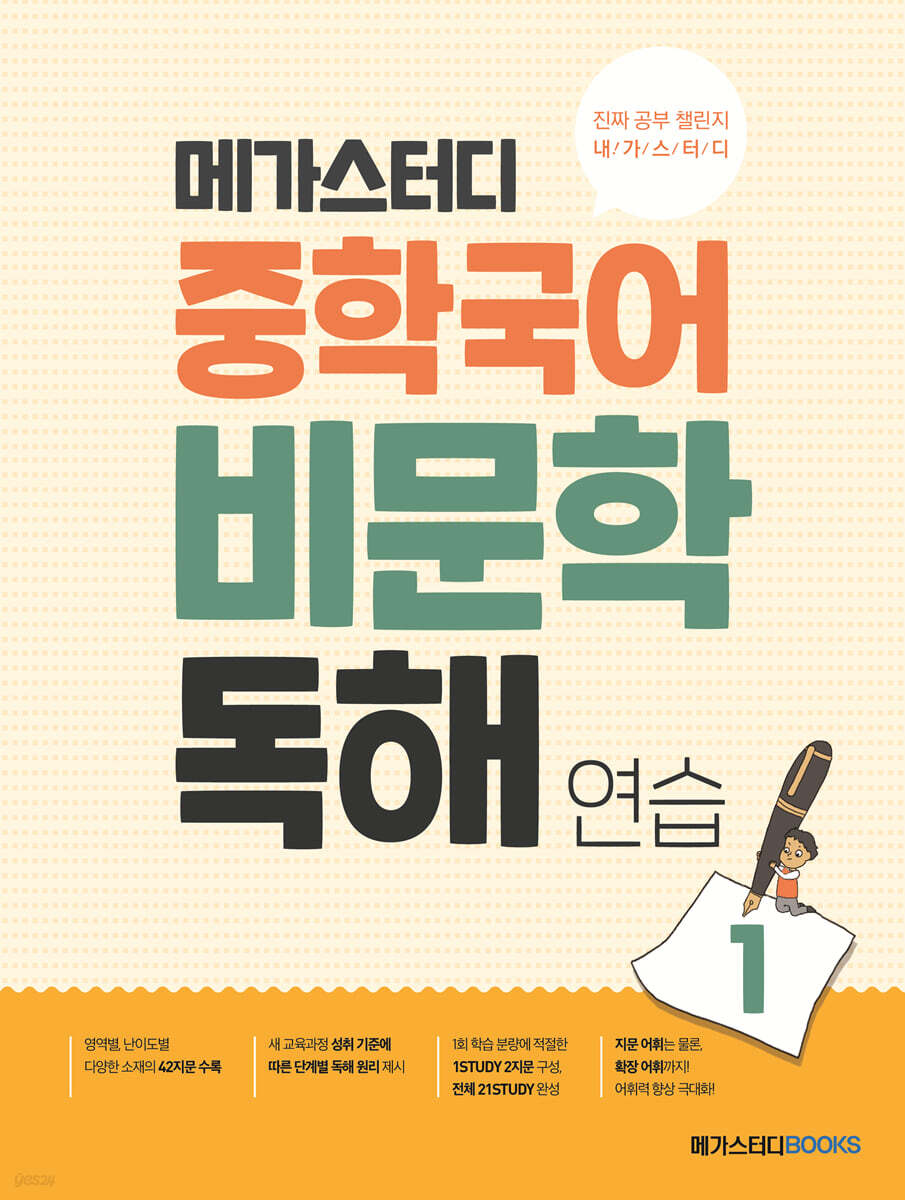
Megastudy Middle School Korean Non-Fiction Reading Practice 1
 |
Description
Book Introduction
"Mega Study Middle School Korean Non-Fiction Reading Practice" is a basic reading book that allows for systematic practice of 42 non-fiction materials carefully selected by subject and difficulty level.
An efficient learning system for non-fiction reading was applied by composing one STUDY with two passages (materials) that are appropriate for middle school students to study at one time, and the reading skills based on the achievement standards for the Korean language reading section of the 2015 revised curriculum that middle school students should know can be identified through problems.
In addition, faithful vocabulary learning is provided for every two fingerprints to maximize vocabulary improvement, and self-study is possible by providing explanations in the form of a text for each fingerprint and detailed explanations of correct and incorrect answers for each question.
An efficient learning system for non-fiction reading was applied by composing one STUDY with two passages (materials) that are appropriate for middle school students to study at one time, and the reading skills based on the achievement standards for the Korean language reading section of the 2015 revised curriculum that middle school students should know can be identified through problems.
In addition, faithful vocabulary learning is provided for every two fingerprints to maximize vocabulary improvement, and self-study is possible by providing explanations in the form of a text for each fingerprint and detailed explanations of correct and incorrect answers for each question.
- You can preview some of the book's contents.
Preview
index
STUDY 01 Finding the Central Content
[Humanities] How to Divide Historical Periods
[Art] What is Public Art?
STUDY 02 Understanding the Author's Intention and Point of View
[Society] Nudge: The Power of Gentle Persuasion
[Culture] Why was it so difficult to hit the newspaper archives?
STUDY 03 Understanding the Structure of Writing and the Characteristics of Paragraphs
[Science] The Amazing Chemical Principles in Trash
[Technology] AlphaGo, which learns ten things when taught one
STUDY 04 Summarizing according to reading purpose
[Humanities] Why was Hunminjeongeum created?
[Art] Van Gogh, the painter who loved yellow
STUDY 05 Summarizing by Characteristics of the Text
[Society] The Origins of Yellow Journalism
[Culture] Dignity: Evaluating Quality of Life
STUDY 06 Predicting Key Content
[Science] Constant width figure
[Technology] Heat Transfer in a Refrigerator
STUDY 07 Predicting Content Through Reading Context
[Humanities] Should I not change the answer I initially chose?
[Art] The concept and characteristics of wind instruments
STUDY 08 Content Prediction Practice
[Society] Choice and Opportunity Cost
[Culture] Convenience Stores: The Scientific and Informatized Space
STUDY 09 Understanding Explanation Methods - Definitions, Examples
[Science] Optical Illusions That Trick Our Eyes
[Technology] Why Tuna Came in a Can
STUDY 10 Understanding Descriptive Methods - Compare and Contrast, Classify and Distinguish
[Humanities] Anyone can be a superhero
[Art] Expanding Design
STUDY 11 Understanding Explanatory Methods - Causality and Analysis
[Society] Pyongyang's urban structure
[Culture] Two Consequences of the Tunneling Effect
STUDY 12 Understanding Texts That Convey Information
[Science] The Dangers of Storm Energy
[Technology] Liquefaction phenomenon
STUDY 13 Practicing Explanation Methods
[Humanities] Criteria for judging right and wrong
[Art] How to Classify Old Paintings
STUDY 14 Understanding Argumentation Methods - Deductive and Inductive
[Society] Why haven't spoons disappeared from our country?
[Culture] Framing Effect
STUDY 15 Understanding Argumentation Methods - Analogy
[Science] Finding the Squid That Left the Table
[Technology] Overcoming the Food Crisis or Dangerous Manipulation?
STUDY 16 Understanding Persuasive Writing
[Humanities] Direct action, the evolution of civil resistance into law
[Art] The Value of 'Dalmado'
STUDY 17 Applying Media Reading Methods - Tables and Graphs
[Society] Is privatization of public enterprises a choice for the public good?
[Culture] The speed of aging in our country
STUDY 18 Evaluating the Expression Methods and Intentions of Media
[Science] Fake Tuberculosis Vaccine Study
[Technology] Features of Smart Grids
STUDY 19 Understanding Differences in Perspectives on the Same Topic
[Humanities] Mencius's Thought
[Art] What Makes Good Film Music?
STUDY 20 Critical and Problem-Solving Reading
[Society] The difference principle that improves equality by allowing inequality
[Culture] Productive Welfare, Welfare for Working People
STUDY 21 Comparing the Viewpoint and Format of Texts
[Science] The Leidenfrost Effect
[Technology] Can DNA be used as a memory stick like a USB?
[Humanities] How to Divide Historical Periods
[Art] What is Public Art?
STUDY 02 Understanding the Author's Intention and Point of View
[Society] Nudge: The Power of Gentle Persuasion
[Culture] Why was it so difficult to hit the newspaper archives?
STUDY 03 Understanding the Structure of Writing and the Characteristics of Paragraphs
[Science] The Amazing Chemical Principles in Trash
[Technology] AlphaGo, which learns ten things when taught one
STUDY 04 Summarizing according to reading purpose
[Humanities] Why was Hunminjeongeum created?
[Art] Van Gogh, the painter who loved yellow
STUDY 05 Summarizing by Characteristics of the Text
[Society] The Origins of Yellow Journalism
[Culture] Dignity: Evaluating Quality of Life
STUDY 06 Predicting Key Content
[Science] Constant width figure
[Technology] Heat Transfer in a Refrigerator
STUDY 07 Predicting Content Through Reading Context
[Humanities] Should I not change the answer I initially chose?
[Art] The concept and characteristics of wind instruments
STUDY 08 Content Prediction Practice
[Society] Choice and Opportunity Cost
[Culture] Convenience Stores: The Scientific and Informatized Space
STUDY 09 Understanding Explanation Methods - Definitions, Examples
[Science] Optical Illusions That Trick Our Eyes
[Technology] Why Tuna Came in a Can
STUDY 10 Understanding Descriptive Methods - Compare and Contrast, Classify and Distinguish
[Humanities] Anyone can be a superhero
[Art] Expanding Design
STUDY 11 Understanding Explanatory Methods - Causality and Analysis
[Society] Pyongyang's urban structure
[Culture] Two Consequences of the Tunneling Effect
STUDY 12 Understanding Texts That Convey Information
[Science] The Dangers of Storm Energy
[Technology] Liquefaction phenomenon
STUDY 13 Practicing Explanation Methods
[Humanities] Criteria for judging right and wrong
[Art] How to Classify Old Paintings
STUDY 14 Understanding Argumentation Methods - Deductive and Inductive
[Society] Why haven't spoons disappeared from our country?
[Culture] Framing Effect
STUDY 15 Understanding Argumentation Methods - Analogy
[Science] Finding the Squid That Left the Table
[Technology] Overcoming the Food Crisis or Dangerous Manipulation?
STUDY 16 Understanding Persuasive Writing
[Humanities] Direct action, the evolution of civil resistance into law
[Art] The Value of 'Dalmado'
STUDY 17 Applying Media Reading Methods - Tables and Graphs
[Society] Is privatization of public enterprises a choice for the public good?
[Culture] The speed of aging in our country
STUDY 18 Evaluating the Expression Methods and Intentions of Media
[Science] Fake Tuberculosis Vaccine Study
[Technology] Features of Smart Grids
STUDY 19 Understanding Differences in Perspectives on the Same Topic
[Humanities] Mencius's Thought
[Art] What Makes Good Film Music?
STUDY 20 Critical and Problem-Solving Reading
[Society] The difference principle that improves equality by allowing inequality
[Culture] Productive Welfare, Welfare for Working People
STUDY 21 Comparing the Viewpoint and Format of Texts
[Science] The Leidenfrost Effect
[Technology] Can DNA be used as a memory stick like a USB?
Detailed image
.jpg)
Publisher's Review
Applying efficient learning methods and reflecting interesting material in the text
This textbook is structured so that two passages become one study, and an efficient learning system is applied that presents an appropriate amount of material for students to study at one time according to the achievement criteria.
Each STUDY reflects the 2015 revised curriculum reading area divisions, such as 'Humanities + Arts → Society + Culture → Science + Technology → Humanities + Arts...', and studies two related texts in one STUDY. However, each area is structured in a circular and repetitive manner to ensure learning without getting bored.
Additionally, we have carefully selected and presented in the form of texts interesting for students to read in each area.
Reflecting the 2015 Revised Curriculum Reading Achievement Standards
The STUDY names corresponding to the learning objectives for the two passages in this textbook are organized step by step based on the achievement standards for reading in the 2015 revised curriculum.
For each fingerprint, we have provided 'problems related to the STUDY name' so that you can learn the achievement standard content naturally.
And after studying the two fingerprints, we presented a 'Reading Method Q&A' to help you understand the key concepts related to the STUDY name in the form of questions and answers.
Additionally, after the core concepts are presented, the contents are organized in a separate page called the 'Concept Directory' so that you can review them at a glance.
Reinforce vocabulary learning
This textbook presents a variety of 'Vocabulary Check' questions to help you check your understanding of the key vocabulary presented in the two STUDY passages.
And, although not presented in the text, we have included a 'Vocabulary Special Lecture' to help you improve your vocabulary by learning various vocabulary such as homonyms and polysemy, synonyms and antonyms, and common misspellings that are frequently tested on the exam.
In addition, the problem explanations include a 'vocabulary recharge' that includes the pronunciation and meaning of Chinese characters so that you can learn difficult vocabulary and concept vocabulary that frequently appear on exams that appear in the problems, helping you learn a wide range of vocabulary.
Improving Reading Comprehension Skills through Self-Directed Learning
In the main text of this textbook, a checklist is provided in the 'Learning Checklist' after each of the two passages to enable self-directed learning.
In the 'Fingerprint Structure & Answers & Explanation' section, the text is presented once again and organized in a written format to help students understand the structure of the text and efficiently learn the key contents of the text.
Additionally, in 'Answers and Explanations', we have provided detailed explanations of correct answers and explanations for incorrect answers so that you can thoroughly understand the correct and incorrect answers to the questions.
This textbook is structured so that two passages become one study, and an efficient learning system is applied that presents an appropriate amount of material for students to study at one time according to the achievement criteria.
Each STUDY reflects the 2015 revised curriculum reading area divisions, such as 'Humanities + Arts → Society + Culture → Science + Technology → Humanities + Arts...', and studies two related texts in one STUDY. However, each area is structured in a circular and repetitive manner to ensure learning without getting bored.
Additionally, we have carefully selected and presented in the form of texts interesting for students to read in each area.
Reflecting the 2015 Revised Curriculum Reading Achievement Standards
The STUDY names corresponding to the learning objectives for the two passages in this textbook are organized step by step based on the achievement standards for reading in the 2015 revised curriculum.
For each fingerprint, we have provided 'problems related to the STUDY name' so that you can learn the achievement standard content naturally.
And after studying the two fingerprints, we presented a 'Reading Method Q&A' to help you understand the key concepts related to the STUDY name in the form of questions and answers.
Additionally, after the core concepts are presented, the contents are organized in a separate page called the 'Concept Directory' so that you can review them at a glance.
Reinforce vocabulary learning
This textbook presents a variety of 'Vocabulary Check' questions to help you check your understanding of the key vocabulary presented in the two STUDY passages.
And, although not presented in the text, we have included a 'Vocabulary Special Lecture' to help you improve your vocabulary by learning various vocabulary such as homonyms and polysemy, synonyms and antonyms, and common misspellings that are frequently tested on the exam.
In addition, the problem explanations include a 'vocabulary recharge' that includes the pronunciation and meaning of Chinese characters so that you can learn difficult vocabulary and concept vocabulary that frequently appear on exams that appear in the problems, helping you learn a wide range of vocabulary.
Improving Reading Comprehension Skills through Self-Directed Learning
In the main text of this textbook, a checklist is provided in the 'Learning Checklist' after each of the two passages to enable self-directed learning.
In the 'Fingerprint Structure & Answers & Explanation' section, the text is presented once again and organized in a written format to help students understand the structure of the text and efficiently learn the key contents of the text.
Additionally, in 'Answers and Explanations', we have provided detailed explanations of correct answers and explanations for incorrect answers so that you can thoroughly understand the correct and incorrect answers to the questions.
GOODS SPECIFICS
- Date of issue: September 1, 2019
- Page count, weight, size: 232 pages | 215*285mm
- ISBN13: 9791129704856
- ISBN10: 1129704858
- Reference book for use in grades: Common for middle school students
- Reference book usage semester: Common semester
- Reference book difficulty: Medium Reference book difficulty guide
You may also like
카테고리
korean


korean

![GQ KOREA Mark (Monthly): December [2025]](http://librairie.coreenne.fr/cdn/shop/files/8ef265dbbfbf186523ed75ba7319009d.jpg?v=1765340328&width=3840)


