

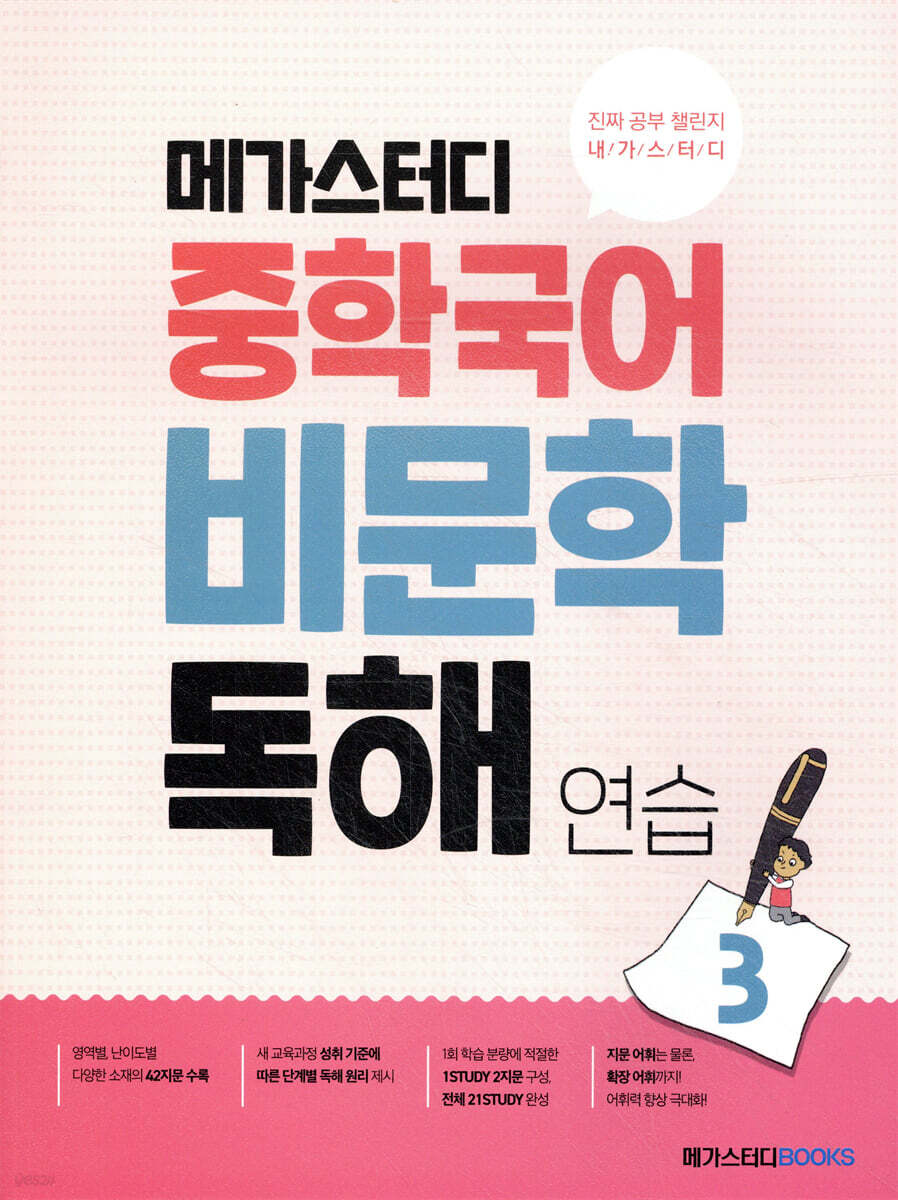
Megastudy Middle School Korean Non-Fiction Reading Practice 3
 |
Description
Book Introduction
『Mega Study Middle School Korean Language Non-Literature Reading Practice 3』 is structured so that two passages become one STUDY, and an efficient learning system is applied that presents an appropriate amount of material for students to study at one time according to the achievement criteria.
Each STUDY reflects the 2015 revised curriculum reading area divisions, with 'Humanities + Arts, Society + Culture, Science + Technology' and 'Long Text', which is the format used in recent scholastic ability assessments. Two texts are studied in one STUDY, but each area is presented separately.
Additionally, we have carefully selected and presented in the form of texts interesting for students to read in each area.
Each STUDY reflects the 2015 revised curriculum reading area divisions, with 'Humanities + Arts, Society + Culture, Science + Technology' and 'Long Text', which is the format used in recent scholastic ability assessments. Two texts are studied in one STUDY, but each area is presented separately.
Additionally, we have carefully selected and presented in the form of texts interesting for students to read in each area.
- You can preview some of the book's contents.
Preview
index
Ⅰ Humanities and Arts
STUDY 01 Understanding the main content
[Humanities] Han Feizi's Philosophy of Governance
[Art] Characteristics of Gaudí's architecture
STUDY 02 Inferring Omitted Content
[Humanities] Hume's Empiricism
[Art] Characteristics and Significance of Kinetic Art
STUDY 03 Evaluating the Appropriateness of Responses and Criticisms
[Humanities] Max Müller's Eudaimonia
[Art] The Conductor's Interpretation of Music
STUDY 04 Identifying Supporting Cases
[Humanities] Three Doctrines of Human Nature
[Art] Characteristics and Significance of Dürer's Prints
STUDY 05 Understanding the Details
[Humanities] Deontological and Teleological Perspectives
[Art] Impressionism and Post-Impressionism
STUDY 06 Inference of Information and Content
[Humanities] The Aspects of Forgetting in the Stages of Memory
[Art] Techniques and Effects of Dancheong
Ⅱ Society and Culture
STUDY 07 Evaluation through Comparison of Viewpoints
[Society] The Advent of the Electronic Panopticon
Crime Prevention Through Environmental Design (CPTED)
STUDY 08 Application to Specific Situations or Materials
[Society] Tax Efficiency and Fairness
[Culture] Consumption patterns in the age of mass consumption
STUDY 09 Understanding the structure and content development of a text
[Society] The Benefits of Trade and How to Determine Export Imports
[Culture] The Relationship Between Life and History
STUDY 10 Inference from Premise and Content
[Society] Price determination through auction
[Culture] Yangcheonje and Bansangje during the Joseon Dynasty
STUDY 11 Evaluating the Appropriateness of Responses and Criticisms
[Society] Modern Joseon law as revealed in Gyeongguk Daejeon
[Culture] A Study of the Political Culture Types of Culturalists
STUDY 12 Identifying Supporting Cases
[Society] The Effectiveness of Advertising in Resolving Cognitive Dissonance
[Society] The Concept and Application of Demand Elasticity
Ⅲ Science and Technology
STUDY 13 Understanding the meaning of vocabulary
[Science] Boiling Point and Vapor Pressure of Solutions
[Technology] Architectural Structure of High-Rise Buildings
STUDY 14 Point of View and Position Reasoning
[Science] The Relationship Between Area and Volume
[Technology] Satellite Orbit and Attitude Control
STUDY 15 Evaluation through Comparative Perspectives
[Science] Our Body's Inflammatory Response
[Technology] Development of bookbinding technology
STUDY 16 Application to Specific Situations or Materials
[Science] The Principle of Planetary Orbit and Swing-By
[Technology] Advantages and Types of SSDs
STUDY 17 Understanding the Details
[Science] The Structure of the Liver and How Its Blood Supply Works
[Technology] How to Obtain Depth Information and TOF Camera
STUDY 18 Application to Specific Situations or Materials
[Science] Bacteriophage Structure and Replication Process
[Technology] Digital Systems Engineering
Ⅳ Long fingerprint
STUDY 19 Reading Long Passages
[Humanities] Emotion Theory and Cognitive Theory
[Art] The changing relationship between artwork and place
STUDY 20 Reading Long Passages
[Society] Key Contents of Product Liability Act
[Society] Information Product Sales Strategy
STUDY 21 Reading Long Passages
[Science] Why Arctic Sea Ice Doesn't Melt Even in Midsummer
[Science] How Plants Draw Up Water
STUDY 01 Understanding the main content
[Humanities] Han Feizi's Philosophy of Governance
[Art] Characteristics of Gaudí's architecture
STUDY 02 Inferring Omitted Content
[Humanities] Hume's Empiricism
[Art] Characteristics and Significance of Kinetic Art
STUDY 03 Evaluating the Appropriateness of Responses and Criticisms
[Humanities] Max Müller's Eudaimonia
[Art] The Conductor's Interpretation of Music
STUDY 04 Identifying Supporting Cases
[Humanities] Three Doctrines of Human Nature
[Art] Characteristics and Significance of Dürer's Prints
STUDY 05 Understanding the Details
[Humanities] Deontological and Teleological Perspectives
[Art] Impressionism and Post-Impressionism
STUDY 06 Inference of Information and Content
[Humanities] The Aspects of Forgetting in the Stages of Memory
[Art] Techniques and Effects of Dancheong
Ⅱ Society and Culture
STUDY 07 Evaluation through Comparison of Viewpoints
[Society] The Advent of the Electronic Panopticon
Crime Prevention Through Environmental Design (CPTED)
STUDY 08 Application to Specific Situations or Materials
[Society] Tax Efficiency and Fairness
[Culture] Consumption patterns in the age of mass consumption
STUDY 09 Understanding the structure and content development of a text
[Society] The Benefits of Trade and How to Determine Export Imports
[Culture] The Relationship Between Life and History
STUDY 10 Inference from Premise and Content
[Society] Price determination through auction
[Culture] Yangcheonje and Bansangje during the Joseon Dynasty
STUDY 11 Evaluating the Appropriateness of Responses and Criticisms
[Society] Modern Joseon law as revealed in Gyeongguk Daejeon
[Culture] A Study of the Political Culture Types of Culturalists
STUDY 12 Identifying Supporting Cases
[Society] The Effectiveness of Advertising in Resolving Cognitive Dissonance
[Society] The Concept and Application of Demand Elasticity
Ⅲ Science and Technology
STUDY 13 Understanding the meaning of vocabulary
[Science] Boiling Point and Vapor Pressure of Solutions
[Technology] Architectural Structure of High-Rise Buildings
STUDY 14 Point of View and Position Reasoning
[Science] The Relationship Between Area and Volume
[Technology] Satellite Orbit and Attitude Control
STUDY 15 Evaluation through Comparative Perspectives
[Science] Our Body's Inflammatory Response
[Technology] Development of bookbinding technology
STUDY 16 Application to Specific Situations or Materials
[Science] The Principle of Planetary Orbit and Swing-By
[Technology] Advantages and Types of SSDs
STUDY 17 Understanding the Details
[Science] The Structure of the Liver and How Its Blood Supply Works
[Technology] How to Obtain Depth Information and TOF Camera
STUDY 18 Application to Specific Situations or Materials
[Science] Bacteriophage Structure and Replication Process
[Technology] Digital Systems Engineering
Ⅳ Long fingerprint
STUDY 19 Reading Long Passages
[Humanities] Emotion Theory and Cognitive Theory
[Art] The changing relationship between artwork and place
STUDY 20 Reading Long Passages
[Society] Key Contents of Product Liability Act
[Society] Information Product Sales Strategy
STUDY 21 Reading Long Passages
[Science] Why Arctic Sea Ice Doesn't Melt Even in Midsummer
[Science] How Plants Draw Up Water
Detailed image
.jpg)
Publisher's Review
- This is a basic reading book that allows you to systematically practice 42 carefully selected non-literary materials by area and difficulty level.
- This is a basic reading textbook that applies an efficient learning system for non-literature reading by composing one STUDY with two passages (materials) that are appropriate for middle school students to study at one time.
- This is a basic reading book that helps middle school students understand reading skills through problems based on the achievement standards for the Korean language reading section of the 2015 revised curriculum.
- This is a basic reading book that maximizes vocabulary improvement by providing faithful vocabulary learning for every two fingerprints.
- This is a basic reading textbook that provides detailed explanations of correct and incorrect answers to questions and explanations of the text in a format that ensures that self-study is not lacking.
1.
Applying efficient learning methods and reflecting interesting material in the text
This textbook is structured so that two passages become one study, and an efficient learning system is applied that presents an appropriate amount of material for students to study at one time according to the achievement criteria.
Each STUDY reflects the 2015 revised curriculum reading area divisions, with 'Humanities + Arts, Society + Culture, Science + Technology' and 'Long Text', which is the format used in recent scholastic ability assessments. Two texts are studied in one STUDY, but each area is presented separately.
Additionally, we have carefully selected and presented in the form of texts interesting for students to read in each area.
2.
Reflecting the 2015 Revised Curriculum Reading Achievement Standards
The STUDY names corresponding to the learning objectives for the two passages in this textbook are organized step by step based on the achievement standards for reading in the 2015 revised curriculum.
For each fingerprint, we have provided 'problems related to the STUDY name' so that you can learn the achievement standard content naturally.
And after studying the two fingerprints, we presented a 'Reading Method Q&A' to help you understand the key concepts related to the STUDY name in the form of questions and answers.
Additionally, after the core concepts are presented, the contents are organized in a separate page called the 'Concept Directory' so that you can review them at a glance.
3.
Reinforce vocabulary learning
This textbook presents a variety of 'Vocabulary Check' questions to help you check your understanding of the key vocabulary presented in the two STUDY passages.
And, although not presented in the text, we have included a 'Vocabulary Special Lecture' to help you improve your vocabulary by learning various vocabulary such as homonyms and polysemy, synonyms and antonyms, and common misspellings that are frequently tested on the exam.
In addition, the problem explanations include a 'vocabulary recharge' that includes the pronunciation and meaning of Chinese characters so that you can learn difficult vocabulary and concept vocabulary that frequently appear on exams that appear in the problems, helping you learn a wide range of vocabulary.
4.
Improving Reading Comprehension Skills through Self-Directed Learning
In the main text of this textbook, a checklist is provided in the 'Learning Checklist' after each of the two passages to enable self-directed learning.
In the 'Fingerprint Structure & Answers & Explanation' section, the text is presented once again and organized in a written format to help students understand the structure of the text and efficiently learn the key contents of the text.
Additionally, in 'Answers and Explanations', we have provided detailed explanations of correct answers and explanations for incorrect answers so that you can thoroughly understand the correct and incorrect answers to the questions.
- This is a basic reading textbook that applies an efficient learning system for non-literature reading by composing one STUDY with two passages (materials) that are appropriate for middle school students to study at one time.
- This is a basic reading book that helps middle school students understand reading skills through problems based on the achievement standards for the Korean language reading section of the 2015 revised curriculum.
- This is a basic reading book that maximizes vocabulary improvement by providing faithful vocabulary learning for every two fingerprints.
- This is a basic reading textbook that provides detailed explanations of correct and incorrect answers to questions and explanations of the text in a format that ensures that self-study is not lacking.
1.
Applying efficient learning methods and reflecting interesting material in the text
This textbook is structured so that two passages become one study, and an efficient learning system is applied that presents an appropriate amount of material for students to study at one time according to the achievement criteria.
Each STUDY reflects the 2015 revised curriculum reading area divisions, with 'Humanities + Arts, Society + Culture, Science + Technology' and 'Long Text', which is the format used in recent scholastic ability assessments. Two texts are studied in one STUDY, but each area is presented separately.
Additionally, we have carefully selected and presented in the form of texts interesting for students to read in each area.
2.
Reflecting the 2015 Revised Curriculum Reading Achievement Standards
The STUDY names corresponding to the learning objectives for the two passages in this textbook are organized step by step based on the achievement standards for reading in the 2015 revised curriculum.
For each fingerprint, we have provided 'problems related to the STUDY name' so that you can learn the achievement standard content naturally.
And after studying the two fingerprints, we presented a 'Reading Method Q&A' to help you understand the key concepts related to the STUDY name in the form of questions and answers.
Additionally, after the core concepts are presented, the contents are organized in a separate page called the 'Concept Directory' so that you can review them at a glance.
3.
Reinforce vocabulary learning
This textbook presents a variety of 'Vocabulary Check' questions to help you check your understanding of the key vocabulary presented in the two STUDY passages.
And, although not presented in the text, we have included a 'Vocabulary Special Lecture' to help you improve your vocabulary by learning various vocabulary such as homonyms and polysemy, synonyms and antonyms, and common misspellings that are frequently tested on the exam.
In addition, the problem explanations include a 'vocabulary recharge' that includes the pronunciation and meaning of Chinese characters so that you can learn difficult vocabulary and concept vocabulary that frequently appear on exams that appear in the problems, helping you learn a wide range of vocabulary.
4.
Improving Reading Comprehension Skills through Self-Directed Learning
In the main text of this textbook, a checklist is provided in the 'Learning Checklist' after each of the two passages to enable self-directed learning.
In the 'Fingerprint Structure & Answers & Explanation' section, the text is presented once again and organized in a written format to help students understand the structure of the text and efficiently learn the key contents of the text.
Additionally, in 'Answers and Explanations', we have provided detailed explanations of correct answers and explanations for incorrect answers so that you can thoroughly understand the correct and incorrect answers to the questions.
GOODS SPECIFICS
- Date of issue: September 1, 2019
- Page count, weight, size: 248 pages | 215*285mm
- ISBN13: 9791129704870
- ISBN10: 1129704874
- Reference book for use in grades: Common for middle school students
- Reference book usage semester: Common semester
- Reference book difficulty: Medium Reference book difficulty guide
You may also like
카테고리
korean


korean

![GQ KOREA Mark (Monthly): December [2025]](http://librairie.coreenne.fr/cdn/shop/files/8ef265dbbfbf186523ed75ba7319009d.jpg?v=1765340328&width=3840)


