

Dokgi Middle School Korean Non-Fiction Reading Comprehension Science Concepts (2025)
 |
Description
Book Introduction
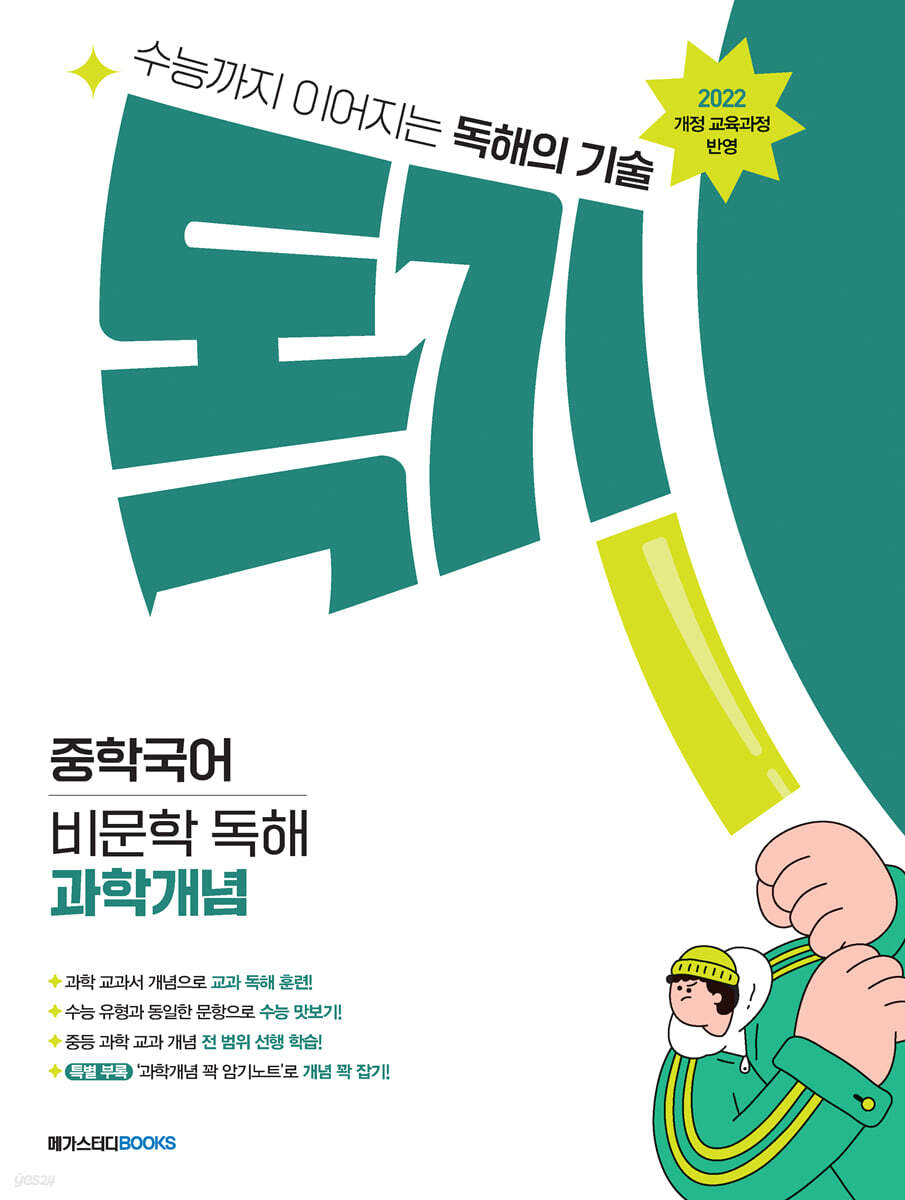
『Reading Non-Fiction - Scientific Concepts』 is a textbook that incorporates difficult and abstract scientific concepts into various texts to make them easier and more natural to understand.
The concepts in science textbooks are closely linked from elementary school through the college entrance exam.
Also, as you advance in grade level, the level gets higher and higher, so if you don't understand the content of the previous level well, it is difficult to understand the content of the next level.
By solving 『Reading Non-Fiction Textbooks - Scientific Concepts』, you can easily and clearly organize the scientific concepts that appear in middle school science textbooks with short texts and interesting pictures.
I hope that through reading comprehension linked to the curriculum, students will naturally build background knowledge in the field of science and effectively develop their reading comprehension skills.
The concepts in science textbooks are closely linked from elementary school through the college entrance exam.
Also, as you advance in grade level, the level gets higher and higher, so if you don't understand the content of the previous level well, it is difficult to understand the content of the next level.
By solving 『Reading Non-Fiction Textbooks - Scientific Concepts』, you can easily and clearly organize the scientific concepts that appear in middle school science textbooks with short texts and interesting pictures.
I hope that through reading comprehension linked to the curriculum, students will naturally build background knowledge in the field of science and effectively develop their reading comprehension skills.
- You can preview some of the book's contents.
Preview
index
Day 1 Life Sciences
1 Cells, the tiny rooms that make up our bodies
2 What kind of friends live around us?
Day 2 Physics
How will column 1 move?
There are things that get bigger when you get 2 rows?
Day 3 Chemistry
1 The Three Faces of Matter
2 Why do Eskimos sprinkle water on the floor of their igloos?
Day 4 Chemistry
1 Particles do not stay still
2 Why do balloons that rise high into the sky burst?
Day 5 Physics
1. The force that changes the state of motion, net force
The many powers hidden in bungee jumping
Day 6 Earth Science
1 The strong sun makes the earth suffer
2 Earth, it's because you moved.
Day 7 Chemistry
1 Why salt water doesn't boil even at 100℃
2 Seawater can also be drinking water.
Day 8 Earth Science
A stone turns into a stone again and again.
2 There is a place where volcanic activity occurs frequently?
Day 9 Physics
1 Why do our legs look shorter underwater?
2 How is sound transmitted?
Day 10 Chemistry
1 What is matter made of?
How do two atoms become ions?
Day 11 Life Sciences
1 Plant-Based Nutrient Recipe
2 How do plants breathe and eat?
Day 12 Life Sciences
1 How do people get energy?
2 How do people breathe and expel waste?
Day 13 Physics
1. Tingling, tingling. Why does static electricity occur?
2. Does the current create a magnetic field like a magnet?
Day 14 Earth Science
1 How can we know the distance to a star?
2 A group of celestial bodies that decorate the night sky, the galaxy
Day 15 Chemistry
1 Does burning wood reduce its mass?
2 Energy produces heat?
Day 16 Earth Science
1 The Earth is getting hotter?
2 When air moves, wind blows.
Day 17 Earth Science
1. Why temperatures vary across the ocean
2. The major currents of ocean water that drive the climate
Day 18 Physics
1 How can an object move?
How do you get energy to do 2 things?
Day 19 Life Sciences
1. Different roles of eyes, nose, and mouth
2 How does our body react to stimuli?
Day 20 Life Sciences
1 How does my body grow?
2. Who the hell do you look like?
1 Cells, the tiny rooms that make up our bodies
2 What kind of friends live around us?
Day 2 Physics
How will column 1 move?
There are things that get bigger when you get 2 rows?
Day 3 Chemistry
1 The Three Faces of Matter
2 Why do Eskimos sprinkle water on the floor of their igloos?
Day 4 Chemistry
1 Particles do not stay still
2 Why do balloons that rise high into the sky burst?
Day 5 Physics
1. The force that changes the state of motion, net force
The many powers hidden in bungee jumping
Day 6 Earth Science
1 The strong sun makes the earth suffer
2 Earth, it's because you moved.
Day 7 Chemistry
1 Why salt water doesn't boil even at 100℃
2 Seawater can also be drinking water.
Day 8 Earth Science
A stone turns into a stone again and again.
2 There is a place where volcanic activity occurs frequently?
Day 9 Physics
1 Why do our legs look shorter underwater?
2 How is sound transmitted?
Day 10 Chemistry
1 What is matter made of?
How do two atoms become ions?
Day 11 Life Sciences
1 Plant-Based Nutrient Recipe
2 How do plants breathe and eat?
Day 12 Life Sciences
1 How do people get energy?
2 How do people breathe and expel waste?
Day 13 Physics
1. Tingling, tingling. Why does static electricity occur?
2. Does the current create a magnetic field like a magnet?
Day 14 Earth Science
1 How can we know the distance to a star?
2 A group of celestial bodies that decorate the night sky, the galaxy
Day 15 Chemistry
1 Does burning wood reduce its mass?
2 Energy produces heat?
Day 16 Earth Science
1 The Earth is getting hotter?
2 When air moves, wind blows.
Day 17 Earth Science
1. Why temperatures vary across the ocean
2. The major currents of ocean water that drive the climate
Day 18 Physics
1 How can an object move?
How do you get energy to do 2 things?
Day 19 Life Sciences
1. Different roles of eyes, nose, and mouth
2 How does our body react to stimuli?
Day 20 Life Sciences
1 How does my body grow?
2. Who the hell do you look like?
Detailed image

Publisher's Review
Why should I study reading comprehension using a textbook?
“I read the article, but I don’t understand what it says.”
“It takes too long to read and understand the text.”
Everyone struggles with reading comprehension.
So how can we improve our reading comprehension? There are many ways, but one of them is to acquire the proper background knowledge necessary to understand the text and solve the problems.
Because the confidence, difficulty, and speed of reading vary depending on the presence or absence of background knowledge.
Having background knowledge makes it easier to understand text and allows you to infer what is being said even when presented with unfamiliar information.
But what's the most practical tool for building this background knowledge? It's the textbooks you use in school, especially the social studies and science textbooks.
In fact, the scope of the Korean language section of the CSAT is the textbook, and the materials of the humanities, social sciences, science, and technology passages on the CSAT are directly or indirectly connected to the core concepts that appear in the social sciences and science textbooks.
Studying the key concepts in the textbook in this way is the most reliable way to acquire background knowledge and is a very practical way to improve reading comprehension.
What can you gain from 『Reading Non-Fiction - Scientific Concepts』?
『Reading Non-Fiction - Scientific Concepts』 is a textbook that incorporates difficult and abstract scientific concepts into various texts to make them easier and more natural to understand.
The concepts in science textbooks are closely linked from elementary school through the college entrance exam.
Also, as you advance in grade level, the level gets higher and higher, so if you don't understand the content of the previous level well, it is difficult to understand the content of the next level.
By solving 『Reading Comprehension of Non-Fiction Textbooks - Scientific Concepts』, you can easily and clearly organize the scientific concepts appearing in middle school science textbooks with short texts and interesting pictures.
We hope that through curriculum-linked reading, you will naturally build background knowledge in the field of science and effectively develop your reading skills.
(1) A three-step systematic system that simultaneously acquires 'reading comprehension skills + science concepts' through textbook reading comprehension training.
'Step 1.
Open the curriculum concept talk → Step 2.
Reading the text to understand the subject concept → Step 3.
Systematic learning is possible through 'summarizing key concepts of the subject.'
Additionally, for detailed reading comprehension study, we provide blank questions that allow students to organize the structure of the text and the main content of each paragraph, allowing students to check their own reading process.
(2) Visual Thinking Methods: 'Concept at a Glance' and 'Curriculum Concept Dictionary'
The essential concepts presented in the textbook are presented clearly in pictures and tables to help you understand and remember the concepts more effectively.
And, to help you clearly understand the meaning of the curriculum concepts through the curriculum concept dictionary, we have included definitions of terms.
(3) Get a taste of the high-difficulty CSAT problem types by taking the CSAT.
We provide questions similar to the actual CSAT, especially questions using the 〈Options〉 and inference questions that are frequently asked as difficult 3-point questions, to help students perfect their reading comprehension skills and develop CSAT-style thinking.
(4) Presentation of the connection between the curriculum from elementary school to high school and the College Scholastic Ability Test (CSAT)
We have provided a curriculum linkage table that reflects the curriculum so that you can check the flow of curriculum concepts that vary depending on the school level, and we have provided reading comprehension objectives so that you can understand the content to be learned in advance.
And based on this, we composed reading passages related to the essential concepts covered in middle school science textbooks.
(5) Secure the concepts once more with the appendix that contains all the concepts of the subject.
All the essential science concepts learned in the text are compiled into one volume, allowing you to easily look up science concepts and conduct efficient, repetitive learning.
“I read the article, but I don’t understand what it says.”
“It takes too long to read and understand the text.”
Everyone struggles with reading comprehension.
So how can we improve our reading comprehension? There are many ways, but one of them is to acquire the proper background knowledge necessary to understand the text and solve the problems.
Because the confidence, difficulty, and speed of reading vary depending on the presence or absence of background knowledge.
Having background knowledge makes it easier to understand text and allows you to infer what is being said even when presented with unfamiliar information.
But what's the most practical tool for building this background knowledge? It's the textbooks you use in school, especially the social studies and science textbooks.
In fact, the scope of the Korean language section of the CSAT is the textbook, and the materials of the humanities, social sciences, science, and technology passages on the CSAT are directly or indirectly connected to the core concepts that appear in the social sciences and science textbooks.
Studying the key concepts in the textbook in this way is the most reliable way to acquire background knowledge and is a very practical way to improve reading comprehension.
What can you gain from 『Reading Non-Fiction - Scientific Concepts』?
『Reading Non-Fiction - Scientific Concepts』 is a textbook that incorporates difficult and abstract scientific concepts into various texts to make them easier and more natural to understand.
The concepts in science textbooks are closely linked from elementary school through the college entrance exam.
Also, as you advance in grade level, the level gets higher and higher, so if you don't understand the content of the previous level well, it is difficult to understand the content of the next level.
By solving 『Reading Comprehension of Non-Fiction Textbooks - Scientific Concepts』, you can easily and clearly organize the scientific concepts appearing in middle school science textbooks with short texts and interesting pictures.
We hope that through curriculum-linked reading, you will naturally build background knowledge in the field of science and effectively develop your reading skills.
(1) A three-step systematic system that simultaneously acquires 'reading comprehension skills + science concepts' through textbook reading comprehension training.
'Step 1.
Open the curriculum concept talk → Step 2.
Reading the text to understand the subject concept → Step 3.
Systematic learning is possible through 'summarizing key concepts of the subject.'
Additionally, for detailed reading comprehension study, we provide blank questions that allow students to organize the structure of the text and the main content of each paragraph, allowing students to check their own reading process.
(2) Visual Thinking Methods: 'Concept at a Glance' and 'Curriculum Concept Dictionary'
The essential concepts presented in the textbook are presented clearly in pictures and tables to help you understand and remember the concepts more effectively.
And, to help you clearly understand the meaning of the curriculum concepts through the curriculum concept dictionary, we have included definitions of terms.
(3) Get a taste of the high-difficulty CSAT problem types by taking the CSAT.
We provide questions similar to the actual CSAT, especially questions using the 〈Options〉 and inference questions that are frequently asked as difficult 3-point questions, to help students perfect their reading comprehension skills and develop CSAT-style thinking.
(4) Presentation of the connection between the curriculum from elementary school to high school and the College Scholastic Ability Test (CSAT)
We have provided a curriculum linkage table that reflects the curriculum so that you can check the flow of curriculum concepts that vary depending on the school level, and we have provided reading comprehension objectives so that you can understand the content to be learned in advance.
And based on this, we composed reading passages related to the essential concepts covered in middle school science textbooks.
(5) Secure the concepts once more with the appendix that contains all the concepts of the subject.
All the essential science concepts learned in the text are compiled into one volume, allowing you to easily look up science concepts and conduct efficient, repetitive learning.
GOODS SPECIFICS
- Date of issue: November 11, 2024
- Page count, weight, size: 264 pages | 215*285*20mm
- ISBN13: 9791129713698
- ISBN10: 1129713695
- Reference book for use in: Pre-middle school students, middle school students
- Reference Difficulty: Hard Reference Difficulty Guide
- KC Certification: Certification Type: Conformity Confirmation
You may also like
카테고리
korean


korean

![GQ KOREA Mark (Monthly): December [2025]](http://librairie.coreenne.fr/cdn/shop/files/8ef265dbbfbf186523ed75ba7319009d.jpg?v=1765340328&width=3840)


