

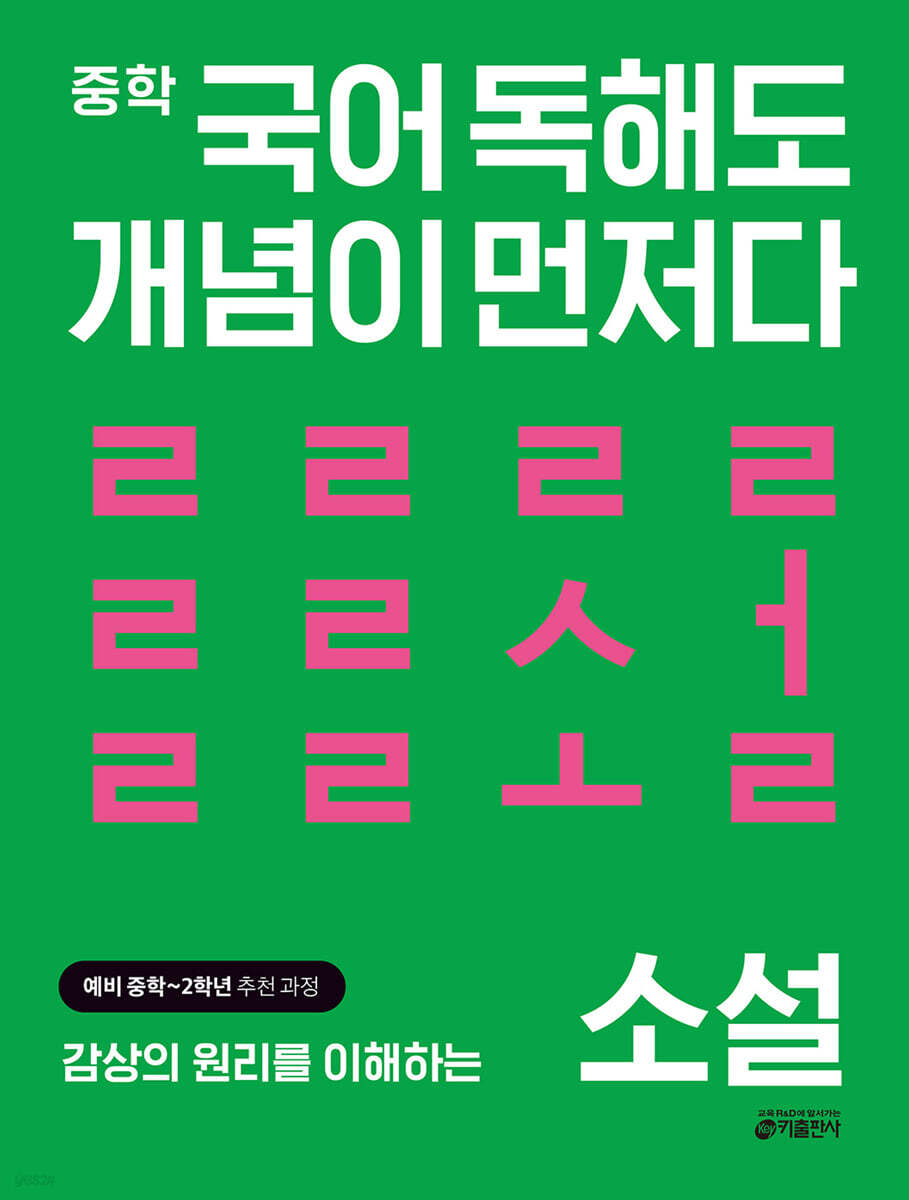
Middle school Korean reading comprehension is also a concept-first novel.
 |
Description
Book Introduction
『Middle School Korean Reading Comprehension: Concepts Come First_Novels: Understanding the Principles of Appreciation』
This is a middle school Korean language concept reading program designed to allow students to study reading comprehension and concepts at the same time.
We've divided concepts into categories, so you can learn quickly and efficiently, tailored to your learning time! We've divided essential concepts like "Novels," "Summaries," "Poetry," and "Parts of Speech" into separate volumes, allowing you to learn them quickly and efficiently.
A novel-based course designed to help students understand the principles of appreciation, recommended for middle school to second-year students.
A summary of the basics of non-fiction, recommended for pre-middle school to first-year students.
A recommended course for middle school to second graders that lays the foundation for expression
A comprehensive course on parts of speech that can be used up to high school. Recommended for middle school students in grades 1-3.
We've provided a study volume (12 lessons each) that can be studied over a period of two weeks to one month, so that you can quickly finish the necessary areas during vacation, right before exams, and between exams.
You can study efficiently when you need to study according to the progress of your school or when you want to deeply organize concepts in a specific area.
Korean language concepts and middle school-level materials all at once! Each concept is thoroughly covered at once! This allows readers to learn Korean language concepts through reading and practice applying them to text.
We've carefully selected 12 must-know novel concepts, including the Korean language achievement standards (learning objectives) for first-year middle school students.
Each concept was studied with detailed explanations and application materials using key middle school Korean language passages (Lecture 1, 2 passages).
In the application text, you can study various problem types such as basic, difficult, writing, and vocabulary.
We have implemented a powerful review system to ensure you have memorized the concepts.
After learning a few more concepts, you can study them by grouping them by chapter (topic).
This is a middle school Korean language concept reading program designed to allow students to study reading comprehension and concepts at the same time.
We've divided concepts into categories, so you can learn quickly and efficiently, tailored to your learning time! We've divided essential concepts like "Novels," "Summaries," "Poetry," and "Parts of Speech" into separate volumes, allowing you to learn them quickly and efficiently.
A novel-based course designed to help students understand the principles of appreciation, recommended for middle school to second-year students.
A summary of the basics of non-fiction, recommended for pre-middle school to first-year students.
A recommended course for middle school to second graders that lays the foundation for expression
A comprehensive course on parts of speech that can be used up to high school. Recommended for middle school students in grades 1-3.
We've provided a study volume (12 lessons each) that can be studied over a period of two weeks to one month, so that you can quickly finish the necessary areas during vacation, right before exams, and between exams.
You can study efficiently when you need to study according to the progress of your school or when you want to deeply organize concepts in a specific area.
Korean language concepts and middle school-level materials all at once! Each concept is thoroughly covered at once! This allows readers to learn Korean language concepts through reading and practice applying them to text.
We've carefully selected 12 must-know novel concepts, including the Korean language achievement standards (learning objectives) for first-year middle school students.
Each concept was studied with detailed explanations and application materials using key middle school Korean language passages (Lecture 1, 2 passages).
In the application text, you can study various problem types such as basic, difficult, writing, and vocabulary.
We have implemented a powerful review system to ensure you have memorized the concepts.
After learning a few more concepts, you can study them by grouping them by chapter (topic).
- You can preview some of the book's contents.
Preview
index
Basic concepts of the novel
01 Concept and Characteristics of Novels
Hyun Jin-geon in "Lucky Day"
02 Three elements of novel composition
"Following Grandmother's Meju" by Oh Seung-hee
conflict
03 The concept and role of conflict
Oh Jeong-hee, "Noise Pollution"
04 Types of Conflict
Heo Gyun from The Tale of Hong Gildong
05 The development of the conflict
The Sky is Clear, Hyun-deok
growth
06 Coming-of-Age Novels
Jin Hyeong-min, "Monkey Wrench"
07 Themes of Coming-of-Age Novels
The Bicycle Thief by Park Wan-seo
08 The Value of Literature
Curtain Call by Jo Woo-ri
In-depth concept of novel
09 Novel materials and symbols
〈4 PM, Dalgona〉 Lee Song-hyeon
10 Narrator and Point of View
Kim Yoo-jung in "Camellia"
11 Three Elements of a Novel
When Buckwheat Flowers Bloom by Lee Hyo-seok
12 Characteristics of Classic Novels
Chunhyangjeon (Author unknown)
Review & Answers and Explanations
01 Concept and Characteristics of Novels
Hyun Jin-geon in "Lucky Day"
02 Three elements of novel composition
"Following Grandmother's Meju" by Oh Seung-hee
conflict
03 The concept and role of conflict
Oh Jeong-hee, "Noise Pollution"
04 Types of Conflict
Heo Gyun from The Tale of Hong Gildong
05 The development of the conflict
The Sky is Clear, Hyun-deok
growth
06 Coming-of-Age Novels
Jin Hyeong-min, "Monkey Wrench"
07 Themes of Coming-of-Age Novels
The Bicycle Thief by Park Wan-seo
08 The Value of Literature
Curtain Call by Jo Woo-ri
In-depth concept of novel
09 Novel materials and symbols
〈4 PM, Dalgona〉 Lee Song-hyeon
10 Narrator and Point of View
Kim Yoo-jung in "Camellia"
11 Three Elements of a Novel
When Buckwheat Flowers Bloom by Lee Hyo-seok
12 Characteristics of Classic Novels
Chunhyangjeon (Author unknown)
Review & Answers and Explanations
Detailed image
.jpg)
Publisher's Review
Middle school Korean seems more difficult than elementary school. Where should I start?
“Wouldn’t you understand if you read it?”
that's right.
It is important to read Korean well and understand its meaning.
but,
● You need to have background knowledge of the Korean language concept to understand it correctly!
Starting from middle school Korean language, problems that require a basic understanding of the concepts are presented.
If you don't know the concepts, it's difficult to understand the content of the Korean language class.
If you don't have a good grasp of the concepts, you may make mistakes on the test.
● Preparing for middle school Korean language grades and improving literacy skills starts with concepts!
Improving literacy skills by focusing on preparing for internal exams and the CSAT!
Concept learning is included in both,
It is efficient to study this in an integrated manner and consistently.
● You definitely need time to study the concepts a little bit every day!
Studying concepts can help you build confidence in the Korean language.
It will show you what to read from the fingerprint and make solving the problem much easier.
You can use it as a foundation for skills that can be extended to high school Korean.
This will be a solid first step toward preparing for the Korean language section of the CSAT.
〉〉 Composition and features
Learn middle school Korean systematically through 'Concept Reading - Concept Application - Review'.
[Concept Reading]
Learn core concepts of fiction by reading 12 non-fiction texts.
If you read along with the easy and friendly explanations, the concepts will naturally sink into your head.
- Reading Comprehension Assistant: Fill in the blanks to summarize the key content of each paragraph in the conceptual reading passage.
- Concept Check Questions: You can check whether you have distinguished and understood the concepts through simple multiple choice questions or true or false questions that allow you to check the content of the concept reading passage.
[Application of concept]
Based on the conceptual information you have learned, practice applying it to Korean literature texts.
By following along with problems that allow you to check your understanding of the concepts, you can solidify the concepts further.
- Concept Application: You can check the concept by checking the concept application fingerprint with basic type problems.
- Concept Difficulty: You can understand the concept more deeply by checking the concept application text in the CSAT-type and advanced type problems.
- Writing: You can check the concepts in the reading comprehension and application texts and prepare for descriptive questions using the descriptive question type.
- Vocabulary: You can review and learn the vocabulary used in the concept reading and concept application texts, focusing on meaning and examples.
- Reading the work as a concept: You can finish your learning by reconfirming the concepts in the concept application text through friendly explanations.
[Review]
Before starting the next lecture, review the concepts you learned previously and solve additional problems.
- Conceptual Notes: You can check whether you have remembered the conceptual words well by rereading the conceptual reading passage and filling in the blanks.
- Problem Plus: You can practice the concepts in the reading comprehension passage through multiple-choice questions.
“Wouldn’t you understand if you read it?”
that's right.
It is important to read Korean well and understand its meaning.
but,
● You need to have background knowledge of the Korean language concept to understand it correctly!
Starting from middle school Korean language, problems that require a basic understanding of the concepts are presented.
If you don't know the concepts, it's difficult to understand the content of the Korean language class.
If you don't have a good grasp of the concepts, you may make mistakes on the test.
● Preparing for middle school Korean language grades and improving literacy skills starts with concepts!
Improving literacy skills by focusing on preparing for internal exams and the CSAT!
Concept learning is included in both,
It is efficient to study this in an integrated manner and consistently.
● You definitely need time to study the concepts a little bit every day!
Studying concepts can help you build confidence in the Korean language.
It will show you what to read from the fingerprint and make solving the problem much easier.
You can use it as a foundation for skills that can be extended to high school Korean.
This will be a solid first step toward preparing for the Korean language section of the CSAT.
〉〉 Composition and features
Learn middle school Korean systematically through 'Concept Reading - Concept Application - Review'.
[Concept Reading]
Learn core concepts of fiction by reading 12 non-fiction texts.
If you read along with the easy and friendly explanations, the concepts will naturally sink into your head.
- Reading Comprehension Assistant: Fill in the blanks to summarize the key content of each paragraph in the conceptual reading passage.
- Concept Check Questions: You can check whether you have distinguished and understood the concepts through simple multiple choice questions or true or false questions that allow you to check the content of the concept reading passage.
[Application of concept]
Based on the conceptual information you have learned, practice applying it to Korean literature texts.
By following along with problems that allow you to check your understanding of the concepts, you can solidify the concepts further.
- Concept Application: You can check the concept by checking the concept application fingerprint with basic type problems.
- Concept Difficulty: You can understand the concept more deeply by checking the concept application text in the CSAT-type and advanced type problems.
- Writing: You can check the concepts in the reading comprehension and application texts and prepare for descriptive questions using the descriptive question type.
- Vocabulary: You can review and learn the vocabulary used in the concept reading and concept application texts, focusing on meaning and examples.
- Reading the work as a concept: You can finish your learning by reconfirming the concepts in the concept application text through friendly explanations.
[Review]
Before starting the next lecture, review the concepts you learned previously and solve additional problems.
- Conceptual Notes: You can check whether you have remembered the conceptual words well by rereading the conceptual reading passage and filling in the blanks.
- Problem Plus: You can practice the concepts in the reading comprehension passage through multiple-choice questions.
GOODS SPECIFICS
- Date of issue: October 23, 2025
- Page count, weight, size: 124 pages | 210*277*9mm
- ISBN13: 9791165263614
- ISBN10: 1165263610
- Reference book grades: prospective middle school students, first year middle school students, second year middle school students
- Reference book usage semester: Common semester
- Reference Difficulty: Hard Reference Difficulty Guide
- KC Certification: Certification Type: Conformity Confirmation
You may also like
카테고리
korean


korean

![GQ KOREA Mark (Monthly): December [2025]](http://librairie.coreenne.fr/cdn/shop/files/8ef265dbbfbf186523ed75ba7319009d.jpg?v=1765340328&width=3840)


