

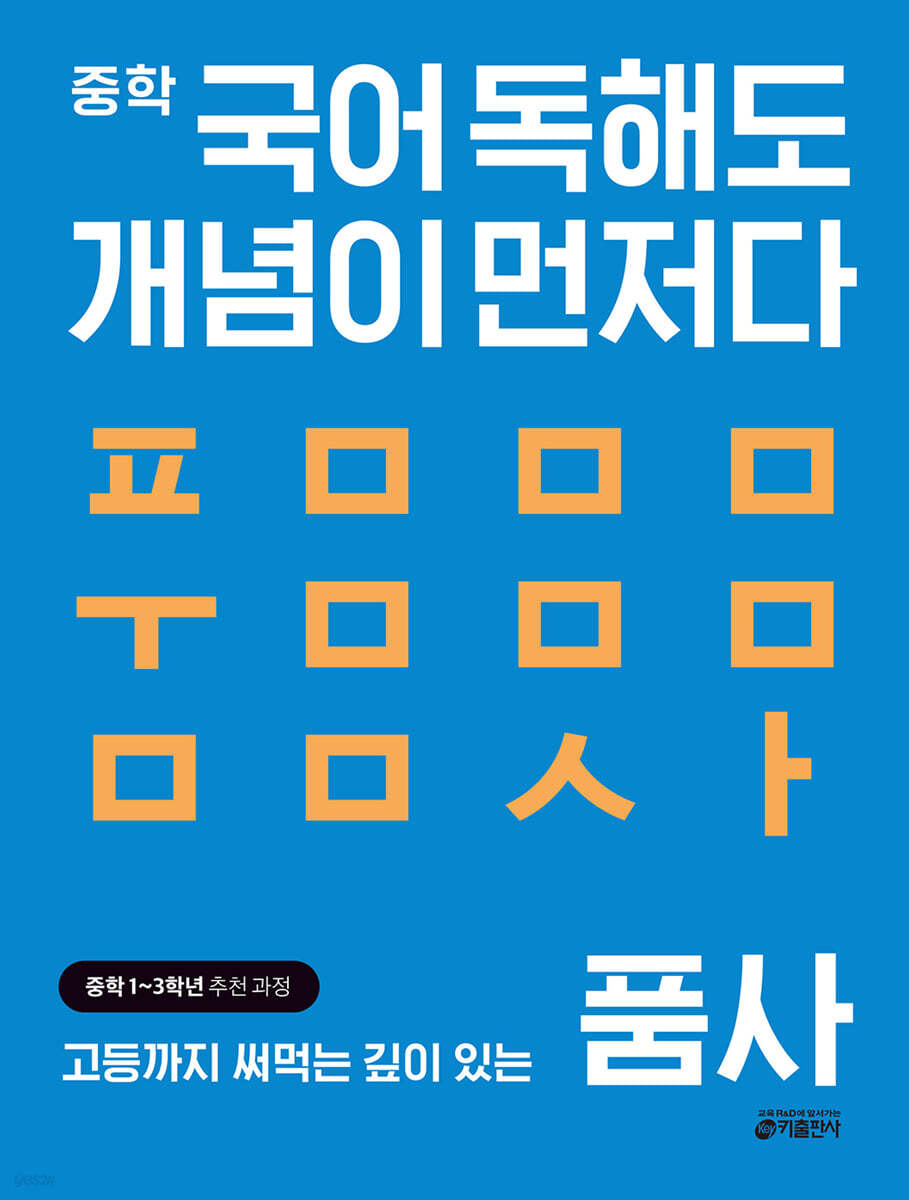
Middle school Korean reading comprehension is also about concepts first. Parts of speech section
 |
Description
Book Introduction
『Middle School Korean Reading Comprehension: Concepts Come First_In-depth Parts of Speech Edition for Use Up to High School』
This is a middle school Korean language concept reading program designed to allow students to study reading comprehension and concepts at the same time.
▶ Divide concepts by area to learn quickly and efficiently according to your learning period!
We have divided the necessary concepts, such as ‘parts of speech’, ‘poetry’, ‘novel’, and ‘summary’, into separate volumes so that you can study them.
A comprehensive course on parts of speech that can be used up to high school. Recommended for middle school students in grades 1-3.
A recommended course for middle school to second graders that lays the foundation for expression
A novel-based course designed to help students understand the principles of appreciation, recommended for middle school to second-year students.
A summary of the basics of non-fiction, recommended for pre-middle school to first-year students.
We've provided a study volume (12 lessons each) that can be studied over a period of two weeks to one month, so that you can quickly finish the necessary areas during vacation, right before exams, and between exams.
You can study efficiently when you need to study according to the progress of your school or when you want to deeply organize concepts in a specific area.
▶ Korean language concepts and middle school-level materials all in one! One concept at a time, fully covered!
We have made it possible to learn Korean language concepts while reading and practice applying them to text.
We have carefully selected 12 parts of speech concepts that must be known, including the Korean language achievement standards (learning objectives) for first-year middle school students.
Each concept was studied through a concept reading passage that covered the basic content and a concept application passage that covered the advanced concept (2 passages per lecture).
In the application fingerprint, you can study various problem types such as basic, difficult, writing, and vocabulary.
We have implemented a powerful review system to ensure you have memorized the concepts.
After learning a few more concepts, you can study them by grouping them by chapter (topic).
I tried to organize the content learned through the '1 Minute Parts of Speech Memorization' lecture into a more clear and light-hearted way.
This is a middle school Korean language concept reading program designed to allow students to study reading comprehension and concepts at the same time.
▶ Divide concepts by area to learn quickly and efficiently according to your learning period!
We have divided the necessary concepts, such as ‘parts of speech’, ‘poetry’, ‘novel’, and ‘summary’, into separate volumes so that you can study them.
A comprehensive course on parts of speech that can be used up to high school. Recommended for middle school students in grades 1-3.
A recommended course for middle school to second graders that lays the foundation for expression
A novel-based course designed to help students understand the principles of appreciation, recommended for middle school to second-year students.
A summary of the basics of non-fiction, recommended for pre-middle school to first-year students.
We've provided a study volume (12 lessons each) that can be studied over a period of two weeks to one month, so that you can quickly finish the necessary areas during vacation, right before exams, and between exams.
You can study efficiently when you need to study according to the progress of your school or when you want to deeply organize concepts in a specific area.
▶ Korean language concepts and middle school-level materials all in one! One concept at a time, fully covered!
We have made it possible to learn Korean language concepts while reading and practice applying them to text.
We have carefully selected 12 parts of speech concepts that must be known, including the Korean language achievement standards (learning objectives) for first-year middle school students.
Each concept was studied through a concept reading passage that covered the basic content and a concept application passage that covered the advanced concept (2 passages per lecture).
In the application fingerprint, you can study various problem types such as basic, difficult, writing, and vocabulary.
We have implemented a powerful review system to ensure you have memorized the concepts.
After learning a few more concepts, you can study them by grouping them by chapter (topic).
I tried to organize the content learned through the '1 Minute Parts of Speech Memorization' lecture into a more clear and light-hearted way.
- You can preview some of the book's contents.
Preview
index
Classification criteria for parts of speech / nouns
01 Parts of speech and sentence elements
〈Form, Function, and Meaning of Words〉
02 Noun
Characteristics of Dependent Nouns
03 Pronouns
The Development of Personal Pronouns
04 Investigation
Common Characteristics of Nouns
Verb
05 Verbs
Verb Stems and Suffixes
06 Adjectives
Irregular Conjugation of Verbs
Modifier
07 Adjectives
The Difference Between a Detective and a Detective
08 Adverb
Distinction between adverbs and adverbials
Independent words / relative words / advanced practice
09 Interjections
Interjections and Independent Words
10 investigations
〈Particles of Occurrence〉
11 Common parts of speech
Part-of-speech analysis in practice
12 Misuse of Parts of Speech
〈Expressive Effect of Parts of Speech〉
Review & Answers and Explanations
01 Parts of speech and sentence elements
〈Form, Function, and Meaning of Words〉
02 Noun
Characteristics of Dependent Nouns
03 Pronouns
The Development of Personal Pronouns
04 Investigation
Common Characteristics of Nouns
Verb
05 Verbs
Verb Stems and Suffixes
06 Adjectives
Irregular Conjugation of Verbs
Modifier
07 Adjectives
The Difference Between a Detective and a Detective
08 Adverb
Distinction between adverbs and adverbials
Independent words / relative words / advanced practice
09 Interjections
Interjections and Independent Words
10 investigations
〈Particles of Occurrence〉
11 Common parts of speech
Part-of-speech analysis in practice
12 Misuse of Parts of Speech
〈Expressive Effect of Parts of Speech〉
Review & Answers and Explanations
Detailed image
.jpg)
Publisher's Review
Middle school Korean seems more difficult than elementary school. Where should I start?
“Wouldn’t you understand if you read it?”
that's right.
It is important to read Korean well and understand its meaning.
but,
· You need to have background knowledge of the Korean language concept to understand it correctly!
Starting from middle school Korean language, problems that require a basic understanding of the concepts are presented.
If you don't know the concepts, it's difficult to understand the content of the Korean language class.
If you don't have a good grasp of the concepts, you may make mistakes on the test.
· Preparing for middle school Korean language grades and improving literacy skills starts with concepts!
Improving literacy skills focused on preparing for both the school exam and the CSAT! Conceptual learning is included in both, and integrating and consistently studying these skills is effective.
· You definitely need to spend time studying the concepts a little bit every day!
Studying concepts can help you build confidence in the Korean language.
It will show you what to read from the fingerprint and make solving the problem much easier.
You can use it as a foundation for skills that can be extended to high school Korean.
This will be a solid first step toward preparing for the Korean language section of the CSAT.
Composition and Features
Learn middle school Korean systematically through 'Concept Reading - Concept Application - Review'.
[Concept Reading]
Learn core concepts of parts of speech by reading 12 non-fiction texts.
If you read along with the easy and friendly explanations, the concepts will naturally sink into your head.
- Reading Comprehension Assistant: Fill in the blanks to summarize the key content of each paragraph in the conceptual reading passage.
- Concept Check Questions: You can check whether you have distinguished and understood the concepts through simple multiple choice questions or true or false questions that allow you to check the content of the concept reading passage.
[Application of concept]
Based on the conceptual information you have learned, practice applying it to Korean texts.
By following along with problems that allow you to check your understanding of the concepts, you can solidify the concepts further.
- Concept Application: You can check the concept by checking the concept application fingerprint with basic type problems.
- Concept Difficulty: You can understand the concept more deeply by checking the concept application text in the CSAT-type and advanced type problems.
- Writing: You can check the concepts in the reading comprehension and application texts and prepare for descriptive questions using the descriptive question type.
- Vocabulary: You can review and learn the vocabulary used in the concept reading and concept application texts, focusing on meaning and examples.
- Reading the work as a concept: You can finish your learning by reconfirming the concepts in the concept application text through friendly explanations.
[Review]
Before starting the next lecture, review the concepts you learned previously and solve additional problems.
- Conceptual Notes: You can check whether you have remembered the conceptual words well by rereading the conceptual reading passage and filling in the blanks.
- Problem Plus: You can practice the concepts in the reading comprehension passage through multiple-choice questions.
“Wouldn’t you understand if you read it?”
that's right.
It is important to read Korean well and understand its meaning.
but,
· You need to have background knowledge of the Korean language concept to understand it correctly!
Starting from middle school Korean language, problems that require a basic understanding of the concepts are presented.
If you don't know the concepts, it's difficult to understand the content of the Korean language class.
If you don't have a good grasp of the concepts, you may make mistakes on the test.
· Preparing for middle school Korean language grades and improving literacy skills starts with concepts!
Improving literacy skills focused on preparing for both the school exam and the CSAT! Conceptual learning is included in both, and integrating and consistently studying these skills is effective.
· You definitely need to spend time studying the concepts a little bit every day!
Studying concepts can help you build confidence in the Korean language.
It will show you what to read from the fingerprint and make solving the problem much easier.
You can use it as a foundation for skills that can be extended to high school Korean.
This will be a solid first step toward preparing for the Korean language section of the CSAT.
Composition and Features
Learn middle school Korean systematically through 'Concept Reading - Concept Application - Review'.
[Concept Reading]
Learn core concepts of parts of speech by reading 12 non-fiction texts.
If you read along with the easy and friendly explanations, the concepts will naturally sink into your head.
- Reading Comprehension Assistant: Fill in the blanks to summarize the key content of each paragraph in the conceptual reading passage.
- Concept Check Questions: You can check whether you have distinguished and understood the concepts through simple multiple choice questions or true or false questions that allow you to check the content of the concept reading passage.
[Application of concept]
Based on the conceptual information you have learned, practice applying it to Korean texts.
By following along with problems that allow you to check your understanding of the concepts, you can solidify the concepts further.
- Concept Application: You can check the concept by checking the concept application fingerprint with basic type problems.
- Concept Difficulty: You can understand the concept more deeply by checking the concept application text in the CSAT-type and advanced type problems.
- Writing: You can check the concepts in the reading comprehension and application texts and prepare for descriptive questions using the descriptive question type.
- Vocabulary: You can review and learn the vocabulary used in the concept reading and concept application texts, focusing on meaning and examples.
- Reading the work as a concept: You can finish your learning by reconfirming the concepts in the concept application text through friendly explanations.
[Review]
Before starting the next lecture, review the concepts you learned previously and solve additional problems.
- Conceptual Notes: You can check whether you have remembered the conceptual words well by rereading the conceptual reading passage and filling in the blanks.
- Problem Plus: You can practice the concepts in the reading comprehension passage through multiple-choice questions.
GOODS SPECIFICS
- Date of issue: August 18, 2025
- Page count, weight, size: 120 pages | 210*277*9mm
- ISBN13: 9791165263355
- ISBN10: 1165263351
- Reference book for use in grades: Common for middle school students
- Reference book usage semester: Common semester
- Reference Difficulty: Hard Reference Difficulty Guide
- KC Certification: Certification Type: Conformity Confirmation
You may also like
카테고리
korean


korean

![GQ KOREA Mark (Monthly): December [2025]](http://librairie.coreenne.fr/cdn/shop/files/8ef265dbbfbf186523ed75ba7319009d.jpg?v=1765340328&width=3840)


