

Summa Junior Middle School Korean Vocabulary 3
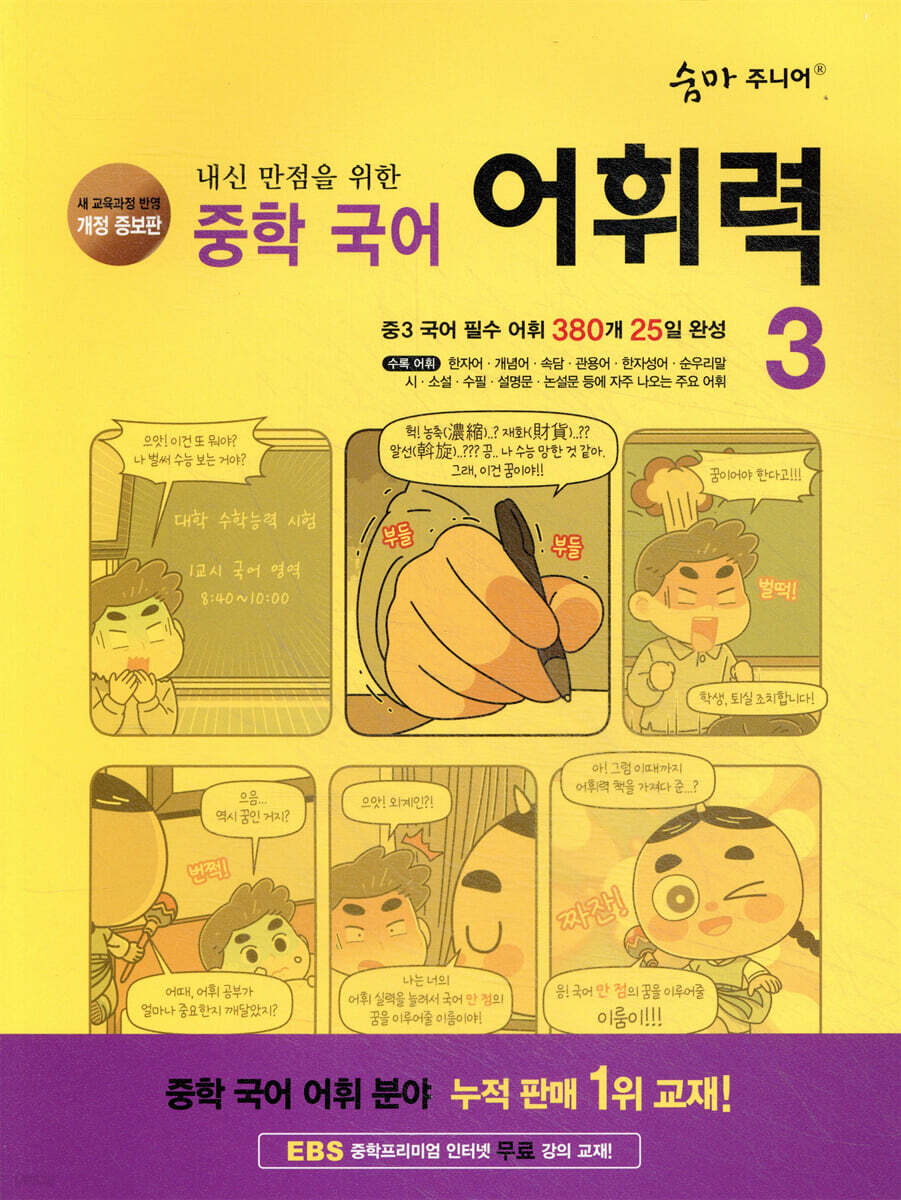 |
Description
Book Introduction
Essential vocabulary was selected from 10 middle school Korean language textbooks.
Essential concepts that will definitely appear on the exam are explained.
Essential Vocabulary - You can repeat learning through confirmation questions.
'Vocabulary Enhancement - High School Preparation' You can start studying Korean at the high school level one step ahead with the 'Literature', 'Reading', 'Speaking/Writing', and 'Grammar' concept guide corner.
Strengthening the internal exam - You can get a taste of the Korean language exam by applying concept words.
You can improve your thinking skills by 'picking up vocabulary'.
Let's utilize spare time with the '5-Minute Test Book'.
Essential concepts that will definitely appear on the exam are explained.
Essential Vocabulary - You can repeat learning through confirmation questions.
'Vocabulary Enhancement - High School Preparation' You can start studying Korean at the high school level one step ahead with the 'Literature', 'Reading', 'Speaking/Writing', and 'Grammar' concept guide corner.
Strengthening the internal exam - You can get a taste of the Korean language exam by applying concept words.
You can improve your thinking skills by 'picking up vocabulary'.
Let's utilize spare time with the '5-Minute Test Book'.
- You can preview some of the book's contents.
Preview
index
Ⅰ.
city
Day 1… … … … … … … 16
Day 2… … … … … … … 22
Day 3… … … … … … … 28
Ⅱ.
Novels, plays, and essays
Day 4… … … … … … … 38
Day 5… … … … … … … 46
Day 6… … … … … … … 54
Day 7… … … … … … … 62
Day 8… … … … … … … 70
Day 9… … … … … … … 82
Day 10… … … … … … 88
Ⅲ.
A text conveying information
Day 11… … … … … … … 94
Day 12… … … … … … … 100
Day 13… … … … … … … 110
Ⅳ.
The article asserts
Day 14… … … … … … … 116
Day 15… … … … … … … 124
Day 16… … … … … … … 130
Day 17… … … … … … … 136
V.
Writing, Listening, Speaking
Day 18… … … … … … … 146
Day 19… … … … … … … 152
Day 20… … … … … … … 158
Ⅵ.
Grammar, Chinese character idioms, proverbs, and idioms
Day 21… … … … … … … 164
Day 22… … … … … … … 174
Day 23… … … … … … … 181
Day 24… … … … … … … 189
Day 25… … … … … … … 196
Special Appendix | A Book Within a Book
5 Minute Test Book … … … 1
Answer and explanation … … … … … 47
city
Day 1… … … … … … … 16
Day 2… … … … … … … 22
Day 3… … … … … … … 28
Ⅱ.
Novels, plays, and essays
Day 4… … … … … … … 38
Day 5… … … … … … … 46
Day 6… … … … … … … 54
Day 7… … … … … … … 62
Day 8… … … … … … … 70
Day 9… … … … … … … 82
Day 10… … … … … … 88
Ⅲ.
A text conveying information
Day 11… … … … … … … 94
Day 12… … … … … … … 100
Day 13… … … … … … … 110
Ⅳ.
The article asserts
Day 14… … … … … … … 116
Day 15… … … … … … … 124
Day 16… … … … … … … 130
Day 17… … … … … … … 136
V.
Writing, Listening, Speaking
Day 18… … … … … … … 146
Day 19… … … … … … … 152
Day 20… … … … … … … 158
Ⅵ.
Grammar, Chinese character idioms, proverbs, and idioms
Day 21… … … … … … … 164
Day 22… … … … … … … 174
Day 23… … … … … … … 181
Day 24… … … … … … … 189
Day 25… … … … … … … 196
Special Appendix | A Book Within a Book
5 Minute Test Book … … … 1
Answer and explanation … … … … … 47
Publisher's Review
1) Essential vocabulary was selected from 10 middle school Korean language textbooks.
In the middle school Korean language textbook, 380 essential vocabulary words that middle school students must know are presented along with example sentences that can be used in real life.
No matter which textbook you study with, these are essential vocabulary words for improving your vocabulary, so studying according to a schedule is very effective.
2) Essential concepts that will definitely appear on the exam are explained.
We have included 1 to 4 important concepts essential for studying Korean for each day.
This does not mean that the concept words are particularly difficult, but rather that they can be learned naturally while studying everyday vocabulary.
These days, in middle school classes, students' literacy skills are declining so much that teachers have to explain the meaning of words separately because they don't know them.
Middle school Korean language classes have become more difficult than before, but this is also due to a lack of vocabulary.
If you know a lot of concept words, it will be easier to understand the content and grammar of the textbook.
3) Essential vocabulary - You can repeat learning through confirmation questions.
You can repeatedly study the headings you studied in the textbook's essential vocabulary through confirmation questions.
It is composed of various types such as parentheses, fill-in-the-blanks, underlining, crossword puzzles, and finding words in word boxes, so that you can become interested in the Korean language subject.
4) 'Vocabulary Enhancement - You can start studying Korean at a high school level one step ahead with the 'Literature', 'Reading', 'Speaking/Writing', and 'Grammar' concept guide corner for high school preparation.
If you learned the basic concepts of middle school Korean and developed solid problem-solving skills through Volumes 1 and 2, Volume 3 provides a corner to prepare for high school-level Korean language learning.
Once you enter high school, the scope of your academic exams will significantly expand.
New passages that go beyond the scope of textbooks and are at the level of the CSAT are being added to provide additional problems that allow students to apply the theories learned in class.
To prepare for this, we have divided all areas of literature, non-literature, speaking, writing, and grammar into sub-categories and included essential concepts that frequently appear in high school courses.
By successfully completing all three volumes, you'll have mastered the strategies necessary to develop advanced thinking and analytical skills, allowing you to confidently prepare for the Korean language mock exam!
5) Strengthening your grades - You can get a taste of the Korean language exam by applying concept words.
When you hear the word concept in Korean, you might be scared in advance, but there is absolutely no need to be.
Because if you carefully review what you studied before, you can solve it easily.
If it feels a bit difficult, you can just skip it the first time you try it.
But the second time, you absolutely must try.
Starting from middle school, you need to know a lot of conceptual words.
This is because learning concept words is linked to school exams and even the College Scholastic Ability Test.
6) You can improve your thinking skills by ‘picking up vocabulary’.
Thank you for your hard work studying this unit so far.
Take a break with this one-panel comic.
Enjoy the cartoon and use the dictionary to learn any unfamiliar words in the pictures.
Studying vocabulary! Don't overthink it.
Everything around us is something to study.
7) Use your spare time with the '5 Minute Test Book'.
Become familiar with the Korean language in just 5 minutes a day.
Since these are vocabulary words that you have already studied in this book, you can solve them without difficulty.
The questions are mixed by unit, so you can test how much of the content you studied in this book has been internalized.
In the middle school Korean language textbook, 380 essential vocabulary words that middle school students must know are presented along with example sentences that can be used in real life.
No matter which textbook you study with, these are essential vocabulary words for improving your vocabulary, so studying according to a schedule is very effective.
2) Essential concepts that will definitely appear on the exam are explained.
We have included 1 to 4 important concepts essential for studying Korean for each day.
This does not mean that the concept words are particularly difficult, but rather that they can be learned naturally while studying everyday vocabulary.
These days, in middle school classes, students' literacy skills are declining so much that teachers have to explain the meaning of words separately because they don't know them.
Middle school Korean language classes have become more difficult than before, but this is also due to a lack of vocabulary.
If you know a lot of concept words, it will be easier to understand the content and grammar of the textbook.
3) Essential vocabulary - You can repeat learning through confirmation questions.
You can repeatedly study the headings you studied in the textbook's essential vocabulary through confirmation questions.
It is composed of various types such as parentheses, fill-in-the-blanks, underlining, crossword puzzles, and finding words in word boxes, so that you can become interested in the Korean language subject.
4) 'Vocabulary Enhancement - You can start studying Korean at a high school level one step ahead with the 'Literature', 'Reading', 'Speaking/Writing', and 'Grammar' concept guide corner for high school preparation.
If you learned the basic concepts of middle school Korean and developed solid problem-solving skills through Volumes 1 and 2, Volume 3 provides a corner to prepare for high school-level Korean language learning.
Once you enter high school, the scope of your academic exams will significantly expand.
New passages that go beyond the scope of textbooks and are at the level of the CSAT are being added to provide additional problems that allow students to apply the theories learned in class.
To prepare for this, we have divided all areas of literature, non-literature, speaking, writing, and grammar into sub-categories and included essential concepts that frequently appear in high school courses.
By successfully completing all three volumes, you'll have mastered the strategies necessary to develop advanced thinking and analytical skills, allowing you to confidently prepare for the Korean language mock exam!
5) Strengthening your grades - You can get a taste of the Korean language exam by applying concept words.
When you hear the word concept in Korean, you might be scared in advance, but there is absolutely no need to be.
Because if you carefully review what you studied before, you can solve it easily.
If it feels a bit difficult, you can just skip it the first time you try it.
But the second time, you absolutely must try.
Starting from middle school, you need to know a lot of conceptual words.
This is because learning concept words is linked to school exams and even the College Scholastic Ability Test.
6) You can improve your thinking skills by ‘picking up vocabulary’.
Thank you for your hard work studying this unit so far.
Take a break with this one-panel comic.
Enjoy the cartoon and use the dictionary to learn any unfamiliar words in the pictures.
Studying vocabulary! Don't overthink it.
Everything around us is something to study.
7) Use your spare time with the '5 Minute Test Book'.
Become familiar with the Korean language in just 5 minutes a day.
Since these are vocabulary words that you have already studied in this book, you can solve them without difficulty.
The questions are mixed by unit, so you can test how much of the content you studied in this book has been internalized.
GOODS SPECIFICS
- Date of issue: December 2, 2024
- Page count, weight, size: 272 pages | 205*270*20mm
- ISBN13: 9788959905225
- ISBN10: 8959905224
You may also like
카테고리
korean


korean

![GQ KOREA Mark (Monthly): December [2025]](http://librairie.coreenne.fr/cdn/shop/files/8ef265dbbfbf186523ed75ba7319009d.jpg?v=1765340328&width=3840)


