

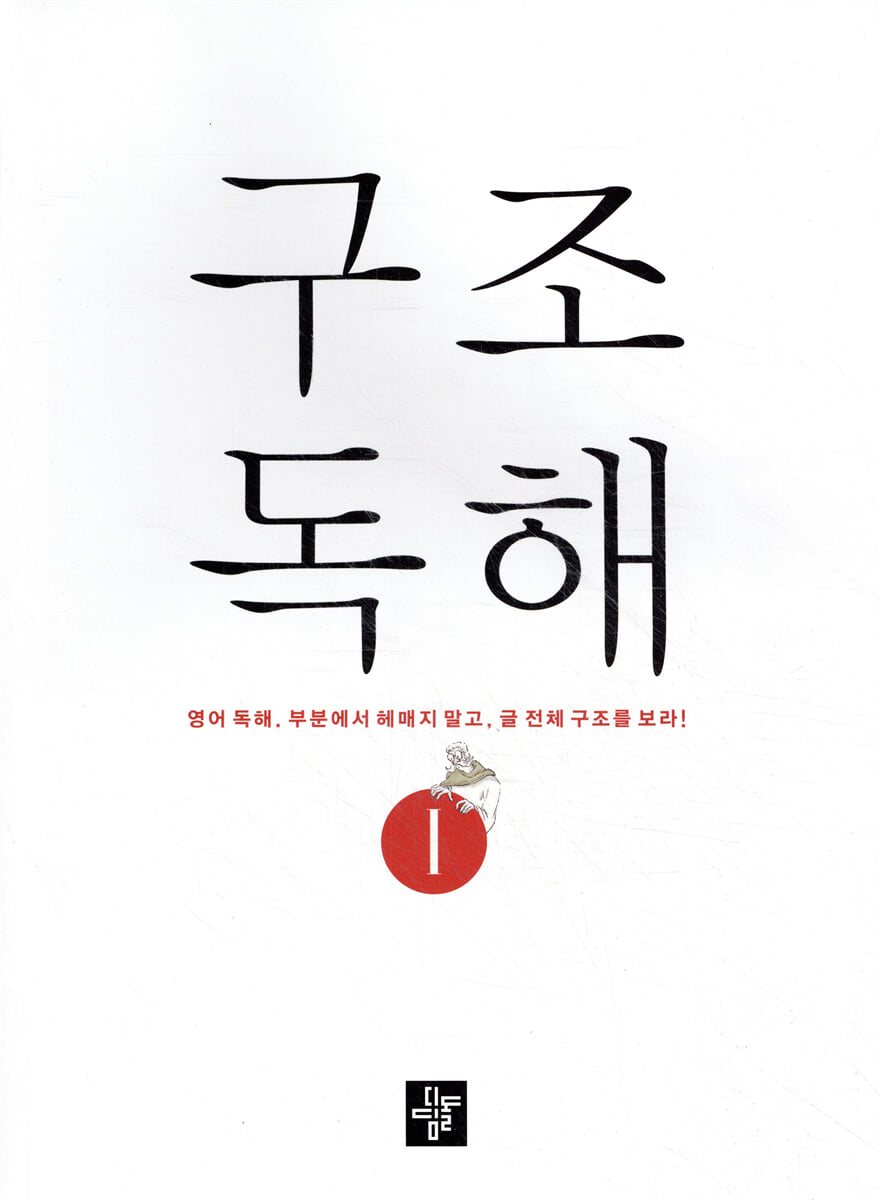
Structural Reading 1
 |
Description
Book Introduction
English reading.
Don't get lost in the parts, read the whole article!
Just as the writer chose the structure of the text to most effectively convey the text's theme, the reader should approach the text structurally to most effectively grasp the text's theme.
To accurately understand the writer's argument and main point without getting lost in the details, you need to look at the writing structure.
The structure of the text is a shortcut to finding the writer's thoughts without losing direction.
Stepping Stone "Structured Reading" begins with the essence of reading comprehension, and covers six basic structures that reflect the format of the texts tested on the CSAT, allowing students to view the text as a structure and actively trace the writer's thoughts.
The series was designed to embody structural reading comprehension by repeating and expanding the structure.
Don't get lost in the parts, read the whole article!
Just as the writer chose the structure of the text to most effectively convey the text's theme, the reader should approach the text structurally to most effectively grasp the text's theme.
To accurately understand the writer's argument and main point without getting lost in the details, you need to look at the writing structure.
The structure of the text is a shortcut to finding the writer's thoughts without losing direction.
Stepping Stone "Structured Reading" begins with the essence of reading comprehension, and covers six basic structures that reflect the format of the texts tested on the CSAT, allowing students to view the text as a structure and actively trace the writer's thoughts.
The series was designed to embody structural reading comprehension by repeating and expanding the structure.
- You can preview some of the book's contents.
Preview
index
01 General-Specific
1 history of money
2 London's taxi drivers
3 urban legend
4 war foods
5 Chinese economy
6 history of shoes
7 Monochronic vs. Polychronic
8 emotion
Why did you write it in a general-specific structure?
02 Problem-Solving
1 submarine
2 window tax
3 Good Samaritan laws
4 La Boheme and Rent
5 exact measurement
6 workplace surveillance
7 de-extinction
8 GM crops
Why did you write it in a problem-solution structure?
03 Confrontation
1 boredom
2 using cell phones
3 women's soccer
4 learning a language
5 marketing
6 history and historians
Why was it written in a confrontational structure?
04 Questions and Answers
1 pencil
2 driving on the left and right
3 a blessing in disguise
4 the ravens in the Tower of London
5 super-sized meals
6 Black Friday
Why did you write it in a question-and-answer structure?
1 history of money
2 London's taxi drivers
3 urban legend
4 war foods
5 Chinese economy
6 history of shoes
7 Monochronic vs. Polychronic
8 emotion
Why did you write it in a general-specific structure?
02 Problem-Solving
1 submarine
2 window tax
3 Good Samaritan laws
4 La Boheme and Rent
5 exact measurement
6 workplace surveillance
7 de-extinction
8 GM crops
Why did you write it in a problem-solution structure?
03 Confrontation
1 boredom
2 using cell phones
3 women's soccer
4 learning a language
5 marketing
6 history and historians
Why was it written in a confrontational structure?
04 Questions and Answers
1 pencil
2 driving on the left and right
3 a blessing in disguise
4 the ravens in the Tower of London
5 super-sized meals
6 Black Friday
Why did you write it in a question-and-answer structure?
Detailed image
Publisher's Review
“English reading.
“Don’t get lost in the parts, look at the whole text!”
The essence of reading comprehension is to accurately grasp the writer's argument and the main point of the text.
Will I be able to read it just by trying hard to interpret it?
There are too many students who don't understand what is being said even though they try hard to interpret it.
Why is that?
This is because we do not look at the ‘structure of the text’, which is as important as the subject of the text.
Just as the writer chose the structure of the piece to most effectively convey the subject matter of the piece,
Readers need to approach a text structurally to most effectively grasp its subject matter.
To accurately understand the author's argument and main point without getting lost in the parts,
You have to look at the text in terms of structure.
The structure of the text is a shortcut to finding the writer's thoughts without losing direction.
“Reading skills that start with structural reading and lead to the CSAT!”
Stepping Stone Structure Reading
Starting from the essence of reading, students view the text as a structure and actively think about the writer's thoughts.
The basic format for organizing writing so that it can be traced, reflecting the format of writing that appears on the CSAT
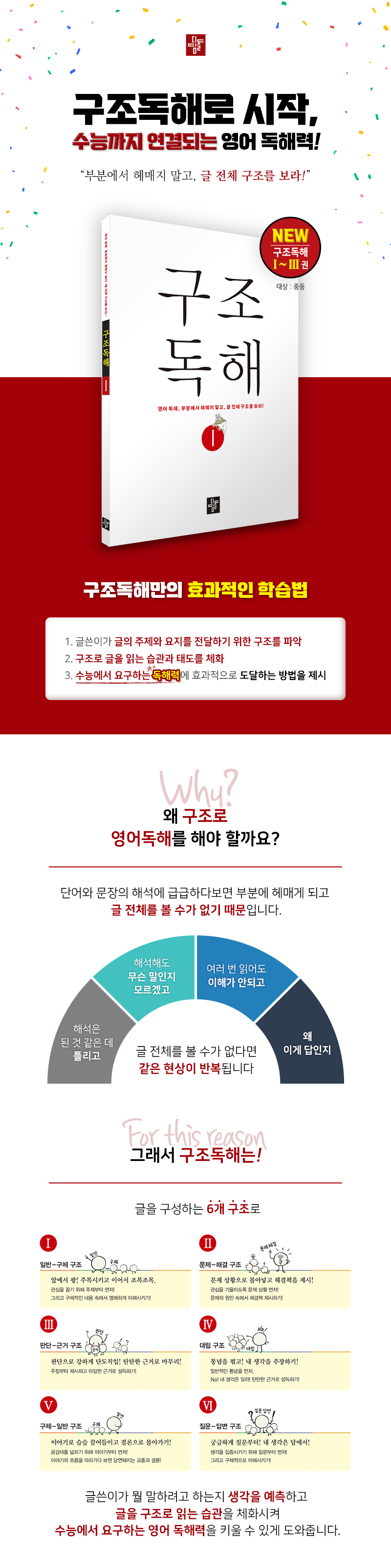
The text is structured in six parts.
To embody structural reading comprehension by repeating and expanding the structure
The series was composed.
Structural Reading I (4 structures) → Structural Reading II (5 structures) → Structural Reading III (up to 6 structures)
□ Check your reading comprehension with past exam questions
Check your reading comprehension skills with past exam questions.
Let's solve past exam questions and answer the examiner's questions.
□ Looking at the structure
By looking at the entire text through a structure diagram, you can easily understand the writer's intention in organizing the paragraphs.
Question 0 allows you to check whether you have grasped the flow of the entire text and the roles and relationships of the paragraphs.
□ Writing Strategy
Writing strategies help you effectively understand the structure of a piece and the writer's thoughts, and provide practical tips.
□ Questioner
The character of the examiner presented next to the question helps students understand the structure and provides direction by constantly asking questions about the intention of the question.
□ Vocabulary and Grammar Box
By learning to understand vocabulary and grammar in context and how to use them, you can effectively grasp the writer's intention and the structure of the text, and also develop the ability to infer context.
□ Looking at the structure!
The effect of looking at the text as a structure is confirmed through the characters.
If you read the text structured and follow the author's thoughts while distinguishing the flow, you will be able to accurately grasp the main idea of any text without getting lost.
□ Check why the writer wrote it in that structure
Depending on the purpose and topic of writing, the structure of the content also changes.
Find out why the author chose each structure.
· General-specific structure
· Problem-solution structure
· Oppositional structure
· Question-answer structure
By looking at the structure of the previous questions presented above, you can experience how effectively you can solve them.
□ Correct answer and explanation
Structure and Summary at a Glance
The text, structure diagram, summary, and expert interpretation are provided on one page, divided into the correct answer and explanation, allowing you to study the structure again at a glance.
□ Appendix Vocabulary List
Vocabulary that is checked repeatedly by looking at the context
You can present words along with text to check the meaning of the words in context.
We also provide tests so you can repeatedly check the English and Korean meanings of the words.
“Don’t get lost in the parts, look at the whole text!”
The essence of reading comprehension is to accurately grasp the writer's argument and the main point of the text.
Will I be able to read it just by trying hard to interpret it?
There are too many students who don't understand what is being said even though they try hard to interpret it.
Why is that?
This is because we do not look at the ‘structure of the text’, which is as important as the subject of the text.
Just as the writer chose the structure of the piece to most effectively convey the subject matter of the piece,
Readers need to approach a text structurally to most effectively grasp its subject matter.
To accurately understand the author's argument and main point without getting lost in the parts,
You have to look at the text in terms of structure.
The structure of the text is a shortcut to finding the writer's thoughts without losing direction.
“Reading skills that start with structural reading and lead to the CSAT!”
Stepping Stone Structure Reading
Starting from the essence of reading, students view the text as a structure and actively think about the writer's thoughts.
The basic format for organizing writing so that it can be traced, reflecting the format of writing that appears on the CSAT
The text is structured in six parts.
To embody structural reading comprehension by repeating and expanding the structure
The series was composed.
Structural Reading I (4 structures) → Structural Reading II (5 structures) → Structural Reading III (up to 6 structures)
□ Check your reading comprehension with past exam questions
Check your reading comprehension skills with past exam questions.
Let's solve past exam questions and answer the examiner's questions.
□ Looking at the structure
By looking at the entire text through a structure diagram, you can easily understand the writer's intention in organizing the paragraphs.
Question 0 allows you to check whether you have grasped the flow of the entire text and the roles and relationships of the paragraphs.
□ Writing Strategy
Writing strategies help you effectively understand the structure of a piece and the writer's thoughts, and provide practical tips.
□ Questioner
The character of the examiner presented next to the question helps students understand the structure and provides direction by constantly asking questions about the intention of the question.
□ Vocabulary and Grammar Box
By learning to understand vocabulary and grammar in context and how to use them, you can effectively grasp the writer's intention and the structure of the text, and also develop the ability to infer context.
□ Looking at the structure!
The effect of looking at the text as a structure is confirmed through the characters.
If you read the text structured and follow the author's thoughts while distinguishing the flow, you will be able to accurately grasp the main idea of any text without getting lost.
□ Check why the writer wrote it in that structure
Depending on the purpose and topic of writing, the structure of the content also changes.
Find out why the author chose each structure.
· General-specific structure
· Problem-solution structure
· Oppositional structure
· Question-answer structure
By looking at the structure of the previous questions presented above, you can experience how effectively you can solve them.
□ Correct answer and explanation
Structure and Summary at a Glance
The text, structure diagram, summary, and expert interpretation are provided on one page, divided into the correct answer and explanation, allowing you to study the structure again at a glance.
□ Appendix Vocabulary List
Vocabulary that is checked repeatedly by looking at the context
You can present words along with text to check the meaning of the words in context.
We also provide tests so you can repeatedly check the English and Korean meanings of the words.
GOODS SPECIFICS
- Date of issue: May 1, 2023
- Page count, weight, size: 240 pages | 749g | 220*300*20mm
- ISBN13: 9788926162989
- ISBN10: 8926162982
- Reference book for use in grades: Common for middle school students
- Reference book usage semester: Common semester
- Reference book difficulty: Medium Reference book difficulty guide
You may also like
카테고리
korean


korean

![GQ KOREA Mark (Monthly): December [2025]](http://librairie.coreenne.fr/cdn/shop/files/8ef265dbbfbf186523ed75ba7319009d.jpg?v=1765340328&width=3840)


