

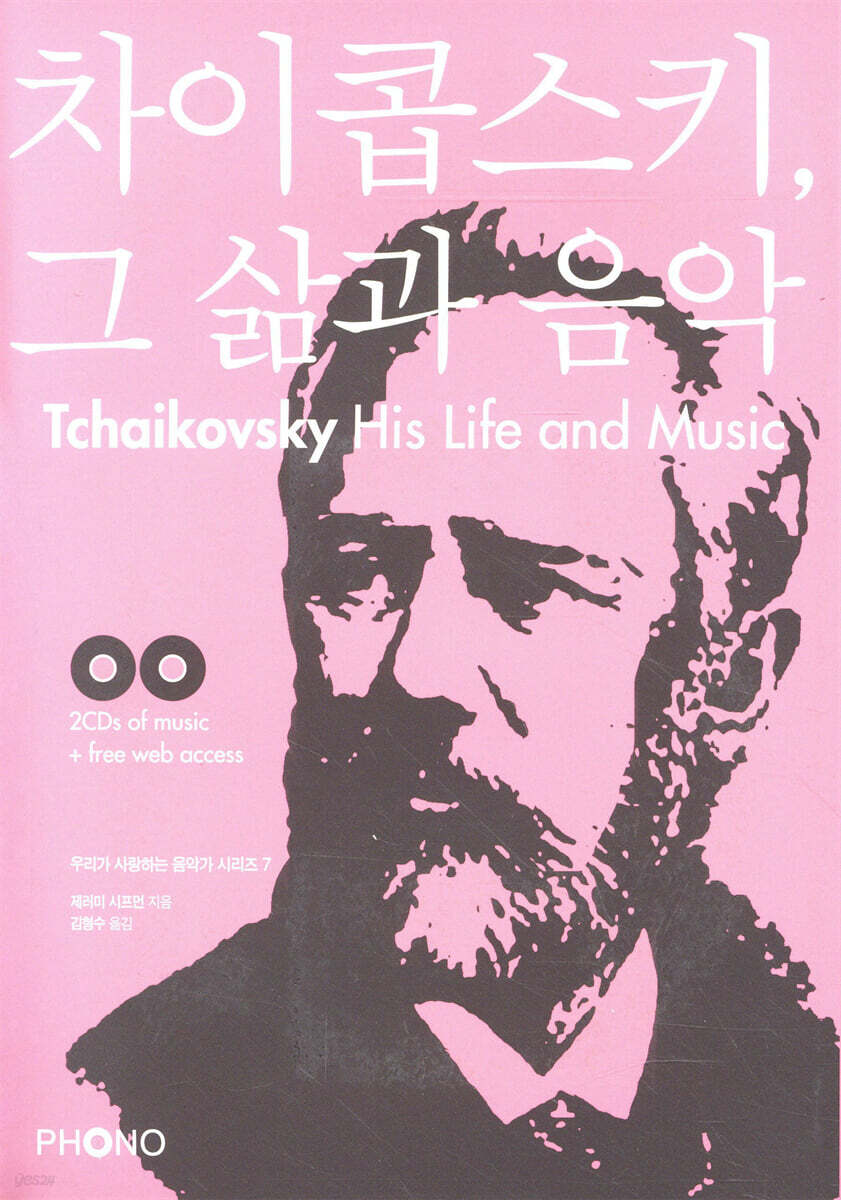
Tchaikovsky, his life and music
 |
Description
Book Introduction
The Music and Life of the Eccentric Genius, Russia's Tchaikovsky
This book allows you to encounter Tchaikovsky, the great Russian composer, through vivid music.
Two CDs of representative works performed by top performers such as Anthony Witt and Philippe Ansermont are provided with detailed commentary, and full movements of major works can be found on the website.
Tchaikovsky, a delicate and charming artist of Russian lyricism who overcame the stereotype of an 'eccentric genius' and heralded film music.
It includes a detailed comparative chronology and explanations of musical terms that allow you to see his life, music, and era at a glance.
This book allows you to encounter Tchaikovsky, the great Russian composer, through vivid music.
Two CDs of representative works performed by top performers such as Anthony Witt and Philippe Ansermont are provided with detailed commentary, and full movements of major works can be found on the website.
Tchaikovsky, a delicate and charming artist of Russian lyricism who overcame the stereotype of an 'eccentric genius' and heralded film music.
It includes a detailed comparative chronology and explanations of musical terms that allow you to see his life, music, and era at a glance.
- You can preview some of the book's contents.
Preview
index
introduction
Chapter 1: Childhood, Adolescence, and Youth 1840–1864
_ Interlude 1 Piano Music
Chapter 2: His Coming Era, 1865-1876
_ Interlude 2 Tchaikovsky and Dramatic Music
Chapter 3: Fame and Crisis, 1876-1877
_ Interlude 3 Orchestra
Chapter 4: Sex, Suffering, Sublimation, and Loss 1878-1884
_ Interlude 4 Chamber Music
Chapter 5: Finding Peace and Happiness in a New Home, 1885-1888
_ Gwanjugok 5 Gagok
Chapter 6: Living as a VIP at Home and Abroad, 1888-1891
_ Interlude 6 Tchaikovsky and Russian Things
_ Epilogue, Tchaikovsky and the Future
supplement
19th century setting
Russian cultural background
Characters in the book
Glossary
CD track commentary
Chronology
Translator's Note
References
List of songs performed by Anthony Witt, Philippe Ansermont, and others (2 CDs)
CD1
1.
Zemfira's Song 2:17
Zemfira's Song
Lyuba Kazanovskaya, soprano; Lyuba Orfenova, piano
Ljuba Kazarnovskaya, soprano; Ljuba Orfenova, piano
2.
Storm, Op. 76 (Conclusion) 7:01
The Storm, Op.76 (Conclusion)
Polish National Radio Symphony Orchestra; Antoni Wit
Polish National Radio Symphony Orchestra; Antoni Wit
3.
Piano Romance in F minor, Op. 5, 6:12
Romance in F minor for piano, Op.5
Oksana Yablonskaya, piano
Oxana Yablonskaya, piano
4.
Romeo and Juliet (Fantasy Overture) 20:26
Romeo and Juliet (fantasy overture)
Ukrainian National Symphony Orchestra; Teodor Kukar
National Symphony Orchestra of Ukraine; Theodore Kuchar
5.
Forget it soon 3:12
To Forget so Soon
Lyuba Kazanovskaya, soprano; Lyuba Orfenova, piano
Ljuba Kazarnovskaya, soprano; Ljuba Orfenova, piano
6.
String Quartet No. 1 in D major, Op.
11 2nd Movement Andante Cantabile 6:36 (W)
String Quartet No.
1 in D major, Op.
11 Movement 2: Andante cantabile
New Haydn Quartet, Budapest
New Haydn Quartet, Budapest
7.
Symphony No. 2 in C minor, Op.
17 'Little Russia' Finale: Moderato Asai-Allegro Vivo 10:32 (W)
Symphony No.
2 in C minor, Op.
17 'Little Russian' Finale: Moderato assai-Allegro vivo
Polish National Radio Symphony Orchestra; Adrian Rieper
Polish National Radio Symphony Orchestra; Adrian Leaper
8.
Snow Maiden, Op.
12 15: Song of Brusilla 1:32 (W)
The Snow Maiden Op.12 No.
15: Brusila's Song
Elena Okolisheva, mezzo-soprano; Arkady Mshenkin, tenor; Moscow Capella; Moscow Symphony Orchestra; Igor Golovshin
Elena Okolysheva, mezzo soprano; Arkady Mshenkin, tenor; Moscow Capella; Moscow Symphony Orchestra; Igor Golovchin
9.
Piano Concerto No. 1 in B flat minor, Op.
23 Finale: Allegro con fuoco 7:10 (W)
Piano Concerto No.
1 in B flat minor, Op.
23 Finale: Allegro con fuoco
Bernd Glemser, piano; Polish National Radio Symphony Orchestra; Antoni Wit
Bernd Glemser, piano; Polish National Radio Symphony Orchestra; Antoni Wit
10.
Symphony No. 4 in F minor, Op.
36 (W)
3rd Movement: Scherzo (Pizzicato Ostinato): Allegro-Meno Mosso-Tempo I 5:55
Symphony No.
4 in F minor, Op.
36
Movement 3: Scherzo (Pizzicato ostinato): Allegro-Meno mosso-Tempo I
Polish National Radio Symphony Orchestra; Adrian Rieper
Polish National Radio Symphony Orchestra; Adrian Leaper
11.
Variations on a Rococo Theme for Cello and Orchestra, Op.
33 (Final) 2:11 (W)
Variations on a Rococo Theme for cello and orchestra, Op.33 (Conclusion)
Maria Kliegel, cello; National Symphony Orchestra of Ireland; Gerhard Markson
Maria Kliegel, cello; National Symphony Orchestra of Ireland; Gerhard Markson
12.
Eugene Onegin, Op.
Act 2, Scene 2: Lensky's Aria "Where, Where Have You Gone?" 6:17
Eugene Onegin, Op.24 Act II, Scene 2: Lensky's aria 'Where o where have you gone?'
Vladimir Grishko, tenor; Ukrainian Radio Symphony Orchestra; Vladimir Sirenko
Vladimir Grishko, tenor; Ukraine State Radio Symphony Orchestra; Vladimir Sirenko
TT 79:29
CD2
1.
Violin Concerto in D major, Op.
35 Finale: Allegro vivacissimo 10:46 (W)
Violin concerto in D major, Op.
35 Finale: Allegro Vivacissimo
Ilya Kahler, violin; Russian Philharmonic Orchestra; Dmitry Yablonsky
Ilya Kaler, violin; Russian Philharmonic Orchestra; Dmitry Yablonsky
2.
The Liturgy of St. John Chrysostom, Op.
41 11: Epiclesis 2:58 (W)
Liturgy of St John Chrysostom, Op.
41 No.
11: Epiclesis
Viktor Offi, ?you; Pablo Mezulin, bass; Kyiv Chamber Choir; Mykola Hovdić
Viktor Ovdiy, tenor; Pavlo Mezhulin, bass; Kiev Chamber Choir; Mykola Hobdych
3.
Italian Capriccio Op.
45 (Final) 4:06
Capriccio italien, Op.
45 (Conclusion)
Ukrainian National Symphony Orchestra; Teodor Kukar
National Symphony Orchestra of Ukraine; Theodore Kuchar
4.
1812 (Festival Overture), Op.
49 (Final) 6:34
1812 (festival overture), Op.
49 (Conclusion)
Ukrainian National Symphony Orchestra; Teodor Kukar
National Symphony Orchestra of Ukraine; Theodore Kuchar
5.
Serenade for Strings in C major, Op.
48 2nd movement: Vals 3:57 (W)
Serenade in C major for strings, Op.
48 Movement 2: Valse
Vienna Chamber Orchestra; Philippe Entremont
Vienna Chamber Orchestra; Philippe Entremont
6.
Piano Trio in D minor, Op.
50 2nd Movement: Thema con Variaccioni (Excerpt) 6:54 (W)
Piano Trio in A minor, Op.
50 Movement 2: Tema con variazioni (Excerpts)
Bofka Ashkenazy, piano; Richard Stamper, violin; Christine Jackson, cello
Vovka Ashkenazy, piano; Richard Stamper, violin; Christine Jackson, cello
7.
Manfred, Op.
58 2nd movement: Vivace con Spirito 9:44 (W)
Manfred, Op.
58 Movement 2: Vivace in spirito
Slovak Radio Symphony Orchestra; Ondrej Leonard
Slovak Radio Symphony Orchestra; Onderj Lenard
8.
Symphony No. 5 in E minor, Op.
64 13:40 (W)
2nd movement: Andante cantabile, con alcuna lisenza
Symphony No.
5 in E minor, Op.
64
Movement 2: Andante cantabile, con alcuna licenza
Polish National Radio Symphony Orchestra; Antoni Wit
Polish National Radio Symphony Orchestra; Antoni Wit
9.
Sleeping Beauty, Op.
66 Act 1, No. 7: Waltz 4:45 (W)
The Sleeping Beauty, Op.
66 Act I, no.
7: Valse
Slovak Philharmonic Orchestra (Kocsis); Andrew Mogrelia
Slovak State Philharmonic Orchestra (Ko?ice); Andrew Mogrelia
10.
Queen of Spades, Op.
Act 1, Scene 3: Hermann's Aria "Heavenly Creature, Forgive Me" 2:48
The Queen of Spades, Op.
68
Act I, Scene 3: Hermann's aria 'forgive me, heavenly creature'
Vladimir Grishko, tenor; Ukrainian Radio Symphony Orchestra; Vladimir Sirenko
Vladimir Grishko, tenor; Ukraine State Radio Symphony Orchestra; Vladimir Sirenko
11.
The Nutcracker, Op.
71 Act 2, Variation 14, No. 2: "Dance of the Plum Dolls" 2:16 (W)
The Nutcracker, Op.
71 Act II, No.
14, Variation 2: 'The Dance of the Sugar-Plum Fairy'
Slovak Radio Symphony Orchestra; Ondrej Leonard
Slovak Radio Symphony Orchestra; Onderj Lenard
12.
Symphony No. 6 in B minor, Op.
74 'Pathetic' Finale: Adagio Lamentoso-Andante 10:51 (W)
Symphony No.
6 in B minor, Op.
74 'Pathetique'
Finale: Adagio lamentoso-Andante
Polish National Radio Symphony Orchestra; Antoni Wit
Polish National Radio Symphony Orchestra; Antoni Wit
TT 79:25
Detailed song commentary is included in the appendix.
Works marked with a W can be viewed in their entirety on the website.
Chapter 1: Childhood, Adolescence, and Youth 1840–1864
_ Interlude 1 Piano Music
Chapter 2: His Coming Era, 1865-1876
_ Interlude 2 Tchaikovsky and Dramatic Music
Chapter 3: Fame and Crisis, 1876-1877
_ Interlude 3 Orchestra
Chapter 4: Sex, Suffering, Sublimation, and Loss 1878-1884
_ Interlude 4 Chamber Music
Chapter 5: Finding Peace and Happiness in a New Home, 1885-1888
_ Gwanjugok 5 Gagok
Chapter 6: Living as a VIP at Home and Abroad, 1888-1891
_ Interlude 6 Tchaikovsky and Russian Things
_ Epilogue, Tchaikovsky and the Future
supplement
19th century setting
Russian cultural background
Characters in the book
Glossary
CD track commentary
Chronology
Translator's Note
References
List of songs performed by Anthony Witt, Philippe Ansermont, and others (2 CDs)
CD1
1.
Zemfira's Song 2:17
Zemfira's Song
Lyuba Kazanovskaya, soprano; Lyuba Orfenova, piano
Ljuba Kazarnovskaya, soprano; Ljuba Orfenova, piano
2.
Storm, Op. 76 (Conclusion) 7:01
The Storm, Op.76 (Conclusion)
Polish National Radio Symphony Orchestra; Antoni Wit
Polish National Radio Symphony Orchestra; Antoni Wit
3.
Piano Romance in F minor, Op. 5, 6:12
Romance in F minor for piano, Op.5
Oksana Yablonskaya, piano
Oxana Yablonskaya, piano
4.
Romeo and Juliet (Fantasy Overture) 20:26
Romeo and Juliet (fantasy overture)
Ukrainian National Symphony Orchestra; Teodor Kukar
National Symphony Orchestra of Ukraine; Theodore Kuchar
5.
Forget it soon 3:12
To Forget so Soon
Lyuba Kazanovskaya, soprano; Lyuba Orfenova, piano
Ljuba Kazarnovskaya, soprano; Ljuba Orfenova, piano
6.
String Quartet No. 1 in D major, Op.
11 2nd Movement Andante Cantabile 6:36 (W)
String Quartet No.
1 in D major, Op.
11 Movement 2: Andante cantabile
New Haydn Quartet, Budapest
New Haydn Quartet, Budapest
7.
Symphony No. 2 in C minor, Op.
17 'Little Russia' Finale: Moderato Asai-Allegro Vivo 10:32 (W)
Symphony No.
2 in C minor, Op.
17 'Little Russian' Finale: Moderato assai-Allegro vivo
Polish National Radio Symphony Orchestra; Adrian Rieper
Polish National Radio Symphony Orchestra; Adrian Leaper
8.
Snow Maiden, Op.
12 15: Song of Brusilla 1:32 (W)
The Snow Maiden Op.12 No.
15: Brusila's Song
Elena Okolisheva, mezzo-soprano; Arkady Mshenkin, tenor; Moscow Capella; Moscow Symphony Orchestra; Igor Golovshin
Elena Okolysheva, mezzo soprano; Arkady Mshenkin, tenor; Moscow Capella; Moscow Symphony Orchestra; Igor Golovchin
9.
Piano Concerto No. 1 in B flat minor, Op.
23 Finale: Allegro con fuoco 7:10 (W)
Piano Concerto No.
1 in B flat minor, Op.
23 Finale: Allegro con fuoco
Bernd Glemser, piano; Polish National Radio Symphony Orchestra; Antoni Wit
Bernd Glemser, piano; Polish National Radio Symphony Orchestra; Antoni Wit
10.
Symphony No. 4 in F minor, Op.
36 (W)
3rd Movement: Scherzo (Pizzicato Ostinato): Allegro-Meno Mosso-Tempo I 5:55
Symphony No.
4 in F minor, Op.
36
Movement 3: Scherzo (Pizzicato ostinato): Allegro-Meno mosso-Tempo I
Polish National Radio Symphony Orchestra; Adrian Rieper
Polish National Radio Symphony Orchestra; Adrian Leaper
11.
Variations on a Rococo Theme for Cello and Orchestra, Op.
33 (Final) 2:11 (W)
Variations on a Rococo Theme for cello and orchestra, Op.33 (Conclusion)
Maria Kliegel, cello; National Symphony Orchestra of Ireland; Gerhard Markson
Maria Kliegel, cello; National Symphony Orchestra of Ireland; Gerhard Markson
12.
Eugene Onegin, Op.
Act 2, Scene 2: Lensky's Aria "Where, Where Have You Gone?" 6:17
Eugene Onegin, Op.24 Act II, Scene 2: Lensky's aria 'Where o where have you gone?'
Vladimir Grishko, tenor; Ukrainian Radio Symphony Orchestra; Vladimir Sirenko
Vladimir Grishko, tenor; Ukraine State Radio Symphony Orchestra; Vladimir Sirenko
TT 79:29
CD2
1.
Violin Concerto in D major, Op.
35 Finale: Allegro vivacissimo 10:46 (W)
Violin concerto in D major, Op.
35 Finale: Allegro Vivacissimo
Ilya Kahler, violin; Russian Philharmonic Orchestra; Dmitry Yablonsky
Ilya Kaler, violin; Russian Philharmonic Orchestra; Dmitry Yablonsky
2.
The Liturgy of St. John Chrysostom, Op.
41 11: Epiclesis 2:58 (W)
Liturgy of St John Chrysostom, Op.
41 No.
11: Epiclesis
Viktor Offi, ?you; Pablo Mezulin, bass; Kyiv Chamber Choir; Mykola Hovdić
Viktor Ovdiy, tenor; Pavlo Mezhulin, bass; Kiev Chamber Choir; Mykola Hobdych
3.
Italian Capriccio Op.
45 (Final) 4:06
Capriccio italien, Op.
45 (Conclusion)
Ukrainian National Symphony Orchestra; Teodor Kukar
National Symphony Orchestra of Ukraine; Theodore Kuchar
4.
1812 (Festival Overture), Op.
49 (Final) 6:34
1812 (festival overture), Op.
49 (Conclusion)
Ukrainian National Symphony Orchestra; Teodor Kukar
National Symphony Orchestra of Ukraine; Theodore Kuchar
5.
Serenade for Strings in C major, Op.
48 2nd movement: Vals 3:57 (W)
Serenade in C major for strings, Op.
48 Movement 2: Valse
Vienna Chamber Orchestra; Philippe Entremont
Vienna Chamber Orchestra; Philippe Entremont
6.
Piano Trio in D minor, Op.
50 2nd Movement: Thema con Variaccioni (Excerpt) 6:54 (W)
Piano Trio in A minor, Op.
50 Movement 2: Tema con variazioni (Excerpts)
Bofka Ashkenazy, piano; Richard Stamper, violin; Christine Jackson, cello
Vovka Ashkenazy, piano; Richard Stamper, violin; Christine Jackson, cello
7.
Manfred, Op.
58 2nd movement: Vivace con Spirito 9:44 (W)
Manfred, Op.
58 Movement 2: Vivace in spirito
Slovak Radio Symphony Orchestra; Ondrej Leonard
Slovak Radio Symphony Orchestra; Onderj Lenard
8.
Symphony No. 5 in E minor, Op.
64 13:40 (W)
2nd movement: Andante cantabile, con alcuna lisenza
Symphony No.
5 in E minor, Op.
64
Movement 2: Andante cantabile, con alcuna licenza
Polish National Radio Symphony Orchestra; Antoni Wit
Polish National Radio Symphony Orchestra; Antoni Wit
9.
Sleeping Beauty, Op.
66 Act 1, No. 7: Waltz 4:45 (W)
The Sleeping Beauty, Op.
66 Act I, no.
7: Valse
Slovak Philharmonic Orchestra (Kocsis); Andrew Mogrelia
Slovak State Philharmonic Orchestra (Ko?ice); Andrew Mogrelia
10.
Queen of Spades, Op.
Act 1, Scene 3: Hermann's Aria "Heavenly Creature, Forgive Me" 2:48
The Queen of Spades, Op.
68
Act I, Scene 3: Hermann's aria 'forgive me, heavenly creature'
Vladimir Grishko, tenor; Ukrainian Radio Symphony Orchestra; Vladimir Sirenko
Vladimir Grishko, tenor; Ukraine State Radio Symphony Orchestra; Vladimir Sirenko
11.
The Nutcracker, Op.
71 Act 2, Variation 14, No. 2: "Dance of the Plum Dolls" 2:16 (W)
The Nutcracker, Op.
71 Act II, No.
14, Variation 2: 'The Dance of the Sugar-Plum Fairy'
Slovak Radio Symphony Orchestra; Ondrej Leonard
Slovak Radio Symphony Orchestra; Onderj Lenard
12.
Symphony No. 6 in B minor, Op.
74 'Pathetic' Finale: Adagio Lamentoso-Andante 10:51 (W)
Symphony No.
6 in B minor, Op.
74 'Pathetique'
Finale: Adagio lamentoso-Andante
Polish National Radio Symphony Orchestra; Antoni Wit
Polish National Radio Symphony Orchestra; Antoni Wit
TT 79:25
Detailed song commentary is included in the appendix.
Works marked with a W can be viewed in their entirety on the website.
Publisher's Review
Tchaikovsky, His Life and Music 1840-1893
Only He Who Knows Loneliness (title of Tchaikovsky's song)
For generations, Tchaikovsky has helped alleviate loneliness in people around the world.
His masterpieces speak to us like this.
'Yeah, that happened to me too.
But I got through it.
I was very proud at that time.
It's even fun sometimes.
I know the pain you've been through.
I know joy too.'
____
No one denies that Pyotr Ilyich Tchaikovsky had problems, and no one would admit it more than Tchaikovsky himself.
However, the nature and root of the problem remains controversial.
Was Tchaikovsky simply neurotic? Was he a spoiled brat with a genius for nothing? So, was genius sometimes a blessing, sometimes a curse? Was his problem hereditary? These debates are neither new nor likely to lead to a conclusion.
There is no need to hear a medical explanation.
Once you learn about the life story of this charismatic yet troubled, annoying yet lovable man, you will be captivated beyond measure.
Throughout the 19th century, when he lived, he captivated the world with his music, and after his death, it only intensified.
Even his death is still a subject of heated debate.
The most bizarre love story in music history, maintained solely through letters
Unlike many musicians who suffered financially, Tchaikovsky was able to enjoy a decent cultural life.
In particular, his 16-year love affair with Madame Nadetzka von Meck, one of the most unique relationships between patron and musician in the history of music, was a great strength.
Madame von Meck, the widow of a railway businessman and a wealthy woman, began exchanging letters with Tchaikovsky in 1876 and provided him with 6,000 rubles annually from 1877 to 1890.
Financial stability greatly encouraged Tchaikovsky's creativity, and he dedicated several works, including the Fourth Symphony, to his wife.
Over the course of 16 years, they met each other by chance, but they passed each other by without saying a word, and maintained their relationship only through letters.
There is no one in the world who gives me such deep and wonderful happiness as you do.
I am so grateful for this beyond words, and I pray that this joy will never end or change.
If something like that happens, I won't be able to recover from the shock.
I cannot express the full impact of your precious letter, and I cannot convey to you the feeling of being overwhelmed by an uncontrollable yearning for comfort in my weary heart.
When I walk into the living room and see an envelope with your precious, familiar handwriting on it on the table, I feel like I can smell the high, heavenly fragrance that takes away my pain as I run towards it.
My love for you is like destiny, and my will cannot resist it.
When I listen to your music, I completely surrender to you.
You are like a god to me.
From the depths of my heart, everything pure, generous, and noble springs forth.
_ A letter from Madame von Meck to Tchaikovsky
To my dear, truly beloved friend.
It's a feeling that can't be expressed in words.
I was afraid that no matter how much I tried to express the inspiration you had on me, it would sound hollow.
And yet, as always, you read my mind.
That's all I have to say.
Before I knew you, I never imagined there could be someone with such an infinitely gentle and sublime spirit.
The way you handled it was as amazing as what you did for me.
My dearest friend, I sincerely thank you for everything.
Please know that from this moment on, every note that flows from my pen is meant for you.
_ A letter from Tchaikovsky to Madame von Meck
He was an incredibly sensitive child.
I felt embarrassed or upset over even the smallest things.
Things that were insignificant to other children had a serious impact on that child.
Corporal punishment was out of the question.
His popularity grew every day, no, every hour.
Everyone who met him at the gathering was immediately captivated by his magic.
“Visitors surrounded me.
“I have mountains of letters from journalists, composers, librettists, and above all, from all over America, asking for my autograph.” _ From my visit to the United States in 1890.
Only He Who Knows Loneliness (title of Tchaikovsky's song)
For generations, Tchaikovsky has helped alleviate loneliness in people around the world.
His masterpieces speak to us like this.
'Yeah, that happened to me too.
But I got through it.
I was very proud at that time.
It's even fun sometimes.
I know the pain you've been through.
I know joy too.'
____
No one denies that Pyotr Ilyich Tchaikovsky had problems, and no one would admit it more than Tchaikovsky himself.
However, the nature and root of the problem remains controversial.
Was Tchaikovsky simply neurotic? Was he a spoiled brat with a genius for nothing? So, was genius sometimes a blessing, sometimes a curse? Was his problem hereditary? These debates are neither new nor likely to lead to a conclusion.
There is no need to hear a medical explanation.
Once you learn about the life story of this charismatic yet troubled, annoying yet lovable man, you will be captivated beyond measure.
Throughout the 19th century, when he lived, he captivated the world with his music, and after his death, it only intensified.
Even his death is still a subject of heated debate.
The most bizarre love story in music history, maintained solely through letters
Unlike many musicians who suffered financially, Tchaikovsky was able to enjoy a decent cultural life.
In particular, his 16-year love affair with Madame Nadetzka von Meck, one of the most unique relationships between patron and musician in the history of music, was a great strength.
Madame von Meck, the widow of a railway businessman and a wealthy woman, began exchanging letters with Tchaikovsky in 1876 and provided him with 6,000 rubles annually from 1877 to 1890.
Financial stability greatly encouraged Tchaikovsky's creativity, and he dedicated several works, including the Fourth Symphony, to his wife.
Over the course of 16 years, they met each other by chance, but they passed each other by without saying a word, and maintained their relationship only through letters.
There is no one in the world who gives me such deep and wonderful happiness as you do.
I am so grateful for this beyond words, and I pray that this joy will never end or change.
If something like that happens, I won't be able to recover from the shock.
I cannot express the full impact of your precious letter, and I cannot convey to you the feeling of being overwhelmed by an uncontrollable yearning for comfort in my weary heart.
When I walk into the living room and see an envelope with your precious, familiar handwriting on it on the table, I feel like I can smell the high, heavenly fragrance that takes away my pain as I run towards it.
My love for you is like destiny, and my will cannot resist it.
When I listen to your music, I completely surrender to you.
You are like a god to me.
From the depths of my heart, everything pure, generous, and noble springs forth.
_ A letter from Madame von Meck to Tchaikovsky
To my dear, truly beloved friend.
It's a feeling that can't be expressed in words.
I was afraid that no matter how much I tried to express the inspiration you had on me, it would sound hollow.
And yet, as always, you read my mind.
That's all I have to say.
Before I knew you, I never imagined there could be someone with such an infinitely gentle and sublime spirit.
The way you handled it was as amazing as what you did for me.
My dearest friend, I sincerely thank you for everything.
Please know that from this moment on, every note that flows from my pen is meant for you.
_ A letter from Tchaikovsky to Madame von Meck
He was an incredibly sensitive child.
I felt embarrassed or upset over even the smallest things.
Things that were insignificant to other children had a serious impact on that child.
Corporal punishment was out of the question.
His popularity grew every day, no, every hour.
Everyone who met him at the gathering was immediately captivated by his magic.
“Visitors surrounded me.
“I have mountains of letters from journalists, composers, librettists, and above all, from all over America, asking for my autograph.” _ From my visit to the United States in 1890.
GOODS SPECIFICS
- Date of publication: June 17, 2011
- Page count, weight, size: 288 pages | 469g | 155*220*20mm
- ISBN13: 9788993818239
- ISBN10: 8993818231
You may also like
카테고리
korean


korean

![GQ KOREA Mark (Monthly): December [2025]](http://librairie.coreenne.fr/cdn/shop/files/8ef265dbbfbf186523ed75ba7319009d.jpg?v=1765340328&width=3840)


