

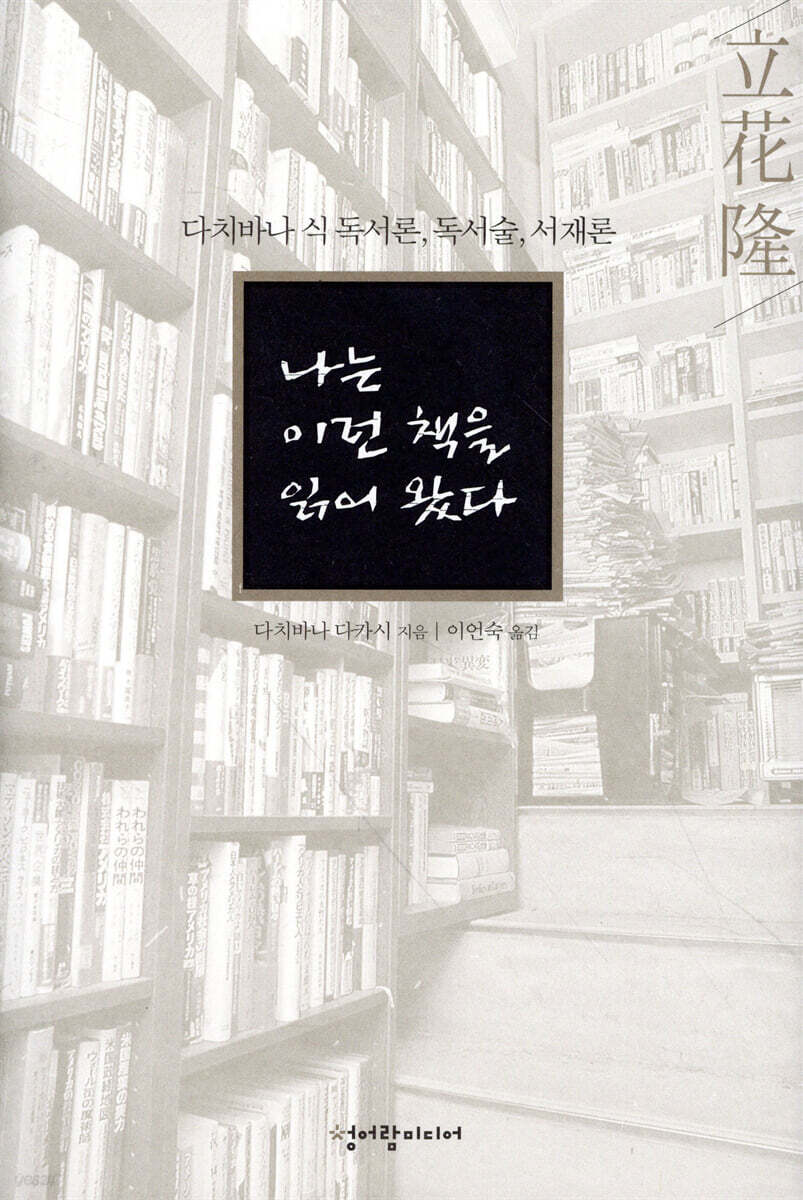
I've been reading books like this
 |
Description
Book Introduction
The Tachibana Method of Reading, Reading Skills, and Studying, by Takashi Tachibana, Japan's top journalist.
Between night and dawn, the time when Minerva's owl flies to its nest.
I imagine taking the secret staircase to the rooftop and peeking into the third floor of his study, the "unstoppable black cat fortress," while the great scholar takes a nap in a corner.
There, where medieval mysticism, Islam, and the papyri of South American Indians illuminate a thousand eyes.
This is a book on reading, reading techniques, and libraries written by Takashi Tachibana, Japan's greatest journalist. He worked as a reporter for Bungei Shunjusha, then re-enrolled at the University of Tokyo to study philosophy. Since then, he has continued to travel across the humanities and natural sciences without letting up on his intellectual tension toward books and the world.
Stories of buying more books than the interview fee to interview one person, hiring a Persian tutor with the pocket money earned from teaching students, how to choose the books you really want, the author's unique standards for building and constructing bookshelves, including building a cat building, an experience of recruiting a secretary because he couldn't handle the overflowing books, and even a detailed look at the current state of the Japanese publishing market and its future.
As expected from a master of knowledge, he conveys his message in a clean and vivid style.
As he said, this is a must-have book for anyone who loves books, as it satisfies not only practical intellectual desires and pure intellectual desires, but also the intellectual desires of a women's weekly magazine.
Between the books, a beautifully drawn illustration of his three-story cat building study hangs.
I imagine taking the secret staircase to the rooftop and peeking into the third floor of his study, the "unstoppable black cat fortress," while the great scholar takes a nap in a corner.
There, where medieval mysticism, Islam, and the papyri of South American Indians illuminate a thousand eyes.
This is a book on reading, reading techniques, and libraries written by Takashi Tachibana, Japan's greatest journalist. He worked as a reporter for Bungei Shunjusha, then re-enrolled at the University of Tokyo to study philosophy. Since then, he has continued to travel across the humanities and natural sciences without letting up on his intellectual tension toward books and the world.
Stories of buying more books than the interview fee to interview one person, hiring a Persian tutor with the pocket money earned from teaching students, how to choose the books you really want, the author's unique standards for building and constructing bookshelves, including building a cat building, an experience of recruiting a secretary because he couldn't handle the overflowing books, and even a detailed look at the current state of the Japanese publishing market and its future.
As expected from a master of knowledge, he conveys his message in a clean and vivid style.
As he said, this is a must-have book for anyone who loves books, as it satisfies not only practical intellectual desires and pure intellectual desires, but also the intellectual desires of a women's weekly magazine.
Between the books, a beautifully drawn illustration of his three-story cat building study hangs.
- You can preview some of the book's contents.
Preview
index
1.
My intellectual curiosity
2.
My Reading Theory
A challenge toward the 'sum of human knowledge'
Experiential self-study method
14 Reading Techniques for "Practical" Use
3.
My Study/Workshop
My Fortress
Build a new library
My Secretary Contest
4.
I've been reading books like this
I've been reading books like this
Looking back on my reading
Resignation letter
The Final Chapter of Tachibana's Studio, "Cat Building" - Text and Illustration: Seno Kappa
5.
Space, Humanity, Books
* Translator's note
* Tachibana Takashi Chronology
My intellectual curiosity
2.
My Reading Theory
A challenge toward the 'sum of human knowledge'
Experiential self-study method
14 Reading Techniques for "Practical" Use
3.
My Study/Workshop
My Fortress
Build a new library
My Secretary Contest
4.
I've been reading books like this
I've been reading books like this
Looking back on my reading
Resignation letter
The Final Chapter of Tachibana's Studio, "Cat Building" - Text and Illustration: Seno Kappa
5.
Space, Humanity, Books
* Translator's note
* Tachibana Takashi Chronology
Into the book
There is a secret staircase next to the bathroom that leads to the rooftop.
A.
Books on medieval mysticism, literature, and philosophy.
Materials related to Oe Kenzaburo
B.
Art books.
Books on Christianity, Judaism, and Islam.
Religion in general.
Books related to the East and China.
C.
Because it's close to my desk, I have a lot of work-related materials.
History of South American Indians, books on the Baroque, religion, cultural anthropology, music, film, photography, etc.
D.
Translated literature.
A book by Kenzaburo Oe.
Near-death experience data.
Mr. Tachibana usually stays in this room a lot.
In other words, it is the most important workroom. This is probably because only on the third floor are there a bathroom and a place to take a quick nap.
The scope of work that can be done in this room is mainly in the humanities, and a wide range of work can be done, including thought, literature, religion, music, art, photography, and film.
It feels like I'm looking into Mr. Tachibana's head.
A.
Books on medieval mysticism, literature, and philosophy.
Materials related to Oe Kenzaburo
B.
Art books.
Books on Christianity, Judaism, and Islam.
Religion in general.
Books related to the East and China.
C.
Because it's close to my desk, I have a lot of work-related materials.
History of South American Indians, books on the Baroque, religion, cultural anthropology, music, film, photography, etc.
D.
Translated literature.
A book by Kenzaburo Oe.
Near-death experience data.
Mr. Tachibana usually stays in this room a lot.
In other words, it is the most important workroom. This is probably because only on the third floor are there a bathroom and a place to take a quick nap.
The scope of work that can be done in this room is mainly in the humanities, and a wide range of work can be done, including thought, literature, religion, music, art, photography, and film.
It feels like I'm looking into Mr. Tachibana's head.
---pp 202~203
To briefly introduce a recent series of articles, I covered research findings on the avian brain in two series.
In the first episode, I wrote about Professor Shigeru Watanabe of Keio University's experiments on pigeon brains.
This experiment involved showing pigeons paintings by Picasso and Monet and training them to distinguish between them.
First, prepare 10 paintings each of Picasso and Monet and show them to the pigeons.
And when the pigeons in the Picasso group look at a Picasso painting, and when the pigeons in the Monet group look at a Monet painting, we train them to knock on the cage door and give them food.
Then, after about two weeks, 90% of the pigeons will be able to distinguish the pictures.
However, this alone does not mean that pigeons can truly 'see and distinguish' the pictures.
I don't know if I'm identifying it with any specific clues, or if I just memorized all 20 pictures.
So in the next experiment, pigeons were shown new paintings by Picasso and Monet mixed with paintings by other artists.
Surprisingly, not only were the pigeons able to distinguish between Picasso's and Monet's new paintings, but the pigeons in the group shown Monet's paintings showed a stronger reaction to paintings by Impressionist painters such as Cezanne and Renoir, while the pigeons in the group shown Picasso's paintings showed a stronger reaction to paintings by avant-garde painters such as Braque and Matisse.
In other words, the pigeons were even able to identify the artist's style.
Another interesting thing is that when the paintings were turned upside down and tested, the pigeons that responded to Monet's paintings showed a significant drop in their correct answers, while the pigeons that responded to Picasso's paintings showed no significant change.
Surprisingly, they reacted exactly like humans.
To briefly introduce a recent series of articles, I covered research findings on the avian brain in two series.
In the first episode, I wrote about Professor Shigeru Watanabe of Keio University's experiments on pigeon brains.
This experiment involved showing pigeons paintings by Picasso and Monet and training them to distinguish between them.
First, prepare 10 paintings each of Picasso and Monet and show them to the pigeons.
And when the pigeons in the Picasso group look at a Picasso painting, and when the pigeons in the Monet group look at a Monet painting, we train them to knock on the cage door and give them food.
Then, after about two weeks, 90% of the pigeons will be able to distinguish the pictures.
However, this alone does not mean that pigeons can truly 'see and distinguish' the pictures.
I don't know if I'm identifying it with any specific clues, or if I just memorized all 20 pictures.
So in the next experiment, pigeons were shown new paintings by Picasso and Monet mixed with paintings by other artists.
Surprisingly, not only were the pigeons able to distinguish between Picasso's and Monet's new paintings, but the pigeons in the group shown Monet's paintings showed a stronger reaction to paintings by Impressionist painters such as Cezanne and Renoir, while the pigeons in the group shown Picasso's paintings showed a stronger reaction to paintings by avant-garde painters such as Braque and Matisse.
In other words, the pigeons were even able to identify the artist's style.
Another interesting thing is that when the paintings were turned upside down and tested, the pigeons that responded to Monet's paintings showed a significant drop in their correct answers, while the pigeons that responded to Picasso's paintings showed no significant change.
Surprisingly, they reacted exactly like humans.
In the first episode, I wrote about Professor Shigeru Watanabe of Keio University's experiments on pigeon brains.
This experiment involved showing pigeons paintings by Picasso and Monet and training them to distinguish between them.
First, prepare 10 paintings each of Picasso and Monet and show them to the pigeons.
And when the pigeons in the Picasso group look at a Picasso painting, and when the pigeons in the Monet group look at a Monet painting, we train them to knock on the cage door and give them food.
Then, after about two weeks, 90% of the pigeons will be able to distinguish the pictures.
However, this alone does not mean that pigeons can truly 'see and distinguish' the pictures.
I don't know if I'm identifying it with any specific clues, or if I just memorized all 20 pictures.
So in the next experiment, pigeons were shown new paintings by Picasso and Monet mixed with paintings by other artists.
Surprisingly, not only were the pigeons able to distinguish between Picasso's and Monet's new paintings, but the pigeons in the group shown Monet's paintings showed a stronger reaction to paintings by Impressionist painters such as Cezanne and Renoir, while the pigeons in the group shown Picasso's paintings showed a stronger reaction to paintings by avant-garde painters such as Braque and Matisse.
In other words, the pigeons were even able to identify the artist's style.
Another interesting thing is that when the paintings were turned upside down and tested, the pigeons that responded to Monet's paintings showed a significant drop in their correct answers, while the pigeons that responded to Picasso's paintings showed no significant change.
Surprisingly, they reacted exactly like humans.
To briefly introduce a recent series of articles, I covered research findings on the avian brain in two series.
In the first episode, I wrote about Professor Shigeru Watanabe of Keio University's experiments on pigeon brains.
This experiment involved showing pigeons paintings by Picasso and Monet and training them to distinguish between them.
First, prepare 10 paintings each of Picasso and Monet and show them to the pigeons.
And when the pigeons in the Picasso group look at a Picasso painting, and when the pigeons in the Monet group look at a Monet painting, we train them to knock on the cage door and give them food.
Then, after about two weeks, 90% of the pigeons will be able to distinguish the pictures.
However, this alone does not mean that pigeons can truly 'see and distinguish' the pictures.
I don't know if I'm identifying it with any specific clues, or if I just memorized all 20 pictures.
So in the next experiment, pigeons were shown new paintings by Picasso and Monet mixed with paintings by other artists.
Surprisingly, not only were the pigeons able to distinguish between Picasso's and Monet's new paintings, but the pigeons in the group shown Monet's paintings showed a stronger reaction to paintings by Impressionist painters such as Cezanne and Renoir, while the pigeons in the group shown Picasso's paintings showed a stronger reaction to paintings by avant-garde painters such as Braque and Matisse.
In other words, the pigeons were even able to identify the artist's style.
Another interesting thing is that when the paintings were turned upside down and tested, the pigeons that responded to Monet's paintings showed a significant drop in their correct answers, while the pigeons that responded to Picasso's paintings showed no significant change.
Surprisingly, they reacted exactly like humans.
--- pp. 14
Don't skimp on buying books.
Although books have become more expensive, they are still relatively cheap.
If you try to obtain the information contained in a book through other means, you will have to pay tens or hundreds of times more.
Don't skimp on buying books.
Although books have become more expensive, they are still relatively cheap.
If you try to obtain the information contained in a book through other means, you will have to pay tens or hundreds of times more.
Although books have become more expensive, they are still relatively cheap.
If you try to obtain the information contained in a book through other means, you will have to pay tens or hundreds of times more.
Don't skimp on buying books.
Although books have become more expensive, they are still relatively cheap.
If you try to obtain the information contained in a book through other means, you will have to pay tens or hundreds of times more.
--- p.81
Now all that remains is to read.
First, read a light introduction.
Read a textbook-like introductory book.
After reading one volume, you will have a rough idea of the outline and reading from the second volume onwards will become easier.
There is no need to read it carefully.
It is better not to take notes.
If you get too ambitious from the beginning, you will definitely get frustrated along the way.
If you read carefully while taking notes, a book that can be read in two hours can take two days.
It is better to skim through five introductory books than to read one introductory book thoroughly.
Even without taking notes, most of the important parts are mentioned repeatedly in other books, so they come into your head naturally.
Instead of taking notes, it's better to underline or mark things.
Then you can refer to the index.
And it is better to handle books roughly.
It is better to abandon the stingy idea of keeping it clean so that you can sell it to a used bookstore later.
Now all that remains is to read.
First, read a light introduction.
Read a textbook-like introductory book.
After reading one volume, you will have a rough idea of the outline and reading from the second volume onwards will become easier.
There is no need to read it carefully.
It is better not to take notes.
If you get too ambitious from the beginning, you will definitely get frustrated along the way.
If you read carefully while taking notes, a book that can be read in two hours can take two days.
It is better to skim through five introductory books than to read one introductory book thoroughly.
Even without taking notes, most of the important parts are mentioned repeatedly in other books, so they come into your head naturally.
Instead of taking notes, it's better to underline or mark things.
Then you can refer to the index.
And it is better to handle books roughly.
It is better to abandon the stingy idea of keeping it clean so that you can sell it to a used bookstore later.
First, read a light introduction.
Read a textbook-like introductory book.
After reading one volume, you will have a rough idea of the outline and reading from the second volume onwards will become easier.
There is no need to read it carefully.
It is better not to take notes.
If you get too ambitious from the beginning, you will definitely get frustrated along the way.
If you read carefully while taking notes, a book that can be read in two hours can take two days.
It is better to skim through five introductory books than to read one introductory book thoroughly.
Even without taking notes, most of the important parts are mentioned repeatedly in other books, so they come into your head naturally.
Instead of taking notes, it's better to underline or mark things.
Then you can refer to the index.
And it is better to handle books roughly.
It is better to abandon the stingy idea of keeping it clean so that you can sell it to a used bookstore later.
Now all that remains is to read.
First, read a light introduction.
Read a textbook-like introductory book.
After reading one volume, you will have a rough idea of the outline and reading from the second volume onwards will become easier.
There is no need to read it carefully.
It is better not to take notes.
If you get too ambitious from the beginning, you will definitely get frustrated along the way.
If you read carefully while taking notes, a book that can be read in two hours can take two days.
It is better to skim through five introductory books than to read one introductory book thoroughly.
Even without taking notes, most of the important parts are mentioned repeatedly in other books, so they come into your head naturally.
Instead of taking notes, it's better to underline or mark things.
Then you can refer to the index.
And it is better to handle books roughly.
It is better to abandon the stingy idea of keeping it clean so that you can sell it to a used bookstore later.
--- p.77-78
Now, as a final word, I believe that books are everyone's university.
No matter which university you enter, what you can learn there is only a very small portion, both quantitatively and qualitatively.
Whether in college or after graduating from college, if you want to learn something, you will eventually have no choice but to read books.
Throughout my life, I have consistently attended the university of books more diligently than anyone else.
And finally, a word of advice you should never forget, no matter what book you read: Don't believe everything you read.
Never trust what others say until you see it for yourself.
Including this book.
Now, as a final word, I believe that books are everyone's university.
No matter which university you enter, what you can learn there is only a very small portion, both quantitatively and qualitatively.
Whether in college or after graduating from college, if you want to learn something, you will eventually have no choice but to read books.
Throughout my life, I have consistently attended the university of books more diligently than anyone else.
And finally, a word of advice you should never forget, no matter what book you read: Don't believe everything you read.
Never trust what others say until you see it for yourself.
Including this book.
No matter which university you enter, what you can learn there is only a very small portion, both quantitatively and qualitatively.
Whether in college or after graduating from college, if you want to learn something, you will eventually have no choice but to read books.
Throughout my life, I have consistently attended the university of books more diligently than anyone else.
And finally, a word of advice you should never forget, no matter what book you read: Don't believe everything you read.
Never trust what others say until you see it for yourself.
Including this book.
Now, as a final word, I believe that books are everyone's university.
No matter which university you enter, what you can learn there is only a very small portion, both quantitatively and qualitatively.
Whether in college or after graduating from college, if you want to learn something, you will eventually have no choice but to read books.
Throughout my life, I have consistently attended the university of books more diligently than anyone else.
And finally, a word of advice you should never forget, no matter what book you read: Don't believe everything you read.
Never trust what others say until you see it for yourself.
Including this book.
--- p.285-286
In this world, there are people with abnormally strong appetites and people with abnormally strong sexual desires.
Likewise, there are also intellectual urges who are stronger than necessary.
I'm one of those people... If someone were to ask, 'Why do you want to know so much?', everyone would probably come up with their own reasons, but in the end, there wouldn't be any particular reason, and all I could say would be, 'I just want to know.'
In this world, there are people with abnormally strong appetites and people with abnormally strong sexual desires.
Likewise, there are also intellectual urges who are stronger than necessary.
I'm one of those people... If someone were to ask, 'Why do you want to know so much?', everyone would probably come up with their own reasons, but in the end, there wouldn't be any particular reason, and all I could say would be, 'I just want to know.'
Likewise, there are also intellectual urges who are stronger than necessary.
I'm one of those people... If someone were to ask, 'Why do you want to know so much?', everyone would probably come up with their own reasons, but in the end, there wouldn't be any particular reason, and all I could say would be, 'I just want to know.'
In this world, there are people with abnormally strong appetites and people with abnormally strong sexual desires.
Likewise, there are also intellectual urges who are stronger than necessary.
I'm one of those people... If someone were to ask, 'Why do you want to know so much?', everyone would probably come up with their own reasons, but in the end, there wouldn't be any particular reason, and all I could say would be, 'I just want to know.'
--- p.
First of all, you cannot be a proper producer unless you are a proper consumer.
People who have not formed their spiritual world through literature are bound to have an unthoughtful perspective on things.
You may also show a schematic tendency in understanding things or situations.
I think the world of literature is a world that appears different when you turn over what it first appears to be, and then when you turn it over again, it appears different again.
Literature is about seeking out what cannot be seen on the surface.
Another influence would be the imagination that is acquired and cultivated through reading, especially through reading literary works.
People who can't do reporting properly ultimately lack imagination.
No one tells you everything they know first.
For example, even if you want to hear about the other person's past experiences, there will still be a lot of things that have not been said.
The ability to perceive what the other person has not yet said, that is imagination.
First of all, you cannot be a proper producer unless you are a proper consumer.
People who have not formed their spiritual world through literature are bound to have an unthoughtful perspective on things.
You may also show a schematic tendency in understanding things or situations.
I think the world of literature is a world that appears different when you turn over what it first appears to be, and then when you turn it over again, it appears different again.
Literature is about seeking out what cannot be seen on the surface.
Another influence would be the imagination that is acquired and cultivated through reading, especially through reading literary works.
People who can't do reporting properly ultimately lack imagination.
No one tells you everything they know first.
For example, even if you want to hear about the other person's past experiences, there will still be a lot of things that have not been said.
The ability to perceive what the other person has not yet said, that is imagination.
People who have not formed their spiritual world through literature are bound to have an unthoughtful perspective on things.
You may also show a schematic tendency in understanding things or situations.
I think the world of literature is a world that appears different when you turn over what it first appears to be, and then when you turn it over again, it appears different again.
Literature is about seeking out what cannot be seen on the surface.
Another influence would be the imagination that is acquired and cultivated through reading, especially through reading literary works.
People who can't do reporting properly ultimately lack imagination.
No one tells you everything they know first.
For example, even if you want to hear about the other person's past experiences, there will still be a lot of things that have not been said.
The ability to perceive what the other person has not yet said, that is imagination.
First of all, you cannot be a proper producer unless you are a proper consumer.
People who have not formed their spiritual world through literature are bound to have an unthoughtful perspective on things.
You may also show a schematic tendency in understanding things or situations.
I think the world of literature is a world that appears different when you turn over what it first appears to be, and then when you turn it over again, it appears different again.
Literature is about seeking out what cannot be seen on the surface.
Another influence would be the imagination that is acquired and cultivated through reading, especially through reading literary works.
People who can't do reporting properly ultimately lack imagination.
No one tells you everything they know first.
For example, even if you want to hear about the other person's past experiences, there will still be a lot of things that have not been said.
The ability to perceive what the other person has not yet said, that is imagination.
--- pp.132-133
I often meet older people who, seeing the books they once considered true classics disappearing, claim that it is because young people today do not read them.
However, the fact that readers are now moving away from literary works makes it more clear and definitive that these literary works cannot be called classics.
Only books that can maintain a readership over time can be called classics; otherwise, they cannot be called classics.
(...)
In the evolutionary tree that the entire human race has walked, there are many species that, like dinosaurs, reached an evolutionary dead end, but were unable to develop further and eventually died out.
It's impossible to list all these examples, but even in the operation of human will there are things that are like evolutionary dead ends.
I think that 19th century Roman Rolland and 19th century speculative philosophy were following that path.
Isn't Hegel also that type?
We have already reached a point where no one except researchers read his works, and I believe this trend will continue.
(...)
If we understand the classics in this way, they are by no means the sum total of the wisdom of the past, as the president of Iwanami Shoten said.
Any classic, at some point, contains only the content of the past perfect.
If it is truly the 'total of past knowledge', then everything up to the present is past knowledge, so it must be present perfect.
Therefore, the classic of the past perfect cannot possibly encompass the totality of all knowledge.
Rather, I think it would be more appropriate to view the entirety of the true past as always existing only in the most recent reports.
Therefore, if you want to know the entirety of the wisdom of the past, you need not be bound by the classics, nor should you be bound by them.
I often meet older people who, seeing the books they once considered true classics disappearing, claim that it is because young people today do not read them.
However, the fact that readers are now moving away from literary works makes it more clear and definitive that these literary works cannot be called classics.
Only books that can maintain a readership over time can be called classics; otherwise, they cannot be called classics.
(...)
In the evolutionary tree that the entire human race has walked, there are many species that, like dinosaurs, reached an evolutionary dead end, but were unable to develop further and eventually died out.
It's impossible to list all these examples, but even in the operation of human will there are things that are like evolutionary dead ends.
I think that 19th century Roman Rolland and 19th century speculative philosophy were following that path.
Isn't Hegel also that type?
We have already reached a point where no one except researchers read his works, and I believe this trend will continue.
(...)
If we understand the classics in this way, they are by no means the sum total of the wisdom of the past, as the president of Iwanami Shoten said.
Any classic, at some point, contains only the content of the past perfect.
If it is truly the 'total of past knowledge', then everything up to the present is past knowledge, so it must be present perfect.
Therefore, the classic of the past perfect cannot possibly encompass the totality of all knowledge.
Rather, I think it would be more appropriate to view the entirety of the true past as always existing only in the most recent reports.
Therefore, if you want to know the entirety of the wisdom of the past, you need not be bound by the classics, nor should you be bound by them.
However, the fact that readers are now moving away from literary works makes it more clear and definitive that these literary works cannot be called classics.
Only books that can maintain a readership over time can be called classics; otherwise, they cannot be called classics.
(...)
In the evolutionary tree that the entire human race has walked, there are many species that, like dinosaurs, reached an evolutionary dead end, but were unable to develop further and eventually died out.
It's impossible to list all these examples, but even in the operation of human will there are things that are like evolutionary dead ends.
I think that 19th century Roman Rolland and 19th century speculative philosophy were following that path.
Isn't Hegel also that type?
We have already reached a point where no one except researchers read his works, and I believe this trend will continue.
(...)
If we understand the classics in this way, they are by no means the sum total of the wisdom of the past, as the president of Iwanami Shoten said.
Any classic, at some point, contains only the content of the past perfect.
If it is truly the 'total of past knowledge', then everything up to the present is past knowledge, so it must be present perfect.
Therefore, the classic of the past perfect cannot possibly encompass the totality of all knowledge.
Rather, I think it would be more appropriate to view the entirety of the true past as always existing only in the most recent reports.
Therefore, if you want to know the entirety of the wisdom of the past, you need not be bound by the classics, nor should you be bound by them.
I often meet older people who, seeing the books they once considered true classics disappearing, claim that it is because young people today do not read them.
However, the fact that readers are now moving away from literary works makes it more clear and definitive that these literary works cannot be called classics.
Only books that can maintain a readership over time can be called classics; otherwise, they cannot be called classics.
(...)
In the evolutionary tree that the entire human race has walked, there are many species that, like dinosaurs, reached an evolutionary dead end, but were unable to develop further and eventually died out.
It's impossible to list all these examples, but even in the operation of human will there are things that are like evolutionary dead ends.
I think that 19th century Roman Rolland and 19th century speculative philosophy were following that path.
Isn't Hegel also that type?
We have already reached a point where no one except researchers read his works, and I believe this trend will continue.
(...)
If we understand the classics in this way, they are by no means the sum total of the wisdom of the past, as the president of Iwanami Shoten said.
Any classic, at some point, contains only the content of the past perfect.
If it is truly the 'total of past knowledge', then everything up to the present is past knowledge, so it must be present perfect.
Therefore, the classic of the past perfect cannot possibly encompass the totality of all knowledge.
Rather, I think it would be more appropriate to view the entirety of the true past as always existing only in the most recent reports.
Therefore, if you want to know the entirety of the wisdom of the past, you need not be bound by the classics, nor should you be bound by them.
--- pp. 52-57
Of course, at first it was like that for any theme.
I didn't even know the meaning of the words. To figure it out, I read the books on this page one by one.
It was only after reading about three books on the bookshelf that I began to understand it little by little.
Of course, at first it was like that for any theme.
I didn't even know the meaning of the words. To figure it out, I read the books on this page one by one.
It was only after reading about three books on the bookshelf that I began to understand it little by little.
I didn't even know the meaning of the words. To figure it out, I read the books on this page one by one.
It was only after reading about three books on the bookshelf that I began to understand it little by little.
Of course, at first it was like that for any theme.
I didn't even know the meaning of the words. To figure it out, I read the books on this page one by one.
It was only after reading about three books on the bookshelf that I began to understand it little by little.
--- p.155
The knowledge you gain from college is not that great.
The quantity and quality of knowledge accumulated as a member of society, especially in one's 20s and 30s, is crucial and plays a crucial role in one's future life.
If nothing else, make sure to make time to read books when you're young.
The knowledge you gain from college is not that great.
The quantity and quality of knowledge accumulated as a member of society, especially in one's 20s and 30s, is crucial and plays a crucial role in one's future life.
If nothing else, make sure to make time to read books when you're young.
The quantity and quality of knowledge accumulated as a member of society, especially in one's 20s and 30s, is crucial and plays a crucial role in one's future life.
If nothing else, make sure to make time to read books when you're young.
The knowledge you gain from college is not that great.
The quantity and quality of knowledge accumulated as a member of society, especially in one's 20s and 30s, is crucial and plays a crucial role in one's future life.
If nothing else, make sure to make time to read books when you're young.
--- p.83
Basically, this intellectual desire is not a desire to write a book, but rather a desire that I have inherently to 'know something by any means possible' and 'know in more detail'.
I can tell you with confidence that this is not just my desire; it is clearly a desire shared by everyone.
Basically, this intellectual desire is not a desire to write a book, but rather a desire that I have inherently to 'know something by any means possible' and 'know in more detail'.
I can tell you with confidence that this is not just my desire; it is clearly a desire shared by everyone.
I can tell you with confidence that this is not just my desire; it is clearly a desire shared by everyone.
Basically, this intellectual desire is not a desire to write a book, but rather a desire that I have inherently to 'know something by any means possible' and 'know in more detail'.
I can tell you with confidence that this is not just my desire; it is clearly a desire shared by everyone.
--- p.20
1 Don't skimp on buying books.
2 Don't try to learn everything about a topic from just one book. Be sure to find and read several similar books.
3 Don't be afraid of failure in choosing books.
You can't learn to choose without failure.
4 Don't force yourself to read books that are not at your level.
Reading a book that is too low or too high of a level is a waste of time.
5 Even if you decide to stop reading a book, at least turn the pages one by one until the last page.
You may make an unexpected discovery.
6. Get used to speed reading.
Speed reading is the only way to cover as much material as possible in the shortest possible time.
7. Do not take notes while reading a book.
8 Don't be fooled by other people's opinions or book guides.
9. Be sure to read the notes. They sometimes contain more information than the main text.
10 When reading a book, always be skeptical.
Although anything written in print often appears plausible, even well-received books can contain a lot of falsehoods and nonsense.
11 When you come across something that makes you think, "No, how?" (whether in a good or bad way), consider how the author obtained that information and what the author's basis for his or her judgment is.
12 If you have any doubts, always wait until you have verified them with original sources or facts.
13 There are more mistranslations or bad translations in translations than you might think.
If you come across a part you don't understand while reading a translation, don't blame yourself for being stupid. First, check to see if it's a mistranslation.
14 The knowledge you gain in college is not that great.
The quantity and quality of knowledge accumulated as a member of society, especially in one's 20s and 30s, is crucial and plays a crucial role in one's future life.
If nothing else, make sure to make time to read books when you're young.
1 Don't skimp on buying books.
2 Don't try to learn everything about a topic from just one book. Be sure to find and read several similar books.
3 Don't be afraid of failure in choosing books.
You can't learn to choose without failure.
4 Don't force yourself to read books that are not at your level.
Reading a book that is too low or too high of a level is a waste of time.
5 Even if you decide to stop reading a book, at least turn the pages one by one until the last page.
You may make an unexpected discovery.
6. Get used to speed reading.
Speed reading is the only way to cover as much material as possible in the shortest possible time.
7. Do not take notes while reading a book.
8 Don't be fooled by other people's opinions or book guides.
9. Be sure to read the notes. They sometimes contain more information than the main text.
10 When reading a book, always be skeptical.
Although anything written in print often appears plausible, even well-received books can contain a lot of falsehoods and nonsense.
11 When you come across something that makes you think, "No, how?" (whether in a good or bad way), consider how the author obtained that information and what the author's basis for his or her judgment is.
12 If you have any doubts, always wait until you have verified them with original sources or facts.
13 There are more mistranslations or bad translations in translations than you might think.
If you come across a part you don't understand while reading a translation, don't blame yourself for being stupid. First, check to see if it's a mistranslation.
14 The knowledge you gain in college is not that great.
The quantity and quality of knowledge accumulated as a member of society, especially in one's 20s and 30s, is crucial and plays a crucial role in one's future life.
If nothing else, make sure to make time to read books when you're young.
2 Don't try to learn everything about a topic from just one book. Be sure to find and read several similar books.
3 Don't be afraid of failure in choosing books.
You can't learn to choose without failure.
4 Don't force yourself to read books that are not at your level.
Reading a book that is too low or too high of a level is a waste of time.
5 Even if you decide to stop reading a book, at least turn the pages one by one until the last page.
You may make an unexpected discovery.
6. Get used to speed reading.
Speed reading is the only way to cover as much material as possible in the shortest possible time.
7. Do not take notes while reading a book.
8 Don't be fooled by other people's opinions or book guides.
9. Be sure to read the notes. They sometimes contain more information than the main text.
10 When reading a book, always be skeptical.
Although anything written in print often appears plausible, even well-received books can contain a lot of falsehoods and nonsense.
11 When you come across something that makes you think, "No, how?" (whether in a good or bad way), consider how the author obtained that information and what the author's basis for his or her judgment is.
12 If you have any doubts, always wait until you have verified them with original sources or facts.
13 There are more mistranslations or bad translations in translations than you might think.
If you come across a part you don't understand while reading a translation, don't blame yourself for being stupid. First, check to see if it's a mistranslation.
14 The knowledge you gain in college is not that great.
The quantity and quality of knowledge accumulated as a member of society, especially in one's 20s and 30s, is crucial and plays a crucial role in one's future life.
If nothing else, make sure to make time to read books when you're young.
1 Don't skimp on buying books.
2 Don't try to learn everything about a topic from just one book. Be sure to find and read several similar books.
3 Don't be afraid of failure in choosing books.
You can't learn to choose without failure.
4 Don't force yourself to read books that are not at your level.
Reading a book that is too low or too high of a level is a waste of time.
5 Even if you decide to stop reading a book, at least turn the pages one by one until the last page.
You may make an unexpected discovery.
6. Get used to speed reading.
Speed reading is the only way to cover as much material as possible in the shortest possible time.
7. Do not take notes while reading a book.
8 Don't be fooled by other people's opinions or book guides.
9. Be sure to read the notes. They sometimes contain more information than the main text.
10 When reading a book, always be skeptical.
Although anything written in print often appears plausible, even well-received books can contain a lot of falsehoods and nonsense.
11 When you come across something that makes you think, "No, how?" (whether in a good or bad way), consider how the author obtained that information and what the author's basis for his or her judgment is.
12 If you have any doubts, always wait until you have verified them with original sources or facts.
13 There are more mistranslations or bad translations in translations than you might think.
If you come across a part you don't understand while reading a translation, don't blame yourself for being stupid. First, check to see if it's a mistranslation.
14 The knowledge you gain in college is not that great.
The quantity and quality of knowledge accumulated as a member of society, especially in one's 20s and 30s, is crucial and plays a crucial role in one's future life.
If nothing else, make sure to make time to read books when you're young.
--- pp.81-83
1 Don't skimp on buying books.
2 Don't try to learn everything about a topic from just one book. Be sure to find and read several similar books.
3 Don't be afraid of failure in choosing books.
You can't learn to choose without failure.
4 Don't force yourself to read books that are not at your level.
Reading a book that is too low or too high of a level is a waste of time.
5 Even if you decide to stop reading a book, at least turn the pages one by one until the last page.
You may make an unexpected discovery.
6. Get used to speed reading.
Speed reading is the only way to cover as much material as possible in the shortest possible time.
7. Do not take notes while reading a book.
8 Don't be fooled by other people's opinions or book guides.
9. Be sure to read the notes. They sometimes contain more information than the main text.
10 When reading a book, always be skeptical.
Although anything written in print often appears plausible, even well-received books can contain a lot of falsehoods and nonsense.
11 When you come across something that makes you think, "No, how?" (whether in a good or bad way), consider how the author obtained that information and what the author's basis for his or her judgment is.
12 If you have any doubts, always wait until you have verified them with original sources or facts.
13 Translations are more prone to mistranslations and poor translations than you might think. If you come across a part you don't understand while reading a translation, don't blame yourself for being stupid. Instead, first consider whether it's a mistranslation.
14 The knowledge you gain in college is not that great.
The quantity and quality of knowledge accumulated as a member of society, especially in one's 20s and 30s, is crucial and plays a crucial role in one's future life.
If nothing else, make sure to make time to read books when you're young.
1 Don't skimp on buying books.
2 Don't try to learn everything about a topic from just one book. Be sure to find and read several similar books.
3 Don't be afraid of failure in choosing books.
You can't learn to choose without failure.
4. Don't force yourself to read books that are not at your level.
Reading a book that is too low or too high of a level is a waste of time.
5 Even if you decide to stop reading a book, at least turn the pages one by one until the last page.
You may make an unexpected discovery.
6. Get used to speed reading.
Speed reading is the only way to cover as much material as possible in the shortest possible time.
7. Do not take notes while reading a book.
8 Don't be fooled by other people's opinions or book guides.
9. Be sure to read the notes. They sometimes contain more information than the main text.
10 When reading a book, always be skeptical.
Although anything written in print often appears plausible, even well-received books can contain a lot of falsehoods and nonsense.
11 When you come across something that makes you think, "No, how?" (whether in a good or bad way), consider how the author obtained that information and what the author's basis for his or her judgment is.
12 If you have any doubts, always wait until you have verified them with original sources or facts.
13 Translations are more prone to mistranslations and poor translations than you might think. If you come across a part you don't understand while reading a translation, don't blame yourself for being stupid. Instead, first consider whether it's a mistranslation.
14 The knowledge you gain in college is not that great.
The quantity and quality of knowledge accumulated as a member of society, especially in one's 20s and 30s, is crucial and plays a crucial role in one's future life.
If nothing else, make sure to make time to read books when you're young.
2 Don't try to learn everything about a topic from just one book. Be sure to find and read several similar books.
3 Don't be afraid of failure in choosing books.
You can't learn to choose without failure.
4 Don't force yourself to read books that are not at your level.
Reading a book that is too low or too high of a level is a waste of time.
5 Even if you decide to stop reading a book, at least turn the pages one by one until the last page.
You may make an unexpected discovery.
6. Get used to speed reading.
Speed reading is the only way to cover as much material as possible in the shortest possible time.
7. Do not take notes while reading a book.
8 Don't be fooled by other people's opinions or book guides.
9. Be sure to read the notes. They sometimes contain more information than the main text.
10 When reading a book, always be skeptical.
Although anything written in print often appears plausible, even well-received books can contain a lot of falsehoods and nonsense.
11 When you come across something that makes you think, "No, how?" (whether in a good or bad way), consider how the author obtained that information and what the author's basis for his or her judgment is.
12 If you have any doubts, always wait until you have verified them with original sources or facts.
13 Translations are more prone to mistranslations and poor translations than you might think. If you come across a part you don't understand while reading a translation, don't blame yourself for being stupid. Instead, first consider whether it's a mistranslation.
14 The knowledge you gain in college is not that great.
The quantity and quality of knowledge accumulated as a member of society, especially in one's 20s and 30s, is crucial and plays a crucial role in one's future life.
If nothing else, make sure to make time to read books when you're young.
1 Don't skimp on buying books.
2 Don't try to learn everything about a topic from just one book. Be sure to find and read several similar books.
3 Don't be afraid of failure in choosing books.
You can't learn to choose without failure.
4. Don't force yourself to read books that are not at your level.
Reading a book that is too low or too high of a level is a waste of time.
5 Even if you decide to stop reading a book, at least turn the pages one by one until the last page.
You may make an unexpected discovery.
6. Get used to speed reading.
Speed reading is the only way to cover as much material as possible in the shortest possible time.
7. Do not take notes while reading a book.
8 Don't be fooled by other people's opinions or book guides.
9. Be sure to read the notes. They sometimes contain more information than the main text.
10 When reading a book, always be skeptical.
Although anything written in print often appears plausible, even well-received books can contain a lot of falsehoods and nonsense.
11 When you come across something that makes you think, "No, how?" (whether in a good or bad way), consider how the author obtained that information and what the author's basis for his or her judgment is.
12 If you have any doubts, always wait until you have verified them with original sources or facts.
13 Translations are more prone to mistranslations and poor translations than you might think. If you come across a part you don't understand while reading a translation, don't blame yourself for being stupid. Instead, first consider whether it's a mistranslation.
14 The knowledge you gain in college is not that great.
The quantity and quality of knowledge accumulated as a member of society, especially in one's 20s and 30s, is crucial and plays a crucial role in one's future life.
If nothing else, make sure to make time to read books when you're young.
--- p.81~83
Publisher's Review
Takashi is a Japanese professional writer, and is also well known as a reportage reporter who wrote articles exposing the plutocracy during the time of Prime Minister Kakuei Tanaka (1974).
After graduating from the Department of French Literature at the University of Tokyo, he worked as a reporter for Bungei Shunjusha, and then re-enrolled in the Department of Philosophy at the University of Tokyo to study philosophy again.
Since then, I have continued to explore the humanities and natural sciences without letting up on my intellectual tension toward books and the world.
This book contains the literary knowledge the author has accumulated since his childhood when he would read world-famous works, the reason his focus shifted from fiction to non-fiction after joining Mungeishunchusa, the fascinating story of bookshelf production and library architecture, the process of recruiting a secretary because he could not handle the overflowing books alone, and the detailed state of the current Japanese publishing market and his outlook on its future. As befitting a master of knowledge, he frequently crosses over the fields of humanities and natural sciences, conveying this in a splendid and vivid writing style.
His reading is different from general reading in that it mostly involves writing.
But it presents a model of reading that is active, concrete, and at the same time very practical.
This book will be of practical help to most modern office workers who need to read books in their spare time during their busy schedules.
It will also be of great help to those readers who have been reading books only for pleasure, or who have read books out of necessity but have been unorganized readers who have chosen books haphazardly.
After graduating from the Department of French Literature at the University of Tokyo, he worked as a reporter for Bungei Shunjusha, and then re-enrolled in the Department of Philosophy at the University of Tokyo to study philosophy again.
Since then, I have continued to explore the humanities and natural sciences without letting up on my intellectual tension toward books and the world.
This book contains the literary knowledge the author has accumulated since his childhood when he would read world-famous works, the reason his focus shifted from fiction to non-fiction after joining Mungeishunchusa, the fascinating story of bookshelf production and library architecture, the process of recruiting a secretary because he could not handle the overflowing books alone, and the detailed state of the current Japanese publishing market and his outlook on its future. As befitting a master of knowledge, he frequently crosses over the fields of humanities and natural sciences, conveying this in a splendid and vivid writing style.
His reading is different from general reading in that it mostly involves writing.
But it presents a model of reading that is active, concrete, and at the same time very practical.
This book will be of practical help to most modern office workers who need to read books in their spare time during their busy schedules.
It will also be of great help to those readers who have been reading books only for pleasure, or who have read books out of necessity but have been unorganized readers who have chosen books haphazardly.
GOODS SPECIFICS
- Date of issue: September 30, 2001
- Page count, weight, size: 308 pages | 470g | 148*210*30mm
- ISBN13: 9788989722007
- ISBN10: 8989722004
You may also like
카테고리
korean


korean

![GQ KOREA Mark (Monthly): December [2025]](http://librairie.coreenne.fr/cdn/shop/files/8ef265dbbfbf186523ed75ba7319009d.jpg?v=1765340328&width=3840)


