

The joy of discovery
 |
Description
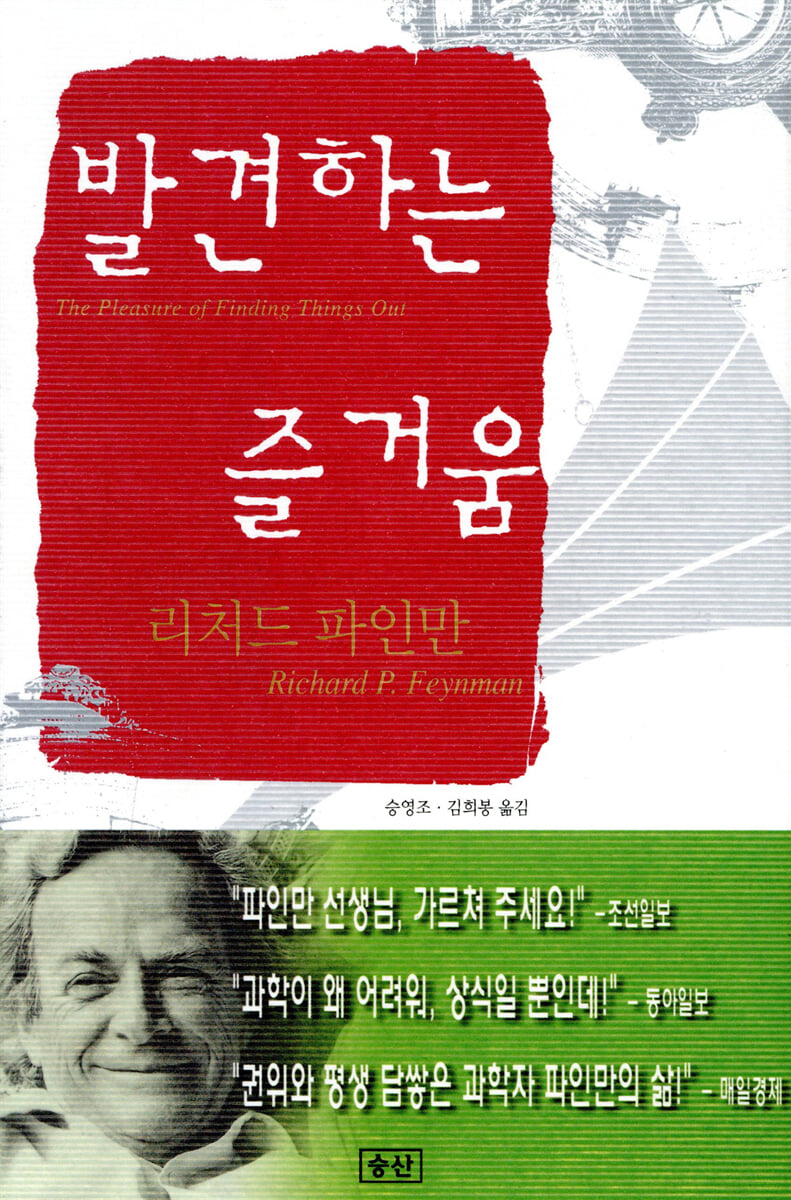
Book Introduction
This is the story of Richard Feynman, a scientist and Nobel Prize winner who laid a solid foundation for physics with 'quantum electrodynamics (QED),' which is considered the most accurate theory among the theories created by humans.
Feynman, who hated authority and fame throughout his life, enjoyed pranks and jokes, and was passionate about making physics accessible and enjoyable for ordinary people.
This book is filled with memories of his father, who instilled in Feynman a free spirit, Feynman's educational philosophy, the values scientists should uphold, and Feynman's outstanding talent.
- You can preview some of the book's contents.
Preview
index
1.
The joy of discovery
2.
What is science?
3.
Los Alamos from the bottom
4.
What is scientific culture in modern society, and what role should it play?
5.
The value of science
6.
There is plenty of space on the floor.
7.
Richard Feynman's Space Shuttle Challenger Investigation Report
8.
The smartest person in the world
9.
Cargo Cult Science: Science, Pseudoscience, and How to Not Fool Yourself
10.
It's as easy as counting one, two, three
11.
Computers of the future
12.
Richard Feynman, Building the Universe
13.
The relationship between science and religion
Into the book
In Hawaii, Feynman visited a Buddhist temple and learned the following humbly:
"Every man is given a key to open the gates of heaven, and with the same key he can also open the gates of hell." This is one of Feynman's most eloquent writings.
Feynman explored the relationship between human experience and science.
He is urging his fellow scientists to take responsibility for the future of civilization.
Sometimes people tell me that scientists should pay more attention to social issues.
In particular, he says science needs to take more responsibility for its impact on society.
There seems to be a general belief that scientists would achieve great success if they focused on very difficult social problems and stopped wasting so much time on less important scientific issues.
I believe many other scientists should heed this advice.
It seems to me that our scientists sometimes think about these issues, but they do not devote their energies to solving social problems.
The reason is that we don't know a magic recipe to solve such problems.
Social problems are not only much more difficult than scientific ones, but thinking about them doesn't necessarily lead to clear solutions.
---pp.151~152
'Now that you've learned a lot, let me ask you just one question.
I've always wondered but never figured it out, so I'm asking. You must have learned it, so please teach me.'
So I asked what it was.
My father said that he knew that when an atom changes from one state to another, a particle called a photon is emitted, and I told him that was true.
'So, did photons exist before they emerged from the atom? Or did they not exist originally?'
'It wasn't there originally.
The moment the electron changes, it pops out.'
"So where do photons come from? How can something that doesn't exist come from nothing?"
At that time, I couldn't say something abstract like 'the number of photons is not conserved, but is simply created according to the movement of electrons.'
So I tried saying this, but that didn't convince him either.
--- p.28
My father really enjoyed being with me.
But one time, when I came back from a few years at MIT, he said this to me.
'Now that you've learned a lot, let me ask you just one question.
I've always wondered but never figured it out, so I'm asking. You must have learned it, so please teach me.'
So I asked what it was.
My father said that he knew that when an atom changes from one state to another, a particle called a photon is emitted, and I told him that was true.
'So, did photons exist before they emerged from the atom? Or did they not exist originally?'
'It wasn't there originally.
The moment the electron changes, it pops out.'
"So where do photons come from? How can something that doesn't exist come from nothing?"
At that time, I couldn't say something abstract like 'the number of photons is not conserved, but is simply created according to the movement of electrons.'
So I tried saying this, but that didn't convince him either.
--- p.28
Publisher's Review
Educator Feynman!
When Feynman was a child, his father took him to a nearby mountain and taught him the names of birds.
But unlike others, he didn't just tell me the names of birds, grass, and trees.
Rather, it taught me that just knowing a name is not true knowledge.
Rather than having them memorize the difficult word 'parasitism', I observed birds pecking at their feathers and explained the bird's habit of pecking at the parasites that live inside its feathers.
Feynman's father knew what was the kernel and what was the shell.
He taught his son free, living, true knowledge, not forced, oppressed, one-time knowledge.
Therefore, studying was not stressful for Feynman but a joy, and he was able to pass that joy on to his students, colleagues, and his own son and daughter.
Feynman's educational philosophy will be of great help in transforming our educational environment, which is saturated with boredom and frustration, into a learning ecosystem alive with fun and enjoyment.
Scientist Feynman!
"In my view, that theory simply sweeps the difficulties under the rug.
Of course, I'm not convinced by that theory."
The theory that Feynman is talking about is his own theory.
Moreover, he is so mercilessly disparaging the theory that won him the Nobel Prize, and that too in his Nobel Prize acceptance speech.
Quantum electrodynamics.
He just laughs at himself for creating the most perfect theory ever created by humans.
But Feynman had a more important theory.
"Doubt everything!" This was a powerful and poignant cry that the true advancement of science, or rather the advancement of civilization, can only be achieved by putting Galileo's sacrifice and teachings into practice.
Blind confidence leads to complacency and dogmatism grows into a poisonous mushroom.
Clearly, Feynman laid the foundations of physics more firmly than anyone else.
And at this point in time, when we are moving from an engineering-centered to a basic science-centered approach, Feynman's achievements shine even brighter.
But above all, Feynman's contribution to the scientific community was the 'freedom to doubt' that rejected dogmatism and blind obedience.
Artist Feynman!
The photo of Feynman playing the bongo drums and the drawings he made clearly show Feynman's talent in many areas.
But we do not call Feynman an artist in that primary sense.
No, such an appearance is rather secondary.
When we discover Feynman's way of life and his 'talent' in scientific achievements, we realize why we can call him an artist.
Piman, who hated honor so much, would talk back to anyone he was talking to in his characteristically blunt way whenever he talked about physics.
I used to propose various theories and experiment with them just for fun, and those very things often bore fruit as actual scientific theories.
'Interest-driven' Feynman truly lived this way, and it was precisely because of this that he was able to enjoy both his work and his life.
GOODS SPECIFICS
- Date of issue: April 30, 2001
- Page count, weight, size: 320 pages | 452g | 148*210*30mm
- ISBN13: 9788988907160
- ISBN10: 8988907167
You may also like
카테고리
korean


korean


