

Portrait of an Independence Activist and Youth
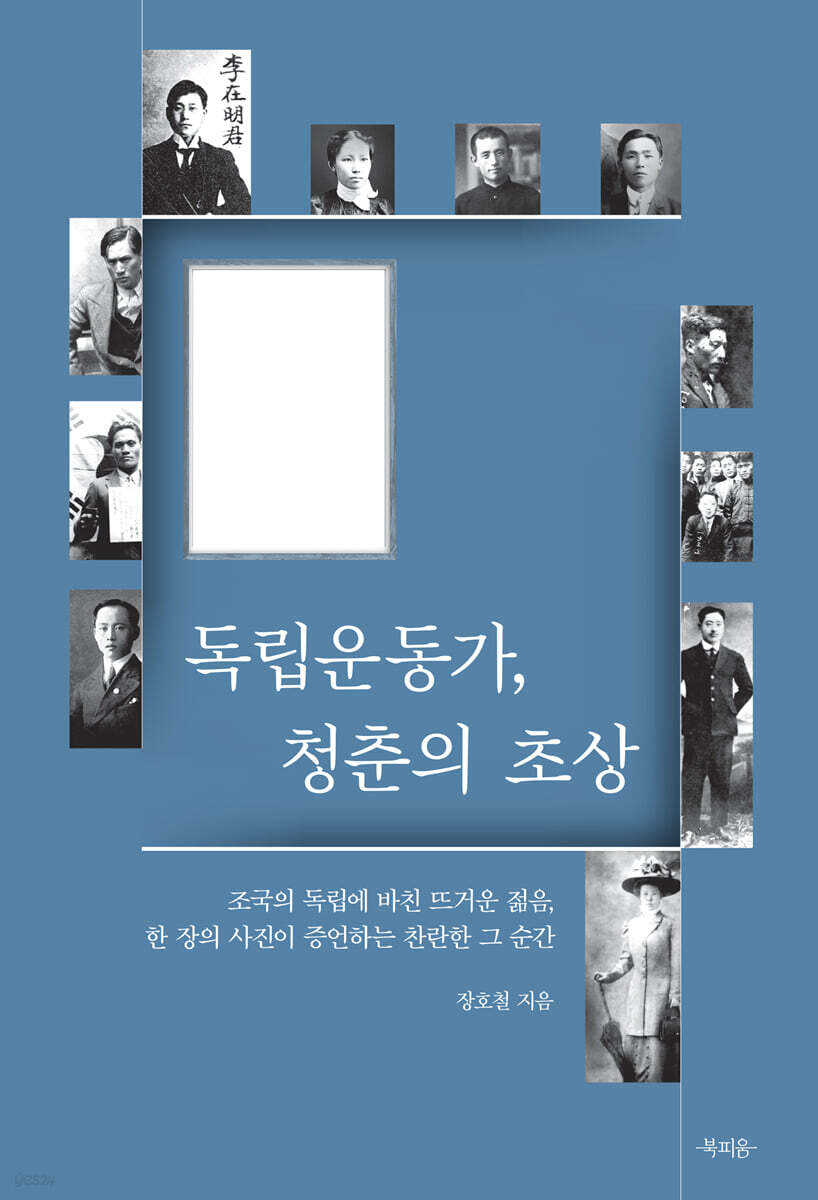 |
Description
Book Introduction
Dedicated to Korean independence
In the middle of hot, blue life!
Yu Gwan-sun was 18, Lee Jae-myeong was 22, Yun Bong-gil was 24, Ahn Jung-geun was 30, Lee Bong-chang was 34…
The shining moments of the independence movement,
The independence activists of that time were the youth of 2030!
A passionate and powerful story of Korea's independence movement told through a single photograph taken 100 years ago, "Portrait of Youth."
Even among the countless independence activists we remember only as old black-and-white photographs of their graying faces and wrinkled faces, there was a beautiful and youthful period filled with a yearning for the independence of their country.
A unique modern and contemporary history book that captures the lives of independence activists in their 20s and 30s, including the bright and energetic teenage boy Kim Kyu-sik, the 30-year-old "teacher" Kim Gu who founded a school and taught students, the 22-year-old Lee Jae-myeong who attempted to assassinate Yi Wan-yong, and the 24-year-old Yun Bong-gil who successfully carried out the Shanghai Uprising. Read this book with a single photograph.
In the middle of hot, blue life!
Yu Gwan-sun was 18, Lee Jae-myeong was 22, Yun Bong-gil was 24, Ahn Jung-geun was 30, Lee Bong-chang was 34…
The shining moments of the independence movement,
The independence activists of that time were the youth of 2030!
A passionate and powerful story of Korea's independence movement told through a single photograph taken 100 years ago, "Portrait of Youth."
Even among the countless independence activists we remember only as old black-and-white photographs of their graying faces and wrinkled faces, there was a beautiful and youthful period filled with a yearning for the independence of their country.
A unique modern and contemporary history book that captures the lives of independence activists in their 20s and 30s, including the bright and energetic teenage boy Kim Kyu-sik, the 30-year-old "teacher" Kim Gu who founded a school and taught students, the 22-year-old Lee Jae-myeong who attempted to assassinate Yi Wan-yong, and the 24-year-old Yun Bong-gil who successfully carried out the Shanghai Uprising. Read this book with a single photograph.
- You can preview some of the book's contents.
Preview
index
preface
Part 1.
Portraits of the Independence Activists Who Couldn't Return
1.
The "New Woman," who also served as King Gojong's interpreter, illuminated Joseon's future.
- Kim Ran-sa, 28, who entered Wesleyan University in the United States
2.
A virtuous young man who was strict with himself founded America's first Korean village.
- Ahn Chang-ho, 27 years old, founded the Public Association in the United States
3.
The first Korean Bolshevik revolutionary died on the Amur River as a flower of revolution.
- Kim Alexandra, a socialist executed at the age of 33
4.
Three gunshots fired in San Francisco, killing a Japanese collaborator.
- 32-year-old Jang In-hwan, who shot American citizen Durham Stevens
5.
Three “bang, bang, bang!”, three “Korea ura!”
- Ahn Jung-geun, 30 years old, assassinated Ito Hirobumi, the mastermind behind the invasion of Korea, in Harbin.
6.
Now that Ito has been executed, the Eulsa Five Traitors will be punished.
- 22-year-old Lee Jae-myung, who stabbed traitor Lee Wan-yong with a knife, causing fatal injuries.
7.
The brilliant and sad struggle for independence of the Uiyoldan member under surveillance number '12310'
Kim Ik-sang, 26, who threw a bomb at the Japanese Government-General of Korea
8.
The "Immortal Innocence" of a Teenage Independence Activist Who Was "Neither a Hero, a God, or a Princess"
- Yu Gwan-sun, 18 years old, died in prison while participating in the independence movement
9.
"Dongdaemun Hardware Store Hong Gil-dong" and the legendary gunfight with hundreds of police officers.
Kim Sang-ok, 34, who threw a bomb at Jongno Police Station
10.
The fighter who shook Hwanghae Province takes revenge on the "vanguard of exploitation."
Na Seok-ju, 34, who threw bombs at the Oriental Development Company and the Joseon Industrial Bank.
11.
Joseon's "revolutionary heroine" who married "Korean independence"
Maria Kim, 35, who went to study abroad in the United States after recovering from torture
12.
Fighting against Japanese oppression and dire poverty
Park Ja-hye, 33, raised two children alone and participated in the independence movement.
13.
From "New Japanese" to "Independence Fighter": A Short and Intense Life of Reversal
- Lee Bong-chang, 32, who threw a grenade at the Japanese emperor
14.
The "Rise of a Twenty-Four-Year-Old" Who "Did What a Million-Man Army of China Couldn't Do"
- Yun Bong-gil, 24, who carried out the Hongkou Park bombing incident
15.
The unfinished Shanghai "Yuk San Jeong Uprising" caught in a trap
- Baek Jeong-gi, 37, who attempted to assassinate the Japanese ambassador during the week
16.
Last summer vacation, and he never came back.
- Yun Dong-ju, 25 years old, spent the summer in his hometown while studying abroad in Japan.
Part 2.
The Return of Independence Activists: A Portrait of Their Youth
17.
A brilliant boy becomes a politician who spearheaded "left-right cooperation" and "inter-Korean negotiations."
Kim Kyu-sik, 15, preparing to study abroad in the United States
18.
The history of the nationalist who led the provisional government for 26 years, enduring hardships and sleeping out in the open for the liberation of the country.
- Kim Gu, 30 years old, founded a school and taught children.
19.
The gunshots of San Francisco that accelerated the integration of the Korean-American community.
- 24-year-old Jeon Myeong-un, who attempted to execute an American who was a Japanese stooge.
20.
Women's liberation begins with economic independence.
- Cha Mirisa, a woman in her mid-30s who devoted herself to women's vocational training in Gyeongseong.
21.
A 20-something leader of the Righteous Army becomes the man with a 1 million won bounty.
- Kim Won-bong, 21 years old, organized the Uiyoldan and became its leader.
22.
Love and Revolution of the Short-Haired 'Modern Girl', or 'Koreeva'
- Joo Se-juk, 28, a university student in Moscow
23.
A couple who served the provisional government as "watchmen" and the tragedy of separation in a divided country.
- Yeon Mi-dang, in her 20s, and Eom Hang-seop, in their 30s, who were engaged in the independence movement in Hangzhou after marrying comrades.
24.
Dreaming of soaring through the sky and bombing the Emperor's Palace
- Kwon Ki-ok, 34, preparing for a propaganda flight in the Chinese Air Force
25.
The bold third daughter of a powerful family, she crossed the Yalu River six times as a secret envoy of the Provisional Government.
Jeong Jeong-hwa, 35, who took charge of the provisional government's affairs in Nanjing.
26.
That summer, I vowed to make a 'stone pillow'
- Jang Jun-ha, 27 years old, walked three thousand miles to join the provisional government and become a member of the Korean Liberation Army.
References
Part 1.
Portraits of the Independence Activists Who Couldn't Return
1.
The "New Woman," who also served as King Gojong's interpreter, illuminated Joseon's future.
- Kim Ran-sa, 28, who entered Wesleyan University in the United States
2.
A virtuous young man who was strict with himself founded America's first Korean village.
- Ahn Chang-ho, 27 years old, founded the Public Association in the United States
3.
The first Korean Bolshevik revolutionary died on the Amur River as a flower of revolution.
- Kim Alexandra, a socialist executed at the age of 33
4.
Three gunshots fired in San Francisco, killing a Japanese collaborator.
- 32-year-old Jang In-hwan, who shot American citizen Durham Stevens
5.
Three “bang, bang, bang!”, three “Korea ura!”
- Ahn Jung-geun, 30 years old, assassinated Ito Hirobumi, the mastermind behind the invasion of Korea, in Harbin.
6.
Now that Ito has been executed, the Eulsa Five Traitors will be punished.
- 22-year-old Lee Jae-myung, who stabbed traitor Lee Wan-yong with a knife, causing fatal injuries.
7.
The brilliant and sad struggle for independence of the Uiyoldan member under surveillance number '12310'
Kim Ik-sang, 26, who threw a bomb at the Japanese Government-General of Korea
8.
The "Immortal Innocence" of a Teenage Independence Activist Who Was "Neither a Hero, a God, or a Princess"
- Yu Gwan-sun, 18 years old, died in prison while participating in the independence movement
9.
"Dongdaemun Hardware Store Hong Gil-dong" and the legendary gunfight with hundreds of police officers.
Kim Sang-ok, 34, who threw a bomb at Jongno Police Station
10.
The fighter who shook Hwanghae Province takes revenge on the "vanguard of exploitation."
Na Seok-ju, 34, who threw bombs at the Oriental Development Company and the Joseon Industrial Bank.
11.
Joseon's "revolutionary heroine" who married "Korean independence"
Maria Kim, 35, who went to study abroad in the United States after recovering from torture
12.
Fighting against Japanese oppression and dire poverty
Park Ja-hye, 33, raised two children alone and participated in the independence movement.
13.
From "New Japanese" to "Independence Fighter": A Short and Intense Life of Reversal
- Lee Bong-chang, 32, who threw a grenade at the Japanese emperor
14.
The "Rise of a Twenty-Four-Year-Old" Who "Did What a Million-Man Army of China Couldn't Do"
- Yun Bong-gil, 24, who carried out the Hongkou Park bombing incident
15.
The unfinished Shanghai "Yuk San Jeong Uprising" caught in a trap
- Baek Jeong-gi, 37, who attempted to assassinate the Japanese ambassador during the week
16.
Last summer vacation, and he never came back.
- Yun Dong-ju, 25 years old, spent the summer in his hometown while studying abroad in Japan.
Part 2.
The Return of Independence Activists: A Portrait of Their Youth
17.
A brilliant boy becomes a politician who spearheaded "left-right cooperation" and "inter-Korean negotiations."
Kim Kyu-sik, 15, preparing to study abroad in the United States
18.
The history of the nationalist who led the provisional government for 26 years, enduring hardships and sleeping out in the open for the liberation of the country.
- Kim Gu, 30 years old, founded a school and taught children.
19.
The gunshots of San Francisco that accelerated the integration of the Korean-American community.
- 24-year-old Jeon Myeong-un, who attempted to execute an American who was a Japanese stooge.
20.
Women's liberation begins with economic independence.
- Cha Mirisa, a woman in her mid-30s who devoted herself to women's vocational training in Gyeongseong.
21.
A 20-something leader of the Righteous Army becomes the man with a 1 million won bounty.
- Kim Won-bong, 21 years old, organized the Uiyoldan and became its leader.
22.
Love and Revolution of the Short-Haired 'Modern Girl', or 'Koreeva'
- Joo Se-juk, 28, a university student in Moscow
23.
A couple who served the provisional government as "watchmen" and the tragedy of separation in a divided country.
- Yeon Mi-dang, in her 20s, and Eom Hang-seop, in their 30s, who were engaged in the independence movement in Hangzhou after marrying comrades.
24.
Dreaming of soaring through the sky and bombing the Emperor's Palace
- Kwon Ki-ok, 34, preparing for a propaganda flight in the Chinese Air Force
25.
The bold third daughter of a powerful family, she crossed the Yalu River six times as a secret envoy of the Provisional Government.
Jeong Jeong-hwa, 35, who took charge of the provisional government's affairs in Nanjing.
26.
That summer, I vowed to make a 'stone pillow'
- Jang Jun-ha, 27 years old, walked three thousand miles to join the provisional government and become a member of the Korean Liberation Army.
References
Detailed image
Into the book
The Japanese government tried hard to get the two men to receive the maximum sentence possible, but thanks to the active defense of three Irish-American lawyers, Jeon Myeong-un was paroled on June 27, 1908, due to insufficient evidence.
Jang In-hwan was spared the death penalty on December 23 of that year and sentenced to 25 years in prison for "second-degree murder due to patriotic fantasy (Insane Delusion)" and was imprisoned in San Quentin Prison.
The jury also seemed to have taken into account, at least to some extent, that this act was motivated by patriotic intentions.
An unknown young man who immigrated to a foreign land to make a living was sentenced to 11 years in prison as a result of his actions for his country.
--- p.50
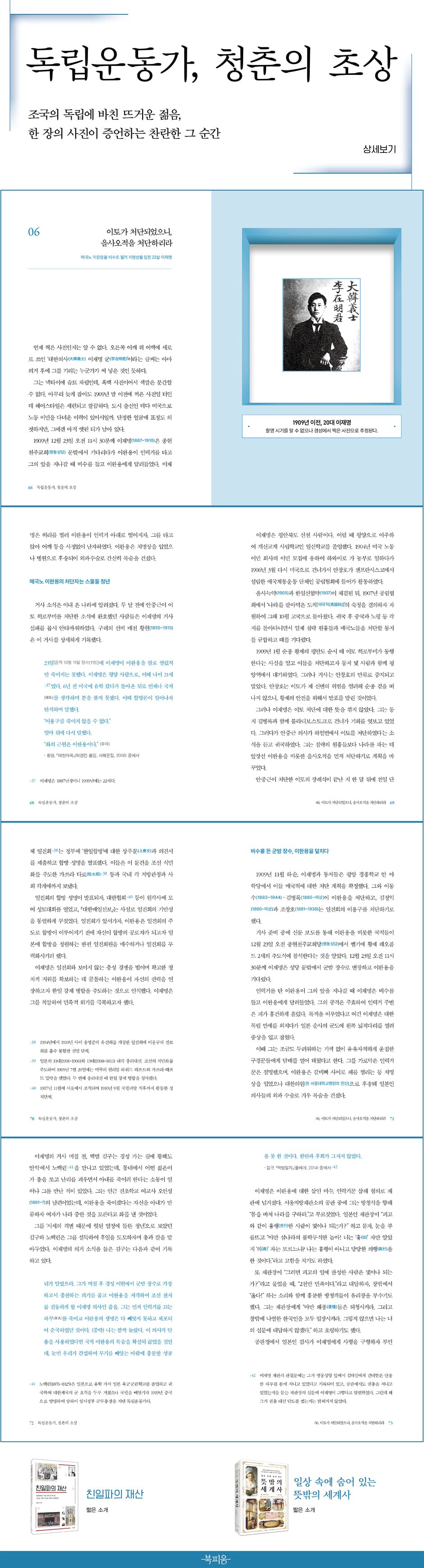
As Lee Wan-yong passed by him on a rickshaw, Lee Jae-myeong rushed at him with a knife in his hand.
His attack was effective, and blood flowed profusely around the rickshaw.
Lee Jae-myung, who believed he had achieved his goal, shouted "Long Live the Independence of Korea" and was then stabbed in the left thigh by a Japanese policeman's sword and was captured with serious injuries.
At this time, he is said to have leisurely asked the gathered onlookers for cigarettes and lit them without showing any sign of fear.
The rickshaw man who blocked him died, and Yi Wan-yong suffered fatal injuries, including a punctured lung between his ribs. However, he was transferred to the Daehan Hospital (the predecessor of the current Seoul National University Hospital) and barely survived thanks to surgical operations by Japanese doctors.
--- p.71
In April 1921, Maria Kim rented a room in a farmhouse in Seongbuk-dong, saying she wanted to recuperate at a private home.
On June 20th, the three-year prison sentence was confirmed, and a few days later, Maria Kim suddenly disappeared from the farmhouse.
After being discharged from Severance Hospital, he boarded a rickshaw and went to Incheon the next morning. In early July, he boarded a smuggling ship with the families of Shanghai exiles and was finally able to reach Weihai Port on the Shandong Peninsula on July 21.
This exile, which was carried out in extreme secrecy to avoid the eyes of the Japanese, was supported by missionary McCune (GS) who provided a large sum of 4,000 won for exile and settlement costs.
McCune) and Yun Eung-nyeom, an agent of the provisional government, were able to achieve this.
--- p.129
After his vacation, Yun Dong-ju returned to Japan and left Tokyo in October 1942 to transfer to the English Literature Department of Doshisha University in Kyoto.
The reason I only studied at Rikkyo University for one semester and then went to Doshisha University, which was also a mission school, was because I refused to attend military training classes at the university.
At Rikkyo University, students had to undergo military training for one hour every week, and male students had to shave their heads.
He once attended a drill class without wearing his uniform, and eventually transferred to Doshisha University in Kyoto, which did not offer drill classes.
--- p.185
This group photo of seven young men is believed to have been taken in the French Concession in Shanghai around March 1920.
(Omitted) In the fall of 1919, the year before, at the age of 21, he founded Uiyoldan and became a Uibak. Kim Won-bong in the photo is a young man of 22.
From the left of Kim Won-bong, in order, are members of the Uiyoldan: Kwak Jae-gi, Kang Se-woo, Kim Gi-deuk, and Lee Seong-woo.
Kwak Jae-gi is 27 years old, Kim Ki-deuk is 21 years old, and Lee Seong-woo is just 20 years old.
They are young and energetic young men, no less than the leader of the Righteous Army.
Jang In-hwan was spared the death penalty on December 23 of that year and sentenced to 25 years in prison for "second-degree murder due to patriotic fantasy (Insane Delusion)" and was imprisoned in San Quentin Prison.
The jury also seemed to have taken into account, at least to some extent, that this act was motivated by patriotic intentions.
An unknown young man who immigrated to a foreign land to make a living was sentenced to 11 years in prison as a result of his actions for his country.
--- p.50
As Lee Wan-yong passed by him on a rickshaw, Lee Jae-myeong rushed at him with a knife in his hand.
His attack was effective, and blood flowed profusely around the rickshaw.
Lee Jae-myung, who believed he had achieved his goal, shouted "Long Live the Independence of Korea" and was then stabbed in the left thigh by a Japanese policeman's sword and was captured with serious injuries.
At this time, he is said to have leisurely asked the gathered onlookers for cigarettes and lit them without showing any sign of fear.
The rickshaw man who blocked him died, and Yi Wan-yong suffered fatal injuries, including a punctured lung between his ribs. However, he was transferred to the Daehan Hospital (the predecessor of the current Seoul National University Hospital) and barely survived thanks to surgical operations by Japanese doctors.
--- p.71
In April 1921, Maria Kim rented a room in a farmhouse in Seongbuk-dong, saying she wanted to recuperate at a private home.
On June 20th, the three-year prison sentence was confirmed, and a few days later, Maria Kim suddenly disappeared from the farmhouse.
After being discharged from Severance Hospital, he boarded a rickshaw and went to Incheon the next morning. In early July, he boarded a smuggling ship with the families of Shanghai exiles and was finally able to reach Weihai Port on the Shandong Peninsula on July 21.
This exile, which was carried out in extreme secrecy to avoid the eyes of the Japanese, was supported by missionary McCune (GS) who provided a large sum of 4,000 won for exile and settlement costs.
McCune) and Yun Eung-nyeom, an agent of the provisional government, were able to achieve this.
--- p.129
After his vacation, Yun Dong-ju returned to Japan and left Tokyo in October 1942 to transfer to the English Literature Department of Doshisha University in Kyoto.
The reason I only studied at Rikkyo University for one semester and then went to Doshisha University, which was also a mission school, was because I refused to attend military training classes at the university.
At Rikkyo University, students had to undergo military training for one hour every week, and male students had to shave their heads.
He once attended a drill class without wearing his uniform, and eventually transferred to Doshisha University in Kyoto, which did not offer drill classes.
--- p.185
This group photo of seven young men is believed to have been taken in the French Concession in Shanghai around March 1920.
(Omitted) In the fall of 1919, the year before, at the age of 21, he founded Uiyoldan and became a Uibak. Kim Won-bong in the photo is a young man of 22.
From the left of Kim Won-bong, in order, are members of the Uiyoldan: Kwak Jae-gi, Kang Se-woo, Kim Gi-deuk, and Lee Seong-woo.
Kwak Jae-gi is 27 years old, Kim Ki-deuk is 21 years old, and Lee Seong-woo is just 20 years old.
They are young and energetic young men, no less than the leader of the Righteous Army.
--- p.242
Publisher's Review
Just one time, remembering the days of youth
'When you're young, you don't know what youth is'.
In the irreversible flow of time, it is only when we look back on the past that we finally feel, 'I was really young back then.'
Yes, that's right.
Everyone is given a shining youthful period once in their life, equally.
The same goes for the lives of independence activists who dedicated their lives to Korean independence.
For countless independence activists, who we remember only as old black-and-white photographs of their graying faces and wrinkled faces, there was a beautiful and blue 2030s filled with a yearning for the independence of their country.
There are countless protagonists who created the shining moments of the independence movement that everyone remembers, moments that strike our hearts deeply.
There are famous independence activists such as Ahn Jung-geun, Yun Bong-gil, Lee Bong-chang, and Yu Gwan-sun.
But do we remember how old they were when they committed such acts or died for their country?
Dr. Yun Bong-gil was 24 years old when he carried out the Hongkou Park lunchbox bombing.
Dr. Lee Bong-chang was 32 years old when he threw a bomb in front of the Japanese emperor.
Martyr Yu Gwan-sun was 18 years old when she was arrested by the Japanese police while shouting "Manse" in Cheonan, suffered brutal torture, and died 548 days after her arrest.
Dr. Lee Jae-myung was 22 years old when he attacked and fatally wounded traitor Lee Wan-yong.
When he assassinated Ito Hirobumi in Harbin, Ahn Jung-geun was 30 years old.
Mr. Jang Jun-ha was 27 years old when he was drafted into the Japanese army, escaped, walked 1,178 kilometers, and joined the Korean Liberation Army.
When he wrote the poem "Confession" out of shame over having to change his name to a Japanese one in order to study abroad in Japan, poet Yun Dong-ju was 25 years old.
"Portraits of Independence Activists and Youth" is a history of the independence movement reread through the lens of these individuals' "portraits of their youth" in their 2030s.
The photos are organized in chronological order in which they were taken, and are largely divided into two parts based on 'Liberation'.
Part 1 deals with the 16 independence activists who died before liberation and passed away without seeing liberation.
Part 2 covers the lives of 10 independence activists who lived through liberation, division, and the Korean War.
Kim Gu, the "first-generation new woman" who served as an interpreter for Emperor Gojong and the "teacher" who taught schoolchildren
The story begins by following the life trajectory and youth of a woman whose name is unfamiliar, 'Kim Ran-sa.'
Kim Ran-sa, a bold elite and a 'first-generation new woman' who went to study abroad at an American university in 1900, and who was so fluent in English that she even served as an interpreter for Emperor Gojong, has only one photo left behind. It is a black-and-white photo taken 125 years ago, in 1900, when she was 28 years old and proudly entering an American university.
Along with the only photograph proving her existence, it sketches the life of a woman who struggled to 'light the light for the future of Joseon' but unfortunately perished.
The successor is Dosan Ahn Chang-ho.
At the age of 24, he went to study education in the United States, and just three years later, at the age of 27, he founded a public association and met the passionate face of those days when he was building the first Korean village in the Americas.
In addition, you can see the 20-year-old wedding photo of Kim Alexandria, the 'first Korean Bolshevik' who passed away at the age of 33; a photo of Jang In-hwan killing an American collaborator of Japan a year before his assassination; a photo of Lee Jae-myeong in a stylish high-collar suit attacking Yi Wan-yong; and a side profile of Kim Ik-sang with sharp eyes through the surveillance card of Uiyoldan member number '12310' who is under surveillance.
In Part 2, you can see the young independence activists who welcomed liberation.
The image of Kim Kyu-sik, who served as Vice Chairman of the Provisional Government but was long forgotten as an 'enemy of Syngman Rhee', as a bright and cheerful boy from a noble family; the image of Chairman Kim Gu, who could be called the icon of the Provisional Government, teaching schoolchildren as a 'teacher' at age 30; and the image of Cha Mirisa, who emphasized the importance of women's vocational education, in her 30s in fancy suits - these come across as colorful portraits of young people who lived in the modern era while fiercely fighting before becoming independence activists.
The reason why our hearts are touched by their appearance 20 or 30 years ago, before they became 'deep-wrinkled and gray', is simple.
We know their arduous and passionate life journey, and we live in the 'future' they so desperately dreamed of in return for sacrificing their one and only youth.
A 100-year-old photograph asks, "How will you live?"
The independence activists who appear in 『Portraits of Youth, Independence Activists』 are no longer in this world.
The independence fighters who fought to reclaim their lost country, as well as the first generation of pro-Japanese collaborators who clung to the Japanese and lived a life of shame, have all passed away.
What's the point of talking about a century ago now? Here, E.'s words, "History is an unending dialogue between the past and the present," come to mind.
I think of H. Carr's famous quote:
It is our generation's responsibility to face our shameful history and ensure that it is not repeated. It is also our generation's responsibility to remember the arduous and brilliant history of the past generations that gave us the "present."
"Portraits of Youth: Independence Activists" is a history book that sharply asks us, living in 21st-century South Korea, "How will you live?" through the "portraits of youth" of independence fighters from 100 years ago.
'When you're young, you don't know what youth is'.
In the irreversible flow of time, it is only when we look back on the past that we finally feel, 'I was really young back then.'
Yes, that's right.
Everyone is given a shining youthful period once in their life, equally.
The same goes for the lives of independence activists who dedicated their lives to Korean independence.
For countless independence activists, who we remember only as old black-and-white photographs of their graying faces and wrinkled faces, there was a beautiful and blue 2030s filled with a yearning for the independence of their country.
There are countless protagonists who created the shining moments of the independence movement that everyone remembers, moments that strike our hearts deeply.
There are famous independence activists such as Ahn Jung-geun, Yun Bong-gil, Lee Bong-chang, and Yu Gwan-sun.
But do we remember how old they were when they committed such acts or died for their country?
Dr. Yun Bong-gil was 24 years old when he carried out the Hongkou Park lunchbox bombing.
Dr. Lee Bong-chang was 32 years old when he threw a bomb in front of the Japanese emperor.
Martyr Yu Gwan-sun was 18 years old when she was arrested by the Japanese police while shouting "Manse" in Cheonan, suffered brutal torture, and died 548 days after her arrest.
Dr. Lee Jae-myung was 22 years old when he attacked and fatally wounded traitor Lee Wan-yong.
When he assassinated Ito Hirobumi in Harbin, Ahn Jung-geun was 30 years old.
Mr. Jang Jun-ha was 27 years old when he was drafted into the Japanese army, escaped, walked 1,178 kilometers, and joined the Korean Liberation Army.
When he wrote the poem "Confession" out of shame over having to change his name to a Japanese one in order to study abroad in Japan, poet Yun Dong-ju was 25 years old.
"Portraits of Independence Activists and Youth" is a history of the independence movement reread through the lens of these individuals' "portraits of their youth" in their 2030s.
The photos are organized in chronological order in which they were taken, and are largely divided into two parts based on 'Liberation'.
Part 1 deals with the 16 independence activists who died before liberation and passed away without seeing liberation.
Part 2 covers the lives of 10 independence activists who lived through liberation, division, and the Korean War.
Kim Gu, the "first-generation new woman" who served as an interpreter for Emperor Gojong and the "teacher" who taught schoolchildren
The story begins by following the life trajectory and youth of a woman whose name is unfamiliar, 'Kim Ran-sa.'
Kim Ran-sa, a bold elite and a 'first-generation new woman' who went to study abroad at an American university in 1900, and who was so fluent in English that she even served as an interpreter for Emperor Gojong, has only one photo left behind. It is a black-and-white photo taken 125 years ago, in 1900, when she was 28 years old and proudly entering an American university.
Along with the only photograph proving her existence, it sketches the life of a woman who struggled to 'light the light for the future of Joseon' but unfortunately perished.
The successor is Dosan Ahn Chang-ho.
At the age of 24, he went to study education in the United States, and just three years later, at the age of 27, he founded a public association and met the passionate face of those days when he was building the first Korean village in the Americas.
In addition, you can see the 20-year-old wedding photo of Kim Alexandria, the 'first Korean Bolshevik' who passed away at the age of 33; a photo of Jang In-hwan killing an American collaborator of Japan a year before his assassination; a photo of Lee Jae-myeong in a stylish high-collar suit attacking Yi Wan-yong; and a side profile of Kim Ik-sang with sharp eyes through the surveillance card of Uiyoldan member number '12310' who is under surveillance.
In Part 2, you can see the young independence activists who welcomed liberation.
The image of Kim Kyu-sik, who served as Vice Chairman of the Provisional Government but was long forgotten as an 'enemy of Syngman Rhee', as a bright and cheerful boy from a noble family; the image of Chairman Kim Gu, who could be called the icon of the Provisional Government, teaching schoolchildren as a 'teacher' at age 30; and the image of Cha Mirisa, who emphasized the importance of women's vocational education, in her 30s in fancy suits - these come across as colorful portraits of young people who lived in the modern era while fiercely fighting before becoming independence activists.
The reason why our hearts are touched by their appearance 20 or 30 years ago, before they became 'deep-wrinkled and gray', is simple.
We know their arduous and passionate life journey, and we live in the 'future' they so desperately dreamed of in return for sacrificing their one and only youth.
A 100-year-old photograph asks, "How will you live?"
The independence activists who appear in 『Portraits of Youth, Independence Activists』 are no longer in this world.
The independence fighters who fought to reclaim their lost country, as well as the first generation of pro-Japanese collaborators who clung to the Japanese and lived a life of shame, have all passed away.
What's the point of talking about a century ago now? Here, E.'s words, "History is an unending dialogue between the past and the present," come to mind.
I think of H. Carr's famous quote:
It is our generation's responsibility to face our shameful history and ensure that it is not repeated. It is also our generation's responsibility to remember the arduous and brilliant history of the past generations that gave us the "present."
"Portraits of Youth: Independence Activists" is a history book that sharply asks us, living in 21st-century South Korea, "How will you live?" through the "portraits of youth" of independence fighters from 100 years ago.
GOODS SPECIFICS
- Date of issue: March 26, 2025
- Page count, weight, size: 316 pages | 458g | 150*220*20mm
- ISBN13: 9791198762955
- ISBN10: 1198762950
You may also like
카테고리
korean


korean

![GQ KOREA Mark (Monthly): December [2025]](http://librairie.coreenne.fr/cdn/shop/files/8ef265dbbfbf186523ed75ba7319009d.jpg?v=1765340328&width=3840)


