

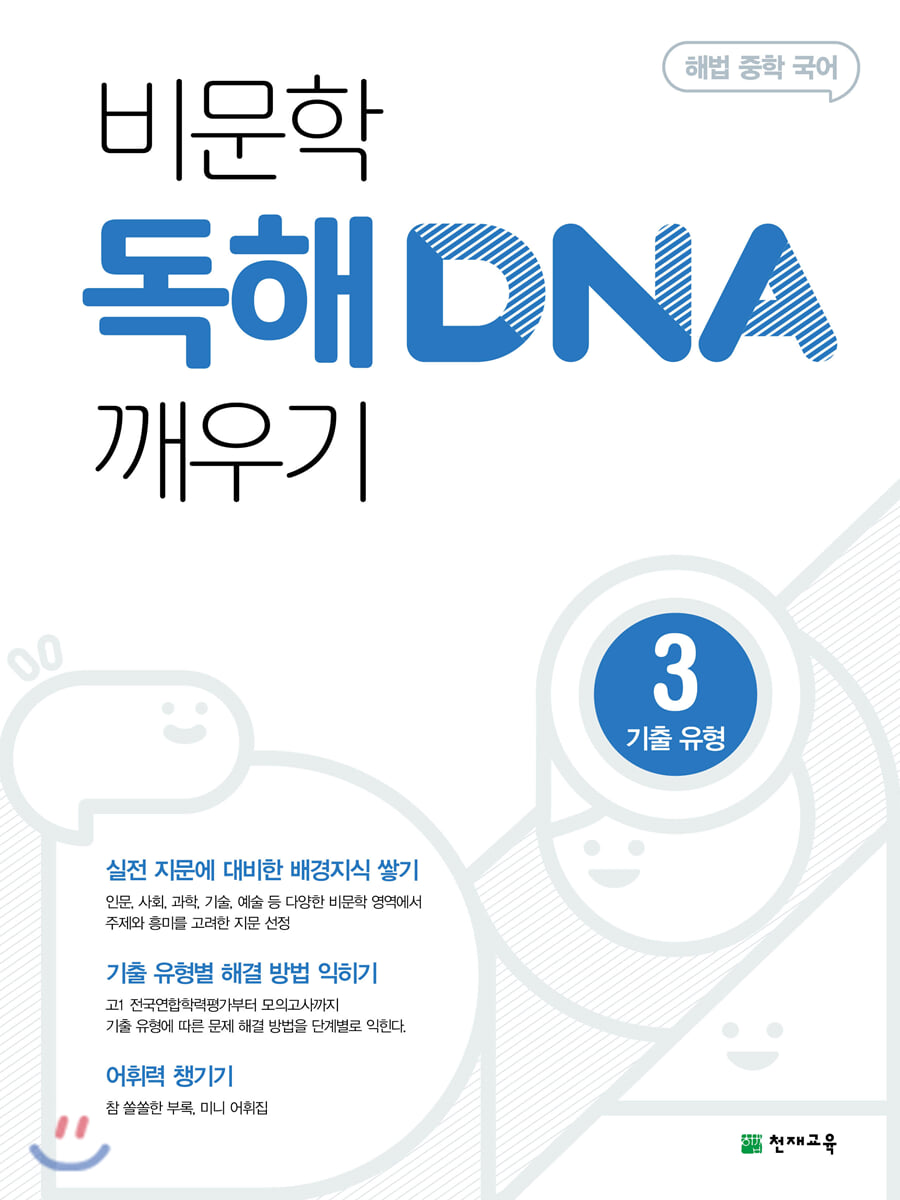
Awakening Non-Fiction Reading DNA 3 Past Questions
 |
Description
Book Introduction
The [Awakening Non-Fiction Reading DNA] series is a book designed to effectively cultivate the 'text analysis skills' and 'vocabulary' necessary for reading comprehension, and to build 'background knowledge'. The principles, techniques, and types of reading comprehension are explained in a friendly manner with abundant examples, and 'reading practice' is provided to help you develop 'text analysis skills' in a repetitive and step-by-step manner. In particular, Volumes 1 and 2 of 'Reading Practice' selected and included materials related to all subjects of the middle school curriculum, including not only Korean but also mathematics, social studies, science, and history, so that students can naturally build 'background knowledge' appropriate to their learning stage. Volume 3, 'Reading Practice', contains carefully selected passages from the National Academic Achievement Test for first-year high school students, along with new passages on interesting topics, to help you prepare for the actual test. |
- You can preview some of the book's contents.
Preview
index
[Non-literature past exam questions]
1.
Understanding the Details Type
① Identifying the test elements through prediction
② Read the passage, check the test elements, and then decide on the answer.
2.
Type of comparison between objects
① Identify the comparison target
② Find the correct answer by focusing on the contrasting pairs
3.
Inference type
① Understanding the basic information that forms the basis of inference
② Infer by considering the relationship between information
4.
Types of evaluating the appropriateness of criticism
① Understanding the perspective (position) that underlies the criticism
② Identify the point of view (position) that is the subject of criticism
③ Criticize based on differences in perspectives (positions)
5.
Types to apply to specific cases
① Find and understand the key information needed to apply the case.
② Match the examples of choices or "views" to the information in the text.
6.
Types to apply to visual materials
① Find and understand the key information needed to apply the data.
② Match the information in the text to the visual materials presented in the choices or “View”
[Reading Practice 1]
Humanities 01_ Making Requests Respond
Humanities 02_ Conatus, the desire to continue living
Society 03_ Climate, Speaking to Civilization
Society 04_ Discussion on reducing crime rates
Science 05_ 17-year cicada and 13-year cicada
Science 06_ How do heavy rains occur?
■ Build more vocabulary | Continue the story
Technique 07_ Fast on flat ground, powerful on uphill
Technology 08_ From Hardcover to Wireless Binding: The Evolution of Bookbinding
Art 09_ John Cage and the Music of Chance
Art 10_ X-ray Art
Unification 11_ Gyeongguk Daejeon and the Virtuous Rule of Joseon, a Confucian State
■ Build more vocabulary | Continue the story
■ Pros vs. Cons of Developing Critical Thinking Skills_ Does Competition Bring Progress?
[Reading Practice 2]
Humanities 01_ Humanity's Duty to Nature
Humanities 02_ The social class structure of early Joseon society
Society 03_ Why do agricultural product prices keep soaring and plummeting?
Society 04_ Why do we look for advertisements after purchasing something?
Science 05_ What happens when you stir water containing sand?
Science 06_ Bacteriophages, viruses that eat bacteria
■ Build more vocabulary | Continue the story
Technique 07_ Ping, a command to diagnose a computer
Technology 08_ CCS Technology: A Realistic Alternative to Global Warming
Art 09_ How to Express Three Dimensions in Two Dimensions
Art 10_ Gaudi's Architecture
Integrated 11_ Cycloid, the roof surface chosen by our ancestors
■ Build more vocabulary | Continue the story
■ Pros vs. Cons of Developing Critical Thinking Skills_ Should the voting age be lowered to 18?
[Reading Practice 3 times]
Humanities 01_ The Annals of the Joseon Dynasty, a Time Capsule of the Joseon Dynasty
Humanities 02_ Three Doctrines of Human Nature
Social Studies 03_ Understanding Television News
Society 04_ Why You Need to Know Interest Rates
Science 05_ Is ink liquid or solid?
Science 06_ How plants draw up water
■ Build more vocabulary | Continue the story
Skill 07_ Submarines also snorkel
Technology 08_ To correct the orbit and attitude of a satellite
Art 09_ Breathing Jar, Onggi
Art 10_ Petroglyphs and Reliefs
Integrated 11_ SSD, a computer's auxiliary memory device
■ Build more vocabulary | Continue the story
■ Critical Thinking Skills Pros vs. Cons_ Is animal testing desirable?
[Reading Practice 4 times]
Humanities 01_ The Relationship Between Language Expression and Meaning
Humanities 02_ The phenomenon of forgetting
Society 03_ What is a tariff?
Society 04_ Useful Law Stories to Know
Science 05_ Are donuts and mugs the same shape?
Science 06_ Why doesn't Arctic sea ice melt easily?
■ Build more vocabulary | Continue the story
Technology 07_ Hydrogen, a new fuel that cares about the environment
Technology 08_ Passive and Active Depth Sensor Methods
Art 09_ Lee Jung-seob's Life and Works
Art 10_ The Conductor's Interpretation of Music
Integrated 11_ How GPS Determines Location
■ Build more vocabulary | Continue the story
■ Pros vs. Cons of Developing Critical Thinking Skills_ Should we invest huge amounts of money in space development?
1.
Understanding the Details Type
① Identifying the test elements through prediction
② Read the passage, check the test elements, and then decide on the answer.
2.
Type of comparison between objects
① Identify the comparison target
② Find the correct answer by focusing on the contrasting pairs
3.
Inference type
① Understanding the basic information that forms the basis of inference
② Infer by considering the relationship between information
4.
Types of evaluating the appropriateness of criticism
① Understanding the perspective (position) that underlies the criticism
② Identify the point of view (position) that is the subject of criticism
③ Criticize based on differences in perspectives (positions)
5.
Types to apply to specific cases
① Find and understand the key information needed to apply the case.
② Match the examples of choices or "views" to the information in the text.
6.
Types to apply to visual materials
① Find and understand the key information needed to apply the data.
② Match the information in the text to the visual materials presented in the choices or “View”
[Reading Practice 1]
Humanities 01_ Making Requests Respond
Humanities 02_ Conatus, the desire to continue living
Society 03_ Climate, Speaking to Civilization
Society 04_ Discussion on reducing crime rates
Science 05_ 17-year cicada and 13-year cicada
Science 06_ How do heavy rains occur?
■ Build more vocabulary | Continue the story
Technique 07_ Fast on flat ground, powerful on uphill
Technology 08_ From Hardcover to Wireless Binding: The Evolution of Bookbinding
Art 09_ John Cage and the Music of Chance
Art 10_ X-ray Art
Unification 11_ Gyeongguk Daejeon and the Virtuous Rule of Joseon, a Confucian State
■ Build more vocabulary | Continue the story
■ Pros vs. Cons of Developing Critical Thinking Skills_ Does Competition Bring Progress?
[Reading Practice 2]
Humanities 01_ Humanity's Duty to Nature
Humanities 02_ The social class structure of early Joseon society
Society 03_ Why do agricultural product prices keep soaring and plummeting?
Society 04_ Why do we look for advertisements after purchasing something?
Science 05_ What happens when you stir water containing sand?
Science 06_ Bacteriophages, viruses that eat bacteria
■ Build more vocabulary | Continue the story
Technique 07_ Ping, a command to diagnose a computer
Technology 08_ CCS Technology: A Realistic Alternative to Global Warming
Art 09_ How to Express Three Dimensions in Two Dimensions
Art 10_ Gaudi's Architecture
Integrated 11_ Cycloid, the roof surface chosen by our ancestors
■ Build more vocabulary | Continue the story
■ Pros vs. Cons of Developing Critical Thinking Skills_ Should the voting age be lowered to 18?
[Reading Practice 3 times]
Humanities 01_ The Annals of the Joseon Dynasty, a Time Capsule of the Joseon Dynasty
Humanities 02_ Three Doctrines of Human Nature
Social Studies 03_ Understanding Television News
Society 04_ Why You Need to Know Interest Rates
Science 05_ Is ink liquid or solid?
Science 06_ How plants draw up water
■ Build more vocabulary | Continue the story
Skill 07_ Submarines also snorkel
Technology 08_ To correct the orbit and attitude of a satellite
Art 09_ Breathing Jar, Onggi
Art 10_ Petroglyphs and Reliefs
Integrated 11_ SSD, a computer's auxiliary memory device
■ Build more vocabulary | Continue the story
■ Critical Thinking Skills Pros vs. Cons_ Is animal testing desirable?
[Reading Practice 4 times]
Humanities 01_ The Relationship Between Language Expression and Meaning
Humanities 02_ The phenomenon of forgetting
Society 03_ What is a tariff?
Society 04_ Useful Law Stories to Know
Science 05_ Are donuts and mugs the same shape?
Science 06_ Why doesn't Arctic sea ice melt easily?
■ Build more vocabulary | Continue the story
Technology 07_ Hydrogen, a new fuel that cares about the environment
Technology 08_ Passive and Active Depth Sensor Methods
Art 09_ Lee Jung-seob's Life and Works
Art 10_ The Conductor's Interpretation of Music
Integrated 11_ How GPS Determines Location
■ Build more vocabulary | Continue the story
■ Pros vs. Cons of Developing Critical Thinking Skills_ Should we invest huge amounts of money in space development?
Detailed image
.jpg)
Publisher's Review
2 fingerprints a day, complete in 30 days!
1.
Through the [Awakening Non-Fiction Reading DNA] series, you can gradually learn “reading principles,” “reading techniques,” and “past question types” to develop solid reading comprehension skills.
- Step 1: Build a solid foundation by learning reading principles based on the curriculum.
- Step 2: Learn the skills of reading step by step, sentence by sentence, paragraph by paragraph, and article by article, and learn how to read complex texts quickly and accurately.
- Step 3: Learn the types of non-literature questions that frequently appear on exams and their solutions, and develop problem-solving skills.
2.
Through practice problems, you can improve your reading comprehension skills and build a variety of background knowledge.
- Stage 1/2: Include at least 50% of texts related to middle school subjects (Korean, math, social studies, history, science, technology/home economics, art, etc.), select texts that stimulate students' interest and curiosity → Build background knowledge for subject learning
- Step 3: Include at least 50% of previous academic ability test questions, and present new questions of similar difficulty → Build background knowledge to prepare for actual exam questions.
3.
Friendly commentary and detailed answer explanations allow learners to achieve perfect reading comprehension on their own.
- Detailed explanations of fingerprints, problem-solving methods, and reasons for correct and incorrect answers.
- Presentation of 'explanation' and 'topic' to help understand the text
4.
You can improve your vocabulary by using the appendix mini vocabulary list.
- Vocabulary from the text is collected by chapter and provided in a mini-book format.
- Synonyms, antonyms, Chinese character idioms, and idiomatic expressions related to vocabulary are organized with example sentences to enable extensive vocabulary learning.
1.
Through the [Awakening Non-Fiction Reading DNA] series, you can gradually learn “reading principles,” “reading techniques,” and “past question types” to develop solid reading comprehension skills.
- Step 1: Build a solid foundation by learning reading principles based on the curriculum.
- Step 2: Learn the skills of reading step by step, sentence by sentence, paragraph by paragraph, and article by article, and learn how to read complex texts quickly and accurately.
- Step 3: Learn the types of non-literature questions that frequently appear on exams and their solutions, and develop problem-solving skills.
2.
Through practice problems, you can improve your reading comprehension skills and build a variety of background knowledge.
- Stage 1/2: Include at least 50% of texts related to middle school subjects (Korean, math, social studies, history, science, technology/home economics, art, etc.), select texts that stimulate students' interest and curiosity → Build background knowledge for subject learning
- Step 3: Include at least 50% of previous academic ability test questions, and present new questions of similar difficulty → Build background knowledge to prepare for actual exam questions.
3.
Friendly commentary and detailed answer explanations allow learners to achieve perfect reading comprehension on their own.
- Detailed explanations of fingerprints, problem-solving methods, and reasons for correct and incorrect answers.
- Presentation of 'explanation' and 'topic' to help understand the text
4.
You can improve your vocabulary by using the appendix mini vocabulary list.
- Vocabulary from the text is collected by chapter and provided in a mini-book format.
- Synonyms, antonyms, Chinese character idioms, and idiomatic expressions related to vocabulary are organized with example sentences to enable extensive vocabulary learning.
GOODS SPECIFICS
- Date of issue: November 1, 2019
- Page count, weight, size: 248 pages | 494g | 210*280*8mm
- ISBN13: 9791125949800
- ISBN10: 1125949805
- Reference book for use in grades: Common for middle school students
- Reference book usage semester: Common semester
- Reference book difficulty: Medium Reference book difficulty guide
You may also like
카테고리
korean


korean

![GQ KOREA Mark (Monthly): December [2025]](http://librairie.coreenne.fr/cdn/shop/files/8ef265dbbfbf186523ed75ba7319009d.jpg?v=1765340328&width=3840)


