

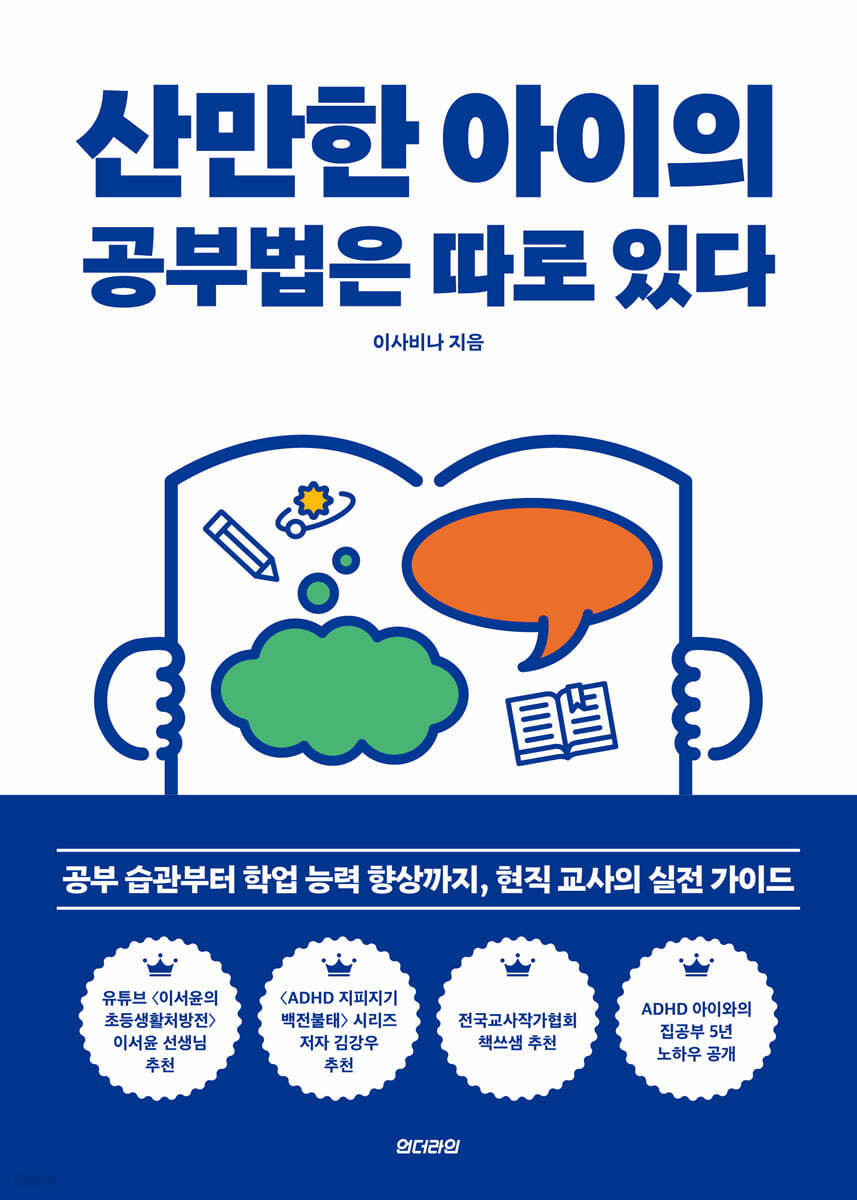
There are different study methods for distracted children.
 |
Description
Book Introduction
“Studying with a distracted child,
“You need a study strategy that suits your temperament.”
* YouTube [Lee Seo-yoon's Elementary School Life Prescription] Recommended by teacher Lee Seo-yoon!
* [ADHD Jipijigi Baekjeonbultae] series recommended by Kim Kang-woo!
* Recommended by the National Teachers' Writers' Association!
“The hardest part is holding the child and getting him to sit down.”
In recent years, the number of parents concerned about their children's learning difficulties such as 'distraction' and 'lack of attention' has been rapidly increasing.
In particular, children raised in environments accustomed to rapid stimulation from smartphones and YouTube often have impaired executive function, leading to difficulties with concentration, planning, and completion. Not only children diagnosed with ADHD, but also those with a distractible temperament struggle to adapt to schoolwork, raising concerns among parents.
One of the reasons why children have difficulty starting to study or concentrating is because of the brain's 'executive function'.
Executive function, the ability to plan, organize, and regulate, is a cognitive activity handled by the frontal lobe. Children with weak executive function are easily distracted and have difficulty maintaining concentration.
This book suggests specific and systematic study methods for children with weak executive function.
A child who procrastinates by saying, "I'll do it in five minutes," a child who always struggles during performance assessments, and a child who loses points on descriptive questions.
Rather than trying to correct a child's behavior, redesign learning strategies to develop executive functions.
This perspective goes beyond simple learning methods and changes the way parents view their children.
“You need a study strategy that suits your temperament.”
* YouTube [Lee Seo-yoon's Elementary School Life Prescription] Recommended by teacher Lee Seo-yoon!
* [ADHD Jipijigi Baekjeonbultae] series recommended by Kim Kang-woo!
* Recommended by the National Teachers' Writers' Association!
“The hardest part is holding the child and getting him to sit down.”
In recent years, the number of parents concerned about their children's learning difficulties such as 'distraction' and 'lack of attention' has been rapidly increasing.
In particular, children raised in environments accustomed to rapid stimulation from smartphones and YouTube often have impaired executive function, leading to difficulties with concentration, planning, and completion. Not only children diagnosed with ADHD, but also those with a distractible temperament struggle to adapt to schoolwork, raising concerns among parents.
One of the reasons why children have difficulty starting to study or concentrating is because of the brain's 'executive function'.
Executive function, the ability to plan, organize, and regulate, is a cognitive activity handled by the frontal lobe. Children with weak executive function are easily distracted and have difficulty maintaining concentration.
This book suggests specific and systematic study methods for children with weak executive function.
A child who procrastinates by saying, "I'll do it in five minutes," a child who always struggles during performance assessments, and a child who loses points on descriptive questions.
Rather than trying to correct a child's behavior, redesign learning strategies to develop executive functions.
This perspective goes beyond simple learning methods and changes the way parents view their children.
- You can preview some of the book's contents.
Preview
index
Recommendation
Prologue: Studying with a Distracted Child: Mental Preparation Requires
Chapter 1: Should distractible children give up on studying?
Children in increasingly distracted classrooms
The Real Meaning of Distraction│Characteristics of Distracted Students as Seen by Teachers│Why Do Distracted Children Have Difficulty Studying?
My child is distracted. Could he have ADHD?
What's the Difference Between a Distractible Child and a Child with ADHD? Distraction: A Problem with This Part of the Brain. The Key to Learning for Distractible Children: Improving Executive Function.
Can distractible children also dream of self-directed learning?
Self-Learning: Why Do Distracted Children Have More Difficulty with Self-Directed Learning? What Happens When We See Distractibility as a Characteristic, Not a Deficit
Is your child's learning or intelligence a problem?
Does High IQ Guarantee Achievements? The "I'm Not Smart" Mindset: How Parents' Mindsets Affect Their Children
Habits that will make learning easier for your child
Distracted Kids Aren't Lazy│How to Build Good Habits That Last Until Eighty
Chapter 2: Getting Started: If Even Getting Started is Difficult
Finding the lost motive
The Motivation of a Single Chocolate │Practice of Long-Term Perspective Is Also Needed │The 'Studying Is Just Doing' Mindset
Why do I need to make a plan?
Time doesn't pass for distracted children. │Distracted children's plans become more sophisticated. │4-step planning training.
"I'll do it in five minutes." Children who procrastinate
The Reason for Procrastination: Look into Your Child's Emotions│If it's difficult to 'get started', try this
I only want to do the subjects I like
I only want to do what I'm good at│Things I don't want to do but have to do│How to turn a subject I hate into a subject I'm good at
Why My Child Became a Whiner
Anxiety Can Cause Distractions│Anxious Children: The Answer Comes From Parents│Effective Study Methods for Anxious Children
How do you study in a place like this?
Difficult learning environment│Keeping your eyes and ears in one place
Chapter 3: The Learning Process: Why Sitting Still Makes Learning Difficult
It's not the amount of time you spend sitting at your desk that matters: Attention Deficit
The body is in the 'here and now', but the mind is floating in the sea│The Pomodoro learning method that increases concentration│Children who can only concentrate when they move
Erasing Our Children's Minds: Children with Low Working Memory
Children with Small Memory Storage Capacity│Training Methods to Improve Working Memory
Children who find review boring
The arduous task of revisiting the same thing│Making review seem like it's not review│Various ways to give review a new form
Children who cannot tell the forest from the trees
Why Distinguish the Forest from the Trees? │Practice Seeing the Big Picture│How to Avoid Getting Lost in the Forest of Writing│The "What if You Were the Teacher?" Method
If you have a learning disability
Distracted children may have learning disabilities│It's not the children's fault│Learning disabilities, how can we help?
The Big Three Attention Thieves: Short-Form, Social Media, and Gaming
All Causes: Smartphones│Teacher, YouTube, not movies│I feel left out without social media│The child who can't stop playing games│How to keep a distracted child's attention
Chapter 4: Conclusion: I studied, but I didn't get a good score.
Don't Make Mistakes Even When You Know: Careless Children
Five Reasons Why You Make Mistakes Even When You Know What You're Doing
I always run out of time for exams.
Are you struggling with poor performance due to slow processing speed? │More accurately, more quickly│Slow processing doesn't mean you don't know.
If you don't want to get the lowest score on your performance evaluation,
Complex Performance Assessments: Children Struggle │ Why Some Students Get the Lowest Scores on Performance Assessments │ How to Avoid Getting the Lowest Scores on Performance Assessments
Essay-type questions that children with high attention spans find particularly difficult
Why scores are deducted in essay and essay-type questions│Read and reread the answers│Minimum way to avoid deducting scores
Reward systems must be used properly.
Reviewing Your Rewards System│Two Core Principles of Rewards
Chapter 5: What We as Parents Should Do
Distracted child, distracted parents
Am I a Distracted Parent? Distracted Parents Need a Strategy
The real reason I want to make you study
What Parents Really Want to Know│What Parents Really Need to Know
Somewhere between control and autonomy
Why Can't We Relinquish Control? │Self-Control: The Key to Self-Directed Learning│Relinquishing Control Requires Long-Term Effort
A child's small society, the environment called parents
What We Can Change: The Environment│Examining Our Family's Learning Culture│Another Environment: How Parents View the World│Raising People to Be Human
Appendix: 5 Years of Homeschooling Tips for a Distracted Child
Resource Link
Epilogue: There's a separate study method for distracted children.
Acknowledgements
References
Prologue: Studying with a Distracted Child: Mental Preparation Requires
Chapter 1: Should distractible children give up on studying?
Children in increasingly distracted classrooms
The Real Meaning of Distraction│Characteristics of Distracted Students as Seen by Teachers│Why Do Distracted Children Have Difficulty Studying?
My child is distracted. Could he have ADHD?
What's the Difference Between a Distractible Child and a Child with ADHD? Distraction: A Problem with This Part of the Brain. The Key to Learning for Distractible Children: Improving Executive Function.
Can distractible children also dream of self-directed learning?
Self-Learning: Why Do Distracted Children Have More Difficulty with Self-Directed Learning? What Happens When We See Distractibility as a Characteristic, Not a Deficit
Is your child's learning or intelligence a problem?
Does High IQ Guarantee Achievements? The "I'm Not Smart" Mindset: How Parents' Mindsets Affect Their Children
Habits that will make learning easier for your child
Distracted Kids Aren't Lazy│How to Build Good Habits That Last Until Eighty
Chapter 2: Getting Started: If Even Getting Started is Difficult
Finding the lost motive
The Motivation of a Single Chocolate │Practice of Long-Term Perspective Is Also Needed │The 'Studying Is Just Doing' Mindset
Why do I need to make a plan?
Time doesn't pass for distracted children. │Distracted children's plans become more sophisticated. │4-step planning training.
"I'll do it in five minutes." Children who procrastinate
The Reason for Procrastination: Look into Your Child's Emotions│If it's difficult to 'get started', try this
I only want to do the subjects I like
I only want to do what I'm good at│Things I don't want to do but have to do│How to turn a subject I hate into a subject I'm good at
Why My Child Became a Whiner
Anxiety Can Cause Distractions│Anxious Children: The Answer Comes From Parents│Effective Study Methods for Anxious Children
How do you study in a place like this?
Difficult learning environment│Keeping your eyes and ears in one place
Chapter 3: The Learning Process: Why Sitting Still Makes Learning Difficult
It's not the amount of time you spend sitting at your desk that matters: Attention Deficit
The body is in the 'here and now', but the mind is floating in the sea│The Pomodoro learning method that increases concentration│Children who can only concentrate when they move
Erasing Our Children's Minds: Children with Low Working Memory
Children with Small Memory Storage Capacity│Training Methods to Improve Working Memory
Children who find review boring
The arduous task of revisiting the same thing│Making review seem like it's not review│Various ways to give review a new form
Children who cannot tell the forest from the trees
Why Distinguish the Forest from the Trees? │Practice Seeing the Big Picture│How to Avoid Getting Lost in the Forest of Writing│The "What if You Were the Teacher?" Method
If you have a learning disability
Distracted children may have learning disabilities│It's not the children's fault│Learning disabilities, how can we help?
The Big Three Attention Thieves: Short-Form, Social Media, and Gaming
All Causes: Smartphones│Teacher, YouTube, not movies│I feel left out without social media│The child who can't stop playing games│How to keep a distracted child's attention
Chapter 4: Conclusion: I studied, but I didn't get a good score.
Don't Make Mistakes Even When You Know: Careless Children
Five Reasons Why You Make Mistakes Even When You Know What You're Doing
I always run out of time for exams.
Are you struggling with poor performance due to slow processing speed? │More accurately, more quickly│Slow processing doesn't mean you don't know.
If you don't want to get the lowest score on your performance evaluation,
Complex Performance Assessments: Children Struggle │ Why Some Students Get the Lowest Scores on Performance Assessments │ How to Avoid Getting the Lowest Scores on Performance Assessments
Essay-type questions that children with high attention spans find particularly difficult
Why scores are deducted in essay and essay-type questions│Read and reread the answers│Minimum way to avoid deducting scores
Reward systems must be used properly.
Reviewing Your Rewards System│Two Core Principles of Rewards
Chapter 5: What We as Parents Should Do
Distracted child, distracted parents
Am I a Distracted Parent? Distracted Parents Need a Strategy
The real reason I want to make you study
What Parents Really Want to Know│What Parents Really Need to Know
Somewhere between control and autonomy
Why Can't We Relinquish Control? │Self-Control: The Key to Self-Directed Learning│Relinquishing Control Requires Long-Term Effort
A child's small society, the environment called parents
What We Can Change: The Environment│Examining Our Family's Learning Culture│Another Environment: How Parents View the World│Raising People to Be Human
Appendix: 5 Years of Homeschooling Tips for a Distracted Child
Resource Link
Epilogue: There's a separate study method for distracted children.
Acknowledgements
References
Detailed image

Into the book
A distracted child has a weak ability to see things that are not visible.
It is difficult to imagine your own unseen future and plan for what comes next.
For these kids, playing one more game right now is more important than studying for an unseen future.
These are children who can read, but have difficulty inferring the invisible author's intentions or logic between sentences and paragraphs.
--- p.7
Distracted children have weak executive functions necessary for learning.
Executive functions refer to the cognitive processes our brain uses to set goals, make plans, solve problems, regulate emotions, and organize behavior.
Simply put, executive function is a mental skill that helps you 'do' what you 'need to do' in your daily life.
When we think about the executive function, one part of our brain comes to mind.
It's the frontal lobe.
This means that children who are distracted and have impaired frontal lobe function also have impaired executive function.
Here's why our children shouldn't give up on learning.
These children may have difficulty learning due to a lack of executive function rather than due to low intelligence.
For example, if children lack working memory, one of the executive functions, they may not remember instructions from their teacher or miss steps needed to solve complex problems.
Therefore, the answer to successful learning for distractible children lies in enhancing this executive function.
--- p.36~37
Distracted children will constantly ask questions about their learning.
“Why do I have to do this? Can’t I not do it?”, “Can’t I do it tomorrow?”, “Why do you have to do it your way?” At these times, it’s a habit to not have to explain to your child why they have to do it or why they have to complete all the promised learning today.
Children who are highly motivated and able to focus while studying will likely develop these habits on their own.
However, children who are easily distracted need parental effort to develop this habit.
Especially before puberty, when children are extremely reluctant to receive parental interference, and in the early elementary school years, when they still follow parental authority well, we must help them develop a learning habit.
--- p.58
The behavior of focusing only on things you like is also a problem that arises from having good concentration but weak attention span.
Children with high attention spans motivate themselves to do things they need to do, even when they don't want to, and complete assigned tasks.
Even during boring classes, I think, "It's school, it's class," and I pay attention and listen to the class diligently.
Therefore, we must teach children who are easily distracted that it is very important to do their best in a given task, even if it is a subject they dislike.
--- p.104
Children who are distracted by anxiety also exhibit this tendency when studying with their parents.
'I have to study today too, but it's so hard to start.
Will I be able to do it? What if I make another mistake? I just want to give up.
I have thoughts like, 'I have a mountain of tasks to do, and I keep wanting to look away.'
Children try to escape their anxiety for a moment by doing something else or looking at their smartphones.
Even children who feel pressured by their parents to study may burst into tears, overcome by negative thoughts. Children with high anxiety often postpone learning when negative thoughts overwhelm them.
We procrastinate until the moment when we can no longer put it off, and then we get so scared of the unfinished tasks that we start doing them in a hurry.
A characteristic of children who are distracted is that they cannot plan systematically and start things impulsively.
--- p.112
Distracted children often move their eyes around in addition to what the teacher is saying.
I react to the sound of soccer being played on the playground, the footsteps of other classmates running to the bathroom, and sometimes I just stare into space.
Everything acts as a variety of information to these children.
However, rather than actively controlling their attention to select the information they need, they passively accept the many stimuli around them.
The brain becomes distracted, restless, or in a daze, wondering, "Where should I focus?"
It is difficult to imagine your own unseen future and plan for what comes next.
For these kids, playing one more game right now is more important than studying for an unseen future.
These are children who can read, but have difficulty inferring the invisible author's intentions or logic between sentences and paragraphs.
--- p.7
Distracted children have weak executive functions necessary for learning.
Executive functions refer to the cognitive processes our brain uses to set goals, make plans, solve problems, regulate emotions, and organize behavior.
Simply put, executive function is a mental skill that helps you 'do' what you 'need to do' in your daily life.
When we think about the executive function, one part of our brain comes to mind.
It's the frontal lobe.
This means that children who are distracted and have impaired frontal lobe function also have impaired executive function.
Here's why our children shouldn't give up on learning.
These children may have difficulty learning due to a lack of executive function rather than due to low intelligence.
For example, if children lack working memory, one of the executive functions, they may not remember instructions from their teacher or miss steps needed to solve complex problems.
Therefore, the answer to successful learning for distractible children lies in enhancing this executive function.
--- p.36~37
Distracted children will constantly ask questions about their learning.
“Why do I have to do this? Can’t I not do it?”, “Can’t I do it tomorrow?”, “Why do you have to do it your way?” At these times, it’s a habit to not have to explain to your child why they have to do it or why they have to complete all the promised learning today.
Children who are highly motivated and able to focus while studying will likely develop these habits on their own.
However, children who are easily distracted need parental effort to develop this habit.
Especially before puberty, when children are extremely reluctant to receive parental interference, and in the early elementary school years, when they still follow parental authority well, we must help them develop a learning habit.
--- p.58
The behavior of focusing only on things you like is also a problem that arises from having good concentration but weak attention span.
Children with high attention spans motivate themselves to do things they need to do, even when they don't want to, and complete assigned tasks.
Even during boring classes, I think, "It's school, it's class," and I pay attention and listen to the class diligently.
Therefore, we must teach children who are easily distracted that it is very important to do their best in a given task, even if it is a subject they dislike.
--- p.104
Children who are distracted by anxiety also exhibit this tendency when studying with their parents.
'I have to study today too, but it's so hard to start.
Will I be able to do it? What if I make another mistake? I just want to give up.
I have thoughts like, 'I have a mountain of tasks to do, and I keep wanting to look away.'
Children try to escape their anxiety for a moment by doing something else or looking at their smartphones.
Even children who feel pressured by their parents to study may burst into tears, overcome by negative thoughts. Children with high anxiety often postpone learning when negative thoughts overwhelm them.
We procrastinate until the moment when we can no longer put it off, and then we get so scared of the unfinished tasks that we start doing them in a hurry.
A characteristic of children who are distracted is that they cannot plan systematically and start things impulsively.
--- p.112
Distracted children often move their eyes around in addition to what the teacher is saying.
I react to the sound of soccer being played on the playground, the footsteps of other classmates running to the bathroom, and sometimes I just stare into space.
Everything acts as a variety of information to these children.
However, rather than actively controlling their attention to select the information they need, they passively accept the many stimuli around them.
The brain becomes distracted, restless, or in a daze, wondering, "Where should I focus?"
--- p.133
Publisher's Review
The beginning, process, and end of study,
Learning Strategies for Distracted Children Based on Their Executive Function
“I sat down at my desk with a determined mind, but time flew by while I was doing something else.”
“I know it’s a problem in my head, but I keep making mistakes.”
“It’s hard to even make a plan, let alone keep to it.”
If you can't even start studying, have trouble concentrating, or study hard but don't see results, your anxiety about studying will deepen.
Many children struggle with these issues, but these learning challenges are especially pronounced for children with inattentive temperaments or those with ADHD.
"There is a separate study method for distracted children" solves their common learning problems within the flow of "beginning-process-finishing of studying" with the key word of executive function development.
The author, a middle school teacher, vividly introduces the characteristics of distracted children in the classroom and specifically identifies the reasons why children have difficulty learning.
Many children have difficulty finding enjoyment in learning, but for distractible children, it's even more so.
In order to effectively guide the learning of a child with such distractibility, it is necessary to have an attitude that accurately understands and accepts the child's temperament.
The core of this book, "The Beginning of Learning," examines the characteristics of children who have difficulty starting to study, such as lack of motivation, avoidance of planning, and procrastination, and suggests specific executive function training methods for these children.
'Precise planning for children with poor sense of time' and 'How to prevent procrastination for children with difficulty controlling emotions' are very specific and practical methods derived from the author's real-life experience as a mother raising a child with ADHD and a middle school teacher.
The second stage, 'The Learning Process', deals with children who do not progress in learning even when sitting at a desk.
We introduce concentration enhancement and memory training techniques to address attention deficit, low working memory, resistance to review, and difficulty making connections between concepts.
The Pomodoro Technique, the essay-style training method, and the "Try to Become a Teacher" strategy are all proven effective in actual classroom settings.
Lastly, in 'Ending Learning', we diagnose the problems in the final stage of children who say, 'I studied, but I didn't get a good score.'
It addresses the challenges often faced by distracted children, including careless mistakes, slow processing speed, the burden of performance assessments, and the overwhelming feeling of being overwhelmed by descriptive questions, and also presents practical test-taking strategies and how to properly utilize the reward system.
"There is a separate study method for distractible children" is a book that informs children that distractibility is not a child's defect, but a temperament that needs to be managed, and contains practical and warm study strategies that develop the ability to execute step by step from the beginning to the end of studying.
A record of my failures and changes as a teacher and mother.
The greatest strength of "There is a separate study method for distracted children" is that it is an 'experiential book' rather than a theory book.
As a teacher, the author has closely observed the learning problems of countless children, and as a mother raising a child with ADHD, she has laughed and cried with her child and studied at home for over five years.
From how to motivate your child, how to set up an environment for a child who can't sit at a desk, to tips for making reviewing less boring, this book is packed with helpful tips for parents who are wondering, "How can I help?"
In particular, the author candidly shares his own experiences of self-reflection and complex emotions as a “distracted parent raising a distracted child.”
This book is not just about changing children.
This book is designed to comfort parents who want to help their children but feel lost.
Learning Strategies for Distracted Children Based on Their Executive Function
“I sat down at my desk with a determined mind, but time flew by while I was doing something else.”
“I know it’s a problem in my head, but I keep making mistakes.”
“It’s hard to even make a plan, let alone keep to it.”
If you can't even start studying, have trouble concentrating, or study hard but don't see results, your anxiety about studying will deepen.
Many children struggle with these issues, but these learning challenges are especially pronounced for children with inattentive temperaments or those with ADHD.
"There is a separate study method for distracted children" solves their common learning problems within the flow of "beginning-process-finishing of studying" with the key word of executive function development.
The author, a middle school teacher, vividly introduces the characteristics of distracted children in the classroom and specifically identifies the reasons why children have difficulty learning.
Many children have difficulty finding enjoyment in learning, but for distractible children, it's even more so.
In order to effectively guide the learning of a child with such distractibility, it is necessary to have an attitude that accurately understands and accepts the child's temperament.
The core of this book, "The Beginning of Learning," examines the characteristics of children who have difficulty starting to study, such as lack of motivation, avoidance of planning, and procrastination, and suggests specific executive function training methods for these children.
'Precise planning for children with poor sense of time' and 'How to prevent procrastination for children with difficulty controlling emotions' are very specific and practical methods derived from the author's real-life experience as a mother raising a child with ADHD and a middle school teacher.
The second stage, 'The Learning Process', deals with children who do not progress in learning even when sitting at a desk.
We introduce concentration enhancement and memory training techniques to address attention deficit, low working memory, resistance to review, and difficulty making connections between concepts.
The Pomodoro Technique, the essay-style training method, and the "Try to Become a Teacher" strategy are all proven effective in actual classroom settings.
Lastly, in 'Ending Learning', we diagnose the problems in the final stage of children who say, 'I studied, but I didn't get a good score.'
It addresses the challenges often faced by distracted children, including careless mistakes, slow processing speed, the burden of performance assessments, and the overwhelming feeling of being overwhelmed by descriptive questions, and also presents practical test-taking strategies and how to properly utilize the reward system.
"There is a separate study method for distractible children" is a book that informs children that distractibility is not a child's defect, but a temperament that needs to be managed, and contains practical and warm study strategies that develop the ability to execute step by step from the beginning to the end of studying.
A record of my failures and changes as a teacher and mother.
The greatest strength of "There is a separate study method for distracted children" is that it is an 'experiential book' rather than a theory book.
As a teacher, the author has closely observed the learning problems of countless children, and as a mother raising a child with ADHD, she has laughed and cried with her child and studied at home for over five years.
From how to motivate your child, how to set up an environment for a child who can't sit at a desk, to tips for making reviewing less boring, this book is packed with helpful tips for parents who are wondering, "How can I help?"
In particular, the author candidly shares his own experiences of self-reflection and complex emotions as a “distracted parent raising a distracted child.”
This book is not just about changing children.
This book is designed to comfort parents who want to help their children but feel lost.
GOODS SPECIFICS
- Date of issue: April 28, 2025
- Page count, weight, size: 308 pages | 442g | 150*210*30mm
- ISBN13: 9791198743046
- ISBN10: 1198743042
You may also like
카테고리
korean


korean

![ELLE 엘르 스페셜 에디션 A형 : 12월 [2025]](http://librairie.coreenne.fr/cdn/shop/files/b8e27a3de6c9538896439686c6b0e8fb.jpg?v=1766436872&width=3840)


