

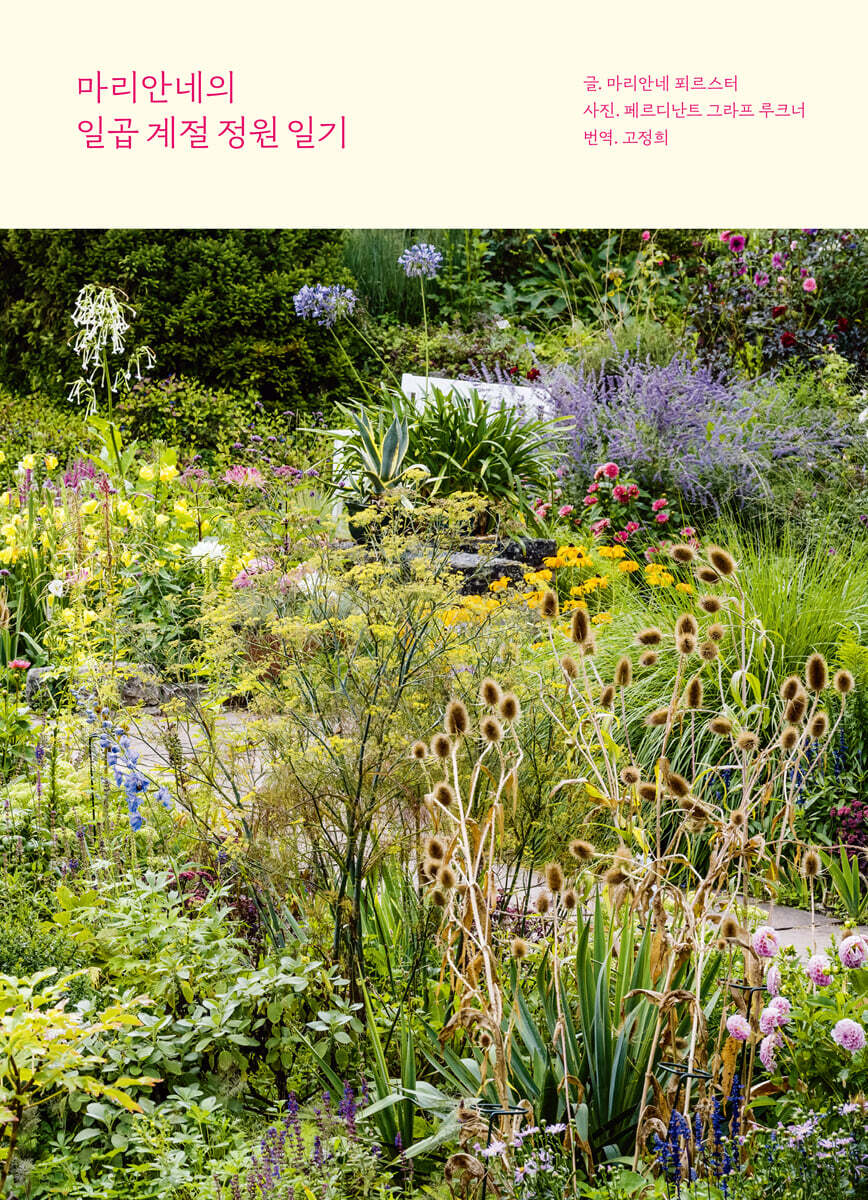
Marianne's Seven Seasons Garden Diary
 |
Description
Book Introduction
This is a book written by Marianne Foerster, the daughter of Karl Foerster, the 'father of 20th-century gardens', who took over the garden he created and cared for it without leaving it for a single day until his death.
It contains everything about 'Kalförster Garden', which was Marianne's last work that she completed with all her might over the course of 20 years after returning to her father's garden.
This is a Korean version of the expanded edition published in Germany in 2024. It features newly photographed recent photos of Karl Foerster's garden, and includes new content such as an article highlighting garden designer Marianne Foerster and a detailed plant list.
It contains everything about 'Kalförster Garden', which was Marianne's last work that she completed with all her might over the course of 20 years after returning to her father's garden.
This is a Korean version of the expanded edition published in Germany in 2024. It features newly photographed recent photos of Karl Foerster's garden, and includes new content such as an article highlighting garden designer Marianne Foerster and a detailed plant list.
- You can preview some of the book's contents.
Preview
index
Translator's Note
Publisher's Preface
Garden designer Marianne Foerster
Author's Preface
Bornim Garden's Yesterday and Today
Karl Foerster History
Early spring: late February to late April
Waiting for Spring | The First Maple Leaves on Easter | The Flower Parade Begins on the Spring Road
Spring: late April to early June
A soft drumbeat blends into the spring symphony | The beginning of a colorful feast of bulbs | Spring fills the sunken garden | Peonies, a distinguished guest from Silesia | A goldfish named Wolfgang | Animals in the Bornim Garden | Things that need pruning | Rhododendron beauties | Early-blooming shrub roses | A garden that transforms every day like a dream | A trio of colors | Summer is finally here | Operation Morning Glory | Continuing the tradition of large flower pots
Early summer: early June to late June
Roses are always a joy to see | About the Knight of the Rose | A new generation of Rose Knights brimming with poetic passion | The golden age of Salvia | A father's love for Vivichu
Midsummer: Late June to late August
Always welcome, those who visit the garden | Garden care in midsummer | August is the month with the most gifts | Deer urine, a treasure hidden in the shade | The scent of the wild oleander | In search of the blue wild oleander | The pond, a place that everyone wonders about | The bride of the sun should not be too tall
Fall: Late August to early November
The world-renowned Bornim variety | About moles and water mice | The growing shade each year | The charm of the first frost | Greetings to the newlyweds and grooms | The prima donnas of the autumn garden | The magic of autumn | Tough times for garden lovers | Breeders' stories are always fascinating.
Late fall: early November to early December
Winter: Early December to late February
Making Christmas Decorations | Winter Sleep
Carl Foerster's Color Triad
List of plants
Publisher's Preface
Garden designer Marianne Foerster
Author's Preface
Bornim Garden's Yesterday and Today
Karl Foerster History
Early spring: late February to late April
Waiting for Spring | The First Maple Leaves on Easter | The Flower Parade Begins on the Spring Road
Spring: late April to early June
A soft drumbeat blends into the spring symphony | The beginning of a colorful feast of bulbs | Spring fills the sunken garden | Peonies, a distinguished guest from Silesia | A goldfish named Wolfgang | Animals in the Bornim Garden | Things that need pruning | Rhododendron beauties | Early-blooming shrub roses | A garden that transforms every day like a dream | A trio of colors | Summer is finally here | Operation Morning Glory | Continuing the tradition of large flower pots
Early summer: early June to late June
Roses are always a joy to see | About the Knight of the Rose | A new generation of Rose Knights brimming with poetic passion | The golden age of Salvia | A father's love for Vivichu
Midsummer: Late June to late August
Always welcome, those who visit the garden | Garden care in midsummer | August is the month with the most gifts | Deer urine, a treasure hidden in the shade | The scent of the wild oleander | In search of the blue wild oleander | The pond, a place that everyone wonders about | The bride of the sun should not be too tall
Fall: Late August to early November
The world-renowned Bornim variety | About moles and water mice | The growing shade each year | The charm of the first frost | Greetings to the newlyweds and grooms | The prima donnas of the autumn garden | The magic of autumn | Tough times for garden lovers | Breeders' stories are always fascinating.
Late fall: early November to early December
Winter: Early December to late February
Making Christmas Decorations | Winter Sleep
Carl Foerster's Color Triad
List of plants
Detailed image
Into the book
Writing this book made me look at my father's garden, which is now my garden, with new eyes.
Things that I used to take for granted became new to me, and I started to worry about how I would appear to other people.
Of course, I've become much more critical of my garden than before, which makes it harder for the gardeners I work with, but I feel like the garden has taken a deeper place in my heart.
I hope readers can relate to my feelings.
Someone recently left this message in the guestbook:
“This garden is no longer your father’s.
It's your garden now.
“Now you are the one who must take responsibility for both the beauty that people love and the shortcomings.” This is what I think.
My father created this space a long time ago, and the creatures living within it have long been my task.
Whenever I walk around the garden with a new plant in hand, looking for a place to plant it, I often have a mental conversation with my father.
“Where should I plant this plant so it looks good?” Even my father would praise the triad above.
You really hate mixing yellow and pink together, but I think a light lemon and apricot pink looks good.
When I talk to visitors to the garden, I often find that people who were previously insensitive to color harmony now listen closely.
The more white flowers there are in the garden, the better.
White is essential because it acts as a buffer between colors and connects things that don't go together.
The grasshopper drinks a lot of water.
When watering, it is important to carefully water only the roots.
After it rains, you must shake off the flowers.
In the fall, you should spread a generous amount of compost and carefully check that the soil has not been washed away by rain, exposing the roots.
In that case, it dries out easily, so you need to take action.
In spring, it is good to mix a little sawdust into the compost and cover it.
Plants that go well with the grassy slope include Gypsophila, and Salvia, which blooms twice with deep purple flowers, also goes well together.
Campanula persicifolia, Leucanthemum maximum, and rudbeckia are especially beautiful when planted with the red and purple-flowered oleander.
It looks quite good with a background of large chrysanthemums, tall rudbeckias and Lavatera that resembles a daisy.
October 15th.
Even though it's mid-October, sometimes we get bright days like today.
I can't forget days like this.
I look at the garden, filled with light and bursting with all sorts of colors, as if I were seeing it for the first time.
I'm speechless for a moment.
Oh, how wonderful it is that this beauty will continue to be repeated year after year!
From now on, the pruning of plants begins in earnest.
Those that have grown too large should be divided into clumps.
Plants that can be transplanted in late fall without any problems, such as aster or rudbeckia, can also be relocated.
Once you have the original garden image in your mind, you need to do what is necessary to maintain it.
In this case, we humans must take the initiative.
We cannot rely solely on the power of Mother Earth.
Many people argue that we should 'leave everything to nature', but then they complain that their gardens are messy.
Peter Josef René left a good saying:
Any 'gardener' should write this quote down and frame it.
“Nothing grows well without care.
“No matter how excellent something is in its essence, there are many cases where it can be ruined by mishandling.” I wrote this very phrase to Mayor Platjek of Potsdam and sent it to him, and the following year he sent me assistant gardeners.
Until March, we leave perennials and grasses standing in our garden like this.
When snow or frost falls, you can experience surprising and unexpected sights and see plants from a completely different angle.
All the plants look fragile and frail.
Gardeners should think carefully before they start clearing out their gardens in the fall.
Who will you spend the winter with?
All plants retain memories of the past season.
But one day, the heartbreaking 'cutting' time will come.
Then the garden suddenly seems naked, the earth bare before your eyes, its flesh exposed without any protection.
And as the years pass, all memories of the garden also disappear.
Almost everyone.
Things that I used to take for granted became new to me, and I started to worry about how I would appear to other people.
Of course, I've become much more critical of my garden than before, which makes it harder for the gardeners I work with, but I feel like the garden has taken a deeper place in my heart.
I hope readers can relate to my feelings.
Someone recently left this message in the guestbook:
“This garden is no longer your father’s.
It's your garden now.
“Now you are the one who must take responsibility for both the beauty that people love and the shortcomings.” This is what I think.
My father created this space a long time ago, and the creatures living within it have long been my task.
Whenever I walk around the garden with a new plant in hand, looking for a place to plant it, I often have a mental conversation with my father.
“Where should I plant this plant so it looks good?” Even my father would praise the triad above.
You really hate mixing yellow and pink together, but I think a light lemon and apricot pink looks good.
When I talk to visitors to the garden, I often find that people who were previously insensitive to color harmony now listen closely.
The more white flowers there are in the garden, the better.
White is essential because it acts as a buffer between colors and connects things that don't go together.
The grasshopper drinks a lot of water.
When watering, it is important to carefully water only the roots.
After it rains, you must shake off the flowers.
In the fall, you should spread a generous amount of compost and carefully check that the soil has not been washed away by rain, exposing the roots.
In that case, it dries out easily, so you need to take action.
In spring, it is good to mix a little sawdust into the compost and cover it.
Plants that go well with the grassy slope include Gypsophila, and Salvia, which blooms twice with deep purple flowers, also goes well together.
Campanula persicifolia, Leucanthemum maximum, and rudbeckia are especially beautiful when planted with the red and purple-flowered oleander.
It looks quite good with a background of large chrysanthemums, tall rudbeckias and Lavatera that resembles a daisy.
October 15th.
Even though it's mid-October, sometimes we get bright days like today.
I can't forget days like this.
I look at the garden, filled with light and bursting with all sorts of colors, as if I were seeing it for the first time.
I'm speechless for a moment.
Oh, how wonderful it is that this beauty will continue to be repeated year after year!
From now on, the pruning of plants begins in earnest.
Those that have grown too large should be divided into clumps.
Plants that can be transplanted in late fall without any problems, such as aster or rudbeckia, can also be relocated.
Once you have the original garden image in your mind, you need to do what is necessary to maintain it.
In this case, we humans must take the initiative.
We cannot rely solely on the power of Mother Earth.
Many people argue that we should 'leave everything to nature', but then they complain that their gardens are messy.
Peter Josef René left a good saying:
Any 'gardener' should write this quote down and frame it.
“Nothing grows well without care.
“No matter how excellent something is in its essence, there are many cases where it can be ruined by mishandling.” I wrote this very phrase to Mayor Platjek of Potsdam and sent it to him, and the following year he sent me assistant gardeners.
Until March, we leave perennials and grasses standing in our garden like this.
When snow or frost falls, you can experience surprising and unexpected sights and see plants from a completely different angle.
All the plants look fragile and frail.
Gardeners should think carefully before they start clearing out their gardens in the fall.
Who will you spend the winter with?
All plants retain memories of the past season.
But one day, the heartbreaking 'cutting' time will come.
Then the garden suddenly seems naked, the earth bare before your eyes, its flesh exposed without any protection.
And as the years pass, all memories of the garden also disappear.
Almost everyone.
--- From the text
Publisher's Review
Karl Foerster Garden, a magical space that has lasted for over 100 years
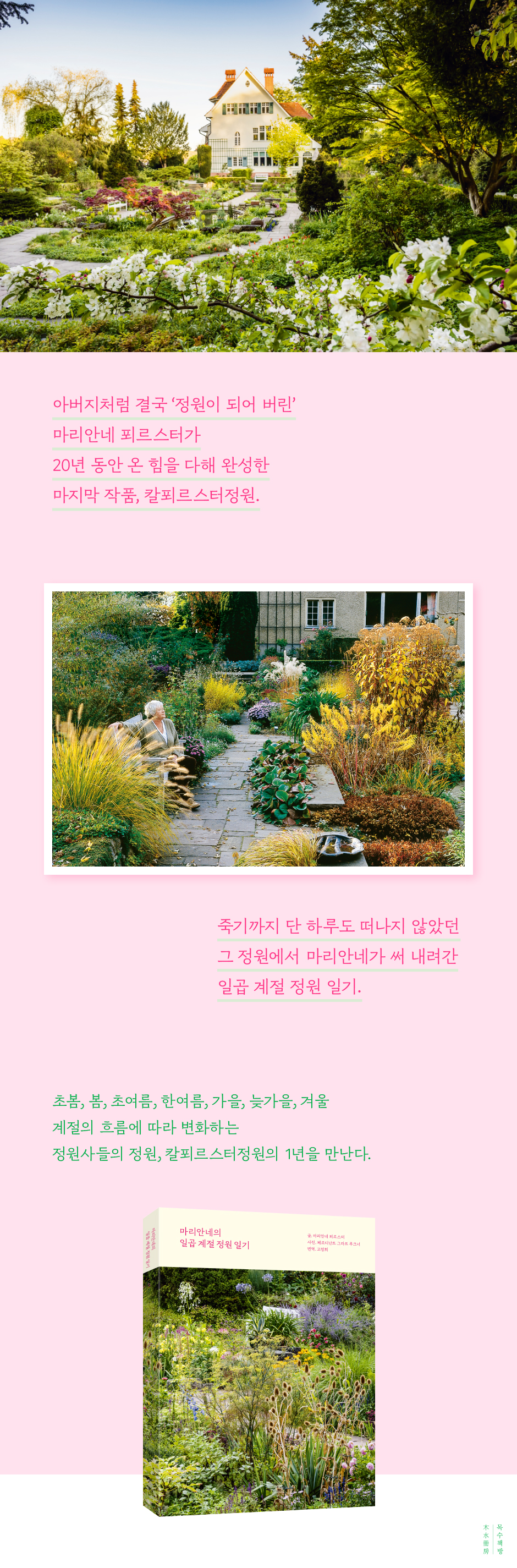
Karl Foerster, a German perennial plant breeder and writer known as the 'father of the 20th-century garden,' created a perennial plant breeding and cultivation farm in a potato field on the Bornim Plain northwest of Potsdam.
The house where the Foerster family lived, the sunken garden in front of the house, the rock garden behind the house, and the spring path, nature garden, and autumn garden surrounding it.
Karl Foerster planted and bred perennials in this thematic space to show how these plants live and how they unfold their beauty.
This exhibition garden is the beginning of the Karl Foerster Garden (Bornim Garden), which has become a place of pilgrimage for gardeners.
This space, to which Karl Foerster had devoted his entire life for 60 years, was taken over by his wife Eva and cared for and maintained for 20 years, and by his daughter Marianne for another 20 years.
And even after Marianne's death, the German Cultural Heritage Foundation took charge of the house and gardens, preserving this significant garden heritage.
A daughter's garden diary, like her father, who has become a gardener.
Born in 1931 in Potsdam-Bornim, Marianne was a child 'born among perennials'.
After receiving training as a gardener from her father and broadening her horizons by traveling around Europe, Marianne worked as a garden designer in Brussels, Belgium for 30 years before returning home to care for her mother and the garden for seven seasons. She never left the garden for a single day until her death in 2010.
Every morning, Marianne sat at the living room table overlooking the garden and wrote down the weather for the day. In the evening, she wrote down in her diary the garden she had seen and felt that day.
This extraordinary garden diary, written to answer frequently asked questions by those visiting the Karl Foerster Garden, is filled with sentences that will deeply resonate with anyone who loves plants and gardens.
The story unfolds with the flow of the 'seven seasons': early spring, spring, early summer, midsummer, fall, late fall, and winter, about the countless plants that brighten up the garden, the animals that live in the garden, and the people who visit the garden.
As you read, you will quickly become captivated by Marianne's warm gaze toward her garden and the charm of her witty writing.
As you turn the pages of the book and listen to Marianne's explanations, you will feel as if you are slowly walking around every corner of the garden.
Published in 2005, this book became a bestseller and won the German Gardeners' Association's Best Book Award the following year, and is still considered an important book in the field of gardening.
Although the house and gardens have been preserved since Marianne's death, the decision to republish this book was made as climate change made their maintenance increasingly difficult.
The expanded edition published in 2024 retains the original text but includes new photographs of the transformed garden, an article highlighting garden designer Marianne, and a section on Karl Foerster's "Color Triad," which is often mentioned in the book.
The Korean version, which has been out of print and is now reaching new garden readers, includes a new, detailed plant list for gardeners curious about the plants in Karl Foerster's garden.
Marianne, a garden designer, not Karl Foerster's daughter
Marianne was often asked by visitors to her garden, “Are you Karl Förster’s daughter?”
Marianne gave them this 'bone-deep' answer:
“My profession is my father’s daughter.” Marianne was not only the daughter of Karl Foerster, but also a prolific landscape architect and garden designer who left behind many fine works.
Although created by Karl Foerster, the garden's most recent appearance was filled and landscaped by his daughter Marianne.
Marianne's last work, which she completed with all her might over the course of 20 years, is 'Kalförster Garden'.
From 1991 to 2010, Marianne preserved the legacy her parents had left her: the house in Bornim, along with the garden and plants.
This expanded edition features additional pages showcasing the work of garden designer Marianne, including her Belgian home gardens and the Schlotz family garden in Potsdam.
One of the charms of this book is that it allows you to see Marianne's garden works in a separate room, which are splendid, harmonious, and very dynamic.
Karl Foerster, a German perennial plant breeder and writer known as the 'father of the 20th-century garden,' created a perennial plant breeding and cultivation farm in a potato field on the Bornim Plain northwest of Potsdam.
The house where the Foerster family lived, the sunken garden in front of the house, the rock garden behind the house, and the spring path, nature garden, and autumn garden surrounding it.
Karl Foerster planted and bred perennials in this thematic space to show how these plants live and how they unfold their beauty.
This exhibition garden is the beginning of the Karl Foerster Garden (Bornim Garden), which has become a place of pilgrimage for gardeners.
This space, to which Karl Foerster had devoted his entire life for 60 years, was taken over by his wife Eva and cared for and maintained for 20 years, and by his daughter Marianne for another 20 years.
And even after Marianne's death, the German Cultural Heritage Foundation took charge of the house and gardens, preserving this significant garden heritage.
A daughter's garden diary, like her father, who has become a gardener.
Born in 1931 in Potsdam-Bornim, Marianne was a child 'born among perennials'.
After receiving training as a gardener from her father and broadening her horizons by traveling around Europe, Marianne worked as a garden designer in Brussels, Belgium for 30 years before returning home to care for her mother and the garden for seven seasons. She never left the garden for a single day until her death in 2010.
Every morning, Marianne sat at the living room table overlooking the garden and wrote down the weather for the day. In the evening, she wrote down in her diary the garden she had seen and felt that day.
This extraordinary garden diary, written to answer frequently asked questions by those visiting the Karl Foerster Garden, is filled with sentences that will deeply resonate with anyone who loves plants and gardens.
The story unfolds with the flow of the 'seven seasons': early spring, spring, early summer, midsummer, fall, late fall, and winter, about the countless plants that brighten up the garden, the animals that live in the garden, and the people who visit the garden.
As you read, you will quickly become captivated by Marianne's warm gaze toward her garden and the charm of her witty writing.
As you turn the pages of the book and listen to Marianne's explanations, you will feel as if you are slowly walking around every corner of the garden.
Published in 2005, this book became a bestseller and won the German Gardeners' Association's Best Book Award the following year, and is still considered an important book in the field of gardening.
Although the house and gardens have been preserved since Marianne's death, the decision to republish this book was made as climate change made their maintenance increasingly difficult.
The expanded edition published in 2024 retains the original text but includes new photographs of the transformed garden, an article highlighting garden designer Marianne, and a section on Karl Foerster's "Color Triad," which is often mentioned in the book.
The Korean version, which has been out of print and is now reaching new garden readers, includes a new, detailed plant list for gardeners curious about the plants in Karl Foerster's garden.
Marianne, a garden designer, not Karl Foerster's daughter
Marianne was often asked by visitors to her garden, “Are you Karl Förster’s daughter?”
Marianne gave them this 'bone-deep' answer:
“My profession is my father’s daughter.” Marianne was not only the daughter of Karl Foerster, but also a prolific landscape architect and garden designer who left behind many fine works.
Although created by Karl Foerster, the garden's most recent appearance was filled and landscaped by his daughter Marianne.
Marianne's last work, which she completed with all her might over the course of 20 years, is 'Kalförster Garden'.
From 1991 to 2010, Marianne preserved the legacy her parents had left her: the house in Bornim, along with the garden and plants.
This expanded edition features additional pages showcasing the work of garden designer Marianne, including her Belgian home gardens and the Schlotz family garden in Potsdam.
One of the charms of this book is that it allows you to see Marianne's garden works in a separate room, which are splendid, harmonious, and very dynamic.
GOODS SPECIFICS
- Date of issue: October 31, 2025
- Format: Hardcover book binding method guide
- Page count, weight, size: 260 pages | 568g | 170*235*16mm
- ISBN13: 9791188806713
- ISBN10: 1188806718
You may also like
카테고리
korean


korean

![ELLE 엘르 스페셜 에디션 A형 : 12월 [2025]](http://librairie.coreenne.fr/cdn/shop/files/b8e27a3de6c9538896439686c6b0e8fb.jpg?v=1766436872&width=3840)


