

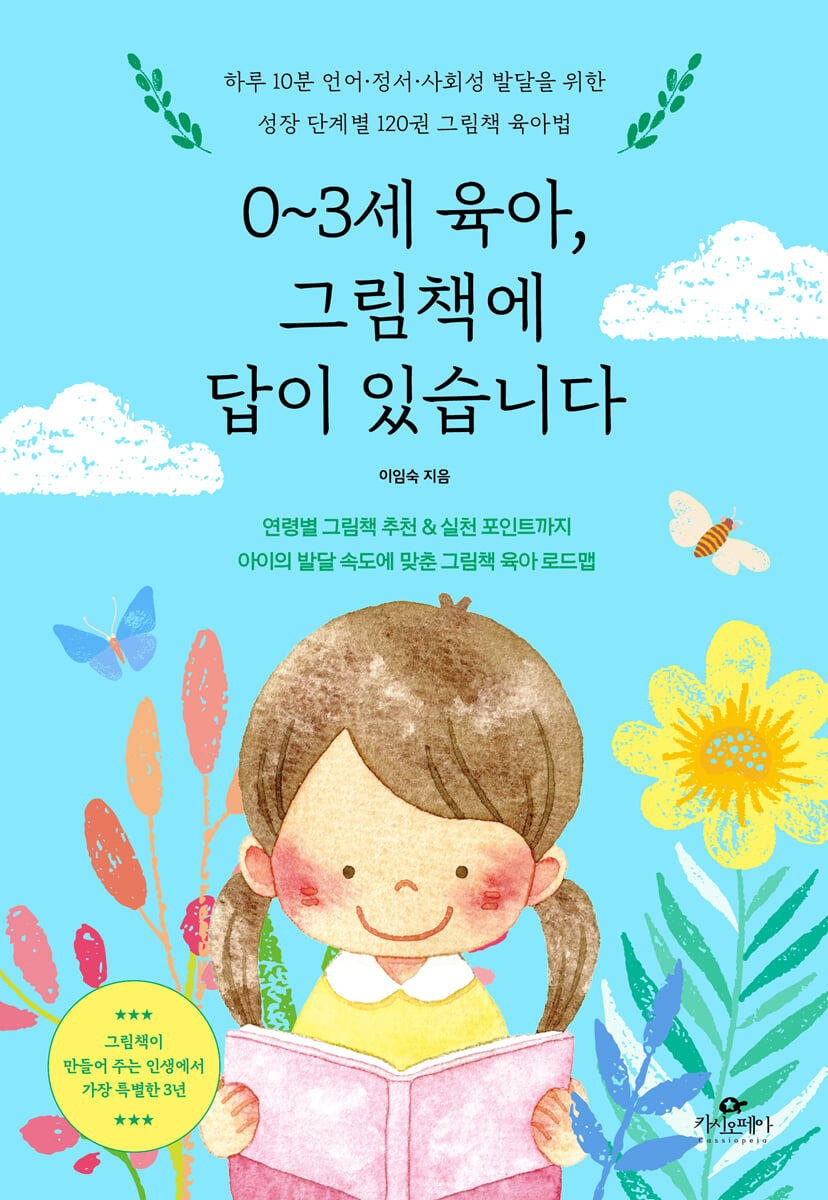
Picture books hold the answer to raising children aged 0-3.
 |
Description
Book Introduction
“In just 10 minutes a day, your child’s speech and mind will grow with picture books.”
Everything You Need to Know About Picture Book Parenting from EBS Parenting Mentor Im Sook Lee
* A new book from the bestselling author of "There is no more important age than 4 to 7" and "How to Speak Your Mind Smartly"
* A customized guide to picture books for each growth stage, ages 0-3
* 120 age-appropriate picture books recommended by Im-Sook Lee, a child and adolescent psychotherapist and communication expert.
* Includes 'Practical Points' for Parenting, a picture book closely related to daily life.
Today's parents, busy working, taking care of household chores, and raising children, live a life of constant running.
It would be great to spend all day interacting with and playing with your child, but the gap between ideals and reality is wide.
So, what we need is ‘picture book parenting.’
You can read 5-6 picture books in 10 minutes a day.
Picture book parenting, which involves holding your child in your arms and reading to them with a warm voice, is the easiest and most effective way to stimulate language, emotions, and social skills evenly.
Because it contains countless words of love, beautiful sentences, and new vocabulary that captures the world that parents wanted to convey.
A child's first three years are a time of wonderful change.
A child who was lying down starts walking and running, and a baby who could only cry starts speaking.
During this period, each and every picture book seen and heard in the arms of parents becomes the child's words, thoughts, and emotions.
This warm and precious time will be the 'first words' that will nurture the child's language and emotions, and the 'seeds' of lifelong reading.
This book, written by Director Im-Sook Lee, a child and adolescent psychology specialist and communication expert, and filled with over 25 years of clinical experience and expertise, contains everything about picture book parenting.
"Parenting 0-3 Year Olds, Picture Books Are the Answer" systematically organizes picture books to help children develop language, emotions, social skills, and brain development during the first three years of life, from newborn to three years old. It guides children on how to use picture books in their daily lives and contains 120 picture books for each age group that are suitable for the child's growth rate.
For new parents who are full of questions like, “Are the words I’m saying really reaching my child’s heart?”, “My child seems to be late in speaking. How can I help?”, and “I don’t know what books to read or how to read them?”, this book will be a reliable parenting compass that guides them with warmth.
Everything You Need to Know About Picture Book Parenting from EBS Parenting Mentor Im Sook Lee
* A new book from the bestselling author of "There is no more important age than 4 to 7" and "How to Speak Your Mind Smartly"
* A customized guide to picture books for each growth stage, ages 0-3
* 120 age-appropriate picture books recommended by Im-Sook Lee, a child and adolescent psychotherapist and communication expert.
* Includes 'Practical Points' for Parenting, a picture book closely related to daily life.
Today's parents, busy working, taking care of household chores, and raising children, live a life of constant running.
It would be great to spend all day interacting with and playing with your child, but the gap between ideals and reality is wide.
So, what we need is ‘picture book parenting.’
You can read 5-6 picture books in 10 minutes a day.
Picture book parenting, which involves holding your child in your arms and reading to them with a warm voice, is the easiest and most effective way to stimulate language, emotions, and social skills evenly.
Because it contains countless words of love, beautiful sentences, and new vocabulary that captures the world that parents wanted to convey.
A child's first three years are a time of wonderful change.
A child who was lying down starts walking and running, and a baby who could only cry starts speaking.
During this period, each and every picture book seen and heard in the arms of parents becomes the child's words, thoughts, and emotions.
This warm and precious time will be the 'first words' that will nurture the child's language and emotions, and the 'seeds' of lifelong reading.
This book, written by Director Im-Sook Lee, a child and adolescent psychology specialist and communication expert, and filled with over 25 years of clinical experience and expertise, contains everything about picture book parenting.
"Parenting 0-3 Year Olds, Picture Books Are the Answer" systematically organizes picture books to help children develop language, emotions, social skills, and brain development during the first three years of life, from newborn to three years old. It guides children on how to use picture books in their daily lives and contains 120 picture books for each age group that are suitable for the child's growth rate.
For new parents who are full of questions like, “Are the words I’m saying really reaching my child’s heart?”, “My child seems to be late in speaking. How can I help?”, and “I don’t know what books to read or how to read them?”, this book will be a reliable parenting compass that guides them with warmth.
- You can preview some of the book's contents.
Preview
index
· Prologue - The Difference of 30 Million Words, Beginning with a Picture Book
CHAPTER 1
“Please read as much as you love.”
My precious baby, what should I do?
Expressing love through picture books
The Best Gift for Baby: Picture Book Parenting
How do babies learn and remember the world?
Can babies remember what they hear?
Focus on picture books, interaction is key.
[Practice Point] Read a book while making eye contact with your baby.
Chapter 2
[4~6 months] “The moment your senses open up!”
Picture book parenting that nurtures the five senses
The power of old stories told from 100 days ago
Peekaboo! My friend in the book is watching me.
Develop your observation skills with this hide-and-seek picture book!
Tactile picture books for children who learn by touching the world.
[Practice Point] Picture Books: A Balance of Repetition and Novelty
CHAPTER 3
[7-12 months] “A time for emotional growth”
Picture books: the key to emotional development
Building Secure Attachments with Picture Books
Baby learning from mom and dad's expressions
Our children's emotional intelligence grows through picture books.
Emotional connection promotes object recognition.
[Practice Point] Mom and Dad, please take turns reading.
Chapter 4
[13-18 months] "The period when language sense explodes"
Picture book play that makes speech flow smoothly
The joy of reading and playing awakens your sense of language.
The moment your vocabulary explodes, the language stimulation provided by picture books
Learning grows through picture book modeling
Developing language and social skills with manipulative picture books that involve touch and feel.
[Practice Point] Read picture books that help language development.
CHAPTER 5
[18-24 months] “I like myself”
Picture books that boost self-esteem
A special time to recognize yourself, with picture books.
Picture book parenting that helps children develop self-esteem and autonomy.
Picture book therapy to overcome separation anxiety
Picture book discipline methods that teach emotions and rules together
[Practice Point] We Need Picture Book Conversations That Boost Self-Esteem
Chapter 6
[24-30 months] “I have so many questions!”
A cognitive development picture book that fosters curiosity
The power of picture books to awaken children's curiosity
[Practice Point] Picture Book Parenting Methods that Foster Curiosity
Memory game picture book that stimulates brain development
A picture book that awakens your mathematical senses
When and how should I read English picture books?
[Practice Point] Imagine the ending of the story.
CHAPTER 7
[30~36 months] “The perfect time to learn about relationships!”
Social Skills Grow! Picture Book Parenting
How to Play with Friends? Picture Books Explain How to Make Friends
The magic of picture books where rules become play
The power of stories to foster empathy and consideration
Resolving sibling disputes with picture books
[Practice Point] When you tell your sibling you hate them, say this.
Epilogue - A Picture Book Journey with Your Child in 10 Minutes a Day
CHAPTER 1
“Please read as much as you love.”
My precious baby, what should I do?
Expressing love through picture books
The Best Gift for Baby: Picture Book Parenting
How do babies learn and remember the world?
Can babies remember what they hear?
Focus on picture books, interaction is key.
[Practice Point] Read a book while making eye contact with your baby.
Chapter 2
[4~6 months] “The moment your senses open up!”
Picture book parenting that nurtures the five senses
The power of old stories told from 100 days ago
Peekaboo! My friend in the book is watching me.
Develop your observation skills with this hide-and-seek picture book!
Tactile picture books for children who learn by touching the world.
[Practice Point] Picture Books: A Balance of Repetition and Novelty
CHAPTER 3
[7-12 months] “A time for emotional growth”
Picture books: the key to emotional development
Building Secure Attachments with Picture Books
Baby learning from mom and dad's expressions
Our children's emotional intelligence grows through picture books.
Emotional connection promotes object recognition.
[Practice Point] Mom and Dad, please take turns reading.
Chapter 4
[13-18 months] "The period when language sense explodes"
Picture book play that makes speech flow smoothly
The joy of reading and playing awakens your sense of language.
The moment your vocabulary explodes, the language stimulation provided by picture books
Learning grows through picture book modeling
Developing language and social skills with manipulative picture books that involve touch and feel.
[Practice Point] Read picture books that help language development.
CHAPTER 5
[18-24 months] “I like myself”
Picture books that boost self-esteem
A special time to recognize yourself, with picture books.
Picture book parenting that helps children develop self-esteem and autonomy.
Picture book therapy to overcome separation anxiety
Picture book discipline methods that teach emotions and rules together
[Practice Point] We Need Picture Book Conversations That Boost Self-Esteem
Chapter 6
[24-30 months] “I have so many questions!”
A cognitive development picture book that fosters curiosity
The power of picture books to awaken children's curiosity
[Practice Point] Picture Book Parenting Methods that Foster Curiosity
Memory game picture book that stimulates brain development
A picture book that awakens your mathematical senses
When and how should I read English picture books?
[Practice Point] Imagine the ending of the story.
CHAPTER 7
[30~36 months] “The perfect time to learn about relationships!”
Social Skills Grow! Picture Book Parenting
How to Play with Friends? Picture Books Explain How to Make Friends
The magic of picture books where rules become play
The power of stories to foster empathy and consideration
Resolving sibling disputes with picture books
[Practice Point] When you tell your sibling you hate them, say this.
Epilogue - A Picture Book Journey with Your Child in 10 Minutes a Day
Detailed image

Into the book
Any parent wants to tell their baby the most beautiful and good words in the world.
But my mind is full, and the thoughts and words that come to mind stay in place.
Even though I want to express my love, I feel like I am lacking in expression.
So what we need is a picture book.
Picture books are the best way to convey mommy and daddy's love to babies while providing interesting visual and auditory stimulation.
If we want our babies to grow up healthy, happy, well-mannered, wise, and smart, let's read them picture books from the moment they are born.
--- p.17
The influence of the media is powerful.
If parents do not consciously block it, it can become a powerful obstacle that hinders the baby's development.
Besides, parents are too busy and have too much to do at home.
No matter how much you love your baby and want to convey that love, you often lack the most important interaction time with your baby.
Now we need a new way to convey deeper love to our babies.
Babies feel secure when they hear their parents' voices, learn about the world with curious eyes, and develop the ability to speak, listen, remember, and judge.
And the most effective way to help with all of this is picture book parenting.
--- p.21
Reading picture books to children is a proven method for their growth and development.
So, don't hesitate and read picture books to your baby while he or she is awake or playing.
Picture books are the foundation for our children to become lifelong readers.
As children grow and face difficult times, they gain wisdom from books and write their own life scenarios.
--- p.29
The importance of using picture books for children from infancy has been scientifically proven.
Studies have shown that babies who habituated more quickly to repetitive stimuli around three months of age scored higher on intelligence tests at age four.
Additionally, babies who had shorter visual attention spans at 5 months of age showed better information processing and executive functioning at 24, 36, and 48 months of age than babies who had longer attention spans.
This means that the more experience babies have with habituation and dishabituation of various object pictures, the more efficiently their information processing speed develops.
Therefore, it is very important to help babies naturally repeat the process of habituation and un-habituation by looking at picture books with focus from the newborn stage.
But my mind is full, and the thoughts and words that come to mind stay in place.
Even though I want to express my love, I feel like I am lacking in expression.
So what we need is a picture book.
Picture books are the best way to convey mommy and daddy's love to babies while providing interesting visual and auditory stimulation.
If we want our babies to grow up healthy, happy, well-mannered, wise, and smart, let's read them picture books from the moment they are born.
--- p.17
The influence of the media is powerful.
If parents do not consciously block it, it can become a powerful obstacle that hinders the baby's development.
Besides, parents are too busy and have too much to do at home.
No matter how much you love your baby and want to convey that love, you often lack the most important interaction time with your baby.
Now we need a new way to convey deeper love to our babies.
Babies feel secure when they hear their parents' voices, learn about the world with curious eyes, and develop the ability to speak, listen, remember, and judge.
And the most effective way to help with all of this is picture book parenting.
--- p.21
Reading picture books to children is a proven method for their growth and development.
So, don't hesitate and read picture books to your baby while he or she is awake or playing.
Picture books are the foundation for our children to become lifelong readers.
As children grow and face difficult times, they gain wisdom from books and write their own life scenarios.
--- p.29
The importance of using picture books for children from infancy has been scientifically proven.
Studies have shown that babies who habituated more quickly to repetitive stimuli around three months of age scored higher on intelligence tests at age four.
Additionally, babies who had shorter visual attention spans at 5 months of age showed better information processing and executive functioning at 24, 36, and 48 months of age than babies who had longer attention spans.
This means that the more experience babies have with habituation and dishabituation of various object pictures, the more efficiently their information processing speed develops.
Therefore, it is very important to help babies naturally repeat the process of habituation and un-habituation by looking at picture books with focus from the newborn stage.
--- p.49
Publisher's Review
“Parents are the ones who engrave the first sentence into a child’s heart.”
Director Im-Sook Lee, Korea's leading child and adolescent psychology expert and communication expert
A picture book parenting roadmap, based on 25 years of clinical experience and expertise.
“The key to children’s brain, emotions, and language development lies in picture books!”
Picture book parenting that matches the child's developmental stage exactly.
Language stimulation, emotional connection, and attachment formation... we all know these are important, but for first-time parents, getting started can be overwhelming.
But now let's put our anxiety and worries aside.
Here's a parenting roadmap that will help you nurture your child's brain and heart simultaneously with picture books in just 10 minutes a day.
For children aged 7 to 12 months, picture books read to them with their mother's voice play a crucial role in forming a secure attachment. For one-year-old children, they stimulate their language senses, and for children aged 2 and older, they help develop self-expression, understanding of rules, and empathy.
In this way, picture book parenting is the most effective tool for stimulating ‘emotional connection,’ ‘cognitive development,’ and ‘social development’ at the same time.
The effectiveness of reading books has been proven through numerous studies.
For example, children whose parents read to them frequently were found to have larger vocabularies at 12 and 24 months of age.
Additionally, there are results showing that children who were read picture books from 9 months of age had better vocabulary expression skills at the age of 3.
Picture books have such proven and diverse effects. What's important in parenting isn't just reading a lot.
Author Im-Sook Lee, a parenting education expert, emphasizes that the 'quality of reading' is much more important than the 'quantity of reading', and provides detailed guidance on conversation techniques and questioning methods for each situation and developmental stage, as well as creative play methods using picture books.
For parents who worry about their children's delayed speech, parents who are exhausted from disciplining children who throw tantrums and have trouble controlling their emotions, parents who are anxious about their children's development being delayed compared to their peers, and parents who want to deepen and enrich their relationships with their children, this book will be the most realistic and warm practical guide.
A child's brain is more than 80% developed by age 3.
During this crucial period of brain development, picture books are the best brain development stimulants.
The period of infancy and toddlerhood (0-3 years old) is a ‘critical period for brain development.’
The author describes these three years as follows:
“When you see a baby just lying down or crawling on the floor, you wonder when they will grow up, but in fact, the baby’s brain is growing incredibly quickly.
Even when it appears to be lying still, or crawling on the floor, the baby's brain is rapidly receiving information, creating countless new brain cells and forming vast networks of connections.
Neuroscientists describe infant brain development as "microscopic fireworks."
It is a change that is so amazing and explosive.
And this dense brain growth occurs exclusively during the first three years of life.”
Language stimulation during this period cannot help but have a decisive impact on the child's learning, emotional, and social development.
So, at this time, the most important thing is what language you use to speak to your child.
And picture books, filled with creative pictures and language, are a comprehensive developmental stimulant optimized for the brain that simultaneously stimulates a child's emotions, cognition, vision, hearing, and touch.
For parents who are anxious about what to do for their babies who are learning about the world at an astonishing pace day by day, "Parenting 0-3 Year Olds: The Answer is in Picture Books" will be the most accurate and affectionate guide.
From our baby's first picture book to memory play books and social skills picture books.
EBS parenting mentor Im Sook Lee recommends 120 picture books for each stage of growth!
The key to picture book parenting is 'what kind of book to read and how to read it.'
This book systematically contains methods for utilizing picture books tailored to the major tasks of each period, such as sensory development, emotional formation, language development, self-esteem enhancement, cognitive development, and social growth of children from infancy to three years of age.
From the first picture book for newborns to books that gently embrace a child's "first emotions," let's take a look at 120 age-appropriate picture books carefully selected by Director Im-Sook Lee, a child and adolescent psychotherapist and communication expert.
· 0-3 months: Picture books that focus on talking and engaging with your baby.
· 4-6 months: Tactile picture books that stimulate the five senses, hide-and-seek picture books, peek-a-boo books
· 7-12 months: Picture books that foster emotional intelligence and secure attachment.
· 13-18 months: Picture books and manipulative picture books that stimulate language
· 18-24 months: Picture books that foster self-esteem and autonomy, and picture books for discipline.
· 24-30 months: Picture books that help with cognitive development and number sense, memory play picture books
· 30-36 months: Picture books that foster social skills and teach order and rules.
"The modern child-rearing environment is experiencing poverty amidst abundance."
Picture books that offer a deeper and richer sense than artificial stimulation.
In the past, when a baby was born, nature was close by, and they naturally learned language through conversations with various adults.
But now it's different.
The baby's room is more sophisticated, toys are overflowing, but something crucial is missing in that abundance.
'Stimulation that awakens the five senses of nature', 'conversations of people with diverse voices', and 'interaction of emotions' are woefully inadequate.
Children are growing up in an environment where the primary caregiver is the only one caring for them, and in a space dominated by digital devices.
In an age where children suffer from sensory poverty amidst physical abundance, the existence of picture books shines even brighter.
Picture books are the most effective and magical tool for opening up a path of expression for parents who are reserved, and for providing visual, auditory, tactile, and emotional stimulation to children who spend their days in monotonous environments.
“Love must ultimately become ‘words.’”
A picture book that will become the world's most beautiful and enriching parenting words.
“You are a miracle.
“You were born to be loved.”
“We love you whether you’re a giraffe or a bear.”
“I will always love you.
“Wherever you are, I love you.”
“What color is your mood?”
These beautiful sentences are all titles of picture books.
When parents want to express their love but are at a loss as to how to do so, picture books can become a tool that conveys those deep emotions in delicate language through the title alone.
Every parent wants to tell their child the most beautiful words in the world.
But when it comes to speaking, words are short and emotions linger only in the head.
At times like these, a picture book can open the mouths of parents who are quiet or have difficulty expressing themselves, and transform formless emotions into shining sentences.
Picture books, which convey love to children and comfort to parents, are a 'miraculous tool' that transforms love into beautiful language.
The joy of reading and playing awakens your sense of language.
A world of book play where you see, hear, touch, and sing
All parents hope that their children will grow up to be children who laugh while reading, who naturally turn to books when bored, and who find comfort and guidance in books when they are feeling down.
What parents must do to make this wish come true is very simple and clear.
Just let your child laugh while playing with books.
So, we need to imprint the existence of books in the unconscious memory of infants as something very pleasant and enjoyable, something from which they can find hope and expectation.
To do this, we must help children perceive books as enjoyable play.
In this way, play experiences with books become the foundation for children to grow into readers who love books.
Picture books go beyond being a catalyst for awakening a child's sense of language; they will become lifelong friends and enrich their lives.
Director Im-Sook Lee, Korea's leading child and adolescent psychology expert and communication expert
A picture book parenting roadmap, based on 25 years of clinical experience and expertise.
“The key to children’s brain, emotions, and language development lies in picture books!”
Picture book parenting that matches the child's developmental stage exactly.
Language stimulation, emotional connection, and attachment formation... we all know these are important, but for first-time parents, getting started can be overwhelming.
But now let's put our anxiety and worries aside.
Here's a parenting roadmap that will help you nurture your child's brain and heart simultaneously with picture books in just 10 minutes a day.
For children aged 7 to 12 months, picture books read to them with their mother's voice play a crucial role in forming a secure attachment. For one-year-old children, they stimulate their language senses, and for children aged 2 and older, they help develop self-expression, understanding of rules, and empathy.
In this way, picture book parenting is the most effective tool for stimulating ‘emotional connection,’ ‘cognitive development,’ and ‘social development’ at the same time.
The effectiveness of reading books has been proven through numerous studies.
For example, children whose parents read to them frequently were found to have larger vocabularies at 12 and 24 months of age.
Additionally, there are results showing that children who were read picture books from 9 months of age had better vocabulary expression skills at the age of 3.
Picture books have such proven and diverse effects. What's important in parenting isn't just reading a lot.
Author Im-Sook Lee, a parenting education expert, emphasizes that the 'quality of reading' is much more important than the 'quantity of reading', and provides detailed guidance on conversation techniques and questioning methods for each situation and developmental stage, as well as creative play methods using picture books.
For parents who worry about their children's delayed speech, parents who are exhausted from disciplining children who throw tantrums and have trouble controlling their emotions, parents who are anxious about their children's development being delayed compared to their peers, and parents who want to deepen and enrich their relationships with their children, this book will be the most realistic and warm practical guide.
A child's brain is more than 80% developed by age 3.
During this crucial period of brain development, picture books are the best brain development stimulants.
The period of infancy and toddlerhood (0-3 years old) is a ‘critical period for brain development.’
The author describes these three years as follows:
“When you see a baby just lying down or crawling on the floor, you wonder when they will grow up, but in fact, the baby’s brain is growing incredibly quickly.
Even when it appears to be lying still, or crawling on the floor, the baby's brain is rapidly receiving information, creating countless new brain cells and forming vast networks of connections.
Neuroscientists describe infant brain development as "microscopic fireworks."
It is a change that is so amazing and explosive.
And this dense brain growth occurs exclusively during the first three years of life.”
Language stimulation during this period cannot help but have a decisive impact on the child's learning, emotional, and social development.
So, at this time, the most important thing is what language you use to speak to your child.
And picture books, filled with creative pictures and language, are a comprehensive developmental stimulant optimized for the brain that simultaneously stimulates a child's emotions, cognition, vision, hearing, and touch.
For parents who are anxious about what to do for their babies who are learning about the world at an astonishing pace day by day, "Parenting 0-3 Year Olds: The Answer is in Picture Books" will be the most accurate and affectionate guide.
From our baby's first picture book to memory play books and social skills picture books.
EBS parenting mentor Im Sook Lee recommends 120 picture books for each stage of growth!
The key to picture book parenting is 'what kind of book to read and how to read it.'
This book systematically contains methods for utilizing picture books tailored to the major tasks of each period, such as sensory development, emotional formation, language development, self-esteem enhancement, cognitive development, and social growth of children from infancy to three years of age.
From the first picture book for newborns to books that gently embrace a child's "first emotions," let's take a look at 120 age-appropriate picture books carefully selected by Director Im-Sook Lee, a child and adolescent psychotherapist and communication expert.
· 0-3 months: Picture books that focus on talking and engaging with your baby.
· 4-6 months: Tactile picture books that stimulate the five senses, hide-and-seek picture books, peek-a-boo books
· 7-12 months: Picture books that foster emotional intelligence and secure attachment.
· 13-18 months: Picture books and manipulative picture books that stimulate language
· 18-24 months: Picture books that foster self-esteem and autonomy, and picture books for discipline.
· 24-30 months: Picture books that help with cognitive development and number sense, memory play picture books
· 30-36 months: Picture books that foster social skills and teach order and rules.
"The modern child-rearing environment is experiencing poverty amidst abundance."
Picture books that offer a deeper and richer sense than artificial stimulation.
In the past, when a baby was born, nature was close by, and they naturally learned language through conversations with various adults.
But now it's different.
The baby's room is more sophisticated, toys are overflowing, but something crucial is missing in that abundance.
'Stimulation that awakens the five senses of nature', 'conversations of people with diverse voices', and 'interaction of emotions' are woefully inadequate.
Children are growing up in an environment where the primary caregiver is the only one caring for them, and in a space dominated by digital devices.
In an age where children suffer from sensory poverty amidst physical abundance, the existence of picture books shines even brighter.
Picture books are the most effective and magical tool for opening up a path of expression for parents who are reserved, and for providing visual, auditory, tactile, and emotional stimulation to children who spend their days in monotonous environments.
“Love must ultimately become ‘words.’”
A picture book that will become the world's most beautiful and enriching parenting words.
“You are a miracle.
“You were born to be loved.”
“We love you whether you’re a giraffe or a bear.”
“I will always love you.
“Wherever you are, I love you.”
“What color is your mood?”
These beautiful sentences are all titles of picture books.
When parents want to express their love but are at a loss as to how to do so, picture books can become a tool that conveys those deep emotions in delicate language through the title alone.
Every parent wants to tell their child the most beautiful words in the world.
But when it comes to speaking, words are short and emotions linger only in the head.
At times like these, a picture book can open the mouths of parents who are quiet or have difficulty expressing themselves, and transform formless emotions into shining sentences.
Picture books, which convey love to children and comfort to parents, are a 'miraculous tool' that transforms love into beautiful language.
The joy of reading and playing awakens your sense of language.
A world of book play where you see, hear, touch, and sing
All parents hope that their children will grow up to be children who laugh while reading, who naturally turn to books when bored, and who find comfort and guidance in books when they are feeling down.
What parents must do to make this wish come true is very simple and clear.
Just let your child laugh while playing with books.
So, we need to imprint the existence of books in the unconscious memory of infants as something very pleasant and enjoyable, something from which they can find hope and expectation.
To do this, we must help children perceive books as enjoyable play.
In this way, play experiences with books become the foundation for children to grow into readers who love books.
Picture books go beyond being a catalyst for awakening a child's sense of language; they will become lifelong friends and enrich their lives.
GOODS SPECIFICS
- Date of issue: April 20, 2025
- Page count, weight, size: 324 pages | 534g | 145*210*30mm
- ISBN13: 9791168272842
- ISBN10: 116827284X
You may also like
카테고리
korean


korean

![GQ KOREA Mark (Monthly): December [2025]](http://librairie.coreenne.fr/cdn/shop/files/8ef265dbbfbf186523ed75ba7319009d.jpg?v=1765340328&width=3840)


