

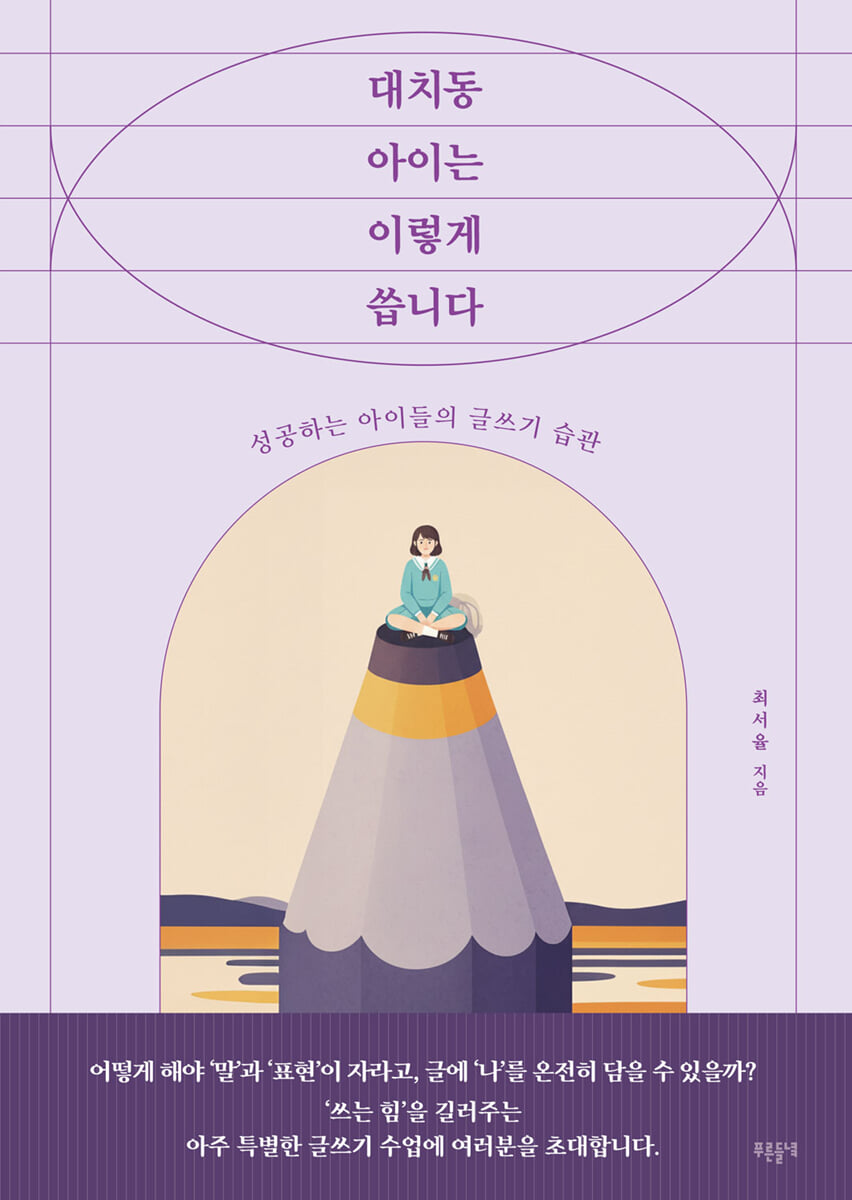
This is how a child from Daechi-dong writes
 |
Description
Book Introduction
There is no such thing as a bad piece of writing, there is only an unpolished piece of writing!!
Discover the power of "thinking skills" gleaned from the field of writing education, a "warm gaze" toward children, and training to develop the "muscles of thinking"!
"This is how children in Daechi-dong write" is a writing guide and a growth essay.
Chapters 1 and 3 are composed of 'Mother's Words', Chapters 2 and 4 are 'Child's Words', and Chapter 5 is 'Teacher's Words', and they explore the reality of 'the work called writing' from each perspective.
This five-chapter structure clearly shows how writing and text have different meanings for children, parents, and teachers.
In addition, it does not neglect practicality by suggesting training methods that can be followed right away at home, such as ‘calendar vocabulary list’, ‘writing Jenga’, and ‘copying’, while guiding the way to develop both ‘thinking skills and emotions’.
Chapter 2, "The Second Rule of Writing: Summary → Comparison → Interpretation → Opinion," and Chapter 5, "How to Develop CSAT Literacy: Free Interpretation Reading + Active Reading," will provide helpful essay writing guidelines for parents of children preparing for the CSAT.
This book stands out from other writing guides in that the author, a critic and writing teacher, has a remarkable sense of language that binds the entire book together tightly.
An analytical perspective and a warm writing style coexist, treating each child's sentence as a 'little literature'.
This is probably because the author defines writing as “a skill and an art that expresses the heart.”
Therefore, this book should be viewed not as a simple writing technique book, but as a comprehensive guide that fosters children's thinking and expressive abilities.
Chapter 3, “1970s Novels Great for Reading with Children,” and the appendix, “Book Recommendations for Improving Literacy,” also offer practical tips for both parents and teachers.
I recommend this book to parents whose children sigh, saying, "I can't write a single word," teachers struggling with how to teach writing, and everyone who wants to move beyond the age of emotion and into the age of reason.
Discover the power of "thinking skills" gleaned from the field of writing education, a "warm gaze" toward children, and training to develop the "muscles of thinking"!
"This is how children in Daechi-dong write" is a writing guide and a growth essay.
Chapters 1 and 3 are composed of 'Mother's Words', Chapters 2 and 4 are 'Child's Words', and Chapter 5 is 'Teacher's Words', and they explore the reality of 'the work called writing' from each perspective.
This five-chapter structure clearly shows how writing and text have different meanings for children, parents, and teachers.
In addition, it does not neglect practicality by suggesting training methods that can be followed right away at home, such as ‘calendar vocabulary list’, ‘writing Jenga’, and ‘copying’, while guiding the way to develop both ‘thinking skills and emotions’.
Chapter 2, "The Second Rule of Writing: Summary → Comparison → Interpretation → Opinion," and Chapter 5, "How to Develop CSAT Literacy: Free Interpretation Reading + Active Reading," will provide helpful essay writing guidelines for parents of children preparing for the CSAT.
This book stands out from other writing guides in that the author, a critic and writing teacher, has a remarkable sense of language that binds the entire book together tightly.
An analytical perspective and a warm writing style coexist, treating each child's sentence as a 'little literature'.
This is probably because the author defines writing as “a skill and an art that expresses the heart.”
Therefore, this book should be viewed not as a simple writing technique book, but as a comprehensive guide that fosters children's thinking and expressive abilities.
Chapter 3, “1970s Novels Great for Reading with Children,” and the appendix, “Book Recommendations for Improving Literacy,” also offer practical tips for both parents and teachers.
I recommend this book to parents whose children sigh, saying, "I can't write a single word," teachers struggling with how to teach writing, and everyone who wants to move beyond the age of emotion and into the age of reason.
- You can preview some of the book's contents.
Preview
index
Opening remarks
Chapter 1: Mom's Words: "Do I have to make you write?"
This is the age of storytelling / Like Scheherazade in One Thousand and One Nights / Only by becoming a narrator can one become a reader / The simplest way to reveal my child's strengths / A mother's keywords
Chapter 2: The Child's Words: "Mom, I Can't Think of Anything"
White is paper, black is writing / 〈The first rule of writing〉 Build-Up / Children who play well write well / 〈The second rule of writing〉 Summary → Comparison → Interpretation → Opinion / A magical calendar vocabulary book that saves writing material / Writing a diary with 'eyes' and 'heart' / 〈The third rule of writing〉 Trust in 'writing twice' / Keywords for children
Chapter 3 Mom's Words "Are you using it well now?"
There's no royal road to writing / Objective writing requires 'training' / To encourage writing and thinking / Daechi-dong's recommended book, 'What Should We Read?' / Mom's Keyword / 1970s novels that are great to read with children
Chapter 4: The Child's Words: "Teacher, this essay is a failure."
Just as there is no such thing as a ruined life, there is no such thing as a ruined piece of writing. / Can you write without an eraser? / Tears fell as I touched the writing. / Retreating as play. / A child's keyword.
Chapter 5: The Teacher's Words: "Therefore, Writing Continues"
Why we can't stop teaching artisans / Pick up a pencil when reading! / How to improve your literacy skills for the CSAT? Free interpretation reading + active reading / "Tracking along" is always effective / A surefire way to improve your writing skills! Maintain good posture and make your voice heard / Who is "writing" for? / Teacher's keywords
Outgoing post
Books/References Recommended by Yul T
Chapter 1: Mom's Words: "Do I have to make you write?"
This is the age of storytelling / Like Scheherazade in One Thousand and One Nights / Only by becoming a narrator can one become a reader / The simplest way to reveal my child's strengths / A mother's keywords
Chapter 2: The Child's Words: "Mom, I Can't Think of Anything"
White is paper, black is writing / 〈The first rule of writing〉 Build-Up / Children who play well write well / 〈The second rule of writing〉 Summary → Comparison → Interpretation → Opinion / A magical calendar vocabulary book that saves writing material / Writing a diary with 'eyes' and 'heart' / 〈The third rule of writing〉 Trust in 'writing twice' / Keywords for children
Chapter 3 Mom's Words "Are you using it well now?"
There's no royal road to writing / Objective writing requires 'training' / To encourage writing and thinking / Daechi-dong's recommended book, 'What Should We Read?' / Mom's Keyword / 1970s novels that are great to read with children
Chapter 4: The Child's Words: "Teacher, this essay is a failure."
Just as there is no such thing as a ruined life, there is no such thing as a ruined piece of writing. / Can you write without an eraser? / Tears fell as I touched the writing. / Retreating as play. / A child's keyword.
Chapter 5: The Teacher's Words: "Therefore, Writing Continues"
Why we can't stop teaching artisans / Pick up a pencil when reading! / How to improve your literacy skills for the CSAT? Free interpretation reading + active reading / "Tracking along" is always effective / A surefire way to improve your writing skills! Maintain good posture and make your voice heard / Who is "writing" for? / Teacher's keywords
Outgoing post
Books/References Recommended by Yul T
Into the book
Literacy is not easily destroyed once it is built, but the problem is that it takes a huge amount of time to build it.
It can be devastating to discover that your child has limited literacy skills when they graduate from middle school or enter high school.
But that doesn't mean we can give up.
There is still one more way left.
It's about becoming a speaker.
Literacy can be improved through writing.
You don't have to repeat it multiple times.
After just a couple of practices, you'll quickly understand the mind of a non-literary speaker.
Who would have a better understanding of the American atmosphere: someone who's read ten books about America or someone who's visited the country once? We already know the answer.
Experience has great power.
Likewise, children who have experienced being speakers easily become competent readers.
Anyone who has thought about how to convey their thoughts to others can naturally embody the structure of writing.
It is ingrained in my mind that if I place the topic at the beginning and end of the text, readers can easily learn the topic, and that I can refresh the text with an appropriate connecting word and then proceed with the important explanation.
Anyone who has ever been a speaker learns implicitly that other speakers write just like them.
This is why there are no children who are good at writing but are bad at reading.
There is no need to raise children as passive 'readers'.
If you raise your children to be 'speakers' who can speak on their own, 'reading skills' will follow naturally.
--- From "You must become a speaker to become a reader"
The contents of the diaries of children seen at academies are generally similar.
Most of the diaries are short descriptions of emotions, such as stories of having a delicious dinner with parents, fighting with friends, and crying at the desk because they didn't want to go to school.
There is only one thing I ask of children who write their first diary.
I will write more specifically.
And show them a newspaper article that is easy for them to read and that suits their tastes.
The article contains the results of numerous observations.
The incident is clearly organized according to the six principles (who, when, where, what, how, and why).
Expressing only 'feelings' in a diary is low-level writing.
In order for emotions to be properly conveyed to the reader, I must write everything I see with my own eyes.
(…) Let’s write a diary using the ‘eyes of an observer’ so that the six principles can be clearly revealed, and then read the diary again.
And if you project the situation in your diary onto others with your ‘heart’, ‘your own perspective’ will be revealed.
A point of view is a word that indicates 'the attitude, direction, or position of a person observing an object or phenomenon.'
The process of thinking about what to say to someone in the same situation as me develops perspective.
Practicing how to create a point of view will be of great help when writing an essay later on.
Reading the given text carefully and writing the correct answer is a perfect essay.
However, if you interpret the given text well and then add your own perspective, you can create a perfect essay.
Interpreting the given text and finding the topic is closer to the 'reading' area, so you can improve in a short period of time by reading multiple texts and practicing finding the topic.
However, finding and writing down a point of view is the realm of 'writing' and the work of the 'heart'.
Therefore, it cannot be completed in a short period of time.
--- From "Writing a Diary with 'Eyes' and 'Heart'"
The criteria for selecting any book, whether a workbook, literature, or non-literature, should always be as follows.
You should choose a book that is easier than your child's level, but not one that you already know 100% about.
You might wonder what kind of growth there is from reading easy books, but humans are forgetful creatures.
Even if it is something you have already learned or known, you will forget it as time goes by.
Even if you memorize information after learning it perfectly, at some point you will scream, “Oh! I forgot!” This is the human memory.
Choosing books that are slightly easier than your child's level will make reading less burdensome.
If the book is a workbook, it won't be difficult to solve.
Not being burdensome means you keep reaching for it.
Books are ultimately objects that must be handled by human hands.
Just because I display it at home and pile it up doesn't mean it becomes mine.
The more you touch and interact with something, the more your knowledge increases.
As you progress towards reading the book, you will inevitably encounter things you don't know.
No matter how easy a book you read, it is not easy to learn all the information contained in one book.
Sometimes, when I come across information I don't know, I look into that part more, and as I read through difficult content, my layer of indirect experience becomes stronger.
Likewise, if it is a workbook, you can get one more question correct on the test by learning something you didn't know before.
--- From "Daechi-dong Pyo's Recommended Books: 'What Should I Read?'"
Tell your friends who love erasers the story of Lee Jung-seop's gum paper paintings.
After hearing the sad story of the genius artist who had no choice but to draw on gum wrappers, children ask questions like, “Couldn’t it be possible because he was a genius?”
Of course, Lee Jung-seob is a genius painter.
Of course, he would have drawn a picture with a single stroke without any mistakes compared to other people.
But Lee Jung-seob is also human.
It is impossible to assume that there were no mistakes at all.
Without an eraser or correction tape, how did Lee Jung-seob recover from his mistakes while drawing on gum-paper? Rather than accepting his mistakes as "mistakes," he likely used the misdrawn lines as an opportunity to create new, different paintings.
(…) I often tell children not to use erasers.
If you make a mistake while solving a problem, you can write a new answer under the original answer. If you make a mistake while writing, you can start a new paragraph or write the text exactly as the mistake occurred.
Other people may see the wrong answers and the textbook may not be written neatly, so how can that be possible? This raises the question.
As with everything in life, writing in particular cannot be perfect on the first try.
Only after going through several revisions does a true piece of writing emerge.
The foundation of a manuscript is a draft.
Therefore, it is important to include as many thoughts as possible in the first draft.
Even if it seems useless or wrong, if you keep it well, it will be useful when you are revising it.
But if you erase those important pieces with an eraser, you can never get them back.
Even if it seems like a wrong answer now, in the future that wrong answer could become a 'gem'.
The saying that a first draft written as one pleases is an important key to finding the right answer is a story that is always included in the autobiographies of many famous writers.
--- From "Can I Write Without an Eraser?"
Just because you cherish a book doesn't mean its contents will stay in your head.
Keeping out-of-print books doesn't increase the value of the book to the reader who owns it.
Even if a book is so precious that it is a shame to read it, it reveals its value when it is 'polluted'.
(…) It is necessary to go through the process of writing down your impressions, interpretations, and minor questions about a book, making it a ‘source of knowledge’ and ‘your own notebook.’
If we misunderstand the idea that it's okay to write comments and questions about a book, we might end up with the wrong answer: "Does that mean I can interpret a book as I please?"
This is because writing directly in the margins creates the illusion of having a conversation with the author or making a direct comment to the author.
It is okay to interpret the contents of a book 'freely', but it is difficult to interpret it 'arbitrarily'.
Although the two may seem similar, there is a big difference in the depth of their thoughts.
‘Freedom’ is a thought based on evidence, while ‘as one pleases’ is closer to a misunderstanding that misses the context.
In order to interpret 'freely', the author's thoughts must first be well organized.
It takes time to consider what wisdom and insight the author is trying to convey, and what the central theme is.
Let's record the stories we learn during that process of thinking in a book.
The book contains the author's thoughts.
And the margins of the book should contain my thoughts.
After I fully understand the book and add my own free appreciation, the book is no longer just 'one book'.
It becomes a tool for communication and a true result of study.
It can be devastating to discover that your child has limited literacy skills when they graduate from middle school or enter high school.
But that doesn't mean we can give up.
There is still one more way left.
It's about becoming a speaker.
Literacy can be improved through writing.
You don't have to repeat it multiple times.
After just a couple of practices, you'll quickly understand the mind of a non-literary speaker.
Who would have a better understanding of the American atmosphere: someone who's read ten books about America or someone who's visited the country once? We already know the answer.
Experience has great power.
Likewise, children who have experienced being speakers easily become competent readers.
Anyone who has thought about how to convey their thoughts to others can naturally embody the structure of writing.
It is ingrained in my mind that if I place the topic at the beginning and end of the text, readers can easily learn the topic, and that I can refresh the text with an appropriate connecting word and then proceed with the important explanation.
Anyone who has ever been a speaker learns implicitly that other speakers write just like them.
This is why there are no children who are good at writing but are bad at reading.
There is no need to raise children as passive 'readers'.
If you raise your children to be 'speakers' who can speak on their own, 'reading skills' will follow naturally.
--- From "You must become a speaker to become a reader"
The contents of the diaries of children seen at academies are generally similar.
Most of the diaries are short descriptions of emotions, such as stories of having a delicious dinner with parents, fighting with friends, and crying at the desk because they didn't want to go to school.
There is only one thing I ask of children who write their first diary.
I will write more specifically.
And show them a newspaper article that is easy for them to read and that suits their tastes.
The article contains the results of numerous observations.
The incident is clearly organized according to the six principles (who, when, where, what, how, and why).
Expressing only 'feelings' in a diary is low-level writing.
In order for emotions to be properly conveyed to the reader, I must write everything I see with my own eyes.
(…) Let’s write a diary using the ‘eyes of an observer’ so that the six principles can be clearly revealed, and then read the diary again.
And if you project the situation in your diary onto others with your ‘heart’, ‘your own perspective’ will be revealed.
A point of view is a word that indicates 'the attitude, direction, or position of a person observing an object or phenomenon.'
The process of thinking about what to say to someone in the same situation as me develops perspective.
Practicing how to create a point of view will be of great help when writing an essay later on.
Reading the given text carefully and writing the correct answer is a perfect essay.
However, if you interpret the given text well and then add your own perspective, you can create a perfect essay.
Interpreting the given text and finding the topic is closer to the 'reading' area, so you can improve in a short period of time by reading multiple texts and practicing finding the topic.
However, finding and writing down a point of view is the realm of 'writing' and the work of the 'heart'.
Therefore, it cannot be completed in a short period of time.
--- From "Writing a Diary with 'Eyes' and 'Heart'"
The criteria for selecting any book, whether a workbook, literature, or non-literature, should always be as follows.
You should choose a book that is easier than your child's level, but not one that you already know 100% about.
You might wonder what kind of growth there is from reading easy books, but humans are forgetful creatures.
Even if it is something you have already learned or known, you will forget it as time goes by.
Even if you memorize information after learning it perfectly, at some point you will scream, “Oh! I forgot!” This is the human memory.
Choosing books that are slightly easier than your child's level will make reading less burdensome.
If the book is a workbook, it won't be difficult to solve.
Not being burdensome means you keep reaching for it.
Books are ultimately objects that must be handled by human hands.
Just because I display it at home and pile it up doesn't mean it becomes mine.
The more you touch and interact with something, the more your knowledge increases.
As you progress towards reading the book, you will inevitably encounter things you don't know.
No matter how easy a book you read, it is not easy to learn all the information contained in one book.
Sometimes, when I come across information I don't know, I look into that part more, and as I read through difficult content, my layer of indirect experience becomes stronger.
Likewise, if it is a workbook, you can get one more question correct on the test by learning something you didn't know before.
--- From "Daechi-dong Pyo's Recommended Books: 'What Should I Read?'"
Tell your friends who love erasers the story of Lee Jung-seop's gum paper paintings.
After hearing the sad story of the genius artist who had no choice but to draw on gum wrappers, children ask questions like, “Couldn’t it be possible because he was a genius?”
Of course, Lee Jung-seob is a genius painter.
Of course, he would have drawn a picture with a single stroke without any mistakes compared to other people.
But Lee Jung-seob is also human.
It is impossible to assume that there were no mistakes at all.
Without an eraser or correction tape, how did Lee Jung-seob recover from his mistakes while drawing on gum-paper? Rather than accepting his mistakes as "mistakes," he likely used the misdrawn lines as an opportunity to create new, different paintings.
(…) I often tell children not to use erasers.
If you make a mistake while solving a problem, you can write a new answer under the original answer. If you make a mistake while writing, you can start a new paragraph or write the text exactly as the mistake occurred.
Other people may see the wrong answers and the textbook may not be written neatly, so how can that be possible? This raises the question.
As with everything in life, writing in particular cannot be perfect on the first try.
Only after going through several revisions does a true piece of writing emerge.
The foundation of a manuscript is a draft.
Therefore, it is important to include as many thoughts as possible in the first draft.
Even if it seems useless or wrong, if you keep it well, it will be useful when you are revising it.
But if you erase those important pieces with an eraser, you can never get them back.
Even if it seems like a wrong answer now, in the future that wrong answer could become a 'gem'.
The saying that a first draft written as one pleases is an important key to finding the right answer is a story that is always included in the autobiographies of many famous writers.
--- From "Can I Write Without an Eraser?"
Just because you cherish a book doesn't mean its contents will stay in your head.
Keeping out-of-print books doesn't increase the value of the book to the reader who owns it.
Even if a book is so precious that it is a shame to read it, it reveals its value when it is 'polluted'.
(…) It is necessary to go through the process of writing down your impressions, interpretations, and minor questions about a book, making it a ‘source of knowledge’ and ‘your own notebook.’
If we misunderstand the idea that it's okay to write comments and questions about a book, we might end up with the wrong answer: "Does that mean I can interpret a book as I please?"
This is because writing directly in the margins creates the illusion of having a conversation with the author or making a direct comment to the author.
It is okay to interpret the contents of a book 'freely', but it is difficult to interpret it 'arbitrarily'.
Although the two may seem similar, there is a big difference in the depth of their thoughts.
‘Freedom’ is a thought based on evidence, while ‘as one pleases’ is closer to a misunderstanding that misses the context.
In order to interpret 'freely', the author's thoughts must first be well organized.
It takes time to consider what wisdom and insight the author is trying to convey, and what the central theme is.
Let's record the stories we learn during that process of thinking in a book.
The book contains the author's thoughts.
And the margins of the book should contain my thoughts.
After I fully understand the book and add my own free appreciation, the book is no longer just 'one book'.
It becomes a tool for communication and a true result of study.
--- From "When reading a book, hold a pencil!"
Publisher's Review
I know a lot and have read a lot of books, so why can't I write well?
“My child reads difficult texts well and has strong opinions, but he stops when he picks up a pencil.” “This is how children in Daechi-dong write” is a heartwarming answer to the concerns of many parents who sympathize with this.
“We live in an age where writing is the very act of thinking,” says the author, a critic and educator who has spent years writing with children.
This is because almost every aspect of social life, including self-introductions, performance evaluations, and essays, requires the ability to tell a good story.
However, many children become frustrated when faced with a blank sheet of paper and say, “I can’t think of anything.”
Why is that? He emphasizes, "Writing ability is not innate; it's a skill that can be trained."
This means that it is not an ability that can be developed overnight.
He said, “There is no child who cannot write.
“There are only children who lack the experience of organizing their thoughts in writing,” he says.
Good writing comes from good thoughts, and good thoughts come from 'experiences training the order of thinking', but these days, children lack training in thinking, including training in getting the thoughts out of their heads and organizing them.
Consistency in training is more important than perfect talent.
The core of writing education that the author particularly emphasizes is the habit of ‘revising.’
Many children think that once they write something, that's it.
But he asserts that 'the real beginning of writing is in the process of reflection.'
Reflection is the 'training to read one's own thoughts one more time.'
As they edit their writing, children reexamine their logic and reflect on their emotional balance.
In other words, revision is not simply a process of refining sentences, but rather 'training to refine my thoughts.'
The book contains specific training methods.
Some suggestions include helping children express what they really want to say instead of just letting them write; showing children who hesitate because they think their parents will dislike what they write how valuable it is for them to write honestly and express their feelings; using various media that pique their interest to guide them through the process of refining their writing little by little; praising the “courage to revise” rather than the perfect writing; and reading and comparing the revised writing.
This approach teaches children the "joy of the process" rather than the "failure of writing."
It is important to instill the perspective that even a single sentence is not a "ruined piece of writing" but a raw material of thought that can be refined. In this sense, writing education should be "a technique of recovery, not a technique of evaluation."
A training book for mothers, children, and teachers to grow together.
The structural strengths of 『This is how children in Daechi-dong write』 are clear.
Each chapter is written from the perspectives of a ‘mother,’ a ‘child,’ and a ‘teacher,’ and at the end, ‘keywords for mothers,’ ‘keywords for children,’ and ‘keywords for teachers’ are provided.
This triple structure expands writing from ‘personal training’ to ‘relationship training.’
For example, it is advised that parents should ask their children, "Why did you write that?" rather than reading their children's writing and telling them to correct it.
For children who are the ones writing the essay, we introduce the 'practical method of creating their own topic sentences and expressing their emotions logically.'
Additionally, teachers are encouraged to use ‘feedback language that allows students to express themselves individually.’
This structure transforms a 'writing class' into a 'class on understanding people.'
In particular, the '3-step writing rule' introduced in Chapter 2 is a very practical tip.
In “Build-Up,” which builds writing in the order of “thought → word → sentence,” it is advised to do sufficient “thinking warm-up exercises” rather than just writing.
Additionally, he suggests correcting the structure of the essay through the process of 'summary → comparison → interpretation → opinion', and points out the importance of polishing the writing through the process of writing 'first with the eyes, second with the heart'.
In this way, the child's daily life and emotions, parental conversations, and teacher feedback are intertwined to complete the cycle of 'thinking-writing-refinement-sharing'. This book is clearly distinguished from existing writing books in that it goes beyond simply cultivating 'writing for school assignments' skills and functions as 'lifelong thinking training'.
"There is no such thing as a failed book!" An educational philosophy that inspires children.
Author Choi Seo-yul says this:
“Just as there is no such thing as a ruined life, there is no such thing as a ruined piece of writing.” When children bow their heads and say, “This piece of writing is ruined,” he doesn’t hand them an eraser.
Instead, I suggest 'writing without an eraser'.
He says that writings containing honest thoughts can be criticized but not condemned, and tells the story of how painter Lee Jung-seop drew on gum wrappers.
This is to emphasize the courage to try something without fear of making mistakes, and then change and move forward from there.
His philosophy that erased manuscripts later become treasures comes as a warm comfort to children and parents who are tired of entrance exam-oriented education.
This philosophy goes beyond writing education and is also connected to the issue of ‘attitude toward children.’
Instead of correcting a child's sentences, we need to trust the child's thoughts. Only when that trust is built up does writing become a language of growth beyond a skill.
He also emphasizes that there is no 'Daechi-dongpyo Reading List' in this book.
Don't be fooled by advertisements like "100 books recommended by ○○ University" and "choose books that are easier than your child's level, but not ones that you already know 100 percent" (along with the suggestion to always carry a pencil when reading).
"This is How Children in Daechi-dong Write" is a rare book that balances the minds and attitudes of both learners and students with vivid examples gleaned from the field of writing education.
“My child reads difficult texts well and has strong opinions, but he stops when he picks up a pencil.” “This is how children in Daechi-dong write” is a heartwarming answer to the concerns of many parents who sympathize with this.
“We live in an age where writing is the very act of thinking,” says the author, a critic and educator who has spent years writing with children.
This is because almost every aspect of social life, including self-introductions, performance evaluations, and essays, requires the ability to tell a good story.
However, many children become frustrated when faced with a blank sheet of paper and say, “I can’t think of anything.”
Why is that? He emphasizes, "Writing ability is not innate; it's a skill that can be trained."
This means that it is not an ability that can be developed overnight.
He said, “There is no child who cannot write.
“There are only children who lack the experience of organizing their thoughts in writing,” he says.
Good writing comes from good thoughts, and good thoughts come from 'experiences training the order of thinking', but these days, children lack training in thinking, including training in getting the thoughts out of their heads and organizing them.
Consistency in training is more important than perfect talent.
The core of writing education that the author particularly emphasizes is the habit of ‘revising.’
Many children think that once they write something, that's it.
But he asserts that 'the real beginning of writing is in the process of reflection.'
Reflection is the 'training to read one's own thoughts one more time.'
As they edit their writing, children reexamine their logic and reflect on their emotional balance.
In other words, revision is not simply a process of refining sentences, but rather 'training to refine my thoughts.'
The book contains specific training methods.
Some suggestions include helping children express what they really want to say instead of just letting them write; showing children who hesitate because they think their parents will dislike what they write how valuable it is for them to write honestly and express their feelings; using various media that pique their interest to guide them through the process of refining their writing little by little; praising the “courage to revise” rather than the perfect writing; and reading and comparing the revised writing.
This approach teaches children the "joy of the process" rather than the "failure of writing."
It is important to instill the perspective that even a single sentence is not a "ruined piece of writing" but a raw material of thought that can be refined. In this sense, writing education should be "a technique of recovery, not a technique of evaluation."
A training book for mothers, children, and teachers to grow together.
The structural strengths of 『This is how children in Daechi-dong write』 are clear.
Each chapter is written from the perspectives of a ‘mother,’ a ‘child,’ and a ‘teacher,’ and at the end, ‘keywords for mothers,’ ‘keywords for children,’ and ‘keywords for teachers’ are provided.
This triple structure expands writing from ‘personal training’ to ‘relationship training.’
For example, it is advised that parents should ask their children, "Why did you write that?" rather than reading their children's writing and telling them to correct it.
For children who are the ones writing the essay, we introduce the 'practical method of creating their own topic sentences and expressing their emotions logically.'
Additionally, teachers are encouraged to use ‘feedback language that allows students to express themselves individually.’
This structure transforms a 'writing class' into a 'class on understanding people.'
In particular, the '3-step writing rule' introduced in Chapter 2 is a very practical tip.
In “Build-Up,” which builds writing in the order of “thought → word → sentence,” it is advised to do sufficient “thinking warm-up exercises” rather than just writing.
Additionally, he suggests correcting the structure of the essay through the process of 'summary → comparison → interpretation → opinion', and points out the importance of polishing the writing through the process of writing 'first with the eyes, second with the heart'.
In this way, the child's daily life and emotions, parental conversations, and teacher feedback are intertwined to complete the cycle of 'thinking-writing-refinement-sharing'. This book is clearly distinguished from existing writing books in that it goes beyond simply cultivating 'writing for school assignments' skills and functions as 'lifelong thinking training'.
"There is no such thing as a failed book!" An educational philosophy that inspires children.
Author Choi Seo-yul says this:
“Just as there is no such thing as a ruined life, there is no such thing as a ruined piece of writing.” When children bow their heads and say, “This piece of writing is ruined,” he doesn’t hand them an eraser.
Instead, I suggest 'writing without an eraser'.
He says that writings containing honest thoughts can be criticized but not condemned, and tells the story of how painter Lee Jung-seop drew on gum wrappers.
This is to emphasize the courage to try something without fear of making mistakes, and then change and move forward from there.
His philosophy that erased manuscripts later become treasures comes as a warm comfort to children and parents who are tired of entrance exam-oriented education.
This philosophy goes beyond writing education and is also connected to the issue of ‘attitude toward children.’
Instead of correcting a child's sentences, we need to trust the child's thoughts. Only when that trust is built up does writing become a language of growth beyond a skill.
He also emphasizes that there is no 'Daechi-dongpyo Reading List' in this book.
Don't be fooled by advertisements like "100 books recommended by ○○ University" and "choose books that are easier than your child's level, but not ones that you already know 100 percent" (along with the suggestion to always carry a pencil when reading).
"This is How Children in Daechi-dong Write" is a rare book that balances the minds and attitudes of both learners and students with vivid examples gleaned from the field of writing education.
GOODS SPECIFICS
- Date of issue: November 14, 2025
- Page count, weight, size: 244 pages | 148*210*20mm
- ISBN13: 9791159259708
- ISBN10: 1159259704
You may also like
카테고리
korean


korean

![ELLE 엘르 스페셜 에디션 A형 : 12월 [2025]](http://librairie.coreenne.fr/cdn/shop/files/b8e27a3de6c9538896439686c6b0e8fb.jpg?v=1766436872&width=3840)


