

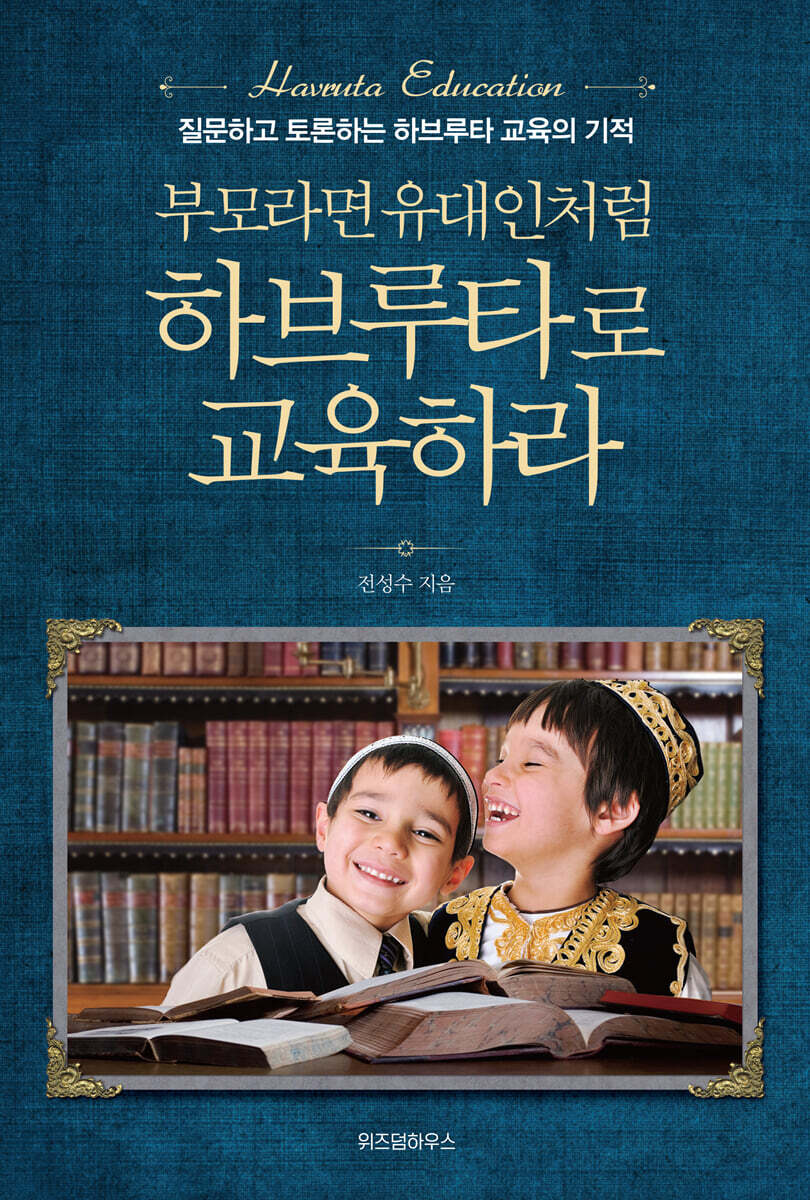
If you are a parent, educate your children in havruta like a Jew.
 |
Description
Book Introduction
The remarkable achievements of Jews, who have achieved international fame and wealth and have risen to prominence in all walks of life, are well-known and well-known.
Jews scattered around the world occupy top positions in almost every field, including politics, law, economics, finance, media, art, and academia, to the point that it is widely agreed that Jews run the world.
Most people believe that this is because Jews are born with superior intelligence compared to other ethnic groups.
However, Professor Jeon Seong-su, author of “Parents, Educate Your Children with Havruta Like Jews,” says that this is nothing more than a naive misunderstanding.
If not, why did Jews, representing only 0.25% of the world's population and ranking 45th in intelligence, achieve such a feat? Why, despite Korean children's intense parental zeal for education and their world-class intelligence, who commute between school, academies, and home to study harder than anyone else, do their results pale in comparison to those of Jews?
The author says that the stark difference between Koreans and Jews stems from 'Havruta', which forms the foundation of Jewish education.
Havruta is a traditional Jewish educational method that involves 'conversation, discussion, and debate in pairs.'
While we leave our children's education to schools and academies, consistently adopting the 'correct answer-based education where teachers stand and explain and students sit and listen' from elementary school to high school and even university, Jews have been educating their children with 'chavruta centered on questions, conversations, and discussions' regardless of place and time, starting from home, and even at school and even in the synagogue.
This book faithfully describes how Havruta permeates Jewish children's education and daily life like air, what Jews have gained and achieved through Havruta, and how we can incorporate Havruta into our children's education and put it into practice.
You will also be able to witness the magical Havruta effect fill in the skills our children lacked, such as thinking, logical thinking, critical thinking, judgment, problem-solving, creativity, imagination, vocabulary, expressive skills, communication, persuasion, and interpersonal skills.
Jews scattered around the world occupy top positions in almost every field, including politics, law, economics, finance, media, art, and academia, to the point that it is widely agreed that Jews run the world.
Most people believe that this is because Jews are born with superior intelligence compared to other ethnic groups.
However, Professor Jeon Seong-su, author of “Parents, Educate Your Children with Havruta Like Jews,” says that this is nothing more than a naive misunderstanding.
If not, why did Jews, representing only 0.25% of the world's population and ranking 45th in intelligence, achieve such a feat? Why, despite Korean children's intense parental zeal for education and their world-class intelligence, who commute between school, academies, and home to study harder than anyone else, do their results pale in comparison to those of Jews?
The author says that the stark difference between Koreans and Jews stems from 'Havruta', which forms the foundation of Jewish education.
Havruta is a traditional Jewish educational method that involves 'conversation, discussion, and debate in pairs.'
While we leave our children's education to schools and academies, consistently adopting the 'correct answer-based education where teachers stand and explain and students sit and listen' from elementary school to high school and even university, Jews have been educating their children with 'chavruta centered on questions, conversations, and discussions' regardless of place and time, starting from home, and even at school and even in the synagogue.
This book faithfully describes how Havruta permeates Jewish children's education and daily life like air, what Jews have gained and achieved through Havruta, and how we can incorporate Havruta into our children's education and put it into practice.
You will also be able to witness the magical Havruta effect fill in the skills our children lacked, such as thinking, logical thinking, critical thinking, judgment, problem-solving, creativity, imagination, vocabulary, expressive skills, communication, persuasion, and interpersonal skills.
- You can preview some of the book's contents.
Preview
index
Prologue: What Makes Jews Special
1.
Jews are made through Havruta education.
The Miracle of Conversation: Havruta Education
Talk, discuss, and argue with your child like a Jew.
Why are the first and last chapters of the Talmud blank?
Children who ask good questions become class leaders.
Jewish parents don't teach you the right answers.
Seek the best answer, not just one right answer.
Jewish Education: Transforming Ordinary Children into World-Class Talents
0.25% of the world, 30% of Nobel Prize winners
Are Jews smart?
The Best Way to Develop Your Brain: Havruta
Stimulate your brain with Havruta
Develop both your right and left brain equally with Havruta.
There are Jews at every summit in the world.
Leading the film industry with creativity and imagination
Masters of controversy sweeping the legal and media worlds
Dominating the political and academic worlds with his unique communication skills
Experts in persuasion and relationships sweep the business and financial worlds.
0 centimeters between parents and children in family Havruta
Why is the attachment to Jewish families so strong?
Success and happiness at the same time
A child's first toy, a piggy bank
The Seed of Noblesse Oblige, the Spirit of Tzedaka
The thinking child has everything.
Build wisdom and use knowledge
Those who question with doubt gain the power of thought.
Be respectful, but ask critical questions.
Where does the ability to think differently come from?
The starting point of creative personality
2.
A child who thinks for himself, a child who is not afraid to speak.
Havruta makes books come alive
Connect books and the world
Develop your child's reading skills by encouraging their curiosity with parental questions.
Havruta begins with "reading a living book."
Bedtime Stories: A Magical Time for Self-Growing
Character education begins at the dinner table.
A heavenly table that leads to family happiness and success
The Jewish Secret: Turn Your Table into a Table of Conversation and Discussion
Studying like play
Don't separate study and play.
Jewish parents communicate through riddles and humorous games.
De-stress with endless chatter
It's only when you're noisy that you can really study.
A Jewish classroom noisier than a market street
Be sure to pair up
1+1=∞, pairing them maximizes study effectiveness.
Jewish students have no textbooks to memorize.
Make lifelong friends through Havruta
Think differently and anew with Havruta
There is no right answer.
Think like Sherlock Holmes!
The Talmudic debate sharpens each other's thinking.
Talk freely, but be formal.
Don't look for answers that block your thinking; ask questions.
Create questions from everyday life
3.
Education that dreams of children's happy studies
Put your family's happiness ahead of your child's success.
Korean children who miss their fathers
Strengthen family bonds
Focus on your child for 10 minutes a day.
From ‘listening education’ to ‘asking education’
The Questioning Child vs.
listening and memorizing machine
A made honor student
From 'period question' to 'question mark question'
Build solid skills rather than high grades
Tear up your report card
Raise your child to be the master of the answer, not the slave of the answer.
Early learning is a vicarious satisfaction for mothers.
Why do our children end up in child psychiatric clinics?
What to do? vs.
What should I not do?
What does a child's brain want?
Find out what your child 'truly wants'
A parent's stalkerish love turns their child into a puppet.
Top grades, bottom class
Praise can be poisonous too.
Absolute confidence comes from a strong identity.
Identity education that creates a global Jewish network
Parents' pride and pride shake their children.
Epilogue_ The long way to go, the shortcut back
1.
Jews are made through Havruta education.
The Miracle of Conversation: Havruta Education
Talk, discuss, and argue with your child like a Jew.
Why are the first and last chapters of the Talmud blank?
Children who ask good questions become class leaders.
Jewish parents don't teach you the right answers.
Seek the best answer, not just one right answer.
Jewish Education: Transforming Ordinary Children into World-Class Talents
0.25% of the world, 30% of Nobel Prize winners
Are Jews smart?
The Best Way to Develop Your Brain: Havruta
Stimulate your brain with Havruta
Develop both your right and left brain equally with Havruta.
There are Jews at every summit in the world.
Leading the film industry with creativity and imagination
Masters of controversy sweeping the legal and media worlds
Dominating the political and academic worlds with his unique communication skills
Experts in persuasion and relationships sweep the business and financial worlds.
0 centimeters between parents and children in family Havruta
Why is the attachment to Jewish families so strong?
Success and happiness at the same time
A child's first toy, a piggy bank
The Seed of Noblesse Oblige, the Spirit of Tzedaka
The thinking child has everything.
Build wisdom and use knowledge
Those who question with doubt gain the power of thought.
Be respectful, but ask critical questions.
Where does the ability to think differently come from?
The starting point of creative personality
2.
A child who thinks for himself, a child who is not afraid to speak.
Havruta makes books come alive
Connect books and the world
Develop your child's reading skills by encouraging their curiosity with parental questions.
Havruta begins with "reading a living book."
Bedtime Stories: A Magical Time for Self-Growing
Character education begins at the dinner table.
A heavenly table that leads to family happiness and success
The Jewish Secret: Turn Your Table into a Table of Conversation and Discussion
Studying like play
Don't separate study and play.
Jewish parents communicate through riddles and humorous games.
De-stress with endless chatter
It's only when you're noisy that you can really study.
A Jewish classroom noisier than a market street
Be sure to pair up
1+1=∞, pairing them maximizes study effectiveness.
Jewish students have no textbooks to memorize.
Make lifelong friends through Havruta
Think differently and anew with Havruta
There is no right answer.
Think like Sherlock Holmes!
The Talmudic debate sharpens each other's thinking.
Talk freely, but be formal.
Don't look for answers that block your thinking; ask questions.
Create questions from everyday life
3.
Education that dreams of children's happy studies
Put your family's happiness ahead of your child's success.
Korean children who miss their fathers
Strengthen family bonds
Focus on your child for 10 minutes a day.
From ‘listening education’ to ‘asking education’
The Questioning Child vs.
listening and memorizing machine
A made honor student
From 'period question' to 'question mark question'
Build solid skills rather than high grades
Tear up your report card
Raise your child to be the master of the answer, not the slave of the answer.
Early learning is a vicarious satisfaction for mothers.
Why do our children end up in child psychiatric clinics?
What to do? vs.
What should I not do?
What does a child's brain want?
Find out what your child 'truly wants'
A parent's stalkerish love turns their child into a puppet.
Top grades, bottom class
Praise can be poisonous too.
Absolute confidence comes from a strong identity.
Identity education that creates a global Jewish network
Parents' pride and pride shake their children.
Epilogue_ The long way to go, the shortcut back
Into the book
Jewish parents, who emphasize that 'questions' are the most important virtue in raising children, always ask questions to their children.
A child who is asked questions by his parents constantly thinks to find the answer and develops his thinking ability and wisdom naturally as he thinks about logical solutions to respond to his parents' opinions.
In this debate, there is no winning or losing.
There is no right or wrong.
Because I'm not looking for the right answer.
Children who are not accustomed to expressing their own thoughts or are not good at expressing their opinions in front of others often have difficulty speaking logically as adults.
But the Jewish child is not like that.
They are not afraid to express their opinions because they have been taught Talmud since childhood and have been respected for expressing their thoughts through natural conversations with their parents in their daily lives.
―1.
Jews are made through Havruta education/The miracle of conversation, Havruta education_ pp. 23-24
Havruta allows for diverse views, diverse perspectives, and diverse perspectives.
Discussion and debate require us to question even objectively accepted facts.
It makes you rethink even things you take for granted.
Because I have to have my own opinion that is different from that of others.
Because discussions and debates cannot be established with the same opinion, and common sense cannot win.
So, Havruta values one's own thoughts, new thoughts, and thoughts that are different from others, and the ability to think differently and in a new way is creativity.
Havruta essentially demands different thinking, new thinking.
The Talmud is a book that compiles the discussions and debates of rabbis and sages, and Havruta is a way to question the views of such great scholars and gain a different perspective.
―1.
Jews are made through Havruta education/Jewish child education that turns ordinary children into the world's best talents_ pp. 41-42
Children are inherently curious beings.
Whenever I get a chance, I pay attention to everything around me and struggle to know more.
First there is curiosity, and then there is knowledge.
The process of learning something you don't know is itself a fun game.
But today's education has reversed the order, forcing knowledge 'first' and then curiosity 'next.'
Children are bound to be bored and miserable.
The separation of study and play and the reversal of the order of curiosity and knowledge stem from the impatience of parents and society.
Today's parents want their children to learn more and faster.
Parents themselves are so caught up in competition that they end up forcing it on their children.
As a result, we hastily pour knowledge into children without waiting for them to develop their own strong curiosity and pure motivation.
It is a mistake to pour water into a bowl that is not ready.
―2.
A child who thinks for himself, a child who is not afraid to speak/Studying like play_ 122p
Questions, rebuttals, and proofs are in fact the flowers of Havruta.
The more sharp questions and sharp rebuttals that dig into the weaknesses in the opponent's logic during the discussion and debate, and the more valid proofs that reinforce one's own logic, the more excellent the havruta becomes.
In this way, you will learn how to interpret any text from various angles, and you will be able to think beyond your own views.
Through this process, students expand and establish their thinking, sometimes supporting each other and sometimes challenging each other.
It is based on this tradition that Jews listen carefully to others and strongly express their own opinions whenever they differ from others.
―2.
A child who thinks for himself, a child who is not afraid to speak up/Think differently and anew with Havruta_ 172p
According to the 'World Values Survey', Koreans' happiness index falls below the OECD average and even the world average.
It is lower than Bangladesh or Mexico.
The reason is that they do not prioritize their families.
They sacrifice their families for success, give up time with their children, and not only do they not communicate with each other, it becomes awkward.
Koreans often choose to break promises to their children when their boss asks them to have a company dinner.
For a Jew, this is unimaginable.
For them, Friday afternoon through Saturday is a time they cannot give up to anyone other than their family.
Even on weekday evenings, I try to spend time with my children by eating at home whenever possible.
For Jews, success is always synonymous with happiness, the ultimate value centered around family.
We think, 'If you are successful, your family will be happy,' but Jews believe, 'If your family is happy, you will be successful.'
―3.
Education that dreams of a child's happy study/Prioritize the family's happiness over the child's success_ 192p
“Did you listen to the teacher well today?” This is the question most often asked by Korean parents to their children when they come home from school.
For us, studying means listening carefully to the teacher's explanation, writing it down, and memorizing it well.
But Jewish parents ask differently.
“What questions did you ask at school today?” Korean parents often tell their children to “quiet down and listen to the teacher” when sending them to school or academy, but Jewish parents say, “Talk a lot and ask a lot of questions.”
They don't think that good children who sit quietly and listen well grow up to be great adults.
They want their children to ask more questions and speak their minds freely.
So, we make every effort to ensure that children develop the habit of thinking and asking questions for themselves from an early age.
―3.
Education that Dreams of Children's Happy Studying / From 'Listening Education' to 'Asking Education'_ 200-201p
A child who is asked questions by his parents constantly thinks to find the answer and develops his thinking ability and wisdom naturally as he thinks about logical solutions to respond to his parents' opinions.
In this debate, there is no winning or losing.
There is no right or wrong.
Because I'm not looking for the right answer.
Children who are not accustomed to expressing their own thoughts or are not good at expressing their opinions in front of others often have difficulty speaking logically as adults.
But the Jewish child is not like that.
They are not afraid to express their opinions because they have been taught Talmud since childhood and have been respected for expressing their thoughts through natural conversations with their parents in their daily lives.
―1.
Jews are made through Havruta education/The miracle of conversation, Havruta education_ pp. 23-24
Havruta allows for diverse views, diverse perspectives, and diverse perspectives.
Discussion and debate require us to question even objectively accepted facts.
It makes you rethink even things you take for granted.
Because I have to have my own opinion that is different from that of others.
Because discussions and debates cannot be established with the same opinion, and common sense cannot win.
So, Havruta values one's own thoughts, new thoughts, and thoughts that are different from others, and the ability to think differently and in a new way is creativity.
Havruta essentially demands different thinking, new thinking.
The Talmud is a book that compiles the discussions and debates of rabbis and sages, and Havruta is a way to question the views of such great scholars and gain a different perspective.
―1.
Jews are made through Havruta education/Jewish child education that turns ordinary children into the world's best talents_ pp. 41-42
Children are inherently curious beings.
Whenever I get a chance, I pay attention to everything around me and struggle to know more.
First there is curiosity, and then there is knowledge.
The process of learning something you don't know is itself a fun game.
But today's education has reversed the order, forcing knowledge 'first' and then curiosity 'next.'
Children are bound to be bored and miserable.
The separation of study and play and the reversal of the order of curiosity and knowledge stem from the impatience of parents and society.
Today's parents want their children to learn more and faster.
Parents themselves are so caught up in competition that they end up forcing it on their children.
As a result, we hastily pour knowledge into children without waiting for them to develop their own strong curiosity and pure motivation.
It is a mistake to pour water into a bowl that is not ready.
―2.
A child who thinks for himself, a child who is not afraid to speak/Studying like play_ 122p
Questions, rebuttals, and proofs are in fact the flowers of Havruta.
The more sharp questions and sharp rebuttals that dig into the weaknesses in the opponent's logic during the discussion and debate, and the more valid proofs that reinforce one's own logic, the more excellent the havruta becomes.
In this way, you will learn how to interpret any text from various angles, and you will be able to think beyond your own views.
Through this process, students expand and establish their thinking, sometimes supporting each other and sometimes challenging each other.
It is based on this tradition that Jews listen carefully to others and strongly express their own opinions whenever they differ from others.
―2.
A child who thinks for himself, a child who is not afraid to speak up/Think differently and anew with Havruta_ 172p
According to the 'World Values Survey', Koreans' happiness index falls below the OECD average and even the world average.
It is lower than Bangladesh or Mexico.
The reason is that they do not prioritize their families.
They sacrifice their families for success, give up time with their children, and not only do they not communicate with each other, it becomes awkward.
Koreans often choose to break promises to their children when their boss asks them to have a company dinner.
For a Jew, this is unimaginable.
For them, Friday afternoon through Saturday is a time they cannot give up to anyone other than their family.
Even on weekday evenings, I try to spend time with my children by eating at home whenever possible.
For Jews, success is always synonymous with happiness, the ultimate value centered around family.
We think, 'If you are successful, your family will be happy,' but Jews believe, 'If your family is happy, you will be successful.'
―3.
Education that dreams of a child's happy study/Prioritize the family's happiness over the child's success_ 192p
“Did you listen to the teacher well today?” This is the question most often asked by Korean parents to their children when they come home from school.
For us, studying means listening carefully to the teacher's explanation, writing it down, and memorizing it well.
But Jewish parents ask differently.
“What questions did you ask at school today?” Korean parents often tell their children to “quiet down and listen to the teacher” when sending them to school or academy, but Jewish parents say, “Talk a lot and ask a lot of questions.”
They don't think that good children who sit quietly and listen well grow up to be great adults.
They want their children to ask more questions and speak their minds freely.
So, we make every effort to ensure that children develop the habit of thinking and asking questions for themselves from an early age.
―3.
Education that Dreams of Children's Happy Studying / From 'Listening Education' to 'Asking Education'_ 200-201p
--- From the text
Publisher's Review
0.25% of the world's population, 45th in the world in intelligence, 30% of Nobel Prize winners, 30% of Harvard graduates
What made the Jews strong and special?
The Great Miracle of Havruta Education, Which Permeated the Jewish People Like Air
The remarkable achievements of Jews, who have achieved international fame and wealth and have risen to prominence in all walks of life, are well-known and well-known.
Jews scattered around the world occupy top positions in almost every field, including politics, law, economics, finance, media, art, and academia, to the point that it is widely agreed that Jews run the world.
Most people believe that this is because Jews are born with superior intelligence compared to other ethnic groups.
However, Professor Jeon Seong-su, author of “Parents, Educate Your Children with Havruta Like Jews,” says that this is nothing more than a naive misunderstanding.
If not, why did Jews, representing only 0.25% of the world's population and ranking 45th in intelligence, achieve such a feat? Why, despite Korean children's intense parental zeal for education and their world-class intelligence, who commute between school, academies, and home to study harder than anyone else, do their results pale in comparison to those of Jews?
The author says that the stark difference between Koreans and Jews stems from 'Havruta', which forms the foundation of Jewish education.
Havruta is a traditional Jewish educational method that involves 'conversation, discussion, and debate in pairs.'
While we leave our children's education to schools and academies, consistently adopting the 'correct answer-based education where teachers stand and explain and students sit and listen' from elementary school to high school and even university, Jews have been educating their children with 'chavruta centered on questions, conversations, and discussions' regardless of place and time, starting from home, and even at school and even in the synagogue.
This book faithfully describes how Havruta permeates Jewish children's education and daily life like air, what Jews have gained and achieved through Havruta, and how we can incorporate Havruta into our children's education and put it into practice.
You will also be able to witness the magical Havruta effect fill in the skills our children lacked, such as thinking, logical thinking, critical thinking, judgment, problem-solving, creativity, imagination, vocabulary, expressive skills, communication, persuasion, and interpersonal skills.
In Jewish schools, the child who asks good questions becomes the class leader!
Havruta, pair up to talk, discuss, and debate.
Havruta means, in a narrow sense, 'discussing and arguing in pairs by exchanging questions and answers', and in a broader sense, 'talking together'.
It refers to all of these things, such as a mother reading a book to her fetus and talking to it, a parent and child talking at the dinner table, or a question-and-answer exchange between a teacher and students or classmates at school.
Jews routinely practice havruta with anyone they can talk to: parents and children, teachers and students, friends, colleagues, strangers.
Whether it's with parents, teachers, bosses, or strangers, Jews are able to ask sharp questions and logically express their opinions about things that differ from their own, without being intimidated by age or status, because they have consistently practiced Havruta education at home, school, and synagogue.
The beginning of Havruta education is ‘questioning.’
Because dialogue, discussion, and debate are possible only when there are questions that raise questions first.
Also, since the questions are about things that are not well understood or that are different from one's own thoughts, it can be assumed that the child's level is just up to that level.
That's why Jewish parents consider questioning to be the most important virtue in raising their children.
Unlike us who check with our children when they come home from school, “Did you listen to the teacher?”, we can tell just by looking at them wondering, “What question did you ask the teacher?”
Unlike in our country, where the top students are ranked by the number of correct answers, in Jewish schools, children who ask good questions are recognized as class leaders.
So while our children memorize textbooks to get a perfect score on a quiz, Jewish children delve deeper into the questions given to them, thinking about them in order to find new, sharper, and more challenging questions than their friends.
What Havruta education, which places such importance on questions, aims for is precisely the ‘power of thought.’
Children who have to ask creative questions, as well as those who have to answer those questions logically, have to think hard for themselves, so their critical thinking skills are naturally developed.
This is why Jewish parents constantly ponder, "What questions will spark their child's curiosity and compel them to think for themselves to find the answers?"
But asking good questions requires training.
This book provides specific instructions on how to delve into even a single sentence of a short story with 30 questions, relieving the burden on parents who are at a loss as to what questions to ask.
The 4,000-Year Jewish Education Secret: Turning Children into Masters of Answers, Not Slaves to Them
Jewish parents don't teach you the right answers.
It is quite strange to us to see Jewish children boldly questioning adults, including their parents and teachers, and asserting their opinions without hesitation.
When our teachers ask, “Does anyone have any questions?” our children are quick to avoid eye contact, and when the teacher asks a question that already has a set answer, they are afraid to speak out for fear of getting their answer wrong.
Moreover, we have traditionally dismissed children's questioning and rebuttal of adults' ideas and perspectives as "rude and argumentative talk."
But Jewish children grow up in an environment where they are encouraged to question and question, to explore different perspectives, and to think new ways, even about the conversations, discussions, and debates of rabbis, sages, and scholars contained in the Talmud, which has served as the guide and scripture for Jewish life for thousands of years.
It is natural that children who grow up in a daily life where Havruta, where people talk freely on equal footing regardless of whether they are adults or children, is a habit, feel free to express their opinions.
Above all, Jewish Havruta prohibits giving immediate answers.
Because Jews believe that there is no right answer to any problem.
Jewish parents want their children to think for themselves and find their own answers, rather than trying to find the same answers as others.
So, instead of giving a direct answer to a child's question, they ask another question to help the child think about it from different perspectives.
This process is repeated until the child comes up with a new answer that is unique to him or her.
In our educational reality, where children are divided into top and bottom students and compete based on their exceptional memorization skills, their ability to find the right answer like a ghost, and their ability to quickly answer short-answer questions, Havruta education may seem like a waste of time.
However, the limitations of our education system, which has failed to foster the power of thought in children with smart minds, are self-evident.
If schools fail to fulfill their role, parents should practice Havruta at home for at least 10 minutes a day to help children, who are tired of being slaves to the right answer, return to being the masters of the answer.
The best parents who grow happily with their children without giving up on either studies or character.
0 centimeters between parents and children in Havruta
They say our country's youth suicide rate is the highest in the world.
Statistics also showed that 723 elementary, middle, and high school students committed suicide between 2008 and July 2012.
Although it is not easy for us to visit a psychiatrist, pediatric psychiatry is thriving amidst the hospital recession.
This clearly shows how extreme the stress is on young people who have to compete in a social atmosphere that emphasizes only prestigious universities and academics.
The even more unfortunate truth is that our children have no way to relieve stress, unable to open up to their parents, who always end every conversation with "Study hard," or to their friends, who are merely competitors they must defeat.
However, Jewish children who have become accustomed to Havruta have no time to accumulate stress due to a breakdown in communication, as it is a conversation in itself.
Because the topics of Havruta can range from the Talmud to books, studies, daily life, and concerns, there are no limits, so you can freely share your thoughts, seek advice, or find solutions, anytime, anywhere, about anything.
Jewish parents listen to what their children truly want, so children often turn to their parents first when they have concerns or problems.
If the attachment relationship with parents is strong like this, the child will be able to communicate sincerely with the parents and will not be burdened with stress alone and rush to death.
The most ideal place for communication is home.
Because the easiest and closest communication partners are family.
A child who does not learn to communicate at home will not be able to communicate outside of home.
Parents who constantly communicate with their children in their daily lives are the best parents who can help their children grow happily without giving up on either their studies or their character.
What made the Jews strong and special?
The Great Miracle of Havruta Education, Which Permeated the Jewish People Like Air
The remarkable achievements of Jews, who have achieved international fame and wealth and have risen to prominence in all walks of life, are well-known and well-known.
Jews scattered around the world occupy top positions in almost every field, including politics, law, economics, finance, media, art, and academia, to the point that it is widely agreed that Jews run the world.
Most people believe that this is because Jews are born with superior intelligence compared to other ethnic groups.
However, Professor Jeon Seong-su, author of “Parents, Educate Your Children with Havruta Like Jews,” says that this is nothing more than a naive misunderstanding.
If not, why did Jews, representing only 0.25% of the world's population and ranking 45th in intelligence, achieve such a feat? Why, despite Korean children's intense parental zeal for education and their world-class intelligence, who commute between school, academies, and home to study harder than anyone else, do their results pale in comparison to those of Jews?
The author says that the stark difference between Koreans and Jews stems from 'Havruta', which forms the foundation of Jewish education.
Havruta is a traditional Jewish educational method that involves 'conversation, discussion, and debate in pairs.'
While we leave our children's education to schools and academies, consistently adopting the 'correct answer-based education where teachers stand and explain and students sit and listen' from elementary school to high school and even university, Jews have been educating their children with 'chavruta centered on questions, conversations, and discussions' regardless of place and time, starting from home, and even at school and even in the synagogue.
This book faithfully describes how Havruta permeates Jewish children's education and daily life like air, what Jews have gained and achieved through Havruta, and how we can incorporate Havruta into our children's education and put it into practice.
You will also be able to witness the magical Havruta effect fill in the skills our children lacked, such as thinking, logical thinking, critical thinking, judgment, problem-solving, creativity, imagination, vocabulary, expressive skills, communication, persuasion, and interpersonal skills.
In Jewish schools, the child who asks good questions becomes the class leader!
Havruta, pair up to talk, discuss, and debate.
Havruta means, in a narrow sense, 'discussing and arguing in pairs by exchanging questions and answers', and in a broader sense, 'talking together'.
It refers to all of these things, such as a mother reading a book to her fetus and talking to it, a parent and child talking at the dinner table, or a question-and-answer exchange between a teacher and students or classmates at school.
Jews routinely practice havruta with anyone they can talk to: parents and children, teachers and students, friends, colleagues, strangers.
Whether it's with parents, teachers, bosses, or strangers, Jews are able to ask sharp questions and logically express their opinions about things that differ from their own, without being intimidated by age or status, because they have consistently practiced Havruta education at home, school, and synagogue.
The beginning of Havruta education is ‘questioning.’
Because dialogue, discussion, and debate are possible only when there are questions that raise questions first.
Also, since the questions are about things that are not well understood or that are different from one's own thoughts, it can be assumed that the child's level is just up to that level.
That's why Jewish parents consider questioning to be the most important virtue in raising their children.
Unlike us who check with our children when they come home from school, “Did you listen to the teacher?”, we can tell just by looking at them wondering, “What question did you ask the teacher?”
Unlike in our country, where the top students are ranked by the number of correct answers, in Jewish schools, children who ask good questions are recognized as class leaders.
So while our children memorize textbooks to get a perfect score on a quiz, Jewish children delve deeper into the questions given to them, thinking about them in order to find new, sharper, and more challenging questions than their friends.
What Havruta education, which places such importance on questions, aims for is precisely the ‘power of thought.’
Children who have to ask creative questions, as well as those who have to answer those questions logically, have to think hard for themselves, so their critical thinking skills are naturally developed.
This is why Jewish parents constantly ponder, "What questions will spark their child's curiosity and compel them to think for themselves to find the answers?"
But asking good questions requires training.
This book provides specific instructions on how to delve into even a single sentence of a short story with 30 questions, relieving the burden on parents who are at a loss as to what questions to ask.
The 4,000-Year Jewish Education Secret: Turning Children into Masters of Answers, Not Slaves to Them
Jewish parents don't teach you the right answers.
It is quite strange to us to see Jewish children boldly questioning adults, including their parents and teachers, and asserting their opinions without hesitation.
When our teachers ask, “Does anyone have any questions?” our children are quick to avoid eye contact, and when the teacher asks a question that already has a set answer, they are afraid to speak out for fear of getting their answer wrong.
Moreover, we have traditionally dismissed children's questioning and rebuttal of adults' ideas and perspectives as "rude and argumentative talk."
But Jewish children grow up in an environment where they are encouraged to question and question, to explore different perspectives, and to think new ways, even about the conversations, discussions, and debates of rabbis, sages, and scholars contained in the Talmud, which has served as the guide and scripture for Jewish life for thousands of years.
It is natural that children who grow up in a daily life where Havruta, where people talk freely on equal footing regardless of whether they are adults or children, is a habit, feel free to express their opinions.
Above all, Jewish Havruta prohibits giving immediate answers.
Because Jews believe that there is no right answer to any problem.
Jewish parents want their children to think for themselves and find their own answers, rather than trying to find the same answers as others.
So, instead of giving a direct answer to a child's question, they ask another question to help the child think about it from different perspectives.
This process is repeated until the child comes up with a new answer that is unique to him or her.
In our educational reality, where children are divided into top and bottom students and compete based on their exceptional memorization skills, their ability to find the right answer like a ghost, and their ability to quickly answer short-answer questions, Havruta education may seem like a waste of time.
However, the limitations of our education system, which has failed to foster the power of thought in children with smart minds, are self-evident.
If schools fail to fulfill their role, parents should practice Havruta at home for at least 10 minutes a day to help children, who are tired of being slaves to the right answer, return to being the masters of the answer.
The best parents who grow happily with their children without giving up on either studies or character.
0 centimeters between parents and children in Havruta
They say our country's youth suicide rate is the highest in the world.
Statistics also showed that 723 elementary, middle, and high school students committed suicide between 2008 and July 2012.
Although it is not easy for us to visit a psychiatrist, pediatric psychiatry is thriving amidst the hospital recession.
This clearly shows how extreme the stress is on young people who have to compete in a social atmosphere that emphasizes only prestigious universities and academics.
The even more unfortunate truth is that our children have no way to relieve stress, unable to open up to their parents, who always end every conversation with "Study hard," or to their friends, who are merely competitors they must defeat.
However, Jewish children who have become accustomed to Havruta have no time to accumulate stress due to a breakdown in communication, as it is a conversation in itself.
Because the topics of Havruta can range from the Talmud to books, studies, daily life, and concerns, there are no limits, so you can freely share your thoughts, seek advice, or find solutions, anytime, anywhere, about anything.
Jewish parents listen to what their children truly want, so children often turn to their parents first when they have concerns or problems.
If the attachment relationship with parents is strong like this, the child will be able to communicate sincerely with the parents and will not be burdened with stress alone and rush to death.
The most ideal place for communication is home.
Because the easiest and closest communication partners are family.
A child who does not learn to communicate at home will not be able to communicate outside of home.
Parents who constantly communicate with their children in their daily lives are the best parents who can help their children grow happily without giving up on either their studies or their character.
GOODS SPECIFICS
- Date of issue: November 5, 2012
- Page count, weight, size: 260 pages | 472g | 152*225mm
- ISBN13: 9788991731653
- ISBN10: 8991731651
You may also like
카테고리
korean


korean

![ELLE 엘르 스페셜 에디션 A형 : 12월 [2025]](http://librairie.coreenne.fr/cdn/shop/files/b8e27a3de6c9538896439686c6b0e8fb.jpg?v=1766436872&width=3840)


