

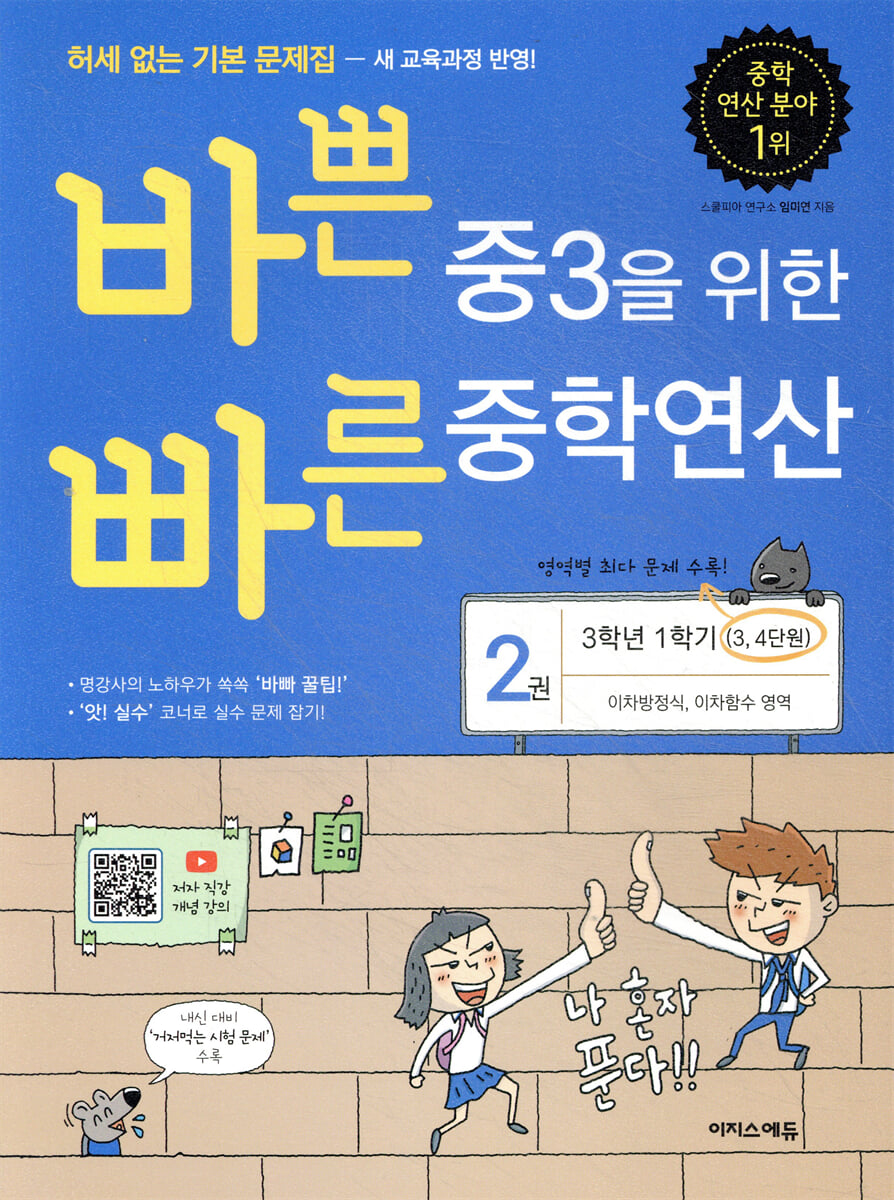
Quick Middle School Math for Busy Third-Year Students, Volume 2 (2026 Edition)
 |
Description
Book Introduction
A basic workbook without pretense! "Busy Middle School Math"
『Quick Middle School Math for Busy Third-Year Middle School Students』(hereafter referred to as 'Busy Middle School Math') is a revised edition that reflects the 2015 revised curriculum and is a middle school math book for the first semester of the third year that can be solved independently without the help of a teacher.
'Busy Middle School Math' is divided into two volumes for each unit of the first semester, and contains the largest number of problems by type.
It is the same as the school curriculum, and it is a training book that progresses from basic problems in a small step manner, so you can understand the concepts on your own as you solve them.
Also, the explanation of 'Busy Middle School Math' is easy.
It's as if the teacher is speaking right in front of the students, so they can solve problems without getting frustrated.
You can build a solid foundation by solving problems on your own while watching the "Busy Tips," and through the "Oops! Mistake" corner, you can organize the mistakes that 70% of middle school students frequently make.
Lastly, the 'Free Exam Questions' section includes basic questions that are sure to appear on the exam and 'hit rates' to help you prepare for school exams.
『Quick Middle School Math for Busy Third-Year Middle School Students』(hereafter referred to as 'Busy Middle School Math') is a revised edition that reflects the 2015 revised curriculum and is a middle school math book for the first semester of the third year that can be solved independently without the help of a teacher.
'Busy Middle School Math' is divided into two volumes for each unit of the first semester, and contains the largest number of problems by type.
It is the same as the school curriculum, and it is a training book that progresses from basic problems in a small step manner, so you can understand the concepts on your own as you solve them.
Also, the explanation of 'Busy Middle School Math' is easy.
It's as if the teacher is speaking right in front of the students, so they can solve problems without getting frustrated.
You can build a solid foundation by solving problems on your own while watching the "Busy Tips," and through the "Oops! Mistake" corner, you can organize the mistakes that 70% of middle school students frequently make.
Lastly, the 'Free Exam Questions' section includes basic questions that are sure to appear on the exam and 'hit rates' to help you prepare for school exams.
- You can preview some of the book's contents.
Preview
index
First yard quadratic equation
01 Meaning and solution of quadratic equations
02 Solving quadratic equations using factorization
03 Application of solving quadratic equations using factorization
04 Double roots of quadratic equations
05 Solving Quadratic Equations Using Square Roots
06 Quadratic Equation Root Formula
07 Solving complex quadratic equations
08 Number of roots of a quadratic equation
09 Finding a quadratic equation when two roots are given
10. Using Quadratic Equations in Real Life
11. Using Quadratic Equations in Figures
Second yard quadratic function
12 Meaning of Quadratic Function
13 Graph of the quadratic function y=ax^2
14 Graph of quadratic functions y=ax^2+q, y=a(xp)^2
15 Graph of the quadratic function y=a(xp)^2+q
16 Application of the graph of the quadratic function y=a(xp)^2+q
17 Coordinates of the vertices of the graph of the quadratic function y=ax^2+bx+c
18 Intersection of the x-axis and y-axis of the graph of the quadratic function y=ax^2+bx+c
19 Graphing the quadratic function y=ax^2+bx+c
20 Finding the equation of a quadratic function
01 Meaning and solution of quadratic equations
02 Solving quadratic equations using factorization
03 Application of solving quadratic equations using factorization
04 Double roots of quadratic equations
05 Solving Quadratic Equations Using Square Roots
06 Quadratic Equation Root Formula
07 Solving complex quadratic equations
08 Number of roots of a quadratic equation
09 Finding a quadratic equation when two roots are given
10. Using Quadratic Equations in Real Life
11. Using Quadratic Equations in Figures
Second yard quadratic function
12 Meaning of Quadratic Function
13 Graph of the quadratic function y=ax^2
14 Graph of quadratic functions y=ax^2+q, y=a(xp)^2
15 Graph of the quadratic function y=a(xp)^2+q
16 Application of the graph of the quadratic function y=a(xp)^2+q
17 Coordinates of the vertices of the graph of the quadratic function y=ax^2+bx+c
18 Intersection of the x-axis and y-axis of the graph of the quadratic function y=ax^2+bx+c
19 Graphing the quadratic function y=ax^2+bx+c
20 Finding the equation of a quadratic function
Detailed image
.jpg)
Publisher's Review
A basic workbook without pretense! Contains the largest number of problems by subject area.
Middle school math is the foundation of higher level math!
How can I study efficiently?
■ Let’s build a solid foundation in middle school math and move on!
Mathematics is a subject with a strong systematic structure, with many units connected from middle school mathematics to high school mathematics courses.
The first semester of middle school mathematics covers algebra for all 1st, 2nd, and 3rd grades, and the content is linked to 1st through 3rd grade middle school.
In particular, square roots, real numbers, factoring, quadratic equations, and quadratic functions in the third year of middle school are important units that form the basis of the algebra area of higher mathematics.
This book is faithful to the most basic issues that need to be known in the third year of middle school.
So, what should I do first to study middle school math efficiently?
① It is better to start with easy problems and solve them one by one.
② It is better to encounter many difficult problems.
I'll give you a hint.
Study experts say this:
“If it is difficult to learn, it helps you remember it for a long time.
However, if the learner does not have background knowledge, the difficulty becomes undesirable.” If the math problem is too difficult without background knowledge, the brain cannot overcome fatigue and gives up on studying.
So, if you are a student who is good at math, ② is the correct answer, but if you are an average student, ① “It is better to start with easy problems and work your way up” is the correct answer.
■ Let’s build a foundation in math with calculations and basic problems!
Operations can be said to be the basic physical strength of mathematics.
You need to build your high school math skills on the foundation you built in middle school, but if you have difficulty with calculations, it will be difficult to improve your math grades in high school.
Also, starting with a basic workbook is actually faster than solving several difficult workbooks.
The first middle school math textbook you encounter should first build a solid foundation of conceptual understanding and calculations, so that you can build the strength to solve more difficult problems later on!
"Busy Middle School Math" is a book that helps you solve basic math problems and calculations that are the foundation of math. It is the only book on the market designed to be solved on your own without a teacher.
■ Busy tips from a famous lecturer! It's like listening face-to-face.
Existing books simply collect vast amounts of knowledge into one volume, but do not teach you how to study it.
So, I often relied on my teacher.
However, this book contains detailed study tips as if the teacher were teaching you face-to-face.
Each concept is explained in detail at each stage, along with helpful tips from renowned instructors, so you can easily understand it even if you study on your own.
■ The first semester is divided into two volumes, containing the largest number of problems by type!
Once you understand the concept, you should now practice solving enough problems until you feel comfortable with the concept.
"Quick Middle School Math for Busy Third-Year Middle School Students" contains the largest number of problems by area, from easy problems to school exam-type problems, to ensure sufficient math training.
So, I divided the third-grade, first-semester math into two volumes.
As you solve the problems in this book, a problem-solving circuit for each type will naturally form in your head.
■ Don't get what you know wrong! 70% of middle school students get this wrong, solved with the "Oops! Mistake" corner!
Even friends who are good at math often lose points due to calculation mistakes.
This book has a special device in place to prevent you from receiving a lower score than your actual ability due to calculation errors.
Through the "Oops! Mistake" corner on every concept page, we've compiled the points of error that 70% of 3rd year middle school students frequently make.
It also helps to drastically reduce computational errors by allowing users to directly solve and check 'Oops! Mistake' type problems.
Additionally, at the end of each stage, we've included 'free exam questions', suggesting middle school exam questions that can be solved just by practicing in this book.
There are many school exam questions that can be answered correctly just by solving all the problems in this book.
If you're a middle school student, it's time to organize your concepts and learn how to solve problems on your own!
How to Effectively Study "Middle School Math for Busy Third-Year Students"
The "Busy Middle School Math" series consists of two volumes covering the first semester of the third year of middle school math, and covers the largest number of math problems among textbooks on the market.
Therefore, even friends who lack a foundation in mathematics can improve the speed and accuracy of calculations through focused training in specific areas.
Volume 1: Square Roots and Real Numbers, Multiplication of Polynomials, and Factorization
Volume 2, Quadratic Equations and Quadratic Functions
1.
Want to strengthen only your weak areas? ― Choose just one of the two books!
If you find square roots or factoring difficult in the middle school 3rd grade curriculum, try quickly organizing them with Volume 1, “Square Roots and Real Numbers, Multiplication of Polynomials, Factoring Area,” and if you find quadratic equations or quadratic functions difficult, try quickly organizing them with Volume 2, “Quadratic Equations, Quadratic Function Area.”
Even if you are a 3rd year middle school student or a 1st year high school student, focus on studying your weak areas to quickly make up for any learning gaps.
2.
What if I am a 3rd year middle school student but my math skills are weak, or if I am a 2nd year middle school student preparing for 3rd year middle school math?
Study in the following order: Volume 1: “Square Roots and Real Numbers, Multiplication of Polynomials, Factoring Area” → Volume 2: “Quadratic Equations, Quadratic Function Area” according to the progress of Middle School Mathematics 3-1.
You can solve basic problems, so you can build a solid foundation for middle school math.
3.
What if you are a teacher at a school or a study room?
This book is designed to ease the burden on teachers.
1) Have students who need more calculation skills come 30-40 minutes early to solve this book.
Even if the teacher doesn't try hard to explain, students can solve the problem just by having the book.
2) It is suitable as a short-term textbook for vacation to supplement light pre-learning and learning deficits.
Volume 1 consists of 26 levels, Volume 2 consists of 20 levels, and each level can be solved within 1 hour.
Middle school math is the foundation of higher level math!
How can I study efficiently?
■ Let’s build a solid foundation in middle school math and move on!
Mathematics is a subject with a strong systematic structure, with many units connected from middle school mathematics to high school mathematics courses.
The first semester of middle school mathematics covers algebra for all 1st, 2nd, and 3rd grades, and the content is linked to 1st through 3rd grade middle school.
In particular, square roots, real numbers, factoring, quadratic equations, and quadratic functions in the third year of middle school are important units that form the basis of the algebra area of higher mathematics.
This book is faithful to the most basic issues that need to be known in the third year of middle school.
So, what should I do first to study middle school math efficiently?
① It is better to start with easy problems and solve them one by one.
② It is better to encounter many difficult problems.
I'll give you a hint.
Study experts say this:
“If it is difficult to learn, it helps you remember it for a long time.
However, if the learner does not have background knowledge, the difficulty becomes undesirable.” If the math problem is too difficult without background knowledge, the brain cannot overcome fatigue and gives up on studying.
So, if you are a student who is good at math, ② is the correct answer, but if you are an average student, ① “It is better to start with easy problems and work your way up” is the correct answer.
■ Let’s build a foundation in math with calculations and basic problems!
Operations can be said to be the basic physical strength of mathematics.
You need to build your high school math skills on the foundation you built in middle school, but if you have difficulty with calculations, it will be difficult to improve your math grades in high school.
Also, starting with a basic workbook is actually faster than solving several difficult workbooks.
The first middle school math textbook you encounter should first build a solid foundation of conceptual understanding and calculations, so that you can build the strength to solve more difficult problems later on!
"Busy Middle School Math" is a book that helps you solve basic math problems and calculations that are the foundation of math. It is the only book on the market designed to be solved on your own without a teacher.
■ Busy tips from a famous lecturer! It's like listening face-to-face.
Existing books simply collect vast amounts of knowledge into one volume, but do not teach you how to study it.
So, I often relied on my teacher.
However, this book contains detailed study tips as if the teacher were teaching you face-to-face.
Each concept is explained in detail at each stage, along with helpful tips from renowned instructors, so you can easily understand it even if you study on your own.
■ The first semester is divided into two volumes, containing the largest number of problems by type!
Once you understand the concept, you should now practice solving enough problems until you feel comfortable with the concept.
"Quick Middle School Math for Busy Third-Year Middle School Students" contains the largest number of problems by area, from easy problems to school exam-type problems, to ensure sufficient math training.
So, I divided the third-grade, first-semester math into two volumes.
As you solve the problems in this book, a problem-solving circuit for each type will naturally form in your head.
■ Don't get what you know wrong! 70% of middle school students get this wrong, solved with the "Oops! Mistake" corner!
Even friends who are good at math often lose points due to calculation mistakes.
This book has a special device in place to prevent you from receiving a lower score than your actual ability due to calculation errors.
Through the "Oops! Mistake" corner on every concept page, we've compiled the points of error that 70% of 3rd year middle school students frequently make.
It also helps to drastically reduce computational errors by allowing users to directly solve and check 'Oops! Mistake' type problems.
Additionally, at the end of each stage, we've included 'free exam questions', suggesting middle school exam questions that can be solved just by practicing in this book.
There are many school exam questions that can be answered correctly just by solving all the problems in this book.
If you're a middle school student, it's time to organize your concepts and learn how to solve problems on your own!
How to Effectively Study "Middle School Math for Busy Third-Year Students"
The "Busy Middle School Math" series consists of two volumes covering the first semester of the third year of middle school math, and covers the largest number of math problems among textbooks on the market.
Therefore, even friends who lack a foundation in mathematics can improve the speed and accuracy of calculations through focused training in specific areas.
Volume 1: Square Roots and Real Numbers, Multiplication of Polynomials, and Factorization
Volume 2, Quadratic Equations and Quadratic Functions
1.
Want to strengthen only your weak areas? ― Choose just one of the two books!
If you find square roots or factoring difficult in the middle school 3rd grade curriculum, try quickly organizing them with Volume 1, “Square Roots and Real Numbers, Multiplication of Polynomials, Factoring Area,” and if you find quadratic equations or quadratic functions difficult, try quickly organizing them with Volume 2, “Quadratic Equations, Quadratic Function Area.”
Even if you are a 3rd year middle school student or a 1st year high school student, focus on studying your weak areas to quickly make up for any learning gaps.
2.
What if I am a 3rd year middle school student but my math skills are weak, or if I am a 2nd year middle school student preparing for 3rd year middle school math?
Study in the following order: Volume 1: “Square Roots and Real Numbers, Multiplication of Polynomials, Factoring Area” → Volume 2: “Quadratic Equations, Quadratic Function Area” according to the progress of Middle School Mathematics 3-1.
You can solve basic problems, so you can build a solid foundation for middle school math.
3.
What if you are a teacher at a school or a study room?
This book is designed to ease the burden on teachers.
1) Have students who need more calculation skills come 30-40 minutes early to solve this book.
Even if the teacher doesn't try hard to explain, students can solve the problem just by having the book.
2) It is suitable as a short-term textbook for vacation to supplement light pre-learning and learning deficits.
Volume 1 consists of 26 levels, Volume 2 consists of 20 levels, and each level can be solved within 1 hour.
GOODS SPECIFICS
- Date of publication: November 6, 2019
- Page count, weight, size: 176 pages | 210*280mm
- ISBN13: 9791163031130
- ISBN10: 1163031135
You may also like
카테고리
korean


korean

![GQ KOREA Mark (Monthly): December [2025]](http://librairie.coreenne.fr/cdn/shop/files/8ef265dbbfbf186523ed75ba7319009d.jpg?v=1765340328&width=3840)


