

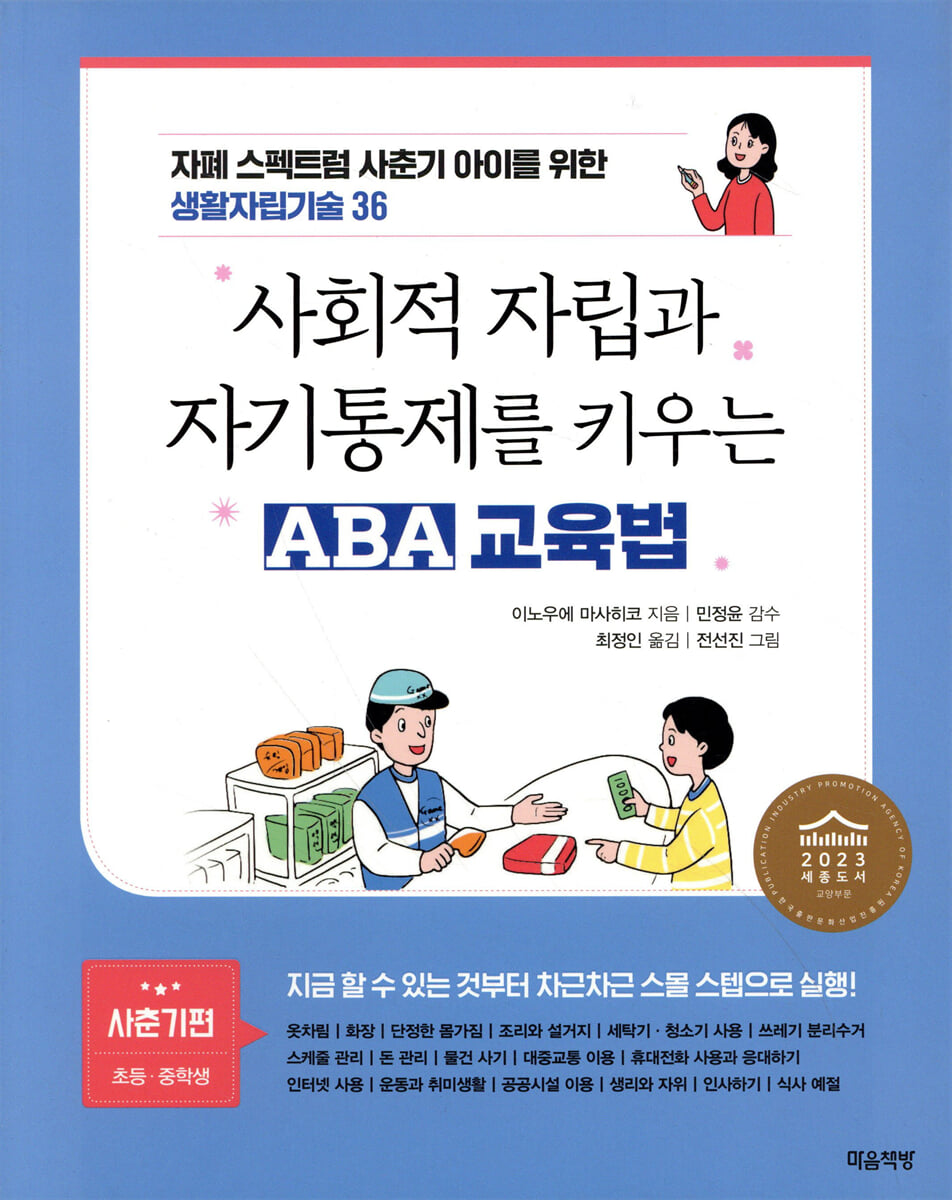
ABA Training for Adolescence: Developing Social Independence and Self-Control
 |
Description
Book Introduction
Adolescence for children on the autism spectrum! The ultimate goal of education is independence.
How should we educate? What should we focus on teaching?
This book is for children on the autism spectrum entering puberty.
Using the Applied Behavior Analysis (ABA) program, which has been studied clinically for a long time, we introduce 36 tasks that are essential for real-life self-reliance skills to achieve the ultimate goal of adolescent education: 'independence.'
Through these tasks, we are helping parents of children with autism and developmental disabilities understand the sensitivity of children entering puberty and providing guidance on what goals to set and how to teach them in accordance with puberty, thereby easing their concerns and answering their questions.
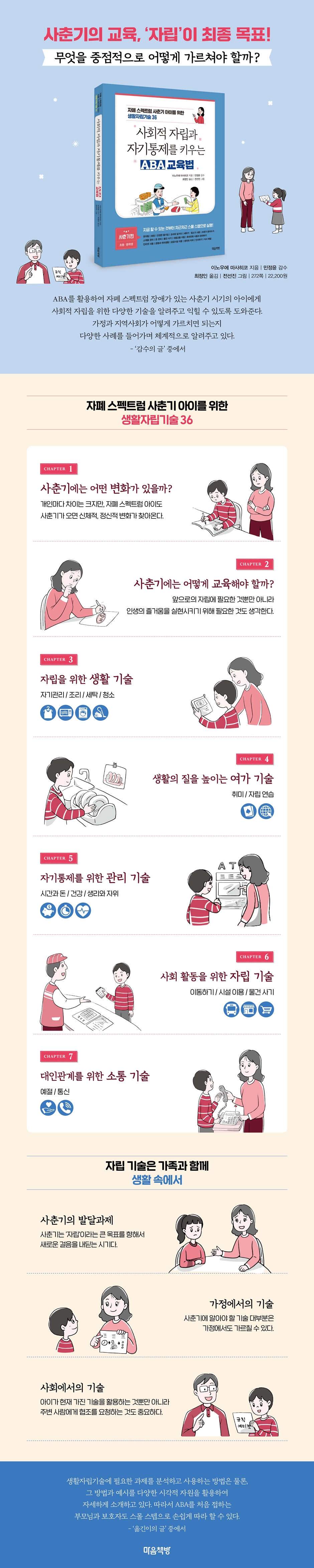
The 36 tasks of independent living skills are dressing, makeup, grooming, cooking and washing dishes, using a washing machine and vacuum cleaner, separating trash, managing schedules, managing money, buying things, using public transportation, using and responding to cell phones, using the Internet, exercising and hobbies, using public facilities, menstruation and masturbation, greeting, and table manners. They guide children through small steps so that they can gradually implement things they can do now.
How should we educate? What should we focus on teaching?
This book is for children on the autism spectrum entering puberty.
Using the Applied Behavior Analysis (ABA) program, which has been studied clinically for a long time, we introduce 36 tasks that are essential for real-life self-reliance skills to achieve the ultimate goal of adolescent education: 'independence.'
Through these tasks, we are helping parents of children with autism and developmental disabilities understand the sensitivity of children entering puberty and providing guidance on what goals to set and how to teach them in accordance with puberty, thereby easing their concerns and answering their questions.
The 36 tasks of independent living skills are dressing, makeup, grooming, cooking and washing dishes, using a washing machine and vacuum cleaner, separating trash, managing schedules, managing money, buying things, using public transportation, using and responding to cell phones, using the Internet, exercising and hobbies, using public facilities, menstruation and masturbation, greeting, and table manners. They guide children through small steps so that they can gradually implement things they can do now.
- You can preview some of the book's contents.
Preview
index
Recommendation | Reviewer's Note | Author's Note | Why Applied Behavior Analysis (ABA)? | Must-Read! Essential ABA Terminology | Translator's Note
PART Ⅰ.
Developmental tasks of adolescence
CHAPTER 1.
What changes occur during puberty?
Emotional independence from caregivers
There is no problem behavior without a reason.
Find a friend who fits you
To spend your free time well
To cope with the changing times of adolescence
CHAPTER 2.
How should we educate adolescents?
The ultimate goal of parenting is 'self-reliance'.
Real-life examples of acquiring self-reliance skills
Developing self-control
A task essential for becoming self-reliant
PART Ⅱ.
Technology at home
CHAPTER 3.
Life Skills for Self-Reliance
Self-management
01.
Get dressed
02.
Combing hair
03.
Putting on makeup
04.
Be neat and tidy
<cook>
05.
Using a microwave
06.
Do simple cooking yourself
07.
Washing the dishes and cleaning up
<laundry>
08.
Using a washing machine
09.
Hanging laundry and drying it
<cleaning>
10.
Run the vacuum cleaner
11.
Using a mop and broom
12.
Separate your trash
CHAPTER 4.
Leisure technologies that improve the quality of life
<hobby>
13.
Handcrafted work
14.
Musical instruments, knitting, origami
15.
Using the Internet Safely
Self-reliance practice
16.
Prepare for employment through errands
17.
Guarding the house alone
CHAPTER 5.
Management skills for self-control
Time and Money
18.
Manage your schedule
19. Using an ATM
<health>
20.
Stay healthy with exercise
21.
Take medicine
Menstruation and Masturbation
22.
Menstruation, let me know in advance
23.
Masturbation, Guided Correctly
PART Ⅲ.
Skills in social life
CHAPTER 6.
Self-reliance skills for social activities
Move
24.
Using public transportation
25.
View map
Facility Use
26.
Using public facilities
27.
Use leisure facilities
28.
Using the hospital
Buying Things
29.
Understanding Expiration Dates
30.
Understanding Discounts
31.
Buy the right amount
CHAPTER 7.
Communication skills for interpersonal relationships
Etiquette
32.
Say hello
33.
Observing table manners
34.
Ask others
<communication>
35.
Answering the phone
36.
Using a smartphone
· Terminology_ Behavioral contract
· Terminology_ Token Economy
· Column_ Self-reliance skills are learned from childhood through living with family.
· Column_ Create a format that is easy to use
· Column_ Leisure skills are the basis of all skills
· Column_ Autism Research Program, TEACCH
· I'm practicing at home ① I'm learning work skills through running errands.
· I'm practicing at home ② I succeeded in taking medicine on my own with small steps.
· I'm practicing at home ③ I ride my bike alone to the desired location.
· I'm practicing at home ④ I buy things I like and manage my money.
PART Ⅰ.
Developmental tasks of adolescence
CHAPTER 1.
What changes occur during puberty?
Emotional independence from caregivers
There is no problem behavior without a reason.
Find a friend who fits you
To spend your free time well
To cope with the changing times of adolescence
CHAPTER 2.
How should we educate adolescents?
The ultimate goal of parenting is 'self-reliance'.
Real-life examples of acquiring self-reliance skills
Developing self-control
A task essential for becoming self-reliant
PART Ⅱ.
Technology at home
CHAPTER 3.
Life Skills for Self-Reliance
Self-management
01.
Get dressed
02.
Combing hair
03.
Putting on makeup
04.
Be neat and tidy
<cook>
05.
Using a microwave
06.
Do simple cooking yourself
07.
Washing the dishes and cleaning up
<laundry>
08.
Using a washing machine
09.
Hanging laundry and drying it
<cleaning>
10.
Run the vacuum cleaner
11.
Using a mop and broom
12.
Separate your trash
CHAPTER 4.
Leisure technologies that improve the quality of life
<hobby>
13.
Handcrafted work
14.
Musical instruments, knitting, origami
15.
Using the Internet Safely
Self-reliance practice
16.
Prepare for employment through errands
17.
Guarding the house alone
CHAPTER 5.
Management skills for self-control
Time and Money
18.
Manage your schedule
19. Using an ATM
<health>
20.
Stay healthy with exercise
21.
Take medicine
Menstruation and Masturbation
22.
Menstruation, let me know in advance
23.
Masturbation, Guided Correctly
PART Ⅲ.
Skills in social life
CHAPTER 6.
Self-reliance skills for social activities
Move
24.
Using public transportation
25.
View map
Facility Use
26.
Using public facilities
27.
Use leisure facilities
28.
Using the hospital
Buying Things
29.
Understanding Expiration Dates
30.
Understanding Discounts
31.
Buy the right amount
CHAPTER 7.
Communication skills for interpersonal relationships
Etiquette
32.
Say hello
33.
Observing table manners
34.
Ask others
<communication>
35.
Answering the phone
36.
Using a smartphone
· Terminology_ Behavioral contract
· Terminology_ Token Economy
· Column_ Self-reliance skills are learned from childhood through living with family.
· Column_ Create a format that is easy to use
· Column_ Leisure skills are the basis of all skills
· Column_ Autism Research Program, TEACCH
· I'm practicing at home ① I'm learning work skills through running errands.
· I'm practicing at home ② I succeeded in taking medicine on my own with small steps.
· I'm practicing at home ③ I ride my bike alone to the desired location.
· I'm practicing at home ④ I buy things I like and manage my money.
Detailed image
Into the book
This book was written to provide options and assistance to children with autism spectrum disorder, from upper elementary school through adolescence, in answer to the question, "What realistic skills should I learn to live independently in the future?"
The areas covered in the book include everyday household skills such as cooking and laundry; skills for spending free time such as hobbies and exercise; self-care skills such as appearance and conduct; skills for living as a member of the community; and basic manners and conversation skills.
Rather than being an extension of the curriculum learned at school, it is structured to be of practical help, focusing on ‘improving the quality of life.’
--- p.
008~009 From the Author's Notes
Task analysis is important when raising adolescents.
Task analysis is one of the analytical methods of applied behavior analysis that divides complex behavior into continuous and specific actions.
For example, the action of 'grocery shopping' can be broken down into several detailed actions such as 'standing in line at the checkout counter', 'handing the product to the clerk', and 'taking money out of the wallet'.
By analyzing the task in this way, you can clearly identify which steps your child is having trouble with when shopping, and which steps require assistance so that they can shop independently.
--- p.
032 From “How to Respond to the Changing Adolescence”
Many parents only realize that their children need more than just language, cognition, and numbers, but also the skills necessary for independence, once their children reach adolescence.
However, they are often confused about what skills are actually needed, and they later realize that the time to teach those skills is actually long before puberty.
--- p.
072 Column.
Self-reliance skills are learned from childhood through living with family.
Start with easy tasks first.
It's a good idea to aim to wash the same amount or type of clothes every day.
For example, only washing clothes in the laundry basket, washing bed sheets on weekends, etc.
When loading clothes into the washing machine, start with the simplest method.
Be careful not to ask them to figure out the right amount of laundry from the start or to separate clothes that are prone to color transfer from heavily soiled clothes.
First, prepare separate baskets for your laundry, such as outerwear, underwear, and towels, and put your clothes in them.
Then, the child can finish the task by simply transferring the clothes sorted in the laundry basket into the washing machine.
--- p.
108 「08.
From “Using the Washing Machine”
When your stomach hurts or your eyes are itchy, practice pointing to specific areas and saying things like “stomach hurts” or “eyes are itchy” so that you can express your condition yourself.
If you have difficulty expressing yourself verbally, practice pointing to pictures of things like a stomachache or bloodshot eyes.
If your child can control the volume of his or her voice, it may be a good idea to practice expressing the intensity of his or her pain in numbers.
For example, if it hurts a little, give it a 1, if it hurts a lot, give it a 5.
The areas covered in the book include everyday household skills such as cooking and laundry; skills for spending free time such as hobbies and exercise; self-care skills such as appearance and conduct; skills for living as a member of the community; and basic manners and conversation skills.
Rather than being an extension of the curriculum learned at school, it is structured to be of practical help, focusing on ‘improving the quality of life.’
--- p.
008~009 From the Author's Notes
Task analysis is important when raising adolescents.
Task analysis is one of the analytical methods of applied behavior analysis that divides complex behavior into continuous and specific actions.
For example, the action of 'grocery shopping' can be broken down into several detailed actions such as 'standing in line at the checkout counter', 'handing the product to the clerk', and 'taking money out of the wallet'.
By analyzing the task in this way, you can clearly identify which steps your child is having trouble with when shopping, and which steps require assistance so that they can shop independently.
--- p.
032 From “How to Respond to the Changing Adolescence”
Many parents only realize that their children need more than just language, cognition, and numbers, but also the skills necessary for independence, once their children reach adolescence.
However, they are often confused about what skills are actually needed, and they later realize that the time to teach those skills is actually long before puberty.
--- p.
072 Column.
Self-reliance skills are learned from childhood through living with family.
Start with easy tasks first.
It's a good idea to aim to wash the same amount or type of clothes every day.
For example, only washing clothes in the laundry basket, washing bed sheets on weekends, etc.
When loading clothes into the washing machine, start with the simplest method.
Be careful not to ask them to figure out the right amount of laundry from the start or to separate clothes that are prone to color transfer from heavily soiled clothes.
First, prepare separate baskets for your laundry, such as outerwear, underwear, and towels, and put your clothes in them.
Then, the child can finish the task by simply transferring the clothes sorted in the laundry basket into the washing machine.
--- p.
108 「08.
From “Using the Washing Machine”
When your stomach hurts or your eyes are itchy, practice pointing to specific areas and saying things like “stomach hurts” or “eyes are itchy” so that you can express your condition yourself.
If you have difficulty expressing yourself verbally, practice pointing to pictures of things like a stomachache or bloodshot eyes.
If your child can control the volume of his or her voice, it may be a good idea to practice expressing the intensity of his or her pain in numbers.
For example, if it hurts a little, give it a 1, if it hurts a lot, give it a 5.
--- p.
227 「28.
From “Using the Hospital”
227 「28.
From “Using the Hospital”
Publisher's Review
ABA programs are more useful for adolescents on the verge of adulthood.
Helping people live independently and connect with their communities through self-reliance skills.
As children grow and their social circles expand, the need for social behavior increases and the things parents have to teach them increase.
But where and how should you begin? This book introduces 36 self-reliance skills to help children with autism spectrum disorder, both in upper elementary and middle school, become independent as they grow into adults.
The self-reliance skills introduced using the ABA (Applied Behavior Analysis) program are tasks closely related to daily life, such as dressing, makeup, neat appearance, cooking and washing dishes, using a washing machine and vacuum cleaner, separating trash, managing schedules, managing money, buying things, using public transportation, using and responding to cell phones, using the Internet, exercising and enjoying hobbies, using public facilities, menstruation and masturbation, greeting, and table manners.
This task is explained in detail with abundant illustrations so that parents and guardians can easily understand and guide it.
“ABA is a discipline that helps people improve and acquire social behaviors so that they can adapt well to social life. It is a discipline that is actually necessary throughout the entire life cycle of a human being, not only during infancy and childhood, but also during adolescence, adulthood, and even middle age.” Sangmin Han, from ‘Recommendation’
Domestic ABA education is still in the introduction stage, so most education at ABA centers is focused on infants and toddlers.
As a result, there is virtually no ABA education for elementary school students and adolescents who spent their childhood and adolescence before ABA became known in Korea.
In that respect, this book is becoming a breakthrough in resolving the concerns of parents of children with autism and developmental disabilities during adolescence.
It provides a better understanding of children entering puberty and provides friendly guidance on what goals to set in parenting and education based on their characteristics, as well as what to prepare and how to prepare.
The most important developmental task during adolescence is 'independence'.
The most important thing for self-reliance: self-control.
“Many parents only realize that their children need skills not only for language, cognition, and numbers, but also for independence,” said Sangmin Han, from his column.
Adolescence is a time when we take new steps toward the greater goal of becoming 'independent'.
Therefore, the major developmental task of adolescence is ‘independence.’
In order to become independent, it is important to first gain ‘self-control.’
Self-control here means controlling one's own actions, desires, and emotions.
If you have self-control, you can navigate social life more easily because you can take action to recover from failure without being confused even if you fail.
Parents of children with autism spectrum disorder want their children to become independent, productive members of society.
To achieve this, education during adolescence is crucial. How should we navigate this period? This book provides parents with insight into the changes that occur during adolescence and how parents can respond to them.
“This book was written to provide children with autism spectrum disorder, from upper elementary school to adolescence, with options and help in answering the question, ‘What realistic skills should I learn to live independently in the future?’” From the author’s note
The author is Professor Masahiko Inoue, who is well known to parents raising children with autism spectrum disorder for publishing a series of books on ABA programs in Korea. Here, he introduces an ABA program specialized for adolescent children and their parents.
Life Skills for Autistic Spectrum Adolescents to Develop Independence and Self-Control
Life skills are introduced by dividing them into ‘skills at home’ and ‘skills in society.’
This book is divided into three major parts and seven smaller chapters.
The first part explains the characteristics of puberty, the changes in children, and the corresponding parental attitudes and educational methods.
Many parents worry that their child's rebellion or behavioral problems are due to autism, even though they are often caused by the changes of puberty.
Learn how to distinguish between these and how to respond and educate your child accordingly as they change.
In other words, it quickly grasps the core points such as '3 essential things to parent during adolescence', '4 key points of ABA parenting', '3 real-life cases of skills acquired through ABA', '4 tasks to develop self-control', and 'Tasks absolutely necessary for independence', and informs how to deal with a child on the autism spectrum during adolescence.
The second and third parts are divided into ‘Home Skills’ and ‘Society Skills’, where you learn 36 self-reliance skills.
In the home skills section, we explained 'life skills for independence' such as self-management, cooking, laundry, and cleaning, 'leisure skills to improve the quality of life', and 'management skills for self-control' which taught time management, appropriate use of money, health management, and how to guide menstruation and masturbation in adolescent children.
In social skills, 'self-reliance skills for social activities' such as using public transportation, public or leisure facilities, hospitals, knowing the appropriate amount and expiration date, and purchasing items, and 'communication skills for interpersonal relationships' such as greetings, table manners, answering the phone, and using a smartphone were explained.
Helping people live independently and connect with their communities through self-reliance skills.
As children grow and their social circles expand, the need for social behavior increases and the things parents have to teach them increase.
But where and how should you begin? This book introduces 36 self-reliance skills to help children with autism spectrum disorder, both in upper elementary and middle school, become independent as they grow into adults.
The self-reliance skills introduced using the ABA (Applied Behavior Analysis) program are tasks closely related to daily life, such as dressing, makeup, neat appearance, cooking and washing dishes, using a washing machine and vacuum cleaner, separating trash, managing schedules, managing money, buying things, using public transportation, using and responding to cell phones, using the Internet, exercising and enjoying hobbies, using public facilities, menstruation and masturbation, greeting, and table manners.
This task is explained in detail with abundant illustrations so that parents and guardians can easily understand and guide it.
“ABA is a discipline that helps people improve and acquire social behaviors so that they can adapt well to social life. It is a discipline that is actually necessary throughout the entire life cycle of a human being, not only during infancy and childhood, but also during adolescence, adulthood, and even middle age.” Sangmin Han, from ‘Recommendation’
Domestic ABA education is still in the introduction stage, so most education at ABA centers is focused on infants and toddlers.
As a result, there is virtually no ABA education for elementary school students and adolescents who spent their childhood and adolescence before ABA became known in Korea.
In that respect, this book is becoming a breakthrough in resolving the concerns of parents of children with autism and developmental disabilities during adolescence.
It provides a better understanding of children entering puberty and provides friendly guidance on what goals to set in parenting and education based on their characteristics, as well as what to prepare and how to prepare.
The most important developmental task during adolescence is 'independence'.
The most important thing for self-reliance: self-control.
“Many parents only realize that their children need skills not only for language, cognition, and numbers, but also for independence,” said Sangmin Han, from his column.
Adolescence is a time when we take new steps toward the greater goal of becoming 'independent'.
Therefore, the major developmental task of adolescence is ‘independence.’
In order to become independent, it is important to first gain ‘self-control.’
Self-control here means controlling one's own actions, desires, and emotions.
If you have self-control, you can navigate social life more easily because you can take action to recover from failure without being confused even if you fail.
Parents of children with autism spectrum disorder want their children to become independent, productive members of society.
To achieve this, education during adolescence is crucial. How should we navigate this period? This book provides parents with insight into the changes that occur during adolescence and how parents can respond to them.
“This book was written to provide children with autism spectrum disorder, from upper elementary school to adolescence, with options and help in answering the question, ‘What realistic skills should I learn to live independently in the future?’” From the author’s note
The author is Professor Masahiko Inoue, who is well known to parents raising children with autism spectrum disorder for publishing a series of books on ABA programs in Korea. Here, he introduces an ABA program specialized for adolescent children and their parents.
Life Skills for Autistic Spectrum Adolescents to Develop Independence and Self-Control
Life skills are introduced by dividing them into ‘skills at home’ and ‘skills in society.’
This book is divided into three major parts and seven smaller chapters.
The first part explains the characteristics of puberty, the changes in children, and the corresponding parental attitudes and educational methods.
Many parents worry that their child's rebellion or behavioral problems are due to autism, even though they are often caused by the changes of puberty.
Learn how to distinguish between these and how to respond and educate your child accordingly as they change.
In other words, it quickly grasps the core points such as '3 essential things to parent during adolescence', '4 key points of ABA parenting', '3 real-life cases of skills acquired through ABA', '4 tasks to develop self-control', and 'Tasks absolutely necessary for independence', and informs how to deal with a child on the autism spectrum during adolescence.
The second and third parts are divided into ‘Home Skills’ and ‘Society Skills’, where you learn 36 self-reliance skills.
In the home skills section, we explained 'life skills for independence' such as self-management, cooking, laundry, and cleaning, 'leisure skills to improve the quality of life', and 'management skills for self-control' which taught time management, appropriate use of money, health management, and how to guide menstruation and masturbation in adolescent children.
In social skills, 'self-reliance skills for social activities' such as using public transportation, public or leisure facilities, hospitals, knowing the appropriate amount and expiration date, and purchasing items, and 'communication skills for interpersonal relationships' such as greetings, table manners, answering the phone, and using a smartphone were explained.
GOODS SPECIFICS
- Publication date: June 20, 2022
- Page count, weight, size: 272 pages | 582g | 183*230*18mm
- ISBN13: 9791190888196
- ISBN10: 119088819X
You may also like
카테고리
korean


korean

![ELLE 엘르 스페셜 에디션 A형 : 12월 [2025]](http://librairie.coreenne.fr/cdn/shop/files/b8e27a3de6c9538896439686c6b0e8fb.jpg?v=1766436872&width=3840)


