

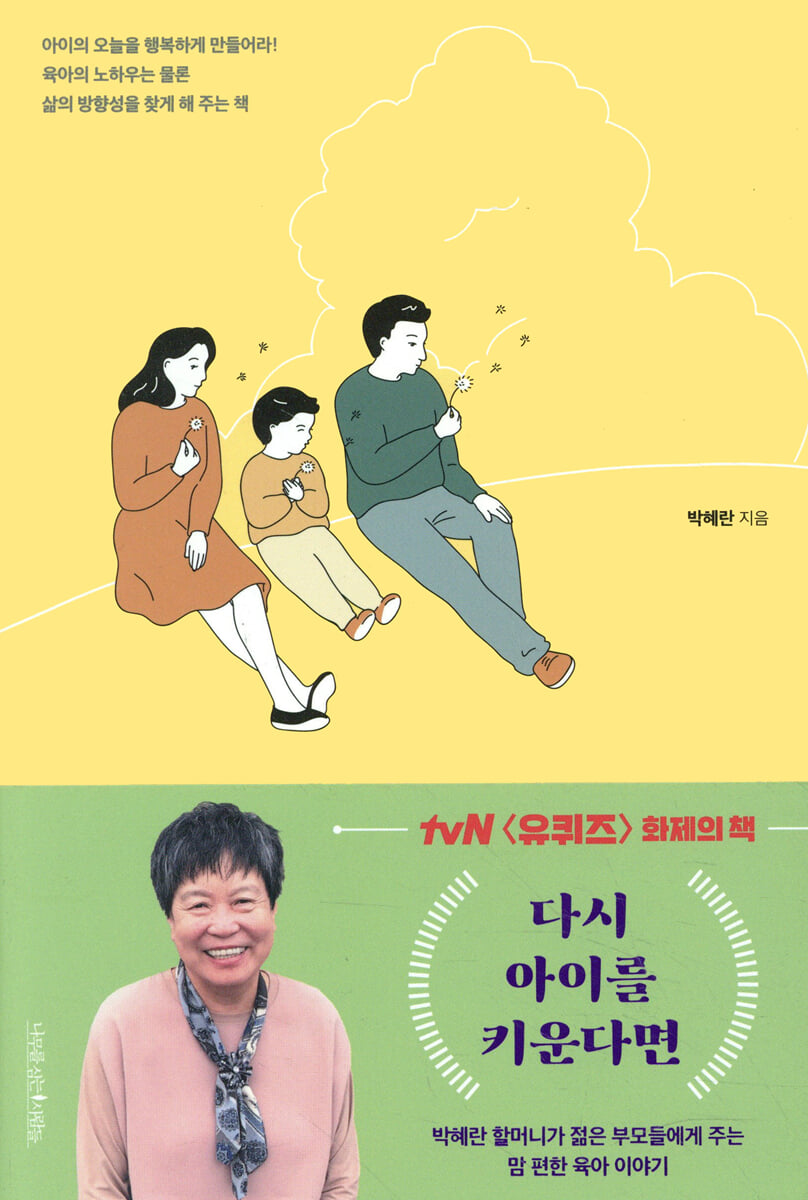
If I were to raise a child again
 |
Description
Book Introduction
The final installment of Happy Parenting by South Korea's parenting mentor, Park Hye-ran!!
A book that not only teaches you parenting skills but also helps you find direction in life!
Now, feminist scholar Park Hye-ran, better known as the mother of singer Lee Juck, has written about her child-rearing as a 70-year-old grandmother.
The three sons of the book "Children Grow as Much as You Believe," which was published in 1996 and became the bible of child education, have all started their own families and have given birth to three grandsons and three granddaughters.
Even he, who saw his own children's faces overlap with those of his grandchildren and was proud of having raised them happily and enjoyably, could not shake off the thought of regrets about not having raised them better.
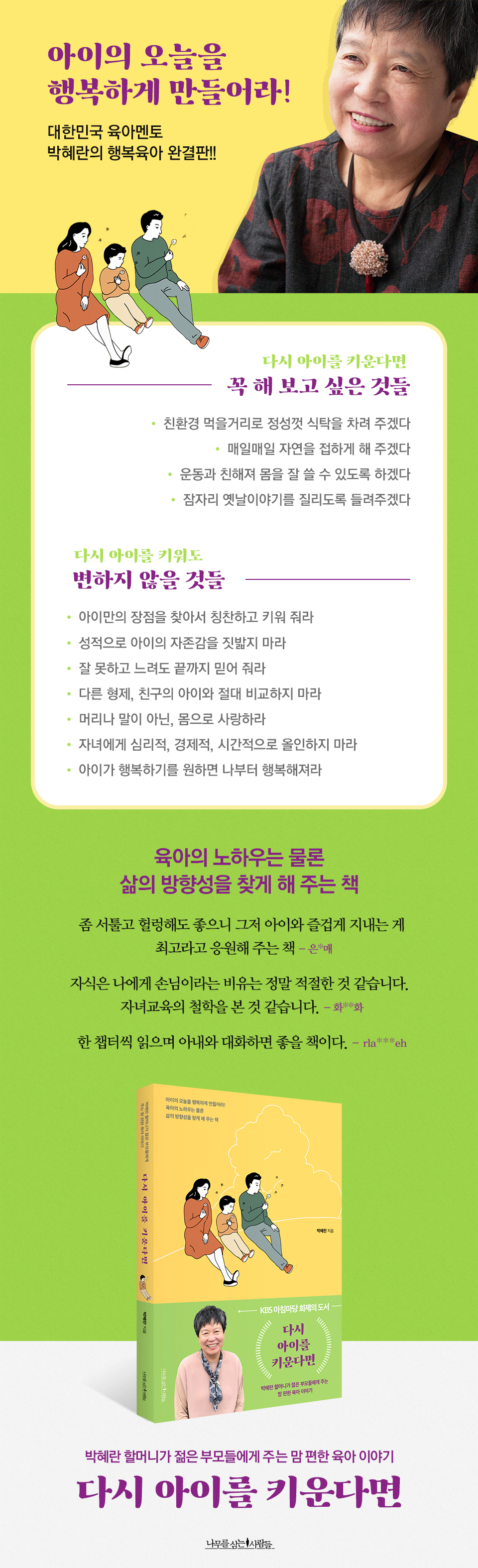
Also, I felt sorry and sad for young parents who struggle with their children every day and cannot enjoy the joy of raising children right away, so I decided to write down 'Things I would definitely try if I were to raise children again' and 'Things that would not change if I were to raise children again.'
Having lived in this world for well over seventy years, I can now see things clearly, and I can honestly share my immature experiences, as well as offer advice and loving rebuke to young mothers.
A book that not only teaches you parenting skills but also helps you find direction in life!
Now, feminist scholar Park Hye-ran, better known as the mother of singer Lee Juck, has written about her child-rearing as a 70-year-old grandmother.
The three sons of the book "Children Grow as Much as You Believe," which was published in 1996 and became the bible of child education, have all started their own families and have given birth to three grandsons and three granddaughters.
Even he, who saw his own children's faces overlap with those of his grandchildren and was proud of having raised them happily and enjoyably, could not shake off the thought of regrets about not having raised them better.
Also, I felt sorry and sad for young parents who struggle with their children every day and cannot enjoy the joy of raising children right away, so I decided to write down 'Things I would definitely try if I were to raise children again' and 'Things that would not change if I were to raise children again.'
Having lived in this world for well over seventy years, I can now see things clearly, and I can honestly share my immature experiences, as well as offer advice and loving rebuke to young mothers.
- You can preview some of the book's contents.
Preview
Detailed image
Into the book
This book is filled with vivid episodes and endless wisdom on child-rearing, with specific and reflective insights for mothers who think of their children as their own selves, go all-in, and yet are always anxious.
From specific methods for children's studies, aptitude, making friends, and fostering creativity to advice on forming a bond with children and how mothers can become happy first, the stories of happy parenting from a wise, aging grandmother are truly entertaining.
Mentoring is all the rage in our society these days, so it wouldn't be such a bad thing for older mothers to mentor younger mothers.
Because as the days go by, young parents (especially mothers) who look younger and younger to me seem to be just nagging their children rather than raising them.
In short, they worry too much about their children.
It feels like we're losing sight of our children's present, crushed by the weight of worry about their future, and the joy of raising them is being pushed aside as a distant luxury.
--- From the "Prologue"
Many people agree with the saying, 'Parents and parents are different.'
Parents know what the right path is, but once you become a parent, things change.
One new mom I know searched for this article online and cried, saying it was so sad.
But she also said, 'For the sake of my child, I should live like that too, right?'
I usually think, 'Women are strong, but mothers are weak.'
I think that every single woman in Korea is really smart, but once they become a mother, they become stupid in an instant.
--- From "Why Mothers with Great Information Power Are More Dangerous"
Don't brag about your child doing what you want, and don't worry about your child not doing what you want.
Conversely, if your child does what you want, worry, and if your child does not do what you want, be relieved.
The biggest concern is that the child has no will.
Any help should be generous.
If help is excessive, the child will become so accustomed that he or she cannot even think about standing on his or her own.
--- From "It's natural for children not to do what you want"
Don't pour everything you have, psychologically, time-wise, and financially, into your children.
If you can't stand the anxiety of not doing so, then at least don't go all-in financially.
Cut your current private education expenses in half, whether it's a lot or a little, and save for retirement.
What kind of parent is stingy with their children? Parents who truly care about their children are those who don't burden them financially when they're already busy making ends meet.
--- From "Don't Be All-In on Your Children"
Creative people are curious about new things and surprisingly indifferent to the opinions of others.
Even if you fail countless times and no matter what others say about you, you never lose faith in yourself.
And this confidence comes from the joy and pride of having chosen what you want to do.
--- From "Creativity is not fostered in academies"
The youngest granddaughter, who dominates the atmosphere from the entrance with her loud voice, is dressed in pink from head to toe.
Not to mention the pink coat, the perfect pink lady has appeared, complete with pink hairband, pink socks, and pink shoes.
This energetic and brave three-year-old girl, who is obsessed with Lightning Man and frequently uses her lightning powers, and the energy baby who is constantly bullied by her older siblings and is the number one target of avoidance, why is she so crazy about the color pink?
It was quite a surprise to my grandmother, who had never seen or worn anything pink in her life.
--- From "Raising a child to be strong yet gentle"
I loved the feeling of my little head tickling my chin as I sat on the sofa and put my baby on my lap.
The warmth that spread through my head warmed my body and mind, which were worn out from the clumsy housework.
Even when we were separated for a very short time and met again, as if we were reuniting as separated families, we would run to each other with our arms outstretched and shout, "Mom!" The physical contact between our bodies, the physical struggles as we competed to cut our heads on Mom's lap - I loved all of these things.
--- From "Love with your body, not your head or words"
From specific methods for children's studies, aptitude, making friends, and fostering creativity to advice on forming a bond with children and how mothers can become happy first, the stories of happy parenting from a wise, aging grandmother are truly entertaining.
Mentoring is all the rage in our society these days, so it wouldn't be such a bad thing for older mothers to mentor younger mothers.
Because as the days go by, young parents (especially mothers) who look younger and younger to me seem to be just nagging their children rather than raising them.
In short, they worry too much about their children.
It feels like we're losing sight of our children's present, crushed by the weight of worry about their future, and the joy of raising them is being pushed aside as a distant luxury.
--- From the "Prologue"
Many people agree with the saying, 'Parents and parents are different.'
Parents know what the right path is, but once you become a parent, things change.
One new mom I know searched for this article online and cried, saying it was so sad.
But she also said, 'For the sake of my child, I should live like that too, right?'
I usually think, 'Women are strong, but mothers are weak.'
I think that every single woman in Korea is really smart, but once they become a mother, they become stupid in an instant.
--- From "Why Mothers with Great Information Power Are More Dangerous"
Don't brag about your child doing what you want, and don't worry about your child not doing what you want.
Conversely, if your child does what you want, worry, and if your child does not do what you want, be relieved.
The biggest concern is that the child has no will.
Any help should be generous.
If help is excessive, the child will become so accustomed that he or she cannot even think about standing on his or her own.
--- From "It's natural for children not to do what you want"
Don't pour everything you have, psychologically, time-wise, and financially, into your children.
If you can't stand the anxiety of not doing so, then at least don't go all-in financially.
Cut your current private education expenses in half, whether it's a lot or a little, and save for retirement.
What kind of parent is stingy with their children? Parents who truly care about their children are those who don't burden them financially when they're already busy making ends meet.
--- From "Don't Be All-In on Your Children"
Creative people are curious about new things and surprisingly indifferent to the opinions of others.
Even if you fail countless times and no matter what others say about you, you never lose faith in yourself.
And this confidence comes from the joy and pride of having chosen what you want to do.
--- From "Creativity is not fostered in academies"
The youngest granddaughter, who dominates the atmosphere from the entrance with her loud voice, is dressed in pink from head to toe.
Not to mention the pink coat, the perfect pink lady has appeared, complete with pink hairband, pink socks, and pink shoes.
This energetic and brave three-year-old girl, who is obsessed with Lightning Man and frequently uses her lightning powers, and the energy baby who is constantly bullied by her older siblings and is the number one target of avoidance, why is she so crazy about the color pink?
It was quite a surprise to my grandmother, who had never seen or worn anything pink in her life.
--- From "Raising a child to be strong yet gentle"
I loved the feeling of my little head tickling my chin as I sat on the sofa and put my baby on my lap.
The warmth that spread through my head warmed my body and mind, which were worn out from the clumsy housework.
Even when we were separated for a very short time and met again, as if we were reuniting as separated families, we would run to each other with our arms outstretched and shout, "Mom!" The physical contact between our bodies, the physical struggles as we competed to cut our heads on Mom's lap - I loved all of these things.
--- From "Love with your body, not your head or words"
--- From the text
Publisher's Review
Let your child play as much as possible until he or she enters elementary school.
According to a recent survey, 36% of respondents said that children in Korea began receiving private education at the age of 1, followed by 27.1% at the age of 2.
The types of private education, including arts and physical education, creativity, science, math, Chinese characters, and English, clearly show the current state of Korean children, who are said to be the busiest in the world.
Children are being pushed into the private education market to develop their learning ability even before they have even learned basic survival skills such as eating, dressing, and standing.
So, what are the chances of success for children who receive private education earlier, more expensively, and more extensively than others, as their mothers hope? The author answers as follows.
'Life is not a sprint.
If you run at full speed from the beginning of a long distance, your energy will be depleted quickly, so you need to gather strength at the beginning to be able to finish.
What we need to nurture in our children from a young age is not cognitive ability, but the ability to enjoy studying and playing.
It is said that many children who are too busy hanging out with their friends are forced to focus only on learning, and as soon as they enter elementary school, they lose physical strength, curiosity, and motivation for everything.
They say that a mother's information power affects her child's life, and that a 'good mother' is one who sends her child to the 'best university,' but the author is firm in his statement.
'There are mothers who are perfectly suited to being a tiger mom, who plans thoroughly and manages meticulously.
But even if you feel resistance to it, you don't have to follow it for the sake of your child.
Parenting methods that you are not confident in yourself will only cause more confusion for yourself and your child.
How others are raising their children is only for reference, so don't be swayed by others' actions out of anxiety.
The author strongly advises leaving things loose at least until the child enters elementary school.
Instead of rushing your child off to academy after school because they have no friends at the playground, let them play on their own. This way, they will invent games to play, and children who grow up like that will eventually become winners in the long race called life.
Treat the child like a guest?
In today's world where people tell you to ask your mother-in-law if you want to know your son's salary, the author's three sons are famous for flocking to his house every weekend, dragging their daughters-in-law and grandchildren along.
Even on days when the sons are busy and cannot come, the daughters-in-law come to play with the children.
People around them often speculate about the secret: because the sons are filial, because the daughters-in-law are kind, because the father-in-law is scary, because the mother-in-law is kind, etc.
The answer he says lies elsewhere.
If you raise your children like guests, they will remain good guests forever. They will come by whenever they want without any burden, and they will want to show you not only by themselves but also by bringing their families.
When love becomes excessive, it becomes obsession, and when obsession becomes excessive, you tend to want to control the child in every way.
A dominated child may become overly dependent or try to run away.
In order to avoid being obsessive and controlling, there needs to be an appropriate distance between mother and child. The best way to keep this distance, which mothers find difficult, is to think of and treat the child as a guest who has come to me.
The benefits of thinking of your child as a guest are much greater than you might think. First, expectations, which are the biggest cause of conflict with your child, are eliminated, and patience increases in most situations.
If you think that your child is not someone who will stay in your home forever but someone who will eventually leave, you will be able to tolerate guests who are annoying or rude.
The best thing is when a guest leaves one day. It's sad, but the satisfaction that comes from seeing them off safely is greater than you can imagine.
Above all, I feel proud of myself for having learned a lot about my mind while entertaining guests.
My relationship with my guests depends on how I act as a host. If I truly respect and care for my guests, they will always be grateful to me and will not forget me even after I leave and will come back often.
Ultimately, if you think of your child as a guest, your thoughts about your child will change drastically. You will look after your child's feelings more than your own, you will always want to do well for them, you will pay more attention to their strengths than their weaknesses, and you will be grateful for even the smallest favors.
Why doesn't a married son visit his parents' home? It's because his daughter-in-law is reluctant to visit his in-laws, and the daughter-in-law is reluctant to visit her in-laws because she finds them inconvenient.
This is because, in the in-laws' house, the son is treated comfortably like an old family member, while the daughter-in-law is treated almost like a guest who is looked down upon.
Parenting is just a moment, so take it easy and have fun.
If you succeed, will you be happy, or if you are happy, will you be successful?
Most people believe that they can endure and sacrifice anything in the present for future success.
However, no matter how hard we try, success seems elusive, and the number of people who consider a happy life to be unrelated to themselves is increasing, so our people's happiness index is stuck at the bottom of the world.
What is even more bitter is that the percentage of children and adolescents who feel unhappy is also increasing.
Fortunately, there is a growing number of young parents who are interested not only in their children's studies but also in their aptitudes, and who believe that if their children can live happily, that is the success of both the child and the parents. However, the problem is that finding ways to make their children happy is a difficult task for parents to handle.
This is because my parents themselves do not have many memories of being happy, either in the past or present.
But happiness also requires practice, so children learn happiness from their parents.
When the author was young, he thought his family was very rich.
This is because not only did their parents never once envy others, but they also brainwashed their children into believing that there would be no other family in Seoul as happy as theirs.
After moving from the outskirts to a middle school in the heart of Seoul, he was surprised to learn that, by objective standards, his family was barely in the lower middle class. However, he said that since he had lived for ten years believing that he was happy, his happiness level did not suddenly drop.
The happiest child in the world is the one who grows up with happy parents.
Therefore, if you want to make your child happy, you as a parent must be happy first.
The most important thing we can give our children is not money or education, but the ability to find happiness and not despair in any situation.
A child who believes he is capable and loved, rather than incompetent and hated, will be happy anywhere.
The time spent raising children is short.
Such fun and rewarding times will never come again.
If a child is happy now, it is certain that he or she will be happy tomorrow and a week from now.
So, instead of worrying about your child's future, gather your energy and make your child happy today.
Parenting will be fun and enjoyable.
According to a recent survey, 36% of respondents said that children in Korea began receiving private education at the age of 1, followed by 27.1% at the age of 2.
The types of private education, including arts and physical education, creativity, science, math, Chinese characters, and English, clearly show the current state of Korean children, who are said to be the busiest in the world.
Children are being pushed into the private education market to develop their learning ability even before they have even learned basic survival skills such as eating, dressing, and standing.
So, what are the chances of success for children who receive private education earlier, more expensively, and more extensively than others, as their mothers hope? The author answers as follows.
'Life is not a sprint.
If you run at full speed from the beginning of a long distance, your energy will be depleted quickly, so you need to gather strength at the beginning to be able to finish.
What we need to nurture in our children from a young age is not cognitive ability, but the ability to enjoy studying and playing.
It is said that many children who are too busy hanging out with their friends are forced to focus only on learning, and as soon as they enter elementary school, they lose physical strength, curiosity, and motivation for everything.
They say that a mother's information power affects her child's life, and that a 'good mother' is one who sends her child to the 'best university,' but the author is firm in his statement.
'There are mothers who are perfectly suited to being a tiger mom, who plans thoroughly and manages meticulously.
But even if you feel resistance to it, you don't have to follow it for the sake of your child.
Parenting methods that you are not confident in yourself will only cause more confusion for yourself and your child.
How others are raising their children is only for reference, so don't be swayed by others' actions out of anxiety.
The author strongly advises leaving things loose at least until the child enters elementary school.
Instead of rushing your child off to academy after school because they have no friends at the playground, let them play on their own. This way, they will invent games to play, and children who grow up like that will eventually become winners in the long race called life.
Treat the child like a guest?
In today's world where people tell you to ask your mother-in-law if you want to know your son's salary, the author's three sons are famous for flocking to his house every weekend, dragging their daughters-in-law and grandchildren along.
Even on days when the sons are busy and cannot come, the daughters-in-law come to play with the children.
People around them often speculate about the secret: because the sons are filial, because the daughters-in-law are kind, because the father-in-law is scary, because the mother-in-law is kind, etc.
The answer he says lies elsewhere.
If you raise your children like guests, they will remain good guests forever. They will come by whenever they want without any burden, and they will want to show you not only by themselves but also by bringing their families.
When love becomes excessive, it becomes obsession, and when obsession becomes excessive, you tend to want to control the child in every way.
A dominated child may become overly dependent or try to run away.
In order to avoid being obsessive and controlling, there needs to be an appropriate distance between mother and child. The best way to keep this distance, which mothers find difficult, is to think of and treat the child as a guest who has come to me.
The benefits of thinking of your child as a guest are much greater than you might think. First, expectations, which are the biggest cause of conflict with your child, are eliminated, and patience increases in most situations.
If you think that your child is not someone who will stay in your home forever but someone who will eventually leave, you will be able to tolerate guests who are annoying or rude.
The best thing is when a guest leaves one day. It's sad, but the satisfaction that comes from seeing them off safely is greater than you can imagine.
Above all, I feel proud of myself for having learned a lot about my mind while entertaining guests.
My relationship with my guests depends on how I act as a host. If I truly respect and care for my guests, they will always be grateful to me and will not forget me even after I leave and will come back often.
Ultimately, if you think of your child as a guest, your thoughts about your child will change drastically. You will look after your child's feelings more than your own, you will always want to do well for them, you will pay more attention to their strengths than their weaknesses, and you will be grateful for even the smallest favors.
Why doesn't a married son visit his parents' home? It's because his daughter-in-law is reluctant to visit his in-laws, and the daughter-in-law is reluctant to visit her in-laws because she finds them inconvenient.
This is because, in the in-laws' house, the son is treated comfortably like an old family member, while the daughter-in-law is treated almost like a guest who is looked down upon.
Parenting is just a moment, so take it easy and have fun.
If you succeed, will you be happy, or if you are happy, will you be successful?
Most people believe that they can endure and sacrifice anything in the present for future success.
However, no matter how hard we try, success seems elusive, and the number of people who consider a happy life to be unrelated to themselves is increasing, so our people's happiness index is stuck at the bottom of the world.
What is even more bitter is that the percentage of children and adolescents who feel unhappy is also increasing.
Fortunately, there is a growing number of young parents who are interested not only in their children's studies but also in their aptitudes, and who believe that if their children can live happily, that is the success of both the child and the parents. However, the problem is that finding ways to make their children happy is a difficult task for parents to handle.
This is because my parents themselves do not have many memories of being happy, either in the past or present.
But happiness also requires practice, so children learn happiness from their parents.
When the author was young, he thought his family was very rich.
This is because not only did their parents never once envy others, but they also brainwashed their children into believing that there would be no other family in Seoul as happy as theirs.
After moving from the outskirts to a middle school in the heart of Seoul, he was surprised to learn that, by objective standards, his family was barely in the lower middle class. However, he said that since he had lived for ten years believing that he was happy, his happiness level did not suddenly drop.
The happiest child in the world is the one who grows up with happy parents.
Therefore, if you want to make your child happy, you as a parent must be happy first.
The most important thing we can give our children is not money or education, but the ability to find happiness and not despair in any situation.
A child who believes he is capable and loved, rather than incompetent and hated, will be happy anywhere.
The time spent raising children is short.
Such fun and rewarding times will never come again.
If a child is happy now, it is certain that he or she will be happy tomorrow and a week from now.
So, instead of worrying about your child's future, gather your energy and make your child happy today.
Parenting will be fun and enjoyable.
GOODS SPECIFICS
- Date of issue: May 30, 2019
- Page count, weight, size: 240 pages | 372g | 153*224*20mm
- ISBN13: 9791186361900
- ISBN10: 1186361905
You may also like
카테고리
korean


korean

![ELLE 엘르 스페셜 에디션 A형 : 12월 [2025]](http://librairie.coreenne.fr/cdn/shop/files/b8e27a3de6c9538896439686c6b0e8fb.jpg?v=1766436872&width=3840)


