

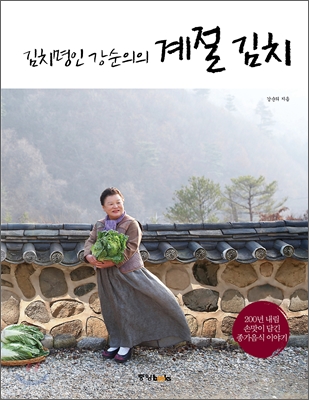
Seasonal Kimchi by Kimchi Master Kang Sun-ui
 |
Description
Book Introduction
Four Seasons Kimchi by Kang Sun-ui, the 25th generation head of the Naju Na clan and a kimchi expert.
Kimchi expert Kang Soon-ui, who learned over 200 kinds of kimchi and 1,000 kinds of traditional food through living in a family home, said to be spicier than chili peppers.
This book introduces kimchi, which is always on our table 365 days a year, divided into spring, summer, fall, and winter kimchi.
From selecting the best ingredients according to the season, to pickling them appropriately, to selecting and adjusting the types of salted seafood according to their use, to finding the right ripening point to bring out the best flavor by mixing them properly, to using seasonings that create subtle differences, this book contains the know-how of a kimchi master accumulated for over 40 years, allowing anyone to enjoy delicious kimchi all year round.
In addition to the familiar kimchi such as commonly pickled cabbage kimchi, bachelor radish kimchi, and green onion kimchi, we also introduce a variety of specialty kimchi that will make your mouth water just by looking at them, such as Kang Soon-ui's patented menu item 'Gochussi Baek Kimchi' that is popular overseas, as well as dongchimi, sukkkakdugi, spinach kimchi, onion kimchi, pomegranate kimchi, and seafood kimchi that are as tangy as cider.
Kimchi expert Kang Soon-ui, who learned over 200 kinds of kimchi and 1,000 kinds of traditional food through living in a family home, said to be spicier than chili peppers.
This book introduces kimchi, which is always on our table 365 days a year, divided into spring, summer, fall, and winter kimchi.
From selecting the best ingredients according to the season, to pickling them appropriately, to selecting and adjusting the types of salted seafood according to their use, to finding the right ripening point to bring out the best flavor by mixing them properly, to using seasonings that create subtle differences, this book contains the know-how of a kimchi master accumulated for over 40 years, allowing anyone to enjoy delicious kimchi all year round.
In addition to the familiar kimchi such as commonly pickled cabbage kimchi, bachelor radish kimchi, and green onion kimchi, we also introduce a variety of specialty kimchi that will make your mouth water just by looking at them, such as Kang Soon-ui's patented menu item 'Gochussi Baek Kimchi' that is popular overseas, as well as dongchimi, sukkkakdugi, spinach kimchi, onion kimchi, pomegranate kimchi, and seafood kimchi that are as tangy as cider.
- You can preview some of the book's contents.
Preview
index
Opening remarks - The story of the head of the Na clan, carrying on the legacy of a 200-year-old family, woven over time - 40 years of experience, with fingertips stained red with chili pepper juice... One story Kang Soon's grandmother's four seasons kimchi Learning the basics of kimchi ① A story about basic seasonings obtained from nature Learning the basics of kimchi ② Picky kimchi ingredients Learning the basics of kimchi ③ The secret to the taste of kimchi from a kimchi master Learning the basics of kimchi ④ Making key seasonings Learning the basics of kimchi ⑤ The kimchi master's principles of flavoring First, a story about fresh spring kimchi Bomdong geotjeori / Bomdongmu geotjeori / Gukbulkkakdugi / Kohlrabi kkakdugi / Sedum kimchi / Sedum mul kimchi / Wild chive kimchi / Angelica spp. kimchi / Sesame leaf kimchi / Spinach kimchi / Green garlic kimchi / Green laver kimchi / Hizikia kimchi / Water parsley water kimchi / Water parsley bean sprout kimchi / Cabbage geotjeori kimchi / Crown daisy kimchi / Green pepper small kimchi / Cucumber small kimchi / Radish dried bossam kimchi Second, a story about refreshing summer kimchi Cucumber small kimchi / Cucumber Sobagi / Young Radish Mul Kimchi / Young Radish Mul Kimchi / Onion Kimchi / Cabbage White Kimchi / Cabbage Geotjeori / Eggplant Kimchi / Eolgal Cabbage Kimchi / Eolgal Geotjeori / Mak Kimchi / Buchu Kimchi / Baekchu Baek Kimchi / Ssam Baechu Kimchi / Jangmul Kimchi / Baekmul Kimchi / Nabak Kimchi Third, the story of kimchi that deepens into autumn Baechu Dongchimi Kimchi / Baechu Gochumul Dongchimi Kimchi / Deodeok Kimchi / Burdock Kimchi / Lotus Root Kimchi / Radish Salad / Pomegranate Kimchi / Seafood Bo Kimchi / Hong-eo Kimchi / Crab Soup Kimchi / Flatfish Salted Kimchi / Red Pepper Seed Salted Kimchi / Baechu Bossam Kimchi / Abalone Kimchi / Green Onion Kimchi / Oyster Kimchi / Yellow Corvina Kimchi / Seafood Kimchi / Radish Kimchi / Scale Kimchi / Mixed Bo Kimchi / Oyster Kkakdugi Kimchi / Suk Kkakdugi Kimchi / Jeong Kkakdugi Kimchi Fourth, Midwinter Kimjang Kimchi Story Learning the basics of kimchi ⑥ Pickling cabbage Learning the basics of kimchi ⑦ Making seasoning in a pot Red pepper seed cabbage kimchi / Red pepper seed white kimchi / Dongchimi kimchi / Red mustard dongchimi kimchi / Green radish kimchi / Chive kimchi / Altari radish kimchi / Ppaegaeji kimchi / Pumpkin crab soup Story 2 Kang Soon's daughter-in-law's family food First, a story of simple and affectionate local food Doenjang jjigae / Kimchi jjigae / Ugeoji jjigae / Steamed egg / Seasoned anchovies with soybean paste / Seasoned anchovies with red pepper paste / Seasoned red pepper paste achiji / Spring coin pancake / Japchae / Braised radish and shrimp / Zucchini perilla seed soup / Spinach soup Second, 14 kinds of vegetables for the first full moon of the lunar year Chwinamul / Bean sprouts / Bamboo shoots / Gondre greens / Bracken fern greens / Shiitake mushroom greens / Stir-fried pollack / Radish greens / Spinach greens / Pumpkin and dried pollack greens / Taro stems and sweet potato stems / Radish greens and dried radish sprouts / Vegetable galmuri Third, pickles of Jongga that are made with nature Pickles made in March and April Bamboo shoot pickles and Eokmul tree shoot pickles / Daylily pickles and Okjamhwa pickles Basic pickles with a simple taste Pickled mugwort leaves and chili seasoned pickles / Mini onion pickles Pickled leaves with a subtle fragrance Pickled myeong-i and windbreak greens / Pickled wild water parsley Pickled pickles made in late autumn Pickled aralia elata and maple sesame leaves / Pickled maple soybean leaves and sesame leaf soybean paste pickles Pickles that can be kept all year round Pickled eggplant and wild chives pickles Pickled whole garlic and plum and chili paste pickles and zucchini Pickled mushrooms to enjoy with their fragrance Pickled neungi mushrooms and shiitake mushrooms / After waiting for the pine mushroom pickles, we finally taste the pickled garlic shoots and green garlic pickles. The story of the bowls of lotus root pickles, mulberry pickles, and burdock pickles.
Detailed image

Into the book
Especially, pickled radish kimchi is great as a substitute for soup or stew in the hot summer... If you freeze the well-fermented, sour broth into small ice cubes and serve it in a large bowl, it's the best way to revive your appetite lost to the heat.
The crunchy taste of the turnips is delicious, but how can I describe the refreshing taste that cools you down to your bones when you slurp down the soup?
If you feel like eating it like this is not enough or you don't like it, you can boil chewy noodles and roll them in a generous amount of broth, mix it with barley rice and gochujang, or mix it with a hard-boiled egg on top of cold noodles and eat it. However you eat it, it's a representative summer water kimchi that will definitely whet your appetite.
--- Page 99, Turnip Kimchi -
This radish kimchi is named ‘pomegranate kimchi’ because its neatly arranged shape resembles a ripe, open pomegranate.
… Around the time when you need to apply weather stripping to prevent cold wind from coming in, choose evenly-sized radishes, cut them into thick pieces, and make small cuts in the length and width of the kimchi to make a checkerboard pattern.
… We make kimchi with colorful ingredients such as shredded stone lettuce, jujube, chestnut, and shredded red pepper, and make radish kimchi that looks like a beautiful pomegranate.
The light taste of the soup, with the subtle scent of jujubes, and the refreshing, tangy flavor were all mixed together. My granddaughter-in-law must have been so impressed with my skill that she lifted her heavy lips and said, “The subtle scent is nice, it’s nice.”
--- Page 145, Pomegranate Kimchi -
When the countless jars of jangdok, polished to a shine by waking up at dawn, are filled one by one with pickled vegetables to be eaten throughout the year, it feels as if there is plenty of rice stored in the granary.
…starting with angelica, aralia, and bamboo shoots that announce the arrival of spring, as well as green garlic, cucumbers, onions, peppers, shiitake mushrooms, lingzhi mushrooms, pine mushrooms, mulberries, pumpkin leaves, chestnuts, persimmons, etc…
I've been preparing and pickling the fresh seasonal vegetables and herbs that come out at the right time, and I've ended up with over 150 jars full of pickled vegetables with different flavors. If I just work a little harder, nature will take care of the flavors for me, so today, I'm drying cucumbers and pumpkins.
--- Page 247, Jangajji from Jongga, a Jangajji Filled with Nature -
The crunchy taste of the turnips is delicious, but how can I describe the refreshing taste that cools you down to your bones when you slurp down the soup?
If you feel like eating it like this is not enough or you don't like it, you can boil chewy noodles and roll them in a generous amount of broth, mix it with barley rice and gochujang, or mix it with a hard-boiled egg on top of cold noodles and eat it. However you eat it, it's a representative summer water kimchi that will definitely whet your appetite.
--- Page 99, Turnip Kimchi -
This radish kimchi is named ‘pomegranate kimchi’ because its neatly arranged shape resembles a ripe, open pomegranate.
… Around the time when you need to apply weather stripping to prevent cold wind from coming in, choose evenly-sized radishes, cut them into thick pieces, and make small cuts in the length and width of the kimchi to make a checkerboard pattern.
… We make kimchi with colorful ingredients such as shredded stone lettuce, jujube, chestnut, and shredded red pepper, and make radish kimchi that looks like a beautiful pomegranate.
The light taste of the soup, with the subtle scent of jujubes, and the refreshing, tangy flavor were all mixed together. My granddaughter-in-law must have been so impressed with my skill that she lifted her heavy lips and said, “The subtle scent is nice, it’s nice.”
--- Page 145, Pomegranate Kimchi -
When the countless jars of jangdok, polished to a shine by waking up at dawn, are filled one by one with pickled vegetables to be eaten throughout the year, it feels as if there is plenty of rice stored in the granary.
…starting with angelica, aralia, and bamboo shoots that announce the arrival of spring, as well as green garlic, cucumbers, onions, peppers, shiitake mushrooms, lingzhi mushrooms, pine mushrooms, mulberries, pumpkin leaves, chestnuts, persimmons, etc…
I've been preparing and pickling the fresh seasonal vegetables and herbs that come out at the right time, and I've ended up with over 150 jars full of pickled vegetables with different flavors. If I just work a little harder, nature will take care of the flavors for me, so today, I'm drying cucumbers and pumpkins.
--- Page 247, Jangajji from Jongga, a Jangajji Filled with Nature -
--- From the text
Publisher's Review
Four Seasons Kimchi by Kang Sun-ui, the 25th generation head of the Naju Na clan and a kimchi expert
Kimchi expert Kang Soon-ui, who learned over 200 kinds of kimchi and 1,000 kinds of traditional food through living in a family home, said to be spicier than chili peppers.
Kang Soon-ui's cooking class, which runs for one year and is famous as the 'Kimchi Teacher', is so popular that people have to wait for years to take a class.
Not only is the taste of the 200-year-old family recipe created by skilled hands special, but it also passes on our traditional tastes, including kimchi, to the younger generation through easy recipes.
This book introduces kimchi, which is always on our table 365 days a year, divided into spring, summer, fall, and winter kimchi.
From selecting the best ingredients according to the season, to pickling them appropriately, to selecting and adjusting the types of salted seafood according to their use, to finding the right ripening point to bring out the best flavor by mixing them properly, to using seasonings that create subtle differences, this book contains the know-how of a kimchi master accumulated for over 40 years, allowing anyone to enjoy delicious kimchi all year round.
In addition to the familiar kimchi such as commonly pickled cabbage kimchi, bachelor radish kimchi, and green onion kimchi, we also introduce a variety of specialty kimchi that will make your mouth water just by looking at them, such as Kang Soon-ui's patented menu item 'Gochussi Baek Kimchi' that is popular overseas, as well as dongchimi, sukkkakdugi, spinach kimchi, onion kimchi, pomegranate kimchi, and seafood kimchi that are as tangy as cider.
It clearly shows how much our kimchi is a valuable food culture that enriches our dining table throughout the four seasons.
The secrets to the delicious flavors of traditional Korean cuisine, including namul (Korean vegetables) and pickled vegetables, all handed down for 200 years.
With so much experience, she is now able to tell the taste of kimchi just by looking at its pickled state. Based on this skill, she teaches housewives who are always striving to make tastier kimchi, as well as the younger generation who are struggling with making kimchi, how to make it easily and deliciously, just like a mother would.
Also, we cannot leave out the story of the food passed down through the 200-year history of the Naju Na clan.
The 14 kinds of vegetables prepared for the first full moon of the lunar year, made with savory and delicious local dishes such as doenjang jjigae, ugeoji jjigae, japchae, zucchini perilla seed soup, and bomdongjeon, as well as seasonal ingredients such as gomchwinamul, gondrenamul, and zucchini gojinamul, all have a simple and refined traditional flavor that is hard to find anywhere else.
Also, Jongga's pickled vegetables, such as bamboo shoot pickles, mugwort leaf pickles, myungi pickles, and green garlic pickles, are made by soaking natural ingredients in well-aged sauces and adding flavor, and the savory flavor created by nature and time stimulates the nostalgic taste buds.
This book contains the secrets of kimchi, a recipe that has been passed down through 200 years, and the best secrets to preparing a healthy and simple meal for your family.
Kimchi expert Kang Soon-ui, who learned over 200 kinds of kimchi and 1,000 kinds of traditional food through living in a family home, said to be spicier than chili peppers.
Kang Soon-ui's cooking class, which runs for one year and is famous as the 'Kimchi Teacher', is so popular that people have to wait for years to take a class.
Not only is the taste of the 200-year-old family recipe created by skilled hands special, but it also passes on our traditional tastes, including kimchi, to the younger generation through easy recipes.
This book introduces kimchi, which is always on our table 365 days a year, divided into spring, summer, fall, and winter kimchi.
From selecting the best ingredients according to the season, to pickling them appropriately, to selecting and adjusting the types of salted seafood according to their use, to finding the right ripening point to bring out the best flavor by mixing them properly, to using seasonings that create subtle differences, this book contains the know-how of a kimchi master accumulated for over 40 years, allowing anyone to enjoy delicious kimchi all year round.
In addition to the familiar kimchi such as commonly pickled cabbage kimchi, bachelor radish kimchi, and green onion kimchi, we also introduce a variety of specialty kimchi that will make your mouth water just by looking at them, such as Kang Soon-ui's patented menu item 'Gochussi Baek Kimchi' that is popular overseas, as well as dongchimi, sukkkakdugi, spinach kimchi, onion kimchi, pomegranate kimchi, and seafood kimchi that are as tangy as cider.
It clearly shows how much our kimchi is a valuable food culture that enriches our dining table throughout the four seasons.
The secrets to the delicious flavors of traditional Korean cuisine, including namul (Korean vegetables) and pickled vegetables, all handed down for 200 years.
With so much experience, she is now able to tell the taste of kimchi just by looking at its pickled state. Based on this skill, she teaches housewives who are always striving to make tastier kimchi, as well as the younger generation who are struggling with making kimchi, how to make it easily and deliciously, just like a mother would.
Also, we cannot leave out the story of the food passed down through the 200-year history of the Naju Na clan.
The 14 kinds of vegetables prepared for the first full moon of the lunar year, made with savory and delicious local dishes such as doenjang jjigae, ugeoji jjigae, japchae, zucchini perilla seed soup, and bomdongjeon, as well as seasonal ingredients such as gomchwinamul, gondrenamul, and zucchini gojinamul, all have a simple and refined traditional flavor that is hard to find anywhere else.
Also, Jongga's pickled vegetables, such as bamboo shoot pickles, mugwort leaf pickles, myungi pickles, and green garlic pickles, are made by soaking natural ingredients in well-aged sauces and adding flavor, and the savory flavor created by nature and time stimulates the nostalgic taste buds.
This book contains the secrets of kimchi, a recipe that has been passed down through 200 years, and the best secrets to preparing a healthy and simple meal for your family.
GOODS SPECIFICS
- Date of issue: December 1, 2011
- Page count, weight, size: 282 pages | 1,032g | 210*270*20mm
- ISBN13: 9788927802846
- ISBN10: 8927802845
You may also like
카테고리
korean


korean

![ELLE 엘르 스페셜 에디션 A형 : 12월 [2025]](http://librairie.coreenne.fr/cdn/shop/files/b8e27a3de6c9538896439686c6b0e8fb.jpg?v=1766436872&width=3840)


