

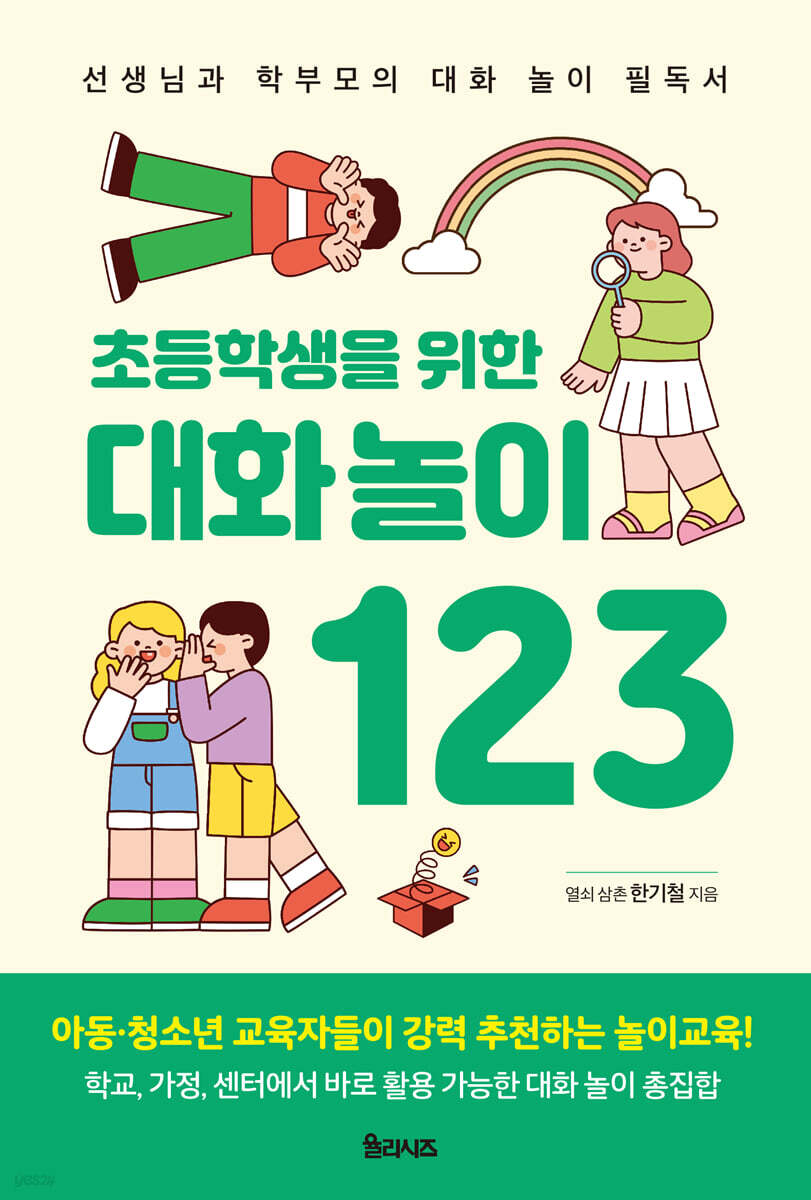
Conversational Games for Elementary School Students 123
 |
Description
Book Introduction
The Amazing Power of Dialogue Play, Proven in Elementary Schools
Highly recommended by children and youth educators
Conversational play methods to raise strong and healthy children
The third play book by Uncle Han Ki-cheol, known as the 'play instructor's instructor'.
This is a conversation playbook for elementary school children and their environments, and was created so that anyone can easily use it, even if they are not a conversation expert or play expert.
This book does not teach conversation skills, but rather guides you to enjoy conversation, inviting you to experience healthy and happy conversation.
The purpose of this book is simple and clear.
The goal is to help foster a healthy culture of conversation among children.
The author, who believes that pleasant and comfortable conversations are healthy conversations, has spent a long time in the field with the hope that children will enjoy the joy of sharing stories, getting to know each other, and becoming closer through conversations.
We have designed and implemented this play in the hope that children will have safe conversations where they can face things as they are, without criticism, blaming, comparing, criticizing, gossiping, or swearing, and that through conversation play, they will be able to meet and connect with each other honestly and happily.
This book contains 152 conversation games that have proven their effectiveness and power, drawing enthusiastic responses in elementary school settings, organized into appropriate situations for use by individuals, groups, and entire groups.
Highly recommended by children and youth educators
Conversational play methods to raise strong and healthy children
The third play book by Uncle Han Ki-cheol, known as the 'play instructor's instructor'.
This is a conversation playbook for elementary school children and their environments, and was created so that anyone can easily use it, even if they are not a conversation expert or play expert.
This book does not teach conversation skills, but rather guides you to enjoy conversation, inviting you to experience healthy and happy conversation.
The purpose of this book is simple and clear.
The goal is to help foster a healthy culture of conversation among children.
The author, who believes that pleasant and comfortable conversations are healthy conversations, has spent a long time in the field with the hope that children will enjoy the joy of sharing stories, getting to know each other, and becoming closer through conversations.
We have designed and implemented this play in the hope that children will have safe conversations where they can face things as they are, without criticism, blaming, comparing, criticizing, gossiping, or swearing, and that through conversation play, they will be able to meet and connect with each other honestly and happily.
This book contains 152 conversation games that have proven their effectiveness and power, drawing enthusiastic responses in elementary school settings, organized into appropriate situations for use by individuals, groups, and entire groups.
- You can preview some of the book's contents.
Preview
index
I recommend this book
preface
Features of the conversational games in this book
Recommended stories for conversation play
Promise of dialogue
Chapter 1: Good Body Exercises to Do Together
1-1 Finger coordination zero / 1-2 Action telepathy / 1-3 Frogs and flies / 1-4 How many are there? / 1-5 Tteokbokki / 1-6 Hurray! Clap! / 1-7 Listening catch (1) / 1-8 Listening catch (2) / 1-9 Rock-paper-scissors speaking / 1-10 Telepathic hand clapping / 1-11 Rock-paper-scissors drawing / 1-12 Classroom bingo / 1-13 Bubble bubble pair / 1-14 How has it changed? / 1-15 Find the missing item / 1-16 Divvydivdyep (1) / 1-17 Divvydivdyep (2) / 1-18 Elevator clapping / 1-19 Snowball fight / 1-20 Thigh wrestling / 1-21 Finger, press / 1-22 Exchange greetings with notes
· Use of body play that is good to do together
Chapter 2: Conversation Games to Enjoy with Your Partner
2-1 Two people in a row/2-2 If I were ∼/2-3 I'll tell you about myself/2-4 We can communicate (1)/2-5 We can communicate (2)/2-6 How is your day?/2-7 Three questions/2-8 Telepathy Bingo/2-9 30-second conversation/2-10 Incomplete sentence conversation/2-11 40 questions, 40 answers/2-12 Everything about me at school/2-13 Satisfaction conversation/2-14 What kind of question is it?/2-15 Yes, No/2-16 Telepathy Chat/2-17 Compliment Bingo conversation/2-18 Which one do you like better?/2-19 My experience/2-20 Catch it! (1)/2-21 Catch it! (2)/2-22 Pull!/2-23 Exploring my head/2-24 Choose what's more important/2-25 Thought telepathy (1)/2-26 Thought telepathy (2)/2-27 Pair interview/2-28 In my opinion/2-29 Guess me, friend/2-30 Interview that makes you laugh/2-31 Likes, dislikes/2-32 Ideal type World Cup/2-33 Yes, no/2-34 Yes, no/2-35 Quiz to get to know each other/2-36 Twelve open questions/2-37 Yes, I've decided!/2-38 Friend Q&A test/2-39 Finding my desires
· Share anecdotes through conversation play
Chapter 3: Group Conversation Games
3-1 Fold your fingers (1)/3-2 Fold your fingers (2)/3-3 There's no such person, right?/3-4 Character OX/3-5 Dice Bingo Dialogue/3-6 True or False (1)/3-7 True or False (2)/3-8 Ask Anything/3-9 Who Could It Be/3-10 Belongings Dialogue (1)/3-11 Belongings Dialogue (2)/3-12 Me too, me too (1)/3-13 Me too, me too (2)/3-14 Character OX Bingo/3-15 Dialogue with the Author (1)/3-19 Timer Story Creation (1)/3-20 Timer Story Creation (2)/3-21 I Have Those Worries Too/3-22 Mixed Notes/3-23 Dice Dialogue Travel/3-24 Today's Expectations/3-25 Me Too!/3-26 Today's Thoughts/3-27 My Own Story/3-28 Guess Who It Is/3-29 This is the kind of person I am/3-30 Introduction to riddles/3-31 What should I do in this situation?/3-32 Number erasing dialogue (1)/3-33 Number erasing dialogue (2)/3-34 I have been like this/3-35 Let's meet and talk by topic/3-36 I have never been like that/3-37 Words that suit me/3-38 Objects that symbolize me/3-39 Shape collection dialogue/3-40 Who on earth could it be?/3-41 Number Q&A test/3-42 My own famous sayings/3-43 Collecting question notes/3-44 Incomplete sentences/3-45 This is my specialty/3-46 Tell me three things/3-47 Question-making dialogue/3-48 Three words to introduce myself/3-49 I will tell you your strengths/3-50 Find strengths in weaknesses/3-51 Rolling paper/3-52 Think with counter-questions/3-53 Stories made with suggested words/3-54 Emotional words
· Share anecdotes through conversation play
· How to form groups and pairs
Chapter 4: A Conversation Game for Everyone to Enjoy
4-1 Getting to know each other through images/4-2 Finding the main character/4-3 Which one is more common?/4-4 What do you like more?/4-5 Let's meet through notes (1)/4-6 Let's meet through notes (2)/4-7 Friend, I want to know (1)/4-8 Friend, I want to know (2)/4-9 Let's meet through business cards/4-10 Let's talk through images/4-11 Teacher, I'm curious/4-12 One-minute conversation/4-13 Question collector/4-14 Only one/4-15 Hot stone/4-16 Before the bomb explodes/4-17 How many people are there? (1)/4-18 How many people are there? (2)/4-19 Guess me with a number/4-20 Are there people like this left?/4-21 Find out quickly! (1)/4-22 Come quickly! (2)/4-23 Find a partner/4-24 Let's talk for a while/4-25 Circle conversation/4-26 Let's think together and find out together/4-27 Secret friend/4-28 Make questions with suggested words/4-29 Quick interview/4-30 Find a friend who can communicate with me/4-31 World Cup of quotations/4-32 Guess the five friends/4-33 Person quiz with suggested words/4-34 Name three-line poem/4-35 This year/4-36 YES or NO/4-37 People book
· Share anecdotes through conversation play
preface
Features of the conversational games in this book
Recommended stories for conversation play
Promise of dialogue
Chapter 1: Good Body Exercises to Do Together
1-1 Finger coordination zero / 1-2 Action telepathy / 1-3 Frogs and flies / 1-4 How many are there? / 1-5 Tteokbokki / 1-6 Hurray! Clap! / 1-7 Listening catch (1) / 1-8 Listening catch (2) / 1-9 Rock-paper-scissors speaking / 1-10 Telepathic hand clapping / 1-11 Rock-paper-scissors drawing / 1-12 Classroom bingo / 1-13 Bubble bubble pair / 1-14 How has it changed? / 1-15 Find the missing item / 1-16 Divvydivdyep (1) / 1-17 Divvydivdyep (2) / 1-18 Elevator clapping / 1-19 Snowball fight / 1-20 Thigh wrestling / 1-21 Finger, press / 1-22 Exchange greetings with notes
· Use of body play that is good to do together
Chapter 2: Conversation Games to Enjoy with Your Partner
2-1 Two people in a row/2-2 If I were ∼/2-3 I'll tell you about myself/2-4 We can communicate (1)/2-5 We can communicate (2)/2-6 How is your day?/2-7 Three questions/2-8 Telepathy Bingo/2-9 30-second conversation/2-10 Incomplete sentence conversation/2-11 40 questions, 40 answers/2-12 Everything about me at school/2-13 Satisfaction conversation/2-14 What kind of question is it?/2-15 Yes, No/2-16 Telepathy Chat/2-17 Compliment Bingo conversation/2-18 Which one do you like better?/2-19 My experience/2-20 Catch it! (1)/2-21 Catch it! (2)/2-22 Pull!/2-23 Exploring my head/2-24 Choose what's more important/2-25 Thought telepathy (1)/2-26 Thought telepathy (2)/2-27 Pair interview/2-28 In my opinion/2-29 Guess me, friend/2-30 Interview that makes you laugh/2-31 Likes, dislikes/2-32 Ideal type World Cup/2-33 Yes, no/2-34 Yes, no/2-35 Quiz to get to know each other/2-36 Twelve open questions/2-37 Yes, I've decided!/2-38 Friend Q&A test/2-39 Finding my desires
· Share anecdotes through conversation play
Chapter 3: Group Conversation Games
3-1 Fold your fingers (1)/3-2 Fold your fingers (2)/3-3 There's no such person, right?/3-4 Character OX/3-5 Dice Bingo Dialogue/3-6 True or False (1)/3-7 True or False (2)/3-8 Ask Anything/3-9 Who Could It Be/3-10 Belongings Dialogue (1)/3-11 Belongings Dialogue (2)/3-12 Me too, me too (1)/3-13 Me too, me too (2)/3-14 Character OX Bingo/3-15 Dialogue with the Author (1)/3-19 Timer Story Creation (1)/3-20 Timer Story Creation (2)/3-21 I Have Those Worries Too/3-22 Mixed Notes/3-23 Dice Dialogue Travel/3-24 Today's Expectations/3-25 Me Too!/3-26 Today's Thoughts/3-27 My Own Story/3-28 Guess Who It Is/3-29 This is the kind of person I am/3-30 Introduction to riddles/3-31 What should I do in this situation?/3-32 Number erasing dialogue (1)/3-33 Number erasing dialogue (2)/3-34 I have been like this/3-35 Let's meet and talk by topic/3-36 I have never been like that/3-37 Words that suit me/3-38 Objects that symbolize me/3-39 Shape collection dialogue/3-40 Who on earth could it be?/3-41 Number Q&A test/3-42 My own famous sayings/3-43 Collecting question notes/3-44 Incomplete sentences/3-45 This is my specialty/3-46 Tell me three things/3-47 Question-making dialogue/3-48 Three words to introduce myself/3-49 I will tell you your strengths/3-50 Find strengths in weaknesses/3-51 Rolling paper/3-52 Think with counter-questions/3-53 Stories made with suggested words/3-54 Emotional words
· Share anecdotes through conversation play
· How to form groups and pairs
Chapter 4: A Conversation Game for Everyone to Enjoy
4-1 Getting to know each other through images/4-2 Finding the main character/4-3 Which one is more common?/4-4 What do you like more?/4-5 Let's meet through notes (1)/4-6 Let's meet through notes (2)/4-7 Friend, I want to know (1)/4-8 Friend, I want to know (2)/4-9 Let's meet through business cards/4-10 Let's talk through images/4-11 Teacher, I'm curious/4-12 One-minute conversation/4-13 Question collector/4-14 Only one/4-15 Hot stone/4-16 Before the bomb explodes/4-17 How many people are there? (1)/4-18 How many people are there? (2)/4-19 Guess me with a number/4-20 Are there people like this left?/4-21 Find out quickly! (1)/4-22 Come quickly! (2)/4-23 Find a partner/4-24 Let's talk for a while/4-25 Circle conversation/4-26 Let's think together and find out together/4-27 Secret friend/4-28 Make questions with suggested words/4-29 Quick interview/4-30 Find a friend who can communicate with me/4-31 World Cup of quotations/4-32 Guess the five friends/4-33 Person quiz with suggested words/4-34 Name three-line poem/4-35 This year/4-36 YES or NO/4-37 People book
· Share anecdotes through conversation play
Detailed image

Publisher's Review
Character education through experience rather than teaching
The core competency of the future, the foundation of communication skills, starts from conversation.
The current crisis in school education is closely linked to the crisis in character education.
The significance of play education, especially conversational play, lies in the fact that a healthy conversation culture is a key alternative for restoring character education.
The reason we need to pay close attention to children's conversations is because communication skills, which are considered a core competency for the future, are deeply connected to 'conversation' in a relational aspect.
Conversation, which ranges from everyday stories to self-expression and problem-solving, is an essential element of communication skills that goes beyond the exchange of stories and encompasses holistic personal growth.
Fostering a healthy conversation culture in children is by no means an easy task, but putting it into practice is surprisingly simple.
The goal is to create a space where children can experience healthy conversations and thereby build the strength to cultivate a healthy conversation culture on their own.
"123 Conversational Games for Elementary School Students," which is packed with information based on the author's extensive field experience, was conceived with that goal in mind from the beginning.
This book effectively presents a variety of play methods that can be easily utilized in elementary school settings, from physical play that is good to be combined with conversation and play to conversation play that many people enjoy.
The five characteristics of the conversation game contained here can be summarized as follows: first, it is a fun and comfortable way to get to know and become close; second, it is enjoyable because the conversation itself becomes the goal, regardless of winning or losing; third, no one is left out or becomes a bystander; fourth, it can be easily played by individuals, groups, or the entire group; and fifth, it can be used not only in schools but also in various fields.
Conversation is something you experience before you can teach it, and the reason you haven't learned conversation is because you haven't experienced healthy conversation.
The author believes that the power to save children lies in 'conversation'. He hopes that through conversations contained in well-crafted play, children will not only develop communication skills but also form a healthy conversation culture, and that this book will serve as an opportunity for 'true encounters' among educational communities invited to conversation play to be realized nationwide.
A relationship that allows for free and comfortable communication
Conflict resolution through dialogue
The world of play is another world that is newly created according to rules and promises in a limited time and space.
If I am happy alone, I cannot be happy.
Children experience in the world of play that they can only have fun if everyone else can have fun, and they grow by learning and trying to acquire the wisdom to have fun themselves and make others happy.
What children learn through play remains intact in their lives.
For a smooth conversation game, a few promises are necessary.
The author proposes seven promises, which are basic conversational attitudes that both children and adults need to keep in mind.
First, listen carefully.
'Listening', which involves focusing your heart and attitude on the other person, shows a respectful attitude and a heart that values and cherishes the other person.
Second, listen to it as it is.
It is about acknowledging each other's differences and accepting each other as they are, without stereotypes or preconceptions.
Remember, this is not the time for advice or counsel.
Third, listen until the end.
Even if you have something you want to ask or say, wait patiently and listen carefully to what the other person has to say until the end.
Fourth, respond.
Expresses that I understand and listen to the other person's feelings.
It is important to respond in a way that allows the other person to feel your sincerity.
Fifth, allow silence.
Silence is also a process of communication and participation.
Respect silence so that you can speak when you want to speak.
Sixth, I speak sincerely.
When I speak sincerely, the other person can also listen and speak sincerely.
Be careful not to use playful or hurtful words or attitudes, and be truthful and honest.
The seventh secret is kept.
The starting point of trust is to protect each other and not carelessly spread the stories shared between the two of you.
A single careless word can turn into uncontrollable gossip among friends.
On the one hand, it is also meaningful to let children set their own play rules and promises to themselves.
Children who have discovered the fun of conversation play spontaneously make various promises.
‘Actively participate in play’, ‘not get upset when losing’, ‘not cry when losing’, ‘wait for other friends’, ‘not get annoyed’, ‘congratulate and applaud’, ‘not fight’, ‘not swear’, ‘play safely’, ‘give in’, ‘get along with friends’, ‘be considerate’, ‘comfort’, etc. are promises that children make during play.
“Children know how to have fun and be happy.
And that power lies within children.
Our role is to let children play, to be there for them, to trust and help them unleash the power within them.”
This book, filled with helpful guides for attempting to restore character through healthy conversational play, will help parents, teachers, and children who have longed for communication with their children take a step closer to understanding and empathy.
The core competency of the future, the foundation of communication skills, starts from conversation.
The current crisis in school education is closely linked to the crisis in character education.
The significance of play education, especially conversational play, lies in the fact that a healthy conversation culture is a key alternative for restoring character education.
The reason we need to pay close attention to children's conversations is because communication skills, which are considered a core competency for the future, are deeply connected to 'conversation' in a relational aspect.
Conversation, which ranges from everyday stories to self-expression and problem-solving, is an essential element of communication skills that goes beyond the exchange of stories and encompasses holistic personal growth.
Fostering a healthy conversation culture in children is by no means an easy task, but putting it into practice is surprisingly simple.
The goal is to create a space where children can experience healthy conversations and thereby build the strength to cultivate a healthy conversation culture on their own.
"123 Conversational Games for Elementary School Students," which is packed with information based on the author's extensive field experience, was conceived with that goal in mind from the beginning.
This book effectively presents a variety of play methods that can be easily utilized in elementary school settings, from physical play that is good to be combined with conversation and play to conversation play that many people enjoy.
The five characteristics of the conversation game contained here can be summarized as follows: first, it is a fun and comfortable way to get to know and become close; second, it is enjoyable because the conversation itself becomes the goal, regardless of winning or losing; third, no one is left out or becomes a bystander; fourth, it can be easily played by individuals, groups, or the entire group; and fifth, it can be used not only in schools but also in various fields.
Conversation is something you experience before you can teach it, and the reason you haven't learned conversation is because you haven't experienced healthy conversation.
The author believes that the power to save children lies in 'conversation'. He hopes that through conversations contained in well-crafted play, children will not only develop communication skills but also form a healthy conversation culture, and that this book will serve as an opportunity for 'true encounters' among educational communities invited to conversation play to be realized nationwide.
A relationship that allows for free and comfortable communication
Conflict resolution through dialogue
The world of play is another world that is newly created according to rules and promises in a limited time and space.
If I am happy alone, I cannot be happy.
Children experience in the world of play that they can only have fun if everyone else can have fun, and they grow by learning and trying to acquire the wisdom to have fun themselves and make others happy.
What children learn through play remains intact in their lives.
For a smooth conversation game, a few promises are necessary.
The author proposes seven promises, which are basic conversational attitudes that both children and adults need to keep in mind.
First, listen carefully.
'Listening', which involves focusing your heart and attitude on the other person, shows a respectful attitude and a heart that values and cherishes the other person.
Second, listen to it as it is.
It is about acknowledging each other's differences and accepting each other as they are, without stereotypes or preconceptions.
Remember, this is not the time for advice or counsel.
Third, listen until the end.
Even if you have something you want to ask or say, wait patiently and listen carefully to what the other person has to say until the end.
Fourth, respond.
Expresses that I understand and listen to the other person's feelings.
It is important to respond in a way that allows the other person to feel your sincerity.
Fifth, allow silence.
Silence is also a process of communication and participation.
Respect silence so that you can speak when you want to speak.
Sixth, I speak sincerely.
When I speak sincerely, the other person can also listen and speak sincerely.
Be careful not to use playful or hurtful words or attitudes, and be truthful and honest.
The seventh secret is kept.
The starting point of trust is to protect each other and not carelessly spread the stories shared between the two of you.
A single careless word can turn into uncontrollable gossip among friends.
On the one hand, it is also meaningful to let children set their own play rules and promises to themselves.
Children who have discovered the fun of conversation play spontaneously make various promises.
‘Actively participate in play’, ‘not get upset when losing’, ‘not cry when losing’, ‘wait for other friends’, ‘not get annoyed’, ‘congratulate and applaud’, ‘not fight’, ‘not swear’, ‘play safely’, ‘give in’, ‘get along with friends’, ‘be considerate’, ‘comfort’, etc. are promises that children make during play.
“Children know how to have fun and be happy.
And that power lies within children.
Our role is to let children play, to be there for them, to trust and help them unleash the power within them.”
This book, filled with helpful guides for attempting to restore character through healthy conversational play, will help parents, teachers, and children who have longed for communication with their children take a step closer to understanding and empathy.
GOODS SPECIFICS
- Date of issue: April 5, 2024
- Page count, weight, size: 296 pages | 152*225*20mm
- ISBN13: 9791198300850
- ISBN10: 119830085X
You may also like
카테고리
korean


korean

![GQ KOREA Mark (Monthly): December [2025]](http://librairie.coreenne.fr/cdn/shop/files/8ef265dbbfbf186523ed75ba7319009d.jpg?v=1765340328&width=3840)


