

The Complete Study Rules for Second Graders to Become Top-Ranking Students
 |
Description
Book Introduction
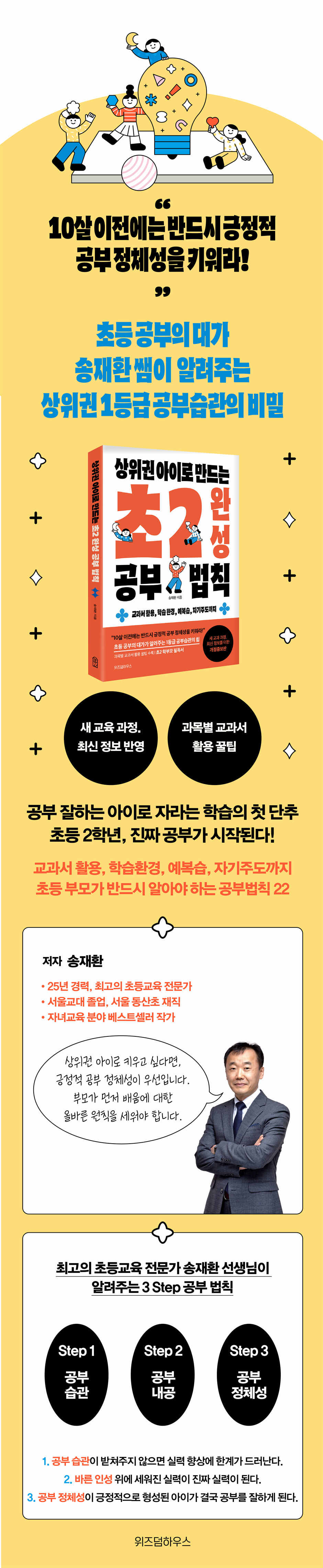
A must-read for parents of elementary school students reflecting the new curriculum. How to Raise a Child with Special Academic Aptitude to Top Rankings Without Private Education Top-tier study tips from Song Jae-hwan, a master of elementary school studies This book is a compilation of only the 'essence of elementary school study methods' written by the author, a leading elementary education expert in Korea. Children who grow up to be 'top tier' children are not created through special academic talent, advanced learning, or excessive private education. Rather, if a child relies on private education without establishing a foundation for self-study habits from the early grades, his or her true abilities will eventually surface. This book contains the author's unique insights into the importance of 'self-directed learning,' 'learning environment,' and 'reading,' which we are all familiar with, as well as 'pre-learning,' 'securing time for play,' and 'relationships with parents.' Parents who feel frustrated and lost about what principles to establish should listen to the 22 rules the author presents in this book. It will be of great help in setting the direction of study needed in the early elementary school years. |
- You can preview some of the book's contents.
Preview
index
prolog
Step 1.
The power of habits that lay the foundation for studying
1.
The Law of Relationships: Your Relationship with Your Parents Affects Your Study Habits
2.
The Law of Environment: A child's surroundings are the source of learning.
3.
The Law of Tidying Up: The Magic of Tidying Up to Improve Your Focus
4.
The Law of the Reservoir: Fill Your Mind's Reservoir with Reading
5.
The Law of Preemptive Failure: Improper Pre-Learning Ruins Children
6.
The Laws of Self-Directed Learning: The Secret to the Longest Study Life
7.
The Law of Play: The Power to Play is the Power to Learn
8.
The Law of Balance: What It Takes to Develop Both the Left and Right Brains Equally
Step 2.
How to Build Lifelong Study Skills
9.
The Law of Patience: The Foundation of Studying Is Patience
10.
The Law of Consideration: Children with High Self-Esteem Do Better in School
11.
The Law of Faith: A parent's faith is the greatest compliment a child can receive.
12.
The Law of Reading Out Loud: What you read out loud is not forgotten.
13.
The Law of Presentation: If you want to raise a child who is recognized by others
Step 3.
2nd Graders: Develop a Positive Study Identity
14.
The Law of Manipulative Activity: What you learn with your body will stay with you.
15.
The Law of Handwriting: Handwriting is a Child's Signature
16.
The Law of Dictation: The Easiest Way to Develop Your Study Identity
17.
The Law of the Diary: Miracles Happen When You Write Every Day
18.
The Laws of Operation: The Computational Skills That Inspire Confidence in Math
19.
The Law of the Snowball: Studying with a Focus on Conceptual Principles is Powerful
20.
The Law of Multiplication Tables: Memorization Isn't Everything, Applying the Principles to Your Study
21.
The Rule of 1, 2, 3: Descriptive Problems, No Longer Difficult
22.
The Law of Weakness: How to avoid making the same mistake again
@ Special appendix.
Tips for 100% Utilization of Second Grade Subject-Specific Textbooks
1.
Uncovering the principles of second-grade textbook composition and use
2.
A Korean language textbook that's great for repeated reading.
3.
The best math textbook for preview and review
4.
An integrated textbook that requires no pre- and post-study.
Step 1.
The power of habits that lay the foundation for studying
1.
The Law of Relationships: Your Relationship with Your Parents Affects Your Study Habits
2.
The Law of Environment: A child's surroundings are the source of learning.
3.
The Law of Tidying Up: The Magic of Tidying Up to Improve Your Focus
4.
The Law of the Reservoir: Fill Your Mind's Reservoir with Reading
5.
The Law of Preemptive Failure: Improper Pre-Learning Ruins Children
6.
The Laws of Self-Directed Learning: The Secret to the Longest Study Life
7.
The Law of Play: The Power to Play is the Power to Learn
8.
The Law of Balance: What It Takes to Develop Both the Left and Right Brains Equally
Step 2.
How to Build Lifelong Study Skills
9.
The Law of Patience: The Foundation of Studying Is Patience
10.
The Law of Consideration: Children with High Self-Esteem Do Better in School
11.
The Law of Faith: A parent's faith is the greatest compliment a child can receive.
12.
The Law of Reading Out Loud: What you read out loud is not forgotten.
13.
The Law of Presentation: If you want to raise a child who is recognized by others
Step 3.
2nd Graders: Develop a Positive Study Identity
14.
The Law of Manipulative Activity: What you learn with your body will stay with you.
15.
The Law of Handwriting: Handwriting is a Child's Signature
16.
The Law of Dictation: The Easiest Way to Develop Your Study Identity
17.
The Law of the Diary: Miracles Happen When You Write Every Day
18.
The Laws of Operation: The Computational Skills That Inspire Confidence in Math
19.
The Law of the Snowball: Studying with a Focus on Conceptual Principles is Powerful
20.
The Law of Multiplication Tables: Memorization Isn't Everything, Applying the Principles to Your Study
21.
The Rule of 1, 2, 3: Descriptive Problems, No Longer Difficult
22.
The Law of Weakness: How to avoid making the same mistake again
@ Special appendix.
Tips for 100% Utilization of Second Grade Subject-Specific Textbooks
1.
Uncovering the principles of second-grade textbook composition and use
2.
A Korean language textbook that's great for repeated reading.
3.
The best math textbook for preview and review
4.
An integrated textbook that requires no pre- and post-study.
Detailed image
Into the book
What's the most powerful enemy that destroys the parent-child relationship? It's the fear of failure.
Most parents think that if their child fails even once, they will be in big trouble.
There are many parents who are anxious about what will happen to their child's life just because they failed to get a perfect score on a dictation test once.
This kind of impatience causes parents to nag their children, and in the process, a rift develops between them.
In fact, when a child is young, these cracks are often so small that they are not easily visible.
But as the child gets older, the rift becomes more severe, and by the time they reach puberty, it has widened to the point where it is impossible for anyone to cross.
---From "The Law of Relationships"
Self-directed learning ability is formed through the process of planning what to do in the given time and then putting it into practice.
It is only natural to make numerous mistakes and experience failure at this time.
This is because it involves correcting mistakes and overcoming failures to find a study method that suits you.
However, if you are obsessed with private education, there are few opportunities to go through this process.
Because the academy schedule is so tight and you only have to study as the academy tells you to, self-directed learning skills are not developed.
---From "The Law of Precedence and Failure"
The biggest difference between children who are good at English and those who are not is their reading skills.
When you ask children who don't speak English to read, they usually have a hard time being patient.
This is because, like a child learning Korean for the first time, they read by pointing at each letter with their hand.
But children who are good at English read fluently.
It is also read by breaking it down into precise units of meaning.
Why does this phenomenon occur? It's because children who are good at English read aloud a lot.
---From "The Law of Reading Out Loud"
The method of memorizing formulas and repeatedly solving problems is more suitable for upperclassmen or middle and high school students.
Forcing children to focus on problem-solving from the early elementary school years is no different from encouraging them to hate math.
In lower grades, you should avoid studying math only in your head as much as possible.
Just because you're learning math through your body doesn't mean you have to start with fancy teaching aids like Gabe.
If parents are willing, they can teach their children math while playing with simple materials such as Go stones, dice, and cards.
Through this, children can not only enjoy math but also develop mathematical sense.
---From "The Law of Manipulative Activity"
The first reason why your scores fluctuate every time you take a test is because of the difficulty of the test.
Math tests are more affected by difficulty than other subjects.
Top-tier children with excellent math skills are relatively less affected by difficulty, but middle- and upper-middle-tier children are greatly affected by difficulty.
Among boys and girls, girls tend to be more affected by difficulty.
Therefore, these children should consistently solve one page of a workbook that they usually find difficult, and acquire a sense of challenge and strategies for overcoming difficult application problems.
Most parents think that if their child fails even once, they will be in big trouble.
There are many parents who are anxious about what will happen to their child's life just because they failed to get a perfect score on a dictation test once.
This kind of impatience causes parents to nag their children, and in the process, a rift develops between them.
In fact, when a child is young, these cracks are often so small that they are not easily visible.
But as the child gets older, the rift becomes more severe, and by the time they reach puberty, it has widened to the point where it is impossible for anyone to cross.
---From "The Law of Relationships"
Self-directed learning ability is formed through the process of planning what to do in the given time and then putting it into practice.
It is only natural to make numerous mistakes and experience failure at this time.
This is because it involves correcting mistakes and overcoming failures to find a study method that suits you.
However, if you are obsessed with private education, there are few opportunities to go through this process.
Because the academy schedule is so tight and you only have to study as the academy tells you to, self-directed learning skills are not developed.
---From "The Law of Precedence and Failure"
The biggest difference between children who are good at English and those who are not is their reading skills.
When you ask children who don't speak English to read, they usually have a hard time being patient.
This is because, like a child learning Korean for the first time, they read by pointing at each letter with their hand.
But children who are good at English read fluently.
It is also read by breaking it down into precise units of meaning.
Why does this phenomenon occur? It's because children who are good at English read aloud a lot.
---From "The Law of Reading Out Loud"
The method of memorizing formulas and repeatedly solving problems is more suitable for upperclassmen or middle and high school students.
Forcing children to focus on problem-solving from the early elementary school years is no different from encouraging them to hate math.
In lower grades, you should avoid studying math only in your head as much as possible.
Just because you're learning math through your body doesn't mean you have to start with fancy teaching aids like Gabe.
If parents are willing, they can teach their children math while playing with simple materials such as Go stones, dice, and cards.
Through this, children can not only enjoy math but also develop mathematical sense.
---From "The Law of Manipulative Activity"
The first reason why your scores fluctuate every time you take a test is because of the difficulty of the test.
Math tests are more affected by difficulty than other subjects.
Top-tier children with excellent math skills are relatively less affected by difficulty, but middle- and upper-middle-tier children are greatly affected by difficulty.
Among boys and girls, girls tend to be more affected by difficulty.
Therefore, these children should consistently solve one page of a workbook that they usually find difficult, and acquire a sense of challenge and strategies for overcoming difficult application problems.
---From "The Law of Weakness"
Publisher's Review
“A book that contains only the essentials of elementary school study methods!”
From textbook utilization to learning environment, previewing and reviewing, and even self-directed learning
22 Study Rules Revealed by Song Jae-hwan, an Elementary Education Master
The book, "The Complete Study Rules for Second Graders to Turn Your Child into a Top-Ranking Student," by Song Jae-hwan, a leading elementary education expert in Korea and author who has taught lower grades in schools for over 25 years, has been published.
This book is a revised and expanded edition of the best-selling book, "Complete Lifelong Study Habits for Second Graders," which received great acclaim upon its publication. Not only does it include a new curriculum and the latest information, but it also enhances the completeness of the book by adding "How to Use Textbooks by Subject."
This book, which contains only the 'essence of elementary school study methods,' argues that instilling proper study principles has a significant impact on a child's long-term learning ability.
If parents do not establish sound principles from the beginning regarding their children's studies, character, and lifestyle habits, they will constantly waver.
If parents are lost and confused, their children will inevitably become confused as well.
The most important task given to parents is to establish sound principles.
Parents who feel frustrated and lost about what principles to establish should definitely listen to the 22 rules the author presents in this book.
Second grade, the real learning begins!
How to Raise a Top-Ranking Child Without Special Aptitude or Advanced Private Education
When their children enter elementary school, many parents worry about whether their children will be able to adapt well to school life.
Because of these concerns, there are dozens of books on the market about preparing for elementary school admission.
So what about second grade? After the first year of adjustment, both children and parents' anxiety about school life gradually diminishes.
If 'adaptation' was the most important keyword in first grade, then the thing to pay the most attention to in second grade is definitely 'learning'.
Unlike the first grade when children were immature and clumsy but still received consideration at school, many things begin to change starting from the second grade.
Homework increases, and there is a big difference in the difficulty of dictation tests.
The author of this book emphasizes that 'real studying begins in the second year.'
This is because the second grade of elementary school is a crucial period for developing habits that will affect a child's entire life, attitudes toward learning, social development, and the formation of a study identity.
This book contains detailed information on the essential elements for a child to grow into a top student, grouped into three keywords: 'study habits', 'study skills', and 'study identity'.
In addition to the well-known importance of 'self-directed learning', 'learning environment', and 'reading', we can also glimpse the author's unique insights into 'pre-learning', 'securing play time', and 'relationships with parents'.
Children who grow up to be top students do not grow up with special academic talent or through excessive private education.
Rather, if a child relies on private education without establishing a foundation for self-study habits from the early grades, his or her true abilities will eventually surface.
Just as a young tree needs strong roots to grow well, it is important to provide a solid and firm foundation for learning for our children to grow well through study.
This book will be of great help in setting the direction for study needed in the second grade of elementary school, when real studying begins.
From textbook utilization to learning environment, previewing and reviewing, and even self-directed learning
22 Study Rules Revealed by Song Jae-hwan, an Elementary Education Master
The book, "The Complete Study Rules for Second Graders to Turn Your Child into a Top-Ranking Student," by Song Jae-hwan, a leading elementary education expert in Korea and author who has taught lower grades in schools for over 25 years, has been published.
This book is a revised and expanded edition of the best-selling book, "Complete Lifelong Study Habits for Second Graders," which received great acclaim upon its publication. Not only does it include a new curriculum and the latest information, but it also enhances the completeness of the book by adding "How to Use Textbooks by Subject."
This book, which contains only the 'essence of elementary school study methods,' argues that instilling proper study principles has a significant impact on a child's long-term learning ability.
If parents do not establish sound principles from the beginning regarding their children's studies, character, and lifestyle habits, they will constantly waver.
If parents are lost and confused, their children will inevitably become confused as well.
The most important task given to parents is to establish sound principles.
Parents who feel frustrated and lost about what principles to establish should definitely listen to the 22 rules the author presents in this book.
Second grade, the real learning begins!
How to Raise a Top-Ranking Child Without Special Aptitude or Advanced Private Education
When their children enter elementary school, many parents worry about whether their children will be able to adapt well to school life.
Because of these concerns, there are dozens of books on the market about preparing for elementary school admission.
So what about second grade? After the first year of adjustment, both children and parents' anxiety about school life gradually diminishes.
If 'adaptation' was the most important keyword in first grade, then the thing to pay the most attention to in second grade is definitely 'learning'.
Unlike the first grade when children were immature and clumsy but still received consideration at school, many things begin to change starting from the second grade.
Homework increases, and there is a big difference in the difficulty of dictation tests.
The author of this book emphasizes that 'real studying begins in the second year.'
This is because the second grade of elementary school is a crucial period for developing habits that will affect a child's entire life, attitudes toward learning, social development, and the formation of a study identity.
This book contains detailed information on the essential elements for a child to grow into a top student, grouped into three keywords: 'study habits', 'study skills', and 'study identity'.
In addition to the well-known importance of 'self-directed learning', 'learning environment', and 'reading', we can also glimpse the author's unique insights into 'pre-learning', 'securing play time', and 'relationships with parents'.
Children who grow up to be top students do not grow up with special academic talent or through excessive private education.
Rather, if a child relies on private education without establishing a foundation for self-study habits from the early grades, his or her true abilities will eventually surface.
Just as a young tree needs strong roots to grow well, it is important to provide a solid and firm foundation for learning for our children to grow well through study.
This book will be of great help in setting the direction for study needed in the second grade of elementary school, when real studying begins.
GOODS SPECIFICS
- Date of issue: February 14, 2024
- Page count, weight, size: 236 pages | 406g | 148*210*23mm
- ISBN13: 9791171711413
- ISBN10: 1171711417
You may also like
카테고리
korean


korean

![GQ KOREA Mark (Monthly): December [2025]](http://librairie.coreenne.fr/cdn/shop/files/8ef265dbbfbf186523ed75ba7319009d.jpg?v=1765340328&width=3840)


