

The Concept Black Label Korean Literature (for 2026)
 |
Description
Book Introduction
A simple study method to understand the work through true or false questions.
"The Concept Black Label Korean Literature": A Plus Basic Book for Grade 1
『The Concept Black Label Korean Literature』 is a basic textbook for advanced Korean language that is designed to help readers understand and apply analytical principles and conceptual terms directly to works.
Knowing a lot of concepts does not lead to skill.
The real skill is reading a work based on the principles of analyzing the work and applying the conceptual language.
Regardless of the work or scene presented, the ability to analyze it in accordance with the question's intent is the key to distinguishing between the mid-level and the top-level.
Therefore, this book implements analytical principles and connects related concepts based on the author's deep insight and long experience.
Additionally, by linking poetry and novels by era, we have enabled a more insightful understanding of literature as a whole.
Above all, each work is specialized in OX problems.
You can thoroughly analyze the work through true or false questions that cover not only the content but also frequently appearing elements in school grades and the college entrance exam, thereby solidifying your literary skills.
"The Concept Black Label Korean Literature": A Plus Basic Book for Grade 1
『The Concept Black Label Korean Literature』 is a basic textbook for advanced Korean language that is designed to help readers understand and apply analytical principles and conceptual terms directly to works.
Knowing a lot of concepts does not lead to skill.
The real skill is reading a work based on the principles of analyzing the work and applying the conceptual language.
Regardless of the work or scene presented, the ability to analyze it in accordance with the question's intent is the key to distinguishing between the mid-level and the top-level.
Therefore, this book implements analytical principles and connects related concepts based on the author's deep insight and long experience.
Additionally, by linking poetry and novels by era, we have enabled a more insightful understanding of literature as a whole.
Above all, each work is specialized in OX problems.
You can thoroughly analyze the work through true or false questions that cover not only the content but also frequently appearing elements in school grades and the college entrance exam, thereby solidifying your literary skills.
- You can preview some of the book's contents.
Preview
index
Part Ⅰ Concept OX
[Chapter 1 Classical Literature]
Lecture 1: Analysis Principles
A.
Principles of classical poetry
B.
Principles of Classical Novels
Lecture 2: Analysis of works by era
A.
Ancient ~ Goryeo
1.
ancient songs
2.
Hyangga
3.
Goryeo songs
B.
Early to mid-Joseon period
1.
father
2.
lyrics
3.
electric novel
C.
Late Joseon Dynasty
1.
father
2.
lyrics
3.
Hero? Military novel
4.
Dream novels
5.
Family novel
6.
romantic novel
7.
satirical novel
8.
Pansori novels
9.
Park Ji-won's Chinese novels
[Chapter 2 Modern Literature]
Lecture 1: Analysis Principles
A.
Principles of Modern Poetry
B.
Principles of Modern Novels
Lecture 2: Analysis of works by era
A.
Japanese colonial period
1.
the suffering of the people
2.
The agony of colonial intellectuals
3.
Criticism of distorted historical perception
4.
A work with a hidden era
B.
Liberation period
1.
The Whirlwind of Liberation - A Time of Chaos
2.
A work with a hidden era
C.
Korean War period
1.
The harsh reality and suffering
2.
Chaos and wandering
3.
A work with a hidden era
D.
Dictatorship and Industrialization Period
1.
Exposing the absurdity of the times
2.
Uprooted people and alienation
3.
A work with a hidden era
Part Ⅱ Mastering the Concept
1 time
2nd time
3 times
[Chapter 1 Classical Literature]
Lecture 1: Analysis Principles
A.
Principles of classical poetry
B.
Principles of Classical Novels
Lecture 2: Analysis of works by era
A.
Ancient ~ Goryeo
1.
ancient songs
2.
Hyangga
3.
Goryeo songs
B.
Early to mid-Joseon period
1.
father
2.
lyrics
3.
electric novel
C.
Late Joseon Dynasty
1.
father
2.
lyrics
3.
Hero? Military novel
4.
Dream novels
5.
Family novel
6.
romantic novel
7.
satirical novel
8.
Pansori novels
9.
Park Ji-won's Chinese novels
[Chapter 2 Modern Literature]
Lecture 1: Analysis Principles
A.
Principles of Modern Poetry
B.
Principles of Modern Novels
Lecture 2: Analysis of works by era
A.
Japanese colonial period
1.
the suffering of the people
2.
The agony of colonial intellectuals
3.
Criticism of distorted historical perception
4.
A work with a hidden era
B.
Liberation period
1.
The Whirlwind of Liberation - A Time of Chaos
2.
A work with a hidden era
C.
Korean War period
1.
The harsh reality and suffering
2.
Chaos and wandering
3.
A work with a hidden era
D.
Dictatorship and Industrialization Period
1.
Exposing the absurdity of the times
2.
Uprooted people and alienation
3.
A work with a hidden era
Part Ⅱ Mastering the Concept
1 time
2nd time
3 times
Detailed image
Publisher's Review
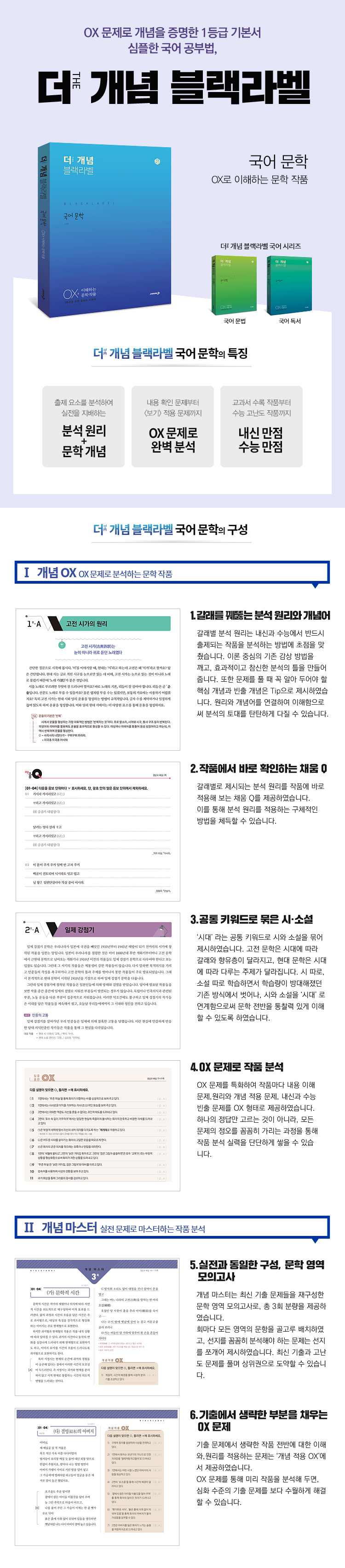
1. The concept is not to be memorized, but to be applied!
- True or False questions that clearly prove the concept
No more separate concepts and separate works! We've organized the concepts so they can be directly applied to the work and understood.
You can apply various concepts to your work by solving true or false problems consisting of content comprehension questions, principle application questions, and questions that frequently appear in school and college entrance exams.
Additionally, you can clearly understand the concept words through true or false questions with clear noon.
2.
The real analysis principle is concrete!
- Effective and novel practical analysis principles
Based on the author's deep insight and extensive experience, the principles of analyzing works that appear in school grades and the college entrance exam have been implemented.
This is not a tired theory of literary appreciation, but an effective and novel analytical principle that prepares you for real-world situations.
We have presented specific analytical principles for reading classical poetry and novels, as well as modern poetry and novels, and have demonstrated the effectiveness of these analytical principles through various examples rather than explanations.
You can also embody the principles through filler Q problems that apply the analytical principles directly to your work.
3.
Weave poetry and novels together based on the times!
- Analysis of works by period, encompassing classical and modern literature.
The works that appear in school reports and the college entrance exam are works that were influenced by the times or had an influence on the times.
So, we subdivided the topics of literary history using 'era' as a keyword and selected and included representative works.
By understanding the themes that inevitably arise in each era, encompassing both classical and contemporary literature, you can gain insight into the works without studying poetry and novels individually.
Meanwhile, works included in the 2015 revised textbooks have been marked separately to facilitate preparation for internal assessments.
- True or False questions that clearly prove the concept
No more separate concepts and separate works! We've organized the concepts so they can be directly applied to the work and understood.
You can apply various concepts to your work by solving true or false problems consisting of content comprehension questions, principle application questions, and questions that frequently appear in school and college entrance exams.
Additionally, you can clearly understand the concept words through true or false questions with clear noon.
2.
The real analysis principle is concrete!
- Effective and novel practical analysis principles
Based on the author's deep insight and extensive experience, the principles of analyzing works that appear in school grades and the college entrance exam have been implemented.
This is not a tired theory of literary appreciation, but an effective and novel analytical principle that prepares you for real-world situations.
We have presented specific analytical principles for reading classical poetry and novels, as well as modern poetry and novels, and have demonstrated the effectiveness of these analytical principles through various examples rather than explanations.
You can also embody the principles through filler Q problems that apply the analytical principles directly to your work.
3.
Weave poetry and novels together based on the times!
- Analysis of works by period, encompassing classical and modern literature.
The works that appear in school reports and the college entrance exam are works that were influenced by the times or had an influence on the times.
So, we subdivided the topics of literary history using 'era' as a keyword and selected and included representative works.
By understanding the themes that inevitably arise in each era, encompassing both classical and contemporary literature, you can gain insight into the works without studying poetry and novels individually.
Meanwhile, works included in the 2015 revised textbooks have been marked separately to facilitate preparation for internal assessments.
GOODS SPECIFICS
- Date of issue: January 15, 2020
- Page count, weight, size: 592 pages | 1,058g | 188*257mm
- ISBN13: 9788960764736
- ISBN10: 8960764736
You may also like
카테고리
korean


korean

![GQ KOREA Mark (Monthly): December [2025]](http://librairie.coreenne.fr/cdn/shop/files/8ef265dbbfbf186523ed75ba7319009d.jpg?v=1765340328&width=3840)


