

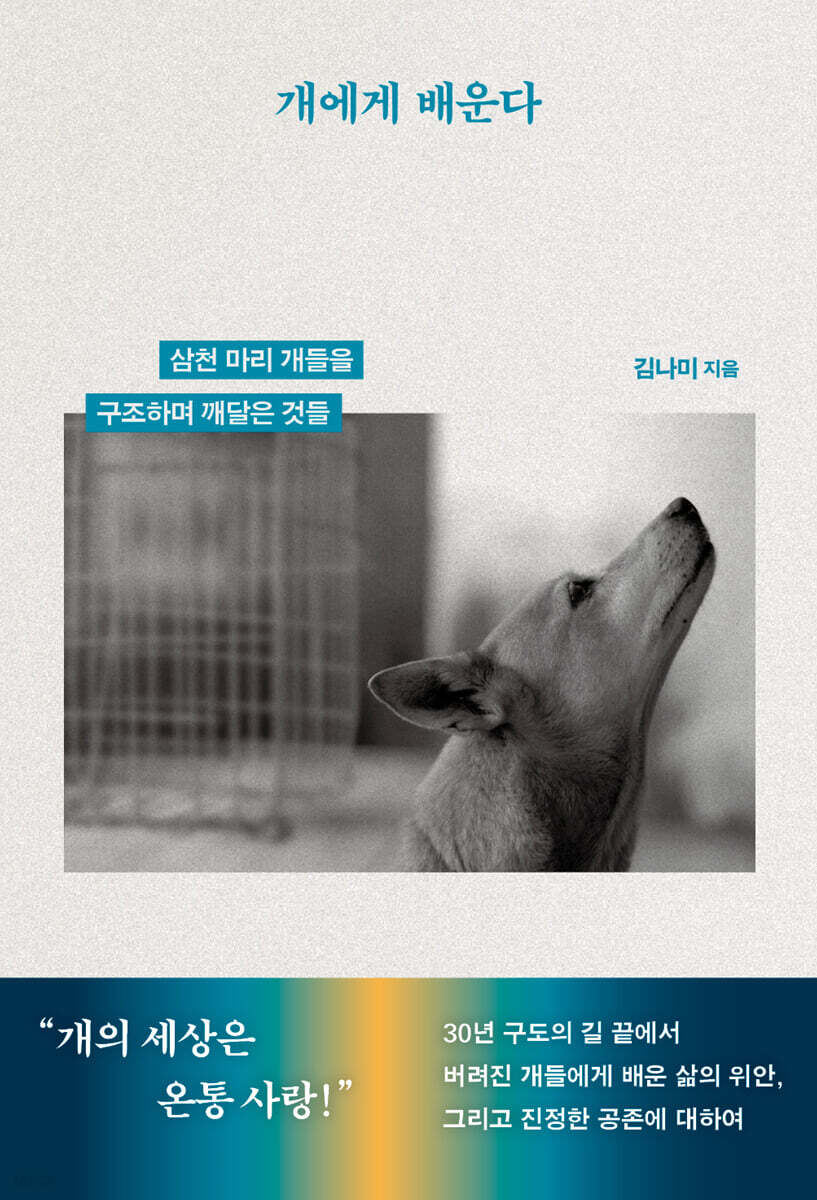
Learn from dogs
 |
Description
Book Introduction
“The dog’s world is full of love!”
Ten years under one roof with wounded dogs,
Moments of love and hope blossom at a dog shelter.
A religious scholar who served as a researcher in the Department of Religious Studies at Stanford University and a visiting professor in the Department of Religious Studies at Hanshin University suddenly founded a dog shelter and rescued 3,000 dogs, and his book, "Learning from Dogs," has been published by Panmi-dong.
The author of this book, Kim Na-mi, has been studying and teaching religious studies both domestically and internationally for over 30 years, seeking to awaken people to the "truth" of the meaning of life and true happiness.
Then, after a fateful encounter with Bodhi, a dog with a disability, in Thailand in 2012, he established a shelter for abandoned dogs in Gimpo in 2016 and dedicated himself to animal protection activities, saving thousands of dogs and helping them find families.
The dogs the author met were abused souls who barely managed to survive on the streets, in dog farms, and in slaughterhouses.
However, they do not exist only as fragile objects of care, but rather provide people with deep comfort and love.
Moreover, it personally demonstrates unconditional giving, complete presence, happiness without possessions, and true humanity.
As we follow the journey of shared joys and sorrows with dogs through this book, we discover that even the lowest of beings has something to teach us, and that the answers we've been searching for our entire lives are actually right here with us.
Furthermore, as we stand in the midst of changes such as the implementation of the dog meat consumption ban, the author's insights, born from 13 years of experience in animal protection activities, provide a glimpse into the path we must take to achieve true coexistence with non-human animals.
Ten years under one roof with wounded dogs,
Moments of love and hope blossom at a dog shelter.
A religious scholar who served as a researcher in the Department of Religious Studies at Stanford University and a visiting professor in the Department of Religious Studies at Hanshin University suddenly founded a dog shelter and rescued 3,000 dogs, and his book, "Learning from Dogs," has been published by Panmi-dong.
The author of this book, Kim Na-mi, has been studying and teaching religious studies both domestically and internationally for over 30 years, seeking to awaken people to the "truth" of the meaning of life and true happiness.
Then, after a fateful encounter with Bodhi, a dog with a disability, in Thailand in 2012, he established a shelter for abandoned dogs in Gimpo in 2016 and dedicated himself to animal protection activities, saving thousands of dogs and helping them find families.
The dogs the author met were abused souls who barely managed to survive on the streets, in dog farms, and in slaughterhouses.
However, they do not exist only as fragile objects of care, but rather provide people with deep comfort and love.
Moreover, it personally demonstrates unconditional giving, complete presence, happiness without possessions, and true humanity.
As we follow the journey of shared joys and sorrows with dogs through this book, we discover that even the lowest of beings has something to teach us, and that the answers we've been searching for our entire lives are actually right here with us.
Furthermore, as we stand in the midst of changes such as the implementation of the dog meat consumption ban, the author's insights, born from 13 years of experience in animal protection activities, provide a glimpse into the path we must take to achieve true coexistence with non-human animals.
- You can preview some of the book's contents.
Preview
index
Prologue - 2
Preface - 20
Chapter 1 - My Long-Haired Teachers
How did you come to me? - 25
The First Masters - 29
A Promise with Body, the Beginning of the Shelter - 35
Dogs Become Interviewers - 44
A Brief Encounter, Eternal Resonance - 48
The answers to life are always at our feet - 54
Chapter 2 - Learning from Dogs
The Aesthetics of Moderation - 67
In Search of Lost Humanity - 74
Unwavering Faith - 78
Here and Now, Just As It Is - 88
Ending a Lifelong Thirst - 93
Chapter 3 - A Heart That Communicates Without Speaking
Listening to the Language of Dogs - 101
Sometimes Silence Is the Greatest Comfort - 107
The Third Eye that Sees Within - 111
I Know Nothing But Love - 116
Communication Beyond the Five Senses - 121
Chapter 4 - Love, Responsibility, and Living Together
"Bok-Hap" is better than "Happiness" - 129
Adoption is a Blessing of Fate - 132
Just as man cannot live by bread alone - 137
First Generation International Adoption - 143
Family Found Across the Sea - 149
Petros and Human Loss - 156
The Joy That Grows When You Share - 162
Chapter 5 - For Better Coexistence
Shadows of Animal Abuse - 171
Lives Raised to Be Eaten - 177
Is there any obedience here? - 184
Dog-Eating Country - 190
A City Without Dogintang - 195
Blind Spots in Animal Protection Administration - 202
Animal Welfare Lessons from the UK and Germany - 211
Conclusion - 217
Acknowledgments - 221
Source - 227
Preface - 20
Chapter 1 - My Long-Haired Teachers
How did you come to me? - 25
The First Masters - 29
A Promise with Body, the Beginning of the Shelter - 35
Dogs Become Interviewers - 44
A Brief Encounter, Eternal Resonance - 48
The answers to life are always at our feet - 54
Chapter 2 - Learning from Dogs
The Aesthetics of Moderation - 67
In Search of Lost Humanity - 74
Unwavering Faith - 78
Here and Now, Just As It Is - 88
Ending a Lifelong Thirst - 93
Chapter 3 - A Heart That Communicates Without Speaking
Listening to the Language of Dogs - 101
Sometimes Silence Is the Greatest Comfort - 107
The Third Eye that Sees Within - 111
I Know Nothing But Love - 116
Communication Beyond the Five Senses - 121
Chapter 4 - Love, Responsibility, and Living Together
"Bok-Hap" is better than "Happiness" - 129
Adoption is a Blessing of Fate - 132
Just as man cannot live by bread alone - 137
First Generation International Adoption - 143
Family Found Across the Sea - 149
Petros and Human Loss - 156
The Joy That Grows When You Share - 162
Chapter 5 - For Better Coexistence
Shadows of Animal Abuse - 171
Lives Raised to Be Eaten - 177
Is there any obedience here? - 184
Dog-Eating Country - 190
A City Without Dogintang - 195
Blind Spots in Animal Protection Administration - 202
Animal Welfare Lessons from the UK and Germany - 211
Conclusion - 217
Acknowledgments - 221
Source - 227
Detailed image

Into the book
What I had been searching for for a long time from books, teachers, and through my own practice was nothing special.
It was the dogs by my side that gave me this realization.
Living with dogs has helped me discover the meaning of life, and I am now comfortably settled, without the thirst I once felt.
So the moments when I reached out to the dogs were actually the moments that saved my soul.
--- p.28
When I try to recall all the memories I can recall, some appear fragmentarily and then disappear, while others appear so vividly that it makes the long years seem colorless.
What is certain is that the times I lived without a dog felt like I was wandering in the dark.
--- p.34
Ten days after being discharged from the hospital, Aisha closed her eyes in my arms, breathing her last peacefully and comfortably at dawn.
Aisha herself seemed to have sensed death and seemed to have given up, but she did not seem to fear it.
They say that Pavo's pain is immense, but after seeing Aisha leave without making a sound, I couldn't say that I was in pain even though I was in pain.
This is also something I learned from animals.
--- p.51
Whether they passed me by briefly or remained in my heart forever, dogs have provided indescribable enlightenment, reminded me of things I had forgotten, or given me food for reflection.
I wonder how I ever looked outside for answers until I realized that a great teacher was right next to me.
Perhaps the act of searching itself was the purpose.
After I brought my gaze closer, both my thirst and my wandering ended.
--- p.54
Santu is now an old dog.
I'm old now, but time passes seven times faster for a dog.
My eyes are blurry, my legs are weak, and Santu is losing a lot of hair.
It feels like a subtle emotion, as if the child, whose body was covered by long hair and could not die, is naturally letting go of the hair.
Santu is one of the teachers who taught me 'to act as if I have everything even though I have nothing'.
grow.
--- pp.62-63
I was about to close my eyes and pass by the shelter, which was so full it was hard to handle, but then I remembered Cheonwoon's desperate eyes and ended up cleaning up the place and bringing the dogs home.
The deep friendship between Cheonwoon and his dead friend continues to save other dogs.
--- p.81
Dogs show us that we can be happy without ownership, that we can be fulfilled without being attached.
As I observe dogs, I find myself becoming my own observer.
The apathy and shamelessness revealed in dogs
It is a reflection on the state of ownership for me.
It has gotten to the point where it is okay if it is there and okay if it is not there.
The world goes on just fine even if you don't own much.
When you let go and take less, your body and mind become lighter.
--- p.86
The most important thing is to simply accompany each other and enjoy the ‘being together’ itself.
When you visit the home of an acquaintance you have a crush on, you often find that the dog and its owner have similar faces.
This may be because their emotions and feelings are naturally transferred to each other.
(·····) It is no exaggeration to say that it is a blessing of fate that a person and a dog who do not know each other at all and have nothing in common meet and form a family.
--- p.136
The first section of our shelter's application form asks you to write the name of the dog you wish to adopt.
Once, I received an application that said "The most suffered" instead of a name.
The applicant, Douglas, an oil company engineer living in Michigan, has been observing children rescued from the most horrific environments every year since 2016, and when no one comes forward to adopt them, he takes them in for adoption.
--- p.152
There is a pain of separation that only those who have lost several companion dogs since childhood know.
I, too, have vowed several times that I will never raise one again.
But the reason I always fall apart is not only because there are so many children who need help, but also because the memories of laughter and pain we shared together bring me back.
--- p.156
A child named Shane's beloved dog is on the brink of death.
When the vet nearby tried to comfort Shane, Shane responded:
“People are born to learn how to live a good life.
To learn how to love and be kind to others.
But dogs know everything.
So there is no need to stay long.”
--- p.158
Birth, aging, illness, and death are natural processes, but the feeling of loss from losing a pet that was more precious than anything else is completely normal.
But if this sadness lasts too long, it becomes a wound to both souls.
One day, while I was feeling indescribably sad because my children had suddenly left me before I could even give them a warm hug, a thought suddenly occurred to me.
If I just cried, would the dog that left be happy? So I decided to create a soul tether.
--- p.158
As I see the trauma gradually disappear and the dark face gradually brighten, I feel a sense of pride that I have brought joy to that child, even if only for a moment.
But that satisfaction is qualitatively different from the fleeting joys of this world.
I called this, which has no equal, 'empty fullness.'
--- p.162
Besides breeding farms and auction houses, there are people who make money by exploiting poor animals.
Since 2020, places that advertise themselves as shelters but are actually pet shops have been popping up like mushrooms.
If you go there because it says 'free distribution', they ask for a certain amount of money.
Dogs that are not sold for more than 15 days are returned to the auction house and re-bid at a lower price, and pet shops disguised as shelters use these dogs to make a profit.
--- p.174
Although dogs are included in the list of livestock under the Livestock Act, they were a blind spot as they were not included in the sanitary management target of the Ministry of Food and Drug Safety.
There was even a day when I had no choice but to watch a dog farm owner dismember a dog because my report was not properly received.
When cold or hot weather came, I worried about the safety of the dogs in the stray dogs, and from the first to the last days of the hottest days of summer, I had nightmares about the screams of dogs being killed.
--- p.195
The few dogs that remained as long-haired teachers guided me through each chapter of my life, and thanks to them, I was able to live without being swayed by joys and sorrows.
This has been a great blessing in this life, and it is no exaggeration to say that the dog has truly raised me to this age.
--- p.217
It felt like my body was screaming that the ten years I had spent in such a tense state had been too long.
The doctor advised me not to witness any more horrific scenes of animal abuse.
But how can I stop?
It is my mission to free even just one animal from its leash and cage.
--- pp.218-219
So, with a heart that asks for forgiveness from the dogs, I plan to spend the rest of my time volunteering at a hospice, staying by the side of children who don't have much time left to live.
Having found my way through life thanks to my companionship with dogs, I can't help but be grateful that I still have the opportunity to provide much-needed care to dogs in the rest of my life.
It was the dogs by my side that gave me this realization.
Living with dogs has helped me discover the meaning of life, and I am now comfortably settled, without the thirst I once felt.
So the moments when I reached out to the dogs were actually the moments that saved my soul.
--- p.28
When I try to recall all the memories I can recall, some appear fragmentarily and then disappear, while others appear so vividly that it makes the long years seem colorless.
What is certain is that the times I lived without a dog felt like I was wandering in the dark.
--- p.34
Ten days after being discharged from the hospital, Aisha closed her eyes in my arms, breathing her last peacefully and comfortably at dawn.
Aisha herself seemed to have sensed death and seemed to have given up, but she did not seem to fear it.
They say that Pavo's pain is immense, but after seeing Aisha leave without making a sound, I couldn't say that I was in pain even though I was in pain.
This is also something I learned from animals.
--- p.51
Whether they passed me by briefly or remained in my heart forever, dogs have provided indescribable enlightenment, reminded me of things I had forgotten, or given me food for reflection.
I wonder how I ever looked outside for answers until I realized that a great teacher was right next to me.
Perhaps the act of searching itself was the purpose.
After I brought my gaze closer, both my thirst and my wandering ended.
--- p.54
Santu is now an old dog.
I'm old now, but time passes seven times faster for a dog.
My eyes are blurry, my legs are weak, and Santu is losing a lot of hair.
It feels like a subtle emotion, as if the child, whose body was covered by long hair and could not die, is naturally letting go of the hair.
Santu is one of the teachers who taught me 'to act as if I have everything even though I have nothing'.
grow.
--- pp.62-63
I was about to close my eyes and pass by the shelter, which was so full it was hard to handle, but then I remembered Cheonwoon's desperate eyes and ended up cleaning up the place and bringing the dogs home.
The deep friendship between Cheonwoon and his dead friend continues to save other dogs.
--- p.81
Dogs show us that we can be happy without ownership, that we can be fulfilled without being attached.
As I observe dogs, I find myself becoming my own observer.
The apathy and shamelessness revealed in dogs
It is a reflection on the state of ownership for me.
It has gotten to the point where it is okay if it is there and okay if it is not there.
The world goes on just fine even if you don't own much.
When you let go and take less, your body and mind become lighter.
--- p.86
The most important thing is to simply accompany each other and enjoy the ‘being together’ itself.
When you visit the home of an acquaintance you have a crush on, you often find that the dog and its owner have similar faces.
This may be because their emotions and feelings are naturally transferred to each other.
(·····) It is no exaggeration to say that it is a blessing of fate that a person and a dog who do not know each other at all and have nothing in common meet and form a family.
--- p.136
The first section of our shelter's application form asks you to write the name of the dog you wish to adopt.
Once, I received an application that said "The most suffered" instead of a name.
The applicant, Douglas, an oil company engineer living in Michigan, has been observing children rescued from the most horrific environments every year since 2016, and when no one comes forward to adopt them, he takes them in for adoption.
--- p.152
There is a pain of separation that only those who have lost several companion dogs since childhood know.
I, too, have vowed several times that I will never raise one again.
But the reason I always fall apart is not only because there are so many children who need help, but also because the memories of laughter and pain we shared together bring me back.
--- p.156
A child named Shane's beloved dog is on the brink of death.
When the vet nearby tried to comfort Shane, Shane responded:
“People are born to learn how to live a good life.
To learn how to love and be kind to others.
But dogs know everything.
So there is no need to stay long.”
--- p.158
Birth, aging, illness, and death are natural processes, but the feeling of loss from losing a pet that was more precious than anything else is completely normal.
But if this sadness lasts too long, it becomes a wound to both souls.
One day, while I was feeling indescribably sad because my children had suddenly left me before I could even give them a warm hug, a thought suddenly occurred to me.
If I just cried, would the dog that left be happy? So I decided to create a soul tether.
--- p.158
As I see the trauma gradually disappear and the dark face gradually brighten, I feel a sense of pride that I have brought joy to that child, even if only for a moment.
But that satisfaction is qualitatively different from the fleeting joys of this world.
I called this, which has no equal, 'empty fullness.'
--- p.162
Besides breeding farms and auction houses, there are people who make money by exploiting poor animals.
Since 2020, places that advertise themselves as shelters but are actually pet shops have been popping up like mushrooms.
If you go there because it says 'free distribution', they ask for a certain amount of money.
Dogs that are not sold for more than 15 days are returned to the auction house and re-bid at a lower price, and pet shops disguised as shelters use these dogs to make a profit.
--- p.174
Although dogs are included in the list of livestock under the Livestock Act, they were a blind spot as they were not included in the sanitary management target of the Ministry of Food and Drug Safety.
There was even a day when I had no choice but to watch a dog farm owner dismember a dog because my report was not properly received.
When cold or hot weather came, I worried about the safety of the dogs in the stray dogs, and from the first to the last days of the hottest days of summer, I had nightmares about the screams of dogs being killed.
--- p.195
The few dogs that remained as long-haired teachers guided me through each chapter of my life, and thanks to them, I was able to live without being swayed by joys and sorrows.
This has been a great blessing in this life, and it is no exaggeration to say that the dog has truly raised me to this age.
--- p.217
It felt like my body was screaming that the ten years I had spent in such a tense state had been too long.
The doctor advised me not to witness any more horrific scenes of animal abuse.
But how can I stop?
It is my mission to free even just one animal from its leash and cage.
--- pp.218-219
So, with a heart that asks for forgiveness from the dogs, I plan to spend the rest of my time volunteering at a hospice, staying by the side of children who don't have much time left to live.
Having found my way through life thanks to my companionship with dogs, I can't help but be grateful that I still have the opportunity to provide much-needed care to dogs in the rest of my life.
--- p.219
Publisher's Review
“Dogs are better than people······”
Discovering life's wisdom from wounded beings
In 『Learning from Dogs』, the characters are not the small and cute puppies we often see in the media, but mainly so-called 'mutts' and 'large dogs' that are waiting to be euthanized in shelters because they cannot find adopters.
Yet, with each moment spent with the neglected dogs, the author finds solace in them and realizes the precious truth that what he had sought through academic approaches and practice was not in a higher realm.
For example, from Milky, who was thrown into a cauldron and dramatically escaped, we learn incredible patience; from Bodhi, who was swept away by the river because he was born unable to use his hind legs, we learn a joy that cannot be felt anywhere else; from the brothers Polo and Striker, who ate food scraps in a narrow iron cage, we learn altruism; and from Santo, who was nothing but skin and bones, we learn the secret to being happy without possessions.
In the end, the author says, “The moments when I reached out to the dogs were actually the moments that saved my soul,” and confesses that the lives of the lowest class taught him the truth that he had been unable to reach even after a long period of learning.
This book, filled with vivid experiences, offers those seeking the true meaning of life the simple yet profound wisdom of the small beings right next to us, rather than difficult theories.
“Dogs are not food!”
Two Years to Completely Abolish Dog Meat Consumption: A New Look at Our Relationship with Nonhuman Animals
While studying abroad in the United States, the author was subjected to the prejudice that he came from a 'dog-eating country'.
In order to prevent this stigma from being passed on to the next generation, he began animal protection activities in 2012 and later established the non-profit organization 'Save Korean Dogs' and an abandoned dog shelter.
When we receive reports of dog farms or abuse, we rush to rescue and bring the dogs back, and for Jindo mixes and Tosa dogs that are difficult to adopt domestically, we find lifelong families in the United States and Canada.
Also, in early summer, when the most dogs die, we held protests with volunteers in front of dog meat markets, dog meat auction houses, and the National Assembly, and in order to change long-term awareness, we expanded the 'Dog Meat Free City' project that we started in 2015 with Bucheon City to various places including Jeonju, Ansan, Gunsan, and Namyangju, and continued it for six years.
He felt helpless every day due to the physical threats from those involved in the dog meat culture and the inadequate animal protection laws, but instead of becoming discouraged, he continued to seek new breakthroughs.
In this book, "Learning from Dogs," the author, based on 13 years of experience, diagnoses the current problems with animal welfare in Korea and suggests solutions for a society that lives together with dogs.
Improvements such as appointing local animal protection supervisors, prohibiting abusers from re-owning animals, and providing proactive alternatives for those involved in the dog meat industry are the result of field experience.
Above all, the author emphasizes the need for a fundamental change in our society's perspective on life, not just legal action.
At a historic turning point, with a pet population of 15 million and the imminent implementation of a ban on dog meat consumption, this book presents practical solutions for advancing toward a world leader in animal welfare, along with the future of coexistence we should strive for.
Discovering life's wisdom from wounded beings
In 『Learning from Dogs』, the characters are not the small and cute puppies we often see in the media, but mainly so-called 'mutts' and 'large dogs' that are waiting to be euthanized in shelters because they cannot find adopters.
Yet, with each moment spent with the neglected dogs, the author finds solace in them and realizes the precious truth that what he had sought through academic approaches and practice was not in a higher realm.
For example, from Milky, who was thrown into a cauldron and dramatically escaped, we learn incredible patience; from Bodhi, who was swept away by the river because he was born unable to use his hind legs, we learn a joy that cannot be felt anywhere else; from the brothers Polo and Striker, who ate food scraps in a narrow iron cage, we learn altruism; and from Santo, who was nothing but skin and bones, we learn the secret to being happy without possessions.
In the end, the author says, “The moments when I reached out to the dogs were actually the moments that saved my soul,” and confesses that the lives of the lowest class taught him the truth that he had been unable to reach even after a long period of learning.
This book, filled with vivid experiences, offers those seeking the true meaning of life the simple yet profound wisdom of the small beings right next to us, rather than difficult theories.
“Dogs are not food!”
Two Years to Completely Abolish Dog Meat Consumption: A New Look at Our Relationship with Nonhuman Animals
While studying abroad in the United States, the author was subjected to the prejudice that he came from a 'dog-eating country'.
In order to prevent this stigma from being passed on to the next generation, he began animal protection activities in 2012 and later established the non-profit organization 'Save Korean Dogs' and an abandoned dog shelter.
When we receive reports of dog farms or abuse, we rush to rescue and bring the dogs back, and for Jindo mixes and Tosa dogs that are difficult to adopt domestically, we find lifelong families in the United States and Canada.
Also, in early summer, when the most dogs die, we held protests with volunteers in front of dog meat markets, dog meat auction houses, and the National Assembly, and in order to change long-term awareness, we expanded the 'Dog Meat Free City' project that we started in 2015 with Bucheon City to various places including Jeonju, Ansan, Gunsan, and Namyangju, and continued it for six years.
He felt helpless every day due to the physical threats from those involved in the dog meat culture and the inadequate animal protection laws, but instead of becoming discouraged, he continued to seek new breakthroughs.
In this book, "Learning from Dogs," the author, based on 13 years of experience, diagnoses the current problems with animal welfare in Korea and suggests solutions for a society that lives together with dogs.
Improvements such as appointing local animal protection supervisors, prohibiting abusers from re-owning animals, and providing proactive alternatives for those involved in the dog meat industry are the result of field experience.
Above all, the author emphasizes the need for a fundamental change in our society's perspective on life, not just legal action.
At a historic turning point, with a pet population of 15 million and the imminent implementation of a ban on dog meat consumption, this book presents practical solutions for advancing toward a world leader in animal welfare, along with the future of coexistence we should strive for.
GOODS SPECIFICS
- Date of issue: June 5, 2025
- Page count, weight, size: 228 pages | 314g | 128*188*20mm
- ISBN13: 9791170526186
- ISBN10: 1170526187
You may also like
카테고리
korean


korean

![GQ KOREA Mark (Monthly): December [2025]](http://librairie.coreenne.fr/cdn/shop/files/8ef265dbbfbf186523ed75ba7319009d.jpg?v=1765340328&width=3840)


