

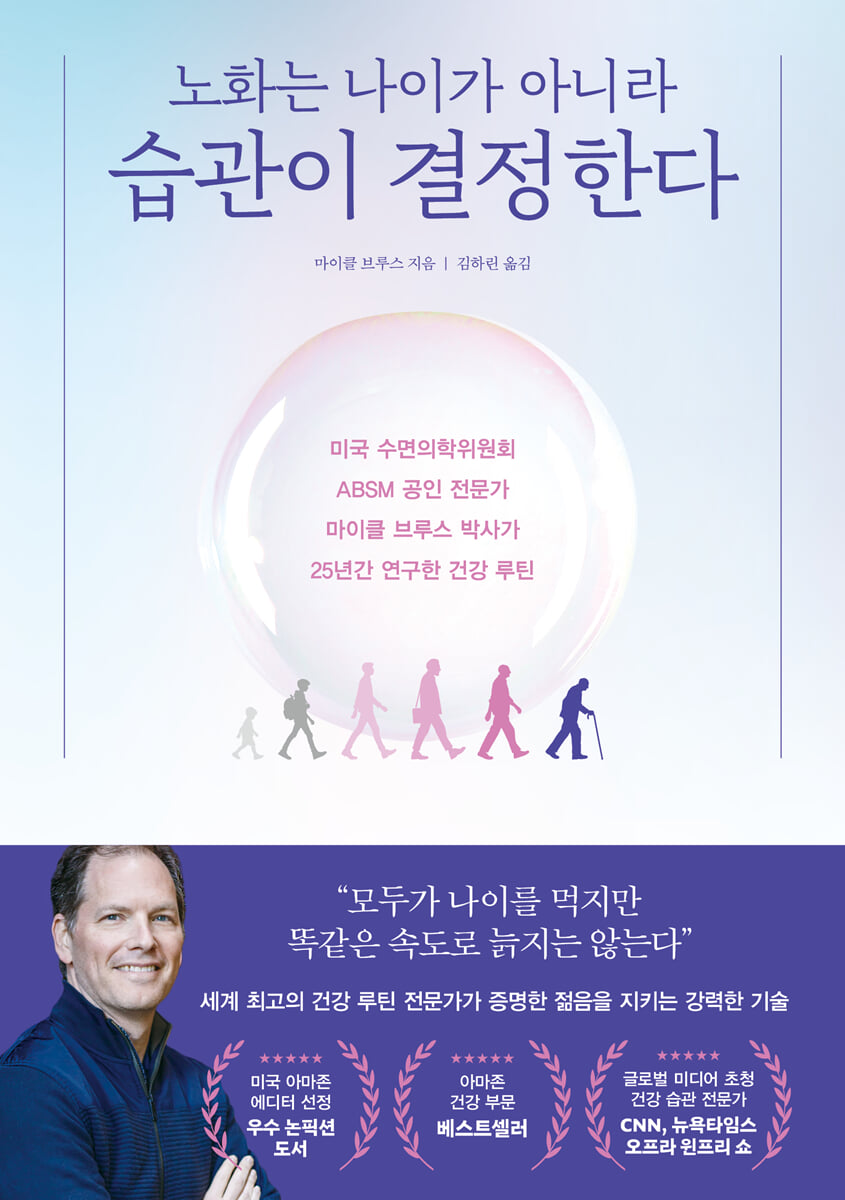
Aging is determined by habits, not age.
 |
Description
Book Introduction
“Everyone gets older,
“We don’t age at the same rate”
Powerful techniques to maintain youthfulness, proven by the world's leading health routine experts.
★★★ Amazon Editors' Choice Best Nonfiction Books ★★★
★★★ Amazon Health Bestseller ★★★
★★★ Global Media Invitation: Health Habits Expert 〈CNN〉 〈The New York Times〉 〈The Oprah Winfrey Show〉 ★★★
“If the basics change, everything changes.” In an era where dozens of health information are released every day, what truly matters is the “basics.”
In this book, world-renowned sleep expert Dr. Michael Bruce proposes a simple and powerful daily health routine that is more effective than any other program.
Sleep, hydration, breathing.
These three things, which everyone knows but most people don't do properly, are actually the most fundamental factors that determine human physiology and quality of life.
Drawing on 25 years of research and clinical experience with over 20,000 patients, the author offers readers concrete practical tips for effectively utilizing three daily routines.
In particular, this book is structured around methods that can be put into practice starting today, without complicated theories or expensive items.
The first half of each part explains why sleep, hydration, and breathing are important, the middle part helps you check your current status using an assessment tool, and the second half guides you through a personalized routine.
This book speaks to those who are tired of the endless health information, those who have given up before even starting, and those who lack the money and energy to do more.
“Don’t force yourself to start something you’ve never done before, but just do what you’ve been doing every day.” Simple changes will be the surest starting point for aging ‘slowly’ and ‘healthily.’
“We don’t age at the same rate”
Powerful techniques to maintain youthfulness, proven by the world's leading health routine experts.
★★★ Amazon Editors' Choice Best Nonfiction Books ★★★
★★★ Amazon Health Bestseller ★★★
★★★ Global Media Invitation: Health Habits Expert 〈CNN〉 〈The New York Times〉 〈The Oprah Winfrey Show〉 ★★★
“If the basics change, everything changes.” In an era where dozens of health information are released every day, what truly matters is the “basics.”
In this book, world-renowned sleep expert Dr. Michael Bruce proposes a simple and powerful daily health routine that is more effective than any other program.
Sleep, hydration, breathing.
These three things, which everyone knows but most people don't do properly, are actually the most fundamental factors that determine human physiology and quality of life.
Drawing on 25 years of research and clinical experience with over 20,000 patients, the author offers readers concrete practical tips for effectively utilizing three daily routines.
In particular, this book is structured around methods that can be put into practice starting today, without complicated theories or expensive items.
The first half of each part explains why sleep, hydration, and breathing are important, the middle part helps you check your current status using an assessment tool, and the second half guides you through a personalized routine.
This book speaks to those who are tired of the endless health information, those who have given up before even starting, and those who lack the money and energy to do more.
“Don’t force yourself to start something you’ve never done before, but just do what you’ve been doing every day.” Simple changes will be the surest starting point for aging ‘slowly’ and ‘healthily.’
- You can preview some of the book's contents.
Preview
index
Preface - Wow, getting healthy is so complicated!
Domino One [Sleep]
Chapter 1: The Truth About Sleep
Chapter 2 Sleep Assessment Tools
Chapter 3: Analyzing and Solving Sleep Problems
Chapter 4: Sleep Optimization Strategies
Domino Two [hydration]
Chapter 5: The Truth About Water Intake
Chapter 6: Fluid Intake Assessment Tool
Chapter 7: Analyzing and Solving Water Intake Problems
Chapter 8: Optimizing Water Intake Strategies
Domino Set [Breathing]
Chapter 9: The Truth About Breathing
Chapter 10 Respiratory Assessment Tools
Chapter 11: Analyzing and Solving Breathing Problems
Chapter 12: Breathing Optimization Strategies
Chapter 13: Coordinating Sleep, Hydration, and Breathing
Practical Guide - Sleep-Hydration-Breathing Plan
Domino One [Sleep]
Chapter 1: The Truth About Sleep
Chapter 2 Sleep Assessment Tools
Chapter 3: Analyzing and Solving Sleep Problems
Chapter 4: Sleep Optimization Strategies
Domino Two [hydration]
Chapter 5: The Truth About Water Intake
Chapter 6: Fluid Intake Assessment Tool
Chapter 7: Analyzing and Solving Water Intake Problems
Chapter 8: Optimizing Water Intake Strategies
Domino Set [Breathing]
Chapter 9: The Truth About Breathing
Chapter 10 Respiratory Assessment Tools
Chapter 11: Analyzing and Solving Breathing Problems
Chapter 12: Breathing Optimization Strategies
Chapter 13: Coordinating Sleep, Hydration, and Breathing
Practical Guide - Sleep-Hydration-Breathing Plan
Detailed image

Into the book
We don't have to follow health trends or worry about missing out.
By going back to basics and understanding the fundamental principles of health, you can create an environment within your body that restores your health and promotes well-being, often for free or at a low cost.
There are a few simple biological functions or behaviors that we must perform several times every day, and if we do them properly, we can achieve overall health.
What if I told you that the secret to achieving real, long-term health could be boiled down to just three things (I like that word because it somehow feels so achievable)? These three fundamental biological behaviors are essential to sustaining life, impact our entire body, and are within our control: sleep, hydration, and breathing.
If everyone focused on just these three things instead of trawling through all the gadgets, devices, lotions, and health drinks the health industry has to offer, we'd all be well.
--- p.6, 「Preface.
"Wow, it's so complicated to get healthy once!"
Carnegie Mellon University conducted a study on sleep and immunity in 153 healthy adults aged 21 to 55.
Subjects self-reported how long they slept, how well they slept, and how relieved they felt for 14 consecutive days.
The researchers then isolated the subjects in a laboratory and administered nasal drops containing a common cold virus.
Then, subjects who slept an average of seven hours a day were three times more likely to cough or sneeze than those who slept eight hours.
A difference of just one hour can make the difference between catching a cold and not.
A 2017 UCLA study found that just four hours of sleep per night can reduce the motility of natural killer cells (immune cells that fight cancer) by up to 72 percent.
Other studies suggest that short sleep duration increases the risk of diabetes, high blood pressure, cardiovascular disease, and obesity.
--- p.81, Chapter 3.
From “Analyzing and Solving Sleep Problems”
Circadian rhythms are an important clue to understanding a person's chronotype, the genetic predisposition that determines whether they are an early riser, a late riser, or somewhere in between.
Knowing your chronotype will help you figure out the best time of day to do whatever you do.
Through studying and meeting thousands of patients, I've discovered four chronotypes, each characterized by their own unique hormonal fluctuations, tendencies, and lifestyles.
If you want to know what your chronotype is, you can take a test at the website chronoquiz.com.
So far, over 2 million people have taken a simple quiz to find out their chronotype.
Just realizing your unique genetic makeup can change your life.
In particular, you may find the key to solving sleep problems.
--- p.88, Chapter 3.
From “Analyzing and Solving Sleep Problems”
Losing just 2 percent of your body weight in water can affect concentration, memory, executive function, and energy levels in both men and women.
What happens to your test scores if you don't drink water for a full day and a half before an important exam? A 2019 Chinese study explored this very question.
Subjects took a math test after eating enough food but drinking no water for 36 hours.
The results were not good.
Not only did the error rate increase and concentration decrease, but symptoms of 'low energy (everything felt burdensome)' and 'low mood (feeling bad)' also appeared.
After rehydrating and retaking the test an hour later, scores improved overall.
--- p.186, Chapter 7.
From “Analyzing and Solving Sleep Problems”
Meanwhile, the idea that you should drink water before meals to reduce your food intake is not without basis.
Science proves it.
For overweight or obese older adults who struggle to lose weight, drinking a glass of water before breakfast actually helped significantly reduce calorie intake.
In another study, researchers in Mumbai, India, had 50 overweight women drink 500 milliliters of water 30 minutes before breakfast, lunch, and dinner every day for eight weeks.
This amount greatly exceeded the amount of fluid the subjects normally drank.
The researchers measured the subjects' weight, body mass index, and body fat percentage before and after the study.
Just one change in hydration habits resulted in significant reductions in subjects' body mass index, weight, and body fat percentage.
The researchers concluded that drinking water before a meal triggers thermogenesis, a process in which the body uses stored fat as fuel to maintain body temperature.
--- p.211, Chapter 8.
From “Water Intake Optimization Strategy”
How many times per minute do you breathe? That number is your respiratory rate.
Some smartwatch apps have the ability to measure breathing rate.
Alternatively, you can count your own breaths.
While sitting still, count how many times you repeat the inhale-exhale cycle for 60 seconds.
Just breathe as usual.
Don't try to breathe deeply, especially if you're conscious of it.
A respiratory rate of less than 12 breaths per minute is considered to be in excellent overall health.
13 to 20 beats per minute is within the normal range.
Anything over 21 beats per minute is considered high and should at least be discussed with a medical professional.
A high respiratory rate may indicate an especially bad allergy day, a panic attack, a chronic condition such as asthma or chronic obstructive pulmonary disease, or an acute condition such as pneumonia, sepsis, pulmonary embolism, or diabetic ketoacidosis.
--- p.262-263, 「Chapter 10.
Among the "Respiratory Assessment Tools"
When you feel stressed or anxious, try using calming breathing techniques.
Start by doing each of the following breathing exercises for one minute each, and work your way up to 10 minutes.
?4-7-8 breathing technique.
The method is very simple.
Inhale through your belly for 4 seconds.
Hold your breath gently for 7 seconds.
Then exhale slowly while pulling your belly in for 8 seconds.
If you do this once, it takes 19 seconds per cycle, so your respiratory rate drops to a very low 3 breaths per minute.
As your breathing slows, your heart rate and blood pressure drop, and your stress response switches off.
?4-4-4-4 breathing technique, also known as box breathing.
Inhale for 4 seconds, hold for 4 seconds, exhale for 4 seconds, hold for 4 seconds.
This means that each cycle takes 16 seconds, which would bring the breathing rate to about 4 breaths per minute.
I guarantee it's a quick way to calm your mind.
--- p.322-323, 「Chapter 12.
From “Breathing Optimization Strategy”
I hope this book has helped you realize that true health doesn't come with a price tag, and that it's within your reach by simply implementing simple behavioral guidelines you can begin right now.
Now it's up to you to decide where to go from here.
By going back to basics and understanding the fundamental principles of health, you can create an environment within your body that restores your health and promotes well-being, often for free or at a low cost.
There are a few simple biological functions or behaviors that we must perform several times every day, and if we do them properly, we can achieve overall health.
What if I told you that the secret to achieving real, long-term health could be boiled down to just three things (I like that word because it somehow feels so achievable)? These three fundamental biological behaviors are essential to sustaining life, impact our entire body, and are within our control: sleep, hydration, and breathing.
If everyone focused on just these three things instead of trawling through all the gadgets, devices, lotions, and health drinks the health industry has to offer, we'd all be well.
--- p.6, 「Preface.
"Wow, it's so complicated to get healthy once!"
Carnegie Mellon University conducted a study on sleep and immunity in 153 healthy adults aged 21 to 55.
Subjects self-reported how long they slept, how well they slept, and how relieved they felt for 14 consecutive days.
The researchers then isolated the subjects in a laboratory and administered nasal drops containing a common cold virus.
Then, subjects who slept an average of seven hours a day were three times more likely to cough or sneeze than those who slept eight hours.
A difference of just one hour can make the difference between catching a cold and not.
A 2017 UCLA study found that just four hours of sleep per night can reduce the motility of natural killer cells (immune cells that fight cancer) by up to 72 percent.
Other studies suggest that short sleep duration increases the risk of diabetes, high blood pressure, cardiovascular disease, and obesity.
--- p.81, Chapter 3.
From “Analyzing and Solving Sleep Problems”
Circadian rhythms are an important clue to understanding a person's chronotype, the genetic predisposition that determines whether they are an early riser, a late riser, or somewhere in between.
Knowing your chronotype will help you figure out the best time of day to do whatever you do.
Through studying and meeting thousands of patients, I've discovered four chronotypes, each characterized by their own unique hormonal fluctuations, tendencies, and lifestyles.
If you want to know what your chronotype is, you can take a test at the website chronoquiz.com.
So far, over 2 million people have taken a simple quiz to find out their chronotype.
Just realizing your unique genetic makeup can change your life.
In particular, you may find the key to solving sleep problems.
--- p.88, Chapter 3.
From “Analyzing and Solving Sleep Problems”
Losing just 2 percent of your body weight in water can affect concentration, memory, executive function, and energy levels in both men and women.
What happens to your test scores if you don't drink water for a full day and a half before an important exam? A 2019 Chinese study explored this very question.
Subjects took a math test after eating enough food but drinking no water for 36 hours.
The results were not good.
Not only did the error rate increase and concentration decrease, but symptoms of 'low energy (everything felt burdensome)' and 'low mood (feeling bad)' also appeared.
After rehydrating and retaking the test an hour later, scores improved overall.
--- p.186, Chapter 7.
From “Analyzing and Solving Sleep Problems”
Meanwhile, the idea that you should drink water before meals to reduce your food intake is not without basis.
Science proves it.
For overweight or obese older adults who struggle to lose weight, drinking a glass of water before breakfast actually helped significantly reduce calorie intake.
In another study, researchers in Mumbai, India, had 50 overweight women drink 500 milliliters of water 30 minutes before breakfast, lunch, and dinner every day for eight weeks.
This amount greatly exceeded the amount of fluid the subjects normally drank.
The researchers measured the subjects' weight, body mass index, and body fat percentage before and after the study.
Just one change in hydration habits resulted in significant reductions in subjects' body mass index, weight, and body fat percentage.
The researchers concluded that drinking water before a meal triggers thermogenesis, a process in which the body uses stored fat as fuel to maintain body temperature.
--- p.211, Chapter 8.
From “Water Intake Optimization Strategy”
How many times per minute do you breathe? That number is your respiratory rate.
Some smartwatch apps have the ability to measure breathing rate.
Alternatively, you can count your own breaths.
While sitting still, count how many times you repeat the inhale-exhale cycle for 60 seconds.
Just breathe as usual.
Don't try to breathe deeply, especially if you're conscious of it.
A respiratory rate of less than 12 breaths per minute is considered to be in excellent overall health.
13 to 20 beats per minute is within the normal range.
Anything over 21 beats per minute is considered high and should at least be discussed with a medical professional.
A high respiratory rate may indicate an especially bad allergy day, a panic attack, a chronic condition such as asthma or chronic obstructive pulmonary disease, or an acute condition such as pneumonia, sepsis, pulmonary embolism, or diabetic ketoacidosis.
--- p.262-263, 「Chapter 10.
Among the "Respiratory Assessment Tools"
When you feel stressed or anxious, try using calming breathing techniques.
Start by doing each of the following breathing exercises for one minute each, and work your way up to 10 minutes.
?4-7-8 breathing technique.
The method is very simple.
Inhale through your belly for 4 seconds.
Hold your breath gently for 7 seconds.
Then exhale slowly while pulling your belly in for 8 seconds.
If you do this once, it takes 19 seconds per cycle, so your respiratory rate drops to a very low 3 breaths per minute.
As your breathing slows, your heart rate and blood pressure drop, and your stress response switches off.
?4-4-4-4 breathing technique, also known as box breathing.
Inhale for 4 seconds, hold for 4 seconds, exhale for 4 seconds, hold for 4 seconds.
This means that each cycle takes 16 seconds, which would bring the breathing rate to about 4 breaths per minute.
I guarantee it's a quick way to calm your mind.
--- p.322-323, 「Chapter 12.
From “Breathing Optimization Strategy”
I hope this book has helped you realize that true health doesn't come with a price tag, and that it's within your reach by simply implementing simple behavioral guidelines you can begin right now.
Now it's up to you to decide where to go from here.
--- p.351, Chapter 13.
From "Combining Sleep-Water Intake-Breathing"
From "Combining Sleep-Water Intake-Breathing"
Publisher's Review
“Just by taking care of your sleep, water, and breathing, you can change the speed at which you age!”
The most basic and everyday solution for health and longevity
We often think of health as a special ability.
From exercising daily, controlling one's diet, taking supplements, to using the latest gadgets, we often feel that only 'those who are diligent and take good care of themselves' can live healthy lives.
But this book says that what really matters are the most basic actions we repeat every day.
The most certain way to restore our bodies is to 'sleep, drink water, and breathe', which anyone can do for free.
As we look at the assessment tools in the book, we see that we currently sleep irregularly, don't drink enough water, and often breathe shallowly and quickly through our mouths.
Dr. Michael Bruce says that simply making small changes to the way we do three things we already do every day—sleep, drink water, and breathe—can dramatically improve our health.
The doctor has proven this simple principle through decades of clinical experience.
Better sleep reduces inflammation, staying hydrated slows aging, and deeper breathing strengthens your body's ability to fight stress.
All these changes start with very small actions.
Modern people are serious about their health, but at the same time, they are tired of it.
This book does not force those who have given up on becoming healthy because it is too complicated to be reborn as a ‘new self.’
Instead, ask this:
“Did you sleep well today? Did you drink enough water? How deeply did you breathe?”
"If you practice three things five times a day for three weeks, you'll look younger than yesterday."
A daily rhythm recovery plan designed by a world-renowned health routine authority.
The author proposes a five-a-day routine based on a design method proven through endless research and thousands of patients.
Immediately after waking up, mid-morning, after lunch, before dinner, and before bedtime – these five points are crucial moments when the circadian rhythms of our body and brain change.
As you repeat these three practices of sleep, hydration, and breathing every moment, your body will gradually remember the new recovery pattern and begin to respond in a way that restores your health.
Drinking 500 milliliters of water and getting some sunlight as soon as you wake up in the morning, taking a brisk walk after lunch and overcoming post-workout drowsiness by hyperventilating, and using the 4-7-8 breathing technique before bed to relax and put your brain into shutdown mode—all of these practices are not difficult, complicated, or expensive.
Although sleep, hydration, and breathing may seem to exist separately, they have a chain structure in which when one improves, the other two automatically improve.
Deeper sleep improves your ability to sense thirst, drinking enough water moisturizes your respiratory mucosa, and repeated deep breathing calms your autonomic nervous system, improving both sleep and water metabolism.
The daily recovery algorithm created by these three routines ultimately teaches your body to remember how to rejuvenate itself.
If you want to be younger than yesterday, start with these five routines today.
The most basic and everyday solution for health and longevity
We often think of health as a special ability.
From exercising daily, controlling one's diet, taking supplements, to using the latest gadgets, we often feel that only 'those who are diligent and take good care of themselves' can live healthy lives.
But this book says that what really matters are the most basic actions we repeat every day.
The most certain way to restore our bodies is to 'sleep, drink water, and breathe', which anyone can do for free.
As we look at the assessment tools in the book, we see that we currently sleep irregularly, don't drink enough water, and often breathe shallowly and quickly through our mouths.
Dr. Michael Bruce says that simply making small changes to the way we do three things we already do every day—sleep, drink water, and breathe—can dramatically improve our health.
The doctor has proven this simple principle through decades of clinical experience.
Better sleep reduces inflammation, staying hydrated slows aging, and deeper breathing strengthens your body's ability to fight stress.
All these changes start with very small actions.
Modern people are serious about their health, but at the same time, they are tired of it.
This book does not force those who have given up on becoming healthy because it is too complicated to be reborn as a ‘new self.’
Instead, ask this:
“Did you sleep well today? Did you drink enough water? How deeply did you breathe?”
"If you practice three things five times a day for three weeks, you'll look younger than yesterday."
A daily rhythm recovery plan designed by a world-renowned health routine authority.
The author proposes a five-a-day routine based on a design method proven through endless research and thousands of patients.
Immediately after waking up, mid-morning, after lunch, before dinner, and before bedtime – these five points are crucial moments when the circadian rhythms of our body and brain change.
As you repeat these three practices of sleep, hydration, and breathing every moment, your body will gradually remember the new recovery pattern and begin to respond in a way that restores your health.
Drinking 500 milliliters of water and getting some sunlight as soon as you wake up in the morning, taking a brisk walk after lunch and overcoming post-workout drowsiness by hyperventilating, and using the 4-7-8 breathing technique before bed to relax and put your brain into shutdown mode—all of these practices are not difficult, complicated, or expensive.
Although sleep, hydration, and breathing may seem to exist separately, they have a chain structure in which when one improves, the other two automatically improve.
Deeper sleep improves your ability to sense thirst, drinking enough water moisturizes your respiratory mucosa, and repeated deep breathing calms your autonomic nervous system, improving both sleep and water metabolism.
The daily recovery algorithm created by these three routines ultimately teaches your body to remember how to rejuvenate itself.
If you want to be younger than yesterday, start with these five routines today.
GOODS SPECIFICS
- Date of issue: August 1, 2025
- Page count, weight, size: 428 pages | 594g | 148*210*27mm
- ISBN13: 9791169851497
- ISBN10: 1169851495
You may also like
카테고리
korean


korean

![GQ KOREA Mark (Monthly): December [2025]](http://librairie.coreenne.fr/cdn/shop/files/8ef265dbbfbf186523ed75ba7319009d.jpg?v=1765340328&width=3840)


