

A tonic found in the garden
 |
Description
Book Introduction
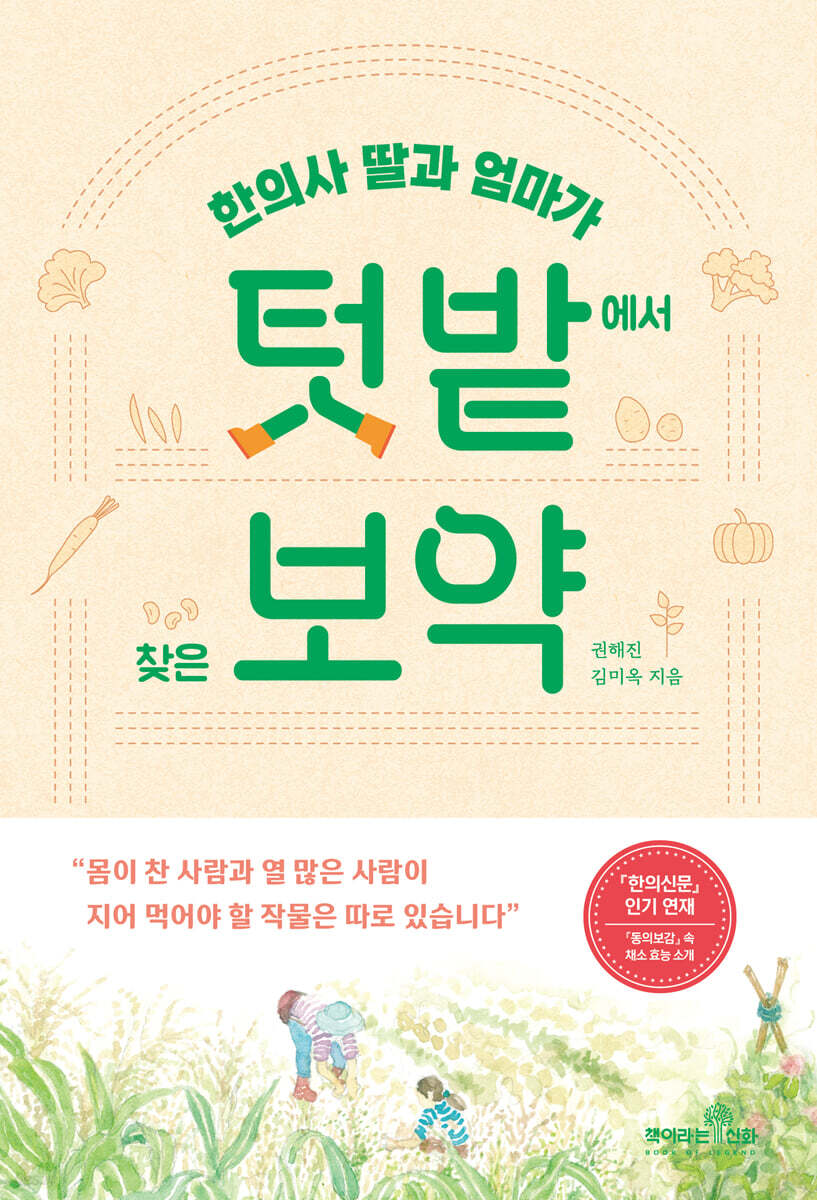
“To live a healthy life, I head to the garden again today!” How seasonal vegetables grown in the garden end up on our table A warm meal story with a traditional Korean medical explanation As Korean society transforms into an era of urbanization, individualization, and hyper-aging, the city of Seoul has recently put forward a plan to create gardens as a solution for improving the quality of life and leading a healthy life. Just admiring a garden can lower anxiety levels by 20 percent, and spending time in the garden at least once a week can reduce stress levels by 60 percent. This fact has already been verified through numerous research results, suggesting that we cannot live apart from nature. Author Kwon Hae-jin (daughter of a Korean medicine doctor, former co-chair of the Paju Environmental Movement Association) has always pondered this issue and sought ways to live well in harmony with nature. One way to do this is to make it a habit with her mother to “cook and eat what we eat ourselves.” After living as urban farmers for 10 years, Kwon Hae-jin and Kim Mi-ok (the mother) have come to believe that eating seasonal vegetables grown in the garden is like eating rice as medicine, and have come to realize that going to the garden is the foundation of a healthy life. And to share this life with people, I serialized it in the 『Hanui Shinmun』. The popular series spread through blogs and word of mouth, and was eventually published as a book thanks to the support of many people who wanted to know what crops their bodies needed and how to grow and eat them in their gardens. 『The Herbal Medicine Found by a Doctor of Oriental Medicine Daughter and Her Mother in the Garden』 is a health essay that shows the entire process of how seasonal vegetables grown in the garden throughout the four seasons end up on our table, combining the daughter Kwon Hae-jin (Doctor of Oriental Medicine)'s explanations of Oriental medicine and heartwarming episodes with the mother Kim Mi-ok (Food Doctor)'s knowledge of the garden and cooking recipes. As an urban farmer, I have gained practical know-how from planting, cooking, and eating the crops my body needs in my garden, and it is filled with in-depth insights into 15 different health supplements. A healthy life depends on a healthy body. And this book will guide us on the path to living a rich and healthy life. |
- You can preview some of the book's contents.
Preview
index
Introduction
[spring]
March - Jerusalem artichokes, which lower blood sugar levels
April - Mugwort, which relieves menstrual cramps
May - Chives for Liver Function
* Our home garden story
[summer]
June - Peas, which are good for the stomach
July - 'Jasoyeop', which clears blocked energy
August - Corn for Cystitis
* Our home garden story
[autumn]
September - 'Doraji', good for the respiratory tract
October - Peanuts, a great remedy for constipation
November - Ginger, a cold cure
* Our home garden story
[winter]
December - Old Pumpkin, which aids digestion
January - Red Beans, Effective for Swelling
February - Angelica, which promotes blood circulation
* Our home garden story
Again, [Spring]
March - 'Cold' to brighten your eyes
April - 'Du-rup', which relieves arthritis
May - Dandelion, which reduces inflammation
* Our home garden story
Going out words
Four Seasons Garden Journal
[spring]
March - Jerusalem artichokes, which lower blood sugar levels
April - Mugwort, which relieves menstrual cramps
May - Chives for Liver Function
* Our home garden story
[summer]
June - Peas, which are good for the stomach
July - 'Jasoyeop', which clears blocked energy
August - Corn for Cystitis
* Our home garden story
[autumn]
September - 'Doraji', good for the respiratory tract
October - Peanuts, a great remedy for constipation
November - Ginger, a cold cure
* Our home garden story
[winter]
December - Old Pumpkin, which aids digestion
January - Red Beans, Effective for Swelling
February - Angelica, which promotes blood circulation
* Our home garden story
Again, [Spring]
March - 'Cold' to brighten your eyes
April - 'Du-rup', which relieves arthritis
May - Dandelion, which reduces inflammation
* Our home garden story
Going out words
Four Seasons Garden Journal
Detailed image

Into the book
There is no better tonic than ‘seasonal food’.
But we don't really know what season the food we eat now is made from.
Since then, I have been reflecting on our eating habits amidst the advancement of agricultural technology and abundance.
And I decided to find the answer in my garden, which produces seasonal foods that are like medicine to my body, growing in the sun, exposed to wind and rain.
--- pp.6~7, from the “Preface”
Although mugwort is said to be edible before it flowers, it is recommended to pick and eat the young leaves if possible.
Around May, when the weather gets warmer, the mugworts grow a little taller and become stiffer, but the leaves are too tough and strong to cook with.
That doesn't mean you can't eat it at all.
It's a bit strong to eat as a soup, but it's good to enjoy the taste and aroma when put in rice cakes.
My grandmother also made injeolmi with some large mugwort and brought it to me.
Thinking back to that time, I think I enjoyed the injeolmi bean paste more than the mugwort.
There was a time when I didn't know the true taste of mugwort.
Now I know the taste so well that I go out and dig up mugwort myself.
--- p.35, from “April - Mugwort that relieves menstrual pain”
In the part where it says that peas “refresh the stomach and benefit the five internal organs (快胃利五臟),” I interpret ‘快’ to mean ‘refreshing.’
June is a month with bright sunshine, but it's not too hot or breezy, so it feels refreshing, and I think the peas I eat during that season will refresh my stomach by absorbing the energy of nature.
Sometimes, when I feel like I can't digest anything and my stomach feels blocked and I have no appetite and don't want to eat anything, I go to a Korean medicine clinic and get acupuncture or take digestive medicine.
And then, when you feel a little better, don't you always reach for porridge? I guess it's because you're worried that if you eat too quickly, you'll get sick again.
For patients with poor digestion, I recommend pea porridge over white rice porridge.
Because peas help to refresh the stomach.
--- p.59, from “June - ‘Peas’ that make the stomach comfortable”
The bitter taste of doraji is due to the component ‘saponin’.
This ingredient is also found in ginseng.
Because they look similar and have similar ingredients, ginseng and doraji are often compared.
However, even though the two contain the same saponin, they have completely different effects.
Ginseng's saponin contains ginsenoside, which has anti-cancer and liver-protecting effects, while the saponin in Platycodon grandiflorum is excellent for reducing inflammation.
--- pp.93~94, from 「September - 'Doraji', good for the respiratory tract」
In our garden, we plant two types of ginger: native and foreign.
Native seeds are fibrous and hard.
As such, it takes a lot of strength and effort to use ginger.
Because it has a strong spicy taste, it is mainly used to make herbal medicine rather than food.
On the other hand, foreign seeds are large and juicy, making them easy to cut into pieces with a knife.
So, after thinly slicing, add it to honey to make 'ginger honey'.
You can make 'ginger syrup' by adding sugar to ginger slices, and since it produces a lot of juice, you can also make 'ginger syrup' by adding fermented malt syrup to ginger juice.
But we don't really know what season the food we eat now is made from.
Since then, I have been reflecting on our eating habits amidst the advancement of agricultural technology and abundance.
And I decided to find the answer in my garden, which produces seasonal foods that are like medicine to my body, growing in the sun, exposed to wind and rain.
--- pp.6~7, from the “Preface”
Although mugwort is said to be edible before it flowers, it is recommended to pick and eat the young leaves if possible.
Around May, when the weather gets warmer, the mugworts grow a little taller and become stiffer, but the leaves are too tough and strong to cook with.
That doesn't mean you can't eat it at all.
It's a bit strong to eat as a soup, but it's good to enjoy the taste and aroma when put in rice cakes.
My grandmother also made injeolmi with some large mugwort and brought it to me.
Thinking back to that time, I think I enjoyed the injeolmi bean paste more than the mugwort.
There was a time when I didn't know the true taste of mugwort.
Now I know the taste so well that I go out and dig up mugwort myself.
--- p.35, from “April - Mugwort that relieves menstrual pain”
In the part where it says that peas “refresh the stomach and benefit the five internal organs (快胃利五臟),” I interpret ‘快’ to mean ‘refreshing.’
June is a month with bright sunshine, but it's not too hot or breezy, so it feels refreshing, and I think the peas I eat during that season will refresh my stomach by absorbing the energy of nature.
Sometimes, when I feel like I can't digest anything and my stomach feels blocked and I have no appetite and don't want to eat anything, I go to a Korean medicine clinic and get acupuncture or take digestive medicine.
And then, when you feel a little better, don't you always reach for porridge? I guess it's because you're worried that if you eat too quickly, you'll get sick again.
For patients with poor digestion, I recommend pea porridge over white rice porridge.
Because peas help to refresh the stomach.
--- p.59, from “June - ‘Peas’ that make the stomach comfortable”
The bitter taste of doraji is due to the component ‘saponin’.
This ingredient is also found in ginseng.
Because they look similar and have similar ingredients, ginseng and doraji are often compared.
However, even though the two contain the same saponin, they have completely different effects.
Ginseng's saponin contains ginsenoside, which has anti-cancer and liver-protecting effects, while the saponin in Platycodon grandiflorum is excellent for reducing inflammation.
--- pp.93~94, from 「September - 'Doraji', good for the respiratory tract」
In our garden, we plant two types of ginger: native and foreign.
Native seeds are fibrous and hard.
As such, it takes a lot of strength and effort to use ginger.
Because it has a strong spicy taste, it is mainly used to make herbal medicine rather than food.
On the other hand, foreign seeds are large and juicy, making them easy to cut into pieces with a knife.
So, after thinly slicing, add it to honey to make 'ginger honey'.
You can make 'ginger syrup' by adding sugar to ginger slices, and since it produces a lot of juice, you can also make 'ginger syrup' by adding fermented malt syrup to ginger juice.
--- p.117, from “November - ‘Ginger’ that cures colds”
Publisher's Review
Are health supplements only available at Oriental medicine clinics?
The daughter of a Korean medicine doctor found something in the garden with her mother.
15 Everyday Supplements Your Body Needs
Everyone knows that seasonal vegetables are good for your health.
But how many people know in which season the food they are eating came from?
Dr. Kwon Hae-jin, a Korean medicine doctor, sits at the dining table and suddenly thinks, 'What season is this food from?' Then he focuses on his mother's words, which he had previously ignored.
“Food is the best medicine!” And after realizing that eating vegetables without knowing the season is no different from living with a body that has lost the season, and that ‘eating vegetables in season’ is the best medicine, she confesses that although she is a doctor of Oriental medicine and treats patients with acupuncture and herbal medicine, the one who actually takes care of herself and her family is her mother, a food doctor.
From then on, she heads to the 'garden' with her mother to produce seasonal foods that are like essential medicine for my body.
This book is an essay in which a Korean medicine doctor's daughter explains 15 everyday health supplements she and her mother discovered in the garden, along with explanations from Korean medicine.
It contains episodes on how to grow crops from the time of sowing in the garden, helping you naturally acquire farming knowledge. It also explains the efficacy of seasonal vegetables based on the Donguibogam and which vegetables are good and which are bad for which people, ultimately providing a prescription for planting crops that are right for you in your garden.
Is that all?
We also introduce ‘Mom’s Homemade Recipes’ to help you eat healthy vegetables you grow yourself, and we also include a ‘Four Seasons Garden Journal’ to help you with practical farming.
We live more convenient lives than ever before, shopping at the seasonal vegetable corner and having food delivered with a single click.
But although life has become more comfortable, our bodies seem to be losing track of the seasons and becoming weaker.
Even if you take all kinds of pills for your body, such as multivitamins, omega-3s, and lutein, if you don't meet the most basic needs, it's like pouring water into a bottomless pit.
What your body needs may not be a handful of supplements, but the greenery of the season.
I hope that this book will be a gateway to filling our empty bodies with the seasons and that we can grow and eat seasonal vegetables ourselves to live healthier lives.
There are seasonal vegetables that are perfect for my body!
Prescribe crops that suit your constitution
For a healthy life, growing and eating directly from the garden
There is a saying that food that suits your taste is also good for you.
Is that really true? Each person develops preferences based on eating habits they've developed since childhood, and they seek out foods that appeal to their palate.
So, it is wrong to say that food that is appealing to the mouth is good for the body.
In fact, it is because we have been eating it all along, so it is appealing to our mouths, and because of that, we repeatedly make the mistake of just ignoring any adverse reactions such as indigestion, which in turn causes our bodies to become increasingly damaged.
If you want to live a healthy life, you must change now.
I need to carefully consider what my body needs and eat crops that are suitable for my body type.
Above all, if you plant, cook, and eat the crops yourself in your garden, you will be able to lead a healthy life without worrying about food ingredients.
"The Herbal Medicines Found in the Garden by a Doctor of Oriental Medicine Daughter and Her Mother" presents 15 everyday herbal medicines from two perspectives, allowing people to prescribe crops that are right for them and grow and eat them in their own garden.
First, it is explained so that you can grow and eat crops that suit your constitution.
Even though people's body temperature is constant, they are born with different constitutions.
For example, people can be divided into those with cold bodies and those with hot bodies, and there are different foods that are good and bad for them to eat.
For example, ginger has a warm nature and has the effect of dissipating cold energy, so it is good for people who are usually cold to eat ginger.
On the other hand, people with a lot of body heat can eat dandelions that are cold in nature, but it is recommended to eat them in moderation as they can cause stomachache and diarrhea if consumed in large quantities for a long time.
Second, it is easily explained so that you can grow and eat crops according to their efficacy.
When it comes to Oriental medicine, it can feel difficult because of the Chinese character terms, but this book accurately explains the efficacy of crops based on the Donguibogam, while also explaining it as clearly as possible so that readers can easily understand it.
It is said that peas mainly “help the middle qi”, where the middle qi refers to the area in the middle when the body is divided into upper, middle, and lower thirds.
So, it is easier to understand that peas help digestion.
This means that peas have the effect of improving overall circulation in the body.
(Page 59, from “Peas that Make the Stomach Comfortable”)
Recently, there has been a lot of interest in personal color diagnosis, which helps find the color that best suits a person's face.
But doesn't skin color actually change depending on the body's health?
Why not take a look at this book and do a personal food diagnosis to find out which crops are right for you?
If I eat crops that are suitable for my body type and become healthy, my life will become more abundant.
This book easily explains the entire process of selecting vegetables that are good for your body, planting them in your garden, and eating them.
Therefore, it will help you take the first step toward a healthy life not only for yourself but also for your entire family.
I recommend this to these people
▶ Those who believe and practice the saying “food is medicine”
▶ Those who are interested in gardening and curious about the efficacy of crops
▶ For those who want to read books about gardening and cooking in a warm essay format
The daughter of a Korean medicine doctor found something in the garden with her mother.
15 Everyday Supplements Your Body Needs
Everyone knows that seasonal vegetables are good for your health.
But how many people know in which season the food they are eating came from?
Dr. Kwon Hae-jin, a Korean medicine doctor, sits at the dining table and suddenly thinks, 'What season is this food from?' Then he focuses on his mother's words, which he had previously ignored.
“Food is the best medicine!” And after realizing that eating vegetables without knowing the season is no different from living with a body that has lost the season, and that ‘eating vegetables in season’ is the best medicine, she confesses that although she is a doctor of Oriental medicine and treats patients with acupuncture and herbal medicine, the one who actually takes care of herself and her family is her mother, a food doctor.
From then on, she heads to the 'garden' with her mother to produce seasonal foods that are like essential medicine for my body.
This book is an essay in which a Korean medicine doctor's daughter explains 15 everyday health supplements she and her mother discovered in the garden, along with explanations from Korean medicine.
It contains episodes on how to grow crops from the time of sowing in the garden, helping you naturally acquire farming knowledge. It also explains the efficacy of seasonal vegetables based on the Donguibogam and which vegetables are good and which are bad for which people, ultimately providing a prescription for planting crops that are right for you in your garden.
Is that all?
We also introduce ‘Mom’s Homemade Recipes’ to help you eat healthy vegetables you grow yourself, and we also include a ‘Four Seasons Garden Journal’ to help you with practical farming.
We live more convenient lives than ever before, shopping at the seasonal vegetable corner and having food delivered with a single click.
But although life has become more comfortable, our bodies seem to be losing track of the seasons and becoming weaker.
Even if you take all kinds of pills for your body, such as multivitamins, omega-3s, and lutein, if you don't meet the most basic needs, it's like pouring water into a bottomless pit.
What your body needs may not be a handful of supplements, but the greenery of the season.
I hope that this book will be a gateway to filling our empty bodies with the seasons and that we can grow and eat seasonal vegetables ourselves to live healthier lives.
There are seasonal vegetables that are perfect for my body!
Prescribe crops that suit your constitution
For a healthy life, growing and eating directly from the garden
There is a saying that food that suits your taste is also good for you.
Is that really true? Each person develops preferences based on eating habits they've developed since childhood, and they seek out foods that appeal to their palate.
So, it is wrong to say that food that is appealing to the mouth is good for the body.
In fact, it is because we have been eating it all along, so it is appealing to our mouths, and because of that, we repeatedly make the mistake of just ignoring any adverse reactions such as indigestion, which in turn causes our bodies to become increasingly damaged.
If you want to live a healthy life, you must change now.
I need to carefully consider what my body needs and eat crops that are suitable for my body type.
Above all, if you plant, cook, and eat the crops yourself in your garden, you will be able to lead a healthy life without worrying about food ingredients.
"The Herbal Medicines Found in the Garden by a Doctor of Oriental Medicine Daughter and Her Mother" presents 15 everyday herbal medicines from two perspectives, allowing people to prescribe crops that are right for them and grow and eat them in their own garden.
First, it is explained so that you can grow and eat crops that suit your constitution.
Even though people's body temperature is constant, they are born with different constitutions.
For example, people can be divided into those with cold bodies and those with hot bodies, and there are different foods that are good and bad for them to eat.
For example, ginger has a warm nature and has the effect of dissipating cold energy, so it is good for people who are usually cold to eat ginger.
On the other hand, people with a lot of body heat can eat dandelions that are cold in nature, but it is recommended to eat them in moderation as they can cause stomachache and diarrhea if consumed in large quantities for a long time.
Second, it is easily explained so that you can grow and eat crops according to their efficacy.
When it comes to Oriental medicine, it can feel difficult because of the Chinese character terms, but this book accurately explains the efficacy of crops based on the Donguibogam, while also explaining it as clearly as possible so that readers can easily understand it.
It is said that peas mainly “help the middle qi”, where the middle qi refers to the area in the middle when the body is divided into upper, middle, and lower thirds.
So, it is easier to understand that peas help digestion.
This means that peas have the effect of improving overall circulation in the body.
(Page 59, from “Peas that Make the Stomach Comfortable”)
Recently, there has been a lot of interest in personal color diagnosis, which helps find the color that best suits a person's face.
But doesn't skin color actually change depending on the body's health?
Why not take a look at this book and do a personal food diagnosis to find out which crops are right for you?
If I eat crops that are suitable for my body type and become healthy, my life will become more abundant.
This book easily explains the entire process of selecting vegetables that are good for your body, planting them in your garden, and eating them.
Therefore, it will help you take the first step toward a healthy life not only for yourself but also for your entire family.
I recommend this to these people
▶ Those who believe and practice the saying “food is medicine”
▶ Those who are interested in gardening and curious about the efficacy of crops
▶ For those who want to read books about gardening and cooking in a warm essay format
GOODS SPECIFICS
- Date of issue: April 5, 2024
- Page count, weight, size: 208 pages | 242g | 128*188*12mm
- ISBN13: 9791198700117
- ISBN10: 1198700114
You may also like
카테고리
korean


korean

![GQ KOREA Mark (Monthly): December [2025]](http://librairie.coreenne.fr/cdn/shop/files/8ef265dbbfbf186523ed75ba7319009d.jpg?v=1765340328&width=3840)


