

A counseling center for healthy eating habits without medication
 |
Description
Book Introduction
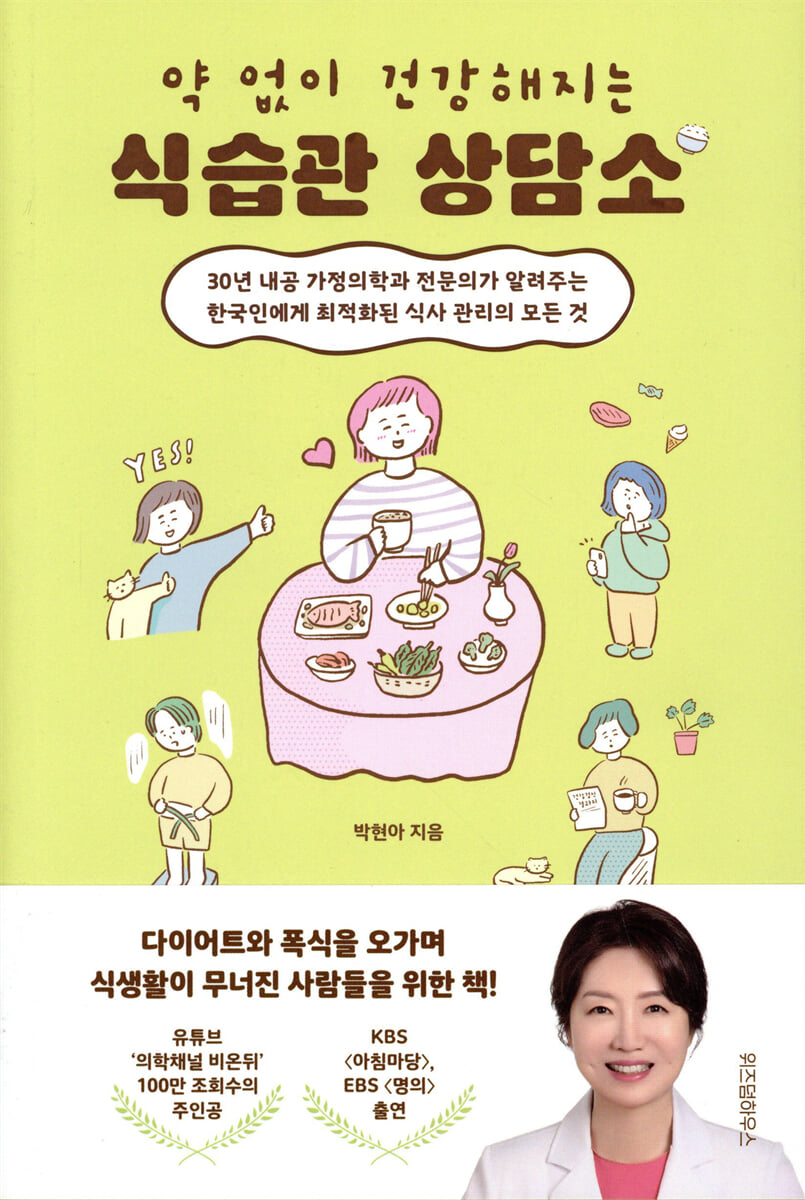
Struggling in the flood of health information A must-read for those who alternate between dieting and binge eating. The most difficult thing in health management is not quitting smoking, drinking, or exercising regularly, but managing your diet. It is not easy to simply and clearly explain in one or two lines what a 'balanced diet' is, and the diet required varies depending on each person's physical condition. 《Healthy Dietary Habits Counseling Center Without Medicine》 is a book written by Professor Park Hyeon-a, who has worked as a family medicine specialist for over 30 years and has developed her expertise, encompassing all the dietary management know-how optimized for Koreans. Focusing on the Korean diet, we provide accurate medical information that people are most curious about but do not know accurately, in an easy and clear manner. If you keep in mind the basic knowledge about eating habits that is packed into this book, you will find it very helpful and helpful when discerning and accepting health information floating around in various media and on the Internet. |
- You can preview some of the book's contents.
Preview
index
[Introduction] What does it mean to eat healthy?
[Words of Advice] To you who are struggling in the flood of health information
[Checklist] Are my eating habits okay?
Chapter 1: Misconceptions and Misunderstandings About Eating Well
Is home cooking good for you and eating out bad for you?
Is it always good to eat a lot of good food?
Do I really need to take nutritional supplements?
Are superfoods super healthy?
Are there any foods that help you lose weight?
Does drinking detox juice regularly really help?
Is it good to eat more fruit?
Can food cure cancer?
Should we absolutely reduce carbohydrate intake?
If I have high cholesterol, should I stop eating meat?
I heard milk is bad for you. Should I stop drinking it?
Chapter 2: Understanding Your Nutritional Status Through Symptoms
I write a food diary every day.
Check your weight once a month
Measure your waist circumference with a tape measure.
Carefully examine the amount and shape of the stool.
Observe the color of your urine
[Problematic Symptom 1] Severe constipation
[Problematic Symptom 2] Feeling drained of energy after eating
[Problematic Symptom 3] Constant thirst
[Problematic Symptom 4] Swelling
[Problematic Symptom 5] Suffering from esophagitis
[Problematic Symptom 6] Hair loss
Chapter 3: Finding out about my nutritional status through health checkup results
Weight, body fat, muscle mass
bone density
Blood sugar
cholesterol
neutral fat
uric acid
hemoglobin
Chapter 4: Healthy Nutrition Formula - Diet Composition
[Absolutely forbidden] Sweet drinks
[As little as possible] trans fat
[Select and consume] Carbohydrates
[Select and consume] Oil
[Consume in moderation] Fruit
[Consume in moderation] Kimchi
[Must-have] Protein
[Must-have] Blue-backed fish
[Must-have] Brown rice and mixed grains
[Must-have] Beans
[Must-have] Vegetables
[Must bring] Nuts
Chapter 5: Healthy Nutrition Formula - How to Eat
How you cook and eat it is more important than you think.
Should I eat breakfast like a princess, lunch like a maid, and dinner like a beggar?
Should I eat rice first or should I eat side dishes first?
Even a single meal requires a formula
Eat a lot once a day vs.
Eat small amounts often
The French say that meal times are two hours, but Koreans say that it's only 20 minutes.
What foods are good for snacks?
Worst Habits After Eating
Chapter 6: Things to keep in mind to eat healthily
The Language of Food Nation, Nutrition Facts
When eating out, do this
If you need to grab a bite to eat at a convenience store
Is it okay to drink zero-calorie drinks instead of water?
How to enjoy coffee healthily
Is it okay to enjoy light drinking to prevent cardiovascular disease?
How to Take Supplements Wisely
Vitamin D, the only nutrient that cannot be obtained through food
[Going out] What you eat is really, really important to your health.
Acknowledgements
main
[Words of Advice] To you who are struggling in the flood of health information
[Checklist] Are my eating habits okay?
Chapter 1: Misconceptions and Misunderstandings About Eating Well
Is home cooking good for you and eating out bad for you?
Is it always good to eat a lot of good food?
Do I really need to take nutritional supplements?
Are superfoods super healthy?
Are there any foods that help you lose weight?
Does drinking detox juice regularly really help?
Is it good to eat more fruit?
Can food cure cancer?
Should we absolutely reduce carbohydrate intake?
If I have high cholesterol, should I stop eating meat?
I heard milk is bad for you. Should I stop drinking it?
Chapter 2: Understanding Your Nutritional Status Through Symptoms
I write a food diary every day.
Check your weight once a month
Measure your waist circumference with a tape measure.
Carefully examine the amount and shape of the stool.
Observe the color of your urine
[Problematic Symptom 1] Severe constipation
[Problematic Symptom 2] Feeling drained of energy after eating
[Problematic Symptom 3] Constant thirst
[Problematic Symptom 4] Swelling
[Problematic Symptom 5] Suffering from esophagitis
[Problematic Symptom 6] Hair loss
Chapter 3: Finding out about my nutritional status through health checkup results
Weight, body fat, muscle mass
bone density
Blood sugar
cholesterol
neutral fat
uric acid
hemoglobin
Chapter 4: Healthy Nutrition Formula - Diet Composition
[Absolutely forbidden] Sweet drinks
[As little as possible] trans fat
[Select and consume] Carbohydrates
[Select and consume] Oil
[Consume in moderation] Fruit
[Consume in moderation] Kimchi
[Must-have] Protein
[Must-have] Blue-backed fish
[Must-have] Brown rice and mixed grains
[Must-have] Beans
[Must-have] Vegetables
[Must bring] Nuts
Chapter 5: Healthy Nutrition Formula - How to Eat
How you cook and eat it is more important than you think.
Should I eat breakfast like a princess, lunch like a maid, and dinner like a beggar?
Should I eat rice first or should I eat side dishes first?
Even a single meal requires a formula
Eat a lot once a day vs.
Eat small amounts often
The French say that meal times are two hours, but Koreans say that it's only 20 minutes.
What foods are good for snacks?
Worst Habits After Eating
Chapter 6: Things to keep in mind to eat healthily
The Language of Food Nation, Nutrition Facts
When eating out, do this
If you need to grab a bite to eat at a convenience store
Is it okay to drink zero-calorie drinks instead of water?
How to enjoy coffee healthily
Is it okay to enjoy light drinking to prevent cardiovascular disease?
How to Take Supplements Wisely
Vitamin D, the only nutrient that cannot be obtained through food
[Going out] What you eat is really, really important to your health.
Acknowledgements
main
Detailed image
Into the book
Home-cooked meals are often thought to be healthy.
It would be possible to have a healthy home-cooked meal with a nutritionist and a chef like Hollywood celebrities, but this is the kind of ideal environment you only see in dramas or movies, far removed from the lives of ordinary people.
For example, if you go to a home where only the elderly live, you will often find the refrigerator filled with only kimchi, pickled vegetables, soybean paste, and red pepper paste.
No matter how many different types of kimchi you eat, rice and kimchi alone cannot provide all the nutrients you need for the day.
Poor home cooking can cause chronic anemia, osteoporosis, and sarcopenia, which are common nutritional deficiencies in the elderly.
So, home cooking that is not properly managed cannot be considered healthy.
--- p.33
The real problem with so-called "slimming foods" that are bulky and low in calories is that they increase the size of your stomach.
To prevent yo-yoing after losing weight, your stomach size must decrease.
Are you curious about the stomach's ability to expand and contract? Just like the amount of food you eat at a Yangdaechang restaurant, the human stomach is a solid muscle, so it doesn't expand and contract like a rubber band.
What increases and decreases is not the physical size of the stomach, but the feeling of fullness, or the satiety threshold.
If you get into the habit of eating large, low-calorie foods frequently, your satiety threshold will increase.
So, even when eating a regular meal other than konjac rice and angel hair, I want to eat until I'm full, and it becomes difficult to put down my spoon in the middle.
If you keep raising your satiety threshold with weight-loss foods, you will gain weight because you will eat more even if you eat low-calorie foods.
To succeed in dieting, you need to train your stomach to finish eating 70-80 percent of the time before you feel full.
Rather than just reducing your calorie intake by eating bulky foods, you should reduce your food intake by eating balanced, regular meals so that you train your stomach not to feel hungry even if you eat less.
--- pp.47~48
There are some fruits that doctors particularly dislike.
The succulent peaches of summer, the sweet persimmons of autumn.
Because it raises patients' blood sugar and triglycerides to a truly astonishing degree.
These are fruits that make the doctor's efforts to lower blood sugar levels by prescribing diabetes medication seem meaningless.
Both fruits are very sweet, and when you buy them, you end up buying them by the box, either because you're worried they'll go bad, because you're running out of space in your fridge, or because they're sweet and delicious.
Doctors even call persimmons "the flu," meaning they are harmful to a patient's health.
Half of the sweetness in fruit comes from glucose and half from fructose.
Glucose raises blood sugar levels directly.
How quickly this happens can be seen in the fact that the emergency food given to a diabetic patient suffering from hypoglycemia is half a cup of fruit juice.
The sugar in the fruit that is not used for energy is stored as neutral fat, so there is more oil floating in the blood.
--- p.55~56
If I were asked, "How can I live a healthy life? Just pick one." I'd answer without hesitation, "Take care of your waistline!"
To manage your waistline, you need to exercise regularly, reduce stress, get enough sleep, and choose good foods.
So, it's a spell that encompasses healthy habits in all aspects.
--- p.90
How can I make sure I get enough protein?
First, eat protein foods every meal.
You can eat 60 grams of lean beef, pork, chicken, fish, or seafood, which have 20 percent protein.
If you eat tofu with 10 percent protein, you'll eat 120 grams, or about a third of a block.
Eating 60 grams of lean meat will give you 12 grams of protein.
If you eat breakfast, lunch, and dinner three times a day, the amount of protein consumed through protein foods is 36 grams.
You are still 24 grams short of the daily requirement of 60 grams.
Fortunately, rice contains protein, and vegetables also contain protein.
Rice is 7-8 percent protein, and vegetables are 1-3 percent protein.
Koreans eat an average of 200 grams of rice per day.
So, the protein consumed through three meals of rice and vegetable side dishes is about 16 to 20 grams per day.
If you've eaten this far, you've eaten 52-56 grams.
Fill up the remaining 4-8 grams with a protein snack.
Eat either milk or yogurt or two slices of cheese.
If you're not concerned about your weight, a handful of nuts is fine.
Eating like this will provide you with the 60 grams of protein you need per day.
It's easy to stick to it for a day or two, but it's definitely not easy to eat it every day for a lifetime.
So, the nutrient that is most easily deficient and that we need to pay extra attention to when consuming it is protein.
--- pp.222~223
There are over 30 to 40 nutrients that have been discovered so far that we need to consume every day.
But, there is probably no one who would say, “I didn’t get enough calcium in the morning and lunch, so I should eat more calcium in the evening,” or “I ate enough fiber in the morning and lunch, so I should skip vegetables in the evening.”
Even people who study nutrition professionally will not be able to manage their diet by carefully considering the sufficiency and deficiency of individual nutrients.
So, how can we ensure we're consuming these numerous nutrients in our daily diets without overdoing or underdoing them? Simply follow the dietary guidelines.
It's very simple.
Healthy Eating Formula for Koreans:
Three times a day: brown rice or mixed grain rice + soup or stew + kimchi + one protein side dish + two vegetable side dishes
One or two pieces of fruit or dairy snack once a day
--- pp.284~286
There is, in my opinion, the worst habit in the world, worse than sitting down after eating.
Lie down right after eating.
When you eat, your parasympathetic nervous system is activated to help you digest food, making you feel relaxed and at ease.
Additionally, blood flow to the gastrointestinal tract for digestion increases two to three times, and blood flow to the brain decreases relatively, making you feel drowsy and sleepy.
It's an easy condition to fall asleep.
This is why I doze off after lunch and why I doze off after dinner while lying down and watching TV.
Eating and lying down is a triply damaging effect on your health.
First, the energy you consume is not used, so it is stored as visceral fat.
Second, if you lie down with your stomach full of food, stomach acid and food will reflux into the esophagus, causing esophagitis.
Then I feel sick and bloated.
Lastly, if you make your digestive system work and then fall asleep, the depth of your sleep will be shallow due to the busy digestive system, making it difficult to get a good night's sleep.
Eating anything before lying down is bad for your health.
Even if it is Qin Shi Huang's elixir of life, it can be bad for your health if you eat it and then lie down right away.
It would be possible to have a healthy home-cooked meal with a nutritionist and a chef like Hollywood celebrities, but this is the kind of ideal environment you only see in dramas or movies, far removed from the lives of ordinary people.
For example, if you go to a home where only the elderly live, you will often find the refrigerator filled with only kimchi, pickled vegetables, soybean paste, and red pepper paste.
No matter how many different types of kimchi you eat, rice and kimchi alone cannot provide all the nutrients you need for the day.
Poor home cooking can cause chronic anemia, osteoporosis, and sarcopenia, which are common nutritional deficiencies in the elderly.
So, home cooking that is not properly managed cannot be considered healthy.
--- p.33
The real problem with so-called "slimming foods" that are bulky and low in calories is that they increase the size of your stomach.
To prevent yo-yoing after losing weight, your stomach size must decrease.
Are you curious about the stomach's ability to expand and contract? Just like the amount of food you eat at a Yangdaechang restaurant, the human stomach is a solid muscle, so it doesn't expand and contract like a rubber band.
What increases and decreases is not the physical size of the stomach, but the feeling of fullness, or the satiety threshold.
If you get into the habit of eating large, low-calorie foods frequently, your satiety threshold will increase.
So, even when eating a regular meal other than konjac rice and angel hair, I want to eat until I'm full, and it becomes difficult to put down my spoon in the middle.
If you keep raising your satiety threshold with weight-loss foods, you will gain weight because you will eat more even if you eat low-calorie foods.
To succeed in dieting, you need to train your stomach to finish eating 70-80 percent of the time before you feel full.
Rather than just reducing your calorie intake by eating bulky foods, you should reduce your food intake by eating balanced, regular meals so that you train your stomach not to feel hungry even if you eat less.
--- pp.47~48
There are some fruits that doctors particularly dislike.
The succulent peaches of summer, the sweet persimmons of autumn.
Because it raises patients' blood sugar and triglycerides to a truly astonishing degree.
These are fruits that make the doctor's efforts to lower blood sugar levels by prescribing diabetes medication seem meaningless.
Both fruits are very sweet, and when you buy them, you end up buying them by the box, either because you're worried they'll go bad, because you're running out of space in your fridge, or because they're sweet and delicious.
Doctors even call persimmons "the flu," meaning they are harmful to a patient's health.
Half of the sweetness in fruit comes from glucose and half from fructose.
Glucose raises blood sugar levels directly.
How quickly this happens can be seen in the fact that the emergency food given to a diabetic patient suffering from hypoglycemia is half a cup of fruit juice.
The sugar in the fruit that is not used for energy is stored as neutral fat, so there is more oil floating in the blood.
--- p.55~56
If I were asked, "How can I live a healthy life? Just pick one." I'd answer without hesitation, "Take care of your waistline!"
To manage your waistline, you need to exercise regularly, reduce stress, get enough sleep, and choose good foods.
So, it's a spell that encompasses healthy habits in all aspects.
--- p.90
How can I make sure I get enough protein?
First, eat protein foods every meal.
You can eat 60 grams of lean beef, pork, chicken, fish, or seafood, which have 20 percent protein.
If you eat tofu with 10 percent protein, you'll eat 120 grams, or about a third of a block.
Eating 60 grams of lean meat will give you 12 grams of protein.
If you eat breakfast, lunch, and dinner three times a day, the amount of protein consumed through protein foods is 36 grams.
You are still 24 grams short of the daily requirement of 60 grams.
Fortunately, rice contains protein, and vegetables also contain protein.
Rice is 7-8 percent protein, and vegetables are 1-3 percent protein.
Koreans eat an average of 200 grams of rice per day.
So, the protein consumed through three meals of rice and vegetable side dishes is about 16 to 20 grams per day.
If you've eaten this far, you've eaten 52-56 grams.
Fill up the remaining 4-8 grams with a protein snack.
Eat either milk or yogurt or two slices of cheese.
If you're not concerned about your weight, a handful of nuts is fine.
Eating like this will provide you with the 60 grams of protein you need per day.
It's easy to stick to it for a day or two, but it's definitely not easy to eat it every day for a lifetime.
So, the nutrient that is most easily deficient and that we need to pay extra attention to when consuming it is protein.
--- pp.222~223
There are over 30 to 40 nutrients that have been discovered so far that we need to consume every day.
But, there is probably no one who would say, “I didn’t get enough calcium in the morning and lunch, so I should eat more calcium in the evening,” or “I ate enough fiber in the morning and lunch, so I should skip vegetables in the evening.”
Even people who study nutrition professionally will not be able to manage their diet by carefully considering the sufficiency and deficiency of individual nutrients.
So, how can we ensure we're consuming these numerous nutrients in our daily diets without overdoing or underdoing them? Simply follow the dietary guidelines.
It's very simple.
Healthy Eating Formula for Koreans:
Three times a day: brown rice or mixed grain rice + soup or stew + kimchi + one protein side dish + two vegetable side dishes
One or two pieces of fruit or dairy snack once a day
--- pp.284~286
There is, in my opinion, the worst habit in the world, worse than sitting down after eating.
Lie down right after eating.
When you eat, your parasympathetic nervous system is activated to help you digest food, making you feel relaxed and at ease.
Additionally, blood flow to the gastrointestinal tract for digestion increases two to three times, and blood flow to the brain decreases relatively, making you feel drowsy and sleepy.
It's an easy condition to fall asleep.
This is why I doze off after lunch and why I doze off after dinner while lying down and watching TV.
Eating and lying down is a triply damaging effect on your health.
First, the energy you consume is not used, so it is stored as visceral fat.
Second, if you lie down with your stomach full of food, stomach acid and food will reflux into the esophagus, causing esophagitis.
Then I feel sick and bloated.
Lastly, if you make your digestive system work and then fall asleep, the depth of your sleep will be shallow due to the busy digestive system, making it difficult to get a good night's sleep.
Eating anything before lying down is bad for your health.
Even if it is Qin Shi Huang's elixir of life, it can be bad for your health if you eat it and then lie down right away.
--- p.300
Publisher's Review
Curiosity about eating habits that are vague and unclear,
We will solve it clearly and definitively!
★ The protagonist of YouTube's 'Medical Channel After the Rain' with 1 million views
★ Appeared on EBS's "Name", KBS's "Morning Plaza", "Ask Anything", and "The Secret of Birth, Aging, Illness, and Death"
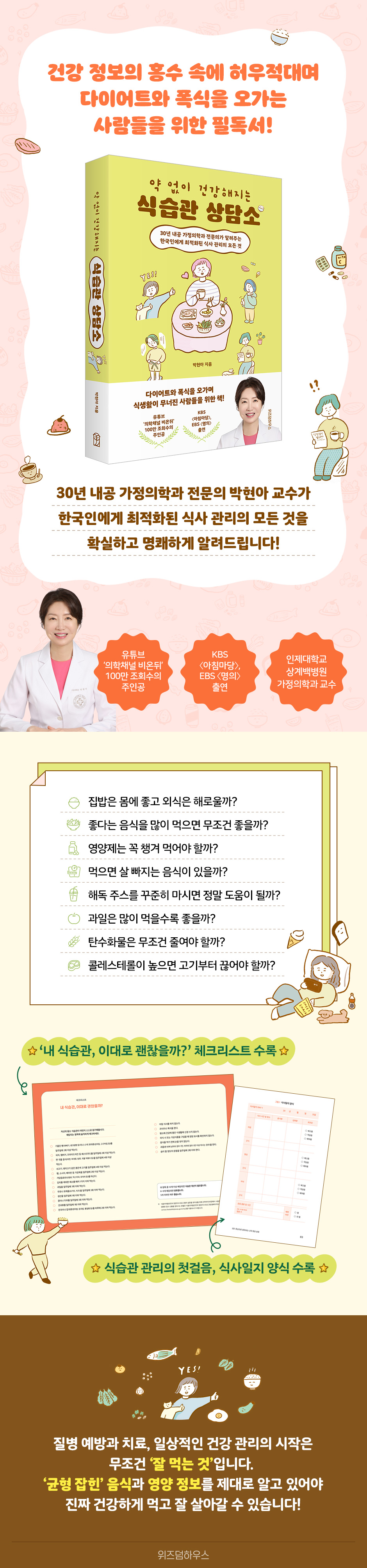
● Includes a checklist titled 'Are my eating habits okay?'
● The first step to managing your eating habits, including a food diary form
There are no cheat keys or shortcuts to diet management.
A solution that is too easy can be poison rather than medicine!
Many people suffer from a weakened immune system, catch colds frequently, have trouble digesting food as well as they used to, are embarrassed by their suddenly gained belly fat, or are worried about receiving an abnormal diagnosis during a health checkup they haven't had in a long time.
However, since it is not yet a serious or chronic illness that requires medication, I am looking for various health information in the hopes of living a little healthier than I do now without medication.
These people are bombarded with information from various TV programs, YouTube channels, health-related books, and media.
There are countless cases where we flounder in the flood of information saying, "This is good here," "That is good there," and don't know what to do.
What is even more unfortunate is the fact that there are many cases where people try to follow all the things that are supposedly good for their health, only to end up worsening their health.
The most difficult thing in health management is not quitting smoking, drinking, or exercising regularly, but managing your diet.
You just need to quit smoking and drinking, and continue exercising to the point where you sweat and get out of breath.
Surprisingly, the solution is simple.
(Of course, the practice is not simple.) On the other hand, eating food, especially a 'balanced diet', is never easy.
It is not easy to simply and clearly explain in one or two lines what a 'balanced diet' is, and the diet required varies depending on each person's physical condition.
Although 'special' diets like 'intermittent fasting' and 'low-carb, high-fat diet' are constantly trending, the most basic thing for our healthy life is to maintain a 'balanced diet' on a daily basis.
Having practiced medicine for over 30 years, I've found that patients are hungry for knowledge about alternatives to medication, especially good foods that can help with their current illnesses and even prevent future ones.
However, since it is impossible to explain what and how to eat during a short consultation, most patients end up looking for information about the disease and eating the food they want.
There are so many people who want to eat healthy but don't know how to eat healthy.
Before it's too late, I'm encouraged by the urgent need for a balanced guide that breaks free from biased opinions and helps people make healthy choices about food and nutrition.
(Pages 10-11)
"Healthy Dietary Habits Counseling Center Without Medicine" is a book written by Professor Park Hyeon-a of Inje University Sanggye Paik Hospital, who has worked as a family medicine specialist and honed her skills while experiencing three changes in the world, and contains a comprehensive collection of dietary management know-how optimized for Koreans.
Professor Park Hyun-ah provides accurate medical information that people are most curious about but do not know accurately, focusing on the Korean diet in an easy and clear manner.
If you keep in mind the basic knowledge about eating habits that is packed into this book, you will find it very helpful and helpful when discerning and accepting health information floating around in the media and on the Internet.
Are my eating habits really okay?
A comprehensive guide to answering all your questions about the ever-changing diet!
In today's society, where each day is suffocatingly hectic, 'eating well' is a truly difficult task.
But one meal missed today will never come back.
When you're young, you can work and exercise without eating a meal or two.
Even in middle age, I somehow manage to hold on, albeit with a little bit of energy.
However, skipping a meal or two in old age not only reduces energy but also immunity and muscle mass.
Moreover, people who neglect their diet during their youth and middle age are bound to age even faster.
This is why you should never give up on managing your eating habits if you want to age even a little more slowly.
Chapter 1 of this book explains the most common nutritional misconceptions.
Because only by getting rid of incorrect knowledge can we gain a correct understanding from zero base.
It explains the truth of common sayings you've likely heard, such as 'Home-cooked meals are good for you, but eating out is bad', 'Eating a lot of food that's good for you is good', 'You should definitely take nutritional supplements', 'Drinking detox juice regularly is helpful', 'Fruit is good for you, so you can eat a lot', and 'You should definitely cut down on carbohydrates'.
Chapters 2 and 3 introduce how to check whether you are eating well based on your personal symptoms and health checkup results.
Since each person needs a different balanced diet depending on their physical condition, it is not optional but essential to carefully examine your own diet.
The most accurate and inexpensive way to know if you're eating well is to keep a food diary.
A food diary form is included in the text, so I highly recommend using it.
In addition, it points out problematic symptoms that should be especially noted and shows you how to interpret the health checkup chart, which is like a code, on your own.
Additionally, you can check the state of your eating habits directly through the checklist in the front part of the book (pages 26-27).
The first step to disease prevention and treatment, and daily health management, is definitely 'eating well'!
To truly eat healthy, you need to know the right foods and nutritional information.
Chapters 4 and 5 are the highlights of this book.
We present a 'meal formula', a way to eat without being too little or too much.
Chapter 4 provides a detailed explanation of how to structure your daily diet by nutrient and food.
From 'absolutely forbidden' sweet drinks to 'minimize as much as possible' trans fats, 'choose' carbohydrates and oils, 'eat in moderation' fruits and kimchi, and 'must have' proteins and vegetables, it kindly teaches us what we should avoid and what we should choose to eat.
Chapter 5 discusses methods for preparing and eating food and what to pay attention to.
After reading this, you will understand why you should avoid grilled meat and fish as much as possible, why you should eat breakfast, why you should eat as slowly as possible, and why lying down after eating is the worst habit.
The harsh reality is that it is difficult for Koreans today to avoid purchasing processed foods, eating out and using convenience stores, and consuming trendy foods.
If you can't cut it out completely, it's better to know how to eat it in a way that's as healthy as possible.
So, Chapter 6, which concludes the book, carefully explains how to read nutrition labels, how to eat relatively healthy at convenience stores, and how to use coffee, alcohol, and supplements wisely.
People who are thinking of neutralizing their unhealthy eating habits with healthy foods will have to read this part with a pang of regret.
Food cannot cure all diseases.
However, a nutritionally balanced diet can help prevent disease, and a diet tailored to your individual medical condition can help treat it.
Anticancer drugs cannot be administered to patients who cannot eat well.
This is because nutritional deficiencies deplete the body's ability to withstand anticancer drugs.
A healthy diet supports your immune system and helps medical treatments work effectively.
Food doesn't cure disease, but it's hard to expect healing without eating right.
What you eat is actually more important to your health than you might think.
Everyone seems to know how to eat and survive, but what they don't actually know is 'what to choose and how much to eat.'
(Pages 367-368)
So many people wonder, 'What should I choose and how much should I eat?'
However, the opportunity to access comprehensive, scientifically proven health information is extremely rare.
For those who are tired of the fragmented information on YouTube and social media, information based on extremely personal experiences and unscientific hypotheses, and thirsty for genuine, gem-like information, this book will be like a ray of rain.
If you want to reflect on your eating habits, and if you want help improving the eating habits of yourself and your loved ones, I strongly recommend keeping this book on your bookshelf, written as if a trustworthy doctor were providing comprehensive dietary care and long-term counseling, and referencing it whenever necessary.
We will solve it clearly and definitively!
★ The protagonist of YouTube's 'Medical Channel After the Rain' with 1 million views
★ Appeared on EBS's "Name", KBS's "Morning Plaza", "Ask Anything", and "The Secret of Birth, Aging, Illness, and Death"
● Includes a checklist titled 'Are my eating habits okay?'
● The first step to managing your eating habits, including a food diary form
There are no cheat keys or shortcuts to diet management.
A solution that is too easy can be poison rather than medicine!
Many people suffer from a weakened immune system, catch colds frequently, have trouble digesting food as well as they used to, are embarrassed by their suddenly gained belly fat, or are worried about receiving an abnormal diagnosis during a health checkup they haven't had in a long time.
However, since it is not yet a serious or chronic illness that requires medication, I am looking for various health information in the hopes of living a little healthier than I do now without medication.
These people are bombarded with information from various TV programs, YouTube channels, health-related books, and media.
There are countless cases where we flounder in the flood of information saying, "This is good here," "That is good there," and don't know what to do.
What is even more unfortunate is the fact that there are many cases where people try to follow all the things that are supposedly good for their health, only to end up worsening their health.
The most difficult thing in health management is not quitting smoking, drinking, or exercising regularly, but managing your diet.
You just need to quit smoking and drinking, and continue exercising to the point where you sweat and get out of breath.
Surprisingly, the solution is simple.
(Of course, the practice is not simple.) On the other hand, eating food, especially a 'balanced diet', is never easy.
It is not easy to simply and clearly explain in one or two lines what a 'balanced diet' is, and the diet required varies depending on each person's physical condition.
Although 'special' diets like 'intermittent fasting' and 'low-carb, high-fat diet' are constantly trending, the most basic thing for our healthy life is to maintain a 'balanced diet' on a daily basis.
Having practiced medicine for over 30 years, I've found that patients are hungry for knowledge about alternatives to medication, especially good foods that can help with their current illnesses and even prevent future ones.
However, since it is impossible to explain what and how to eat during a short consultation, most patients end up looking for information about the disease and eating the food they want.
There are so many people who want to eat healthy but don't know how to eat healthy.
Before it's too late, I'm encouraged by the urgent need for a balanced guide that breaks free from biased opinions and helps people make healthy choices about food and nutrition.
(Pages 10-11)
"Healthy Dietary Habits Counseling Center Without Medicine" is a book written by Professor Park Hyeon-a of Inje University Sanggye Paik Hospital, who has worked as a family medicine specialist and honed her skills while experiencing three changes in the world, and contains a comprehensive collection of dietary management know-how optimized for Koreans.
Professor Park Hyun-ah provides accurate medical information that people are most curious about but do not know accurately, focusing on the Korean diet in an easy and clear manner.
If you keep in mind the basic knowledge about eating habits that is packed into this book, you will find it very helpful and helpful when discerning and accepting health information floating around in the media and on the Internet.
Are my eating habits really okay?
A comprehensive guide to answering all your questions about the ever-changing diet!
In today's society, where each day is suffocatingly hectic, 'eating well' is a truly difficult task.
But one meal missed today will never come back.
When you're young, you can work and exercise without eating a meal or two.
Even in middle age, I somehow manage to hold on, albeit with a little bit of energy.
However, skipping a meal or two in old age not only reduces energy but also immunity and muscle mass.
Moreover, people who neglect their diet during their youth and middle age are bound to age even faster.
This is why you should never give up on managing your eating habits if you want to age even a little more slowly.
Chapter 1 of this book explains the most common nutritional misconceptions.
Because only by getting rid of incorrect knowledge can we gain a correct understanding from zero base.
It explains the truth of common sayings you've likely heard, such as 'Home-cooked meals are good for you, but eating out is bad', 'Eating a lot of food that's good for you is good', 'You should definitely take nutritional supplements', 'Drinking detox juice regularly is helpful', 'Fruit is good for you, so you can eat a lot', and 'You should definitely cut down on carbohydrates'.
Chapters 2 and 3 introduce how to check whether you are eating well based on your personal symptoms and health checkup results.
Since each person needs a different balanced diet depending on their physical condition, it is not optional but essential to carefully examine your own diet.
The most accurate and inexpensive way to know if you're eating well is to keep a food diary.
A food diary form is included in the text, so I highly recommend using it.
In addition, it points out problematic symptoms that should be especially noted and shows you how to interpret the health checkup chart, which is like a code, on your own.
Additionally, you can check the state of your eating habits directly through the checklist in the front part of the book (pages 26-27).
The first step to disease prevention and treatment, and daily health management, is definitely 'eating well'!
To truly eat healthy, you need to know the right foods and nutritional information.
Chapters 4 and 5 are the highlights of this book.
We present a 'meal formula', a way to eat without being too little or too much.
Chapter 4 provides a detailed explanation of how to structure your daily diet by nutrient and food.
From 'absolutely forbidden' sweet drinks to 'minimize as much as possible' trans fats, 'choose' carbohydrates and oils, 'eat in moderation' fruits and kimchi, and 'must have' proteins and vegetables, it kindly teaches us what we should avoid and what we should choose to eat.
Chapter 5 discusses methods for preparing and eating food and what to pay attention to.
After reading this, you will understand why you should avoid grilled meat and fish as much as possible, why you should eat breakfast, why you should eat as slowly as possible, and why lying down after eating is the worst habit.
The harsh reality is that it is difficult for Koreans today to avoid purchasing processed foods, eating out and using convenience stores, and consuming trendy foods.
If you can't cut it out completely, it's better to know how to eat it in a way that's as healthy as possible.
So, Chapter 6, which concludes the book, carefully explains how to read nutrition labels, how to eat relatively healthy at convenience stores, and how to use coffee, alcohol, and supplements wisely.
People who are thinking of neutralizing their unhealthy eating habits with healthy foods will have to read this part with a pang of regret.
Food cannot cure all diseases.
However, a nutritionally balanced diet can help prevent disease, and a diet tailored to your individual medical condition can help treat it.
Anticancer drugs cannot be administered to patients who cannot eat well.
This is because nutritional deficiencies deplete the body's ability to withstand anticancer drugs.
A healthy diet supports your immune system and helps medical treatments work effectively.
Food doesn't cure disease, but it's hard to expect healing without eating right.
What you eat is actually more important to your health than you might think.
Everyone seems to know how to eat and survive, but what they don't actually know is 'what to choose and how much to eat.'
(Pages 367-368)
So many people wonder, 'What should I choose and how much should I eat?'
However, the opportunity to access comprehensive, scientifically proven health information is extremely rare.
For those who are tired of the fragmented information on YouTube and social media, information based on extremely personal experiences and unscientific hypotheses, and thirsty for genuine, gem-like information, this book will be like a ray of rain.
If you want to reflect on your eating habits, and if you want help improving the eating habits of yourself and your loved ones, I strongly recommend keeping this book on your bookshelf, written as if a trustworthy doctor were providing comprehensive dietary care and long-term counseling, and referencing it whenever necessary.
GOODS SPECIFICS
- Date of issue: March 20, 2024
- Page count, weight, size: 376 pages | 594g | 140*210*22mm
- ISBN13: 9791171711697
- ISBN10: 1171711697
You may also like
카테고리
korean


korean

![GQ KOREA Mark (Monthly): December [2025]](http://librairie.coreenne.fr/cdn/shop/files/8ef265dbbfbf186523ed75ba7319009d.jpg?v=1765340328&width=3840)


