

Musk Risk
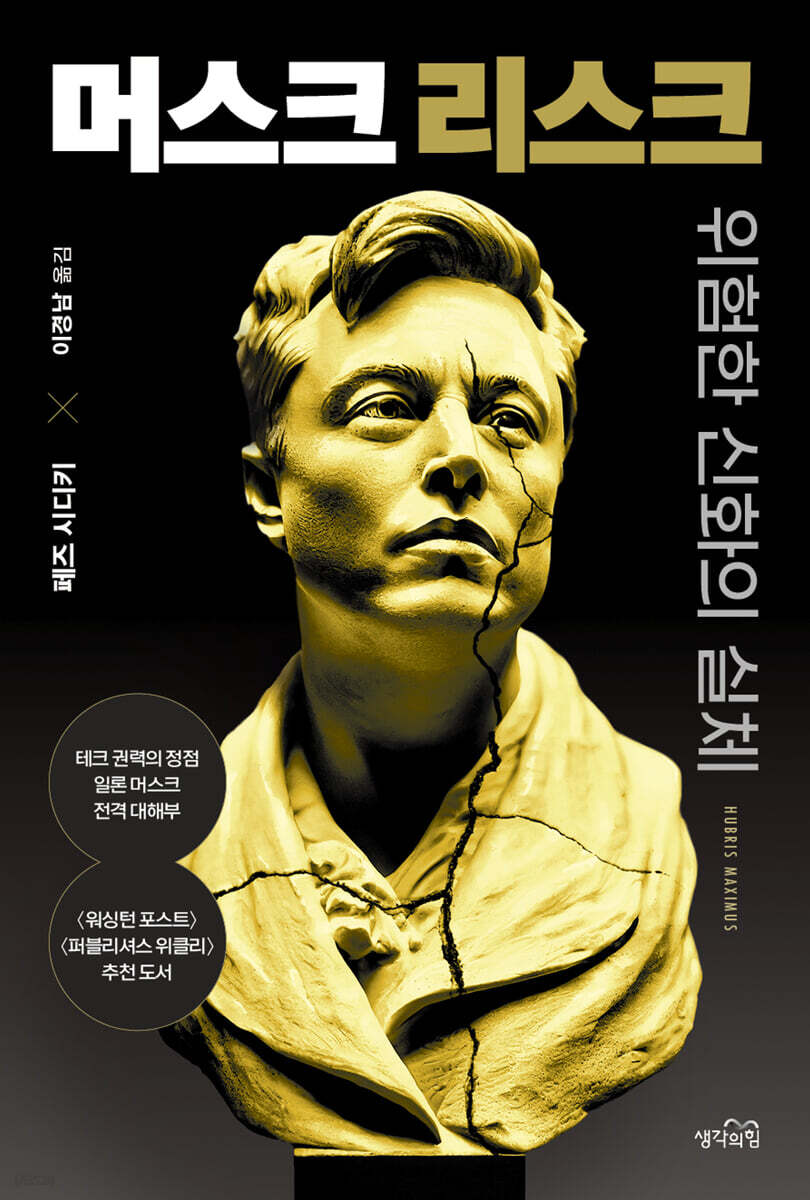 |
Description
Book Introduction
The world's best-selling vehicle in 2024 will be Tesla's Model Y (SUV, 1.223 million units).
Tesla was also the best-selling imported car brand in Korea for the two months of July and August 2025.
Elon Musk, the CEO there.
A Washington Post tech reporter delves into the man whose name alone has become a legend.
Elon Musk is the world's richest man and the CEO of Tesla and SpaceX.
Having even acquired Twitter (X), he stood at the pinnacle of technological and economic power, dreaming of becoming a new icon of innovation following Steve Jobs.
He is considered the “last bastion of meritocracy,” but many who believed in his vision found their careers cut short or their lives turned upside down.
A few words he spews out on Twitter can cause stock prices to fluctuate and the market to become unstable.
"Musk Risk" is a warning about the dangers of blindly deifying charismatic leaders.
The author reconstructs fatal accidents involving Tesla's autonomous driving system, Autopilot, and meticulously uncovers the causal relationships behind Musk's puzzling actions, including taking Tesla private, acquiring Twitter, and violating COVID-19 pandemic regulations.
It points out that Musk's actions are not just the eccentricities of a "geeky genius," but rather a "dangerous risk" that borders on uncontrollable, and that Musk's leadership is inefficient and unethical.
Musk-style innovation is closer to the uncertainty the market fears.
If we examine why Musk, who has built Tesla's success through government deregulation, subsidies, and the sale of regulatory credits, displays a contradictory attitude of fiercely criticizing regulation itself, we can see the direction of macro-level investment.
“The best way to guess what he might do next is to look at how he has wielded his power so far.” Musk Risk helps readers accurately understand Musk Risk and make wise decisions.
Tesla was also the best-selling imported car brand in Korea for the two months of July and August 2025.
Elon Musk, the CEO there.
A Washington Post tech reporter delves into the man whose name alone has become a legend.
Elon Musk is the world's richest man and the CEO of Tesla and SpaceX.
Having even acquired Twitter (X), he stood at the pinnacle of technological and economic power, dreaming of becoming a new icon of innovation following Steve Jobs.
He is considered the “last bastion of meritocracy,” but many who believed in his vision found their careers cut short or their lives turned upside down.
A few words he spews out on Twitter can cause stock prices to fluctuate and the market to become unstable.
"Musk Risk" is a warning about the dangers of blindly deifying charismatic leaders.
The author reconstructs fatal accidents involving Tesla's autonomous driving system, Autopilot, and meticulously uncovers the causal relationships behind Musk's puzzling actions, including taking Tesla private, acquiring Twitter, and violating COVID-19 pandemic regulations.
It points out that Musk's actions are not just the eccentricities of a "geeky genius," but rather a "dangerous risk" that borders on uncontrollable, and that Musk's leadership is inefficient and unethical.
Musk-style innovation is closer to the uncertainty the market fears.
If we examine why Musk, who has built Tesla's success through government deregulation, subsidies, and the sale of regulatory credits, displays a contradictory attitude of fiercely criticizing regulation itself, we can see the direction of macro-level investment.
“The best way to guess what he might do next is to look at how he has wielded his power so far.” Musk Risk helps readers accurately understand Musk Risk and make wise decisions.
- You can preview some of the book's contents.
Preview
index
On publication
0 Introduction
Elon Musk's War with Washington
2 “A difficult and painful year” and a generous reward
3 Return to the water
4 Paralyzed Reason
5 Arms Race
6 “We must fight to the end”
7 Tesla vs. Children
8 “They’re just playing with the government.”
9 Mood-Spoilers
10 Twitter Buybacks
11 Exit Strategy
12 lifelines
13 “I just want to make Twitter fun again.”
14 “Welcome to Level 2 of Hell”
15 “Can someone like Elon Musk do whatever he wants and pretend not to know anything?”
16 Limited Autopilot
17 Naked Techno King
Words that were not said
Acknowledgments/Notes/Search
0 Introduction
Elon Musk's War with Washington
2 “A difficult and painful year” and a generous reward
3 Return to the water
4 Paralyzed Reason
5 Arms Race
6 “We must fight to the end”
7 Tesla vs. Children
8 “They’re just playing with the government.”
9 Mood-Spoilers
10 Twitter Buybacks
11 Exit Strategy
12 lifelines
13 “I just want to make Twitter fun again.”
14 “Welcome to Level 2 of Hell”
15 “Can someone like Elon Musk do whatever he wants and pretend not to know anything?”
16 Limited Autopilot
17 Naked Techno King
Words that were not said
Acknowledgments/Notes/Search
Detailed image

Into the book
Musk has been rumored to be taking Tesla private at $420 per share.
420 was the number that meant marijuana.
This playful, bizarre number serves as a running theme that runs through his every major mistake.
A few years later, he made the stupidest mistake he had ever made.
That will probably remain the biggest mistake of his career.
It acquired Twitter for $54.20 per share (the number 420 was also included here).
But even as the SEC tried to bring him to his knees, Musk just laughed.
Is there something the employees don't know?
When this act was revealed to be securities fraud, Musk was removed as Tesla's chairman, and both he and Tesla were fined $20 million, but Musk himself ended up richer and more powerful.
--- p.13, from “Introductory Remarks”
Huang had set his car to reach 120 kilometers per hour on autopilot, but his car didn't have time to reach that speed.
Hwang's car was running with uncontrollable force and soon encountered an immovable object.
The car struck the median at 114 kilometers per hour, veered into the lane of traffic and struck two other vehicles before coming to a stop.
“The SUV spun counterclockwise, separating the front and rear of the vehicle,” investigators said.
(...) The Tesla soon burst into flames as its battery compartment ruptured.
(...) At 1:02 p.m., Walter Huang was pronounced dead.
--- p.31, from “Chapter 1 Elon Musk’s War with Washington”
Von Holzhausen, who led the design, appeared swinging a sledgehammer.
(Or maybe it was a "sledgehammer," as the Washington Post reported.
(Not sure.) He came out with leather gloves hanging from the back of his skinny jeans, showing off his biceps bulging out of his black t-shirt, took off his leather jacket and asked.
“Are you sure you want to do this?” He swung the hammer back and slammed it against the large white door.
It was a regular pickup truck door.
Boom! There's a huge scratch.
“Hit a few more times,” Musk urged.
Bang! Bang!
With the competition's doors somewhat closed, Musk turned his attention to Tesla.
“Now, try hitting the Cybertruck.
“Harder.”
thud.
There was no trace.
“Please do it properly.
“I told you to finish it,” Musk urged.
thud.
There was no twist.
The hammer bounced right back.
--- p.96, from “Chapter 3: Returning to the Watershed”
Tesla seemed to downplay the employee outbreak.
Despite explicit social distancing measures in place, including keeping workers apart on the assembly line, disinfecting machines, and requiring masks, Tesla factories have become the site of hundreds of COVID-19 outbreaks in the months since Musk forced them to reopen.
--- p.128, from “Chapter 4: Paralyzed Reason”
If you were to pinpoint the exact moment when the Tesla story began to spiral downward, it would be hard to find a better moment than 2:13 PM Pacific Standard Time on August 9, 2022.
Just then, Kaji made a simple request via Twitter.
The content was that if someone borrowed his son or daughter, he would drive a car weighing about 1,800 kilograms and head towards the child.
For science.
--- p.182, from “Chapter 7: Tesla vs. the Child”
As Twitter researchers began to investigate spam and bots internally, they found that even if the issue was limited to Musk's experience, his concerns about fake accounts were not entirely unfounded.
Yet they still couldn't shake the feeling that this was a highly complex ruse to renege on the deal.
Actually, both may have been true.
When Musk feels something based on misinformation, he often invests a lot of money and human resources to prove it.
--- p.280~281, from “Chapter 11 Exit Strategy”
Musk has proposed a solution.
“What about a presidential pardon?” he said, according to a person familiar with the matter.
“Presidential pardon is something that is specified in the Constitution.
“Can’t I just pardon the president?”
Ross said that if Twitter were to allow exceptions to its policies, which are already inconsistent, it could provoke a backlash from users and undermine trust.
So what if we allowed everyone to post that kind of content? That would be a policy change, Ross said.
Musk followed his logic.
Musk said the tweet in question was "not pretty," but did not involve "sticks and rocks" that would imply physical violence.
--- p.344, from Chapter 14, “Welcome to Level 2 of Hell”
Musk seemed to be focusing not only on the platform's user experience but also on what was truly important to his business.
According to a Washington Post report, Musk was asked during Tesla's earnings call what he thought about concerns that his politically charged tweets could be detrimental to the Tesla brand.
He then mentioned his Twitter following.
“Let me check my Twitter account.
“Oh, you have 127 million followers,” Musk said.
“And it continues to grow very rapidly.
“Doesn’t that mean I’m pretty popular?”
--- p.378, from Chapter 15, “Can someone like Elon Musk do whatever he wants and pretend not to know anything?”
As with all of his political activities, Musk has been open about his personal interests.
“If Trump loses, you’re screwed,” Tucker Carlson told Musk in an October 2024 interview.
“If he loses, I’m finished,” Musk agreed.
"How long do you think my prison sentence will be? Will I even get to see my kids? I don't know." It was meant to be a joke, but it gave us a sense of the risk Musk was taking.
At the time, Musk's companies, and in some cases Musk himself, were facing investigations by the Justice Department, the SEC, the FTC, federal transportation regulators, and the Federal Communications Commission, among others, and his PAC's unconventional voter outreach practices were already raising eyebrows.
420 was the number that meant marijuana.
This playful, bizarre number serves as a running theme that runs through his every major mistake.
A few years later, he made the stupidest mistake he had ever made.
That will probably remain the biggest mistake of his career.
It acquired Twitter for $54.20 per share (the number 420 was also included here).
But even as the SEC tried to bring him to his knees, Musk just laughed.
Is there something the employees don't know?
When this act was revealed to be securities fraud, Musk was removed as Tesla's chairman, and both he and Tesla were fined $20 million, but Musk himself ended up richer and more powerful.
--- p.13, from “Introductory Remarks”
Huang had set his car to reach 120 kilometers per hour on autopilot, but his car didn't have time to reach that speed.
Hwang's car was running with uncontrollable force and soon encountered an immovable object.
The car struck the median at 114 kilometers per hour, veered into the lane of traffic and struck two other vehicles before coming to a stop.
“The SUV spun counterclockwise, separating the front and rear of the vehicle,” investigators said.
(...) The Tesla soon burst into flames as its battery compartment ruptured.
(...) At 1:02 p.m., Walter Huang was pronounced dead.
--- p.31, from “Chapter 1 Elon Musk’s War with Washington”
Von Holzhausen, who led the design, appeared swinging a sledgehammer.
(Or maybe it was a "sledgehammer," as the Washington Post reported.
(Not sure.) He came out with leather gloves hanging from the back of his skinny jeans, showing off his biceps bulging out of his black t-shirt, took off his leather jacket and asked.
“Are you sure you want to do this?” He swung the hammer back and slammed it against the large white door.
It was a regular pickup truck door.
Boom! There's a huge scratch.
“Hit a few more times,” Musk urged.
Bang! Bang!
With the competition's doors somewhat closed, Musk turned his attention to Tesla.
“Now, try hitting the Cybertruck.
“Harder.”
thud.
There was no trace.
“Please do it properly.
“I told you to finish it,” Musk urged.
thud.
There was no twist.
The hammer bounced right back.
--- p.96, from “Chapter 3: Returning to the Watershed”
Tesla seemed to downplay the employee outbreak.
Despite explicit social distancing measures in place, including keeping workers apart on the assembly line, disinfecting machines, and requiring masks, Tesla factories have become the site of hundreds of COVID-19 outbreaks in the months since Musk forced them to reopen.
--- p.128, from “Chapter 4: Paralyzed Reason”
If you were to pinpoint the exact moment when the Tesla story began to spiral downward, it would be hard to find a better moment than 2:13 PM Pacific Standard Time on August 9, 2022.
Just then, Kaji made a simple request via Twitter.
The content was that if someone borrowed his son or daughter, he would drive a car weighing about 1,800 kilograms and head towards the child.
For science.
--- p.182, from “Chapter 7: Tesla vs. the Child”
As Twitter researchers began to investigate spam and bots internally, they found that even if the issue was limited to Musk's experience, his concerns about fake accounts were not entirely unfounded.
Yet they still couldn't shake the feeling that this was a highly complex ruse to renege on the deal.
Actually, both may have been true.
When Musk feels something based on misinformation, he often invests a lot of money and human resources to prove it.
--- p.280~281, from “Chapter 11 Exit Strategy”
Musk has proposed a solution.
“What about a presidential pardon?” he said, according to a person familiar with the matter.
“Presidential pardon is something that is specified in the Constitution.
“Can’t I just pardon the president?”
Ross said that if Twitter were to allow exceptions to its policies, which are already inconsistent, it could provoke a backlash from users and undermine trust.
So what if we allowed everyone to post that kind of content? That would be a policy change, Ross said.
Musk followed his logic.
Musk said the tweet in question was "not pretty," but did not involve "sticks and rocks" that would imply physical violence.
--- p.344, from Chapter 14, “Welcome to Level 2 of Hell”
Musk seemed to be focusing not only on the platform's user experience but also on what was truly important to his business.
According to a Washington Post report, Musk was asked during Tesla's earnings call what he thought about concerns that his politically charged tweets could be detrimental to the Tesla brand.
He then mentioned his Twitter following.
“Let me check my Twitter account.
“Oh, you have 127 million followers,” Musk said.
“And it continues to grow very rapidly.
“Doesn’t that mean I’m pretty popular?”
--- p.378, from Chapter 15, “Can someone like Elon Musk do whatever he wants and pretend not to know anything?”
As with all of his political activities, Musk has been open about his personal interests.
“If Trump loses, you’re screwed,” Tucker Carlson told Musk in an October 2024 interview.
“If he loses, I’m finished,” Musk agreed.
"How long do you think my prison sentence will be? Will I even get to see my kids? I don't know." It was meant to be a joke, but it gave us a sense of the risk Musk was taking.
At the time, Musk's companies, and in some cases Musk himself, were facing investigations by the Justice Department, the SEC, the FTC, federal transportation regulators, and the Federal Communications Commission, among others, and his PAC's unconventional voter outreach practices were already raising eyebrows.
--- p.411~412, from “Words Untold”
Publisher's Review
Elon Musk, at the pinnacle of tech and economic power: Who is he?
The world's richest man, the ruler of a company with a market capitalization of $1 trillion
Elon Musk is the world's richest man and the CEO of Tesla and SpaceX.
Having even acquired Twitter (X), he stood at the pinnacle of technological and economic power, dreaming of becoming a new icon of innovation following Steve Jobs.
It seemed that he would gain political power through his political actions supporting Trump, but his political actions were hindered by the conflict with the U.S. government that arose through the Department of Government Effectiveness (DOGE).
Musk's charisma and innovation have won him countless followers, and his vision has attracted enormous capital.
He is considered “the last bastion of meritocracy” for his tireless work and constant tweeting.
Musk now appears to be aiming to become more than just an entrepreneur; he is also an emperor.
He built his foundation in Silicon Valley (PayPal), turned around a struggling manufacturing industry in the US and achieved success (Tesla), and acquired media power that swayed public opinion by acquiring Twitter (now X).
Additionally, his skillful political moves played a decisive role in Trump's re-election.
He has now survived a confrontation with Trump and is poised to wield unprecedented power across technology, economics, and politics.
In this book, Fez Siddiqui, a tech reporter for the Washington Post who has covered Tesla for many years, doggedly delves into the dark side of Musk's glossy narrative.
His radical and unpredictable actions endanger the company, its employees, and even its investors.
Musk relentlessly pushes forward, overcoming technical and regulatory obstacles, but remains indifferent to the negative consequences that arise along the way.
Many who blindly believed in his utopian vision found their careers interrupted or their lives turned upside down.
In particular, many people who entrusted themselves to autonomous driving died or were injured.
A few words he spews out on Twitter can cause stock prices to fluctuate and the market to become unstable.
With the influence of Big Tech leaders more powerful than ever, "Musk Risk" warns of the dangers of blindly deifying charismatic leaders.
Tesla SpaceX Twitter (X)...
Those who seek to conquer the world beyond the United States and the "Musk Risk"
Elon Musk's dream of solving fossil fuel dependence through electric vehicles and of making humanity a multi-planetary species through the development of Mars has inspired many.
He positions himself as a "modern-day Edison," transforming manufacturing and the space industry through Tesla and SpaceX, and even influencing national policy.
Is he a savior of humanity, a philanthropist who spares no expense for a better future?
The author refutes this and draws attention to the 'Musk risk'.
The author, who has closely covered Tesla and Uber, focuses on Musk's risks through the clash between Tesla's autonomous driving technology and regulators in "Musk Risk."
It reconstructs several incidents, including the death of Walter Huang, an Apple engineer and Tesla enthusiast (page 31), and shows how Musk's decisions led to tragic real-world consequences.
The fatal accidents caused by blind trust in Tesla's self-driving system, Autopilot, are not simply technical flaws, but clear examples of the dangers of Musk's vision.
Musk supporter Omar Kaji even went so far as to test a self-driving car on the road, leaving a five-year-old boy there, saying, "Please lend me your child." (p. 182)
Tesla circumvents numerous regulations, and its consistent use of wordplay and exaggeration exposes the fallacy of the tech myth.
When fatal accidents related to autonomous driving occurred, they shifted the blame to the drivers, claiming it was "autonomous driving, not autonomous driving." During the COVID-19 pandemic, they flaunted their hiring prowess and ignored shutdown regulations to operate their factories, leading to numerous infections and deaths (p. 127).
Tesla was sanctioned for tweeting about going private at $420 and having "funding secured," and after a Delaware court ruling that it had suffered losses and acquired Twitter, they were told never to establish a company in Delaware.
The regressive and arbitrary attitude that began with verbal abuse of civil servants and journalists culminated in a self-righteous management style that pressured employees with the card of layoffs, excluded the union, and made unpredictable demands.
The massive layoffs and abrupt changes to platform policies following Twitter's acquisition have sparked considerable confusion and controversy, all in the name of "freedom of expression." (p. 326)
The author chronicles these events in detail, emphasizing that Musk's actions are not merely the eccentricities of a "geeky genius," but rather a "dangerous risk" that borders on uncontrollable.
It points out that Musk's leadership may be inefficient and unethical.
Another name for Musk-style innovation is the uncertainty the market so fears.
My biggest individual investments are TSLA and TSLL.
A Guide to Investing and Surviving in a Time of Turmoil
Investors are facing a slew of issues to watch, including the Tesla-Samsung deal, semiconductor stocks such as Hynix and Samsung Electronics driving the KOSPI to 3400, Tesla's $1 billion stock buyback, and the Tesla board's proposed $1 trillion performance-based bonus package for Elon Musk.
Korean individual investors hold TSLA (Tesla stock) worth 34 trillion won, and Korean investors account for 42% of TSLL (Tesla 2x ETF).
Musk Risk provides an in-depth analysis of Musk's business moves amidst the turbulent international climate.
Musk's choice is significant because it is closely linked to US technological hegemony, tariff policy, and changes in global supply chains.
“The best way to guess what his future actions will be is to look at how he has wielded his power so far.” (Page 10, Preface)
Note that the author points out Musk's contradictory attitude of blaming government deregulation, subsidies, and the sale of regulatory credits for Tesla's success, yet fiercely criticizing regulation itself.
The fact that a $465 million loan from the U.S. government during the 2009 recession was crucial to Tesla's survival shows that Musk's success was not achieved without government help.
It's also important to note that Musk's unpredictable personality and autocratic leadership style have a direct impact on Tesla's stock price.
"Twitter risk," where a single tweet or interview can shake the market and cause stock prices to plummet, has now become a variable that must be considered when investing.
This book delves into the sources of this volatility, helping investors accurately understand the risks Musk poses and make informed decisions.
The world's richest man, the ruler of a company with a market capitalization of $1 trillion
Elon Musk is the world's richest man and the CEO of Tesla and SpaceX.
Having even acquired Twitter (X), he stood at the pinnacle of technological and economic power, dreaming of becoming a new icon of innovation following Steve Jobs.
It seemed that he would gain political power through his political actions supporting Trump, but his political actions were hindered by the conflict with the U.S. government that arose through the Department of Government Effectiveness (DOGE).
Musk's charisma and innovation have won him countless followers, and his vision has attracted enormous capital.
He is considered “the last bastion of meritocracy” for his tireless work and constant tweeting.
Musk now appears to be aiming to become more than just an entrepreneur; he is also an emperor.
He built his foundation in Silicon Valley (PayPal), turned around a struggling manufacturing industry in the US and achieved success (Tesla), and acquired media power that swayed public opinion by acquiring Twitter (now X).
Additionally, his skillful political moves played a decisive role in Trump's re-election.
He has now survived a confrontation with Trump and is poised to wield unprecedented power across technology, economics, and politics.
In this book, Fez Siddiqui, a tech reporter for the Washington Post who has covered Tesla for many years, doggedly delves into the dark side of Musk's glossy narrative.
His radical and unpredictable actions endanger the company, its employees, and even its investors.
Musk relentlessly pushes forward, overcoming technical and regulatory obstacles, but remains indifferent to the negative consequences that arise along the way.
Many who blindly believed in his utopian vision found their careers interrupted or their lives turned upside down.
In particular, many people who entrusted themselves to autonomous driving died or were injured.
A few words he spews out on Twitter can cause stock prices to fluctuate and the market to become unstable.
With the influence of Big Tech leaders more powerful than ever, "Musk Risk" warns of the dangers of blindly deifying charismatic leaders.
Tesla SpaceX Twitter (X)...
Those who seek to conquer the world beyond the United States and the "Musk Risk"
Elon Musk's dream of solving fossil fuel dependence through electric vehicles and of making humanity a multi-planetary species through the development of Mars has inspired many.
He positions himself as a "modern-day Edison," transforming manufacturing and the space industry through Tesla and SpaceX, and even influencing national policy.
Is he a savior of humanity, a philanthropist who spares no expense for a better future?
The author refutes this and draws attention to the 'Musk risk'.
The author, who has closely covered Tesla and Uber, focuses on Musk's risks through the clash between Tesla's autonomous driving technology and regulators in "Musk Risk."
It reconstructs several incidents, including the death of Walter Huang, an Apple engineer and Tesla enthusiast (page 31), and shows how Musk's decisions led to tragic real-world consequences.
The fatal accidents caused by blind trust in Tesla's self-driving system, Autopilot, are not simply technical flaws, but clear examples of the dangers of Musk's vision.
Musk supporter Omar Kaji even went so far as to test a self-driving car on the road, leaving a five-year-old boy there, saying, "Please lend me your child." (p. 182)
Tesla circumvents numerous regulations, and its consistent use of wordplay and exaggeration exposes the fallacy of the tech myth.
When fatal accidents related to autonomous driving occurred, they shifted the blame to the drivers, claiming it was "autonomous driving, not autonomous driving." During the COVID-19 pandemic, they flaunted their hiring prowess and ignored shutdown regulations to operate their factories, leading to numerous infections and deaths (p. 127).
Tesla was sanctioned for tweeting about going private at $420 and having "funding secured," and after a Delaware court ruling that it had suffered losses and acquired Twitter, they were told never to establish a company in Delaware.
The regressive and arbitrary attitude that began with verbal abuse of civil servants and journalists culminated in a self-righteous management style that pressured employees with the card of layoffs, excluded the union, and made unpredictable demands.
The massive layoffs and abrupt changes to platform policies following Twitter's acquisition have sparked considerable confusion and controversy, all in the name of "freedom of expression." (p. 326)
The author chronicles these events in detail, emphasizing that Musk's actions are not merely the eccentricities of a "geeky genius," but rather a "dangerous risk" that borders on uncontrollable.
It points out that Musk's leadership may be inefficient and unethical.
Another name for Musk-style innovation is the uncertainty the market so fears.
My biggest individual investments are TSLA and TSLL.
A Guide to Investing and Surviving in a Time of Turmoil
Investors are facing a slew of issues to watch, including the Tesla-Samsung deal, semiconductor stocks such as Hynix and Samsung Electronics driving the KOSPI to 3400, Tesla's $1 billion stock buyback, and the Tesla board's proposed $1 trillion performance-based bonus package for Elon Musk.
Korean individual investors hold TSLA (Tesla stock) worth 34 trillion won, and Korean investors account for 42% of TSLL (Tesla 2x ETF).
Musk Risk provides an in-depth analysis of Musk's business moves amidst the turbulent international climate.
Musk's choice is significant because it is closely linked to US technological hegemony, tariff policy, and changes in global supply chains.
“The best way to guess what his future actions will be is to look at how he has wielded his power so far.” (Page 10, Preface)
Note that the author points out Musk's contradictory attitude of blaming government deregulation, subsidies, and the sale of regulatory credits for Tesla's success, yet fiercely criticizing regulation itself.
The fact that a $465 million loan from the U.S. government during the 2009 recession was crucial to Tesla's survival shows that Musk's success was not achieved without government help.
It's also important to note that Musk's unpredictable personality and autocratic leadership style have a direct impact on Tesla's stock price.
"Twitter risk," where a single tweet or interview can shake the market and cause stock prices to plummet, has now become a variable that must be considered when investing.
This book delves into the sources of this volatility, helping investors accurately understand the risks Musk poses and make informed decisions.
GOODS SPECIFICS
- Date of issue: October 10, 2025
- Page count, weight, size: 488 pages | 738g | 152*225*30mm
- ISBN13: 9791194880240
- ISBN10: 119488024X
You may also like
카테고리
korean


korean

![GQ KOREA Mark (Monthly): December [2025]](http://librairie.coreenne.fr/cdn/shop/files/8ef265dbbfbf186523ed75ba7319009d.jpg?v=1765340328&width=3840)


