

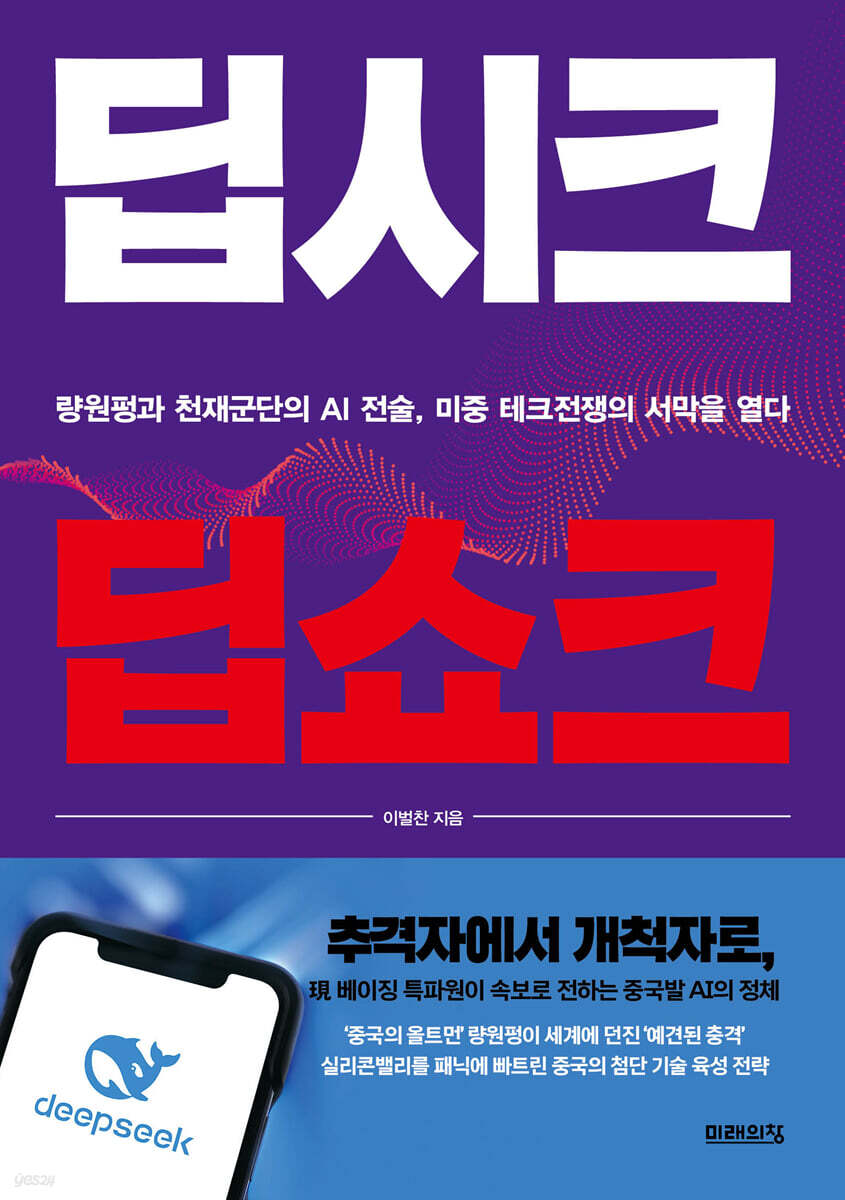
Deepseek Deepshock
 |
Description
Book Introduction
What's happening in China right now?
Deep-seated stories from our Beijing correspondent, delivered in-depth from the field.
A three-dimensional investigative report on behind-the-scenes information and people you've never heard of before.
What's the inside story behind China's AI offensive that shook up AI hegemony and the 21st-century hegemony war?
The "anticipated shock" thrown at the world by Liang Wenfeng, "China's Altman."
China's cutting-edge technology development strategy has sent Silicon Valley into a panic.
- The founder of the 'traitor to the people' fund became a 'hero of the people' overnight.
"1% of geniuses do what 99% of companies can't." - DeepSec's hiring philosophy
- Hong Kong's Hang Seng Index rose 15.41%.
Alibaba's stock price rose 69% (YTD to February 20)
Deep-seated stories from our Beijing correspondent, delivered in-depth from the field.
A three-dimensional investigative report on behind-the-scenes information and people you've never heard of before.
What's the inside story behind China's AI offensive that shook up AI hegemony and the 21st-century hegemony war?
The "anticipated shock" thrown at the world by Liang Wenfeng, "China's Altman."
China's cutting-edge technology development strategy has sent Silicon Valley into a panic.
- The founder of the 'traitor to the people' fund became a 'hero of the people' overnight.
"1% of geniuses do what 99% of companies can't." - DeepSec's hiring philosophy
- Hong Kong's Hang Seng Index rose 15.41%.
Alibaba's stock price rose 69% (YTD to February 20)
- You can preview some of the book's contents.
Preview
index
Prologue: Deepseek, the Shock Foreseen
Part 1: Liang Yuanfeng and the Genius Corps
Panic 17 · A festival in a remote village 24 · Amazing achievements 29 · A hero shrouded in mystery 33 · A descendant of a traitor 37 · A genius boy's hiatus 42 · A superstar in the fund industry 46 · The introduction of supercomputers 51 · Predicting the future of developers 56 · From national traitors to national heroes 60 · Temu in the industry 69 · DeepSec is a Chinese company, so 73 · % of geniuses do what 99% cannot 79 · Luo Fuli, the goddess of DeepSec 84 · The seeds of Chinese AI sown by the United States 87 · One of hundreds of AI companies in China 94 · Poetry from the Chu Dynasty that re-emerged in the 1st century 99
Part 2 China's Big Picture
Lessons from "Sukdan Yeongi" 105 · The Collaboration of the Nation and Genius 111 · Genius is Created by Non-Equalization 120 · The Backside of the Human Sea Tactic 125 · The Country That Treats Scholars Best 132 · The Kunpeng Project 136 · The Three Stages of the National Mobilization System 140 · How to Use Genius 148 · Deep Seek's Guide to Deep Seek 153 · Unpleasant Smell 159
Part 3: The AI Hegemony War
A New Era of AI 167 · Liang Wenfeng's AI Challenge 170 · Silicon Valley's Counterattack 177 · Cooking Small Fish 183 · Confronting with a Straightforward Edge, but Winning with Unconventionality 190 · China's Trusted Corner 196 · The Second DeepSec 202 · The Era of the True AI Big Bang 209 · Companies Protected by the State 212 · The Data War of the Dinosaurs 218 · The First-Century AI Silk Road 222 · Opportunities and Challenges 226
Epilogue: Answering Your Questions 230
Liang Wenfeng's Path 238
Week 240
Part 1: Liang Yuanfeng and the Genius Corps
Panic 17 · A festival in a remote village 24 · Amazing achievements 29 · A hero shrouded in mystery 33 · A descendant of a traitor 37 · A genius boy's hiatus 42 · A superstar in the fund industry 46 · The introduction of supercomputers 51 · Predicting the future of developers 56 · From national traitors to national heroes 60 · Temu in the industry 69 · DeepSec is a Chinese company, so 73 · % of geniuses do what 99% cannot 79 · Luo Fuli, the goddess of DeepSec 84 · The seeds of Chinese AI sown by the United States 87 · One of hundreds of AI companies in China 94 · Poetry from the Chu Dynasty that re-emerged in the 1st century 99
Part 2 China's Big Picture
Lessons from "Sukdan Yeongi" 105 · The Collaboration of the Nation and Genius 111 · Genius is Created by Non-Equalization 120 · The Backside of the Human Sea Tactic 125 · The Country That Treats Scholars Best 132 · The Kunpeng Project 136 · The Three Stages of the National Mobilization System 140 · How to Use Genius 148 · Deep Seek's Guide to Deep Seek 153 · Unpleasant Smell 159
Part 3: The AI Hegemony War
A New Era of AI 167 · Liang Wenfeng's AI Challenge 170 · Silicon Valley's Counterattack 177 · Cooking Small Fish 183 · Confronting with a Straightforward Edge, but Winning with Unconventionality 190 · China's Trusted Corner 196 · The Second DeepSec 202 · The Era of the True AI Big Bang 209 · Companies Protected by the State 212 · The Data War of the Dinosaurs 218 · The First-Century AI Silk Road 222 · Opportunities and Challenges 226
Epilogue: Answering Your Questions 230
Liang Wenfeng's Path 238
Week 240
Into the book
I really want to tell this story to my readers.
The Deepsick Shock was not a fiction, it was a 'foreseen shock'.
The incident of DeepSec's launch of a high-performance AI model has been portrayed as a "mystery" on social media and in foreign media, but given China's "technological breakthrough" strategy, it was inevitable.
The Chinese party and government rapidly built an infrastructure for advanced technological innovation through a socialist-style national mobilization system (mobilizing industry, academia, research institutes, and the entire population), and by putting flexible, genius startups on top of it, they successfully broke through the US technological blockade against China.
China's "rigidity" in mobilizing all national resources to achieve its goals, combined with its "flexibility" in deploying young geniuses to the front lines, has produced results.
This strategy, which can be called a 'collaboration between the state and genius,' has proven effective and is sure to be used more widely in the future.
That's why Deepseek Shock is called 'Deepshock'.
Because it is not a temporary phenomenon or something that appeared by chance, but the starting point of something that will always happen in the future.
The emergence of DeepSec demonstrates that even if the United States controls the export of equipment and technology, it will no longer be able to stop China's technological rise.
Even though we mobilized our allies and applied pressure from all sides, didn't we face limitations?
China has already succeeded in producing 7nm semiconductors using older-generation exposure equipment, DUV, in 2023, and has secured advanced technologies in its electric vehicle and battery industries, backed by a huge market and government support.
It is no longer easy to expect South Korea to benefit from the US's containment of China.
Rather, the expectation that the United States will tie China's hands and feet in the field of advanced technology is blinding us and making us complacent.
--- pp.7-8
Silicon Valley was shocked, but I suspect that Jensen Huang, CEO of Nvidia and DeepSec's biggest 'victim,' was somewhat aware of it.
He was in Beijing on January 20th, the day of US President Donald Trump's second inauguration.
He praised China as "the greatest market in the world" and poured out words full of goodwill, saying, "China is the country that 'raised' Nvidia, and Nvidia and the Chinese technology industry have grown together."
He may have anticipated the Deepsick shock, but he at least knew that in a rapidly changing world, he could no longer ignore China.
--- p.10
However, questions persist as to why Huanfang Lianghua purchased such a large quantity of advanced semiconductors from the United States.
Coincidentally, the timing of his massive purchase of A100s, essential for developing high-performance AI models, was just before the United States banned the export of cutting-edge AI semiconductors to China in September 2022.
Accordingly, some have raised suspicions that Huanfang Lianghua may have made some kind of deal with Nvidia under government orders in preparation for the US's technological sanctions against China.
It is also possible that the Chinese government tipped him off to a strategy for securing advanced semiconductors in advance.
The period when Liang Wenfeng purchased semiconductors in large quantities was when the US-China technology war was showing signs of escalating, and Chinese big tech companies were also gradually starting to 'buy up semiconductors' as a preparation for the future.
--- p.53
"In my personal opinion, Liang Yuanfeng was not a person who was obsessed with money because he had too much money.
Starting around 2019, the company showed greater interest in AI technology development than in managing Huanfang Lianghua, and gradually delegated management to management.
A few years later, it seemed that Huanfang Lianghua was no longer his main occupation, but rather AI technology research, and he wanted to focus on things that would benefit society.
A global investment industry insider from Shanghai was a bit more blunt.
He said, "The sequence of events—Huanfang Lianghua stopping new fundraising in 2021, Liang Wenfeng making a large-scale anonymous donation the following year, and Huanfang Lianghua founding Deepseak in January 2023—is reminiscent of a child being punished after being scolded." He added, "At a time when the authorities' investigation and pressure on companies in China's financial industry were at their peak, Liang Wenfeng focused on an industry that he was interested in and that the country wanted."
--- p.65
It is easy to explain why there are almost no 'sea turtles' (students who returned to Korea after studying abroad) among the members of Deep Seek.
If you are overseas, you cannot verify from a young age or get hands-on experience on the ground.
Above all, there were already enough geniuses within China.
As I will explain in Chapter 2 of this book, by this time China's genius training system was already well established.
Just as with the first wave of Chinese internet companies like Alibaba and Tencent two decades ago, China's top talent has opted to work for homegrown tech startups rather than seek opportunities abroad or join multinational corporations.
There was also a widespread belief in every Chinese household that "the moment you become a skilled worker, wealth and fame are guaranteed."
The story goes that no parent would stop their child from working at a tech startup.
China is poised to compete with Silicon Valley in ambition, resources, and influence.
--- p.82
"Whenever China faces a challenge requiring national innovation, it borrows the brains and passion of young, flexible 'child soldiers' to compensate for the inevitably rigid limitations of a government-led economy," said a Beijing-based tech industry insider.
China's "casting principle" of putting young geniuses at the forefront rather than seasoned, white-haired generals is surprisingly practical.
So, if we were to name China's cutting-edge technology breakthrough strategy, wouldn't "Collaboration between the State and Genius" be an appropriate name?
The Chinese government leads industry, academia, and research to build a solid foundation of cutting-edge technology, and then releases geniuses on top of it.
It seems that Liang Yuanfeng confidently said such things because the country had its backing.
“OpenAI is not God.
“You can’t stay at the forefront forever.”
--- p.118
It's not unusual for geniuses to start up startups or find jobs in China.
When asked by Chinese media how DeepSeek, a startup, managed to attract such talented individuals, Liang Wenfeng replied, "Because we are doing the most difficult job."
“What attracts the best talent the most is solving the world’s most difficult problems.
"There has been so little innovation in China so far that they are desperate for opportunities to showcase their talents," he explained.
--- p.131
Ultimately, in China, the "how to use genius" is to serve as a "breakwater" so that genius can achieve technological goals without being swayed by external storms.
In fact, China's leading companies in cutting-edge industries such as semiconductors and drones have been displaying their genius with the support and protection of the state.
The cutting-edge technology industry is characterized by small initial markets and large investment scales. In foreign countries such as Korea and the United States, large corporations dominate the market. However, in China, state-selected startups, backed by state-owned capital and preferential policies, play a central role in the industrial ecosystem.
Representative examples of this collaboration between genius and the state include YMTC (NAND flash) and CXMT (DRAM), the two pillars of China's memory semiconductor industry; HiSilicon and UniSOC, the top two fabless (semiconductor design) companies in China; and DJI, which accounts for 75% of the global drone market.
All of these companies are also unlisted.
--- p.151
As the 'DeepSeeker Ban' spread globally, the consolidation of Chinese companies also accelerated.
China's largest messenger company, telecommunications company, and even automobile company are pushing DeepSeak.
Tencent, which operates China's super app WeChat (the Chinese version of KakaoTalk), announced on February 15, 2025, that it would integrate DeepSearch's AI into its services.
Moore Threads Technology, an AI semiconductor design company founded by former Nvidia China general manager Zhang Jianzhong, announced that it plans to open an AI data center based on its own semiconductors to service DeepSec's AI models.
A list of about 10 companies that have stepped forward to provide DeepSearch services with their own technology, similar to Moore's Thread Technology, is circulating in China under the name of "patriotic semiconductor companies."
--- p.181
China's state-run Global Times reported that "South Korea blocked DeepSeek due to so-called 'data collection concerns,'" and that "China will resolutely protect its companies' legitimate rights."
Chinese IT media outlet ZAKER wrote, “Anyone who is not envied is stupid,” and “Countries like Korea, which call themselves science and technology powerhouses, have expressed their bewilderment.”
“Korea, as a country competing industrially with China, has great anxiety about China’s rise in AI,” said blogger Darao Zhuo, who has 150,000 followers.
“It was a political decision for the Korean government to step in and blockade Chinese technology,” he wrote.
--- p.214
Africa, a key target of China's "One Belt, One Road" initiative and the top destination for Foreign Minister Wang Yi's overseas tour, is embracing DeepSeak without resistance.
In countries with underdeveloped AI industries, such as South Africa and Nigeria, the use of DeepSearch is already being observed.
If China makes the Global South its "deep-secret sphere of influence," it may establish an AI order that can rival the United States.
DeepSearch was developed at a low cost and is open source, making it accessible to anyone, providing a new entry point into the AI industry for developing countries.
In some countries, the United States, which monopolized the advanced AI industry based on expensive semiconductors, is portrayed as the "villain," while China, which brought open-source AI, is portrayed as the "benefactor."
Americas Quarterly, a New York-based South American political analysis media outlet, wrote, "It is true that China has brought about 'AI democratization' through DeepSec, enabling resource-poor countries to jump into AI development at a low cost," but added, "South American countries should be wary of China's 'AI diplomacy' as they move beyond the West's hardware (semiconductor) advantage."
The Deepsick Shock was not a fiction, it was a 'foreseen shock'.
The incident of DeepSec's launch of a high-performance AI model has been portrayed as a "mystery" on social media and in foreign media, but given China's "technological breakthrough" strategy, it was inevitable.
The Chinese party and government rapidly built an infrastructure for advanced technological innovation through a socialist-style national mobilization system (mobilizing industry, academia, research institutes, and the entire population), and by putting flexible, genius startups on top of it, they successfully broke through the US technological blockade against China.
China's "rigidity" in mobilizing all national resources to achieve its goals, combined with its "flexibility" in deploying young geniuses to the front lines, has produced results.
This strategy, which can be called a 'collaboration between the state and genius,' has proven effective and is sure to be used more widely in the future.
That's why Deepseek Shock is called 'Deepshock'.
Because it is not a temporary phenomenon or something that appeared by chance, but the starting point of something that will always happen in the future.
The emergence of DeepSec demonstrates that even if the United States controls the export of equipment and technology, it will no longer be able to stop China's technological rise.
Even though we mobilized our allies and applied pressure from all sides, didn't we face limitations?
China has already succeeded in producing 7nm semiconductors using older-generation exposure equipment, DUV, in 2023, and has secured advanced technologies in its electric vehicle and battery industries, backed by a huge market and government support.
It is no longer easy to expect South Korea to benefit from the US's containment of China.
Rather, the expectation that the United States will tie China's hands and feet in the field of advanced technology is blinding us and making us complacent.
--- pp.7-8
Silicon Valley was shocked, but I suspect that Jensen Huang, CEO of Nvidia and DeepSec's biggest 'victim,' was somewhat aware of it.
He was in Beijing on January 20th, the day of US President Donald Trump's second inauguration.
He praised China as "the greatest market in the world" and poured out words full of goodwill, saying, "China is the country that 'raised' Nvidia, and Nvidia and the Chinese technology industry have grown together."
He may have anticipated the Deepsick shock, but he at least knew that in a rapidly changing world, he could no longer ignore China.
--- p.10
However, questions persist as to why Huanfang Lianghua purchased such a large quantity of advanced semiconductors from the United States.
Coincidentally, the timing of his massive purchase of A100s, essential for developing high-performance AI models, was just before the United States banned the export of cutting-edge AI semiconductors to China in September 2022.
Accordingly, some have raised suspicions that Huanfang Lianghua may have made some kind of deal with Nvidia under government orders in preparation for the US's technological sanctions against China.
It is also possible that the Chinese government tipped him off to a strategy for securing advanced semiconductors in advance.
The period when Liang Wenfeng purchased semiconductors in large quantities was when the US-China technology war was showing signs of escalating, and Chinese big tech companies were also gradually starting to 'buy up semiconductors' as a preparation for the future.
--- p.53
"In my personal opinion, Liang Yuanfeng was not a person who was obsessed with money because he had too much money.
Starting around 2019, the company showed greater interest in AI technology development than in managing Huanfang Lianghua, and gradually delegated management to management.
A few years later, it seemed that Huanfang Lianghua was no longer his main occupation, but rather AI technology research, and he wanted to focus on things that would benefit society.
A global investment industry insider from Shanghai was a bit more blunt.
He said, "The sequence of events—Huanfang Lianghua stopping new fundraising in 2021, Liang Wenfeng making a large-scale anonymous donation the following year, and Huanfang Lianghua founding Deepseak in January 2023—is reminiscent of a child being punished after being scolded." He added, "At a time when the authorities' investigation and pressure on companies in China's financial industry were at their peak, Liang Wenfeng focused on an industry that he was interested in and that the country wanted."
--- p.65
It is easy to explain why there are almost no 'sea turtles' (students who returned to Korea after studying abroad) among the members of Deep Seek.
If you are overseas, you cannot verify from a young age or get hands-on experience on the ground.
Above all, there were already enough geniuses within China.
As I will explain in Chapter 2 of this book, by this time China's genius training system was already well established.
Just as with the first wave of Chinese internet companies like Alibaba and Tencent two decades ago, China's top talent has opted to work for homegrown tech startups rather than seek opportunities abroad or join multinational corporations.
There was also a widespread belief in every Chinese household that "the moment you become a skilled worker, wealth and fame are guaranteed."
The story goes that no parent would stop their child from working at a tech startup.
China is poised to compete with Silicon Valley in ambition, resources, and influence.
--- p.82
"Whenever China faces a challenge requiring national innovation, it borrows the brains and passion of young, flexible 'child soldiers' to compensate for the inevitably rigid limitations of a government-led economy," said a Beijing-based tech industry insider.
China's "casting principle" of putting young geniuses at the forefront rather than seasoned, white-haired generals is surprisingly practical.
So, if we were to name China's cutting-edge technology breakthrough strategy, wouldn't "Collaboration between the State and Genius" be an appropriate name?
The Chinese government leads industry, academia, and research to build a solid foundation of cutting-edge technology, and then releases geniuses on top of it.
It seems that Liang Yuanfeng confidently said such things because the country had its backing.
“OpenAI is not God.
“You can’t stay at the forefront forever.”
--- p.118
It's not unusual for geniuses to start up startups or find jobs in China.
When asked by Chinese media how DeepSeek, a startup, managed to attract such talented individuals, Liang Wenfeng replied, "Because we are doing the most difficult job."
“What attracts the best talent the most is solving the world’s most difficult problems.
"There has been so little innovation in China so far that they are desperate for opportunities to showcase their talents," he explained.
--- p.131
Ultimately, in China, the "how to use genius" is to serve as a "breakwater" so that genius can achieve technological goals without being swayed by external storms.
In fact, China's leading companies in cutting-edge industries such as semiconductors and drones have been displaying their genius with the support and protection of the state.
The cutting-edge technology industry is characterized by small initial markets and large investment scales. In foreign countries such as Korea and the United States, large corporations dominate the market. However, in China, state-selected startups, backed by state-owned capital and preferential policies, play a central role in the industrial ecosystem.
Representative examples of this collaboration between genius and the state include YMTC (NAND flash) and CXMT (DRAM), the two pillars of China's memory semiconductor industry; HiSilicon and UniSOC, the top two fabless (semiconductor design) companies in China; and DJI, which accounts for 75% of the global drone market.
All of these companies are also unlisted.
--- p.151
As the 'DeepSeeker Ban' spread globally, the consolidation of Chinese companies also accelerated.
China's largest messenger company, telecommunications company, and even automobile company are pushing DeepSeak.
Tencent, which operates China's super app WeChat (the Chinese version of KakaoTalk), announced on February 15, 2025, that it would integrate DeepSearch's AI into its services.
Moore Threads Technology, an AI semiconductor design company founded by former Nvidia China general manager Zhang Jianzhong, announced that it plans to open an AI data center based on its own semiconductors to service DeepSec's AI models.
A list of about 10 companies that have stepped forward to provide DeepSearch services with their own technology, similar to Moore's Thread Technology, is circulating in China under the name of "patriotic semiconductor companies."
--- p.181
China's state-run Global Times reported that "South Korea blocked DeepSeek due to so-called 'data collection concerns,'" and that "China will resolutely protect its companies' legitimate rights."
Chinese IT media outlet ZAKER wrote, “Anyone who is not envied is stupid,” and “Countries like Korea, which call themselves science and technology powerhouses, have expressed their bewilderment.”
“Korea, as a country competing industrially with China, has great anxiety about China’s rise in AI,” said blogger Darao Zhuo, who has 150,000 followers.
“It was a political decision for the Korean government to step in and blockade Chinese technology,” he wrote.
--- p.214
Africa, a key target of China's "One Belt, One Road" initiative and the top destination for Foreign Minister Wang Yi's overseas tour, is embracing DeepSeak without resistance.
In countries with underdeveloped AI industries, such as South Africa and Nigeria, the use of DeepSearch is already being observed.
If China makes the Global South its "deep-secret sphere of influence," it may establish an AI order that can rival the United States.
DeepSearch was developed at a low cost and is open source, making it accessible to anyone, providing a new entry point into the AI industry for developing countries.
In some countries, the United States, which monopolized the advanced AI industry based on expensive semiconductors, is portrayed as the "villain," while China, which brought open-source AI, is portrayed as the "benefactor."
Americas Quarterly, a New York-based South American political analysis media outlet, wrote, "It is true that China has brought about 'AI democratization' through DeepSec, enabling resource-poor countries to jump into AI development at a low cost," but added, "South American countries should be wary of China's 'AI diplomacy' as they move beyond the West's hardware (semiconductor) advantage."
--- p.224
Publisher's Review
“In war, fight with the right strategy, but win with the wrong strategy.” - The Art of War
Quietly bide one's time and build up strength
Perhaps we have been trying to ignore China.
Caught in the whirlwind of the US-China war and amidst the high waves of the THAAD retaliation, China has been our enemy for some time now, and while the media is filled with negative news from China, we only occasionally hear of its remarkable progress and high competitiveness in certain fields.
But now, China has made its presence felt around the world as a force that cannot be ignored.
The world, which had thought that innovation was only possible in Silicon Valley in the United States, was shocked.
So quickly, so cheaply, with so few people, they came up with a world-class AI model.
That too on the day of US President Donald Trump's second inauguration.
We didn't know.
The fact that China is the world's leading country in AI patent applications, is home to a plethora of young, science- and engineering-focused entrepreneurs like Liang Wenfeng, and that DeepSec is just one of many AI models they are developing.
Consider the world's leading tech companies today. BYD has surpassed Tesla to become the world's leading electric vehicle seller, and TikTok, a thorn in the side of the US government, remains the most beloved social network globally, especially in the US.
Huawei is the leader in 5G despite all the US interference, and DJI is the world's leading drone company.
If I were to list them all, there would be no end to them.
The author attributes China's global competitiveness to the Chinese government's long-term and unwavering industrial support policy, its policy of nurturing science and engineering talent, and the fantastic collaboration between geniuses and the state.
The Chinese science fiction novel, The Three-Body Problem, contains a fantasy world where three suns rise.
There are two suns rising in the world today.
This is not an exaggeration, it is a fact that cannot be ignored.
It's a perfect revival of G2.
Regarding this, the author says this:
“Two worlds are opening up.” Wise choices and broader opportunities.
Let's find out how South Korea can survive the AI world war through this book.
Quietly bide one's time and build up strength
Perhaps we have been trying to ignore China.
Caught in the whirlwind of the US-China war and amidst the high waves of the THAAD retaliation, China has been our enemy for some time now, and while the media is filled with negative news from China, we only occasionally hear of its remarkable progress and high competitiveness in certain fields.
But now, China has made its presence felt around the world as a force that cannot be ignored.
The world, which had thought that innovation was only possible in Silicon Valley in the United States, was shocked.
So quickly, so cheaply, with so few people, they came up with a world-class AI model.
That too on the day of US President Donald Trump's second inauguration.
We didn't know.
The fact that China is the world's leading country in AI patent applications, is home to a plethora of young, science- and engineering-focused entrepreneurs like Liang Wenfeng, and that DeepSec is just one of many AI models they are developing.
Consider the world's leading tech companies today. BYD has surpassed Tesla to become the world's leading electric vehicle seller, and TikTok, a thorn in the side of the US government, remains the most beloved social network globally, especially in the US.
Huawei is the leader in 5G despite all the US interference, and DJI is the world's leading drone company.
If I were to list them all, there would be no end to them.
The author attributes China's global competitiveness to the Chinese government's long-term and unwavering industrial support policy, its policy of nurturing science and engineering talent, and the fantastic collaboration between geniuses and the state.
The Chinese science fiction novel, The Three-Body Problem, contains a fantasy world where three suns rise.
There are two suns rising in the world today.
This is not an exaggeration, it is a fact that cannot be ignored.
It's a perfect revival of G2.
Regarding this, the author says this:
“Two worlds are opening up.” Wise choices and broader opportunities.
Let's find out how South Korea can survive the AI world war through this book.
GOODS SPECIFICS
- Date of issue: March 10, 2025
- Page count, weight, size: 250 pages | 402g | 153*224*16mm
- ISBN13: 9791193638774
- ISBN10: 1193638771
You may also like
카테고리
korean


korean

![ELLE 엘르 스페셜 에디션 A형 : 12월 [2025]](http://librairie.coreenne.fr/cdn/shop/files/b8e27a3de6c9538896439686c6b0e8fb.jpg?v=1766436872&width=3840)


