

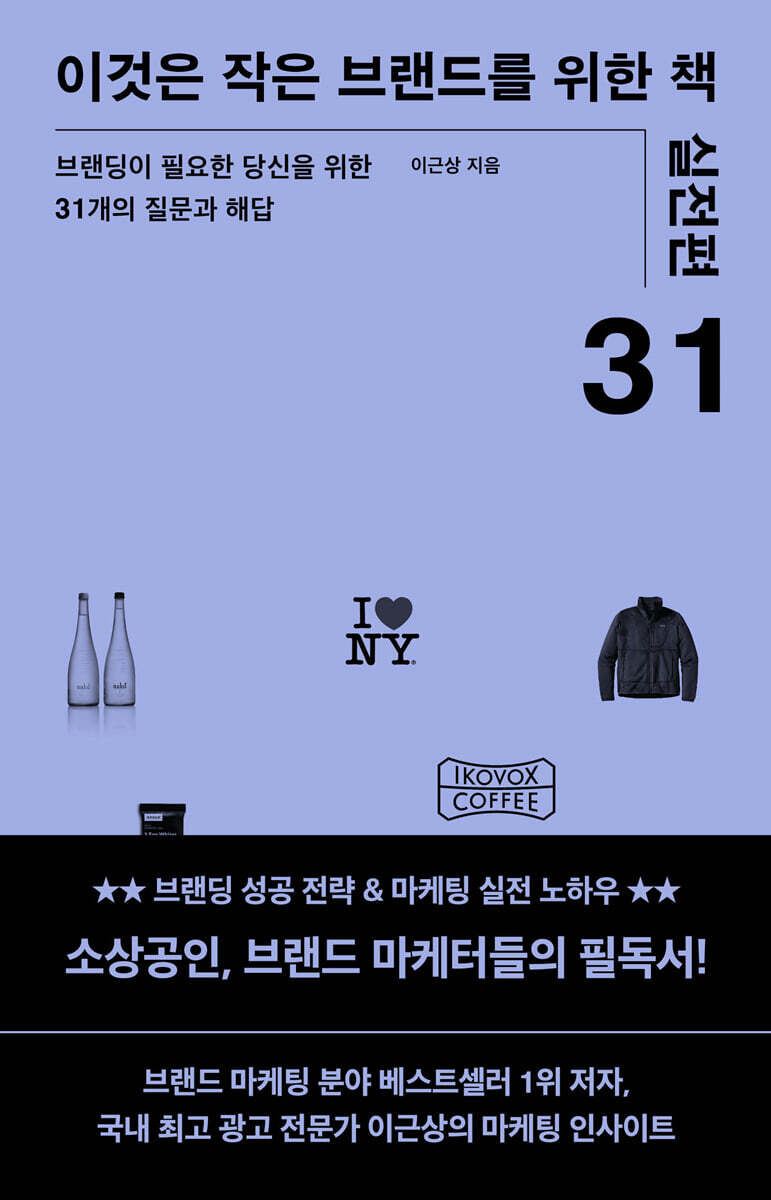
This is a book for small brands (practical edition)
 |
Description
Book Introduction
- A word from MD
-
Speak to the essence of the brandThis is a new book by author Lee Geun-sang, who has led the advertising industry for 30 years as an icon of innovation.
We are moving beyond the era of creating good advertisements and packaging, and talking about a strategy to create a good brand centered on its essence.
31 vivid questions and answers are organized with various examples so that they can be applied in real life.
October 4, 2023. Economics and Management PD Kim Sang-geun
From the Age of Advertising to the Age of Essence
Author Lee Geun-sang, who has worked in the advertising industry for over 30 years, declares in his book, “This is a Practical Book for Small Brands,” that “the era when marketing shook the market is over.”
After 50 years of storm and stress where the focus was on 'how to package' rather than the essence of the brand, we have returned to an era of essence.
“Now, without a proper essence, no help is of any use.
In other words, we have entered an era where, if you build a brand well centered on its essence, you can succeed without much help.”
- In the introduction
In his previous book, “This is a book for small brands,” which has become a steady seller in the field of brand marketing, the author said, “The era of big brands is over.
This overlaps with what I said, “Now is the era of small brands.”
The advertising market is centered around large corporations, and he, as an advertiser, has worked for large brands his entire life.
However, he argued that the methods that had grown big brands in the past have now lost their momentum, and that “small brands now have an opportunity to establish their own territory in a different way than before,” and this message provided insight to numerous ‘small brands’ in the market.
In this book, he talks about the futility of 'advertising or marketing activities for packaging.'
As it has become easier to turn outstanding technology or ideas into products or services, the power of advertising creativity has become less important as long as the product is truly excellent.
Instead, he said he wrote this book to share the 'help that is not so different' that is needed and how to provide that help.
What the author describes as 'no different' help is none other than 'properly understanding and practicing the concept of the brand.'
So then, what exactly is the brand the author is talking about?
Author Lee Geun-sang, who has worked in the advertising industry for over 30 years, declares in his book, “This is a Practical Book for Small Brands,” that “the era when marketing shook the market is over.”
After 50 years of storm and stress where the focus was on 'how to package' rather than the essence of the brand, we have returned to an era of essence.
“Now, without a proper essence, no help is of any use.
In other words, we have entered an era where, if you build a brand well centered on its essence, you can succeed without much help.”
- In the introduction
In his previous book, “This is a book for small brands,” which has become a steady seller in the field of brand marketing, the author said, “The era of big brands is over.
This overlaps with what I said, “Now is the era of small brands.”
The advertising market is centered around large corporations, and he, as an advertiser, has worked for large brands his entire life.
However, he argued that the methods that had grown big brands in the past have now lost their momentum, and that “small brands now have an opportunity to establish their own territory in a different way than before,” and this message provided insight to numerous ‘small brands’ in the market.
In this book, he talks about the futility of 'advertising or marketing activities for packaging.'
As it has become easier to turn outstanding technology or ideas into products or services, the power of advertising creativity has become less important as long as the product is truly excellent.
Instead, he said he wrote this book to share the 'help that is not so different' that is needed and how to provide that help.
What the author describes as 'no different' help is none other than 'properly understanding and practicing the concept of the brand.'
So then, what exactly is the brand the author is talking about?
- You can preview some of the book's contents.
Preview
index
Introduction 012
01 Your Brand May Not Be a Brand 018
02 Brands are People 025
03 A Brand Without DNA Isn't a Brand 032
04 Product power is not the only core value. 042
05 Brands are born where essence and consumers meet. 051
06 Look at it from the user's perspective, not the creator's. 059
07 Core values must evolve 068
08 'My Experience' is the Best Material 077
09 Branding isn't about solving today's problems 085
10 Find Your Persona 093
11 Don't Work with Advertising Agencies 101
12 Copy is not writing (1) 109
13 Copy is not writing (2) 115
14 The answer is on the other side 123
15 Internal Customers Come First 132
16 There's no motivation as powerful as branding 141
17 A Well-Crafted Vision Properly Grows a Brand 149
18 The problem is not knowing the problem 156
19 Become a Part of Your Community 163
20. Respond Wisely to Environmental Issues 172
21 Challengers, Make the News 182
22 Is PPL Effective? 190
23 'Middle-breaking' is the key 198
24 Marketing is no longer just the art of packaging 208
25 If you want to turn things around, redraw the competitive landscape. 215
26 The bird that sees far flies long 223
27 Just changing the design can make a difference 231
28 Design the Experience 240
29 Create a spiritual membership 250
30 Traces disappear when expanded 259
31 Your Brand Should Be a Brand 268
Conclusion 276
01 Your Brand May Not Be a Brand 018
02 Brands are People 025
03 A Brand Without DNA Isn't a Brand 032
04 Product power is not the only core value. 042
05 Brands are born where essence and consumers meet. 051
06 Look at it from the user's perspective, not the creator's. 059
07 Core values must evolve 068
08 'My Experience' is the Best Material 077
09 Branding isn't about solving today's problems 085
10 Find Your Persona 093
11 Don't Work with Advertising Agencies 101
12 Copy is not writing (1) 109
13 Copy is not writing (2) 115
14 The answer is on the other side 123
15 Internal Customers Come First 132
16 There's no motivation as powerful as branding 141
17 A Well-Crafted Vision Properly Grows a Brand 149
18 The problem is not knowing the problem 156
19 Become a Part of Your Community 163
20. Respond Wisely to Environmental Issues 172
21 Challengers, Make the News 182
22 Is PPL Effective? 190
23 'Middle-breaking' is the key 198
24 Marketing is no longer just the art of packaging 208
25 If you want to turn things around, redraw the competitive landscape. 215
26 The bird that sees far flies long 223
27 Just changing the design can make a difference 231
28 Design the Experience 240
29 Create a spiritual membership 250
30 Traces disappear when expanded 259
31 Your Brand Should Be a Brand 268
Conclusion 276
Detailed image
.jpg)
Into the book
The most serious problem, more than anything else mentioned above, is that people are deluding themselves into thinking they are a brand while doing things that are far removed from branding.
They use terms like brand, branding, marketing, etc. indiscriminately without understanding the difference between product and brand, and without really knowing how sales promotion activities differ from branding.
What is the problem in this case?
--- p.21, from “Your Brand May Not Be a Brand”
Creating a 'good' brand can be likened to creating a 'cool' personality.
The most important thing for anyone building a brand is to define their own specific adjectives that will take the place of “good” and “awesome.”
And all activities should be focused in one direction so that the goal of the adjective can be achieved.
--- p.30, from “A Brand is a Person”
When a brand has DNA, from the consumer's or customer's perspective, it becomes 'a reason to attract that brand into my life.'
The world is rapidly diversifying, and accordingly, life forms are becoming more diverse and more closely divided.
In this way, the 'reason' must be specific and irreplaceable to increase the possibility of connecting 'my life' and 'that brand'.
--- p.38, from “What doesn’t have DNA isn’t a brand”
Rather, it's better to talk about what positive role your brand can play in the lives of consumers or customers.
Rather than saying, "I am this great," it is much more effective to say, "I am this important in your life."
--- p.62, from “Look at it from the perspective of the writer, not the creator”
In reality, these kinds of things happen quite often in the field.
After being selected as an advertising expert, they end up creating what they want through several revisions.
The hired 'advertising agency' is acting as such a 'agent' reluctantly from a business perspective.
--- p.103, from “Don’t Work with Advertising Agencies”
Advertisers often prefer phrases that convey their position.
In particular, brand founders want slogans such as ‘the prestigious ~’, ‘luxury ~’, ‘with ~ years of tradition’, and ‘made with the spirit of craftsmanship ~’.
This is neither a copy nor a slogan.
It is just a one-sided claim by the producer.
--- p.113, from “Copy is not writing (1)”
However, even for products or services that were previously classified as low-involvement, it is now becoming difficult to make a brand successful through the power of copy alone.
First of all, there are so many brands to pay attention to and remember, and the amount of messages they send out is staggering.
--- p.117, from “Copy is not writing (2)”
Lee Clow, the world-renowned creator who created Apple's famous 'Think Different' commercial, also declared his advertising philosophy in one word: 'Disruption.'
It is argued that we must 'break down' what we know so far in order to create something new.
--- p.125, from “The answer is on the other side”
There are many things needed to motivate internal organization members.
Things like wage levels, working conditions, office location, and minor employee benefits will all have an impact.
Assuming that these are somewhat satisfactory, the tag that says, 'I am a person who makes ~' plays an important role.
--- p.145, from “There is no motivation as powerful as branding”
First of all, we need to get rid of the attitude of 'I know all the problems.'
Let's start from the point of 'My product or idea might be wrong.'
Just as a weather forecaster looks at today's weather with a rational attitude, we must start by looking at the big picture with an objective perspective.
If you're struggling with a problem that won't go away, consider whether you're solving the wrong problem.
--- p.162, from “Not knowing is the problem”
The challenger's strategy should be news in itself.
The fact that something becomes news in itself means that it is unexpected, and if it can actually become news and spread, it has the advantage of being able to enjoy the effect of the available budget several times over.
This increases the chances of turning things around on a small budget.
--- p.184, from “Challenger, Make the News”
In conclusion, it is difficult to give a positive evaluation of the effectiveness of PPL.
Because it has become a method whose true intentions have been completely revealed.
This is especially true for brands that appear in supporting roles with little PPL costs.
I am worried that it might create a negative image by acting as a villain that disrupts the flow of content.
--- p.193, from “Is PPL Effective?”
Experiencing a brand like this isn't simply about displaying products and letting customers experience their strengths. It's about giving customers enough reasons to visit, naturally allowing them to experience the brand's core values, philosophy, and vision.
That's why, when creating offline customer touchpoints, it's important to design them so that the brand's values are well-informed to visitors.
--- p.244, from “Design the Experience”
Even Allbirds, which promised to “leave a mark on the universe,” could not avoid the trial and error that many brands have experienced when they ‘mistakenly’ thought they were on the path to success.
Looking back at the situation at Allbirds, it is not surprising that they had a 'victor's fantasy'.
--- p.263p From 'Traces disappear when you expand them'
Apple, which launched anew in 1997 by establishing the core value of "Think Different," has a brand value of over $480 billion as of 2022, according to Interbrand.
There's no reason why your brand can't do the same.
So your brand has to be a brand.
They use terms like brand, branding, marketing, etc. indiscriminately without understanding the difference between product and brand, and without really knowing how sales promotion activities differ from branding.
What is the problem in this case?
--- p.21, from “Your Brand May Not Be a Brand”
Creating a 'good' brand can be likened to creating a 'cool' personality.
The most important thing for anyone building a brand is to define their own specific adjectives that will take the place of “good” and “awesome.”
And all activities should be focused in one direction so that the goal of the adjective can be achieved.
--- p.30, from “A Brand is a Person”
When a brand has DNA, from the consumer's or customer's perspective, it becomes 'a reason to attract that brand into my life.'
The world is rapidly diversifying, and accordingly, life forms are becoming more diverse and more closely divided.
In this way, the 'reason' must be specific and irreplaceable to increase the possibility of connecting 'my life' and 'that brand'.
--- p.38, from “What doesn’t have DNA isn’t a brand”
Rather, it's better to talk about what positive role your brand can play in the lives of consumers or customers.
Rather than saying, "I am this great," it is much more effective to say, "I am this important in your life."
--- p.62, from “Look at it from the perspective of the writer, not the creator”
In reality, these kinds of things happen quite often in the field.
After being selected as an advertising expert, they end up creating what they want through several revisions.
The hired 'advertising agency' is acting as such a 'agent' reluctantly from a business perspective.
--- p.103, from “Don’t Work with Advertising Agencies”
Advertisers often prefer phrases that convey their position.
In particular, brand founders want slogans such as ‘the prestigious ~’, ‘luxury ~’, ‘with ~ years of tradition’, and ‘made with the spirit of craftsmanship ~’.
This is neither a copy nor a slogan.
It is just a one-sided claim by the producer.
--- p.113, from “Copy is not writing (1)”
However, even for products or services that were previously classified as low-involvement, it is now becoming difficult to make a brand successful through the power of copy alone.
First of all, there are so many brands to pay attention to and remember, and the amount of messages they send out is staggering.
--- p.117, from “Copy is not writing (2)”
Lee Clow, the world-renowned creator who created Apple's famous 'Think Different' commercial, also declared his advertising philosophy in one word: 'Disruption.'
It is argued that we must 'break down' what we know so far in order to create something new.
--- p.125, from “The answer is on the other side”
There are many things needed to motivate internal organization members.
Things like wage levels, working conditions, office location, and minor employee benefits will all have an impact.
Assuming that these are somewhat satisfactory, the tag that says, 'I am a person who makes ~' plays an important role.
--- p.145, from “There is no motivation as powerful as branding”
First of all, we need to get rid of the attitude of 'I know all the problems.'
Let's start from the point of 'My product or idea might be wrong.'
Just as a weather forecaster looks at today's weather with a rational attitude, we must start by looking at the big picture with an objective perspective.
If you're struggling with a problem that won't go away, consider whether you're solving the wrong problem.
--- p.162, from “Not knowing is the problem”
The challenger's strategy should be news in itself.
The fact that something becomes news in itself means that it is unexpected, and if it can actually become news and spread, it has the advantage of being able to enjoy the effect of the available budget several times over.
This increases the chances of turning things around on a small budget.
--- p.184, from “Challenger, Make the News”
In conclusion, it is difficult to give a positive evaluation of the effectiveness of PPL.
Because it has become a method whose true intentions have been completely revealed.
This is especially true for brands that appear in supporting roles with little PPL costs.
I am worried that it might create a negative image by acting as a villain that disrupts the flow of content.
--- p.193, from “Is PPL Effective?”
Experiencing a brand like this isn't simply about displaying products and letting customers experience their strengths. It's about giving customers enough reasons to visit, naturally allowing them to experience the brand's core values, philosophy, and vision.
That's why, when creating offline customer touchpoints, it's important to design them so that the brand's values are well-informed to visitors.
--- p.244, from “Design the Experience”
Even Allbirds, which promised to “leave a mark on the universe,” could not avoid the trial and error that many brands have experienced when they ‘mistakenly’ thought they were on the path to success.
Looking back at the situation at Allbirds, it is not surprising that they had a 'victor's fantasy'.
--- p.263p From 'Traces disappear when you expand them'
Apple, which launched anew in 1997 by establishing the core value of "Think Different," has a brand value of over $480 billion as of 2022, according to Interbrand.
There's no reason why your brand can't do the same.
So your brand has to be a brand.
--- p.274, from “Your brand must become a brand”
Publisher's Review
The Complete Guide to Successful Branding Strategies & Practical Marketing Know-How
** Author of "This is a book for small business owners and brand marketers," a must-read
** An icon of innovation who has led numerous hit advertising campaigns Hyundai Card 'You who have worked hard, now leave' SM5 'Who are you?' Tromm 'I want to wear it for a long time' Hyundai Development Company 'Think innovation' Hankook Tire 'Driving Emotion' Korea Investment & Securities 'The power of the Korean people' Hyundai Development Company "Don't be satisfied" Paradise Group 'Design Life as Art' Prospecs 'I hope it goes well'...
** An advertising legend with an undefeated record of 20 consecutive winning advertising presentations.
** EBS Business Review, KBS1 Radio's Success Premonition, Baemin Academy lectures, etc.
** Current CEO of KS'IDEA, former youngest planning director at advertising agency Korad, former vice president of Welcome
Lee Geun-sang, an icon of advertising innovation, shares 30 years of marketing insights.
"A brand is a person. Anything without DNA isn't a brand."
31 vivid questions and clear answers drawn from the branding and marketing field.
Where to start with an eco-friendly brand's consumer campaign.
Online plant brands, do they need offline stores?
I want to create a Korean Muji brand.
How should a pet supply brand spend its limited marketing budget?
Local city branding and slogan are a concern.
Small neighborhood bookstores need a differentiating idea.
Should a 10-year-old food brand change its packaging?
I'm not sure about the drama PPL.
Running a hotel in a rural city is a lot of competition.
Organic store, need some bait products?
A sandwich shop is struggling to attract customers.
Even if you do outdoor brand marketing and advertising, your market share will drop.
Where should you start with branding for your food startup?
I'm curious about how domestic furniture brands can increase their brand awareness.
I am a marketer for a kitchenware brand.
How do I find an advertising agency?
Small appliance brand, advertising is not effective.
Sales are stagnant, and the organization feels like it's fallen into a rut.
What should I prepare first when starting my own brand for a bottled water company that used to supply OEMs?
As a small planter company, we are facing increasing competition and want to try something new.
A 10-year-old juice brand, isn't branding too idealistic?
Education platform startups need powerful slogans and copy.
It seems like the people in charge of marketing are doing something completely different from what I thought.
How long does it take to achieve proper branding?
How should we handle issues that arise in the field during the branding period?
Securities firms are struggling to find a way to market online to their 20-something customers.
10 Questions to Ask Your Brand
The author begins by asking the following ten questions about your current branding efforts:
Rather than judging how many of these questions apply to you, it would be better to use it as a measure to determine where your brand is located on the path to becoming a brand.
Just by reading the 10 questions and checking the current direction and activities of my brand, I can roughly grasp the concept of 'brand'.
1.
Is there one adjective that best describes your brand?
2.
Isn't that adjective so general that it's difficult for it to become a brand asset?
3.
Can that adjective create a perception that differentiates you from competing brands?
4.
Does that differentiated perception have any meaning in the lives of consumers or customers?
5.
Do you have a plan (at least) for three years to create a differentiated perception?
6.
Can you describe how your brand successfully connects with consumers' lives?
7.
Are all decisions about your brand based on a differentiated perception?
8.
Have you ever done anything unrelated to your brand identity to increase sales?
9.
Is the decision-making structure related to the brand simple and consistent?
10.
Are all members of the organization well-aware of the brand concept and identity?
A brand is a person, and anything without DNA isn't a brand.
To truly understand what a brand is, the author says, we must first distinguish between a 'brand' and a 'product.'
If a product is a service or something produced on site, the brand is the consumer's perception of that product.
To easily explain the concept of a brand, the author explains, 'Creating a brand is like raising a person.'
If you understand that branding is about providing various forms of support to help people grow properly, many problems can be solved more easily than you think.
Creating a 'good' brand can be likened to creating a 'cool' personality, and each brand just needs to define specific adjectives that can fill the space of 'good' and 'cool.'
And we must focus all our activities in the direction of that adjective.
And considering the increasingly segmented and personalized tastes of consumers, it is explained that it is advantageous to 'raise individuals who are recognized as experts in specific fields rather than all-rounders.'
In addition, it emphasizes the need to equip the brand with its core value, ‘DNA.’
In classical marketing, what was expressed as brand image, brand concept, and positioning, the author expressed it as DNA to emphasize the meaning that 'the substance of the brand is important.'
Consumers form relationships with brands that have a certain 'meaning' to their lifestyles, and the substance of that meaning must be embedded in the brand's DNA.
When a brand has DNA, from the consumer's or customer's perspective, it becomes 'a reason to attract that brand into my life.'
The world is rapidly diversifying, and accordingly, life forms are becoming more diverse and more closely divided.
In this way, the 'reason' must be specific and irreplaceable to increase the possibility of connecting 'my life' and 'that brand'.
- In the text
31 questions and answers pulled from the field
This book provides answers to 31 questions raised in the marketing field.
Each chapter's text takes the form of questions and answers, with people in various fields asking the author about the challenges they faced on the front lines of marketing.
Readers will be able to apply 'My Question' based on very specific questions and answers.
Also, as in the previous book, “This is a book for small brands,” it explains with various cases.
The author says he spent a lot of time trying to find appropriate examples that fit the topic of the article but weren't covered in existing branding books.
However, he says that we must be aware that the cases introduced in the book are stories of 'one point in time' when branding demonstrated its positive function, and are stories of the past, not the future.
What this means is that it is important to grasp the core of a case rather than repeating past cases.
Imitating specific directions or implementation ideas is like using a strategy that has already been exposed, so it is unlikely to work in the market.
It is the ability of a wise brand operator to properly grasp the implications of such cases.
And you have to digest it and apply it to fit the situation your brand is in.
- In the text
** This book is a revised edition of "Your Brand May Not Be a Brand," published in 2023.
** Author of "This is a book for small business owners and brand marketers," a must-read
** An icon of innovation who has led numerous hit advertising campaigns Hyundai Card 'You who have worked hard, now leave' SM5 'Who are you?' Tromm 'I want to wear it for a long time' Hyundai Development Company 'Think innovation' Hankook Tire 'Driving Emotion' Korea Investment & Securities 'The power of the Korean people' Hyundai Development Company "Don't be satisfied" Paradise Group 'Design Life as Art' Prospecs 'I hope it goes well'...
** An advertising legend with an undefeated record of 20 consecutive winning advertising presentations.
** EBS Business Review, KBS1 Radio's Success Premonition, Baemin Academy lectures, etc.
** Current CEO of KS'IDEA, former youngest planning director at advertising agency Korad, former vice president of Welcome
Lee Geun-sang, an icon of advertising innovation, shares 30 years of marketing insights.
"A brand is a person. Anything without DNA isn't a brand."
31 vivid questions and clear answers drawn from the branding and marketing field.
Where to start with an eco-friendly brand's consumer campaign.
Online plant brands, do they need offline stores?
I want to create a Korean Muji brand.
How should a pet supply brand spend its limited marketing budget?
Local city branding and slogan are a concern.
Small neighborhood bookstores need a differentiating idea.
Should a 10-year-old food brand change its packaging?
I'm not sure about the drama PPL.
Running a hotel in a rural city is a lot of competition.
Organic store, need some bait products?
A sandwich shop is struggling to attract customers.
Even if you do outdoor brand marketing and advertising, your market share will drop.
Where should you start with branding for your food startup?
I'm curious about how domestic furniture brands can increase their brand awareness.
I am a marketer for a kitchenware brand.
How do I find an advertising agency?
Small appliance brand, advertising is not effective.
Sales are stagnant, and the organization feels like it's fallen into a rut.
What should I prepare first when starting my own brand for a bottled water company that used to supply OEMs?
As a small planter company, we are facing increasing competition and want to try something new.
A 10-year-old juice brand, isn't branding too idealistic?
Education platform startups need powerful slogans and copy.
It seems like the people in charge of marketing are doing something completely different from what I thought.
How long does it take to achieve proper branding?
How should we handle issues that arise in the field during the branding period?
Securities firms are struggling to find a way to market online to their 20-something customers.
10 Questions to Ask Your Brand
The author begins by asking the following ten questions about your current branding efforts:
Rather than judging how many of these questions apply to you, it would be better to use it as a measure to determine where your brand is located on the path to becoming a brand.
Just by reading the 10 questions and checking the current direction and activities of my brand, I can roughly grasp the concept of 'brand'.
1.
Is there one adjective that best describes your brand?
2.
Isn't that adjective so general that it's difficult for it to become a brand asset?
3.
Can that adjective create a perception that differentiates you from competing brands?
4.
Does that differentiated perception have any meaning in the lives of consumers or customers?
5.
Do you have a plan (at least) for three years to create a differentiated perception?
6.
Can you describe how your brand successfully connects with consumers' lives?
7.
Are all decisions about your brand based on a differentiated perception?
8.
Have you ever done anything unrelated to your brand identity to increase sales?
9.
Is the decision-making structure related to the brand simple and consistent?
10.
Are all members of the organization well-aware of the brand concept and identity?
A brand is a person, and anything without DNA isn't a brand.
To truly understand what a brand is, the author says, we must first distinguish between a 'brand' and a 'product.'
If a product is a service or something produced on site, the brand is the consumer's perception of that product.
To easily explain the concept of a brand, the author explains, 'Creating a brand is like raising a person.'
If you understand that branding is about providing various forms of support to help people grow properly, many problems can be solved more easily than you think.
Creating a 'good' brand can be likened to creating a 'cool' personality, and each brand just needs to define specific adjectives that can fill the space of 'good' and 'cool.'
And we must focus all our activities in the direction of that adjective.
And considering the increasingly segmented and personalized tastes of consumers, it is explained that it is advantageous to 'raise individuals who are recognized as experts in specific fields rather than all-rounders.'
In addition, it emphasizes the need to equip the brand with its core value, ‘DNA.’
In classical marketing, what was expressed as brand image, brand concept, and positioning, the author expressed it as DNA to emphasize the meaning that 'the substance of the brand is important.'
Consumers form relationships with brands that have a certain 'meaning' to their lifestyles, and the substance of that meaning must be embedded in the brand's DNA.
When a brand has DNA, from the consumer's or customer's perspective, it becomes 'a reason to attract that brand into my life.'
The world is rapidly diversifying, and accordingly, life forms are becoming more diverse and more closely divided.
In this way, the 'reason' must be specific and irreplaceable to increase the possibility of connecting 'my life' and 'that brand'.
- In the text
31 questions and answers pulled from the field
This book provides answers to 31 questions raised in the marketing field.
Each chapter's text takes the form of questions and answers, with people in various fields asking the author about the challenges they faced on the front lines of marketing.
Readers will be able to apply 'My Question' based on very specific questions and answers.
Also, as in the previous book, “This is a book for small brands,” it explains with various cases.
The author says he spent a lot of time trying to find appropriate examples that fit the topic of the article but weren't covered in existing branding books.
However, he says that we must be aware that the cases introduced in the book are stories of 'one point in time' when branding demonstrated its positive function, and are stories of the past, not the future.
What this means is that it is important to grasp the core of a case rather than repeating past cases.
Imitating specific directions or implementation ideas is like using a strategy that has already been exposed, so it is unlikely to work in the market.
It is the ability of a wise brand operator to properly grasp the implications of such cases.
And you have to digest it and apply it to fit the situation your brand is in.
- In the text
** This book is a revised edition of "Your Brand May Not Be a Brand," published in 2023.
GOODS SPECIFICS
- Date of issue: February 10, 2024
- Page count, weight, size: 280 pages | 362g | 135*210*18mm
- ISBN13: 9791191401745
- ISBN10: 119140174X
You may also like
카테고리
korean


korean

![ELLE 엘르 스페셜 에디션 A형 : 12월 [2025]](http://librairie.coreenne.fr/cdn/shop/files/b8e27a3de6c9538896439686c6b0e8fb.jpg?v=1766436872&width=3840)


