

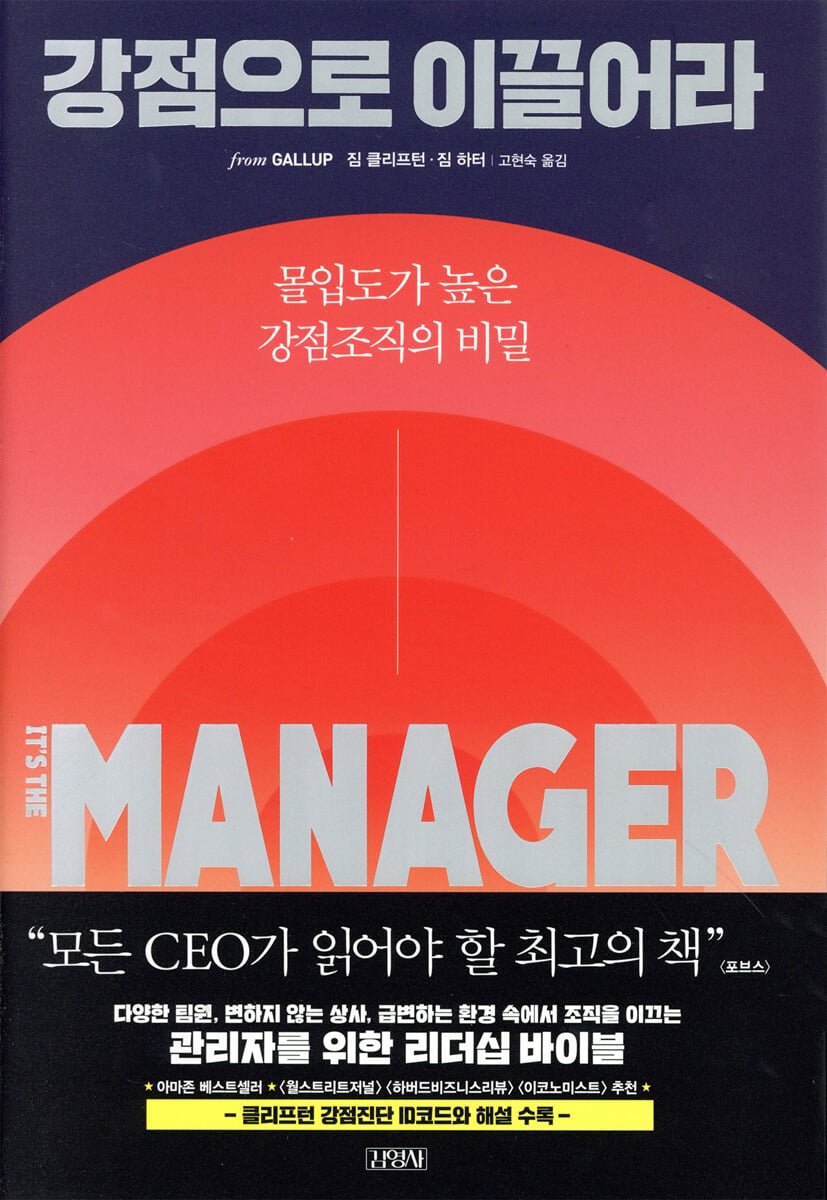
Lead with your strengths
 |
Description
Book Introduction
“Everything changes when you stop giving orders and start coaching.”
Leading an organization in a rapidly changing environment with diverse team members, an unchanging boss, and
The Leadership Bible for Managers
These days, organizational leaders have complicated minds.
This is because the environment surrounding organizational management is changing constantly.
While identifying employees born in the 1990s and Generation Z and adapting to a 52-hour workweek and a culture of "leaving work on time," COVID-19 has brought about even greater changes, including remote work and economic uncertainty.
Especially, the concerns of middle managers responsible for their teams transcend national borders between superiors who 'instruct' and subordinates who ask 'why'.
Gallup, which created a global strengths syndrome with the message of "Work with your strengths," has now focused on "organizations."
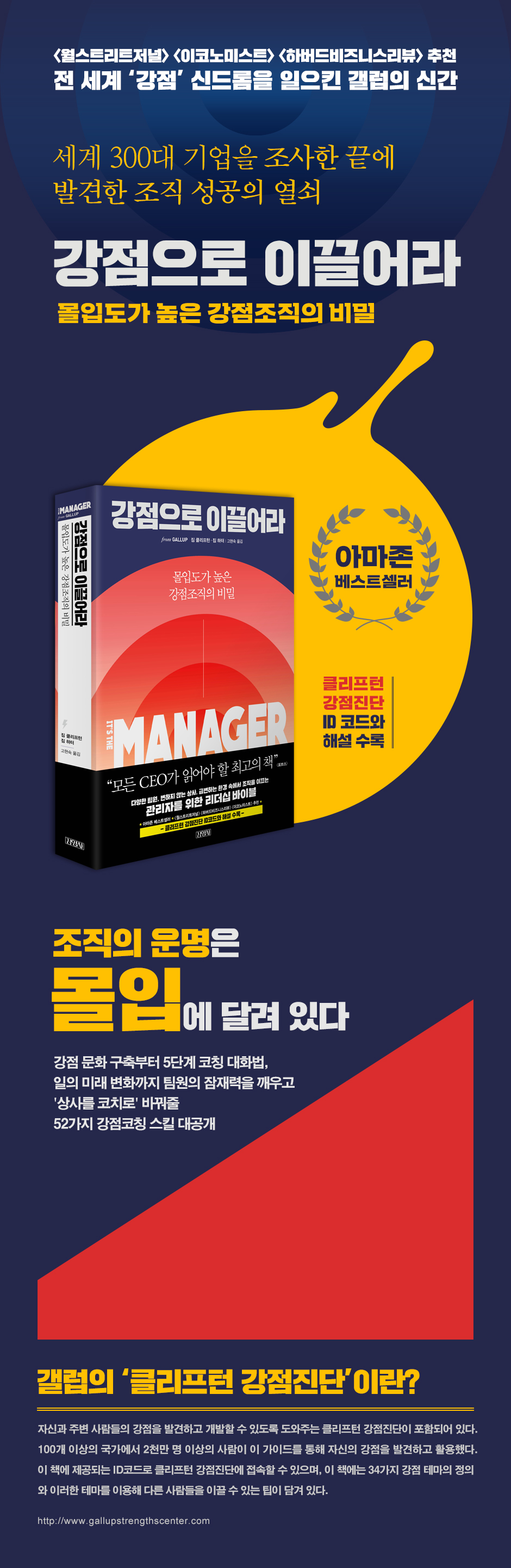
Gallup, a global research firm, surveyed the world's 300 largest companies and uncovered the secrets of organizations that achieve high performance in any environment.
The point was that I was very immersed in my work.
Gallup emphasizes the role of leaders as a key factor in determining organizational engagement.
What all excellent organizations have in common is that their leaders “coach with strengths.”
"The key to leadership that will navigate the coming uncertainty is to coach members to their strengths, increase individual and organizational engagement, and create an organizational culture that fosters exceptional performance."
"Leading with Strengths" introduces the coaching techniques leaders need to know to create a strength-based organization.
From building a culture of strengths to a five-step coaching conversation to transforming the future of work, this book provides a comprehensive overview of the perspectives, solutions, and key practical guidelines leaders need.
Do you want to build a team that actively engages with its work, encourages honest opinions, and encourages people to stay for the sake of personal growth? If so, this book is the guide you need to keep by your side.
Leading an organization in a rapidly changing environment with diverse team members, an unchanging boss, and
The Leadership Bible for Managers
These days, organizational leaders have complicated minds.
This is because the environment surrounding organizational management is changing constantly.
While identifying employees born in the 1990s and Generation Z and adapting to a 52-hour workweek and a culture of "leaving work on time," COVID-19 has brought about even greater changes, including remote work and economic uncertainty.
Especially, the concerns of middle managers responsible for their teams transcend national borders between superiors who 'instruct' and subordinates who ask 'why'.
Gallup, which created a global strengths syndrome with the message of "Work with your strengths," has now focused on "organizations."
Gallup, a global research firm, surveyed the world's 300 largest companies and uncovered the secrets of organizations that achieve high performance in any environment.
The point was that I was very immersed in my work.
Gallup emphasizes the role of leaders as a key factor in determining organizational engagement.
What all excellent organizations have in common is that their leaders “coach with strengths.”
"The key to leadership that will navigate the coming uncertainty is to coach members to their strengths, increase individual and organizational engagement, and create an organizational culture that fosters exceptional performance."
"Leading with Strengths" introduces the coaching techniques leaders need to know to create a strength-based organization.
From building a culture of strengths to a five-step coaching conversation to transforming the future of work, this book provides a comprehensive overview of the perspectives, solutions, and key practical guidelines leaders need.
Do you want to build a team that actively engages with its work, encourages honest opinions, and encourages people to stay for the sake of personal growth? If so, this book is the guide you need to keep by your side.
- You can preview some of the book's contents.
Preview
index
Translator's Note: Focus on developing your strengths and increasing engagement.
How to read this book
Preface: The World's New Will
strategy
1.
What Leaders Need to Change
2.
Why is organizational change so difficult?
3.
Two essential qualities for a leader
4.
Bring multiple teams together
5.
Make good decisions
culture
6.
What is organizational culture?
7.
Why Organizational Culture Matters
8.
How to change culture
Employment Brand
9.
Attracting new talent
10.
Hiring competent staff
11.
Employment Analysis: Solutions
12.
Where to find 'game footage' of talented employees
13.
5 Questions to Ask Your New Employee Training
14.
Accelerate Development: Strengths-Based Dialogue
15.
Clifton Strength 34: A Taxonomy of Human Potential
16.
5 Steps to Building a Strengths-Based Culture
17.
Right Expectations: Competency 2.0
18.
Establishing a sound succession plan
19.
retirement
From boss to coach
20.
3 Requirements for Coaching
21.
5 Coaching Conversations
22.
Salary and promotion
23.
Performance Appraisal: Bias
24.
Performance Appraisal: Solutions
25.
Keep employees at the company for the sake of "my development."
26.
Moneyball for Work
27.
Team Leader's Breakthrough
28.
Why Employee Engagement Programs Don't Work
29.
Creating a culture of high development
30.
5 Characteristics of a Good Manager
31.
How to Grow a Manager
The future of work
32.
Changes in the workplace
33.
Three Conditions for Diversity and Inclusion
34.
Diversity and Inclusion: "Respect Me"
35.
Diversity and Inclusion: "Recognize My Strengths"
36.
Diversity and Inclusion: 'Leaders Will Do the Right Thing'
37.
gender gap
38.
Women in the Workplace: The #MeToo Era
39.
Women in the Workplace: Why the Wage Gap Occurs
40.
Women in the Workplace: Work-Life Flexibility
41.
Will Baby Boomers Become a Burden?
42.
Benefits, Perks, and Flexible Work: What Employees Really Value
43.
How to Get Flexible Work and High Performance Together
44.
new office
45.
Corporate Innovation: How to Manage and Foster Creativity
46.
You can't be agile without great managers.
47.
Gig Work: The New Relationship Between Companies and Employees
48.
Gig Workers: Desperate or Satisfied?
49.
The Rise of Artificial Intelligence: What Now?
50.
Artificial Intelligence: What Workplaces Need to Prepare
51.
In the Technology Maelstrom: Human Capital Management Systems and Other Solutions
52.
Making Better Decisions with Predictive Analytics: Moneyball for Managers
supplement
1.
Leading with Strengths: A Guide to the 34 Themes of the Clifton Strengths Assessment
2.
Q12: 12 Elements of Great Management
3.
The Relationship Between Workplace Engagement and Organizational Performance
4.
The Relationship Between Strengths-Based Employee Development and Organizational Performance
5.
A meta-analysis study on managerial hiring and development profiles
References and Notes
About Gallup
Introduction to the Coaching Management Institute Program
How to read this book
Preface: The World's New Will
strategy
1.
What Leaders Need to Change
2.
Why is organizational change so difficult?
3.
Two essential qualities for a leader
4.
Bring multiple teams together
5.
Make good decisions
culture
6.
What is organizational culture?
7.
Why Organizational Culture Matters
8.
How to change culture
Employment Brand
9.
Attracting new talent
10.
Hiring competent staff
11.
Employment Analysis: Solutions
12.
Where to find 'game footage' of talented employees
13.
5 Questions to Ask Your New Employee Training
14.
Accelerate Development: Strengths-Based Dialogue
15.
Clifton Strength 34: A Taxonomy of Human Potential
16.
5 Steps to Building a Strengths-Based Culture
17.
Right Expectations: Competency 2.0
18.
Establishing a sound succession plan
19.
retirement
From boss to coach
20.
3 Requirements for Coaching
21.
5 Coaching Conversations
22.
Salary and promotion
23.
Performance Appraisal: Bias
24.
Performance Appraisal: Solutions
25.
Keep employees at the company for the sake of "my development."
26.
Moneyball for Work
27.
Team Leader's Breakthrough
28.
Why Employee Engagement Programs Don't Work
29.
Creating a culture of high development
30.
5 Characteristics of a Good Manager
31.
How to Grow a Manager
The future of work
32.
Changes in the workplace
33.
Three Conditions for Diversity and Inclusion
34.
Diversity and Inclusion: "Respect Me"
35.
Diversity and Inclusion: "Recognize My Strengths"
36.
Diversity and Inclusion: 'Leaders Will Do the Right Thing'
37.
gender gap
38.
Women in the Workplace: The #MeToo Era
39.
Women in the Workplace: Why the Wage Gap Occurs
40.
Women in the Workplace: Work-Life Flexibility
41.
Will Baby Boomers Become a Burden?
42.
Benefits, Perks, and Flexible Work: What Employees Really Value
43.
How to Get Flexible Work and High Performance Together
44.
new office
45.
Corporate Innovation: How to Manage and Foster Creativity
46.
You can't be agile without great managers.
47.
Gig Work: The New Relationship Between Companies and Employees
48.
Gig Workers: Desperate or Satisfied?
49.
The Rise of Artificial Intelligence: What Now?
50.
Artificial Intelligence: What Workplaces Need to Prepare
51.
In the Technology Maelstrom: Human Capital Management Systems and Other Solutions
52.
Making Better Decisions with Predictive Analytics: Moneyball for Managers
supplement
1.
Leading with Strengths: A Guide to the 34 Themes of the Clifton Strengths Assessment
2.
Q12: 12 Elements of Great Management
3.
The Relationship Between Workplace Engagement and Organizational Performance
4.
The Relationship Between Strengths-Based Employee Development and Organizational Performance
5.
A meta-analysis study on managerial hiring and development profiles
References and Notes
About Gallup
Introduction to the Coaching Management Institute Program
Detailed image
Into the book
Korean workplaces are now saying goodbye to long working hours.
We need to stop the practice of trying to achieve results through long working hours and focus on engagement to increase productivity and effectiveness.
Additionally, managers should be able to act as coaches for their employees so that work becomes a process of personal growth.
--- p.10
The problem is that only about 15% of workers worldwide appear to be engaged at work or have decent jobs.
These few people who drive the global economy provide extraordinary value to organizations and society.
Meanwhile, about 85% say they are disengaged at work or, worse, dislike their jobs, managers, and companies.
They say, among other things, that their jobs are meaningless.
In the new millennium, this could be interpreted as follows:
“Their lives have no meaning.”
--- p.15
The answer is managers.
If an organization has 50,000 employees, there will be about 5,000 managers or team leaders.
That's where all the difference lies.
It's got all the bells and whistles, a new grading system, free lunches, and an on-site volleyball court.
But that doesn't change the outcome.
Only increasing the ratio of good managers can change the outcome.
--- p.22
He was not so much interested in developing personality tests as he was trying to identify universal but practical traits that could predict high-performance outcomes.
And while each individual is unique, I wanted to identify personal tendencies that could be developed into true strengths through training.
Money's work was intended to engage people in conversations that helped them better understand not only who they were but also what they could achieve.
--- p.72
Remember that each employee views growth and development differently.
Some employees may value receiving awards within the company as part of their career growth, while others may find earning a master's or doctorate degree more valuable.
Another employee might see presenting to big clients as a growth opportunity, while another might want to get a mentor.
--- p.112
Organizations can now find remote workers with the right equipment and expectations, and empower them to do what they do best.
However, for remote workers, there may be no opportunities for collaboration or recognition.
When remote workers become isolated from their colleagues and managers, they are more likely to quit their jobs.
--- p.138
Goldin found that the wage gap was particularly large in occupations with little "temporal flexibility" in the workplace, such as corporate, financial, and legal professions.
In other words, the occupations with the largest gender wage gap are those with rigid working locations and hours.
These jobs require working long hours in an office.
On the other hand, occupations with relatively small gender wage gaps include science, technology, and some health professions.
These types of jobs often offer flexibility.
We need to stop the practice of trying to achieve results through long working hours and focus on engagement to increase productivity and effectiveness.
Additionally, managers should be able to act as coaches for their employees so that work becomes a process of personal growth.
--- p.10
The problem is that only about 15% of workers worldwide appear to be engaged at work or have decent jobs.
These few people who drive the global economy provide extraordinary value to organizations and society.
Meanwhile, about 85% say they are disengaged at work or, worse, dislike their jobs, managers, and companies.
They say, among other things, that their jobs are meaningless.
In the new millennium, this could be interpreted as follows:
“Their lives have no meaning.”
--- p.15
The answer is managers.
If an organization has 50,000 employees, there will be about 5,000 managers or team leaders.
That's where all the difference lies.
It's got all the bells and whistles, a new grading system, free lunches, and an on-site volleyball court.
But that doesn't change the outcome.
Only increasing the ratio of good managers can change the outcome.
--- p.22
He was not so much interested in developing personality tests as he was trying to identify universal but practical traits that could predict high-performance outcomes.
And while each individual is unique, I wanted to identify personal tendencies that could be developed into true strengths through training.
Money's work was intended to engage people in conversations that helped them better understand not only who they were but also what they could achieve.
--- p.72
Remember that each employee views growth and development differently.
Some employees may value receiving awards within the company as part of their career growth, while others may find earning a master's or doctorate degree more valuable.
Another employee might see presenting to big clients as a growth opportunity, while another might want to get a mentor.
--- p.112
Organizations can now find remote workers with the right equipment and expectations, and empower them to do what they do best.
However, for remote workers, there may be no opportunities for collaboration or recognition.
When remote workers become isolated from their colleagues and managers, they are more likely to quit their jobs.
--- p.138
Goldin found that the wage gap was particularly large in occupations with little "temporal flexibility" in the workplace, such as corporate, financial, and legal professions.
In other words, the occupations with the largest gender wage gap are those with rigid working locations and hours.
These jobs require working long hours in an office.
On the other hand, occupations with relatively small gender wage gaps include science, technology, and some health professions.
These types of jobs often offer flexibility.
--- p.152
Publisher's Review
“Everything changes when you stop giving instructions and start coaching.”
Leading an organization in a rapidly changing environment with diverse team members, an unchanging boss, and
The Leadership Bible for Managers
These days, organizational leaders have complicated minds.
This is because the environment surrounding organizational management is changing constantly.
While identifying employees born in the 1990s and Generation Z and adapting to a 52-hour workweek and a culture of "leaving work on time," COVID-19 has brought about even greater changes, including remote work and economic uncertainty.
Especially, the concerns of middle managers responsible for their teams transcend national borders between superiors who 'instruct' and subordinates who ask 'why'.
Gallup, which created a global strengths syndrome with the message of "work with your strengths," has now focused on "organizations" rather than "individuals."
Gallup, a global research firm renowned for its insights into organizational culture, surveyed the world's 300 largest companies and discovered the secrets of organizations that thrive in any environment.
The point was that I was very immersed in my work.
Gallup emphasizes the role of leaders as a key factor in determining organizational engagement.
Today's employees want to find purpose in their work and grow through their strengths.
Also, I prefer 'mentor' over 'boss'.
What organizations with this kind of atmosphere have in common is that the leader 'coaches with strengths.'
Strength development cannot be done alone; it is only possible when a leader understands the characteristics of each member of the organization and connects them to their work.
This is why the role of a leader is more important than anything else.
"The key to leadership that will navigate the coming uncertainty is to coach members to their strengths, increase individual and organizational engagement, and create an organizational culture that fosters exceptional performance."
"Leading with Strengths" introduces the coaching techniques leaders need to know to create a strength-based organization.
From building a culture of strengths to a five-step coaching conversation to transforming the future of work, this book provides a comprehensive overview of the perspectives, solutions, and key practical guidelines leaders need.
Do you want to build a team that actively engages with its work, encourages honest opinions, and encourages people to stay for the sake of personal growth? If so, this book is the guide you need to keep by your side.
From weakness to strength, from command to question
52 Coaching Skills to Increase Engagement in Your Organization
“Weaknesses never become strengths, but strengths can be developed infinitely.” Strengths coaching begins with this basic principle.
The purpose of coaching is to keep employees in the organization for the sake of 'development'.
To do this, leaders must set expectations with their team members, communicate consistently, and hold them accountable.
The authors categorize coaching conversation techniques into five stages, introduce each method, and then explain guidelines for building trust with organizational members and enhancing teamwork, including "Standards for Salary and Promotion," "Guidelines for Fair Evaluation," and "12 Checklists for Team Success."
In addition, it includes methods to eliminate the gender wage gap and create a culture of autonomy and responsibility through various flexible work systems that take into account work type, organizational structure, and job duties.
Once you have mastered strengths coaching techniques, the first thing to do is to change the ‘culture.’
Organizational culture stems from a company's purpose and directly impacts its brand and performance.
However, cultural integration is not easy because humans have a natural tendency to maintain their own identity.
The book states that “leaders must clearly define their purpose and ensure that all of the organization’s programs are aligned with that purpose.”
Organizational culture leads to an 'employment brand'.
Employment branding, which refers to the attractiveness of a workplace, is a very important factor in attracting talent.
Is my organization a place people want to work? From criteria for successful hiring to five questions for onboarding new employees, how to build a strengths-based culture, and tips for interviewing departing employees, this step-by-step guide will help managers.
This will help you develop seven core competencies (building relationships, developing people, leading change, inspiring, critical thinking, communicating clearly, and fostering accountability) and turn your strengths into results.
To successfully build a strengths-based culture, the authors say, “top management must take the lead, and every employee must be able to discover their strengths.”
“Once we awaken to the powerful potential of talent and strengths, it will dramatically change how we lead, how we treat our people, and how we develop them.
“The idea that everyone has strengths becomes a catalyst for changing organizational culture.”
Discover your and your organization's strengths with the Clifton Strengths Assessment.
Strengths Diagnosis ID Code and 34 Strengths Explanations and Utilization Methods
"As a leader, do you clearly understand your team members' strengths? Let alone your team members, you're only vaguely aware of your own strengths.
“I hope that you and your team members will discover their talents and strengths through the strengths assessment included in this book.”
This book provides the Clifton Strengths Assessment, which helps you identify and develop your own and your team's innate strengths.
The Gallup Strengths Assessment, which categorizes human talents into 34 types, is a program developed by Gallup over the past 50 years and has been used by over 20 million people in over 100 countries.
You can take a diagnostic test on Gallup's website using the ID code included in this book, and find out which of the 34 strength themes you have in your top five.
Another great advantage is that you can apply the included strengths theme explanations directly to your work.
Beyond discovering your own strengths, the effectiveness is maximized when you identify the strengths of your organization members and utilize them appropriately.
“Strengths assessment helps us learn about ourselves – what potential already exists in us and how it applies to our lives and work.
As our self-awareness grows, we stop trying to be someone we are not in order to succeed and gain the confidence to be our true selves.”
Leading an organization in a rapidly changing environment with diverse team members, an unchanging boss, and
The Leadership Bible for Managers
These days, organizational leaders have complicated minds.
This is because the environment surrounding organizational management is changing constantly.
While identifying employees born in the 1990s and Generation Z and adapting to a 52-hour workweek and a culture of "leaving work on time," COVID-19 has brought about even greater changes, including remote work and economic uncertainty.
Especially, the concerns of middle managers responsible for their teams transcend national borders between superiors who 'instruct' and subordinates who ask 'why'.
Gallup, which created a global strengths syndrome with the message of "work with your strengths," has now focused on "organizations" rather than "individuals."
Gallup, a global research firm renowned for its insights into organizational culture, surveyed the world's 300 largest companies and discovered the secrets of organizations that thrive in any environment.
The point was that I was very immersed in my work.
Gallup emphasizes the role of leaders as a key factor in determining organizational engagement.
Today's employees want to find purpose in their work and grow through their strengths.
Also, I prefer 'mentor' over 'boss'.
What organizations with this kind of atmosphere have in common is that the leader 'coaches with strengths.'
Strength development cannot be done alone; it is only possible when a leader understands the characteristics of each member of the organization and connects them to their work.
This is why the role of a leader is more important than anything else.
"The key to leadership that will navigate the coming uncertainty is to coach members to their strengths, increase individual and organizational engagement, and create an organizational culture that fosters exceptional performance."
"Leading with Strengths" introduces the coaching techniques leaders need to know to create a strength-based organization.
From building a culture of strengths to a five-step coaching conversation to transforming the future of work, this book provides a comprehensive overview of the perspectives, solutions, and key practical guidelines leaders need.
Do you want to build a team that actively engages with its work, encourages honest opinions, and encourages people to stay for the sake of personal growth? If so, this book is the guide you need to keep by your side.
From weakness to strength, from command to question
52 Coaching Skills to Increase Engagement in Your Organization
“Weaknesses never become strengths, but strengths can be developed infinitely.” Strengths coaching begins with this basic principle.
The purpose of coaching is to keep employees in the organization for the sake of 'development'.
To do this, leaders must set expectations with their team members, communicate consistently, and hold them accountable.
The authors categorize coaching conversation techniques into five stages, introduce each method, and then explain guidelines for building trust with organizational members and enhancing teamwork, including "Standards for Salary and Promotion," "Guidelines for Fair Evaluation," and "12 Checklists for Team Success."
In addition, it includes methods to eliminate the gender wage gap and create a culture of autonomy and responsibility through various flexible work systems that take into account work type, organizational structure, and job duties.
Once you have mastered strengths coaching techniques, the first thing to do is to change the ‘culture.’
Organizational culture stems from a company's purpose and directly impacts its brand and performance.
However, cultural integration is not easy because humans have a natural tendency to maintain their own identity.
The book states that “leaders must clearly define their purpose and ensure that all of the organization’s programs are aligned with that purpose.”
Organizational culture leads to an 'employment brand'.
Employment branding, which refers to the attractiveness of a workplace, is a very important factor in attracting talent.
Is my organization a place people want to work? From criteria for successful hiring to five questions for onboarding new employees, how to build a strengths-based culture, and tips for interviewing departing employees, this step-by-step guide will help managers.
This will help you develop seven core competencies (building relationships, developing people, leading change, inspiring, critical thinking, communicating clearly, and fostering accountability) and turn your strengths into results.
To successfully build a strengths-based culture, the authors say, “top management must take the lead, and every employee must be able to discover their strengths.”
“Once we awaken to the powerful potential of talent and strengths, it will dramatically change how we lead, how we treat our people, and how we develop them.
“The idea that everyone has strengths becomes a catalyst for changing organizational culture.”
Discover your and your organization's strengths with the Clifton Strengths Assessment.
Strengths Diagnosis ID Code and 34 Strengths Explanations and Utilization Methods
"As a leader, do you clearly understand your team members' strengths? Let alone your team members, you're only vaguely aware of your own strengths.
“I hope that you and your team members will discover their talents and strengths through the strengths assessment included in this book.”
This book provides the Clifton Strengths Assessment, which helps you identify and develop your own and your team's innate strengths.
The Gallup Strengths Assessment, which categorizes human talents into 34 types, is a program developed by Gallup over the past 50 years and has been used by over 20 million people in over 100 countries.
You can take a diagnostic test on Gallup's website using the ID code included in this book, and find out which of the 34 strength themes you have in your top five.
Another great advantage is that you can apply the included strengths theme explanations directly to your work.
Beyond discovering your own strengths, the effectiveness is maximized when you identify the strengths of your organization members and utilize them appropriately.
“Strengths assessment helps us learn about ourselves – what potential already exists in us and how it applies to our lives and work.
As our self-awareness grows, we stop trying to be someone we are not in order to succeed and gain the confidence to be our true selves.”
GOODS SPECIFICS
- Date of issue: June 1, 2020
- Format: Hardcover book binding method guide
- Page count, weight, size: 480 pages | 830g | 160*230*30mm
- ISBN13: 9788934993049
- ISBN10: 8934993049
You may also like
카테고리
korean


korean

![ELLE 엘르 스페셜 에디션 A형 : 12월 [2025]](http://librairie.coreenne.fr/cdn/shop/files/b8e27a3de6c9538896439686c6b0e8fb.jpg?v=1766436872&width=3840)


