

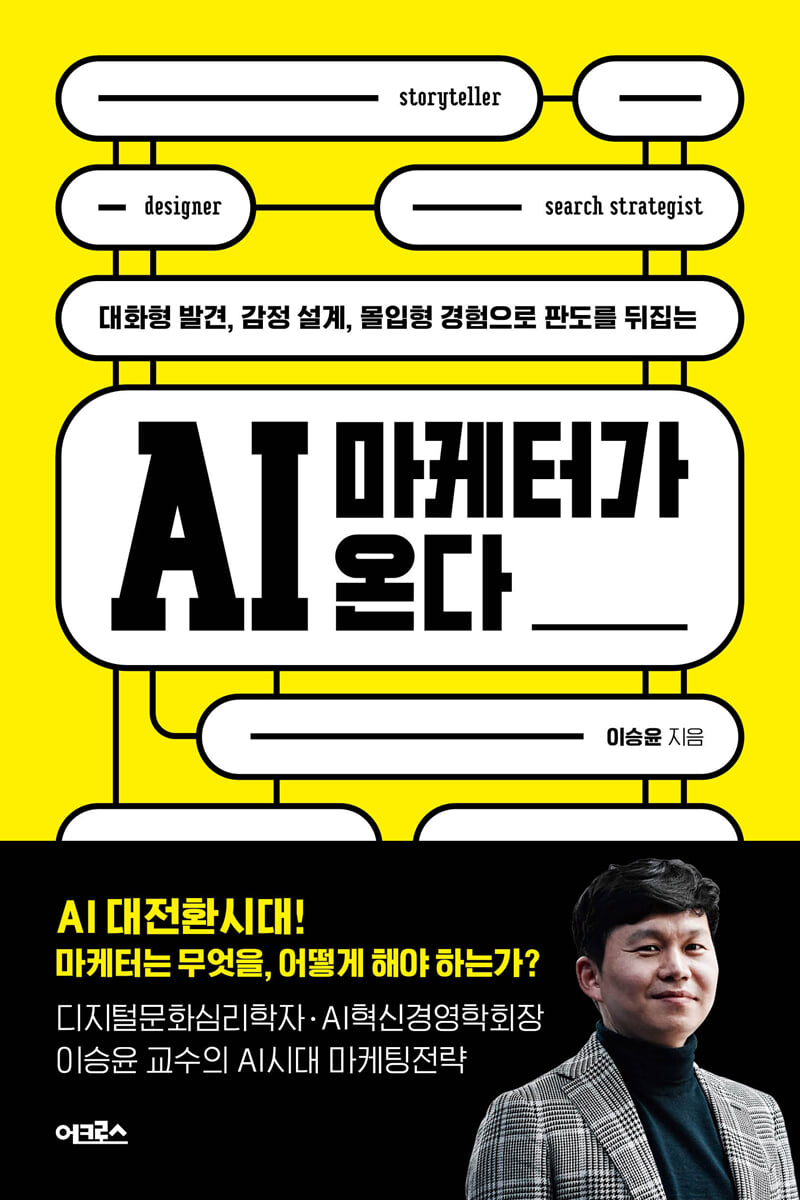
AI marketers are coming
 |
Description
Book Introduction
In the era of AI transformation, what should marketing do and how?
Marketing Strategies for the AI Era by Professor Seungyoon Lee, a digital cultural psychologist and president of the AI Innovation Management Association.
As Sam Altman, founder of OpenAI, said, “95 percent of the work that marketers now rely on agencies, strategists, and creatives for could be done by AI almost instantly and cost-free.” This is the age of AI, and it’s irreversible.
AI, once considered a high-tech technology used in specialized industrial fields, has begun to permeate our lives.
Especially in the marketing field, AI is creating innovation in various forms.
In the so-called AI era of transformation, what should marketing do and how?
Professor Seungyoon Lee, author of "AI Marketers Are Coming," is the president of the "AI Innovation Management Society" and director of the "Digital Marketing Research Institute." He conducts various research activities with experts in the digital and big data fields, and has provided consulting and lectures to various companies and institutions.
In this book, the author presents unique insights into what marketers should do in the future and where the marketing paradigm should go through the seven keywords of "AI as a Marketer."
By citing countless examples of AI marketing success and failure from various companies, it feels vivid and real, like reading a marketing report.
Marketing Strategies for the AI Era by Professor Seungyoon Lee, a digital cultural psychologist and president of the AI Innovation Management Association.
As Sam Altman, founder of OpenAI, said, “95 percent of the work that marketers now rely on agencies, strategists, and creatives for could be done by AI almost instantly and cost-free.” This is the age of AI, and it’s irreversible.
AI, once considered a high-tech technology used in specialized industrial fields, has begun to permeate our lives.
Especially in the marketing field, AI is creating innovation in various forms.
In the so-called AI era of transformation, what should marketing do and how?
Professor Seungyoon Lee, author of "AI Marketers Are Coming," is the president of the "AI Innovation Management Society" and director of the "Digital Marketing Research Institute." He conducts various research activities with experts in the digital and big data fields, and has provided consulting and lectures to various companies and institutions.
In this book, the author presents unique insights into what marketers should do in the future and where the marketing paradigm should go through the seven keywords of "AI as a Marketer."
By citing countless examples of AI marketing success and failure from various companies, it feels vivid and real, like reading a marketing report.
- You can preview some of the book's contents.
Preview
index
Prologue. The Job of a Marketer in the AI Era
Part 1. Can AI really move the human heart?
AI as a storyteller
NEXT: Is Director Bong Joon-ho's Competitor AI? / AI's 'Calculated Creativity' / Rule-Based Approaches and Probabilistic Models / How to Make 'What If' a Reality / The Core Element of Storytelling: The Likely Story / AI as the Emotion Designer / 'Interactive Storytelling' Based on Interactivity / Co-creation Between Businesses and Consumers / 'This is Ketchup' / The Light and Dark Side of AI Storytelling
Part 2.
The era has arrived where anyone can become a designer.
AI as a designer
Two axes: novelty, usability, and creativity / The birth of the 'next-generation Air Jordan' through AI / Hublot, the troublemaker of the Swiss watch industry / Teaching design archives / Democratization of AI and design / No special skills or time-consuming experience are needed anymore / A new wind blowing in the content consumption landscape / The message that 'the brand is listening to my voice' / The scalability of AI design / Dove, exploiting AI's weaknesses / Why did Indiana Jones fail? / The key is not 'means' but 'emotions' / AI, a designer who uniquely expresses brands
Part 3.
We have now entered the era of 'interactive discovery'.
AI as a search partner
Will Google's empire collapse? / The answer lies in the 3Cs. / AI chatbots, knowledge navigators and smart captains. / Captivating digital natives seeking two-way communication. / The key to search is 'hyper-personalization.' / The 'relationship' between people and technology is changing.
Part 4.
Marketing is a mind-reading game.
AI as a Customer and Market Analyst
“People don’t know what they want” / Relieving psychological discomfort / Who is your customer’s persona? / A simple way to turn a ‘crisis’ into an ‘opportunity’ / Advancement of customer profiling, Airbnb / ‘Customer digital twin’ and ‘habit prediction’ / Capturing the truth that has not been told to anyone / Virtual consumers vs. real consumers / Meta-persona, tabular persona, descriptive persona / Advantages of AI persona / The problem is ‘reliability’ / The emergence of AI researchers who extract hidden needs
Part 5.
The 'right message' at the 'optimal time'!
AI as an SNS advertising executive
What's Meta's Next Growth Engine? / Instagram, Empowered by AI / Strengthening its Identity as "Sharing Emotional Daily Life" / TikTok's "User-Initiative" Strategy / The Right to "Choose" What I Want to See / A World Where Content Becomes Both Advertisement and Store / Success Stories of AI Ads in Instagram - TikTok Manages "Ad Fatigue" / YouTube's AI Combination Experiment / "Algorithms Know When We Want It"
Part 6.
Provide an immersive experience for your customers' five senses.
AI as a creator of the five senses
Nike's 'House of Innovation' / AI Innovation in Vision and Hearing / AI Innovation in Olfactory / AI Innovation in Taste / AI Innovation in Touch / AI Learning and Growing Through the Five Senses / Multimodality and 'Intelligence with Senses'
Part 7.
The birth of a smart space that knows me better than I know myself.
AI as a Retail Salesperson
Insight Labs and Golden Time / The emergence of offline spaces to secure customer data / To whom will consumers reveal their personal information more? / IKEA is becoming an AI curator / Realizing imagination through technology / The emergence of AI stylists / Solving the shortcoming of offline stores, ‘waiting’ / The light and shade of various robot stores equipped with AI / Innovation in customer experience through robots based on hyper-personalization and accuracy / The emergence of AI-based smart manufacturing technology innovation / Another innovation in smart factories / The emergence of AI that embodies human emotions / The introduction of human-like AI brings about negative treatment of employees / Can technology create a more humane space? / Automation tools vs. human friends / The birth of the world’s most unique art space
Epilogue: The Key Is the Customer's Innovative Experience
Part 1. Can AI really move the human heart?
AI as a storyteller
NEXT: Is Director Bong Joon-ho's Competitor AI? / AI's 'Calculated Creativity' / Rule-Based Approaches and Probabilistic Models / How to Make 'What If' a Reality / The Core Element of Storytelling: The Likely Story / AI as the Emotion Designer / 'Interactive Storytelling' Based on Interactivity / Co-creation Between Businesses and Consumers / 'This is Ketchup' / The Light and Dark Side of AI Storytelling
Part 2.
The era has arrived where anyone can become a designer.
AI as a designer
Two axes: novelty, usability, and creativity / The birth of the 'next-generation Air Jordan' through AI / Hublot, the troublemaker of the Swiss watch industry / Teaching design archives / Democratization of AI and design / No special skills or time-consuming experience are needed anymore / A new wind blowing in the content consumption landscape / The message that 'the brand is listening to my voice' / The scalability of AI design / Dove, exploiting AI's weaknesses / Why did Indiana Jones fail? / The key is not 'means' but 'emotions' / AI, a designer who uniquely expresses brands
Part 3.
We have now entered the era of 'interactive discovery'.
AI as a search partner
Will Google's empire collapse? / The answer lies in the 3Cs. / AI chatbots, knowledge navigators and smart captains. / Captivating digital natives seeking two-way communication. / The key to search is 'hyper-personalization.' / The 'relationship' between people and technology is changing.
Part 4.
Marketing is a mind-reading game.
AI as a Customer and Market Analyst
“People don’t know what they want” / Relieving psychological discomfort / Who is your customer’s persona? / A simple way to turn a ‘crisis’ into an ‘opportunity’ / Advancement of customer profiling, Airbnb / ‘Customer digital twin’ and ‘habit prediction’ / Capturing the truth that has not been told to anyone / Virtual consumers vs. real consumers / Meta-persona, tabular persona, descriptive persona / Advantages of AI persona / The problem is ‘reliability’ / The emergence of AI researchers who extract hidden needs
Part 5.
The 'right message' at the 'optimal time'!
AI as an SNS advertising executive
What's Meta's Next Growth Engine? / Instagram, Empowered by AI / Strengthening its Identity as "Sharing Emotional Daily Life" / TikTok's "User-Initiative" Strategy / The Right to "Choose" What I Want to See / A World Where Content Becomes Both Advertisement and Store / Success Stories of AI Ads in Instagram - TikTok Manages "Ad Fatigue" / YouTube's AI Combination Experiment / "Algorithms Know When We Want It"
Part 6.
Provide an immersive experience for your customers' five senses.
AI as a creator of the five senses
Nike's 'House of Innovation' / AI Innovation in Vision and Hearing / AI Innovation in Olfactory / AI Innovation in Taste / AI Innovation in Touch / AI Learning and Growing Through the Five Senses / Multimodality and 'Intelligence with Senses'
Part 7.
The birth of a smart space that knows me better than I know myself.
AI as a Retail Salesperson
Insight Labs and Golden Time / The emergence of offline spaces to secure customer data / To whom will consumers reveal their personal information more? / IKEA is becoming an AI curator / Realizing imagination through technology / The emergence of AI stylists / Solving the shortcoming of offline stores, ‘waiting’ / The light and shade of various robot stores equipped with AI / Innovation in customer experience through robots based on hyper-personalization and accuracy / The emergence of AI-based smart manufacturing technology innovation / Another innovation in smart factories / The emergence of AI that embodies human emotions / The introduction of human-like AI brings about negative treatment of employees / Can technology create a more humane space? / Automation tools vs. human friends / The birth of the world’s most unique art space
Epilogue: The Key Is the Customer's Innovative Experience
Detailed image

Into the book
Now, the design of emotion is expanding beyond a person's directing sense to an area where algorithms can judge and coordinate.
The premise of Shinhan Financial Group's advertisement, "My present self meets my future self," goes beyond mere imagination and is based on numerical and quantitative assumptions created by an AI prediction model.
It gives the consumer a sense of persuasion, realism and empathy.
Likewise, when AI restores the faces of missing children and reconstructs the smiles of independence activists, we are not simply amazed by the "greatness of technology," but by the "world of possibilities" it opens up.
--- From "Part 1. Can AI Really Move the Human Heart?"
What marketers should pay attention to here is that during the promotional campaign process, they should actively encourage consumers to use AI tools to promote their products or services virally.
A representative example of this type of participatory campaign is the fan art campaign commemorating the 30th anniversary of the launch of the French automobile company Renault's 'Twingo'.
This is the first case in the automotive industry where AI tools were used in a campaign, encouraging social media users to create fan art of the Twingo model using AI image generators like 'DALL-E' and share it with the hashtag '#ReinventTwingo'. (...)
Ultimately, the most important function of generative AI is to create hyper-personalized advertising campaigns for consumers.
At this time, hyper-personalization is achieved through individuals actively expressing themselves by creating their own content.
--- 「Part 2.
“The era has begun where anyone can become a designer.”
Microsoft CEO Satya Nadella said.
“We have now entered the era of conversational discovery.
“Brands need to move beyond being mere information providers and become storytellers that drive conversations.”
His words offer insight into how to develop new AI-based search marketing strategies in the zero-click era.
Consumers no longer want to navigate a vast ocean of information. This is why content that can be quickly and accurately discovered by AI—content that can "converse" with consumers and provide answers to their questions—is becoming increasingly important.
--- 「Part 3.
We have now entered the era of ‘interactive discovery’”
In marketing, customer personas have been used as a primary tool for understanding core customers.
These personas were elaborately designed at great expense at a specific point in time (usually by an external consulting firm) and were hung on the walls of each company's offices or featured in important presentation materials.
The problem, however, is that this information, while failing to accurately reflect the living, breathing real-world customer experience, mostly provides vague insights and gradually fades away.
Going forward, AI-powered customer personas will radically change this. AI-generated customer personas differ from the static, formal personas used in the past.
It will be a dynamic, interactive persona that can have real-time conversations, provide feedback, and respond to questions.
--- 「Part 4.
Marketing is a mind-reading game”
Companies that operate retail stores must implement strategies to reduce privacy concerns among customers.
What's interesting is that the presence and intervention of AI service agents can relatively lower consumers' privacy concerns compared to the presence and intervention of human service agents.
Therefore, when companies collect personal information from customers in various retail situations, it may be better to collect relevant information using electronic devices such as tablet PCs.
The premise of Shinhan Financial Group's advertisement, "My present self meets my future self," goes beyond mere imagination and is based on numerical and quantitative assumptions created by an AI prediction model.
It gives the consumer a sense of persuasion, realism and empathy.
Likewise, when AI restores the faces of missing children and reconstructs the smiles of independence activists, we are not simply amazed by the "greatness of technology," but by the "world of possibilities" it opens up.
--- From "Part 1. Can AI Really Move the Human Heart?"
What marketers should pay attention to here is that during the promotional campaign process, they should actively encourage consumers to use AI tools to promote their products or services virally.
A representative example of this type of participatory campaign is the fan art campaign commemorating the 30th anniversary of the launch of the French automobile company Renault's 'Twingo'.
This is the first case in the automotive industry where AI tools were used in a campaign, encouraging social media users to create fan art of the Twingo model using AI image generators like 'DALL-E' and share it with the hashtag '#ReinventTwingo'. (...)
Ultimately, the most important function of generative AI is to create hyper-personalized advertising campaigns for consumers.
At this time, hyper-personalization is achieved through individuals actively expressing themselves by creating their own content.
--- 「Part 2.
“The era has begun where anyone can become a designer.”
Microsoft CEO Satya Nadella said.
“We have now entered the era of conversational discovery.
“Brands need to move beyond being mere information providers and become storytellers that drive conversations.”
His words offer insight into how to develop new AI-based search marketing strategies in the zero-click era.
Consumers no longer want to navigate a vast ocean of information. This is why content that can be quickly and accurately discovered by AI—content that can "converse" with consumers and provide answers to their questions—is becoming increasingly important.
--- 「Part 3.
We have now entered the era of ‘interactive discovery’”
In marketing, customer personas have been used as a primary tool for understanding core customers.
These personas were elaborately designed at great expense at a specific point in time (usually by an external consulting firm) and were hung on the walls of each company's offices or featured in important presentation materials.
The problem, however, is that this information, while failing to accurately reflect the living, breathing real-world customer experience, mostly provides vague insights and gradually fades away.
Going forward, AI-powered customer personas will radically change this. AI-generated customer personas differ from the static, formal personas used in the past.
It will be a dynamic, interactive persona that can have real-time conversations, provide feedback, and respond to questions.
--- 「Part 4.
Marketing is a mind-reading game”
Companies that operate retail stores must implement strategies to reduce privacy concerns among customers.
What's interesting is that the presence and intervention of AI service agents can relatively lower consumers' privacy concerns compared to the presence and intervention of human service agents.
Therefore, when companies collect personal information from customers in various retail situations, it may be better to collect relevant information using electronic devices such as tablet PCs.
--- 「Part 7.
From “The Birth of a Smart Space that Knows Me Better Than I Know Myself”
From “The Birth of a Smart Space that Knows Me Better Than I Know Myself”
Publisher's Review
To gain creative and human insights that will lead the AI era
A management strategy book and future forecast for people
What kind of talent will survive in the AI era? Many experts emphasize that only those who view AI not as a potential "destroyer" that will eliminate their jobs, but as a "partner" that unleashes limitless creativity, will thrive.
This is often referred to as the 'era of AI creative directors'.
AI now acts as a creative partner and emotional mediator, permeating every aspect of a brand's creation, exploration, understanding, and communication.
In other words, an AI creative director is someone who views AI as a creative tool and actively utilizes it to realize unique and original visions and ideas.
Furthermore, the era of AI creative directors means an era in which technology is used not as a “tool for efficiency” but as a “designer of experience and emotion.”
"AI is no longer simply a technological tool. It creates 'triggers' that enable brands to connect emotionally with customers, helping customers evolve from 'consumers of brand value' to 'partners who spread stories.'
Building on this foundation, AI can reproduce customers' positive experiences as content, enabling them to participate in shaping the brand narrative as fans and co-creators of the brand.
Through this process, brands experience a new form of relationship evolution that goes beyond simply managing loyalty, but fandomizes supporters.
Now, we have entered an era where AI goes beyond its role as a technical tool and acts as a ‘fandom catalyst’ that connects brands and customers emotionally.” - From the text
Based on this customer experience journey, the author suggests the following seven changes that should be considered to leverage AI as a creative tool.
# Can AI really move the human heart?
AI as a Storyteller and AI as a Designer
First, AI will bring about a major revolution in the way we create diverse content.
The book examines how AI can act as a storyteller that moves people's hearts from the perspective of content planning and creation, as well as how it can function as a designer that expands creativity in the visual field, through various examples such as Heinz's "This is Ketchup," the "Next Generation Air Jordan" created by AI, and Dove's marketing campaign that exploits AI's weaknesses.
# We have now entered the era of 'interactive discovery'.
AI as a search partner
AI will also transform the way we find content. We explore how AI is transforming the search market into a more personalized and interactive platform.
Search is an essential area of marketing, if only because it reveals consumers' desires.
But increasingly, people are stopping at clicking and engaging with a variety of generative AIs to get information.
To keep pace with these changes, companies need to adapt their search engine marketing to ensure that information favorable to their company is cited in generative AI responses. They should also focus on the three core values of communication, clarity, and credibility when creating marketing content.
# Marketing is a mind-reading game.
AI as a Customer and Market Analyst and AI as a Social Media Advertising Executor
AI will also bring significant changes to how we understand our core target consumers. AI will be able to more precisely decipher customers' hidden desires scattered throughout data.
And based on this, we will continue to work on recommending content that best suits the needs of consumers.
This is a story about AI as a customer? Market analyst and AI as a social media advertising executive.
We explore ways to read customers' minds and deliver the right message at the optimal time through examples such as Airbnb, which achieved success through advanced customer profiling, TikTok, which even manages ad fatigue, YouTube, which is experimenting with AI combinations, and Instagram, which is captivating consumers by strengthening its identity as "sharing emotional daily life."
# Provide an immersive experience for your customers' five senses.
AI as a five-sense creator and AI as a retail store salesperson
AI is expected to bring about significant innovation in the way we communicate with customers.
The emergence of multimodal AI, which learns and develops through the five senses like humans, will change the way customers interact with external stimuli.
Furthermore, through the use of various AI technologies, retail spaces will grow into places where online and offline are more closely integrated, delivering the best customer experience.
Marketing in the AI Era: Focusing on Customer Experience, Not Technology, is Key to Success
In the age of digital transformation, one of the most important strategies is to tailor the customer experience journey to the changing customer.
The customer experience journey (CEI) is a meticulously managed strategy that ensures customers "recognize" and "explore" a company's products and services, "compare" them with competitors, and ultimately reach the "purchase" stage. This process is managed through the post-purchase experience, ultimately transforming them into brand fans. AI will continue to drive innovation across many stages of this CEI journey.
Therefore, rather than examining the impact of AI in a linear manner, learning about changes within a structural framework is a more creative way to utilize AI.
This is why this book is organized around the key keywords of the customer experience journey: the "creation stage," the "exploration/search stage," the "understanding/analysis/matching stage," and the "communication/experience stage."
As Professor Hong Seong-tae of Mobiv Academy recommends, “This book is an ‘innovative perspective’ that talks about how to become creative creators by collaborating with AI, rather than an ‘instrumental perspective’ on how to handle AI,” this book, “AI Marketers Are Coming,” is a marketing book for marketers preparing for the AI era, and a management strategy book and trend book that provides meaningful insights not only to practitioners but also to opinion leaders such as managers.
A management strategy book and future forecast for people
What kind of talent will survive in the AI era? Many experts emphasize that only those who view AI not as a potential "destroyer" that will eliminate their jobs, but as a "partner" that unleashes limitless creativity, will thrive.
This is often referred to as the 'era of AI creative directors'.
AI now acts as a creative partner and emotional mediator, permeating every aspect of a brand's creation, exploration, understanding, and communication.
In other words, an AI creative director is someone who views AI as a creative tool and actively utilizes it to realize unique and original visions and ideas.
Furthermore, the era of AI creative directors means an era in which technology is used not as a “tool for efficiency” but as a “designer of experience and emotion.”
"AI is no longer simply a technological tool. It creates 'triggers' that enable brands to connect emotionally with customers, helping customers evolve from 'consumers of brand value' to 'partners who spread stories.'
Building on this foundation, AI can reproduce customers' positive experiences as content, enabling them to participate in shaping the brand narrative as fans and co-creators of the brand.
Through this process, brands experience a new form of relationship evolution that goes beyond simply managing loyalty, but fandomizes supporters.
Now, we have entered an era where AI goes beyond its role as a technical tool and acts as a ‘fandom catalyst’ that connects brands and customers emotionally.” - From the text
Based on this customer experience journey, the author suggests the following seven changes that should be considered to leverage AI as a creative tool.
# Can AI really move the human heart?
AI as a Storyteller and AI as a Designer
First, AI will bring about a major revolution in the way we create diverse content.
The book examines how AI can act as a storyteller that moves people's hearts from the perspective of content planning and creation, as well as how it can function as a designer that expands creativity in the visual field, through various examples such as Heinz's "This is Ketchup," the "Next Generation Air Jordan" created by AI, and Dove's marketing campaign that exploits AI's weaknesses.
# We have now entered the era of 'interactive discovery'.
AI as a search partner
AI will also transform the way we find content. We explore how AI is transforming the search market into a more personalized and interactive platform.
Search is an essential area of marketing, if only because it reveals consumers' desires.
But increasingly, people are stopping at clicking and engaging with a variety of generative AIs to get information.
To keep pace with these changes, companies need to adapt their search engine marketing to ensure that information favorable to their company is cited in generative AI responses. They should also focus on the three core values of communication, clarity, and credibility when creating marketing content.
# Marketing is a mind-reading game.
AI as a Customer and Market Analyst and AI as a Social Media Advertising Executor
AI will also bring significant changes to how we understand our core target consumers. AI will be able to more precisely decipher customers' hidden desires scattered throughout data.
And based on this, we will continue to work on recommending content that best suits the needs of consumers.
This is a story about AI as a customer? Market analyst and AI as a social media advertising executive.
We explore ways to read customers' minds and deliver the right message at the optimal time through examples such as Airbnb, which achieved success through advanced customer profiling, TikTok, which even manages ad fatigue, YouTube, which is experimenting with AI combinations, and Instagram, which is captivating consumers by strengthening its identity as "sharing emotional daily life."
# Provide an immersive experience for your customers' five senses.
AI as a five-sense creator and AI as a retail store salesperson
AI is expected to bring about significant innovation in the way we communicate with customers.
The emergence of multimodal AI, which learns and develops through the five senses like humans, will change the way customers interact with external stimuli.
Furthermore, through the use of various AI technologies, retail spaces will grow into places where online and offline are more closely integrated, delivering the best customer experience.
Marketing in the AI Era: Focusing on Customer Experience, Not Technology, is Key to Success
In the age of digital transformation, one of the most important strategies is to tailor the customer experience journey to the changing customer.
The customer experience journey (CEI) is a meticulously managed strategy that ensures customers "recognize" and "explore" a company's products and services, "compare" them with competitors, and ultimately reach the "purchase" stage. This process is managed through the post-purchase experience, ultimately transforming them into brand fans. AI will continue to drive innovation across many stages of this CEI journey.
Therefore, rather than examining the impact of AI in a linear manner, learning about changes within a structural framework is a more creative way to utilize AI.
This is why this book is organized around the key keywords of the customer experience journey: the "creation stage," the "exploration/search stage," the "understanding/analysis/matching stage," and the "communication/experience stage."
As Professor Hong Seong-tae of Mobiv Academy recommends, “This book is an ‘innovative perspective’ that talks about how to become creative creators by collaborating with AI, rather than an ‘instrumental perspective’ on how to handle AI,” this book, “AI Marketers Are Coming,” is a marketing book for marketers preparing for the AI era, and a management strategy book and trend book that provides meaningful insights not only to practitioners but also to opinion leaders such as managers.
GOODS SPECIFICS
- Date of issue: November 20, 2025
- Page count, weight, size: 292 pages | 442g | 140*210*18mm
- ISBN13: 9791167742520
- ISBN10: 1167742524
You may also like
카테고리
korean


korean

![ELLE 엘르 스페셜 에디션 A형 : 12월 [2025]](http://librairie.coreenne.fr/cdn/shop/files/b8e27a3de6c9538896439686c6b0e8fb.jpg?v=1766436872&width=3840)


