

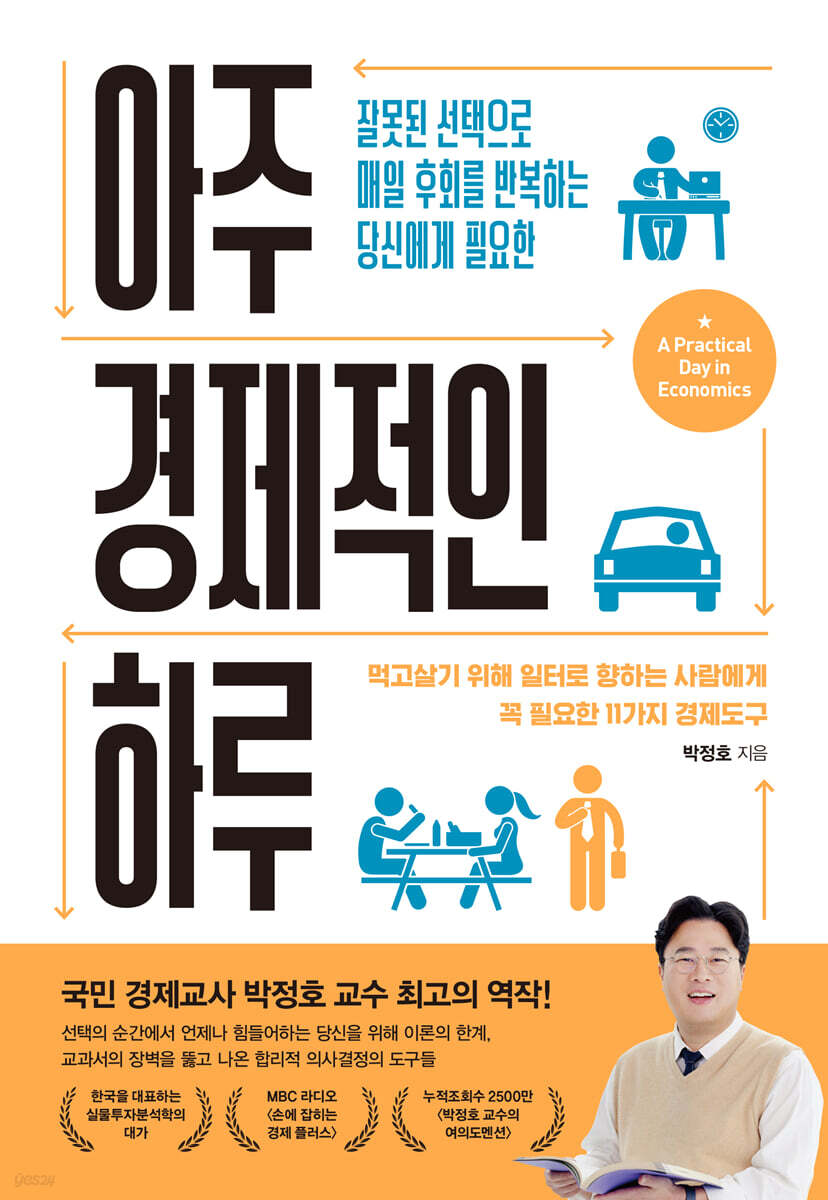
A very economical day
 |
Description
Book Introduction
How economical were you today?
From heading to work early in the morning, to spending a day like war, to returning home and lying down in bed again,
11 Economic Tools for Those Who Feel the Burden of Every Day
An amazing experience where our inefficient daily lives are transformed into economic ones in an instant!
Now you too can create a 'very economical day'!
All of our days are driven by the economy.
In the moments of life-changing decisions we make every day, economics becomes the most realistic compass.
From weighty decisions like whether to buy a home to choosing a gift for a loved one to a cup of coffee on a lazy afternoon, we make dozens of "economic choices" every day.
But these 'economic choices' remain difficult and sometimes feel disconnected from our lives.
The new book, "A Very Economical Day," delves into this very point.
Professor Park Jeong-ho, a national economics teacher, emphasizes in "A Very Economical Day" that what we need, as we continue to regret bad choices every day, is "economic choices," and introduces 11 economic tools necessary for this.
Through tools for rational decision-making that transcend the limitations of theory and textbooks, we will be able to acquire the rational thinking and practical judgment skills essential to our lives.
From heading to work early in the morning, to spending a day like war, to returning home and lying down in bed again,
11 Economic Tools for Those Who Feel the Burden of Every Day
An amazing experience where our inefficient daily lives are transformed into economic ones in an instant!
Now you too can create a 'very economical day'!
All of our days are driven by the economy.
In the moments of life-changing decisions we make every day, economics becomes the most realistic compass.
From weighty decisions like whether to buy a home to choosing a gift for a loved one to a cup of coffee on a lazy afternoon, we make dozens of "economic choices" every day.
But these 'economic choices' remain difficult and sometimes feel disconnected from our lives.
The new book, "A Very Economical Day," delves into this very point.
Professor Park Jeong-ho, a national economics teacher, emphasizes in "A Very Economical Day" that what we need, as we continue to regret bad choices every day, is "economic choices," and introduces 11 economic tools necessary for this.
Through tools for rational decision-making that transcend the limitations of theory and textbooks, we will be able to acquire the rational thinking and practical judgment skills essential to our lives.
- You can preview some of the book's contents.
Preview
index
Before entering _
A Gift from Economics to Our Daily Lives: "A Very Economical Day"
Chapter 1: Question Marks for Rational Choice
Everyday rationality comes from economics.
Economics: Why You Should Learn Economics
We can't all have as much as we want
The Two Pillars of Economics: Efficiency and Equity
Giving and receiving gifts is also an economic activity.
What if I just give cash to buy a gift?
The utility of a gift varies depending on the recipient.
Why do business next to your competitors?
Why it's advantageous to stick close to your competitors
When we gather together, both workers and customers benefit.
Why everyone and everything is heading to the city
The first standard of law and institutions, economics
The Impact of Costs and Benefits on Law
Economics as the basis for legal judgment
Road traffic patterns also require economic debate.
Why Roads Can't Be Widened Easily
Institutions that hinder efficiency and fairness
Am I being uneconomical by making rough decisions?
Errors of judgment, heuristics
If you don't want to waste time and money on information
Chapter 2: Will Evaluating Costs Make Decisions Easier?
Cost, how do you perceive it?
What You Give Up When You Don't Choose
How much does a CEO earn per hour?
Value judgments and costs cannot be separated.
If you put a value on safety
If you put a price on something that never happened
Limitations that must be calculated along with opportunity costs
Clarify the calculation subject
Opportunity cost is determined by market value.
Alternatives for Cigar Determination - EVA
How does shareholder equity relate to opportunity cost?
The 'costs' that must be abandoned for innovation
Why New Technologies and Innovation Are Difficult for Existing Companies
Why Startups Are So Driven by Innovation - The Substitution Effect
To avoid falling into the swamp of sunk costs
Fixed costs and sunk costs are easily confused.
Businesses sunk by incorrect sunk costs
Why do we keep considering sunk costs?
Miscalculation, what's done is done
Sunk costs: Don't forget them even if you hate them, and let's meet again even if it's annoying.
Reasonably reflecting costs in decision-making
Don't ignore your intuition
Intuition is a product of experience and know-how.
Chapter 3: Rational People Think Marginally
Knowing your limits increases your profits: Analyzing your company's limits
Limitations Suppliers Need to Understand
Limitations Consumers Need to Understand
Companies that utilize the principles of marginal analysis
The reason why marginal humans are economic
Seducing Consumers Using the Principle of Marginal Analysis
Pushing customers with marginal utility
The ramifications of marginal utility spread everywhere.
The Law of Diminishing Marginal Utility: The Cost of Gaining Profit
Marginal utility moves little by little
To significantly increase marginal utility, catch it early.
Even when reducing losses, marginal utility
Flexibility in utilizing fixed and variable costs
Another name for the marginal principle, cost-benefit analysis
When calculating cost-benefit analysis
Can you give me a specific cost estimate?
Cost-benefit analysis used in practice
Things that cannot be analyzed with cost-benefit analysis
Calculating benefits is more difficult
Various ways to narrow the scope of benefits
The common thread among benefit estimation methods is 'anxiety'.
Cost-benefit analysis: Beware of the double-edged sword
Chapter 4: We Are Ruled by Incentives
People driven by incentives
What does it take to effectively incentivize?
For incentives to work, you need to remember the threshold.
Wage levels and labor productivity rise together
Corporate trust, employee trust
The basis makes the difference in salary
Is it okay to evaluate subjectively?
Can invisible work be evaluated as performance?
Appropriateness of subjective evaluation factors
Fixed salary, another form of incentive
Why You Should Use Both Efficiency-Based and Fixed-Based Pay Together
Incentives that vary depending on where you work
Various incentive factors that move us
Benefits and promotions given to the chosen ones
The promotion dilemma that no one can solve
Career management, what I need to do thoroughly
Career management that varies depending on accumulated experience
Company goals and their impact on my career
The huge butterfly effect of incentives
Chapter 5: Free Trade Benefits Everyone
Was the original surplus in economics?
Consumer surplus, producer surplus
How is a dominant relationship formed?
What it takes to gain a comparative advantage
Differences in positions between countries are becoming more acute in trade.
An externally oriented economic model is the trend
Trade: A Few Things We Don't Know
For the domestic market, dumping and tariffs
A cunning government, imports are being unfairly treated.
Global financial crisis puts everyone on edge
Chapter 6: The Closest, But Least Known Place - The Market
The market is alive and changing.
The economist's utopia: the perfectly competitive market
Market failure, monopoly market
The changing face of the market before defining it
Can you make a lot of money by becoming a monopoly?
Entry barriers that a monopoly must have
A clearly drawn line between 'scope' and 'limit'
The allure of becoming a weapon, the barrier to entry
Those who want to enter, bear the weight of advertising costs - Advertising
Getting used to the present, becoming too lazy to change - switching costs and the lock-in effect
I only use this brand - product differentiation/experience is more solid than any equipment.
Don't blindly believe in patents
To avoid becoming a monopoly or a 'poison'
Monopoly begins with unprecedented innovation.
As long as innovation continues, there will be no permanent monopolies.
Chapter 7: When Market Functions Fail - Market Failure
We all unintentionally influence each other.
We influence each other without even intending to.
Externalities: shaking the entire society from the outside
To prevent new externalities from emerging
Complete elimination of external diseconomies is not the optimal method.
People who don't know pay more
Without the necessary information, you have no choice but to lean.
Adverse selection is signaling and selection.
Moral decay is caused by institutions and structures.
What the National Museum Admission Fee Does
Goods without exclusion and competition are factors of market failure.
It wasn't made for free riding.
Public Goods: How Much Should We Produce?
To measure the benefits of public goods
Another issue with public goods: shared resources
Common resources are maintained and preserved by those who share them.
Summary of courses that solve shared resource problems
Why Inefficient Companies Continue to Operate
A market failure factor that must be left alone for now: the monopoly market.
Chapter 8: A Mirror Showing Reality - Indicators
The most basic thing to understand about the real economy
Everyone should check economic indicators.
Be suspicious at every moment and use it appropriately.
As the environment changes, so too should the indicators.
When it comes to economic indicators, the "how" is important.
Non-financial aspects: What is the most appropriate way to consider them?
The ultimate daily routine aims for "more than just double-crossing."
Chapter 9: Key Points for Understanding the Economic Situation - Prices and Employment
What the Price Index Means
The consumer price index, a representative price index
Why the Consumer Price Index and Perceived Prices Differ
Why Understanding Prices Is Important
How does economics classify people in terms of labor?
Even if the economy is too bad, the unemployment rate can fall.
Representative economic indicators
The face of a country's economic situation, its national credit rating
National Competitiveness Index: A Criteria for Selecting Investment Locations
Evaluation factors of the national competitiveness index
Chapter 10: The Most Painful Monetary Phenomenon: Inflation
When economic issues hit hardest
The impact of prices on our entire lives
The problem is unexpected inflation.
Inflation that takes advantage of a breakdown in the price mechanism
High prices also need an excuse.
Do I have to pay as much as a backpack to buy bread?
We need more words to describe inflation.
Expensive items when you need them - when demand and prices rise together
As the national economy grows, keep an eye on the money supply.
Inflation is becoming more diverse and complex
Deflation: The Thing Economists Fear Most
Chapter 11: What Makes a Difference in an Age of Uncertainty: Risk Management
Start by overcoming erroneous subjective biases.
Objective value of risk vs.
subjective value
Our attitude toward risk
Examples of risks and solutions occurring around us
The 'real' risk management we need to know
Selling or passing on risk to others
Actions intended to reduce risk can actually create risk.
A Gift from Economics to Our Daily Lives: "A Very Economical Day"
Chapter 1: Question Marks for Rational Choice
Everyday rationality comes from economics.
Economics: Why You Should Learn Economics
We can't all have as much as we want
The Two Pillars of Economics: Efficiency and Equity
Giving and receiving gifts is also an economic activity.
What if I just give cash to buy a gift?
The utility of a gift varies depending on the recipient.
Why do business next to your competitors?
Why it's advantageous to stick close to your competitors
When we gather together, both workers and customers benefit.
Why everyone and everything is heading to the city
The first standard of law and institutions, economics
The Impact of Costs and Benefits on Law
Economics as the basis for legal judgment
Road traffic patterns also require economic debate.
Why Roads Can't Be Widened Easily
Institutions that hinder efficiency and fairness
Am I being uneconomical by making rough decisions?
Errors of judgment, heuristics
If you don't want to waste time and money on information
Chapter 2: Will Evaluating Costs Make Decisions Easier?
Cost, how do you perceive it?
What You Give Up When You Don't Choose
How much does a CEO earn per hour?
Value judgments and costs cannot be separated.
If you put a value on safety
If you put a price on something that never happened
Limitations that must be calculated along with opportunity costs
Clarify the calculation subject
Opportunity cost is determined by market value.
Alternatives for Cigar Determination - EVA
How does shareholder equity relate to opportunity cost?
The 'costs' that must be abandoned for innovation
Why New Technologies and Innovation Are Difficult for Existing Companies
Why Startups Are So Driven by Innovation - The Substitution Effect
To avoid falling into the swamp of sunk costs
Fixed costs and sunk costs are easily confused.
Businesses sunk by incorrect sunk costs
Why do we keep considering sunk costs?
Miscalculation, what's done is done
Sunk costs: Don't forget them even if you hate them, and let's meet again even if it's annoying.
Reasonably reflecting costs in decision-making
Don't ignore your intuition
Intuition is a product of experience and know-how.
Chapter 3: Rational People Think Marginally
Knowing your limits increases your profits: Analyzing your company's limits
Limitations Suppliers Need to Understand
Limitations Consumers Need to Understand
Companies that utilize the principles of marginal analysis
The reason why marginal humans are economic
Seducing Consumers Using the Principle of Marginal Analysis
Pushing customers with marginal utility
The ramifications of marginal utility spread everywhere.
The Law of Diminishing Marginal Utility: The Cost of Gaining Profit
Marginal utility moves little by little
To significantly increase marginal utility, catch it early.
Even when reducing losses, marginal utility
Flexibility in utilizing fixed and variable costs
Another name for the marginal principle, cost-benefit analysis
When calculating cost-benefit analysis
Can you give me a specific cost estimate?
Cost-benefit analysis used in practice
Things that cannot be analyzed with cost-benefit analysis
Calculating benefits is more difficult
Various ways to narrow the scope of benefits
The common thread among benefit estimation methods is 'anxiety'.
Cost-benefit analysis: Beware of the double-edged sword
Chapter 4: We Are Ruled by Incentives
People driven by incentives
What does it take to effectively incentivize?
For incentives to work, you need to remember the threshold.
Wage levels and labor productivity rise together
Corporate trust, employee trust
The basis makes the difference in salary
Is it okay to evaluate subjectively?
Can invisible work be evaluated as performance?
Appropriateness of subjective evaluation factors
Fixed salary, another form of incentive
Why You Should Use Both Efficiency-Based and Fixed-Based Pay Together
Incentives that vary depending on where you work
Various incentive factors that move us
Benefits and promotions given to the chosen ones
The promotion dilemma that no one can solve
Career management, what I need to do thoroughly
Career management that varies depending on accumulated experience
Company goals and their impact on my career
The huge butterfly effect of incentives
Chapter 5: Free Trade Benefits Everyone
Was the original surplus in economics?
Consumer surplus, producer surplus
How is a dominant relationship formed?
What it takes to gain a comparative advantage
Differences in positions between countries are becoming more acute in trade.
An externally oriented economic model is the trend
Trade: A Few Things We Don't Know
For the domestic market, dumping and tariffs
A cunning government, imports are being unfairly treated.
Global financial crisis puts everyone on edge
Chapter 6: The Closest, But Least Known Place - The Market
The market is alive and changing.
The economist's utopia: the perfectly competitive market
Market failure, monopoly market
The changing face of the market before defining it
Can you make a lot of money by becoming a monopoly?
Entry barriers that a monopoly must have
A clearly drawn line between 'scope' and 'limit'
The allure of becoming a weapon, the barrier to entry
Those who want to enter, bear the weight of advertising costs - Advertising
Getting used to the present, becoming too lazy to change - switching costs and the lock-in effect
I only use this brand - product differentiation/experience is more solid than any equipment.
Don't blindly believe in patents
To avoid becoming a monopoly or a 'poison'
Monopoly begins with unprecedented innovation.
As long as innovation continues, there will be no permanent monopolies.
Chapter 7: When Market Functions Fail - Market Failure
We all unintentionally influence each other.
We influence each other without even intending to.
Externalities: shaking the entire society from the outside
To prevent new externalities from emerging
Complete elimination of external diseconomies is not the optimal method.
People who don't know pay more
Without the necessary information, you have no choice but to lean.
Adverse selection is signaling and selection.
Moral decay is caused by institutions and structures.
What the National Museum Admission Fee Does
Goods without exclusion and competition are factors of market failure.
It wasn't made for free riding.
Public Goods: How Much Should We Produce?
To measure the benefits of public goods
Another issue with public goods: shared resources
Common resources are maintained and preserved by those who share them.
Summary of courses that solve shared resource problems
Why Inefficient Companies Continue to Operate
A market failure factor that must be left alone for now: the monopoly market.
Chapter 8: A Mirror Showing Reality - Indicators
The most basic thing to understand about the real economy
Everyone should check economic indicators.
Be suspicious at every moment and use it appropriately.
As the environment changes, so too should the indicators.
When it comes to economic indicators, the "how" is important.
Non-financial aspects: What is the most appropriate way to consider them?
The ultimate daily routine aims for "more than just double-crossing."
Chapter 9: Key Points for Understanding the Economic Situation - Prices and Employment
What the Price Index Means
The consumer price index, a representative price index
Why the Consumer Price Index and Perceived Prices Differ
Why Understanding Prices Is Important
How does economics classify people in terms of labor?
Even if the economy is too bad, the unemployment rate can fall.
Representative economic indicators
The face of a country's economic situation, its national credit rating
National Competitiveness Index: A Criteria for Selecting Investment Locations
Evaluation factors of the national competitiveness index
Chapter 10: The Most Painful Monetary Phenomenon: Inflation
When economic issues hit hardest
The impact of prices on our entire lives
The problem is unexpected inflation.
Inflation that takes advantage of a breakdown in the price mechanism
High prices also need an excuse.
Do I have to pay as much as a backpack to buy bread?
We need more words to describe inflation.
Expensive items when you need them - when demand and prices rise together
As the national economy grows, keep an eye on the money supply.
Inflation is becoming more diverse and complex
Deflation: The Thing Economists Fear Most
Chapter 11: What Makes a Difference in an Age of Uncertainty: Risk Management
Start by overcoming erroneous subjective biases.
Objective value of risk vs.
subjective value
Our attitude toward risk
Examples of risks and solutions occurring around us
The 'real' risk management we need to know
Selling or passing on risk to others
Actions intended to reduce risk can actually create risk.
Detailed image

Into the book
Economics can be defined as a discipline that suggests ways to carry out a series of economic activities, such as consumption, investment, and production, more efficiently and thus bring us greater benefits.
To put it concisely so that the general public and office workers can understand and utilize economics more clearly, 'economics is ultimately a discipline for rational decision-making.'
Economics is the study of systematic approaches and methods for reaching rational conclusions when the subject of an activity is faced with the choice of what to do, how to do it, and how much to do it while carrying out consumption, investment, and production activities.
This is also why office workers and entrepreneurs, who face a wider range of decision-making situations than the general public, should pay more attention to economics.
--- From "Chapter 1: Question Marks for Rational Choice"
Opportunity cost is something that must be considered in making rational decisions, but a high opportunity cost does not necessarily mean that the decision is a wrong one.
As will be explained later, economics offers various tools to overcome the limitations inherent in opportunity costs.
--- From "Will Evaluating Costs in Chapter 2 Make Decisions Easier?"
In fact, cost-benefit analysis is difficult even for economists.
In this situation, it is difficult to expect the general public to derive the costs and benefits of their economic activities and compare them.
Cost-benefit analysis is complex, controversial, and has many shortcomings.
Nonetheless, there is sufficient value in consistently applying cost-benefit analysis to many business and economic activities.
Cost-benefit analysis clearly provides us with an important basis for judging various economic phenomena.
The limitations of cost-benefit analysis are also not a problem.
If only we were clearly aware of those limitations.
This is precisely why many economists still favor cost-benefit analysis, even though they know it is not a panacea.
--- From "Chapter 3: Rational People Think Marginally"
Incentives are the easiest way to explain people's behavior, and they are also the most persuasive tool for inducing people's actions.
However, it seems that there are still not many people who properly understand and utilize incentives.
In a way, this may be another reason why we should pay attention to economics.
--- From "Chapter 4 We Are Ruled by Incentives"
Trade and transactions based on comparative advantage are clearly methods that can bring greater benefits to those participating in the transaction.
However, we must remember that the current transactions and trade content will be an important factor in forming comparative advantage in future trade.
We must not forget that this is also the reason why many countries seek to artificially control their trade.
--- From "Chapter 5: Free Trade Benefits Everyone"
Perhaps what we should be interested in about monopolies is how they can achieve a monopoly position and benefit not only themselves but also the members of society in their own way.
--- From "Chapter 6: The Closest, But Least Unknown Place - The Market"
Even now, we are still fighting a war against market failure, but we have not yet come up with an alternative that can completely resolve the market failure situation.
However, many economists are coming up with strategies to deal with market failures in a more improved way than before.
Moreover, technological advancements are also greatly helping economists solve market failure problems.
Of course, the market doesn't remain the same as it used to, allowing us to easily solve problems.
This is because it is bringing back to the forefront new issues such as network externalities, which were previously not a major concern.
--- From “Chapter 7: When the Market Function Does Not Work Properly - Market Failure”
Considering the current situation where indicators are no longer simply based on statistics of the real world, as in the past, but are being utilized in conjunction with science and technology, it is possible that in a few decades, a world will arrive where people will have to submit blood samples rather than resumes to get a job.
In fact, some foreign companies have begun to utilize this information when hiring new employees or assigning them to departments.
These facts confirm that the range of content and information we can verify through indicators will expand in the future, and therefore, the ability to utilize indicators will become a key factor in determining competitiveness.
--- From "Chapter 8: A Mirror Showing Reality - Indicators"
Money is an essential element in economic activity.
Additionally, the value of currency can be determined through transactions and the value of goods that can be purchased with currency.
In this sense, understanding prices and the phenomena of inflation and deflation may mean understanding the most fundamental phenomenon in economic activity.
--- From "Chapter 10: The Most Painful Monetary Phenomenon - Inflation"
How can we effectively manage risk? Simply put, risk management is about increasing the probability of a favorable outcome and reducing the probability of an unfavorable outcome.
However, to accomplish such a simple task, we must solve more complex problems than we might think.
First, you must be able to define what risks you are facing.
You need to determine what you need to manage.
In principle, in order to manage risk, you must clearly know the scale of loss or profit due to each risk and the probability of each risk occurring.
But clearly recognizing the danger like this is by no means easy.
To put it concisely so that the general public and office workers can understand and utilize economics more clearly, 'economics is ultimately a discipline for rational decision-making.'
Economics is the study of systematic approaches and methods for reaching rational conclusions when the subject of an activity is faced with the choice of what to do, how to do it, and how much to do it while carrying out consumption, investment, and production activities.
This is also why office workers and entrepreneurs, who face a wider range of decision-making situations than the general public, should pay more attention to economics.
--- From "Chapter 1: Question Marks for Rational Choice"
Opportunity cost is something that must be considered in making rational decisions, but a high opportunity cost does not necessarily mean that the decision is a wrong one.
As will be explained later, economics offers various tools to overcome the limitations inherent in opportunity costs.
--- From "Will Evaluating Costs in Chapter 2 Make Decisions Easier?"
In fact, cost-benefit analysis is difficult even for economists.
In this situation, it is difficult to expect the general public to derive the costs and benefits of their economic activities and compare them.
Cost-benefit analysis is complex, controversial, and has many shortcomings.
Nonetheless, there is sufficient value in consistently applying cost-benefit analysis to many business and economic activities.
Cost-benefit analysis clearly provides us with an important basis for judging various economic phenomena.
The limitations of cost-benefit analysis are also not a problem.
If only we were clearly aware of those limitations.
This is precisely why many economists still favor cost-benefit analysis, even though they know it is not a panacea.
--- From "Chapter 3: Rational People Think Marginally"
Incentives are the easiest way to explain people's behavior, and they are also the most persuasive tool for inducing people's actions.
However, it seems that there are still not many people who properly understand and utilize incentives.
In a way, this may be another reason why we should pay attention to economics.
--- From "Chapter 4 We Are Ruled by Incentives"
Trade and transactions based on comparative advantage are clearly methods that can bring greater benefits to those participating in the transaction.
However, we must remember that the current transactions and trade content will be an important factor in forming comparative advantage in future trade.
We must not forget that this is also the reason why many countries seek to artificially control their trade.
--- From "Chapter 5: Free Trade Benefits Everyone"
Perhaps what we should be interested in about monopolies is how they can achieve a monopoly position and benefit not only themselves but also the members of society in their own way.
--- From "Chapter 6: The Closest, But Least Unknown Place - The Market"
Even now, we are still fighting a war against market failure, but we have not yet come up with an alternative that can completely resolve the market failure situation.
However, many economists are coming up with strategies to deal with market failures in a more improved way than before.
Moreover, technological advancements are also greatly helping economists solve market failure problems.
Of course, the market doesn't remain the same as it used to, allowing us to easily solve problems.
This is because it is bringing back to the forefront new issues such as network externalities, which were previously not a major concern.
--- From “Chapter 7: When the Market Function Does Not Work Properly - Market Failure”
Considering the current situation where indicators are no longer simply based on statistics of the real world, as in the past, but are being utilized in conjunction with science and technology, it is possible that in a few decades, a world will arrive where people will have to submit blood samples rather than resumes to get a job.
In fact, some foreign companies have begun to utilize this information when hiring new employees or assigning them to departments.
These facts confirm that the range of content and information we can verify through indicators will expand in the future, and therefore, the ability to utilize indicators will become a key factor in determining competitiveness.
--- From "Chapter 8: A Mirror Showing Reality - Indicators"
Money is an essential element in economic activity.
Additionally, the value of currency can be determined through transactions and the value of goods that can be purchased with currency.
In this sense, understanding prices and the phenomena of inflation and deflation may mean understanding the most fundamental phenomenon in economic activity.
--- From "Chapter 10: The Most Painful Monetary Phenomenon - Inflation"
How can we effectively manage risk? Simply put, risk management is about increasing the probability of a favorable outcome and reducing the probability of an unfavorable outcome.
However, to accomplish such a simple task, we must solve more complex problems than we might think.
First, you must be able to define what risks you are facing.
You need to determine what you need to manage.
In principle, in order to manage risk, you must clearly know the scale of loss or profit due to each risk and the probability of each risk occurring.
But clearly recognizing the danger like this is by no means easy.
--- From "Chapter 11: What Determines Success or Failure in an Age of Uncertainty? Risk Management"
Publisher's Review
The best work of Professor Park Jeong-ho, the national economics teacher!
For you who always have a hard time at the moment of choice
Tools for rational decision-making that break through the limitations of theory and the barriers of textbooks.
★★★ Korea's leading expert in real estate investment analysis
★★★ MBC's "Economy Plus"
★★★ 25 million cumulative views on YouTube: Professor Park Jeong-ho's Yeouido Mention
What is more rational among the choices we make in our daily lives?
Economics, which felt distant and difficult,
We easily encounter it in our daily lives
We often hear things like, “You absolutely must know current affairs and the economy,” and “Studying stocks is not an option, it’s a must.”
I nod when I hear that I should study economics, but once I open the book, I quickly lose interest in the rigid theories and unfamiliar terms.
Even though you studied hard because you thought it would help you in real life, it is true that when it comes to making important choices, it is difficult to use what you learned to the point that it becomes meaningless.
The new book, “A Very Economical Day,” is a book that started from these concerns.
“The economy is difficult.
“Just tell me what I can use right away in my daily life.”
This is what the author heard most often.
I want to save money diligently, but I have no economic knowledge, and at work, I get criticized for no reason.
This book follows the daily life of such an office worker and provides 11 economic principles that can be applied immediately.
When choosing a new store location, when thinking about a birthday gift for your loved one, when taking the subway instead of driving…
Economics operates quietly but clearly in the moments of choice we constantly encounter throughout the day.
This book helps you understand why these choices make more sense, without complex terms or formulas.
The moment you close this book, you will have become someone with a more practical economic sense than anyone else.
Learn economic principles and the secrets of rational choice through one person's 'day'!
Can I also create a 'very economical day'?
On the way to work, in the conference room, at the coffee shop, at the department store,
From a gift for your lover, an afternoon cup of coffee, to booking a holiday exhibition…
For you who are faced with economic choices at every moment
Professor Park Jeong-ho's clear economic prescription!
Instead of rigid terms and graphs, this book follows the daily life of an ordinary office worker called "An Kyung-je" and examines economic principles and rational choices.
Office worker Ahn Kyung-je contemplates his day's work on the subway on his way to work, writes a report for a meeting with his head of the headquarters, and thinks about where to eat out with his wife after work.
And the countless moments of choice he faces become the core subject of economics.
We also experience situations every day, but we do not recognize them as 'economics', but they are actually going back to the principles of economics.
And the economic principles that can be salvaged from these situations and choices are 'economic tools' that can be applied in practice right now.
As you follow the concerns and choices of the glasses maker, you will soon find that complex economic concepts are transformed into the language of realistic judgment.
The new book, "A Very Economical Day," is a practical, practical economics book that you can use right away.
For readers living in this day and age, this will be a very practical economics lesson that teaches through empathy rather than theory.
Key points of the tariff war highlighted in this book!
1 Economics in a Daily Workday
- Realistic economic stories straight from the everyday lives of office workers.
2. Mastering economic principles without complex theories.
- Explanations that even non-economics majors can read and apply without difficulty.
3 11 Economic Tools to Develop Economic Thinking
- Apply key concepts such as opportunity cost, marginal utility, and sunk cost in practice.
4 Empathetic episodes and life-related case studies
- Studying economics through everyday situations such as meetings, gifts, transportation, and consumption.
For you who always have a hard time at the moment of choice
Tools for rational decision-making that break through the limitations of theory and the barriers of textbooks.
★★★ Korea's leading expert in real estate investment analysis
★★★ MBC's "Economy Plus"
★★★ 25 million cumulative views on YouTube: Professor Park Jeong-ho's Yeouido Mention
What is more rational among the choices we make in our daily lives?
Economics, which felt distant and difficult,
We easily encounter it in our daily lives
We often hear things like, “You absolutely must know current affairs and the economy,” and “Studying stocks is not an option, it’s a must.”
I nod when I hear that I should study economics, but once I open the book, I quickly lose interest in the rigid theories and unfamiliar terms.
Even though you studied hard because you thought it would help you in real life, it is true that when it comes to making important choices, it is difficult to use what you learned to the point that it becomes meaningless.
The new book, “A Very Economical Day,” is a book that started from these concerns.
“The economy is difficult.
“Just tell me what I can use right away in my daily life.”
This is what the author heard most often.
I want to save money diligently, but I have no economic knowledge, and at work, I get criticized for no reason.
This book follows the daily life of such an office worker and provides 11 economic principles that can be applied immediately.
When choosing a new store location, when thinking about a birthday gift for your loved one, when taking the subway instead of driving…
Economics operates quietly but clearly in the moments of choice we constantly encounter throughout the day.
This book helps you understand why these choices make more sense, without complex terms or formulas.
The moment you close this book, you will have become someone with a more practical economic sense than anyone else.
Learn economic principles and the secrets of rational choice through one person's 'day'!
Can I also create a 'very economical day'?
On the way to work, in the conference room, at the coffee shop, at the department store,
From a gift for your lover, an afternoon cup of coffee, to booking a holiday exhibition…
For you who are faced with economic choices at every moment
Professor Park Jeong-ho's clear economic prescription!
Instead of rigid terms and graphs, this book follows the daily life of an ordinary office worker called "An Kyung-je" and examines economic principles and rational choices.
Office worker Ahn Kyung-je contemplates his day's work on the subway on his way to work, writes a report for a meeting with his head of the headquarters, and thinks about where to eat out with his wife after work.
And the countless moments of choice he faces become the core subject of economics.
We also experience situations every day, but we do not recognize them as 'economics', but they are actually going back to the principles of economics.
And the economic principles that can be salvaged from these situations and choices are 'economic tools' that can be applied in practice right now.
As you follow the concerns and choices of the glasses maker, you will soon find that complex economic concepts are transformed into the language of realistic judgment.
The new book, "A Very Economical Day," is a practical, practical economics book that you can use right away.
For readers living in this day and age, this will be a very practical economics lesson that teaches through empathy rather than theory.
Key points of the tariff war highlighted in this book!
1 Economics in a Daily Workday
- Realistic economic stories straight from the everyday lives of office workers.
2. Mastering economic principles without complex theories.
- Explanations that even non-economics majors can read and apply without difficulty.
3 11 Economic Tools to Develop Economic Thinking
- Apply key concepts such as opportunity cost, marginal utility, and sunk cost in practice.
4 Empathetic episodes and life-related case studies
- Studying economics through everyday situations such as meetings, gifts, transportation, and consumption.
GOODS SPECIFICS
- Date of issue: June 19, 2025
- Page count, weight, size: 468 pages | 754g | 145*210*25mm
- ISBN13: 9791194777212
- ISBN10: 119477721X
You may also like
카테고리
korean


korean

![ELLE 엘르 스페셜 에디션 A형 : 12월 [2025]](http://librairie.coreenne.fr/cdn/shop/files/b8e27a3de6c9538896439686c6b0e8fb.jpg?v=1766436872&width=3840)


