

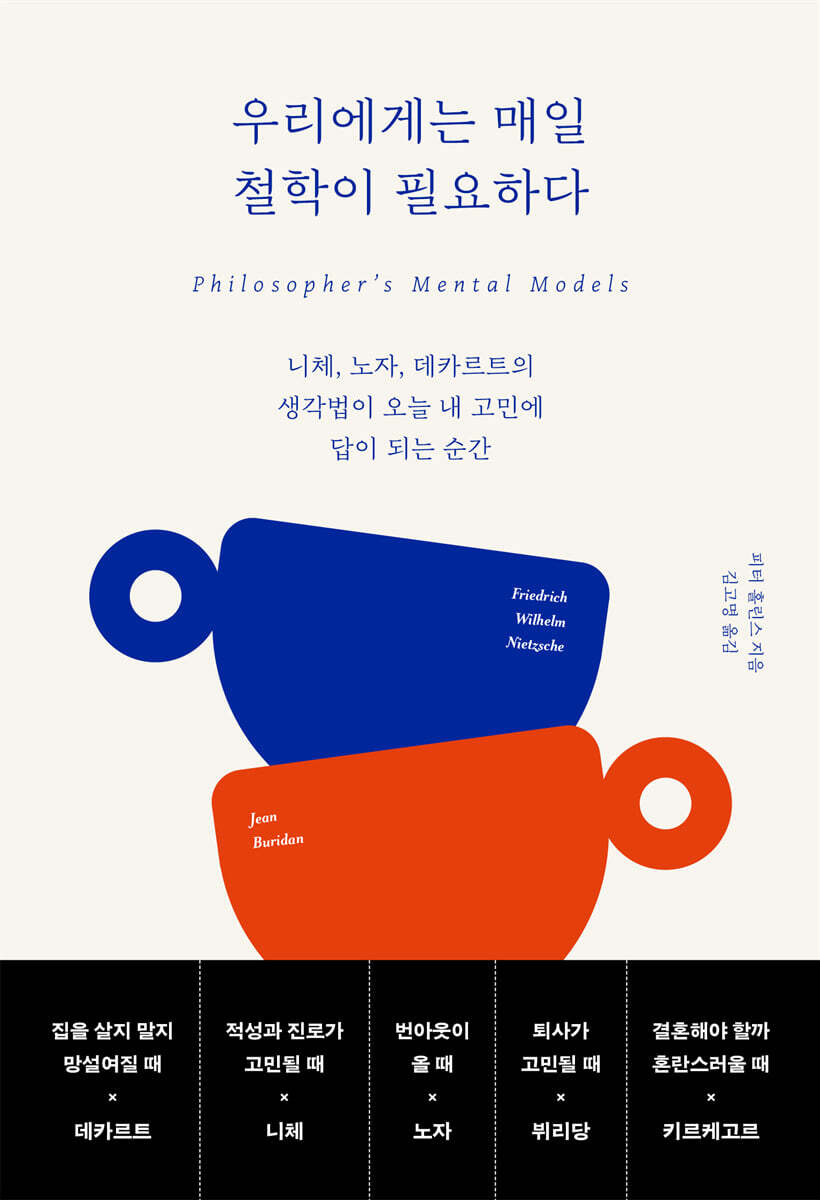
We need philosophy every day.
 |
Description
Book Introduction
Philosophy becomes the most useful compass for life when it connects with my current life.
The moment when Nietzsche, Lao Tzu, and Descartes' thinking becomes the answer to my worries today!
"The Most Realistic Philosophy Lesson" by Amazon psychology bestselling author Peter Hollins
A person is in trouble.
Should I sign a contract for that house I saw yesterday? It's in the neighborhood of my dreams, but budget worries are keeping me from getting anything done.
The same goes for company work.
Is now the time to change jobs, or should I hold out a little longer and wait for a promotion? As I get older, I'm torn between whether I should get married or not.
These are problems that everyone experiences, but there are no correct answers and not everyone can solve them wisely.
Every day we stand before a crossroads of choice.
Some hesitate before it, while others move forward resolutely.
The difference comes not from genes or luck, but from problem-solving skills, that is, decision-making ability.
And surprisingly, the most sophisticated discipline for training this ability is philosophy.
Philosophy is also one of the oldest problem-solving techniques in human history, enabling us to answer the numerous questions life poses.
This book does not explain any grand philosophical theories.
Rather, we apply philosophical thinking to the realistic concerns we face in our daily lives.
Rather than imagining a thousand things when your lover doesn't contact you, choose the simplest assumption (Occam's Razor), when you feel burnout, take a step back and observe the situation (Lao Tzu's inaction), when you feel unsettled about marriage and childbirth, take a leap of faith (Kierkegaard), and enjoy and love the life you've been given to yourself (Nietzsche).
There are many books that explain philosophy in an easy-to-understand way, but few convey philosophy in a language that addresses real-life problems.
In "We Need Philosophy Every Day," it seems as if the great philosophers who have been wandering in the sky have finally come down to earth and sit next to me to give me life lessons.
If you are someone who thinks you are wasting your time worrying all the time, let's look at the problem through the thinking of philosophers as a 'lens'.
By the time you finish reading this book, you'll find yourself looking at your options with greater clarity and making confident decisions about any issue.
The moment when Nietzsche, Lao Tzu, and Descartes' thinking becomes the answer to my worries today!
"The Most Realistic Philosophy Lesson" by Amazon psychology bestselling author Peter Hollins
A person is in trouble.
Should I sign a contract for that house I saw yesterday? It's in the neighborhood of my dreams, but budget worries are keeping me from getting anything done.
The same goes for company work.
Is now the time to change jobs, or should I hold out a little longer and wait for a promotion? As I get older, I'm torn between whether I should get married or not.
These are problems that everyone experiences, but there are no correct answers and not everyone can solve them wisely.
Every day we stand before a crossroads of choice.
Some hesitate before it, while others move forward resolutely.
The difference comes not from genes or luck, but from problem-solving skills, that is, decision-making ability.
And surprisingly, the most sophisticated discipline for training this ability is philosophy.
Philosophy is also one of the oldest problem-solving techniques in human history, enabling us to answer the numerous questions life poses.
This book does not explain any grand philosophical theories.
Rather, we apply philosophical thinking to the realistic concerns we face in our daily lives.
Rather than imagining a thousand things when your lover doesn't contact you, choose the simplest assumption (Occam's Razor), when you feel burnout, take a step back and observe the situation (Lao Tzu's inaction), when you feel unsettled about marriage and childbirth, take a leap of faith (Kierkegaard), and enjoy and love the life you've been given to yourself (Nietzsche).
There are many books that explain philosophy in an easy-to-understand way, but few convey philosophy in a language that addresses real-life problems.
In "We Need Philosophy Every Day," it seems as if the great philosophers who have been wandering in the sky have finally come down to earth and sit next to me to give me life lessons.
If you are someone who thinks you are wasting your time worrying all the time, let's look at the problem through the thinking of philosophers as a 'lens'.
By the time you finish reading this book, you'll find yourself looking at your options with greater clarity and making confident decisions about any issue.
- You can preview some of the book's contents.
Preview
index
Entering
Chapter 1: The Philosopher's Model of Thinking, Part 1: Intelligent Decisions
When you're wondering whether to buy a house, doubt like Descartes.
When you don't hear from your lover, think simply like William of Occam.
When I want to know what I really care about, I use a Venn diagram.
Chapter 2: The Philosopher's Model of Thinking, Part 2: Ethical Decisions
When You Don't Like Your Next Seatmate: The Law of Buddhist Karma
When you get tired of trying, follow inaction like Lao Tzu.
When I want to completely change my old self, I think of Chesterton's fence.
Chapter 3: The Philosopher's Model of Thinking, Part 3: Determining Long-Term Meaning
When you don't know the meaning of life, like Nietzsche, 'Amor Fati'
When you're conflicted about whether to step down for your dreams, bet like Pascal.
When taking on a seemingly impossible challenge, look at it with a beginner's mindset.
Chapter 4: The Philosopher's Model of Thinking, Part Four: The Decision to Act
Before you sign up for a personal trainer or buy supplements, quit your bad habits with Via Negativa.
When you're struggling with a breakup, throw away your distorted map like Korzybski.
When the day is over and you've been worrying about everything, try making a choice like Buridan.
Chapter 5: The Philosopher's Model of Thinking, Part 5: The Decision to Accept the Unknown
Should I Have a Child? When the Choice Is Fearful, the Vampire Parable
When you hesitate about marriage, take a leap of faith like Kierkegaard.
When the world I know seems to be the only correct answer, come out of the cave like Plato
Chapter 1: The Philosopher's Model of Thinking, Part 1: Intelligent Decisions
When you're wondering whether to buy a house, doubt like Descartes.
When you don't hear from your lover, think simply like William of Occam.
When I want to know what I really care about, I use a Venn diagram.
Chapter 2: The Philosopher's Model of Thinking, Part 2: Ethical Decisions
When You Don't Like Your Next Seatmate: The Law of Buddhist Karma
When you get tired of trying, follow inaction like Lao Tzu.
When I want to completely change my old self, I think of Chesterton's fence.
Chapter 3: The Philosopher's Model of Thinking, Part 3: Determining Long-Term Meaning
When you don't know the meaning of life, like Nietzsche, 'Amor Fati'
When you're conflicted about whether to step down for your dreams, bet like Pascal.
When taking on a seemingly impossible challenge, look at it with a beginner's mindset.
Chapter 4: The Philosopher's Model of Thinking, Part Four: The Decision to Act
Before you sign up for a personal trainer or buy supplements, quit your bad habits with Via Negativa.
When you're struggling with a breakup, throw away your distorted map like Korzybski.
When the day is over and you've been worrying about everything, try making a choice like Buridan.
Chapter 5: The Philosopher's Model of Thinking, Part 5: The Decision to Accept the Unknown
Should I Have a Child? When the Choice Is Fearful, the Vampire Parable
When you hesitate about marriage, take a leap of faith like Kierkegaard.
When the world I know seems to be the only correct answer, come out of the cave like Plato
Detailed image

Into the book
Some people seem to be born with all the luck and opportunities, but they fail to succeed.
Some people seem to be born with nothing, yet they achieve feats that defy expectations.
Why is that? Many people overlook the importance of decision-making and problem-solving skills for a successful life.
From now on, we will discuss free will, choice, and knowledge by examining various models of thought.
Which model is the best among them? That's the question.
Every model has its own usefulness.
So, as we analyze each model from a decision-making perspective, we'll learn how to switch modes of thinking appropriately.
--- From the "Preface"
There's clearly something we can learn from Descartes' writings hundreds of years ago to help us make wiser decisions, and more broadly, to think better.
As beneficiaries of the epistemological revolution he sparked, we can use his skepticism to counteract the damaging effects of biases, blind spots, and "common-sense" assumptions.
The simplest solution isn't always the best solution, but it's usually more likely to be the best solution.
Every problem has an unknown element.
If you're not careful, you might end up pouring all kinds of assumptions into that unknown territory.
Occam's razor is necessary to prevent fear and assumptions from running rampant in decision-making.
The Venn diagram shows that how we process information greatly affects what we can process and what we can see from the same data.
--- From "Chapter 1: The Philosopher's Thinking Model: The First: Intelligent Decision"
If we look at karma from a cognitive-behavioral perspective, it can be interpreted to mean that if we develop the habit of performing certain actions under certain conditions, such unconscious actions can influence our lives.
The patterns we think, feel, and act in themselves become stimuli that continually lead to specific outcomes.
…remember that choosing any action also means choosing its consequences.
Knowing nothingness allows you to let go of the natural flow without forcing anything.
Be less nervous, less serious, and less swayed by your ego.
Then, without wasting energy, you will arrive at the right result as if by chance.
It's something you get without any hardship!
--- From "Chapter 2: The Philosopher's Thinking Model, Part 2: Ethical Decisions"
Think about the long-term, or even the very long-term, consequences.
Let's step back, clear away all the emotions and hopes surrounding the decisions we need to make now, and look at the bigger picture, the picture of our entire lives.
Imagine making the same decisions over and over again forever.
My present choices create my future self, and my future self will also make her own choices.
Still, would you choose what you want to choose now?
Pascal's Wager is helpful even when you don't know the probability of a certain outcome.
Instead of focusing on the odds, focus on the size of the potential reward.
…a good strategy is to choose the option with the lowest cost and highest reward among the given options.
--- From "Chapter 3: The Philosopher's Model of Thinking, Part 3: Determining Long-Term Meaning"
Via Negativa helps you see your most valuable work and most important goals by identifying your boundaries and limitations.
Instead of asking, “What do I want?” we can ask ourselves, “What do I absolutely not want?”
So, after we eliminate everything we don't want, what's left? Logically, that's what we want.
Buridan's donkey also illustrates the problem of myopic perfectionism.
I can't choose anything because I feel like I have to make a decision right now with the best option.
It's much better to make a choice and then learn from your mistakes.
--- From "Chapter 4: The Decision to Take Action"
Kierkegaard recommends 'a deliberate embrace of everything that transcends reason and empirical evidence.'
According to Kierkegaard, entering such unknown territory is more a matter of faith.
Here, faith means an active action that goes beyond simply believing something.
That is, it is deliberately choosing or accepting something that cannot be proven, explained, or understood through logic and reason.
After much deliberation, the answer we found was that 'action is the best decision-making process.'
Of the thought models introduced so far, I cannot know in advance which ones will work for me and which ones will not.
There is no choice but to test it yourself in the laboratory called life.
You have to create your own thinking model that works best for you.
Some people seem to be born with nothing, yet they achieve feats that defy expectations.
Why is that? Many people overlook the importance of decision-making and problem-solving skills for a successful life.
From now on, we will discuss free will, choice, and knowledge by examining various models of thought.
Which model is the best among them? That's the question.
Every model has its own usefulness.
So, as we analyze each model from a decision-making perspective, we'll learn how to switch modes of thinking appropriately.
--- From the "Preface"
There's clearly something we can learn from Descartes' writings hundreds of years ago to help us make wiser decisions, and more broadly, to think better.
As beneficiaries of the epistemological revolution he sparked, we can use his skepticism to counteract the damaging effects of biases, blind spots, and "common-sense" assumptions.
The simplest solution isn't always the best solution, but it's usually more likely to be the best solution.
Every problem has an unknown element.
If you're not careful, you might end up pouring all kinds of assumptions into that unknown territory.
Occam's razor is necessary to prevent fear and assumptions from running rampant in decision-making.
The Venn diagram shows that how we process information greatly affects what we can process and what we can see from the same data.
--- From "Chapter 1: The Philosopher's Thinking Model: The First: Intelligent Decision"
If we look at karma from a cognitive-behavioral perspective, it can be interpreted to mean that if we develop the habit of performing certain actions under certain conditions, such unconscious actions can influence our lives.
The patterns we think, feel, and act in themselves become stimuli that continually lead to specific outcomes.
…remember that choosing any action also means choosing its consequences.
Knowing nothingness allows you to let go of the natural flow without forcing anything.
Be less nervous, less serious, and less swayed by your ego.
Then, without wasting energy, you will arrive at the right result as if by chance.
It's something you get without any hardship!
--- From "Chapter 2: The Philosopher's Thinking Model, Part 2: Ethical Decisions"
Think about the long-term, or even the very long-term, consequences.
Let's step back, clear away all the emotions and hopes surrounding the decisions we need to make now, and look at the bigger picture, the picture of our entire lives.
Imagine making the same decisions over and over again forever.
My present choices create my future self, and my future self will also make her own choices.
Still, would you choose what you want to choose now?
Pascal's Wager is helpful even when you don't know the probability of a certain outcome.
Instead of focusing on the odds, focus on the size of the potential reward.
…a good strategy is to choose the option with the lowest cost and highest reward among the given options.
--- From "Chapter 3: The Philosopher's Model of Thinking, Part 3: Determining Long-Term Meaning"
Via Negativa helps you see your most valuable work and most important goals by identifying your boundaries and limitations.
Instead of asking, “What do I want?” we can ask ourselves, “What do I absolutely not want?”
So, after we eliminate everything we don't want, what's left? Logically, that's what we want.
Buridan's donkey also illustrates the problem of myopic perfectionism.
I can't choose anything because I feel like I have to make a decision right now with the best option.
It's much better to make a choice and then learn from your mistakes.
--- From "Chapter 4: The Decision to Take Action"
Kierkegaard recommends 'a deliberate embrace of everything that transcends reason and empirical evidence.'
According to Kierkegaard, entering such unknown territory is more a matter of faith.
Here, faith means an active action that goes beyond simply believing something.
That is, it is deliberately choosing or accepting something that cannot be proven, explained, or understood through logic and reason.
After much deliberation, the answer we found was that 'action is the best decision-making process.'
Of the thought models introduced so far, I cannot know in advance which ones will work for me and which ones will not.
There is no choice but to test it yourself in the laboratory called life.
You have to create your own thinking model that works best for you.
--- From "Chapter 5: The Philosopher's Thinking Model, Part 5: The Decision to Accept the Unknown"
Publisher's Review
Doubt like Descartes
Like William of Occam, cut out what is not true.
Let's go back to the person who was wondering whether to buy a house.
He knows that 'it's better to buy a house than to rent' and 'when you get older, it's more secure to have your own house'.
We also know that 'there needs to be two bathrooms for the whole family to live comfortably.'
But is this reality he knows really the real reality?
Descartes would advise this:
“If we believe something to be true, we must first doubt whether it is really true.
"What does it mean to 'know'?" If we look a little more honestly within ourselves, following this question, we might uncover our true motivation: "I want to buy a nice house because I want to appear more successful to others."
The moment we honestly acknowledge this fundamental desire, decision-making becomes much simpler.
Because I can judge based on what is truly necessary in my life, rather than based on the opinions of others.
Ultimately, he may buy a house, or he may make a different choice altogether.
Descartes' way of thinking is also in line with the 'principle of the razor' mentioned by William of Occam.
Occam's razor is a way of thinking that eliminates all complex assumptions and leaves only the simplest assumptions.
This principle also helps us maintain our judgment in an age overflowing with fake news and conspiracy theories.
If you look closely at all kinds of conspiracy theories, you will find that they contain numerous underlying assumptions.
When you overcomplicate a simple problem, it may seem plausible at first glance, but what is at work then is emotion, not intellect.
Emotions such as suspicion, distrust, and anger become excessively stimulated, interfering with rational thinking.
If you want to make intelligent decisions with clearer judgment than others in your daily life, first question what you know and boldly cut out unnecessary assumptions.
Simplicity is the beginning of the most sophisticated thinking.
Everything is karma, so look deeply into the situation.
When even effort becomes tiring, like Lao Tzu, stop for a moment and observe.
Everyone has at least one person they don't like.
I haven't been able to sleep well lately and I've been suffering from headaches. My coworker is like that every morning when he drinks his coffee while making a "slurp, slurp" sound.
I want to say something, but I hold back for fear of seeming petty.
If Shakyamuni saw this scene, he would say this.
“Everything is your karma.”
Karma is entirely mine, and the cause of the problems I am experiencing now lies within me.
So, instead of reacting hastily, take a step back and look deeper into the situation.
I was irritated from the morning because I overslept and missed the subway, and the reason I overslept was because I went to bed late the night before after scrolling through social media.
In the end, the root of the problem wasn't my colleague, but myself.
Once you've found the cause, make a plan to turn off your phone notifications and go to bed early, and put it into practice.
The next day, I went to work feeling much lighter, and the sound of my coworkers drinking coffee didn't bother me as much as before.
In this way, my thoughts and actions are the result of a combination of karmic impulses and environmental factors.
Although this causal theory is a useful cognitive system, an all-out effort attitude does not always lead to good results.
Lao Tzu presents a much gentler worldview, one in which excessive effort is actually against the flow of nature.
Aren't you struggling with burnout, trying to live a so-called "new life" by filling every moment with efficiency? Sometimes, let go of your obsession with results and let it flow like water.
“Nature is slow, yet accomplishes everything.”
Bet on what you truly want, like Pascal.
Embrace life and love like Nietzsche
Life feels empty sometimes.
When I look at this absurd world, I wonder if there is no God.
However, Pascal says that since humans cannot know for sure whether God exists or not, they should bet on believing that he does exist.
The logic is simple.
Because the benefits of God's existence (eternal life) are far greater than the losses of not existing (hell).
This is more of a philosophical suggestion about how to approach life than religious advice.
This story also resonates with people who are contemplating whether to take on a long-planned business or stay at their current job.
The challenge may seem risky, but there's no guarantee it won't work out.
Conversely, there is no certainty that the current stability will last forever.
Pascal would advise you to take the path with greater positive possibilities.
If you're facing a decision that will have long-term consequences, such as quitting your job or changing jobs, it can be helpful to think about Nietzsche.
What if you had to endure the consequences of the choices you're about to make forever? Even if there's no improvement or addition to the future, even if there are failures and setbacks, is it a decision you'd say, "I'm willing to repeat this moment forever"? If you can confidently say yes, you've practiced "Amor Fati."
Life is always uncertain, but it becomes lovable only when you bet on your choices and fully embrace the fate that has been given to you.
If the day passes by just thinking about it, then I decide to take action.
If you choose, leap forward with faith like Kierkegaard.
Even though we can learn from the thinking of countless philosophers to make wiser choices, there is one thing we must acknowledge.
The perfect choice is impossible.
No matter how much information you gather and how much probability you calculate, you can't control all variables.
Eventually, we face a moment of choice where we must close our eyes and take a leap of faith.
We don't know if the person next to us will be with us for the rest of our lives, or if they will be able to have and raise a child in this harsh world.
Kierkegaard says:
“Go beyond reason and evidence, leap into faith.” Instead of asking, “Should I get married?” try asking, “How can I get married and live happily?”
The moment we take a step into the unknown, paradoxically, we land back in reality.
(Kierkegaard just said this.
("You'll regret getting married, and you'll regret not getting married.") If regret is ultimately unavoidable, how about considering it as the price humans pay for living with free will?
Plato said that even all the thoughts we form in our heads are just shadows on the wall.
The same goes for philosophers' thought models.
If you think only with your head, it is still a shadow.
Philosophy becomes reality only when we close the book and go out into the world and take action.
Action is the best decision-making process, so it doesn't have to be perfect.
Finally, the author asks:
Which philosopher's lens will you take into the world? And what choices will you make today to live out your philosophy?
Like William of Occam, cut out what is not true.
Let's go back to the person who was wondering whether to buy a house.
He knows that 'it's better to buy a house than to rent' and 'when you get older, it's more secure to have your own house'.
We also know that 'there needs to be two bathrooms for the whole family to live comfortably.'
But is this reality he knows really the real reality?
Descartes would advise this:
“If we believe something to be true, we must first doubt whether it is really true.
"What does it mean to 'know'?" If we look a little more honestly within ourselves, following this question, we might uncover our true motivation: "I want to buy a nice house because I want to appear more successful to others."
The moment we honestly acknowledge this fundamental desire, decision-making becomes much simpler.
Because I can judge based on what is truly necessary in my life, rather than based on the opinions of others.
Ultimately, he may buy a house, or he may make a different choice altogether.
Descartes' way of thinking is also in line with the 'principle of the razor' mentioned by William of Occam.
Occam's razor is a way of thinking that eliminates all complex assumptions and leaves only the simplest assumptions.
This principle also helps us maintain our judgment in an age overflowing with fake news and conspiracy theories.
If you look closely at all kinds of conspiracy theories, you will find that they contain numerous underlying assumptions.
When you overcomplicate a simple problem, it may seem plausible at first glance, but what is at work then is emotion, not intellect.
Emotions such as suspicion, distrust, and anger become excessively stimulated, interfering with rational thinking.
If you want to make intelligent decisions with clearer judgment than others in your daily life, first question what you know and boldly cut out unnecessary assumptions.
Simplicity is the beginning of the most sophisticated thinking.
Everything is karma, so look deeply into the situation.
When even effort becomes tiring, like Lao Tzu, stop for a moment and observe.
Everyone has at least one person they don't like.
I haven't been able to sleep well lately and I've been suffering from headaches. My coworker is like that every morning when he drinks his coffee while making a "slurp, slurp" sound.
I want to say something, but I hold back for fear of seeming petty.
If Shakyamuni saw this scene, he would say this.
“Everything is your karma.”
Karma is entirely mine, and the cause of the problems I am experiencing now lies within me.
So, instead of reacting hastily, take a step back and look deeper into the situation.
I was irritated from the morning because I overslept and missed the subway, and the reason I overslept was because I went to bed late the night before after scrolling through social media.
In the end, the root of the problem wasn't my colleague, but myself.
Once you've found the cause, make a plan to turn off your phone notifications and go to bed early, and put it into practice.
The next day, I went to work feeling much lighter, and the sound of my coworkers drinking coffee didn't bother me as much as before.
In this way, my thoughts and actions are the result of a combination of karmic impulses and environmental factors.
Although this causal theory is a useful cognitive system, an all-out effort attitude does not always lead to good results.
Lao Tzu presents a much gentler worldview, one in which excessive effort is actually against the flow of nature.
Aren't you struggling with burnout, trying to live a so-called "new life" by filling every moment with efficiency? Sometimes, let go of your obsession with results and let it flow like water.
“Nature is slow, yet accomplishes everything.”
Bet on what you truly want, like Pascal.
Embrace life and love like Nietzsche
Life feels empty sometimes.
When I look at this absurd world, I wonder if there is no God.
However, Pascal says that since humans cannot know for sure whether God exists or not, they should bet on believing that he does exist.
The logic is simple.
Because the benefits of God's existence (eternal life) are far greater than the losses of not existing (hell).
This is more of a philosophical suggestion about how to approach life than religious advice.
This story also resonates with people who are contemplating whether to take on a long-planned business or stay at their current job.
The challenge may seem risky, but there's no guarantee it won't work out.
Conversely, there is no certainty that the current stability will last forever.
Pascal would advise you to take the path with greater positive possibilities.
If you're facing a decision that will have long-term consequences, such as quitting your job or changing jobs, it can be helpful to think about Nietzsche.
What if you had to endure the consequences of the choices you're about to make forever? Even if there's no improvement or addition to the future, even if there are failures and setbacks, is it a decision you'd say, "I'm willing to repeat this moment forever"? If you can confidently say yes, you've practiced "Amor Fati."
Life is always uncertain, but it becomes lovable only when you bet on your choices and fully embrace the fate that has been given to you.
If the day passes by just thinking about it, then I decide to take action.
If you choose, leap forward with faith like Kierkegaard.
Even though we can learn from the thinking of countless philosophers to make wiser choices, there is one thing we must acknowledge.
The perfect choice is impossible.
No matter how much information you gather and how much probability you calculate, you can't control all variables.
Eventually, we face a moment of choice where we must close our eyes and take a leap of faith.
We don't know if the person next to us will be with us for the rest of our lives, or if they will be able to have and raise a child in this harsh world.
Kierkegaard says:
“Go beyond reason and evidence, leap into faith.” Instead of asking, “Should I get married?” try asking, “How can I get married and live happily?”
The moment we take a step into the unknown, paradoxically, we land back in reality.
(Kierkegaard just said this.
("You'll regret getting married, and you'll regret not getting married.") If regret is ultimately unavoidable, how about considering it as the price humans pay for living with free will?
Plato said that even all the thoughts we form in our heads are just shadows on the wall.
The same goes for philosophers' thought models.
If you think only with your head, it is still a shadow.
Philosophy becomes reality only when we close the book and go out into the world and take action.
Action is the best decision-making process, so it doesn't have to be perfect.
Finally, the author asks:
Which philosopher's lens will you take into the world? And what choices will you make today to live out your philosophy?
GOODS SPECIFICS
- Date of issue: December 3, 2025
- Page count, weight, size: 224 pages | 130*190*15mm
- ISBN13: 9791193528952
You may also like
카테고리
korean


korean

![GQ KOREA Mark (Monthly): December [2025]](http://librairie.coreenne.fr/cdn/shop/files/8ef265dbbfbf186523ed75ba7319009d.jpg?v=1765340328&width=3840)


