

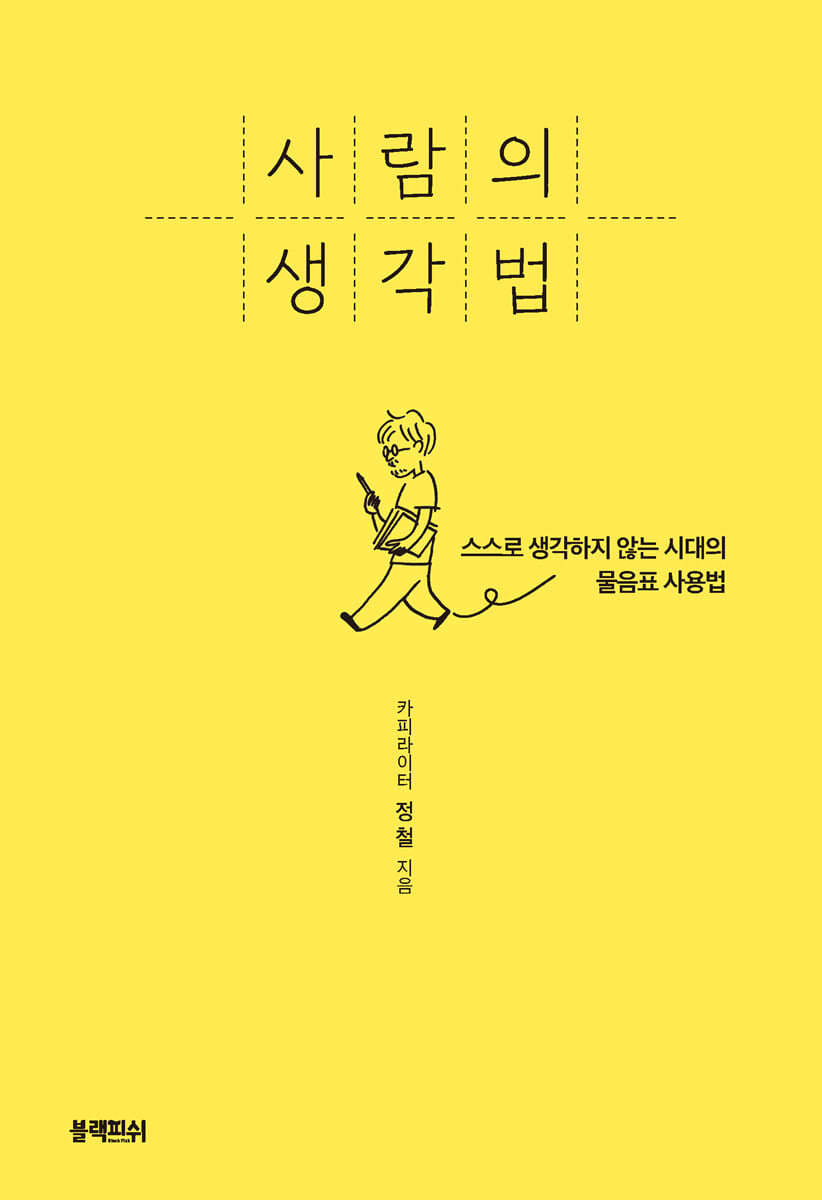
Human thought patterns
 |
Description
Book Introduction
“There are things that only humans can do and that artificial intelligence cannot do.
It is a question and a thought.”
In an age of outsourcing thinking, how to ask and write with your own head
This book conveys the essential "human way of thinking" in an era where generative artificial intelligence (AI) is replacing human intelligence. Since AI has become deeply ingrained in our lives, the ability to ask questions has emerged as a survival weapon.
Haven't we diligently asked AI questions today, seeking answers to our needs—whether to do a good job on an assignment, write a report quickly, or translate a foreign language? But this question arises.
How many times a day have I asked myself questions that had nothing to do with solving a problem, and have I ever thought about it in my head first when I had a question?
Aren't we forgetting the ability to ask useless but interesting questions, the ability to think for ourselves and find answers, that can inject vitality into our often hectic lives?
In "How People Think," author Jeongcheol poses imaginative questions that only humans can ask, and provides unpredictable answers based on the insight and sharp intuition of a copywriter with 35 years of experience.
This book is as entertaining as the author's previous books, but completely different.
First, it contains new questions that the writer, who has made a living by asking himself and revising hundreds of times just to write a single line, has pondered and written for a long time.
There are absurd questions that awaken dormant imaginations, dangerous questions that shake the rigid framework of the world, and quiet questions that make you look into how you should live as yourself.
It doesn't end here.
The author breaks away from the image of 'copywriter Jeong-cheol' and embarks on an exciting journey of inquiry as an anonymous 'I' who is Jeong-cheol but is not Jeong-cheol.
The travel destinations are a department store of imagination, an unlicensed philosophy museum, a midsummer commute home, and a lakeside fishing spot, where 'I' experience strange encounters and incidents.
Readers will be immersed in the story, which unfolds vividly with the warm illustrations of Kim Paka, in a fresh format never seen before in the author's books, with the novel woven into the text.
The questions the author poses are short and easy, but the world of thought contained in the answers is deep and wide.
We need to break free from mechanical stereotypes and let our imagination run wild.
By laughing at the questions in this book, empathizing with them, and applying them to ourselves, we will gain new perspectives on the world, ideas for problem-solving, and even find our own direction in life.
In an age where thinking is outsourced to civilization, if you don't want to forget how to think for yourself, if you need unconventional ideas and inspiration, experience the world of questions and thoughts unique to humans through this book.
It is a question and a thought.”
In an age of outsourcing thinking, how to ask and write with your own head
This book conveys the essential "human way of thinking" in an era where generative artificial intelligence (AI) is replacing human intelligence. Since AI has become deeply ingrained in our lives, the ability to ask questions has emerged as a survival weapon.
Haven't we diligently asked AI questions today, seeking answers to our needs—whether to do a good job on an assignment, write a report quickly, or translate a foreign language? But this question arises.
How many times a day have I asked myself questions that had nothing to do with solving a problem, and have I ever thought about it in my head first when I had a question?
Aren't we forgetting the ability to ask useless but interesting questions, the ability to think for ourselves and find answers, that can inject vitality into our often hectic lives?
In "How People Think," author Jeongcheol poses imaginative questions that only humans can ask, and provides unpredictable answers based on the insight and sharp intuition of a copywriter with 35 years of experience.
This book is as entertaining as the author's previous books, but completely different.
First, it contains new questions that the writer, who has made a living by asking himself and revising hundreds of times just to write a single line, has pondered and written for a long time.
There are absurd questions that awaken dormant imaginations, dangerous questions that shake the rigid framework of the world, and quiet questions that make you look into how you should live as yourself.
It doesn't end here.
The author breaks away from the image of 'copywriter Jeong-cheol' and embarks on an exciting journey of inquiry as an anonymous 'I' who is Jeong-cheol but is not Jeong-cheol.
The travel destinations are a department store of imagination, an unlicensed philosophy museum, a midsummer commute home, and a lakeside fishing spot, where 'I' experience strange encounters and incidents.
Readers will be immersed in the story, which unfolds vividly with the warm illustrations of Kim Paka, in a fresh format never seen before in the author's books, with the novel woven into the text.
The questions the author poses are short and easy, but the world of thought contained in the answers is deep and wide.
We need to break free from mechanical stereotypes and let our imagination run wild.
By laughing at the questions in this book, empathizing with them, and applying them to ourselves, we will gain new perspectives on the world, ideas for problem-solving, and even find our own direction in life.
In an age where thinking is outsourced to civilization, if you don't want to forget how to think for yourself, if you need unconventional ideas and inspiration, experience the world of questions and thoughts unique to humans through this book.
- You can preview some of the book's contents.
Preview
index
Introduction / Why Me?
1.
First question
2.
A Pilgrimage to the Department Store of Imagination
3.
Odd question
4.
A visit to an unlicensed philosophy museum
5.
Dangerous question
6.
Midsummer landscape painting on the way home from work
7.
Quiet question
8.
Non-certified teacher contact
9.
Last question
Back door / Can I continue writing?
1.
First question
2.
A Pilgrimage to the Department Store of Imagination
3.
Odd question
4.
A visit to an unlicensed philosophy museum
5.
Dangerous question
6.
Midsummer landscape painting on the way home from work
7.
Quiet question
8.
Non-certified teacher contact
9.
Last question
Back door / Can I continue writing?
Detailed image

Into the book
I would like to call this book a question essay.
This is because it is a book that gradually teaches you how to expand your thoughts through questions that others don't often ask, and how to connect the expanded thoughts.
Because it is a book that teaches you how to think for yourself in an age where people don't think for themselves.
Of course, there are no surprising insights that will go down in history anywhere in this book.
However, you will be able to confirm that the world of thought that a trivial and trivial question brings you is by no means trivial or trivial in depth or breadth.
--- From the "Preface"
A department store of imagination.
How on earth did they display such imagination?
I was curious and wanted to check.
I asked the navigation for directions and went there.
Along the road, unimaginative trees stood at unimaginative intervals.
It seemed like he had no intention of making eye contact with me.
I didn't look at him for long either.
I thought we were almost there, but there was a long line of cars forming a long way before the department store entrance.
It must be a hot line created by people thirsty for imagination.
I too joined the ranks.
The waiting time wasn't boring.
Considering what I had to do today, I believed I deserved this amount of time.
It was my turn and I slipped into the department store with my car.
Oh my goodness, there's an underground parking lot.
--- From "Is there a limit to imagination?"
As I passed by the hamburger shop, I asked myself this odd question.
Why not put cola in a hamburger that is stuffed with meat, sauce, onions, lettuce, tomato, and even jajangmyeon between the buns?
If you just add cola, it would be perfect.
First, I erased the obvious answers 1 and 2 from my head.
What is that? The answer that just popped into your head.
1. Coke is a liquid, so it can't be trapped between bread, so whatever.
2. It would help sales if cola was sold separately, but something like that.
So how do we get an answer that isn't obvious?
I'm imagining it.
How to imagine is the question again.
--- From "Why isn't there a cola burger?"
He opened the door slightly and asked with only his face inside.
I think I'm just over thirty.
A woman of her age, dressed in casual clothes, answered indifferently with an expression that said, "Is that the question again?"
It was informal speech.
Who gave you permission to live your life? It's your life, so don't you live it however you want? Life is unauthorized and unlicensed, so the eyes you look into it with must also be unlicensed to make it work.
If you were expecting a magical place like a tutoring service, then go back. If you want to hear free speech without worrying about what the world thinks, then close the door and come in.
--- From "Why is it an unlicensed philosophy museum?"
The person who knows me best.
He's the one who's been following me for twenty-four hours.
He is a person who lives with me almost as if he were one with me.
He is a person who knows not only how I am today, but also how I lived yesterday.
I am one of those people who remembers when I was nine years old and ran away with a piece of candy from the local convenience store.
Don't doubt that there is such a person.
There is such a person.
It's me.
I know myself.
I know best in the world.
So I can't give you a score.
How many points would you give to the candy thief?
But don't hate me for being stingy.
In gymnastics competitions, the highest and lowest scores are discarded and the remaining scores are averaged.
--- From "Who gives me the lowest score?"
Sometimes the warmest words are those that remain unspoken.
If we all add a word about someone else's weakness, laziness, or giving up, that person might be swept away by the flood of words.
I took out his words that were in my ear, put them in my mouth, and rolled them again.
Waste of words.
Waste of words.
This is because it is a book that gradually teaches you how to expand your thoughts through questions that others don't often ask, and how to connect the expanded thoughts.
Because it is a book that teaches you how to think for yourself in an age where people don't think for themselves.
Of course, there are no surprising insights that will go down in history anywhere in this book.
However, you will be able to confirm that the world of thought that a trivial and trivial question brings you is by no means trivial or trivial in depth or breadth.
--- From the "Preface"
A department store of imagination.
How on earth did they display such imagination?
I was curious and wanted to check.
I asked the navigation for directions and went there.
Along the road, unimaginative trees stood at unimaginative intervals.
It seemed like he had no intention of making eye contact with me.
I didn't look at him for long either.
I thought we were almost there, but there was a long line of cars forming a long way before the department store entrance.
It must be a hot line created by people thirsty for imagination.
I too joined the ranks.
The waiting time wasn't boring.
Considering what I had to do today, I believed I deserved this amount of time.
It was my turn and I slipped into the department store with my car.
Oh my goodness, there's an underground parking lot.
--- From "Is there a limit to imagination?"
As I passed by the hamburger shop, I asked myself this odd question.
Why not put cola in a hamburger that is stuffed with meat, sauce, onions, lettuce, tomato, and even jajangmyeon between the buns?
If you just add cola, it would be perfect.
First, I erased the obvious answers 1 and 2 from my head.
What is that? The answer that just popped into your head.
1. Coke is a liquid, so it can't be trapped between bread, so whatever.
2. It would help sales if cola was sold separately, but something like that.
So how do we get an answer that isn't obvious?
I'm imagining it.
How to imagine is the question again.
--- From "Why isn't there a cola burger?"
He opened the door slightly and asked with only his face inside.
I think I'm just over thirty.
A woman of her age, dressed in casual clothes, answered indifferently with an expression that said, "Is that the question again?"
It was informal speech.
Who gave you permission to live your life? It's your life, so don't you live it however you want? Life is unauthorized and unlicensed, so the eyes you look into it with must also be unlicensed to make it work.
If you were expecting a magical place like a tutoring service, then go back. If you want to hear free speech without worrying about what the world thinks, then close the door and come in.
--- From "Why is it an unlicensed philosophy museum?"
The person who knows me best.
He's the one who's been following me for twenty-four hours.
He is a person who lives with me almost as if he were one with me.
He is a person who knows not only how I am today, but also how I lived yesterday.
I am one of those people who remembers when I was nine years old and ran away with a piece of candy from the local convenience store.
Don't doubt that there is such a person.
There is such a person.
It's me.
I know myself.
I know best in the world.
So I can't give you a score.
How many points would you give to the candy thief?
But don't hate me for being stingy.
In gymnastics competitions, the highest and lowest scores are discarded and the remaining scores are averaged.
--- From "Who gives me the lowest score?"
Sometimes the warmest words are those that remain unspoken.
If we all add a word about someone else's weakness, laziness, or giving up, that person might be swept away by the flood of words.
I took out his words that were in my ear, put them in my mouth, and rolled them again.
Waste of words.
Waste of words.
--- From "What are the next warm words?"
Publisher's Review
★ A challenging new work from best-selling author Jeong Cheol of "Copy Book"!
★ A must-read for planners, creators, editors, marketers, and copywriters.
“Don’t ask the right question, ask a different question.”
In an era where artificial intelligence replaces humans,
A story about asking and writing with my head
In a world where question marks are more important than ever.
In an era where generative artificial intelligence is becoming commonplace, the ability to ask good questions is a survival skill.
Haven't we diligently asked AI questions today, seeking answers to our needs—to do a good job on assignments, write reports quickly, translate business emails into foreign languages? But this question arises.
How many times a day do I ask questions that have nothing to do with obtaining information or solving a problem?
Aren't we losing the unique ability of humans to come up with interesting ideas 'on their own', useless but fun, that can inject vitality into our tough lives and inject ideas into our hardened minds?
- Why aren't there any stores that sell people?
- Am I a straight line or a curve?
- Is intelligence smarter or is instinct smarter?
- What do the leaves prepare when a tree prepares for winter?
In this book, "The Way People Think," author Jeongcheol asks questions full of imagination that only humans can ask, such as these absurd yet resonant ones, and provides unpredictable answers based on the insight and intuition of a copywriter with 35 years of experience.
In the preface, the author cynically asks himself why he asks such questions that contribute nothing to the peace and prosperity of mankind, and answers as follows:
“There are things that artificial intelligence cannot do.
Something only humans can do.
It is a question and a thought.”
“You have to go through the question mark to get to the exclamation point.”
Twist and overturn mechanical thinking
How to Use Human Question Marks
What are the questions and reasons that only humans can ask? To answer this question, let's examine how AI and humans answer the same questions.
If you input the question “What is the difference between 1% and 99%?” from Part 3 of this book (Odd Questions) into AI, it will give you an answer like “1% is a self-optimizing model that continuously repeats small improvements, and 99% is closer to a stationary model that stays at the initial value.”
Author Jeongcheol says, “Both are probabilities that can be committed, probabilities that can be committed, and probabilities that have been attempted countless times.”
Do you notice the difference? Which answer sticks with you longer and more deeply? Humans can expand their thinking through questions, and by connecting those expanded thoughts, they can make further creative discoveries.
Based on life experiences and literary literacy, you can better understand and use implicit sentences.
By doing so, you can arrive at ideas that inspire and captivate others! "How Humans Think" takes you on a special journey of inquiry that will cultivate that uniquely human strength: flexible thinking.
“Imagination never compromises.”
A journey to find thoughts that only humans can have
A journey of unpredictable questions
The book is largely divided into nine parts.
There are bizarre questions that awaken dormant imaginations, dangerous questions that shake the rigid framework of the world, and quiet questions that make us reflect on how we should live as ourselves.
It doesn't end here.
The author breaks away from the image of 'copywriter Jeong-cheol' and embarks on a journey of questions that may lead him nowhere as an anonymous 'me' who is Jeong-cheol but is also not Jeong-cheol.
The travel destinations are a department store of imagination, an unlicensed philosophy museum, a midsummer commute home, and a lakeside fishing spot, where 'I' experience strange encounters and incidents.
These scenes are made even more vivid by the illustrations of Kim Paka, an artist who has drawn readers' sympathy with his delicate writing and warm drawings.
It is a fresh and adventurous format that has never been seen in the author's books before, with novels plopped into the text.
“For me, who has always written similar articles, this book is a new attempt and challenge.
An essay in the form of a novel.
“An essay in which each line runs without being separated.” _From the afterword
As you read the wise dialogues between you and the philosopher who gives wise answers to life like Socrates, and the Korean language teacher who is not a certified professional but knows better than anyone how to speak and write well, you will experience the joy of thinking with your own head.
Let's apply the questions in this book to ourselves.
You will learn to break free from the inertia of outsourcing your thoughts and discover the creativity, imagination, and insight hidden within you by asking questions and finding answers for yourself.
If you'd rather sacrifice your memory and computational skills to civilization than your imagination, and if you're curious about the world of questions and thoughts unique to humans, this is a must-read.
★ A must-read for planners, creators, editors, marketers, and copywriters.
“Don’t ask the right question, ask a different question.”
In an era where artificial intelligence replaces humans,
A story about asking and writing with my head
In a world where question marks are more important than ever.
In an era where generative artificial intelligence is becoming commonplace, the ability to ask good questions is a survival skill.
Haven't we diligently asked AI questions today, seeking answers to our needs—to do a good job on assignments, write reports quickly, translate business emails into foreign languages? But this question arises.
How many times a day do I ask questions that have nothing to do with obtaining information or solving a problem?
Aren't we losing the unique ability of humans to come up with interesting ideas 'on their own', useless but fun, that can inject vitality into our tough lives and inject ideas into our hardened minds?
- Why aren't there any stores that sell people?
- Am I a straight line or a curve?
- Is intelligence smarter or is instinct smarter?
- What do the leaves prepare when a tree prepares for winter?
In this book, "The Way People Think," author Jeongcheol asks questions full of imagination that only humans can ask, such as these absurd yet resonant ones, and provides unpredictable answers based on the insight and intuition of a copywriter with 35 years of experience.
In the preface, the author cynically asks himself why he asks such questions that contribute nothing to the peace and prosperity of mankind, and answers as follows:
“There are things that artificial intelligence cannot do.
Something only humans can do.
It is a question and a thought.”
“You have to go through the question mark to get to the exclamation point.”
Twist and overturn mechanical thinking
How to Use Human Question Marks
What are the questions and reasons that only humans can ask? To answer this question, let's examine how AI and humans answer the same questions.
If you input the question “What is the difference between 1% and 99%?” from Part 3 of this book (Odd Questions) into AI, it will give you an answer like “1% is a self-optimizing model that continuously repeats small improvements, and 99% is closer to a stationary model that stays at the initial value.”
Author Jeongcheol says, “Both are probabilities that can be committed, probabilities that can be committed, and probabilities that have been attempted countless times.”
Do you notice the difference? Which answer sticks with you longer and more deeply? Humans can expand their thinking through questions, and by connecting those expanded thoughts, they can make further creative discoveries.
Based on life experiences and literary literacy, you can better understand and use implicit sentences.
By doing so, you can arrive at ideas that inspire and captivate others! "How Humans Think" takes you on a special journey of inquiry that will cultivate that uniquely human strength: flexible thinking.
“Imagination never compromises.”
A journey to find thoughts that only humans can have
A journey of unpredictable questions
The book is largely divided into nine parts.
There are bizarre questions that awaken dormant imaginations, dangerous questions that shake the rigid framework of the world, and quiet questions that make us reflect on how we should live as ourselves.
It doesn't end here.
The author breaks away from the image of 'copywriter Jeong-cheol' and embarks on a journey of questions that may lead him nowhere as an anonymous 'me' who is Jeong-cheol but is also not Jeong-cheol.
The travel destinations are a department store of imagination, an unlicensed philosophy museum, a midsummer commute home, and a lakeside fishing spot, where 'I' experience strange encounters and incidents.
These scenes are made even more vivid by the illustrations of Kim Paka, an artist who has drawn readers' sympathy with his delicate writing and warm drawings.
It is a fresh and adventurous format that has never been seen in the author's books before, with novels plopped into the text.
“For me, who has always written similar articles, this book is a new attempt and challenge.
An essay in the form of a novel.
“An essay in which each line runs without being separated.” _From the afterword
As you read the wise dialogues between you and the philosopher who gives wise answers to life like Socrates, and the Korean language teacher who is not a certified professional but knows better than anyone how to speak and write well, you will experience the joy of thinking with your own head.
Let's apply the questions in this book to ourselves.
You will learn to break free from the inertia of outsourcing your thoughts and discover the creativity, imagination, and insight hidden within you by asking questions and finding answers for yourself.
If you'd rather sacrifice your memory and computational skills to civilization than your imagination, and if you're curious about the world of questions and thoughts unique to humans, this is a must-read.
GOODS SPECIFICS
- Date of issue: July 28, 2025
- Page count, weight, size: 264 pages | 372g | 137*200*17mm
- ISBN13: 9788968335082
- ISBN10: 8968335087
You may also like
카테고리
korean


korean

![GQ KOREA Mark (Monthly): December [2025]](http://librairie.coreenne.fr/cdn/shop/files/8ef265dbbfbf186523ed75ba7319009d.jpg?v=1765340328&width=3840)


