

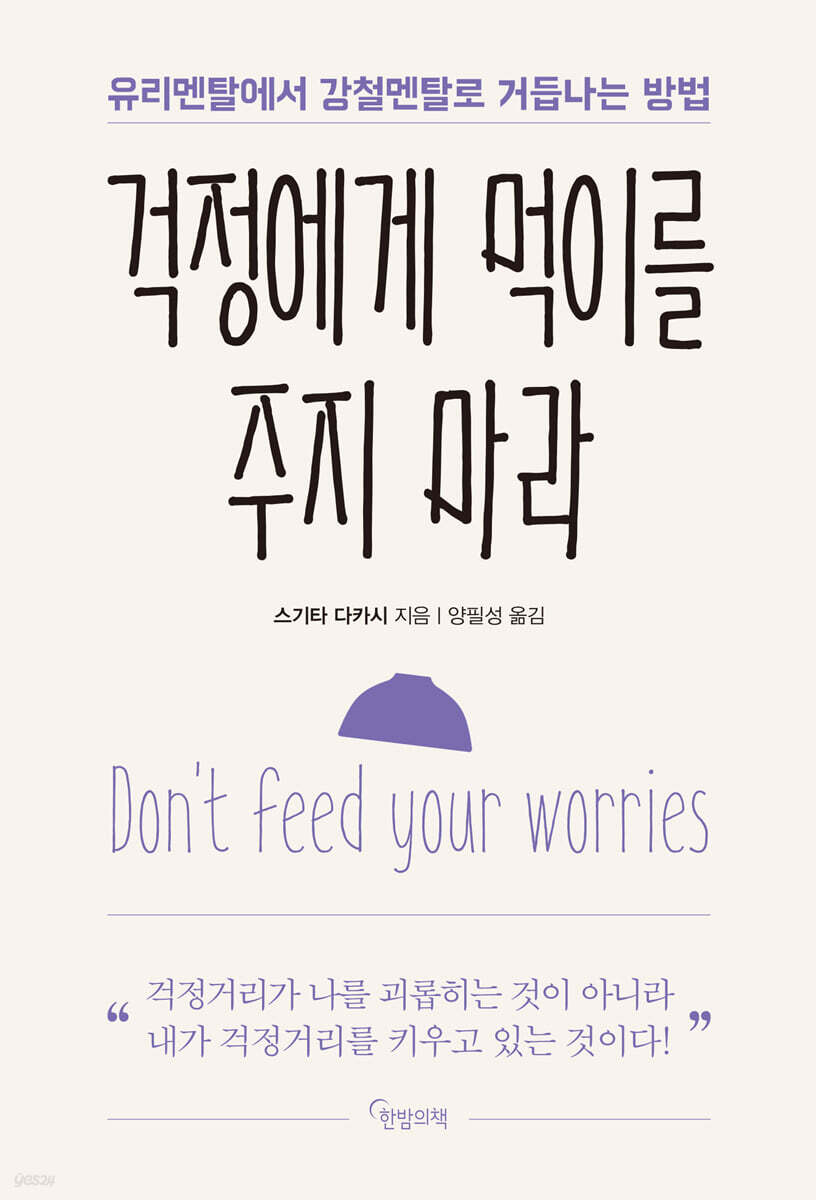
Don't feed your worries
 |
Description
Book Introduction
Don't be a slave to your worries,
Become the master of your worries!
Takashi Sugita, a famous Japanese psychological counselor who is also highly sought after overseas.
But in fact, before he became a counselor, he was a reclusive loner who lived surrounded by countless worries.
What is the secret behind his transformation from a reclusive loner to a psychologist who helps people solve their worries, after a string of failed jobs and scars in interpersonal relationships?
After receiving hundreds of hours of counseling and studying thousands of hours of counseling psychology, he discovered that the culprit of his worries was none other than “himself.”
It is natural for everyone to have worries, and they are unavoidable.
However, some people can easily escape from their worries, while others are caught up in them and cannot escape. The difference lies in whether or not they feed their worries.
Many books about worry make impossible promises, like “I’ll take your worries and concerns away in one fell swoop.”
And they only teach us methods that are not very helpful in reality, such as “always think positively” and “keep your mind at ease.”
However, the author of this book, as a “worry expert,” tells us how to understand and accept the state of mind called “worry,” how to manage and resolve that “worry,” and even how to make that “worry” the driving force of life.
Through the author's vivid, firsthand accounts, we will learn to easily and conveniently understand the true nature of worry and learn how to deal with it.
Become the master of your worries!
Takashi Sugita, a famous Japanese psychological counselor who is also highly sought after overseas.
But in fact, before he became a counselor, he was a reclusive loner who lived surrounded by countless worries.
What is the secret behind his transformation from a reclusive loner to a psychologist who helps people solve their worries, after a string of failed jobs and scars in interpersonal relationships?
After receiving hundreds of hours of counseling and studying thousands of hours of counseling psychology, he discovered that the culprit of his worries was none other than “himself.”
It is natural for everyone to have worries, and they are unavoidable.
However, some people can easily escape from their worries, while others are caught up in them and cannot escape. The difference lies in whether or not they feed their worries.
Many books about worry make impossible promises, like “I’ll take your worries and concerns away in one fell swoop.”
And they only teach us methods that are not very helpful in reality, such as “always think positively” and “keep your mind at ease.”
However, the author of this book, as a “worry expert,” tells us how to understand and accept the state of mind called “worry,” how to manage and resolve that “worry,” and even how to make that “worry” the driving force of life.
Through the author's vivid, firsthand accounts, we will learn to easily and conveniently understand the true nature of worry and learn how to deal with it.
- You can preview some of the book's contents.
Preview
index
Preface - How to Fight the Monster Called Worry
Chapter 1.
There's a formula for worrying
The Worry-Free Way You Can't Learn in School | The Formula for Worrying Properly | Positivity Without a Plan Is Poisonous
Chapter 2.
Don't feed your mind
Leave problems you can't control alone? | Most problems are trivial? | Blaming yourself doesn't change anything? | Effort isn't a panacea? | Your feelings aren't wrong.
Chapter 3.
Don't feed the conflict
People don't move based solely on the right answer | Why people leave without even realizing it | Distance yourself from the problem and you'll see the answer | If you don't express it, it won't be conveyed | Psychological techniques to make uncomfortable people feel comfortable
Chapter 4.
Don't feed anxiety
Don't let your worries become your escape | You can still be happy even if you give up | How to overcome life's "disappointments" | Find meaning in what you do now | Balance what you want to do with what you have to do | It's okay not to force decisions
Chapter 5.
Don't feed your ego
Imperfection is lovable | How to be joyfully diligent | How to work hard without profit | The foundation of confidence is something I create.
Chapter 6.
Don't feed the prejudice
We always see what we want to see | Even bad habits can be strengths | There's nothing you have to do 'naturally'
Chapter 7.
How to fill my stomach with worry
Accepting it makes me feel better | Worry is a cold in the heart | Even I, who am not good enough, need to be embraced
Conclusion - Those who worry have dreams.
Chapter 1.
There's a formula for worrying
The Worry-Free Way You Can't Learn in School | The Formula for Worrying Properly | Positivity Without a Plan Is Poisonous
Chapter 2.
Don't feed your mind
Leave problems you can't control alone? | Most problems are trivial? | Blaming yourself doesn't change anything? | Effort isn't a panacea? | Your feelings aren't wrong.
Chapter 3.
Don't feed the conflict
People don't move based solely on the right answer | Why people leave without even realizing it | Distance yourself from the problem and you'll see the answer | If you don't express it, it won't be conveyed | Psychological techniques to make uncomfortable people feel comfortable
Chapter 4.
Don't feed anxiety
Don't let your worries become your escape | You can still be happy even if you give up | How to overcome life's "disappointments" | Find meaning in what you do now | Balance what you want to do with what you have to do | It's okay not to force decisions
Chapter 5.
Don't feed your ego
Imperfection is lovable | How to be joyfully diligent | How to work hard without profit | The foundation of confidence is something I create.
Chapter 6.
Don't feed the prejudice
We always see what we want to see | Even bad habits can be strengths | There's nothing you have to do 'naturally'
Chapter 7.
How to fill my stomach with worry
Accepting it makes me feel better | Worry is a cold in the heart | Even I, who am not good enough, need to be embraced
Conclusion - Those who worry have dreams.
Detailed image

Into the book
To put it metaphorically, worry is like a gluttonous monster that follows us around like a shadow.
This monster has a very strong appetite, so it will constantly chase after anyone who feeds it.
The more food it receives, the bigger and heavier it becomes, and eventually it crushes the person who gave it food.
So, people who are good at controlling their worries don't feed this monster.
Instead of trying to force away the worry that rushes in and makes you drool, you make yourself small and hungry, leaving you powerless.
--- p.7
The reason we deal with our worries 'in our own way' is because we have never 'properly' learned how to deal with worry or anxiety.
Neither at school nor at home, I've ever learned anything concrete like, "What is worry?", "Why do we worry?", or "What should we do when we have worries?"
In this book, I'd like to step by step explain the skills for coexisting with worry, which aren't taught in school or at home.
To you who are having a hard time day by day, carrying unresolved worries.
--- p.18
Most worries can be summarized in a clear form: a clash of two conflicting desires.
If you look closely at your worries, you will see that your conscious and unconscious minds are pointing in different directions.
The human mind tends to expand in so many directions that even we ourselves may not realize it.
Of these, we are only conscious of a small part.
There may have been a war going on in your mind without you even knowing it.
Just facing the truth of your worries and understanding their true nature can bring a lot of peace to your mind.
--- p.22
The result is to guide, not control.
We can try several things to induce results.
Of course, things may not go as planned.
But that's something even the Roman emperor couldn't do anything about.
So whenever I have a problem, I ask myself:
'Is this problem something I can control? Or am I just struggling with something I can't control?'
--- p.34
So self-loathing and self-pity are a pair that always go together.
Because the mind is always trying to find balance, even when we are not aware of it.
When self-loathing arises, self-pity follows.
Because you have to affirm yourself as much as you deny yourself to achieve balance.
This kind of self-loathing is nothing more than a situation where you live as you please and forgive and comfort yourself.
--- p.43
A person's inner self is more natural when it is a complex mixture of various emotions.
Because that's just how people are.
No one reacts consistently to every situation.
Each of them has its own little contradictions.
We must not try to eliminate these contradictions.
No, trying to get rid of it will only lead to failure.
Instead, I just need to accept the contradictions within me as they are, manage them well, and resolve them in a way that I can understand.
There is nothing wrong with having bad feelings.
That kind of mind is mine, and another kind of mind is mine too.
'I' am a whole made up of various minds.
--- p.59
It's surprising how often relationships problems are resolved when you don't stir things up unnecessarily.
We've all had that experience where the more we try to solve a problem, the worse it gets instead of getting better.
It's like if you keep picking at a pimple, it will eventually fester and bleed.
In such cases, you should consider that the clue to solving the problem may lie somewhere else entirely.
You have to realize that you also have the option of giving up on solving the problem and leaving it to time.
It's not always the case that confronting every problem head-on is the right answer.
--- p.77
It may sound strange, but worrying can also bring peace of mind.
Because while you are worrying, you can feel proud that 'I am living this hard.'
There is one more reason.
The point is that while you are thinking, you will not fail.
If you don't execute, you won't succeed, but you won't fail either.
You can live each day by continuing to dream and cherishing the optimistic hope that 'someday it will come true.'
It's as if nothing happens if you don't confess to the person you like.
--- p.96
Mythologist Joseph Campbell said, “People are loved not for what they can do or what they have, but rather for what they cannot do or what they do not have.”
Think about it.
If Mickey Mouse had a perfectly proportioned 9-head-to-10-inch body, a sharp nose, and well-toned muscles, would he have become the mascot of Disneyland? And what about the intelligent and logical Tom and Jerry?
--- p.144
The point is to avoid creating situations where conflict will arise.
It's like not entering a bear zone.
No human can win a fight with a bear.
But anyone can do something about it: avoid entering places where bears are likely to appear.
The conflict in our hearts is the same.
There are not many people who are strong-willed enough to overcome conflict.
But anyone can avoid situations that could lead to conflict.
This monster has a very strong appetite, so it will constantly chase after anyone who feeds it.
The more food it receives, the bigger and heavier it becomes, and eventually it crushes the person who gave it food.
So, people who are good at controlling their worries don't feed this monster.
Instead of trying to force away the worry that rushes in and makes you drool, you make yourself small and hungry, leaving you powerless.
--- p.7
The reason we deal with our worries 'in our own way' is because we have never 'properly' learned how to deal with worry or anxiety.
Neither at school nor at home, I've ever learned anything concrete like, "What is worry?", "Why do we worry?", or "What should we do when we have worries?"
In this book, I'd like to step by step explain the skills for coexisting with worry, which aren't taught in school or at home.
To you who are having a hard time day by day, carrying unresolved worries.
--- p.18
Most worries can be summarized in a clear form: a clash of two conflicting desires.
If you look closely at your worries, you will see that your conscious and unconscious minds are pointing in different directions.
The human mind tends to expand in so many directions that even we ourselves may not realize it.
Of these, we are only conscious of a small part.
There may have been a war going on in your mind without you even knowing it.
Just facing the truth of your worries and understanding their true nature can bring a lot of peace to your mind.
--- p.22
The result is to guide, not control.
We can try several things to induce results.
Of course, things may not go as planned.
But that's something even the Roman emperor couldn't do anything about.
So whenever I have a problem, I ask myself:
'Is this problem something I can control? Or am I just struggling with something I can't control?'
--- p.34
So self-loathing and self-pity are a pair that always go together.
Because the mind is always trying to find balance, even when we are not aware of it.
When self-loathing arises, self-pity follows.
Because you have to affirm yourself as much as you deny yourself to achieve balance.
This kind of self-loathing is nothing more than a situation where you live as you please and forgive and comfort yourself.
--- p.43
A person's inner self is more natural when it is a complex mixture of various emotions.
Because that's just how people are.
No one reacts consistently to every situation.
Each of them has its own little contradictions.
We must not try to eliminate these contradictions.
No, trying to get rid of it will only lead to failure.
Instead, I just need to accept the contradictions within me as they are, manage them well, and resolve them in a way that I can understand.
There is nothing wrong with having bad feelings.
That kind of mind is mine, and another kind of mind is mine too.
'I' am a whole made up of various minds.
--- p.59
It's surprising how often relationships problems are resolved when you don't stir things up unnecessarily.
We've all had that experience where the more we try to solve a problem, the worse it gets instead of getting better.
It's like if you keep picking at a pimple, it will eventually fester and bleed.
In such cases, you should consider that the clue to solving the problem may lie somewhere else entirely.
You have to realize that you also have the option of giving up on solving the problem and leaving it to time.
It's not always the case that confronting every problem head-on is the right answer.
--- p.77
It may sound strange, but worrying can also bring peace of mind.
Because while you are worrying, you can feel proud that 'I am living this hard.'
There is one more reason.
The point is that while you are thinking, you will not fail.
If you don't execute, you won't succeed, but you won't fail either.
You can live each day by continuing to dream and cherishing the optimistic hope that 'someday it will come true.'
It's as if nothing happens if you don't confess to the person you like.
--- p.96
Mythologist Joseph Campbell said, “People are loved not for what they can do or what they have, but rather for what they cannot do or what they do not have.”
Think about it.
If Mickey Mouse had a perfectly proportioned 9-head-to-10-inch body, a sharp nose, and well-toned muscles, would he have become the mascot of Disneyland? And what about the intelligent and logical Tom and Jerry?
--- p.144
The point is to avoid creating situations where conflict will arise.
It's like not entering a bear zone.
No human can win a fight with a bear.
But anyone can do something about it: avoid entering places where bears are likely to appear.
The conflict in our hearts is the same.
There are not many people who are strong-willed enough to overcome conflict.
But anyone can avoid situations that could lead to conflict.
--- p.149
Publisher's Review
The unproven prescription of “unconditional positivity”
Throw away the empty consolation that says, “It’ll be okay no matter what!”
The author, Takashi Sugita, is the representative of the psychological counseling center [Mental Travel], which has the motto “There is no one in this world without worries,” and is a famous Japanese psychological counselor who has communicated with people from all walks of life through his blog for many years.
But would you believe that even he, who seems to be better at managing his worries than anyone else, was once a “reclusive loner” who shut himself away in his room for over a year due to repeated job failures and relationship frustrations?
The author draws on these experiences to teach readers struggling with various anxieties and worries “how to worry properly.”
What people who worry a lot need is neither the positive pressure to just cheer up, nor the irresponsible healing that says it's okay no matter what.
When you accurately identify what is causing you worry and struggle and respond appropriately, your worries become manageable and a springboard for a better future.
In this book, the author dissects the unique thinking patterns of people who worry a lot and offers tailored solutions.
Anyone can easily learn "how to worry properly" by turning the pages, nodding to the insights and humorous tone that come from real-life experiences.
Life is not about controlling, it's about guiding!
Nothing makes me more miserable than the thought of trying to control my life.
Our lives are largely out of control.
Even the ancient Roman emperor Marcus Aurelius, who was troubled by problems that did not go his way, emphasized the importance of “distinguishing between what can be done and what cannot be done.”
People who seem to live life without worries are not the ones who are more determined than others and live their lives according to plan.
These are people who, like Aurelius, clearly distinguish between what they can control and what they cannot, and focus on what they can control.
We can't make water flow from bottom to top, but we can make a small channel to direct it in a different direction.
If you have a future you want, rather than trying to turn back the flow of life's great current, create a small channel and guide it in the direction you want.
If you do so, you will be able to take a step back from worrying about the uncertain future.
Worry is not something to be eliminated, it is something to be managed!
Worry is a natural reaction, like heat or cold.
Just as blindly enduring the heat can lead to heatstroke, blindly suppressing worries can also lead to more serious mental illness.
Just as standing in the blazing sun and telling ourselves that we are not hot only makes the sweat flow harder, if we try to forcefully ignore and get rid of our worries, they will escape our control and start to run wild.
What you need from someone who worries a lot is not “patience,” but “acknowledgment.”
It is about honestly accepting your fears and anxieties as they are.
As you do this, your wavering heart begins to calm down.
And soon you realize.
That inside me, in addition to fear and anxiety, there are many other feelings such as passion, excitement, and curiosity.
When we recognize that worry is just one of many complex emotions in our minds, and when we can stop feeding them and focus on what truly matters in life, we will learn to live well with worry.
Throw away the empty consolation that says, “It’ll be okay no matter what!”
The author, Takashi Sugita, is the representative of the psychological counseling center [Mental Travel], which has the motto “There is no one in this world without worries,” and is a famous Japanese psychological counselor who has communicated with people from all walks of life through his blog for many years.
But would you believe that even he, who seems to be better at managing his worries than anyone else, was once a “reclusive loner” who shut himself away in his room for over a year due to repeated job failures and relationship frustrations?
The author draws on these experiences to teach readers struggling with various anxieties and worries “how to worry properly.”
What people who worry a lot need is neither the positive pressure to just cheer up, nor the irresponsible healing that says it's okay no matter what.
When you accurately identify what is causing you worry and struggle and respond appropriately, your worries become manageable and a springboard for a better future.
In this book, the author dissects the unique thinking patterns of people who worry a lot and offers tailored solutions.
Anyone can easily learn "how to worry properly" by turning the pages, nodding to the insights and humorous tone that come from real-life experiences.
Life is not about controlling, it's about guiding!
Nothing makes me more miserable than the thought of trying to control my life.
Our lives are largely out of control.
Even the ancient Roman emperor Marcus Aurelius, who was troubled by problems that did not go his way, emphasized the importance of “distinguishing between what can be done and what cannot be done.”
People who seem to live life without worries are not the ones who are more determined than others and live their lives according to plan.
These are people who, like Aurelius, clearly distinguish between what they can control and what they cannot, and focus on what they can control.
We can't make water flow from bottom to top, but we can make a small channel to direct it in a different direction.
If you have a future you want, rather than trying to turn back the flow of life's great current, create a small channel and guide it in the direction you want.
If you do so, you will be able to take a step back from worrying about the uncertain future.
Worry is not something to be eliminated, it is something to be managed!
Worry is a natural reaction, like heat or cold.
Just as blindly enduring the heat can lead to heatstroke, blindly suppressing worries can also lead to more serious mental illness.
Just as standing in the blazing sun and telling ourselves that we are not hot only makes the sweat flow harder, if we try to forcefully ignore and get rid of our worries, they will escape our control and start to run wild.
What you need from someone who worries a lot is not “patience,” but “acknowledgment.”
It is about honestly accepting your fears and anxieties as they are.
As you do this, your wavering heart begins to calm down.
And soon you realize.
That inside me, in addition to fear and anxiety, there are many other feelings such as passion, excitement, and curiosity.
When we recognize that worry is just one of many complex emotions in our minds, and when we can stop feeding them and focus on what truly matters in life, we will learn to live well with worry.
GOODS SPECIFICS
- Date of issue: October 30, 2023
- Page count, weight, size: 216 pages | 294g | 128*188*18mm
- ISBN13: 9791191731552
- ISBN10: 1191731553
You may also like
카테고리
korean


korean

![GQ KOREA Mark (Monthly): December [2025]](http://librairie.coreenne.fr/cdn/shop/files/8ef265dbbfbf186523ed75ba7319009d.jpg?v=1765340328&width=3840)


