

Studying the mind starting at fifty
 |
Description
Book Introduction
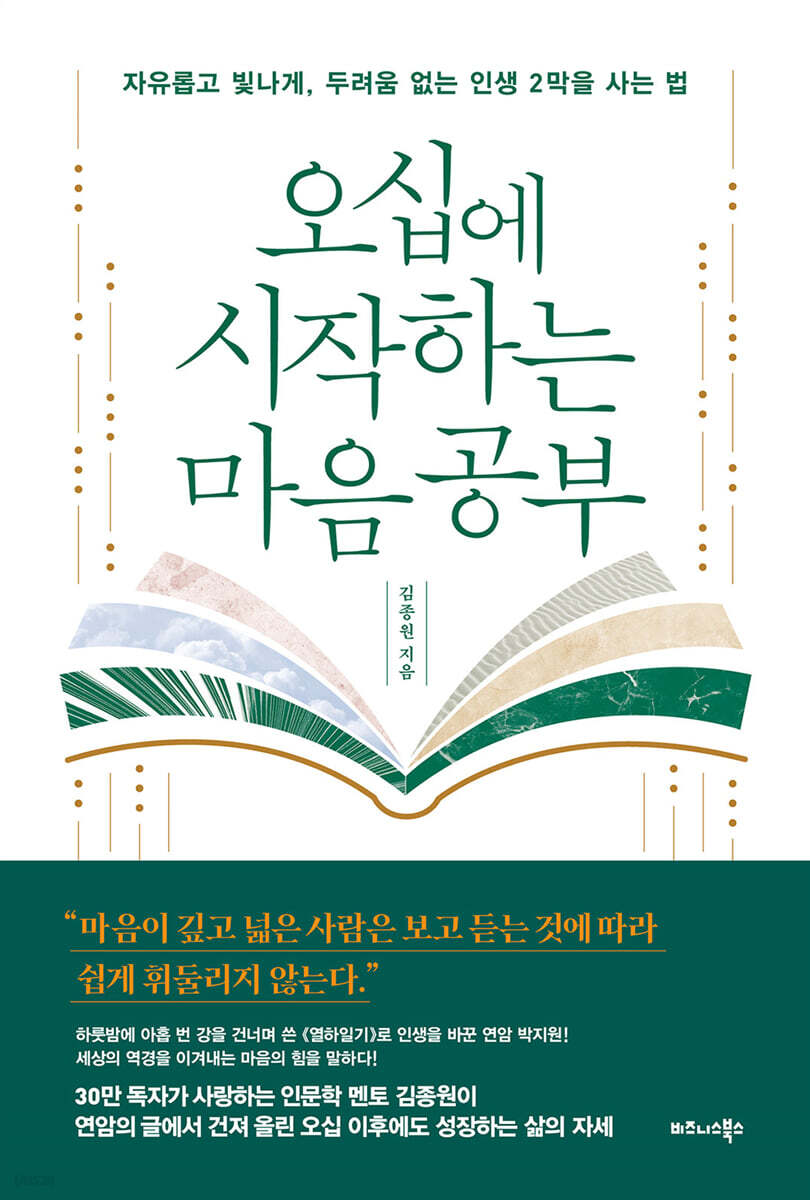
Fifty is the time to build up your mental strength!
Let age be a springboard for life, not an obstacle.
How to live your most brilliant 50s by letting go of regret, anxiety, and fear!
Actor Lee Sung-min, who has recently been receiving attention for his excellent acting, Google director Jeong-Kim Kyung-sook, McDonald's founder Ray Crook, Stan Lee, the father of Marvel Comics, and Vera Wang, who started out as a figure skater and became a world-renowned designer...
These people, despite their different nationalities and fields, have one thing in common.
It means that he reached the prime of his life around the age of fifty.
What they achieved was not a success calculated simply in wealth and fame.
There are differences between those who steadily walked one path and blossomed late in life or those who changed careers after turning forty, but they are said to be in their prime and successful because they took on the challenge of what they wanted and achieved their goals.
You don't think that's my story anyway? It's not realistically feasible to challenge something again, and I don't have the stamina I had in my 20s or 30s.
But don't be discouraged or give up before you turn fifty.
In operas and plays, the climax always appears after the second act.
Like an intermission, the age of fifty is the best time to reorganize myself for a more wonderful second act of life.
What should I do from now on to live the way I want without any more regrets?
This book discusses the 'strength of the mind' as the secret to living well after fifty, and finds hints from Yeonam Park Ji-won, a Silhak scholar of the late Joseon Dynasty.
Author Kim Jong-won focused on Yeonam's attitude toward life, which saw age as a springboard rather than an obstacle, accumulating new knowledge and experiences throughout his life with his uniquely dense humanistic perspective.
The side of Yeonam that he discovered was not the 'free-spirited intellectual' or 'Joseon's representative unemployed person' that we have seen so far.
Rather, he is closer to a 'hardworking genius' who does not rely solely on talent but pursues lifelong learning.
In short, his life was one that could not have been achieved without constant study of the mind.
If you're attributing the anxiety, regret, and fear you feel now to your age, think of Yeonam, who crossed the river nine times and successfully completed his life's bucket list even though he was well over forty.
The meaning of the five powers of the mind that he left behind in writing and how to obtain them will still be heard in Yeonam's vivid voice.
Let age be a springboard for life, not an obstacle.
How to live your most brilliant 50s by letting go of regret, anxiety, and fear!
Actor Lee Sung-min, who has recently been receiving attention for his excellent acting, Google director Jeong-Kim Kyung-sook, McDonald's founder Ray Crook, Stan Lee, the father of Marvel Comics, and Vera Wang, who started out as a figure skater and became a world-renowned designer...
These people, despite their different nationalities and fields, have one thing in common.
It means that he reached the prime of his life around the age of fifty.
What they achieved was not a success calculated simply in wealth and fame.
There are differences between those who steadily walked one path and blossomed late in life or those who changed careers after turning forty, but they are said to be in their prime and successful because they took on the challenge of what they wanted and achieved their goals.
You don't think that's my story anyway? It's not realistically feasible to challenge something again, and I don't have the stamina I had in my 20s or 30s.
But don't be discouraged or give up before you turn fifty.
In operas and plays, the climax always appears after the second act.
Like an intermission, the age of fifty is the best time to reorganize myself for a more wonderful second act of life.
What should I do from now on to live the way I want without any more regrets?
This book discusses the 'strength of the mind' as the secret to living well after fifty, and finds hints from Yeonam Park Ji-won, a Silhak scholar of the late Joseon Dynasty.
Author Kim Jong-won focused on Yeonam's attitude toward life, which saw age as a springboard rather than an obstacle, accumulating new knowledge and experiences throughout his life with his uniquely dense humanistic perspective.
The side of Yeonam that he discovered was not the 'free-spirited intellectual' or 'Joseon's representative unemployed person' that we have seen so far.
Rather, he is closer to a 'hardworking genius' who does not rely solely on talent but pursues lifelong learning.
In short, his life was one that could not have been achieved without constant study of the mind.
If you're attributing the anxiety, regret, and fear you feel now to your age, think of Yeonam, who crossed the river nine times and successfully completed his life's bucket list even though he was well over forty.
The meaning of the five powers of the mind that he left behind in writing and how to obtain them will still be heard in Yeonam's vivid voice.
- You can preview some of the book's contents.
Preview
index
To begin with, to live in the most free and shining fifties.
Chapter 1: "Consistent Learning," the Foundation of Intellect
Every time I write, the center of my life becomes stronger.
The Secret to Growing Up After Fifty
Thousands of inspirations exist in one line.
A Four-Step Questioning Method to Expand Your Intellectual Capital
Ask and ask again, renewing yourself every day.
Yeonam's method of questioning to create a philosophy that will sustain life
Get out of the derivative and get to the main body.
The value of life that stands on the border of intellect
A yearning for learning
Become a thinker who sows seeds
A life path that requires a 'question and exclamation point'
Chapter 2: "Bright Perspective," the Standard for Practicality
Things I can do because I am 'me'
Each pursues something different
The power of vision to create something that never existed before from a single, small clue
Have the courage to stop in the middle of life.
Life is at its richest when you let it flow.
The things I endure lead to beautiful changes in life.
Things we lose by only pursuing our own interests
Principles can be measured, but desires cannot be guessed.
I am far and you are close
When you see the road, you don't rush.
Chapter 3: The Art of Speech: Breaking the Boundaries of Impossibility
Have a sentence that represents you
What makes words that penetrate deep into the heart different?
About the words 'I understand you'
Do you have a language that suits your ideals?
How you approach books is how you approach your daily life.
Subtle language builds the muscles of the heart.
Ten Words That Help Me Discover My Potential
What makes language that respects the thoughts of others different?
The stronger your inner self, the stronger your life becomes.
If our lives are to become a classic,
Chapter 4: Intellectual Judgment: Helping You Make Clear and Clear Choices
What will you do to live?
'Knowledge for survival' becomes 'the power to live'
The true meaning of 'not compromising with the world'
Break free from your old self every day
The power of variation: finding a thousand inspirations in one thing
Intelligence begins with a life of shame.
The power to protect me from all kinds of criticism
Decide your own worth
Good judgment comes from three minds.
If you are a flower, you will eventually bloom.
Chapter 5: The Power of the Mind Beyond Me: A Strong Inner Self
How to overcome the biggest mountain of all: yourself
Wait until the scenery opens its mouth to speak.
Look at the world with a positive outlook on all possibilities.
Charisma that dominates life is a gift life grants.
When you calm your wavering mind, the turbulent waves calm down.
Six Ways to Heal Your Wounded Soul
Take out what is rotten and sunken inside you.
Evolve into a relationship that inspires each other
The 'quality of your writing' determines the 'quality of your life'
In conclusion, from now on, choose your own happiness.
References
Chapter 1: "Consistent Learning," the Foundation of Intellect
Every time I write, the center of my life becomes stronger.
The Secret to Growing Up After Fifty
Thousands of inspirations exist in one line.
A Four-Step Questioning Method to Expand Your Intellectual Capital
Ask and ask again, renewing yourself every day.
Yeonam's method of questioning to create a philosophy that will sustain life
Get out of the derivative and get to the main body.
The value of life that stands on the border of intellect
A yearning for learning
Become a thinker who sows seeds
A life path that requires a 'question and exclamation point'
Chapter 2: "Bright Perspective," the Standard for Practicality
Things I can do because I am 'me'
Each pursues something different
The power of vision to create something that never existed before from a single, small clue
Have the courage to stop in the middle of life.
Life is at its richest when you let it flow.
The things I endure lead to beautiful changes in life.
Things we lose by only pursuing our own interests
Principles can be measured, but desires cannot be guessed.
I am far and you are close
When you see the road, you don't rush.
Chapter 3: The Art of Speech: Breaking the Boundaries of Impossibility
Have a sentence that represents you
What makes words that penetrate deep into the heart different?
About the words 'I understand you'
Do you have a language that suits your ideals?
How you approach books is how you approach your daily life.
Subtle language builds the muscles of the heart.
Ten Words That Help Me Discover My Potential
What makes language that respects the thoughts of others different?
The stronger your inner self, the stronger your life becomes.
If our lives are to become a classic,
Chapter 4: Intellectual Judgment: Helping You Make Clear and Clear Choices
What will you do to live?
'Knowledge for survival' becomes 'the power to live'
The true meaning of 'not compromising with the world'
Break free from your old self every day
The power of variation: finding a thousand inspirations in one thing
Intelligence begins with a life of shame.
The power to protect me from all kinds of criticism
Decide your own worth
Good judgment comes from three minds.
If you are a flower, you will eventually bloom.
Chapter 5: The Power of the Mind Beyond Me: A Strong Inner Self
How to overcome the biggest mountain of all: yourself
Wait until the scenery opens its mouth to speak.
Look at the world with a positive outlook on all possibilities.
Charisma that dominates life is a gift life grants.
When you calm your wavering mind, the turbulent waves calm down.
Six Ways to Heal Your Wounded Soul
Take out what is rotten and sunken inside you.
Evolve into a relationship that inspires each other
The 'quality of your writing' determines the 'quality of your life'
In conclusion, from now on, choose your own happiness.
References
Detailed image
Into the book
Yeonam's life before and after his fifties was starkly different.
In his youth, Yeonam lived his life as if it were a piece of change he could afford to lose.
I spent my 20s focusing on writing rather than studying, and in my 30s, I even gave up on the past due to depression.
While other scholars pursued money and fame, he devoted himself solely to the study of Silhak (practical learning).
Then, in the mid-40s, a major turning point occurs.
He published the travelogue “Yeolha Diary” (熱河日記) written while traveling to Qing China as a member of the diplomatic mission of his cousin Park Myeong-won (朴明源).
Afterwards, when Yeonam reached his fifties, he was recognized as ‘Joseon’s greatest writer.’
He truly revolutionized himself.
(Omitted) Every time he stood at a crossroads in life, he stuck to his own way.
Yeonam at thirty, Yeonam at forty, and Yeonam after fifty all had the light and value appropriate to their age, and thus were able to be freer than anyone else.
---From "Starting Out: Living the Freest and Brightest Fifties"
The reason Gong Myeong-seon did not read a book for three years was because he had not yet put into practice what he had seen and learned from his teacher's life.
I thought that I could not move on to the next step, reading, when I had not yet fully digested the book called “The Master.”
Now that I hear it, it's true.
There are many people in the world who want to get what they want in a hurry.
People like that often came to Yeonam to ask for help.
Every time that happened, Yeonam would calm their impatient minds and ask, “How are you studying now?”
They were all different, but the answers they gave all came down to one thing.
“I read more than others, and if I can’t understand quickly, I try to memorize it somehow.” At first glance, it seems like I’m studying very well.
However, Yeonam, who had a completely different opinion, advised, “It would be good to change your study method from now on,” and explained his reason as follows.
“Reading a lot and memorizing things blindly is not the best method.
Even if you know one thing, it is important to savor it and think about it carefully.”
The strength that allowed Yeonam to remain steadfast and maintain his original resolve in the latter half of his life was his philosophy that “It is important to live a daily life learning everything properly and making it your own.”
---From "Chapter 1: 'Constant Learning', the Foundation of Intellect"
If a human being wants to have dignity, he must overcome his own selfish desires.
Through such a process, you can have a true heart that is not shaken.
A person who fears others is weak.
The stronger a person is, the more he fears himself and does not lose the opportunity to win in that fierce battle.
Because it is always I who deceive myself.
We must develop the discernment to protect ourselves from falling into a life of chasing money because we cannot control our desires.
Yeonam recommends a clear method for developing discernment.
“Let each pursue his own distinct pursuits.” His call for each to pursue his own distinct pursuits came from this thought.
The idea is that if everyone pursues their own thing, each person will have a framework, so it won't be easily shaken or collapsed.
This could be seen as his life itself.
---From "Chapter 2: 'Bright Vision' as a Criteria for Practicality"
Life is a staircase again.
Let go of your impatience, sit calmly, and face the bad news that has come to you.
People with a sense of urgency believe that if they do one good deed today, a good fate awaits them tomorrow.
Also, if you say something that makes the other person feel good when they hear it, you think that he will give you something in return.
However, Yeonam warns against such a life, saying, “If you act like that every time hoping for something, heaven will get tired and will not help you no matter what you do in the future.”
And he emphasizes that “one must have a language that fits one’s ideals,” and explains the reason as follows:
“It is not good to just become successful early.
“Because if you start out in this chaotic world without having the language to protect yourself, you will end up not being able to fulfill your duty.” People who start to have things go smoothly as they turn 50 have one thing in common.
The fact that he has a wonderful language that fits his ideals.
Actually, when I think of an expression, there is a person who comes to mind automatically.
Language soon determines a person's life.
Let's not forget that fact.
---From "Chapter 3: The 'Inner Strength of Words' that Breaks the Boundary of Impossibility"
However, if you truly choose what you want to do, it may seem unstable to those around you at first, but as time goes by, your life will become more and more solid.
At this point, let's ask ourselves three questions again.
“What should I do with my life?” “What will make my life not regrettable?” “What is the reason for my living?” (Omitted) When I ask people these kinds of questions and help them figure out what they really want to do, these are the things that come out of their mouths in the end.
“That job doesn’t pay.” “That job has no future.” Most people would think similarly.
Actually, a lot of people ask this question.
This is where you need to be more honest with yourself.
Yeonam's life still asks us burning questions today.
"Were you born to make money? Or to do whatever you can, day in and day out? Or to do something that makes your heart race just thinking about it?"
---From Chapter 4: 'Intellectual Judgment' that Helps Make Clear and Clear Choices
Imagine the hot sun of a day, the winding river, the slippery moss-covered bottom, and Yeonam's heart as he had to cross the river on horseback all by himself.
You will find yourself thinking, 'What kind of suffering am I going through right now!'
What would you think if you were in that situation?
When the future looks bleak, giving up might be the wiser choice.
Yeonam's thoughts were not much different.
'One wrong move and I'll be thrown straight into the river.' As I thought that, the sound of the water grew louder.
Having thoroughly analyzed his situation, he realized that he could never cross the river with a weak mind, and felt the need to change his mind and reframe the landscape before him.
First, Yeonam blocked out all the noise from outside and listened only to the sounds coming from within.
'You can cross.
'This is not a river, but a vast, beautiful meadow.' Then, all the scenery before my eyes began to change itself.
The cold river waters turned into solid ground, the fiercely flowing waves into comfortable clothes, the disobedient horse into a tool as easy to handle as one's own body. One by one, everything changed into the most comfortable and safe form.
Now, Yeonam's mind was filled with only these kinds of thoughts.
'The anxious mind is not mine.
"What if I fall into the water?" The sound of the river that had been bothering him finally disappeared, and he fell into the pleasant illusion of hearing soothing music. Even though he crossed the rough river nine times, he felt as if he were sitting on a comfortable chair or lying in his bedroom, and was able to cross the river safely.
After all the movements were over, he finally shouted out loud:
“Only today have I realized what the ‘Tao’ is!”
---From "Chapter 5: The Power of the Mind Beyond Me, 'A Strong Inner Self'"
From the age of fifty, it is wise to spend each day thinking that you are living for yourself, not for the world.
And, like Yeonam felt in the old days, let us not feel miserable or give up because the world does not choose us.
The fact that the world didn't choose you means you have a wonderful opportunity to choose yourself.
If you are not chosen by the world, choose yourself.
We can always put our resentful minds to rest by shifting our thoughts away from the emotion of anger.
(Omitted) We all make money by selling time, which cannot be bought with money.
We must be able to see exactly what is lost and what remains in this shackle.
That way, you can minimize the amount of regret and pain you have in your life after fifty.
(Omitted) It is important to repeatedly choose what is best for you.
If the choices you've made for someone else's happiness, or the times you've struggled to be chosen by someone, haven't brought you happiness, change your thinking and live your life choosing only your own happiness.
In his youth, Yeonam lived his life as if it were a piece of change he could afford to lose.
I spent my 20s focusing on writing rather than studying, and in my 30s, I even gave up on the past due to depression.
While other scholars pursued money and fame, he devoted himself solely to the study of Silhak (practical learning).
Then, in the mid-40s, a major turning point occurs.
He published the travelogue “Yeolha Diary” (熱河日記) written while traveling to Qing China as a member of the diplomatic mission of his cousin Park Myeong-won (朴明源).
Afterwards, when Yeonam reached his fifties, he was recognized as ‘Joseon’s greatest writer.’
He truly revolutionized himself.
(Omitted) Every time he stood at a crossroads in life, he stuck to his own way.
Yeonam at thirty, Yeonam at forty, and Yeonam after fifty all had the light and value appropriate to their age, and thus were able to be freer than anyone else.
---From "Starting Out: Living the Freest and Brightest Fifties"
The reason Gong Myeong-seon did not read a book for three years was because he had not yet put into practice what he had seen and learned from his teacher's life.
I thought that I could not move on to the next step, reading, when I had not yet fully digested the book called “The Master.”
Now that I hear it, it's true.
There are many people in the world who want to get what they want in a hurry.
People like that often came to Yeonam to ask for help.
Every time that happened, Yeonam would calm their impatient minds and ask, “How are you studying now?”
They were all different, but the answers they gave all came down to one thing.
“I read more than others, and if I can’t understand quickly, I try to memorize it somehow.” At first glance, it seems like I’m studying very well.
However, Yeonam, who had a completely different opinion, advised, “It would be good to change your study method from now on,” and explained his reason as follows.
“Reading a lot and memorizing things blindly is not the best method.
Even if you know one thing, it is important to savor it and think about it carefully.”
The strength that allowed Yeonam to remain steadfast and maintain his original resolve in the latter half of his life was his philosophy that “It is important to live a daily life learning everything properly and making it your own.”
---From "Chapter 1: 'Constant Learning', the Foundation of Intellect"
If a human being wants to have dignity, he must overcome his own selfish desires.
Through such a process, you can have a true heart that is not shaken.
A person who fears others is weak.
The stronger a person is, the more he fears himself and does not lose the opportunity to win in that fierce battle.
Because it is always I who deceive myself.
We must develop the discernment to protect ourselves from falling into a life of chasing money because we cannot control our desires.
Yeonam recommends a clear method for developing discernment.
“Let each pursue his own distinct pursuits.” His call for each to pursue his own distinct pursuits came from this thought.
The idea is that if everyone pursues their own thing, each person will have a framework, so it won't be easily shaken or collapsed.
This could be seen as his life itself.
---From "Chapter 2: 'Bright Vision' as a Criteria for Practicality"
Life is a staircase again.
Let go of your impatience, sit calmly, and face the bad news that has come to you.
People with a sense of urgency believe that if they do one good deed today, a good fate awaits them tomorrow.
Also, if you say something that makes the other person feel good when they hear it, you think that he will give you something in return.
However, Yeonam warns against such a life, saying, “If you act like that every time hoping for something, heaven will get tired and will not help you no matter what you do in the future.”
And he emphasizes that “one must have a language that fits one’s ideals,” and explains the reason as follows:
“It is not good to just become successful early.
“Because if you start out in this chaotic world without having the language to protect yourself, you will end up not being able to fulfill your duty.” People who start to have things go smoothly as they turn 50 have one thing in common.
The fact that he has a wonderful language that fits his ideals.
Actually, when I think of an expression, there is a person who comes to mind automatically.
Language soon determines a person's life.
Let's not forget that fact.
---From "Chapter 3: The 'Inner Strength of Words' that Breaks the Boundary of Impossibility"
However, if you truly choose what you want to do, it may seem unstable to those around you at first, but as time goes by, your life will become more and more solid.
At this point, let's ask ourselves three questions again.
“What should I do with my life?” “What will make my life not regrettable?” “What is the reason for my living?” (Omitted) When I ask people these kinds of questions and help them figure out what they really want to do, these are the things that come out of their mouths in the end.
“That job doesn’t pay.” “That job has no future.” Most people would think similarly.
Actually, a lot of people ask this question.
This is where you need to be more honest with yourself.
Yeonam's life still asks us burning questions today.
"Were you born to make money? Or to do whatever you can, day in and day out? Or to do something that makes your heart race just thinking about it?"
---From Chapter 4: 'Intellectual Judgment' that Helps Make Clear and Clear Choices
Imagine the hot sun of a day, the winding river, the slippery moss-covered bottom, and Yeonam's heart as he had to cross the river on horseback all by himself.
You will find yourself thinking, 'What kind of suffering am I going through right now!'
What would you think if you were in that situation?
When the future looks bleak, giving up might be the wiser choice.
Yeonam's thoughts were not much different.
'One wrong move and I'll be thrown straight into the river.' As I thought that, the sound of the water grew louder.
Having thoroughly analyzed his situation, he realized that he could never cross the river with a weak mind, and felt the need to change his mind and reframe the landscape before him.
First, Yeonam blocked out all the noise from outside and listened only to the sounds coming from within.
'You can cross.
'This is not a river, but a vast, beautiful meadow.' Then, all the scenery before my eyes began to change itself.
The cold river waters turned into solid ground, the fiercely flowing waves into comfortable clothes, the disobedient horse into a tool as easy to handle as one's own body. One by one, everything changed into the most comfortable and safe form.
Now, Yeonam's mind was filled with only these kinds of thoughts.
'The anxious mind is not mine.
"What if I fall into the water?" The sound of the river that had been bothering him finally disappeared, and he fell into the pleasant illusion of hearing soothing music. Even though he crossed the rough river nine times, he felt as if he were sitting on a comfortable chair or lying in his bedroom, and was able to cross the river safely.
After all the movements were over, he finally shouted out loud:
“Only today have I realized what the ‘Tao’ is!”
---From "Chapter 5: The Power of the Mind Beyond Me, 'A Strong Inner Self'"
From the age of fifty, it is wise to spend each day thinking that you are living for yourself, not for the world.
And, like Yeonam felt in the old days, let us not feel miserable or give up because the world does not choose us.
The fact that the world didn't choose you means you have a wonderful opportunity to choose yourself.
If you are not chosen by the world, choose yourself.
We can always put our resentful minds to rest by shifting our thoughts away from the emotion of anger.
(Omitted) We all make money by selling time, which cannot be bought with money.
We must be able to see exactly what is lost and what remains in this shackle.
That way, you can minimize the amount of regret and pain you have in your life after fifty.
(Omitted) It is important to repeatedly choose what is best for you.
If the choices you've made for someone else's happiness, or the times you've struggled to be chosen by someone, haven't brought you happiness, change your thinking and live your life choosing only your own happiness.
---From “In conclusion: From now on, choose your own happiness”
Publisher's Review
“Starting at fifty, change the questions you ask me!”
A humanities mentor loved by 300,000 readers, author Jongwon Kim delivers
How to Live Free from Regret and Anxiety in Your Fifties
“The eyes of people who know their life goals and do what they can do because they are themselves
“It shines deeper and brighter than others.” (Page 95)
Everyone over 40 probably has a vision of life after 50.
Some people dream of a life of abundance, with more wealth and success, while others dream of a life of health and leisure, with exercise and travel.
However, when faced with the reality that the age of 'fifty' awakens, I become increasingly anxious and impatient.
Comparing myself to people who achieved early retirement through 'FIRE', I regret not having studied financial management harder, and even though I hear encouragement that 50 is still young in a 100-year lifespan and that I should do what I wanted now, I am afraid that I might not be able to try again.
The author, who communicates with 300,000 readers, points out that the biggest enemy for those approaching fifty is 'impatience', and says that it is an emotion that must be discarded from life.
An impatient mind is like a glass window, clearly visible to everyone, and because it shows on the outside, it makes you treat people clumsily and ultimately does not help you in what you do.
And another thing, when you're wondering whether to do what's possible now or what you want to do now, I recommend changing the question you ask yourself.
Rather than asking, “I’m not young, can I do this?”, it’s better to first answer, “Will this be something I won’t regret for the rest of my life?” and “Do I really want this?”
No matter what you choose, the outcome is always yours, but if you choose what you truly want to do, you won't regret it after you turn fifty and say, "Oh, I should have done what I wanted to do then."
Fifty is by no means a young age.
So, we must strive to have fewer regrets and greater satisfaction in our future lives.
That may be a duty of the age of fifty.
If you want to make clearer choices, keep asking yourself more questions.
Without being swept away by the noise of the world
Where does the strength to protect me come from?
Five Intellectual Capitals for a Strong Life: Discovered in the Writings of Yeonam Park Ji-won
“I can’t do anything about the wind that blows in the world,
“The wind blowing inside me can be calmed by changing my thoughts.” (Page 316)
The author focused on Yeonam's unique, dense, humanistic perspective, his lifelong approach to accumulating new knowledge and experiences, and his use of age as a springboard rather than an obstacle.
The side of Yeonam that he discovered is quite different from the 'free-spirited intellectual' or 'Joseon's representative unemployed person' that we have seen so far.
In his 20s, he suffered from depression and started studying late; in his 30s, he gave up on the civil service examination but did not give up on writing; in his 40s, he risked his life and crossed the Jehol River with the determination to see a wider world while other scholars pursued money and fame; and finally, until he ended his old age as Joseon's greatest writer and a Silhak scholar with a realistic economic sense, devoting himself to the people, he was a man who never neglected the study of his heart.
Yeonam's long study of the mind is condensed into 'mindfulness', or in other words, 'a mind that is not swayed by what is seen or heard.'
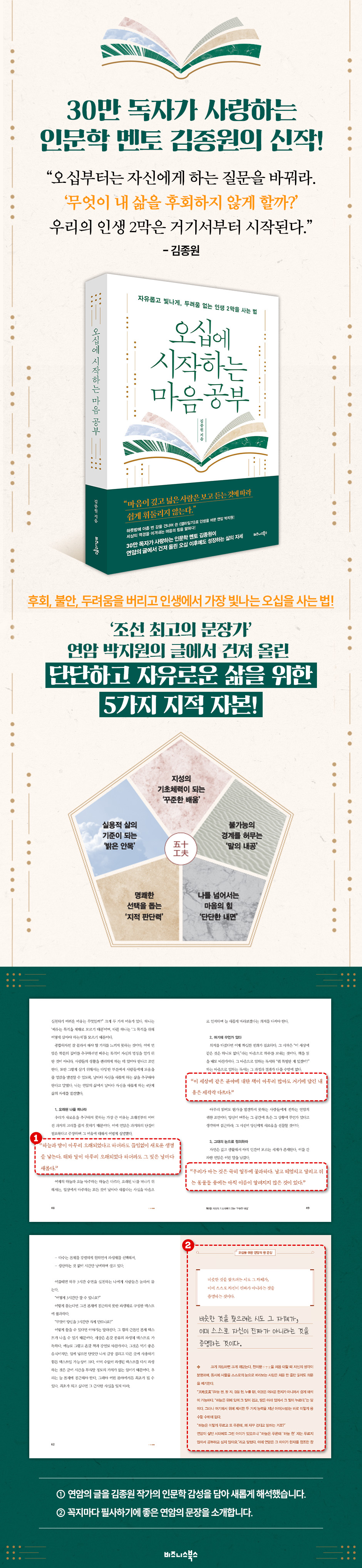
And the author discovers and conveys five intellectual capitals that lead to this ‘mindfulness’ in the writings of Yeonam, such as ‘Yeonamjip’ and ‘Yeolha Diary’.
These are ‘constant learning’, ‘bright vision’, ‘skill in speaking’, ‘intellectual judgment’, and ‘strong inner self’.
If you consistently 'learn' knowledge that will help you live wisely in the world, whether for professional expertise or as a hobby, you will develop the 'eye' to properly discern the knowledge you have learned.
Then, you will build up the 'inner strength of speech' that will help you break down the walls of impossibility in various places in your daily life, and you will naturally acquire the 'clear judgment' that will not make mistakes no matter where you go.
He continues to give advice step by step, saying that when that time accumulates, you will finally be reborn as a person with a 'strong inner self'.
The famous quotes from Yeonam for those in their fifties, reinterpreted and introduced by the author, are the best way to complete these five steps.
You can either write it down or read it out loud.
Don't be discouraged if life doesn't go the way you hoped or if your efforts don't match yours.
As a famous saying goes these days, 'what matters is an unwavering heart.'
From the age of fifty, let's not give up on the belief that we can do anything and be happy for ourselves.
If you were a flower, you would bloom at any time.
A humanities mentor loved by 300,000 readers, author Jongwon Kim delivers
How to Live Free from Regret and Anxiety in Your Fifties
“The eyes of people who know their life goals and do what they can do because they are themselves
“It shines deeper and brighter than others.” (Page 95)
Everyone over 40 probably has a vision of life after 50.
Some people dream of a life of abundance, with more wealth and success, while others dream of a life of health and leisure, with exercise and travel.
However, when faced with the reality that the age of 'fifty' awakens, I become increasingly anxious and impatient.
Comparing myself to people who achieved early retirement through 'FIRE', I regret not having studied financial management harder, and even though I hear encouragement that 50 is still young in a 100-year lifespan and that I should do what I wanted now, I am afraid that I might not be able to try again.
The author, who communicates with 300,000 readers, points out that the biggest enemy for those approaching fifty is 'impatience', and says that it is an emotion that must be discarded from life.
An impatient mind is like a glass window, clearly visible to everyone, and because it shows on the outside, it makes you treat people clumsily and ultimately does not help you in what you do.
And another thing, when you're wondering whether to do what's possible now or what you want to do now, I recommend changing the question you ask yourself.
Rather than asking, “I’m not young, can I do this?”, it’s better to first answer, “Will this be something I won’t regret for the rest of my life?” and “Do I really want this?”
No matter what you choose, the outcome is always yours, but if you choose what you truly want to do, you won't regret it after you turn fifty and say, "Oh, I should have done what I wanted to do then."
Fifty is by no means a young age.
So, we must strive to have fewer regrets and greater satisfaction in our future lives.
That may be a duty of the age of fifty.
If you want to make clearer choices, keep asking yourself more questions.
Without being swept away by the noise of the world
Where does the strength to protect me come from?
Five Intellectual Capitals for a Strong Life: Discovered in the Writings of Yeonam Park Ji-won
“I can’t do anything about the wind that blows in the world,
“The wind blowing inside me can be calmed by changing my thoughts.” (Page 316)
The author focused on Yeonam's unique, dense, humanistic perspective, his lifelong approach to accumulating new knowledge and experiences, and his use of age as a springboard rather than an obstacle.
The side of Yeonam that he discovered is quite different from the 'free-spirited intellectual' or 'Joseon's representative unemployed person' that we have seen so far.
In his 20s, he suffered from depression and started studying late; in his 30s, he gave up on the civil service examination but did not give up on writing; in his 40s, he risked his life and crossed the Jehol River with the determination to see a wider world while other scholars pursued money and fame; and finally, until he ended his old age as Joseon's greatest writer and a Silhak scholar with a realistic economic sense, devoting himself to the people, he was a man who never neglected the study of his heart.
Yeonam's long study of the mind is condensed into 'mindfulness', or in other words, 'a mind that is not swayed by what is seen or heard.'
And the author discovers and conveys five intellectual capitals that lead to this ‘mindfulness’ in the writings of Yeonam, such as ‘Yeonamjip’ and ‘Yeolha Diary’.
These are ‘constant learning’, ‘bright vision’, ‘skill in speaking’, ‘intellectual judgment’, and ‘strong inner self’.
If you consistently 'learn' knowledge that will help you live wisely in the world, whether for professional expertise or as a hobby, you will develop the 'eye' to properly discern the knowledge you have learned.
Then, you will build up the 'inner strength of speech' that will help you break down the walls of impossibility in various places in your daily life, and you will naturally acquire the 'clear judgment' that will not make mistakes no matter where you go.
He continues to give advice step by step, saying that when that time accumulates, you will finally be reborn as a person with a 'strong inner self'.
The famous quotes from Yeonam for those in their fifties, reinterpreted and introduced by the author, are the best way to complete these five steps.
You can either write it down or read it out loud.
Don't be discouraged if life doesn't go the way you hoped or if your efforts don't match yours.
As a famous saying goes these days, 'what matters is an unwavering heart.'
From the age of fifty, let's not give up on the belief that we can do anything and be happy for ourselves.
If you were a flower, you would bloom at any time.
GOODS SPECIFICS
- Date of issue: February 24, 2023
- Page count, weight, size: 320 pages | 552g | 152*225*18mm
- ISBN13: 9791162543306
- ISBN10: 1162543302
You may also like
카테고리
korean


korean

![GQ KOREA Mark (Monthly): December [2025]](http://librairie.coreenne.fr/cdn/shop/files/8ef265dbbfbf186523ed75ba7319009d.jpg?v=1765340328&width=3840)


