

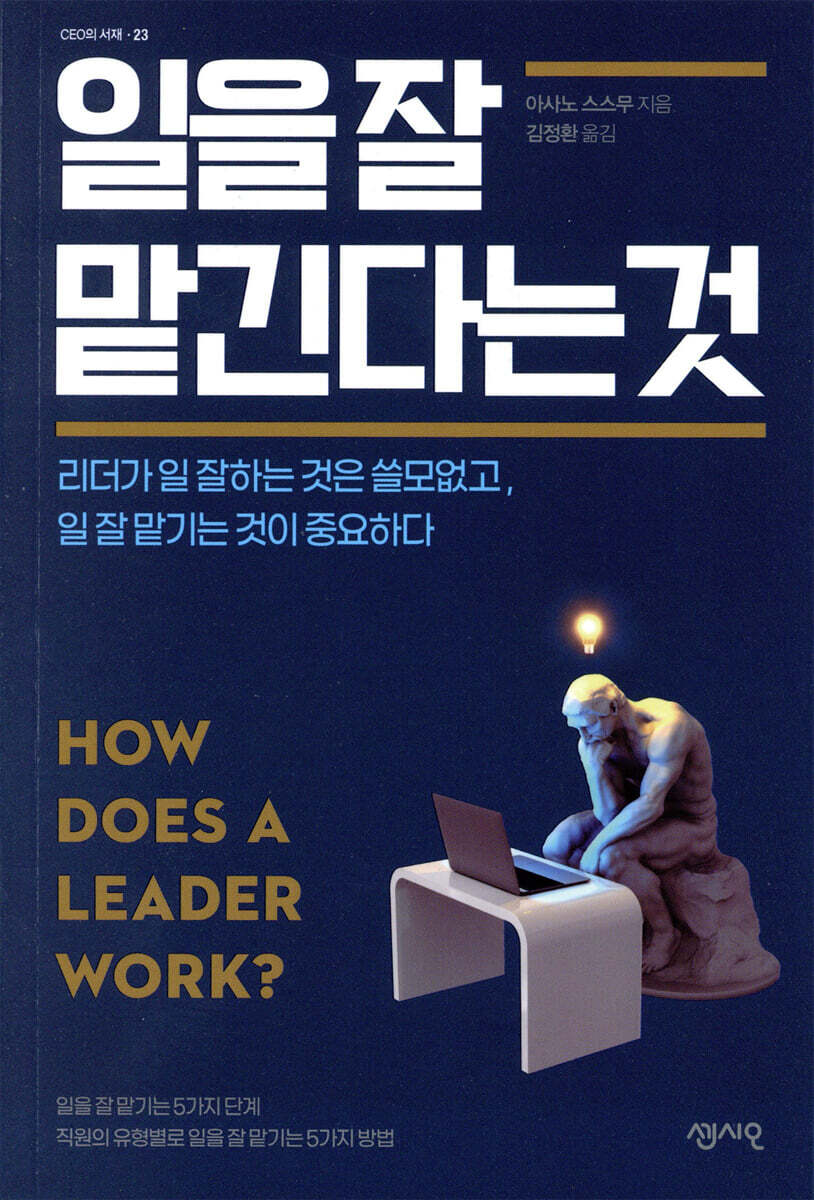
Delegating work well
 |
Description
Book Introduction
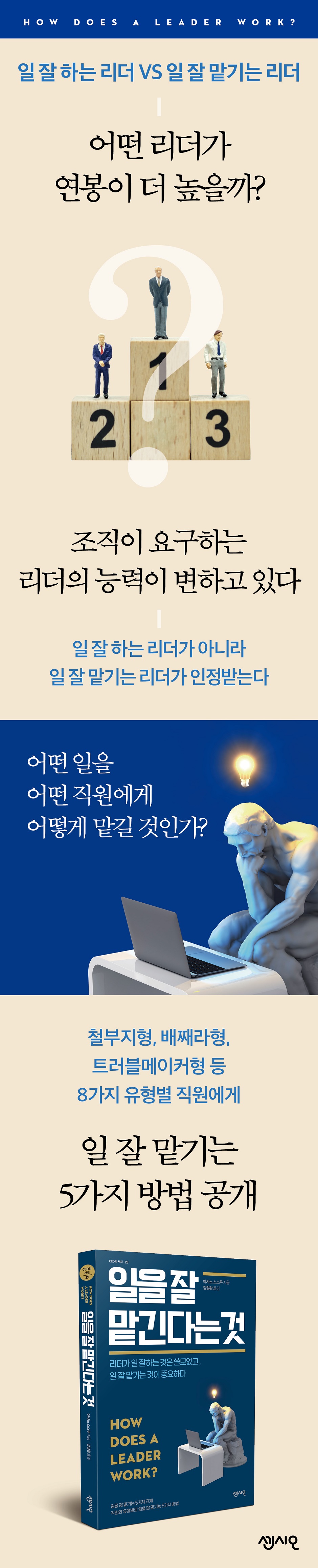
A leader who is good at work VS a leader who is good at delegating Who has a higher salary? There are leaders who are good at their jobs and there are leaders who are good at delegating. What kind of leader are you? The new book, "Delegating Well," argues that being good at delegating is useless for leaders, and that delegating well is crucial. The author is an organizational management expert who has coached over 1,000 leaders annually for the past 20 years on how to delegate effectively. The leadership skills organizations require are changing. Because the work environment is changing rapidly. Working hours have been shortened to 52 hours a week, and the Work-Life Balance generation, which values work-life balance, has emerged. These days, we live in a time when we just do things when told to do them, like we did in the past. The problem is that this doesn't mean that the goals companies require from their leaders are any less. Even if the leader increases the working hours indefinitely, it will not be solved. The author points out that it is not that there are no employees to delegate work to, but rather that there are leaders who cannot delegate work. He says that the era in which a leader's ability was recognized solely through his or her own efforts is over, and that the most important ability for a leader now is to delegate work to subordinates and ensure that the work is carried out without a hitch. This is why leaders must learn the art of delegating well. However, many leaders find it difficult to delegate. This is because there are an infinite number of combinations of types of subordinates to whom work can be delegated and situations in which work must be delegated. How great would it be if all your subordinates were excellent, positive, proactive, and responsible? But this situation does not exist in reality. Employees born in the 90s, male and female employees, employees older than me, etc. They are of different ages, genders, and values. Their personalities are also different, such as being reckless and trouble makers. Moreover, the situations in which work must be delegated are different. So, how do you delegate tasks to which subordinates? The book includes a checklist to help leaders identify their own style, a five-step principle for delegating tasks, eight subordinate types and how to delegate tasks accordingly, and tips for creating the image of a leader who excels at delegating. You will see how important the 'art of delegation' is and realize that you need to reform the way you work. |
- You can preview some of the book's contents.
Preview
index
Preface _ It's Useless for a Leader to Be Good at What They Do
Chapter 1: Why Can't I Delegate Things Well?
Why can't I delegate work?
The 'big picture' of delegating work well
Am I a leader who delegates?
[Type 1] Player-type leader must have practical skills!
[Type 2] A timid, anxious leader who feels anxious when not informed.
[Type 3] Laissez-faire leader: Each person takes care of their own work.
[Type 4] A helpless leader who is likely to have a mental breakdown in an emergency situation.
[Type 5] I don't know who the right leader is for the job.
Self-Check: Am I good at delegating or am I bad at it?
Chapter 2: How to Effectively Delegate Work to Eight Types of Employees
5 Principles for Delegating to Difficult Subordinates
[Type 1] Reckless or timid employee
[Type 2] Super-sincerity tunnel vision employee I only do my own work!
[Type 3] The employee who is always full says, “I want to quit!”
[Type 4] Troublemaker type employee: If you give them work, they will cause trouble.
[Type 5] The Ghostly Employee I don't like doing annoying work.
[Type 6] A person with no thoughts or motivation.
[Type 7] The employee who refuses to do work I don't want to do that kind of work!
[Type 8] Employees who are inconsistent in their words and actions: They answer but do not act.
Even excellent employees should not let their guard down.
Technology that makes excellent employees even better
Points for each type of employee when entrusting work to a difficult employee
Chapter 3: The Real Reason You Should Delegate
The era of suffering for leaders has begun.
I don't want to get promoted anymore
Even when delegating work, communication is necessary.
A completely unknown 90s-born person has appeared.
There are definitely companies for women.
Let me tell you about your roles and responsibilities.
An aging society and the emergence of older subordinates
The talent a company needs is created by the company.
Chapter 4: The Five-Step Rule for Delegating Well
There are principles when delegating work.
[Step 1] What tasks should be assigned?
[Step 2] Which employee should I assign it to?
[Step 3] Can you distinguish between expectations and facts about your employees?
[Step 4] The Secret to Distinguishing Objective Circumstances from Personal Effort
[Step 5] How do I give feedback after work is finished?
What great leaders do in secret
Chapter 5: Knowing When to Step Up and When to Hand Over
A boss is a forgetful animal, while a subordinate is a creature that never forgets.
Consistency is more important than ability
If you insist on feeling or experience alone, you'll be in big trouble.
An accurate instrument panel is required to be recognized.
Building trust is all about balance.
5 Key Points to Becoming a Effective Leader
A subtle line that can make you seem awkward at delegating tasks
Conclusion: A leader who does not delegate has no leadership.
Chapter 1: Why Can't I Delegate Things Well?
Why can't I delegate work?
The 'big picture' of delegating work well
Am I a leader who delegates?
[Type 1] Player-type leader must have practical skills!
[Type 2] A timid, anxious leader who feels anxious when not informed.
[Type 3] Laissez-faire leader: Each person takes care of their own work.
[Type 4] A helpless leader who is likely to have a mental breakdown in an emergency situation.
[Type 5] I don't know who the right leader is for the job.
Self-Check: Am I good at delegating or am I bad at it?
Chapter 2: How to Effectively Delegate Work to Eight Types of Employees
5 Principles for Delegating to Difficult Subordinates
[Type 1] Reckless or timid employee
[Type 2] Super-sincerity tunnel vision employee I only do my own work!
[Type 3] The employee who is always full says, “I want to quit!”
[Type 4] Troublemaker type employee: If you give them work, they will cause trouble.
[Type 5] The Ghostly Employee I don't like doing annoying work.
[Type 6] A person with no thoughts or motivation.
[Type 7] The employee who refuses to do work I don't want to do that kind of work!
[Type 8] Employees who are inconsistent in their words and actions: They answer but do not act.
Even excellent employees should not let their guard down.
Technology that makes excellent employees even better
Points for each type of employee when entrusting work to a difficult employee
Chapter 3: The Real Reason You Should Delegate
The era of suffering for leaders has begun.
I don't want to get promoted anymore
Even when delegating work, communication is necessary.
A completely unknown 90s-born person has appeared.
There are definitely companies for women.
Let me tell you about your roles and responsibilities.
An aging society and the emergence of older subordinates
The talent a company needs is created by the company.
Chapter 4: The Five-Step Rule for Delegating Well
There are principles when delegating work.
[Step 1] What tasks should be assigned?
[Step 2] Which employee should I assign it to?
[Step 3] Can you distinguish between expectations and facts about your employees?
[Step 4] The Secret to Distinguishing Objective Circumstances from Personal Effort
[Step 5] How do I give feedback after work is finished?
What great leaders do in secret
Chapter 5: Knowing When to Step Up and When to Hand Over
A boss is a forgetful animal, while a subordinate is a creature that never forgets.
Consistency is more important than ability
If you insist on feeling or experience alone, you'll be in big trouble.
An accurate instrument panel is required to be recognized.
Building trust is all about balance.
5 Key Points to Becoming a Effective Leader
A subtle line that can make you seem awkward at delegating tasks
Conclusion: A leader who does not delegate has no leadership.
Detailed image
Publisher's Review
“It is not the leader who works, but the leader who delegates well who achieves results!”
5 Principles for Delegating Well
“Leave that to your subordinates!”
It's easy for bosses and colleagues to tell subordinates to delegate work.
However, the reality is that many leaders are reluctant to delegate tasks to their subordinates for various reasons or circumstances.
This book categorizes leaders who are not good at delegating tasks by type and presents the pitfalls and problems they fall into.
The first type to mention is the 'player-type' leader, who focuses solely on the tasks assigned to him.
They may be skilled in practical work, but they are so focused on their work as mere practitioners that they are unable to lead or manage the organization as leaders and are unable to properly guide their team members.
If a leader is solely focused on practical matters, he or she will neglect to divide up work and coordinate with other organizations, and as a result, even subordinates will face a situation where they cannot properly perform their duties.
On the other hand, a 'timid and worrying' leader who gets impatient over trivial matters demands reports from time to time, blows out even trivial matters and gives instructions to do work, creating unnecessary work and hindering the efficient operation of the organization.
In addition, it meticulously organizes the problems created by leaders who are unable to delegate work, such as the 'helpless' type of leader who fails to prepare alternatives when problems arise, and the 'neglectful' type of leader who is so absorbed in his own work that he neglects the members of the organization, as well as the mistakes that leaders easily make when delegating work.
Based on this, we will explain how to delegate work effectively by summarizing it into five principles.
The author argues that leaders who fail to delegate are more likely to fail to achieve the organization's most important goal, performance, and not only harm the organization in some way, but also face the risk of being eliminated themselves.
On the other hand, he emphasizes that if the technology of delegating work can be used wisely and appropriately, not only the company but also the leader himself can overcome risks and grow further.
“How should I delegate what task to whom?”
How to Delegate Work to 8 Different Types of Subordinates
When delegating work, it is important to decide who to delegate what work to.
The standard at this time is that achieving results should be given the highest priority.
The most important role required of a leader is to achieve goals.
It must be made clear that teaching subordinates is a means to an end, not an end in itself.
Therefore, the principle is to objectively assess the abilities and experience levels of subordinates and assign them tasks that are appropriate or lower in level.
And even if your subordinates only do 60-70 percent of their work, you must be prepared to ensure that work proceeds without a hitch, and you must guide all employees with a fair attitude.
In this way, this book provides detailed information on how to delegate work to subordinates.
He also says that you should understand the circumstances and tendencies of the employees you are entrusting work to and delegate work in a way that suits them.
In the past, it was difficult to find employees who raised issues or rebelled against their superiors' instructions.
However, with the emergence of a new generation, known as the 90s generation, leaders are faced with the challenge of assigning tasks to a diverse range of subordinates and leading them to achieve results.
The author divides the personality of employees who are difficult to delegate work to among various types of employees: 'immature' employees who are overly confident or timid in everything, 'tunnel vision' employees who only care about their own work regardless of those around them, 'troublemaker' employees who cause problems with everything they are told to do, and 'inconsistent in words and actions' employees who only answer but do not actually do the work.
And it provides detailed instructions on how to delegate work and lead each type to achieve results.
This book presents detailed, practical organizational management methods, including solutions to situations that middle managers, positioned between the younger generation and their superiors, have likely pondered at least once, methods for effectively delegating work, and methods for dealing with various types of employees who are difficult to delegate work to.
It goes beyond simply delegating work, but also provides practical tips on how to manage work after it has been delegated and how to appear to be a leader who is good at delegating.
Therefore, this book will serve as a concrete guideline for many who are struggling to create an efficient and high-performing organization.
5 Principles for Delegating Well
“Leave that to your subordinates!”
It's easy for bosses and colleagues to tell subordinates to delegate work.
However, the reality is that many leaders are reluctant to delegate tasks to their subordinates for various reasons or circumstances.
This book categorizes leaders who are not good at delegating tasks by type and presents the pitfalls and problems they fall into.
The first type to mention is the 'player-type' leader, who focuses solely on the tasks assigned to him.
They may be skilled in practical work, but they are so focused on their work as mere practitioners that they are unable to lead or manage the organization as leaders and are unable to properly guide their team members.
If a leader is solely focused on practical matters, he or she will neglect to divide up work and coordinate with other organizations, and as a result, even subordinates will face a situation where they cannot properly perform their duties.
On the other hand, a 'timid and worrying' leader who gets impatient over trivial matters demands reports from time to time, blows out even trivial matters and gives instructions to do work, creating unnecessary work and hindering the efficient operation of the organization.
In addition, it meticulously organizes the problems created by leaders who are unable to delegate work, such as the 'helpless' type of leader who fails to prepare alternatives when problems arise, and the 'neglectful' type of leader who is so absorbed in his own work that he neglects the members of the organization, as well as the mistakes that leaders easily make when delegating work.
Based on this, we will explain how to delegate work effectively by summarizing it into five principles.
The author argues that leaders who fail to delegate are more likely to fail to achieve the organization's most important goal, performance, and not only harm the organization in some way, but also face the risk of being eliminated themselves.
On the other hand, he emphasizes that if the technology of delegating work can be used wisely and appropriately, not only the company but also the leader himself can overcome risks and grow further.
“How should I delegate what task to whom?”
How to Delegate Work to 8 Different Types of Subordinates
When delegating work, it is important to decide who to delegate what work to.
The standard at this time is that achieving results should be given the highest priority.
The most important role required of a leader is to achieve goals.
It must be made clear that teaching subordinates is a means to an end, not an end in itself.
Therefore, the principle is to objectively assess the abilities and experience levels of subordinates and assign them tasks that are appropriate or lower in level.
And even if your subordinates only do 60-70 percent of their work, you must be prepared to ensure that work proceeds without a hitch, and you must guide all employees with a fair attitude.
In this way, this book provides detailed information on how to delegate work to subordinates.
He also says that you should understand the circumstances and tendencies of the employees you are entrusting work to and delegate work in a way that suits them.
In the past, it was difficult to find employees who raised issues or rebelled against their superiors' instructions.
However, with the emergence of a new generation, known as the 90s generation, leaders are faced with the challenge of assigning tasks to a diverse range of subordinates and leading them to achieve results.
The author divides the personality of employees who are difficult to delegate work to among various types of employees: 'immature' employees who are overly confident or timid in everything, 'tunnel vision' employees who only care about their own work regardless of those around them, 'troublemaker' employees who cause problems with everything they are told to do, and 'inconsistent in words and actions' employees who only answer but do not actually do the work.
And it provides detailed instructions on how to delegate work and lead each type to achieve results.
This book presents detailed, practical organizational management methods, including solutions to situations that middle managers, positioned between the younger generation and their superiors, have likely pondered at least once, methods for effectively delegating work, and methods for dealing with various types of employees who are difficult to delegate work to.
It goes beyond simply delegating work, but also provides practical tips on how to manage work after it has been delegated and how to appear to be a leader who is good at delegating.
Therefore, this book will serve as a concrete guideline for many who are struggling to create an efficient and high-performing organization.
GOODS SPECIFICS
- Date of issue: May 19, 2020
- Page count, weight, size: 228 pages | 340g | 140*205*20mm
- ISBN13: 9791190356527
- ISBN10: 119035652X
You may also like
카테고리
korean


korean

![GQ KOREA Mark (Monthly): December [2025]](http://librairie.coreenne.fr/cdn/shop/files/8ef265dbbfbf186523ed75ba7319009d.jpg?v=1765340328&width=3840)


