

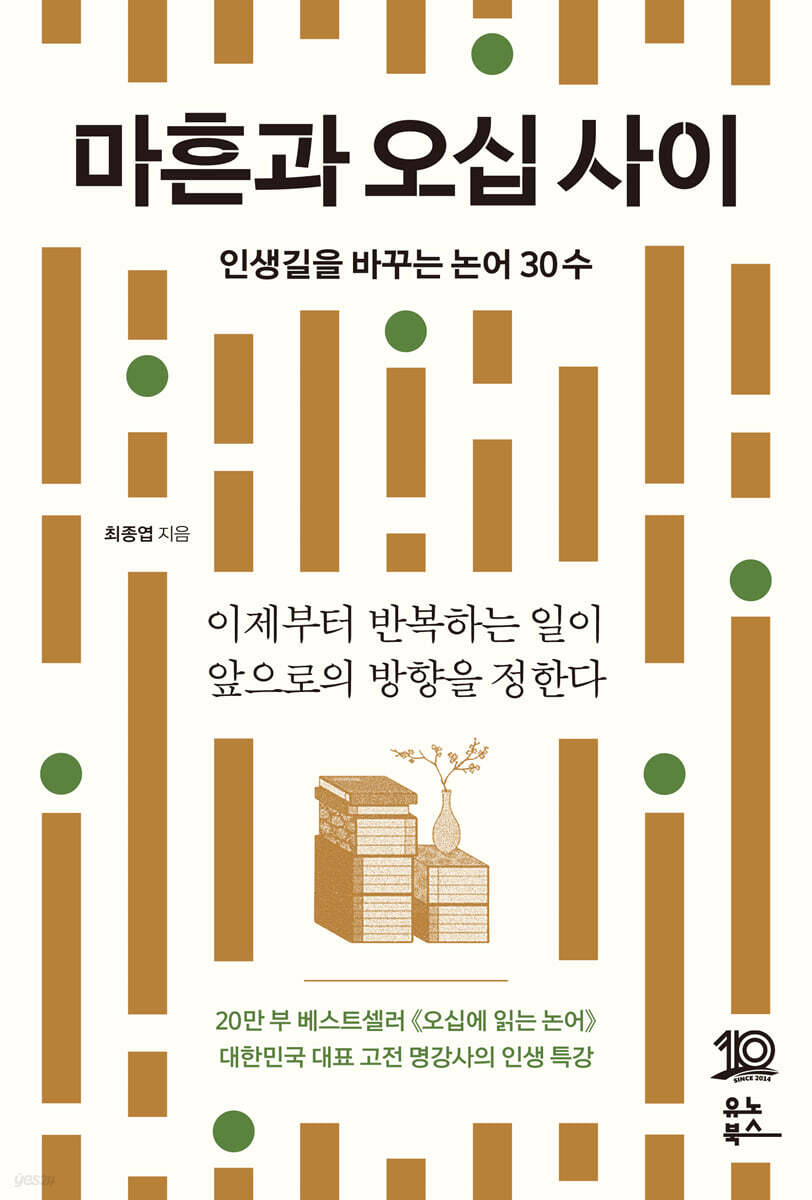
Between forty and fifty
 |
Description
Book Introduction
What we repeat from now on will determine our future direction.
The 200,000-copy bestseller "The Analects of Confucius for Fifty"
A special lecture on life from Korea's leading classical lecturer
“At forty, you should be unshaken by the temptations of life and the world.”
“If you do something that will make you hated at forty, your life will be worthless.”
“People who haven’t heard the words ‘you’re good’ even at the age of forty or fifty have nothing to fear.”
Confucius also emphasized how important the years between forty and fifty are in life.
Will you live your life going with the flow, or will you be dragged along? Will you wander, wavering, or will you move forward unwaveringly? Will you live in loneliness and hatred, or will you live in harmony with others? The Analects of Confucius say, "What you repeat determines your future direction and changes your life."
And it tells the 40s, the pivotal age of work, people, and life, the standards of life and things to repeat.
Confucius set the standards of life on 'the highest wisdom' and 'the highest mind.'
The greatest wisdom is the ability to understand others, and the greatest mind is the mind that loves and understands others without fighting, and lives in harmony and peace.
A person who possesses these two qualities is a ‘wise man’ and a ‘benevolent man’ respectively.
Confucius became a wise man at the age of forty, and a benevolent man at the age of fifty, when he was given the mandate of heaven.
Same goes for us.
Between the ages of forty and fifty, when you realize life, you need to be able to see people well and get along well with them to make your future life easier.
So, what should we repeat to achieve the ultimate wisdom and heart between forty and fifty? Choi Jong-yeop, author of the 200,000-copy bestseller "The Analects: Reading at Fifty" and a leading lecturer on classical Korean literature, has compiled 30 key passages from the 2,500-year-old self-management textbook "The Analects," along with stories from Confucius and his disciples, into "Between Forty and Fifty."
This book provides advice on how to live by redefining your standards for yourself, work, and relationships.
Between forty and fifty is the perfect time to live a brighter and more fulfilling life.
What will fill this time? What will we repeat and pass through? The gap between the lives of those who have read the Analects and those who haven't will be enormous.
I hope that the Analects will fill you with the fundamentals to be more firmly rooted in the present, the inner strength to stand firm and steady, and the vision to move forward with virtue and wisdom.
The 200,000-copy bestseller "The Analects of Confucius for Fifty"
A special lecture on life from Korea's leading classical lecturer
“At forty, you should be unshaken by the temptations of life and the world.”
“If you do something that will make you hated at forty, your life will be worthless.”
“People who haven’t heard the words ‘you’re good’ even at the age of forty or fifty have nothing to fear.”
Confucius also emphasized how important the years between forty and fifty are in life.
Will you live your life going with the flow, or will you be dragged along? Will you wander, wavering, or will you move forward unwaveringly? Will you live in loneliness and hatred, or will you live in harmony with others? The Analects of Confucius say, "What you repeat determines your future direction and changes your life."
And it tells the 40s, the pivotal age of work, people, and life, the standards of life and things to repeat.
Confucius set the standards of life on 'the highest wisdom' and 'the highest mind.'
The greatest wisdom is the ability to understand others, and the greatest mind is the mind that loves and understands others without fighting, and lives in harmony and peace.
A person who possesses these two qualities is a ‘wise man’ and a ‘benevolent man’ respectively.
Confucius became a wise man at the age of forty, and a benevolent man at the age of fifty, when he was given the mandate of heaven.
Same goes for us.
Between the ages of forty and fifty, when you realize life, you need to be able to see people well and get along well with them to make your future life easier.
So, what should we repeat to achieve the ultimate wisdom and heart between forty and fifty? Choi Jong-yeop, author of the 200,000-copy bestseller "The Analects: Reading at Fifty" and a leading lecturer on classical Korean literature, has compiled 30 key passages from the 2,500-year-old self-management textbook "The Analects," along with stories from Confucius and his disciples, into "Between Forty and Fifty."
This book provides advice on how to live by redefining your standards for yourself, work, and relationships.
Between forty and fifty is the perfect time to live a brighter and more fulfilling life.
What will fill this time? What will we repeat and pass through? The gap between the lives of those who have read the Analects and those who haven't will be enormous.
I hope that the Analects will fill you with the fundamentals to be more firmly rooted in the present, the inner strength to stand firm and steady, and the vision to move forward with virtue and wisdom.
- You can preview some of the book's contents.
Preview
index
To begin with
Not being confused at the age of 40, knowing one's destiny | Finding the standard of life through the Analects of Confucius: The Ancient Future
Chapter 1: Clear the Way
:If you don't want to live as you are pushed
Sambuji (三不知) | You need to know three things to stand up for yourself.
- Clues to life from the last sentence of the Analects
If you want to change your life, look at what you repeat.
- The key to determining life contained in the first sentence of the Analects
A person who likes someone is hard to beat.
- The more you know, the more you like, and the more you enjoy, the deeper your life becomes.
Time flows like a river without rest.
- The meaning of time that intellectuals unanimously speak of
I am humble and lowly (吾少也賤) | I can have because I have nothing
- The human side of Confucius
Follow my passion | Find what you love and stick to it.
- Parents can pass on wealth, but they cannot live your life for you.
Worry about yourself, not others.
- Once you realize what to worry about, there is no problem you can't solve.
Learning without thinking | You must think while learning, and you must learn while thinking.
- If life is hard, look back and see if there is anything you have learned.
What do you know and what do you not know?
- The value of advice depends on the listener's mind.
Learning from the past to learn from the new | You can't always be great with the same method.
- Why Confucius became the greatest teacher in the East
Chapter 2: Think about the work
:If you don't want to live your life wandering around
The farther you look, the easier it becomes.
- Three times in life to think about the future
You must sharpen your own sword first.
- If everyone does their own job well, everything in the world will go well.
Geum Yeo-hwak | Only those who are positive will do it.
- The power to overcome shortcomings
If you don't think about it, nothing happens.
- If you want to get what you want, keep asking for it
Three things to reflect on every day
- To avoid being swayed by external stimuli, you must discipline your inner self.
Even if it's all covered up? | Both the one who starts and the one who finishes are themselves.
- Everything begins with a handful of sincerity.
Forty-five (四十五十) | Abilities that are essential for life
- What are the six words of my life?
What to Think About Before Asking About Death
- The courage to focus on the present moment
Just as you cut, grind, and polish jade,
- The more you train, the more you realize that it is endless and difficult.
If you don't learn when you're in trouble, there's no way to save you.
- The most prestigious family in Joseon
Chapter 3: Change Your Position
:If you don't want to live alone and lonely
The sorrow of its disease | It is easy to love, but it is difficult to love.
It's hard to take care of your parents, but it's even harder to care for them wholeheartedly.
A helpful friend is always welcome.
- How to become a fun and comfortable friend when you're together
If you don't admit it and just make excuses, you're a petty person.
- Do we live in a society that corrects mistakes?
Virtue does not remain alone | People remain by the side of a virtuous person.
- Three reasons why virtue is necessary in this age
Forgiveness | What I don't want to do, others don't want to do either.
- Trying to change the position of myself and the other person
A wise man does not repeat the same mistakes.
- How to live a better tomorrow than today
Once you establish the basics, you will see the path.
- The standard of the world is that you receive as much as you give and you give as much as you receive.
Sayings of a Nearby Person | Make those around you happy
- Change begins with me
If you rush too much, it's hard to achieve what you want.
- Don't be greedy for small gains and lose the bigger ones.
Yosanyosu (樂山樂水) | The two axes that hold life together
- Dynamic like water, stable like a mountain
Epilogue
Life is divided into before and after reading the Analects.
Not being confused at the age of 40, knowing one's destiny | Finding the standard of life through the Analects of Confucius: The Ancient Future
Chapter 1: Clear the Way
:If you don't want to live as you are pushed
Sambuji (三不知) | You need to know three things to stand up for yourself.
- Clues to life from the last sentence of the Analects
If you want to change your life, look at what you repeat.
- The key to determining life contained in the first sentence of the Analects
A person who likes someone is hard to beat.
- The more you know, the more you like, and the more you enjoy, the deeper your life becomes.
Time flows like a river without rest.
- The meaning of time that intellectuals unanimously speak of
I am humble and lowly (吾少也賤) | I can have because I have nothing
- The human side of Confucius
Follow my passion | Find what you love and stick to it.
- Parents can pass on wealth, but they cannot live your life for you.
Worry about yourself, not others.
- Once you realize what to worry about, there is no problem you can't solve.
Learning without thinking | You must think while learning, and you must learn while thinking.
- If life is hard, look back and see if there is anything you have learned.
What do you know and what do you not know?
- The value of advice depends on the listener's mind.
Learning from the past to learn from the new | You can't always be great with the same method.
- Why Confucius became the greatest teacher in the East
Chapter 2: Think about the work
:If you don't want to live your life wandering around
The farther you look, the easier it becomes.
- Three times in life to think about the future
You must sharpen your own sword first.
- If everyone does their own job well, everything in the world will go well.
Geum Yeo-hwak | Only those who are positive will do it.
- The power to overcome shortcomings
If you don't think about it, nothing happens.
- If you want to get what you want, keep asking for it
Three things to reflect on every day
- To avoid being swayed by external stimuli, you must discipline your inner self.
Even if it's all covered up? | Both the one who starts and the one who finishes are themselves.
- Everything begins with a handful of sincerity.
Forty-five (四十五十) | Abilities that are essential for life
- What are the six words of my life?
What to Think About Before Asking About Death
- The courage to focus on the present moment
Just as you cut, grind, and polish jade,
- The more you train, the more you realize that it is endless and difficult.
If you don't learn when you're in trouble, there's no way to save you.
- The most prestigious family in Joseon
Chapter 3: Change Your Position
:If you don't want to live alone and lonely
The sorrow of its disease | It is easy to love, but it is difficult to love.
It's hard to take care of your parents, but it's even harder to care for them wholeheartedly.
A helpful friend is always welcome.
- How to become a fun and comfortable friend when you're together
If you don't admit it and just make excuses, you're a petty person.
- Do we live in a society that corrects mistakes?
Virtue does not remain alone | People remain by the side of a virtuous person.
- Three reasons why virtue is necessary in this age
Forgiveness | What I don't want to do, others don't want to do either.
- Trying to change the position of myself and the other person
A wise man does not repeat the same mistakes.
- How to live a better tomorrow than today
Once you establish the basics, you will see the path.
- The standard of the world is that you receive as much as you give and you give as much as you receive.
Sayings of a Nearby Person | Make those around you happy
- Change begins with me
If you rush too much, it's hard to achieve what you want.
- Don't be greedy for small gains and lose the bigger ones.
Yosanyosu (樂山樂水) | The two axes that hold life together
- Dynamic like water, stable like a mountain
Epilogue
Life is divided into before and after reading the Analects.
Detailed image

Into the book
Between forty and fifty.
Standing at the midpoint of your life, you take a moment to ask yourself whether you have lived well so far and how you will live in the future.
That's because the period between forty and fifty isn't just a midpoint, but a crucial time when a new chapter in life begins.
It is time to look back on myself and refine myself for a better, more wonderful life.
If there's anything we need at this time, it's to understand ourselves more deeply, to re-establish our relationships with work, and to confirm our unwavering standards for living.
--- p.6, from “The Standard of Life Found in the Old Future 《Analects》”
Habits become distant, repetition makes things more and more distant.
Repetition is what makes life successful, and consistency is what makes life different.
But that repetition is difficult.
Consistency isn't easy.
If it were easy, why would they have emphasized it so much 2,500 years ago? We already know that if you practice it long enough, you can become good at it, and if you excel at anything, you can succeed.
It's not that I don't know the principle and can't do it.
I can't do it because it's not easy to do it consistently.
However, Confucius gave a model answer to that question as follows:
Confucius said:
He who knows it is not as good as he who loves it, and he who loves it is not as good as he who enjoys it.
Son says, knowledgeable person, good person, good person, good person, pleasant person.
If you support me, I will support you. If you support me, I will support you.
--- p.27, from “The One Who Likes It is Hard to Defeat”
“This is how time passes.”
The disciples did not miss this one word from their teacher and wrote it down.
How should we live? How should we spend our time? What should we focus on? For whom should we work? This is a profound book that makes us realize the reason for living, the way we live, the reason for living, and the purpose for which we must live.
--- p.34, from “Time is like a river, flowing without rest”
Confucius said:
Don't worry about others not knowing you, worry about not knowing others.
子不曰不患人之不己知 患不知人也
Jawal is a non-refundable and non-refundable person.
Don't worry about your boss not knowing you, worry about not knowing your boss well. Only then will you be able to solve the problem.
Don't worry about your teammates not knowing you; worry about not knowing your teammates well. That's when the problem is solved.
Don't worry about your customers not knowing you, worry about not knowing your customers well, and that's when your customers' wallets open.
Don't worry that your wife doesn't know you; worry that you don't know her well. That's when you find peace.
Don't worry about your child not knowing you; worry about not knowing your child well. Only then will the problem be solved.
Don't worry about the job not being right for you; worry about not knowing enough about the job is what makes things easier.
--- p.69, from “Don’t Worry About Nothing | Worry About Yourself, Not About Others”
Confucius said:
If a person does not think far ahead, there will inevitably be worries nearby.
The child said, “There is no sorrow, no sorrow, no sorrow.”
Jawal Inmuwonryeo Pilyu Geunwoo
The saying that if you don't think far ahead, your worries will be nearby means that if you think far ahead, your worries and concerns about nearby things will decrease.
It means that you can overcome your worries and concerns.
So if you have any worries or concerns, you need to think a little further ahead.
It means to have hope and dreams.
This is because these hopes, dreams, and goals for the future give us the strength to overcome the worries and concerns that are weighing us down now.
--- p.103, from “People Don’t Foresee | The Farther You Look, the Easier It Gets”
Confucius said:
For example, if I stop building a mountain because I don't have enough earth to build it, then I have stopped. For example, if I start leveling the land because I pour in enough earth, then I have made progress.
子曰 譬如爲山 Is it the end of the world? Is it the end of the world? It's the flat land of the future? Go ahead and go
Jawal Biyeowisan Misungilgwi Ji Ojiya Biyeo Pyeongji Subokilgwi Jinohwangya
If you don't start, the chances of it working out are zero.
But the chances of getting started start from 1.
The important thing is the beginning, because 1 can become 2 and 2 can become 4.
If you can't do it alone, your family can do it together.
If I can't achieve it in my generation, my son or grandson may.
If I can't do it, the village or group can do it.
If a village or group cannot achieve it, the country can.
That is why Confucius said that the reckless beginning was not a reckless beginning.
--- p.145, from “Even if it is covered by one? | Both the one who begins and the one who finishes are themselves”
There is no unimportant period in our lives, but our 40s are a pivotal one.
When forty is shaken, life is shaken, family is shaken, business is shaken, and nation is shaken.
That's why the number 'forty' appears three times in the Analects.
First, there is no confusion at the age of forty.
If you waver at forty, your life will be messed up.
If you are swayed by promotion, you will only focus on work, and if you are swayed by salary, you will focus on changing jobs and careers.
If you are swayed by reason, the tower of life you have built up so far may become an empty chant, and if you take your eyes off one eye, the rest of your eyes may be taken away as well.
The second mention is the forty-two-year-old view of evil.
Confucius's point is that if you show hatred at the age of forty, your life is already over.
The third mention is that of being forty-five and not knowing anything.
Confucius's warning is that if you don't hear people say you're good at something even when you're forty or fifty, you're not someone to be afraid of.
Confucius repeatedly mentioned in the Analects that successfully reaching the age of forty is the shortcut to a successful life.
--- p.153, from “Forty-Fifty (四十五十) | Abilities that must be possessed at the center of life”
Confucius said:
Those who are born knowing are superior, those who learn by learning are next in line, those who learn through hardship are next in line, and those who do not learn even when faced with hardship are lower in line among the people.
Confucius said: Born, educated, educated, educated, educated, educated, educated, educated, learned, learned, learned, learned, learned, learned, learned, learned, learned, learned, studied, studied, studied, learned, studied, learned, learned, learned, studied, studied, learned, studied, learned, studied, learned as a student, learned as a student
Confucius said, “If a person is born, he will support them. If a student is born, he will support them. If a person is born without learning, he will learn. If a person is born without learning, he will learn. If a person is born without learning, he will learn.
If there is one thing you need to do between the pivotal years of your life, your forties and fifties, to prepare for the more stable and hopeful forties of your fifties, sixties, seventies, and eighties after spending the busy forties of your 10s, 20s, 30s, and 40s, it is to build the strength to establish yourself and your work.
If you were dissatisfied with your 10s, 20s, or 30s, it is time to think about studying hardship.
It is time to take action to escape the difficulties we have been facing.
You need to change your attitude and the way you work.
You have to change your thinking or change your beliefs.
The years between forty and fifty in our lives are the best times to study Gon-i-hak.
So far, quite a few people have established themselves and created things during this period.
If someone in the past could have such a meaningful time between forty and fifty, it is possible for us now too.
--- p.178, from “If you don’t learn when you’re in trouble, there’s no way to save you”
When Meng Wubo asked about filial piety, Confucius said:
Parents only worry about their children getting sick.
The story of the child, the father, the mother, the family, and the sorrow of the child.
The saying, "Meng Wu Baek Mun Hyo Ja-Wol" means "the abandonment of parents is the quality of life"
The disciple who asked Confucius this question was Meng Wubo, a young man from the Meng family, one of the most famous families in the state of Lu at the time.
Meng Wubai was a descendant of a powerful family at the time and was very fat.
Che(?) was his original name.
This means 'pig', which is also a clue that he was very fat.
So when he asked Confucius about filial piety, Confucius said this:
“Your parents will only worry about you getting sick.
Your parents are always worried that you might suffer from an illness.
So you have to take good care of your body.
If you get sick, there's nothing more heartbreaking for your parents than that.
“What kind of filial piety is that?”
--- p.191, from 「The sorrow of its disease | It is easy to love, but it is difficult to love to the death」
Zizhang asked.
If there is one thing that a person who lives a righteous life should have in his or her heart, what would it be?
Confucius said:
That's what it means to stand.
I don't ask others to do what I don't want to do myself.
The child is talking about money, it is one person, the other person, the person who wants to use the body, the person who wants to use it, the person who wants to use it, and the person who wants to use it
The only one who can say this is the one who has lived a long life. The poet who has said this is the one who has said this.
I asked what letter would be needed for a person who strives to live an upright and honest life.
When his disciple Zigong asked Confucius to teach him just one word, Confucius's answer was 'forgiveness'.
The word is forgiveness.
Forgiveness is a combination of 恕 and 容, meaning 'to accept, to contain.'
The character 恕 is a combination of the characters 如 (like) and 心 (heart), meaning 'same heart'.
So, to forgive someone means that their heart and my heart become one.
In order to have the same mind as each other, we must stand in each other's shoes.
Those who forgive forgive
It is possible only when the receiver is in the position of the one who forgives, and the one who is forgiven is in the position of the one who forgives.
--- p.226, from “Seo (恕) | What I don’t want to do, others don’t want to do either”
Confucius said:
The wise man loves water, and the benevolent man loves mountains.
The land is dynamic and the people are static.
The wise live happily, and the benevolent live long.
The wise man, the wise man, the joyful water, the wise man, the wise man, the wise man, the wise man, the wise man, the wise man, the wise man, the wise man, the wise man, the wise man, the wise man.
Jawal Jijayosu Injayosan Jijadong Injajeong Jijarak Injasu
Life is similar to this.
Life in general is more suited to the life of a wise person.
Because our lives are only one for each of us, and because they are unstable and unstable, we need standards.
So, if you live the first half of your life like a powerful river, more actively, more challengingly, and more passionately, focusing on work, you will have fewer regrets.
The latter half of life is more suited to the life of a person of character.
Even if it is to live a more comfortable, more stable, and more loving life, different from the rough and tumble of life.
This is because a life of more forgiveness, more love, and more understanding is a life of mercy.
Standing at the midpoint of your life, you take a moment to ask yourself whether you have lived well so far and how you will live in the future.
That's because the period between forty and fifty isn't just a midpoint, but a crucial time when a new chapter in life begins.
It is time to look back on myself and refine myself for a better, more wonderful life.
If there's anything we need at this time, it's to understand ourselves more deeply, to re-establish our relationships with work, and to confirm our unwavering standards for living.
--- p.6, from “The Standard of Life Found in the Old Future 《Analects》”
Habits become distant, repetition makes things more and more distant.
Repetition is what makes life successful, and consistency is what makes life different.
But that repetition is difficult.
Consistency isn't easy.
If it were easy, why would they have emphasized it so much 2,500 years ago? We already know that if you practice it long enough, you can become good at it, and if you excel at anything, you can succeed.
It's not that I don't know the principle and can't do it.
I can't do it because it's not easy to do it consistently.
However, Confucius gave a model answer to that question as follows:
Confucius said:
He who knows it is not as good as he who loves it, and he who loves it is not as good as he who enjoys it.
Son says, knowledgeable person, good person, good person, good person, pleasant person.
If you support me, I will support you. If you support me, I will support you.
--- p.27, from “The One Who Likes It is Hard to Defeat”
“This is how time passes.”
The disciples did not miss this one word from their teacher and wrote it down.
How should we live? How should we spend our time? What should we focus on? For whom should we work? This is a profound book that makes us realize the reason for living, the way we live, the reason for living, and the purpose for which we must live.
--- p.34, from “Time is like a river, flowing without rest”
Confucius said:
Don't worry about others not knowing you, worry about not knowing others.
子不曰不患人之不己知 患不知人也
Jawal is a non-refundable and non-refundable person.
Don't worry about your boss not knowing you, worry about not knowing your boss well. Only then will you be able to solve the problem.
Don't worry about your teammates not knowing you; worry about not knowing your teammates well. That's when the problem is solved.
Don't worry about your customers not knowing you, worry about not knowing your customers well, and that's when your customers' wallets open.
Don't worry that your wife doesn't know you; worry that you don't know her well. That's when you find peace.
Don't worry about your child not knowing you; worry about not knowing your child well. Only then will the problem be solved.
Don't worry about the job not being right for you; worry about not knowing enough about the job is what makes things easier.
--- p.69, from “Don’t Worry About Nothing | Worry About Yourself, Not About Others”
Confucius said:
If a person does not think far ahead, there will inevitably be worries nearby.
The child said, “There is no sorrow, no sorrow, no sorrow.”
Jawal Inmuwonryeo Pilyu Geunwoo
The saying that if you don't think far ahead, your worries will be nearby means that if you think far ahead, your worries and concerns about nearby things will decrease.
It means that you can overcome your worries and concerns.
So if you have any worries or concerns, you need to think a little further ahead.
It means to have hope and dreams.
This is because these hopes, dreams, and goals for the future give us the strength to overcome the worries and concerns that are weighing us down now.
--- p.103, from “People Don’t Foresee | The Farther You Look, the Easier It Gets”
Confucius said:
For example, if I stop building a mountain because I don't have enough earth to build it, then I have stopped. For example, if I start leveling the land because I pour in enough earth, then I have made progress.
子曰 譬如爲山 Is it the end of the world? Is it the end of the world? It's the flat land of the future? Go ahead and go
Jawal Biyeowisan Misungilgwi Ji Ojiya Biyeo Pyeongji Subokilgwi Jinohwangya
If you don't start, the chances of it working out are zero.
But the chances of getting started start from 1.
The important thing is the beginning, because 1 can become 2 and 2 can become 4.
If you can't do it alone, your family can do it together.
If I can't achieve it in my generation, my son or grandson may.
If I can't do it, the village or group can do it.
If a village or group cannot achieve it, the country can.
That is why Confucius said that the reckless beginning was not a reckless beginning.
--- p.145, from “Even if it is covered by one? | Both the one who begins and the one who finishes are themselves”
There is no unimportant period in our lives, but our 40s are a pivotal one.
When forty is shaken, life is shaken, family is shaken, business is shaken, and nation is shaken.
That's why the number 'forty' appears three times in the Analects.
First, there is no confusion at the age of forty.
If you waver at forty, your life will be messed up.
If you are swayed by promotion, you will only focus on work, and if you are swayed by salary, you will focus on changing jobs and careers.
If you are swayed by reason, the tower of life you have built up so far may become an empty chant, and if you take your eyes off one eye, the rest of your eyes may be taken away as well.
The second mention is the forty-two-year-old view of evil.
Confucius's point is that if you show hatred at the age of forty, your life is already over.
The third mention is that of being forty-five and not knowing anything.
Confucius's warning is that if you don't hear people say you're good at something even when you're forty or fifty, you're not someone to be afraid of.
Confucius repeatedly mentioned in the Analects that successfully reaching the age of forty is the shortcut to a successful life.
--- p.153, from “Forty-Fifty (四十五十) | Abilities that must be possessed at the center of life”
Confucius said:
Those who are born knowing are superior, those who learn by learning are next in line, those who learn through hardship are next in line, and those who do not learn even when faced with hardship are lower in line among the people.
Confucius said: Born, educated, educated, educated, educated, educated, educated, educated, learned, learned, learned, learned, learned, learned, learned, learned, learned, learned, studied, studied, studied, learned, studied, learned, learned, learned, studied, studied, learned, studied, learned, studied, learned as a student, learned as a student
Confucius said, “If a person is born, he will support them. If a student is born, he will support them. If a person is born without learning, he will learn. If a person is born without learning, he will learn. If a person is born without learning, he will learn.
If there is one thing you need to do between the pivotal years of your life, your forties and fifties, to prepare for the more stable and hopeful forties of your fifties, sixties, seventies, and eighties after spending the busy forties of your 10s, 20s, 30s, and 40s, it is to build the strength to establish yourself and your work.
If you were dissatisfied with your 10s, 20s, or 30s, it is time to think about studying hardship.
It is time to take action to escape the difficulties we have been facing.
You need to change your attitude and the way you work.
You have to change your thinking or change your beliefs.
The years between forty and fifty in our lives are the best times to study Gon-i-hak.
So far, quite a few people have established themselves and created things during this period.
If someone in the past could have such a meaningful time between forty and fifty, it is possible for us now too.
--- p.178, from “If you don’t learn when you’re in trouble, there’s no way to save you”
When Meng Wubo asked about filial piety, Confucius said:
Parents only worry about their children getting sick.
The story of the child, the father, the mother, the family, and the sorrow of the child.
The saying, "Meng Wu Baek Mun Hyo Ja-Wol" means "the abandonment of parents is the quality of life"
The disciple who asked Confucius this question was Meng Wubo, a young man from the Meng family, one of the most famous families in the state of Lu at the time.
Meng Wubai was a descendant of a powerful family at the time and was very fat.
Che(?) was his original name.
This means 'pig', which is also a clue that he was very fat.
So when he asked Confucius about filial piety, Confucius said this:
“Your parents will only worry about you getting sick.
Your parents are always worried that you might suffer from an illness.
So you have to take good care of your body.
If you get sick, there's nothing more heartbreaking for your parents than that.
“What kind of filial piety is that?”
--- p.191, from 「The sorrow of its disease | It is easy to love, but it is difficult to love to the death」
Zizhang asked.
If there is one thing that a person who lives a righteous life should have in his or her heart, what would it be?
Confucius said:
That's what it means to stand.
I don't ask others to do what I don't want to do myself.
The child is talking about money, it is one person, the other person, the person who wants to use the body, the person who wants to use it, the person who wants to use it, and the person who wants to use it
The only one who can say this is the one who has lived a long life. The poet who has said this is the one who has said this.
I asked what letter would be needed for a person who strives to live an upright and honest life.
When his disciple Zigong asked Confucius to teach him just one word, Confucius's answer was 'forgiveness'.
The word is forgiveness.
Forgiveness is a combination of 恕 and 容, meaning 'to accept, to contain.'
The character 恕 is a combination of the characters 如 (like) and 心 (heart), meaning 'same heart'.
So, to forgive someone means that their heart and my heart become one.
In order to have the same mind as each other, we must stand in each other's shoes.
Those who forgive forgive
It is possible only when the receiver is in the position of the one who forgives, and the one who is forgiven is in the position of the one who forgives.
--- p.226, from “Seo (恕) | What I don’t want to do, others don’t want to do either”
Confucius said:
The wise man loves water, and the benevolent man loves mountains.
The land is dynamic and the people are static.
The wise live happily, and the benevolent live long.
The wise man, the wise man, the joyful water, the wise man, the wise man, the wise man, the wise man, the wise man, the wise man, the wise man, the wise man, the wise man, the wise man, the wise man.
Jawal Jijayosu Injayosan Jijadong Injajeong Jijarak Injasu
Life is similar to this.
Life in general is more suited to the life of a wise person.
Because our lives are only one for each of us, and because they are unstable and unstable, we need standards.
So, if you live the first half of your life like a powerful river, more actively, more challengingly, and more passionately, focusing on work, you will have fewer regrets.
The latter half of life is more suited to the life of a person of character.
Even if it is to live a more comfortable, more stable, and more loving life, different from the rough and tumble of life.
This is because a life of more forgiveness, more love, and more understanding is a life of mercy.
--- p.265, from “Yosanyosu (樂山樂水) | Two axes that hold life together”
Publisher's Review
The Analects of Confucius: A Guide to Reading at Fifty, a Leading Figure in the Classical Craze
A special lecture on life from Korea's leading classical lecturer
Choi Jong-yeop, author of 『The Analects』 and 『Reading the Analects at Fifty』, the longest-running bestselling humanities textbook that sparked a craze for classics, and a leading lecturer on classics in Korea, has returned after three years with 『Between Forty and Fifty』.
Having given approximately 1,000 lectures on the humanities, 100 times a year for 10 years, he is renowned for providing readers and audiences with comfort, courage, and a time for reflection and contemplation through his lectures.
The topic discussed in this new book, ‘Between Forty and Fifty’, is ‘self-development between forty and fifty.’
There is no self-help book as essential to life as the Analects.
The Analects, a collection of conversations between Confucius and his disciples, is the greatest self-management textbook in the East that remains vivid even today.
This classic, which has influenced countless great figures and the public throughout the East and the West for 2,500 years, has taught managers the principles of management, taught politicians the fundamentals of politics, developed leadership skills in leaders, and taught the principles of life to those who ask about life.
"Between Forty and Fifty" is based on this book of wisdom and provides guidance on attitudes and methods for life, work, and interpersonal relationships.
In the meantime, the author has been thinking about how more people can deeply understand the Analects and put them into practice in their lives.
Like Confucius, he cut, polished, and rubbed his own enlightenment with the mindset of 'what is it like?'
In this book, I was able to include 30 Analects of Confucius and various stories that will change your life path between the ages of 40 and 50.
This book will provide the fun of reciting the 30 golden poems, the fun of pondering key words selected from the 30 poems, the fun of imagining anecdotes about Confucius and his disciples, the fun of reading contemporary examples, and the fun of gaining enlightenment and insight.
From now on, it will be repeated
Determine the future direction
Confucius considered the age of 40 to be important.
The words of Confucius when he was forty appear three times in the Analects.
Confucius repeatedly mentioned in the Analects that successfully reaching the age of forty is the shortcut to a successful life.
“At forty, you should not be shaken by the temptations of your life and the world.”
“If you do something that will be hated at the age of forty, your life will be worthless.”
“There is no need to be afraid if you are forty or fifty and still haven’t heard the words ‘you are good’.”
Every stage of life is important.
But if you falter at forty, your whole life can be messed up, and it's very difficult to straighten it out.
What kind of person do you want to be in your 40s? Someone who only criticizes others' shortcomings, someone who is rude, someone who views prejudice as wisdom and is completely closed-minded, and someone who is arrogant—whether 2,500 years ago or today—are the types of people you don't want around.
Also, people who do not stand out and develop themselves until they are forty or fifty are not competitive, whether they were 2,500 years ago or today.
Forty and fifty are ages where, if you live poorly, you will not be treated well by others or yourself.
It is a crucial point in time when the second half of one's life depends on it.
There is only one way to get through your 40s well.
It is about setting standards for life and moving in a consistent direction.
“My path is one-way.
Confucius's life can also be summarized as "I have consistently walked the path I was meant to follow without being swayed by the flow of the world [吾道一以貫之 (wodo il igwan ji)]"
And in the Analects, he provides a method for anyone to put this into practice.
It is 'repetition'.
“Our nature is similar to each other, but our later lives are different depending on what we repeat [Seongsanggeunya sipsangwonya (性相近也 習相遠也)].”
Depending on what you repeat, your future direction is determined and your life changes.
Will you live your life going with the flow, or will you be dragged along? Will you wander, wavering, or will you move forward unwaveringly? Will you live a life of loneliness and hatred, or will you lead others? If you continue to live the way you have lived, your future will remain unchanged.
But if you adopt a different attitude and method and repeat it, your life path will change.
So, what should be the standard by which we live and repeat ourselves? The Analects of Confucius offer the ultimate wisdom and highest standards, spanning 2,500 years.
'The highest wisdom is the ability to understand others,' and 'the highest standard is the mind that can live in harmony and peace by loving and understanding each other without fighting.'
These two are the abilities and minds that we most desire to have as we live our lives.
Confucius called a person who possesses the highest wisdom and standards a 'wise man' and a 'benevolent man'.
He also became a wise man at the age of forty, and a man who realized life at the age of fifty.
If you repeat Confucius's guidance based on these two criteria between forty and fifty, you will not only be able to successfully overcome the forty-year-old age, but also enjoy a smooth second half of your life.
Between forty and fifty
30 Analects of Confucius that will change your life
Confucius' realistic and honest personality is revealed in several anecdotes.
The reason why the Analects are praised as the greatest classic is because every word left by Confucius has had a positive influence on the lives of individuals for 2,500 years.
If you have ever felt that the Analects of Confucius, which has no explanation, is complicated and difficult, you will be able to understand it easily and clearly with Between Forty and Fifty.
#1.
Zigong was a disciple whom Confucius trusted and relied on until his death.
One day, Zigong complained to his teacher that he was tired of learning and wanted to rest.
Even though Zigong said he wanted to rest and serve his ruler, take care of his parents, spend time with his wife and children, spend time with his friends, or farm, Confucius said that all of these were difficult.
Zigong sighed and asked if he meant that there was no place to rest.
Then Confucius pointed to the tomb and said, “Look at the mound of the tomb on that hill.
“If you look over there, you will know where to rest,” he replied.
Confucius, who taught his disciples by pointing to a silent tomb, speaks more specifically about life in the last sentence of the Analects.
It means knowing your own dreams, knowing etiquette between people, and being able to communicate with each other.
Confucius said:
If you don't know your destiny, you can't be a gentleman.
If you don't know the example, you can't get up.
If you don't know the language, you can't know the person.
The child said, not knowing, living without knowing, not knowing, not knowing, not knowing, not knowing, not knowing, not knowing, not knowing.
Jawal, the name of the city, Muiwi, the name of the city, Muilip, the name of the city, Muiji, the name of the city,
#2.
Zilu, Confucius's most loyal disciple and friend, feared that since he had not practiced his teacher's teachings, he would not be able to practice new teachings either.
Confucius advised Zilu, “To say that you know what you know and to say that you do not know what you do not know is true knowledge,” and taught him about a wise attitude toward life.
Confucius said:
Yuya, let me teach you what I know.
Knowing what you know and not knowing what you don't know is true knowledge.
子曰由誨Women know, know, know, do not know, do not know, do not know, do not know, do not know
Jawal Yu Huiyeojijiho Jijiwijiji Bujiwibuji Sijiya
#3.
Confucius gave strength to his timid disciple.
One of the ten disciples, Yeomgu's weakness was his timid personality.
Yeomgu says that he is not good enough to practice the teacher's teachings.
Then Confucius said, “Please do not draw a line of negativity in advance and say, ‘No.’”
Whether you have the strength or not, whether you have the ability or not, if you have the will to do something, you will be able to do anything.
Yeomgu said.
It's not that I don't enjoy the Master's way, but I lack the strength.
Confucius said:
Those who lack strength give up halfway, but now you are making a mark.
?求曰 非不說之道 Strength 不足也 Child 曰 Strength 不足者中道而廢 今畵
Yeomguwal is not enough to be a non-heated person, Jawal is not enough to be a non-heated person, and ...
#4.
Confucius spoke about the meaning of starting and ending everything yourself.
It means that you should live proactively toward your future goals, as it is all your fault whether you can't even start, start but give up halfway, or can't finish properly.
Confucius said:
For example, if I stop building a mountain because I don't have enough earth to build it, then I have stopped. For example, if I start leveling the land because I pour in enough earth, then I have made progress.
子曰 譬如爲山 Is it the end of the world? Is it the end of the world? It's the flat land of the future? Go ahead and go
Jawal Biyeowisan Misungilgwi Ji Ojiya Biyeo Pyeongji Subokilgwi Jinohwangya
"Between Forty and Fifty" guides you through the fundamentals, inner strength, and vision that are essential to the core of life.
Through the ability to understand others, the ability to understand one another and live in harmony, and the 30 things you must repeat to achieve this, you will be able to set the direction of your life and move forward without wavering.
Repeat the process of developing the strength to stand up for yourself and become the master of your own life, the strength to move forward without wavering and become the master of your own work, and the strength to live with others in your relationships.
Between the ages of forty and fifty, your worries and concerns will disappear and you will become rich.
A special lecture on life from Korea's leading classical lecturer
Choi Jong-yeop, author of 『The Analects』 and 『Reading the Analects at Fifty』, the longest-running bestselling humanities textbook that sparked a craze for classics, and a leading lecturer on classics in Korea, has returned after three years with 『Between Forty and Fifty』.
Having given approximately 1,000 lectures on the humanities, 100 times a year for 10 years, he is renowned for providing readers and audiences with comfort, courage, and a time for reflection and contemplation through his lectures.
The topic discussed in this new book, ‘Between Forty and Fifty’, is ‘self-development between forty and fifty.’
There is no self-help book as essential to life as the Analects.
The Analects, a collection of conversations between Confucius and his disciples, is the greatest self-management textbook in the East that remains vivid even today.
This classic, which has influenced countless great figures and the public throughout the East and the West for 2,500 years, has taught managers the principles of management, taught politicians the fundamentals of politics, developed leadership skills in leaders, and taught the principles of life to those who ask about life.
"Between Forty and Fifty" is based on this book of wisdom and provides guidance on attitudes and methods for life, work, and interpersonal relationships.
In the meantime, the author has been thinking about how more people can deeply understand the Analects and put them into practice in their lives.
Like Confucius, he cut, polished, and rubbed his own enlightenment with the mindset of 'what is it like?'
In this book, I was able to include 30 Analects of Confucius and various stories that will change your life path between the ages of 40 and 50.
This book will provide the fun of reciting the 30 golden poems, the fun of pondering key words selected from the 30 poems, the fun of imagining anecdotes about Confucius and his disciples, the fun of reading contemporary examples, and the fun of gaining enlightenment and insight.
From now on, it will be repeated
Determine the future direction
Confucius considered the age of 40 to be important.
The words of Confucius when he was forty appear three times in the Analects.
Confucius repeatedly mentioned in the Analects that successfully reaching the age of forty is the shortcut to a successful life.
“At forty, you should not be shaken by the temptations of your life and the world.”
“If you do something that will be hated at the age of forty, your life will be worthless.”
“There is no need to be afraid if you are forty or fifty and still haven’t heard the words ‘you are good’.”
Every stage of life is important.
But if you falter at forty, your whole life can be messed up, and it's very difficult to straighten it out.
What kind of person do you want to be in your 40s? Someone who only criticizes others' shortcomings, someone who is rude, someone who views prejudice as wisdom and is completely closed-minded, and someone who is arrogant—whether 2,500 years ago or today—are the types of people you don't want around.
Also, people who do not stand out and develop themselves until they are forty or fifty are not competitive, whether they were 2,500 years ago or today.
Forty and fifty are ages where, if you live poorly, you will not be treated well by others or yourself.
It is a crucial point in time when the second half of one's life depends on it.
There is only one way to get through your 40s well.
It is about setting standards for life and moving in a consistent direction.
“My path is one-way.
Confucius's life can also be summarized as "I have consistently walked the path I was meant to follow without being swayed by the flow of the world [吾道一以貫之 (wodo il igwan ji)]"
And in the Analects, he provides a method for anyone to put this into practice.
It is 'repetition'.
“Our nature is similar to each other, but our later lives are different depending on what we repeat [Seongsanggeunya sipsangwonya (性相近也 習相遠也)].”
Depending on what you repeat, your future direction is determined and your life changes.
Will you live your life going with the flow, or will you be dragged along? Will you wander, wavering, or will you move forward unwaveringly? Will you live a life of loneliness and hatred, or will you lead others? If you continue to live the way you have lived, your future will remain unchanged.
But if you adopt a different attitude and method and repeat it, your life path will change.
So, what should be the standard by which we live and repeat ourselves? The Analects of Confucius offer the ultimate wisdom and highest standards, spanning 2,500 years.
'The highest wisdom is the ability to understand others,' and 'the highest standard is the mind that can live in harmony and peace by loving and understanding each other without fighting.'
These two are the abilities and minds that we most desire to have as we live our lives.
Confucius called a person who possesses the highest wisdom and standards a 'wise man' and a 'benevolent man'.
He also became a wise man at the age of forty, and a man who realized life at the age of fifty.
If you repeat Confucius's guidance based on these two criteria between forty and fifty, you will not only be able to successfully overcome the forty-year-old age, but also enjoy a smooth second half of your life.
Between forty and fifty
30 Analects of Confucius that will change your life
Confucius' realistic and honest personality is revealed in several anecdotes.
The reason why the Analects are praised as the greatest classic is because every word left by Confucius has had a positive influence on the lives of individuals for 2,500 years.
If you have ever felt that the Analects of Confucius, which has no explanation, is complicated and difficult, you will be able to understand it easily and clearly with Between Forty and Fifty.
#1.
Zigong was a disciple whom Confucius trusted and relied on until his death.
One day, Zigong complained to his teacher that he was tired of learning and wanted to rest.
Even though Zigong said he wanted to rest and serve his ruler, take care of his parents, spend time with his wife and children, spend time with his friends, or farm, Confucius said that all of these were difficult.
Zigong sighed and asked if he meant that there was no place to rest.
Then Confucius pointed to the tomb and said, “Look at the mound of the tomb on that hill.
“If you look over there, you will know where to rest,” he replied.
Confucius, who taught his disciples by pointing to a silent tomb, speaks more specifically about life in the last sentence of the Analects.
It means knowing your own dreams, knowing etiquette between people, and being able to communicate with each other.
Confucius said:
If you don't know your destiny, you can't be a gentleman.
If you don't know the example, you can't get up.
If you don't know the language, you can't know the person.
The child said, not knowing, living without knowing, not knowing, not knowing, not knowing, not knowing, not knowing, not knowing, not knowing.
Jawal, the name of the city, Muiwi, the name of the city, Muilip, the name of the city, Muiji, the name of the city,
#2.
Zilu, Confucius's most loyal disciple and friend, feared that since he had not practiced his teacher's teachings, he would not be able to practice new teachings either.
Confucius advised Zilu, “To say that you know what you know and to say that you do not know what you do not know is true knowledge,” and taught him about a wise attitude toward life.
Confucius said:
Yuya, let me teach you what I know.
Knowing what you know and not knowing what you don't know is true knowledge.
子曰由誨Women know, know, know, do not know, do not know, do not know, do not know, do not know
Jawal Yu Huiyeojijiho Jijiwijiji Bujiwibuji Sijiya
#3.
Confucius gave strength to his timid disciple.
One of the ten disciples, Yeomgu's weakness was his timid personality.
Yeomgu says that he is not good enough to practice the teacher's teachings.
Then Confucius said, “Please do not draw a line of negativity in advance and say, ‘No.’”
Whether you have the strength or not, whether you have the ability or not, if you have the will to do something, you will be able to do anything.
Yeomgu said.
It's not that I don't enjoy the Master's way, but I lack the strength.
Confucius said:
Those who lack strength give up halfway, but now you are making a mark.
?求曰 非不說之道 Strength 不足也 Child 曰 Strength 不足者中道而廢 今畵
Yeomguwal is not enough to be a non-heated person, Jawal is not enough to be a non-heated person, and ...
#4.
Confucius spoke about the meaning of starting and ending everything yourself.
It means that you should live proactively toward your future goals, as it is all your fault whether you can't even start, start but give up halfway, or can't finish properly.
Confucius said:
For example, if I stop building a mountain because I don't have enough earth to build it, then I have stopped. For example, if I start leveling the land because I pour in enough earth, then I have made progress.
子曰 譬如爲山 Is it the end of the world? Is it the end of the world? It's the flat land of the future? Go ahead and go
Jawal Biyeowisan Misungilgwi Ji Ojiya Biyeo Pyeongji Subokilgwi Jinohwangya
"Between Forty and Fifty" guides you through the fundamentals, inner strength, and vision that are essential to the core of life.
Through the ability to understand others, the ability to understand one another and live in harmony, and the 30 things you must repeat to achieve this, you will be able to set the direction of your life and move forward without wavering.
Repeat the process of developing the strength to stand up for yourself and become the master of your own life, the strength to move forward without wavering and become the master of your own work, and the strength to live with others in your relationships.
Between the ages of forty and fifty, your worries and concerns will disappear and you will become rich.
GOODS SPECIFICS
- Date of issue: October 14, 2024
- Page count, weight, size: 280 pages | 430g | 142*210*17mm
- ISBN13: 9791171830572
- ISBN10: 1171830572
You may also like
카테고리
korean


korean

![GQ KOREA Mark (Monthly): December [2025]](http://librairie.coreenne.fr/cdn/shop/files/8ef265dbbfbf186523ed75ba7319009d.jpg?v=1765340328&width=3840)


